AI Summary
About
Lindy is an AI executive assistant that runs your inbox, calendar, meetings, and follow-ups — you text it over iMessage or SMS, and it triages email, drafts replies in your voice, schedules meetings, and takes meeting notes across 100+ integrations (Gmail, Outlook, Google Calendar, Slack, Notion). Founded in 2023 by Flo Crivello — previously Head of Product at Uber and founder of virtual-office startup Teamflow — Lindy has raised about $50M from investors including Menlo Ventures and Coatue.
The company’s positioning has changed dramatically. Lindy launched as a no-code AI agent-builder platform (“build a team of AI employees”), billed in credits, competing with Zapier, Make, and n8n. In early 2026 it pivoted to a consumer-grade personal assistant product — Lindy Assistant, officially launched 2026-05-04 — and rebuilt its pricing from credit packs into flat monthly subscriptions.
For the most current information, visit Lindy.
Pricing summary : How Lindy’s pricing model works
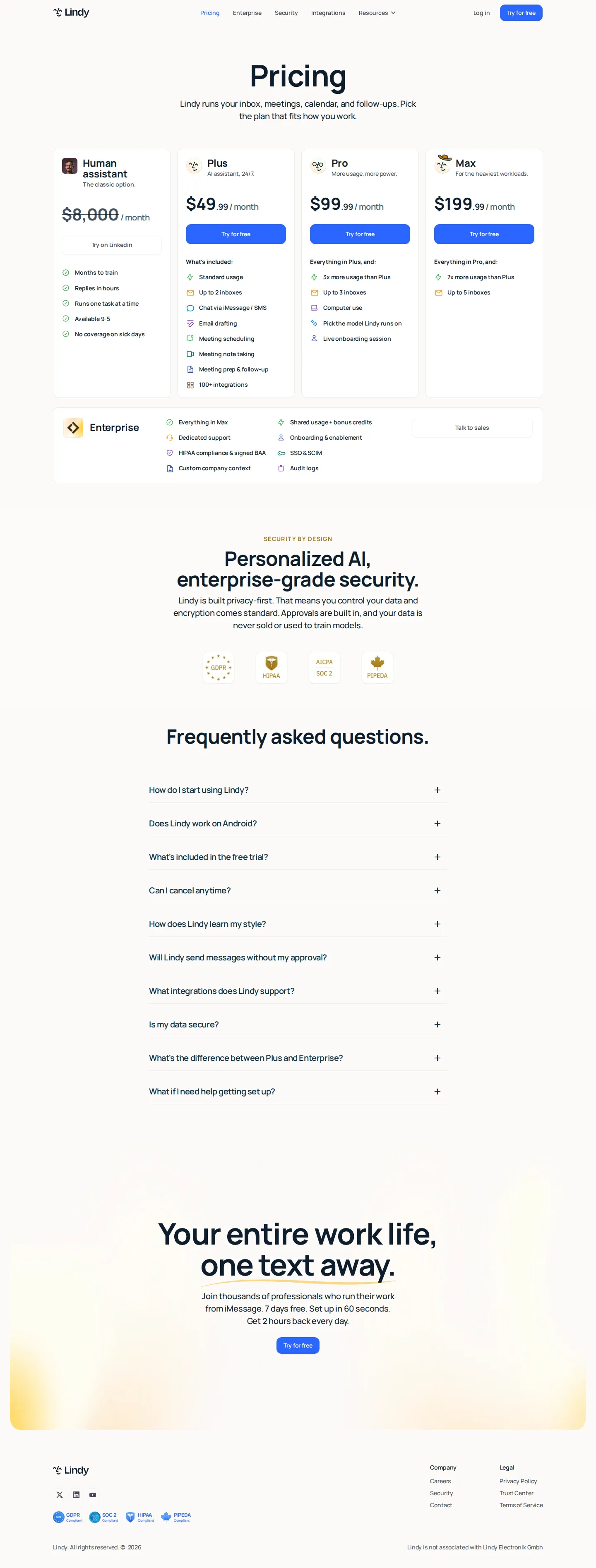
Lindy bills flat monthly subscriptions per assistant across three self-serve tiers plus a quoted Enterprise plan. Plus is $49.99/month (standard usage, up to 2 connected inboxes, iMessage/SMS chat, email drafting, meeting scheduling/notes/prep). Pro is $99.99/month and includes 3x more usage than Plus, up to 3 inboxes, computer use, and the ability to pick the underlying model. Max is $199.99/month with 7x more usage than Plus and up to 5 inboxes. Enterprise is sales-quoted and adds shared usage with bonus credits, HIPAA compliance with a signed BAA, SSO/SCIM, audit logs, and dedicated support. There is no free tier — only a 7-day free trial of Plus features.
The usage dimension is real but opaque: tiers are differentiated by relative multiples (“3x,” “7x”) of an undefined “standard usage” allowance, and the Enterprise row’s “shared usage + bonus credits” reveals that credits still meter consumption under the hood — Lindy just no longer publishes the per-credit rates it advertised in the agent-builder era (see Pricing evolution).
What makes this different: the pricing page’s first column is a struck-through “Human assistant — $8,000/month” (“months to train,” “replies in hours,” “available 9-5,” “no coverage on sick days”). Lindy prices against human labor, not against software competitors — a value-anchoring move that makes $49.99 look like a 99% discount rather than another SaaS line item.
Pricing by product
| Tier | Price | Included | Key mechanics |
|---|---|---|---|
| Plus | $49.99/mo | Standard usage, 2 inboxes, iMessage/SMS, email drafting, meeting scheduling/notes/prep, 100+ integrations | Self-serve; 7-day free trial; cancel anytime |
| Pro | $99.99/mo | 3x more usage than Plus, 3 inboxes, computer use, model choice | Live onboarding session |
| Max | $199.99/mo | 7x more usage than Plus, 5 inboxes | For heaviest workloads |
| Enterprise | Custom | Everything in Max, shared usage + bonus credits | HIPAA/BAA, SSO & SCIM, audit logs, dedicated support, sales-led |
Sales motions across products: self-serve for Plus/Pro/Max (signup in about 60 seconds, 7-day trial, no long-term contracts) and sales-led for Enterprise. Android works via standard SMS; the experience is optimized for iMessage on iOS.
Hidden costs : What Lindy users actually pay
The headline prices are honest, but the usage allowances behind them are undefined. “Standard usage” has no published number, the 3x/7x multiples are relative to that unknown base, and Lindy no longer publishes the per-credit rates from its agent-builder era. Heavy users discover the ceiling empirically — and the right tier is whichever one stops cutting you off.
| Line item | Monthly cost |
|---|---|
| Plus base plan | $49.99 |
| Heavy email/meeting load beyond “standard usage” | Upgrade to Pro (+$50) |
| Computer use + model choice | Pro-only (+$50 over Plus) |
| More than 3 inboxes | Max-only (+$100 over Plus) |
| HIPAA/BAA, SSO, audit logs | Enterprise (quoted) |
| Estimated total (busy professional, 3 inboxes + computer use) | ~$99.99–$199.99 |
Other things to budget for: there is no free plan to fall back to after the 7-day trial; inbox caps (2/3/5) push multi-account users up the ladder independent of usage; and team controls of any kind (shared usage, provisioning, audit) are Enterprise-only, so a small team that just wants centralized billing still lands in a sales conversation.
Want to estimate your own Lindy bill? Use the Lindy pricing calculator to model your costs based on usage patterns.
Pricing evolution : Lindy pricing history and changes
Cadence
| Period | Price changes | Product / SKU additions | Notes |
|---|---|---|---|
| 2024 | Credit packs $49–$199 | Free / Starter / Standard / Pro | $0.080/credit; GPT-query capacity framing |
| 2025 | Free 400 credits/mo | Task framing (“up to 400 tasks”) | Paid tiers client-rendered; third-party reports vary |
| 2026 Q1 | Pivot | Lindy Assistant — Plus $49.99 + Enterprise | Credit packs dropped; free tier removed; $8,000 human anchor |
| 2026 Q2 | Ladder added | Pro $99.99, Max $199.99 | 3x/7x usage multiples; launch blog 2026-05-04 |
Tracked range: 2024–present, via Wayback Machine snapshots (2024-04, 2025-01, 2025-06, 2026-01, 2026-03, 2026-04) and a live 2026-06-10 capture.
Notable changes
- 2024-04 — Agent-builder credit packs: Free ($0, 200 one-time credits), Starter ($49/mo, 600 credits), Standard ($99/mo, 1,250 credits), Pro ($199/mo, 3,000 credits at $0.067). Credits priced at $0.080 with capacity quoted in GPT-3.5/GPT-4 Turbo queries.
- 2025 — Free tier becomes 400 credits/month (“up to 400 tasks”) at $0.080/credit; positioning is “build AI agents in minutes.” Paid tiers were rendered client-side and didn’t survive in archives; third-party guides place Pro near $49.99/mo with credit allotments and a Business tier between $199.99 and $299.99/mo (indicative, not archive-verified).
- 2026-01 — Still agent-builder positioning (“400 free credits / 400 free tasks”), with a heavier “talk to sales” Enterprise motion appearing.
- 2026-03 — The pivot. Pricing page rebuilt around Lindy Assistant: struck-through $8,000/month “Human assistant” anchor, Plus $49.99/mo, quoted Enterprise. Free plan deleted; 7-day trial instead. An annual-billing variant (Pro $59.99/mo, “save 17% with annual”) appears in the same snapshot, suggesting live price testing.
- 2026-04 — Plus / Pro / Max ladder: $49.99 / $99.99 (3x usage, computer use) / $199.99 (7x usage). Official launch post follows 2026-05-04.
- 2026-06 — Live capture confirms the ladder, with Enterprise gaining explicit “shared usage + bonus credits” and HIPAA/BAA line items.
What’s unique : Lindy’s distinctive pricing mechanics
1. Priced against a salary, not against software. The $8,000/month struck-through “Human assistant” column reframes the comparison set: Lindy isn’t 5x more expensive than ChatGPT, it’s 99% cheaper than an EA. Few AI products commit to labor-replacement anchoring this literally on the pricing page itself.
2. Usage multiples instead of published meters. Pro and Max are sold as “3x” and “7x” the usage of Plus — a usage-based ladder with no published units. This keeps the simplicity of flat subscriptions while preserving an upgrade path for heavy users, at the cost of transparency: the credit meter still exists (Enterprise gets “bonus credits”) but is hidden from the price card.
3. A full-stack repricing in one quarter. Between January and April 2026, Lindy replaced its entire pricing architecture — credit packs, per-credit rates, free tier, GPT-query capacity tables — with flat assistant subscriptions. Pivots of product are common; pivots that simultaneously delete the free tier and triple down on value anchoring are rarer and reflect how differently a consumer-ish assistant monetizes versus a developer-ish automation platform.
Strengths & weaknesses
| Strengths | Weaknesses |
|---|---|
| Simple, public flat prices ($49.99/$99.99/$199.99) — no meter anxiety | ”Standard usage” and 3x/7x multiples are undefined — ceiling discovered in use |
| Brilliant $8,000/mo human-assistant anchor reframes value | No free tier — trial-to-paid cliff after 7 days |
| Cancel anytime, no long-term contracts on self-serve plans | Credit meter still exists under the hood but rates are unpublished |
| Clear upgrade triggers (usage, inboxes, computer use) | Inbox caps (2/3/5) tax multi-account users independent of usage |
| Enterprise carries real compliance (HIPAA/BAA, SSO/SCIM, audit logs) | Any team feature requires a sales conversation — no team self-serve tier |
Billing UX : Lindy billing controls and transparency
- Billing controls — Self-serve signup (“about 60 seconds”), a 7-day free trial with full Plus features, and self-service cancellation from account settings with access through the end of the billing period. No long-term contracts on self-serve plans; Enterprise is contracted via sales.
- Usage visibility — The weakest link. Tiers advertise relative multiples (3x/7x) of an undefined “standard usage,” and no usage meter, credit rate, or overage policy is published on the pricing page. The agent-builder era was more transparent (published per-credit rates and task counts); the assistant era trades that for simplicity.
- Payment options — Standard card-based monthly self-serve checkout; a March 2026 snapshot shows annual billing tested at a 17% discount, though the current page lists monthly prices only. Enterprise is invoiced with onboarding, enablement, and dedicated support.
Strategic wins : Why Lindy’s pricing decisions worked
1. Anchoring against the $8,000 human
Pricing an AI assistant against an executive assistant’s salary rather than against software peers gives Lindy room to charge $49.99–$199.99 for what is, mechanically, an LLM workflow product — well above automation-platform norms. It’s the cleanest labor-arbitrage framing in the corpus and aligns with outcome-based pricing trends where AI products price against the work replaced, not the tokens consumed.
2. Trading the credit meter for flat simplicity
Credits made sense for developers building agents; they’re poison for a consumer-ish assistant buyer who just wants email handled. Swapping per-credit math for flat tiers with usage multiples removed meter anxiety from the purchase decision while quietly keeping usage economics intact under the hood. See choosing the right usage metric for when to hide versus expose the meter.
3. Deleting the free tier at the pivot
The agent-builder’s 400-free-credits funnel attracted tinkerers; the assistant product monetizes professionals who feel the pain daily. Replacing free-forever with a 7-day trial filters for intent and matches how AI companies are restructuring pricing as inference costs make free tiers genuinely expensive to run.
Areas to improve : Gaps in Lindy’s pricing approach
1. Define “standard usage”
The entire ladder rests on an unpublished base allowance. Buyers can’t predict whether they’re a Plus or a Max customer without burning through limits mid-month, and “3x more” of an unknown quantity is unfalsifiable. Publishing the underlying allowance (tasks, actions, or credits per month) would close the gap. See bill shock and cost unpredictability for why opaque ceilings erode trust.
2. A team tier between Max and Enterprise
A 3–10 person team that wants shared billing and basic admin has no self-serve option — Enterprise gates everything behind sales. A self-serve Team SKU (per-assistant pricing with central billing) would capture SMBs that won’t book a call.
3. Smooth the trial-to-paid cliff
With no free tier, day 8 is a $49.99 decision with no fallback. A degraded free mode (for example read-only triage or a small monthly task allowance) would keep churned trialists in the funnel — particularly important for a product whose value compounds as it learns your style over time.
Key takeaways
- Anchor against the labor, not the software. Lindy’s $8,000/month human-assistant column lets a $49.99 AI product feel like a 99% discount instead of an expensive subscription.
- The meter should match the buyer. Credits suited agent-building developers; flat tiers suit assistant-buying professionals. Lindy repriced the whole company when the buyer changed.
- Usage ladders can survive without published units — but only by trading transparency for simplicity. “3x more usage” sells better than a credit table and predicts worse.
- Free tiers are strategy, not furniture. Lindy deleted free-forever the moment its funnel shifted from tinkerers to professionals with daily pain.
- Pricing pivots can be total. In one quarter Lindy swapped its value metric, tier structure, free tier, and anchoring — evidence that repositioning is as much a pricing exercise as a product one.
UBP implications
- Hidden meters are still meters. Lindy’s tiers are usage-based (3x/7x allowances, credits under the hood) even though no unit price is published — a reminder that UBP design includes deciding what not to show. See usage-based pricing strategy.
- Value metrics shift with the audience. The same engine moved from per-credit (developer buyer) to per-assistant-with-allowances (professional buyer) without changing the underlying cost structure.
- Labor-replacement anchoring raises the ceiling. When the alternative is an $8,000/month hire, usage allowances can be generous and prices can sit far above software comparables — the value conversation never touches tokens.
Sources
- Lindy pricing page — live capture (accessed 2026-06-10)
- Lindy Assistant launch post — published 2026-05-04 (accessed 2026-06-10)
- Zapier — Lindy review — updated 2026-03-23; documents the agent-platform-to-assistant pivot (accessed 2026-06-10)
- Founders Forum — Flo Crivello, Lindy — $50M raised; Menlo, Coatue (accessed 2026-06-10)
- Crunchbase — Lindy — founded 2023; Seed/A/B rounds (accessed 2026-06-10)
- Wayback Machine snapshots: lindy.ai/pricing — 2024-04-13, 2025-01-15, 2025-06-04, 2026-01-18, 2026-03-10, 2026-04-16 (accessed 2026-06-10)
Bottom line
Lindy, founded in 2023 by Flo Crivello (~$50M raised from Menlo Ventures and Coatue), began as a credit-billed no-code AI agent platform (eight cents per credit, 400 free credits a month) and pivoted in early 2026 into an iMessage AI executive assistant. Today’s pricing is flat per-assistant subscriptions — Plus $49.99, Pro $99.99 (3x usage), Max $199.99 (7x usage), Enterprise quoted — anchored against a struck-through $8,000/month human assistant, with no free tier and usage allowances that remain deliberately unpublished. Browse the pricing blueprint for more fully-researched company profiles.
Want to compare Lindy against other AI agent and automation companies like Zapier, n8n, or Gumloop? Browse the pricing blueprint.
Pricing timeline : Major events on a vertical axis
Each milestone below corresponds to a public pricing change, product launch, or material adjustment. Major events use a filled marker; minor adjustments use a faded one.
Current — Plus $49.99 / Pro $99.99 / Max $199.99 + Enterprise
Live capture: Plus $49.99/mo (standard usage, 2 inboxes), Pro $99.99/mo (3x usage, 3 inboxes, computer use, model choice), Max $199.99/mo (7x usage, 5 inboxes), and quoted Enterprise (shared usage + bonus credits, HIPAA/BAA, SSO/SCIM, audit logs). The $8,000/mo human-assistant anchor remains.
Plus / Pro / Max usage ladder added
Three-tier ladder goes live: Plus $49.99, Pro $99.99 (3x more usage than Plus, computer use), Max $199.99 (7x more usage). The official Lindy Assistant launch post follows on 2026-05-04 with the same prices.
Pivot — Lindy Assistant subscriptions replace credits
Lindy repositions from agent-builder to iMessage AI executive assistant. Credit-pack pricing disappears: the page anchors against a struck-through 'Human assistant — $8,000/month' column, sells Plus at $49.99/mo, and quotes Enterprise. The free plan is removed in favor of a 7-day trial.
Free 400 credits/month, task-based framing
Free tier shows 400 credits/month at $0.080/credit, framed as 'up to 400 tasks.' Paid tiers were client-rendered and not preserved in archives; third-party guides from this era place Pro near $49.99/mo with credit allotments and a Business tier at $199.99–$299.99/mo.
Credit-pack tiers at $0.080 per credit
Agent-builder era: Free ($0, 200 one-time credits), Starter ($49/mo, 600 credits), Standard ($99/mo, 1,250 credits), and Pro ($199/mo, 3,000 credits at a discounted $0.067/credit). Plans quoted capacity in GPT-3.5 and GPT-4 Turbo queries.
- · Lindy's pricing page leads with a struck-through 'Human assistant — $8,000/month' column ('months to train,' 'replies in hours,' 'no coverage on sick days') as the anchor against which $49.99/mo looks like a bargain.
- · Founder Flo Crivello was Head of Product at Uber and previously founded Teamflow, a virtual-office startup, before starting Lindy in 2023; Lindy has raised about $50M from Menlo Ventures, Coatue, and others.
- · In April 2024 Lindy's pricing page denominated plans in GPT queries: a credit cost exactly eight cents, and each tier quoted capacity as 'up to X GPT-3.5 / GPT-4 Turbo queries.'
Questions & answers
- What is Lindy's pricing model?
- Lindy uses flat monthly subscriptions for its AI assistant: Plus at $49.99/month, Pro at $99.99/month, and Max at $199.99/month. Tiers differ mainly by usage allowance — Pro includes 3x and Max 7x the usage of Plus — plus connected-inbox caps (2/3/5) and computer use on Pro and above. Enterprise is custom-quoted.
- Does Lindy offer a free tier?
- No. Lindy removed its free plan (previously 400 credits/month in the agent-builder era) during the early-2026 pivot to Lindy Assistant. Today there is a 7-day free trial with full Plus features, and no long-term contract — you can cancel anytime from account settings.
- How much does Lindy cost per month?
- Plus is $49.99/month, Pro is $99.99/month, and Max is $199.99/month, per Lindy's pricing page (captured June 2026). Enterprise pricing is quoted by sales and adds shared usage with bonus credits, HIPAA compliance with a signed BAA, SSO/SCIM, and audit logs.
- Is Lindy pricing usage-based or subscription?
- It is a subscription with usage allowances. You pay a flat monthly fee, and each tier carries a usage cap — Pro gets 3x and Max 7x the usage of Plus — though Lindy no longer publishes the underlying credit rates it used in the agent-builder era (eight cents per credit in 2024–2025).
- What happened to Lindy's AI agent-builder pricing?
- Until early 2026 Lindy was a no-code AI agent platform billed in credits — 400 free credits/month at eight cents per credit, with tasks consuming credits. Between January and March 2026 Lindy repositioned as an iMessage AI executive assistant and replaced credit packs with flat Plus/Pro/Max subscriptions.