AI Summary
About
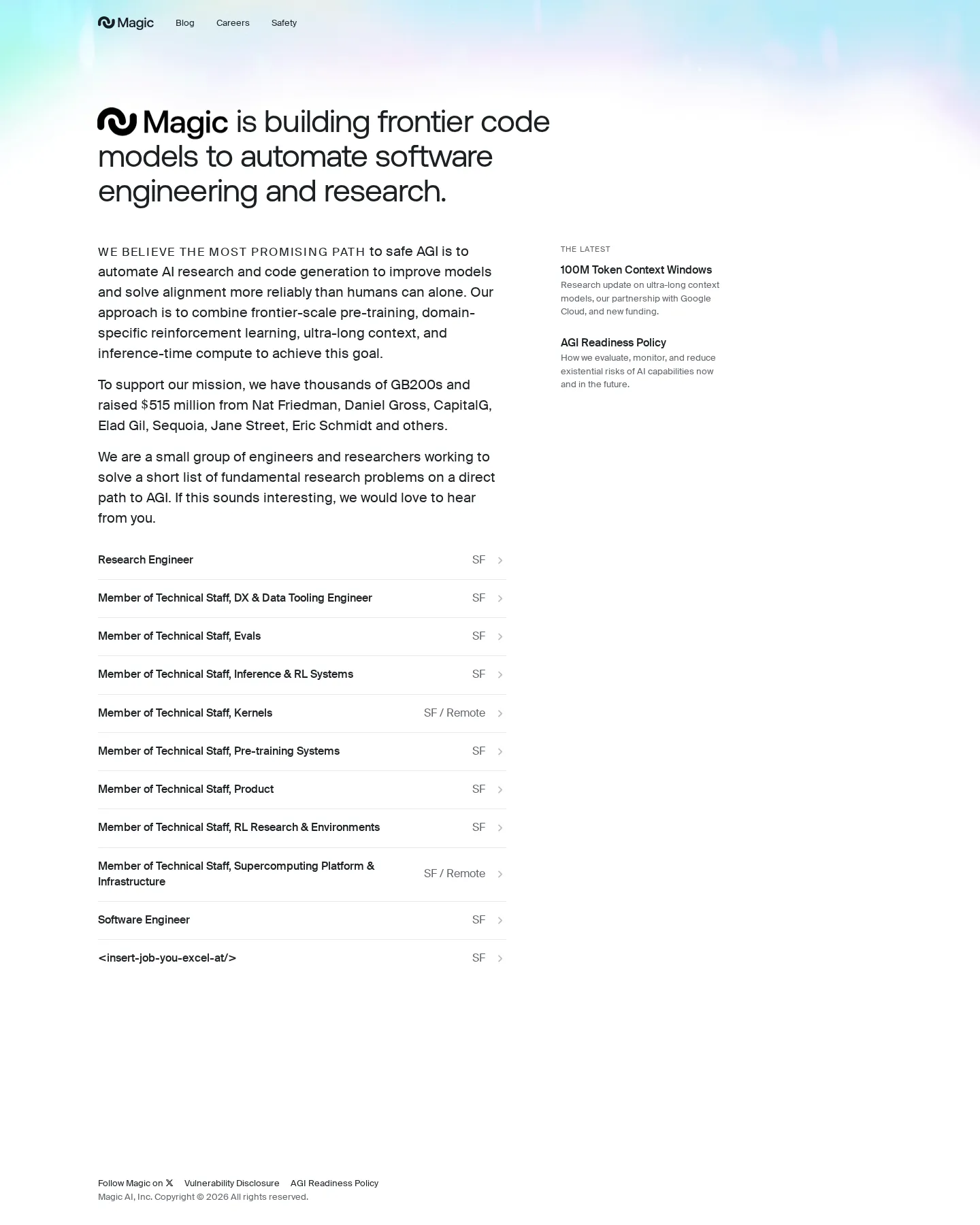
Magic (magic.dev) is a frontier AI research lab building code models to automate software engineering and research. Per its homepage, Magic frames this as “the most promising path to safe AGI” — automating AI research and code generation to improve models and solve alignment. Its technical approach combines frontier-scale pre-training, domain-specific reinforcement learning, ultra-long context, and inference-time compute. The standout research claim is ultra-long context: Magic’s “100M Token Context Windows” update describes models that can hold the equivalent of large codebases entirely in context.
Magic is heavily capitalized and compute-rich for its stage. The site states it runs “thousands of GB200s” (NVIDIA’s latest-generation accelerators) through a partnership with Google Cloud, and has raised $515 million from investors including Nat Friedman, Daniel Gross, Google’s CapitalG, Elad Gil, Sequoia, Jane Street, and Eric Schmidt. The company describes itself as “a small group of engineers and researchers” — the homepage is essentially a research-and-hiring page, listing roles like Research Engineer and Members of Technical Staff across pre-training, RL, kernels, evals, and supercomputing infrastructure.
Critically for a pricing blueprint: Magic publishes no pricing. There is no pricing page (magic.dev/pricing is not published), no self-serve plans, and no advertised commercial product on the site. It is a research-stage, sales-led company; any commercial access would be arranged through direct contact, not a checkout. This entry records that absence honestly rather than inventing figures. For the latest, visit Magic.
Pricing summary : How Magic AI’s pricing model works
Magic has no public pricing. As of the 2026-06-08 capture, magic.dev shows no pricing page, no plans, no per-token or per-seat rates, and no free tier — the site is a research-and-hiring presence, not a product storefront. There is therefore no published billing model to summarize: no subscription tiers, no usage meters, and no advertised enterprise band.
This is consistent with a frontier research-lab posture: Magic is building long-context code models (100M-token context) on thousands of Google Cloud GB200s and is still research-stage. Any commercial engagement would be arranged via direct contact and custom quote, not self-serve checkout.
- Public price: none —
/pricingis not published and no rates appear anywhere on the site. - Billing units: unknown (frontier code models would plausibly meter on tokens/compute, but Magic discloses nothing).
- Free tier: none.
- Sales motion: sales-led / contact-only.
What makes this different: Magic is a compute-rich, well-funded frontier lab ($515M raised, thousands of GB200s) that deliberately publishes zero commercial pricing — the opposite of the self-serve, transparent-pricing norm in coding-assistant tooling.
Pricing by product
Magic publishes no productized pricing. There are no named plans, no per-tier feature lists, and no rate card on magic.dev as of 2026-06-08. The only customer-facing path is direct contact.
| Offering | Price | Included | Key mechanics |
|---|---|---|---|
| Frontier code models (magic.dev) | No public price | Not disclosed | Research-stage; contact-only, custom quote |
Sales motions across products: sales-led / contact-only. Magic runs no self-serve or PLG motion — there is no checkout, free tier, or published price to self-serve against.
Hidden costs : Why there is no bill to construct
There is no Magic AI bill to model. Because magic.dev publishes no plans, no per-token rates, no seat prices, and no overage schedule, there are no list-price line items, no add-on charges, and no committed-use discounts to reconstruct. Building a hypothetical cost table here would mean inventing numbers Magic has never disclosed — so this section deliberately leaves them blank rather than fabricate a figure.
What is known about access is qualitative, not quantitative:
| What a buyer would want | What Magic publishes |
|---|---|
| Per-seat or per-token list price | None — no rate card anywhere on magic.dev |
| Free tier or trial | None — no self-serve sign-up |
| Waitlist for early access | None on the 2026 site (earlier 2022–2023 versions had a “Join Waitlist” CTA) |
| Enterprise “starting at” figure | None — terms would be a private, NDA-bound quote |
| Overage / usage-cap schedule | None disclosed |
The structural takeaways behind that empty rate card:
- No self-serve checkout, no waitlist (as of 2026). Earlier site versions (2022–2023) ran a “Join Waitlist” call-to-action; the current homepage drops even that, leaving only Blog, Careers, and Safety. There is no path to buy or trial the models.
- Any commercial terms would be a private quote. For a contact-only frontier lab, the “hidden cost” is structural: pricing, minimums, and usage caps would all be negotiated in a sales conversation and bound by an NDA, so a buyer cannot benchmark Magic against a public rate card the way they can with self-serve coding tools.
- Compute is the real cost center — borne by Magic, not the buyer. Magic states it runs thousands of NVIDIA GB200s on Google Cloud (Magic-G5) and disclosed roughly 8,000 H100s in 2024. The economics that would eventually shape any price live in that training-and-inference compute bill, which is why a long-context lab’s eventual pricing is so sensitive to token-cost deflation.
Want to estimate your own Magic AI bill? A Magic AI pricing calculator cannot be modeled yet — Magic publishes no rates, seats, or per-token prices, so there is no bill to construct. For how usage-metered AI bills are built once a vendor does publish rates, see our guide to choosing the right usage metric.
Pricing evolution : A funding and research story, not a price history
Magic has no pricing history to trace — there has never been a published price to change. Archived versions of magic.dev from September 2022 through 2026 consistently show a research-and-hiring page with no rate card, so the only “evolution” to record is the company’s funding and model milestones. The cadence below maps those events; the price columns are blank because Magic has never advertised a price.
Cadence
| Quarter | Price changes | Product / SKU additions | Notes |
|---|---|---|---|
| 2022 Q3 | 0 | 0 | Earliest archived site: “Software that builds software” with a Join-Waitlist CTA; no pricing |
| 2023 Q1 | 0 | 0 | 2023-02-06 $23M Series A led by Alphabet’s CapitalG; still a waitlist, no checkout |
| 2023 Q2 | 0 | 1 | 2023-06-06 LTM-1 launched — a coding-assistant LLM with a 5M-token context window, waitlist-only |
| 2024 Q1 | 0 | 0 | Roughly $117M round reported (NFDG-led), total funding to ~$145M; no product change |
| 2024 Q3 | 0 | 1 | 2024-08-29 $320M round (total ~$465M); LTM-2-mini with 100M-token context; Google Cloud Magic-G4/G5 supercomputers |
Tracked range: 2022 Q3–present. Quarters not listed had no funding, model, or site changes material to pricing. Magic has had zero price changes across the entire tracked range because it has never published a price.
Notable changes
- 2023-02-06 — Magic raised a $23M Series A led by Alphabet’s CapitalG, with Elad Gil, Nat Friedman, and Amplify Partners; coverage framed it as a Copilot challenger, but no commercial pricing followed.
- 2023-06-06 — Magic published LTM-1, a 5M-token-context coding-assistant LLM, accessible only via a waitlist.
- 2024-08-29 — Magic announced a $320M raise (Eric Schmidt, Jane Street, Sequoia, Atlassian, CapitalG, NFDG) lifting total funding to about $465M, alongside LTM-2-mini (100M-token context) and the Google Cloud Magic-G4 (H100) and Magic-G5 (GB200) supercomputers.
- 2026-06-08 — Live capture confirms total funding stated as $515M, thousands of GB200s, and still no pricing page, plans, or free tier.
What’s unique : A frontier lab with no product to price
A frontier-scale lab that ships no commercial product — and prices nothing. Magic is unusual in the AI-coding category precisely because it has inverted the normal sequence: most peers (Cursor, GitHub Copilot, Tabnine) launched a self-serve product first and raised on the traction. Magic raised about $515M and built supercomputers before publishing any product or price. The site is a research-and-hiring page, which is why this entry sits in the sales-led sales motion corpus despite there being nothing yet to sell.
The 100M-token context window is the differentiating research bet. Magic’s LTM-2-mini holds a 100-million-token context window — roughly 10 million lines of code or 750 novels — and the company claims its sequence-dimension algorithm is about 1000x cheaper per decoded token than the attention mechanism in Llama 3.1 405B at that length. If realized commercially, ultra-long context is itself a pricing wedge: a model that ingests an entire codebase changes what a “unit” of code assistance even is.
Vertical compute integration via Google Cloud. Rather than renting inference from a third party, Magic operates dedicated Google Cloud supercomputers — Magic-G4 on NVIDIA H100s and Magic-G5 on GB200 NVL72 racks. Owning the training-and-inference stack is what lets a 23-person team chase frontier scale, and it means any eventual pricing would be anchored to Magic’s own compute economics rather than a reseller margin.
Deliberate price opacity as positioning. The absence of pricing is a choice, not an oversight. By staying contact-only and research-stage, Magic signals that it is selling capability and access to a scarce frontier model, not a commoditized seat. This is the opposite pole from the transparent, self-serve hybrid credit-pool models that dominate the rest of the AI-coding corpus.
Strengths & weaknesses
Assessed as a pricing-and-go-to-market posture, not as a shipping product.
| Strengths | Weaknesses |
|---|---|
| Deep capitalization (~$515M) removes pressure to monetize prematurely or under-price | No public price, plan, or rate card — buyers cannot evaluate or budget without a sales call |
| Owned Google Cloud supercomputers (H100 + GB200) anchor pricing to real compute economics | No self-serve or free tier — zero bottom-of-funnel, unlike Cursor or Copilot |
| Differentiated 100M-token research wedge that could reframe the “unit” of code assistance | No revenue motion proven; an unpriced model is an unvalidated willingness-to-pay |
| Contact-only opacity preserves negotiating leverage and a premium frontier positioning | Opacity also means no community pricing signal, no review-site billing feedback to learn from |
| Marquee investor and advisor roster (Eric Schmidt, CapitalG, Sequoia, NFDG) lends credibility | Long research-stage runway risks being out-shipped by self-serve incumbents that compound on usage data |
Billing UX : Magic AI billing controls and transparency
There is no billing UX to evaluate. As of the 2026-06-08 capture, magic.dev has no account, dashboard, billing, or checkout surface — the navigation is limited to Blog, Careers, and Safety, plus a footer with Vulnerability Disclosure and the AGI Readiness Policy.
- Self-serve checkout — none. No sign-up, plan selector, or purchase flow exists on the site.
- Usage / spend dashboard — none published. No metering, usage console, or spend-alert surface is exposed publicly.
- Pricing transparency — none. No rate card, no
/pricingpage; the only commercial path is direct contact, so terms would be set in a private quote rather than shown in-product.
Strategic wins : Why a no-pricing posture has worked so far
1. Raising capital instead of revenue bought pricing optionality
Magic raised roughly $515M across rounds (Series A in 2023, ~$117M in early 2024, $320M in August 2024) without ever publishing a price. That capital lets it defer the willingness-to-pay question entirely, avoiding the trap of anchoring on a cheap self-serve seat that would be hard to walk back. For a contrast in how committing to a public price early constrains a company, see how AI companies are shifting from per-user licenses — and the introduction to usage-based pricing for why metric choice is best made late, not early.
2. Betting the differentiation on a research metric, not a price point
By making 100M-token context the headline rather than “$X per seat,” Magic competes on a capability axis where it has no peer, sidestepping a price war with Cursor and Copilot. If ultra-long context proves out, the eventual value metric (tokens, repositories, or outcomes) can be priced from a position of scarcity rather than parity — which is exactly the outcome- and value-based direction the category is trending toward.
3. Owning the compute stack to control future unit economics
Standing up dedicated Google Cloud supercomputers (Magic-G4 on H100s, Magic-G5 on GB200) means Magic’s eventual price floor is its own marginal compute cost, not a reseller’s. That vertical integration is the precondition for ever pricing a 100M-token model competitively, and it makes the eventual usage-metric decision a matter of internal economics rather than vendor pass-through.
Areas to improve : What an unpriced lab forgoes
1. No bottom-of-funnel access to learn willingness-to-pay
With no free tier, trial, or even a waitlist on the 2026 site, Magic collects no usage data from prospective buyers and no signal on what they would pay. Fix: a gated research-preview or design-partner program with metered access (even at $0) would let Magic instrument real usage of 100M-token context before it has to commit to a price — the same discovery loop described in choosing the right usage metric.
2. Zero published pricing makes budgeting and comparison impossible for buyers
Enterprise buyers evaluating long-context code models cannot slot Magic into a budget or a vendor comparison without a sales call, which lengthens cycles and excludes Magic from self-serve bake-offs. Fix: even a single indicative “starting at” enterprise figure or a published unit (per-million-token, per-seat) would let Magic appear in shortlists without giving away negotiating leverage.
3. Opacity forfeits the community pricing signal its peers compound on
Because there are no plans, there are no G2 billing reviews, no Reddit “is it worth it” threads, and no community price benchmarks — so Magic learns nothing from the market and risks the bill-shock and unpredictability reputation that opaque enterprise pricing often earns. Fix: publishing a transparent pricing philosophy (even before exact numbers) would pre-empt that perception and seed the community signal loop early.
Key takeaways
- Deep funding lets a company defer pricing indefinitely. Magic raised ~$515M without ever publishing a price; ample runway converts the pricing decision from an urgent revenue need into a deliberate, late-stage strategic choice.
- Capability can be the differentiator instead of price. By leading with a 100M-token context window rather than a dollar figure, Magic competes where it has no peer and avoids anchoring to a commoditized seat.
- Owning the compute stack precedes pricing power. Dedicated H100/GB200 supercomputers mean Magic’s eventual price floor is its own marginal cost, not a reseller margin — vertical integration is upstream of any rate card.
- Opacity is a two-edged tool. Contact-only positioning preserves negotiating leverage and a premium frame, but it forfeits self-serve funnel, usage data, and community pricing signal that compounding competitors enjoy.
- “No pricing” is itself a documentable pricing posture. For a corpus, the absence of a rate card — and the reasons for it — is real intelligence; a research-stage frontier lab is a distinct archetype from a self-serve coding assistant.
UBP implications
- Usage-based pricing is a downstream decision, not a launch requirement. Magic shows that a frontier model can mature for years on capital alone; the eventual metric (tokens, repos, or outcomes) is best chosen once real usage data exists rather than guessed at launch.
- Ultra-long context reframes the value metric. A model that ingests an entire codebase blurs the line between per-token and per-task pricing, suggesting outcome- or repository-based units may fit long-context labs better than the per-seat norm.
- Compute economics set the floor for any future UBP. For a lab that owns its supercomputers, token-cost deflation flows directly to margin and pricing flexibility — making the timing of a price launch as much a hardware-cost question as a market one.
Sources
- Magic official website (accessed 2026-06-08) — no pricing page; homepage states $515M raised, thousands of GB200s, a Google Cloud partnership, and 100M-token context models
- Magic blog: 100M Token Context Windows (accessed 2026-06-08) — LTM-2-mini, $320M raise (~$465M total), Magic-G4/G5 supercomputers, 1000x efficiency claim vs Llama 3.1 405B
- Magic blog: LTM-1 (accessed 2026-06-08) — the original 5M-token-context coding-assistant model, June 2023
- Magic blog: Series A (accessed 2026-06-08) — the $23M Series A announcement, February 2023
- Magic careers (accessed 2026-06-08) — research/engineering roles, underscoring the research-stage posture
Bottom line
Magic AI is the corpus’s clearest example of a frontier research lab that has raised about half a billion dollars while publishing no price at all — no plans, no rate card, no free tier. Its “pricing evolution” is really a funding-and-research story (LTM-1’s 5M-token context, then LTM-2-mini’s 100M), and the most honest thing this blueprint can do is record that absence rather than invent figures. The interesting question is not what Magic charges today, but how a compute-rich, capability-led lab will eventually convert a 100M-token model into a price.
Want to compare Magic AI against other AI-coding and developer-tool companies? Browse the pricing blueprint.
Pricing timeline : Major events on a vertical axis
Each milestone below corresponds to a public pricing change, product launch, or material adjustment. Major events use a filled marker; minor adjustments use a faded one.
Still no public pricing — $515M raised
Capture confirms magic.dev publishes no pricing page or plans. The homepage is a research-and-hiring presence stating thousands of GB200s, a Google Cloud partnership, and $515M raised. Commercial access is contact-only.
$320M round + LTM-2-mini (100M-token context)
Magic announced a $320M raise (Eric Schmidt, Jane Street, Sequoia, Atlassian, CapitalG, NFDG) lifting total to ~$465M, plus LTM-2-mini with a 100M-token context window and Google Cloud supercomputers (Magic-G4 H100, Magic-G5 GB200). Still no public pricing.
LTM-1: a 5M-token context model
Magic published LTM-1, a coding-assistant LLM with a 5M-token context window, behind a waitlist. No pricing, no self-serve access — research preview only.
$23M Series A led by Alphabet's CapitalG
Magic raised a $23M Series A (CapitalG, Elad Gil, Nat Friedman, Amplify Partners). Still no product checkout or pricing — positioned as a Copilot challenger building long-context code models.
Magic launches as a research-stage waitlist
Earliest archived magic.dev (Wayback, Sep 2022) is a 'Software that builds software' page with a Join-Waitlist call and no pricing — a research-and-hiring presence from day one.
- · Magic (magic.dev) is a frontier research lab building code models with 100M-token context windows — equal to roughly 10 million lines of code or 750 novels — yet it has never published a pricing page.
- · Magic has raised about $515 million from backers including Eric Schmidt, Nat Friedman, Daniel Gross, Google's CapitalG, Sequoia, Jane Street, and Atlassian — despite shipping no self-serve product.
- · Magic's first model, LTM-1 (June 2023), already had a 5M-token context window; LTM-2-mini (August 2024) pushed that 20x to 100M tokens.
Questions & answers
- What is Magic AI's pricing model?
- Magic has no public pricing. It is a sales-led, research-stage frontier-model lab; there has never been a pricing page or advertised plans on magic.dev.
- Does Magic AI offer a free tier?
- No. Magic publishes no self-serve plans or free tier. The site is a research-and-hiring presence with no product checkout or waitlist as of 2026.
- How much does Magic AI cost per month?
- No monthly price is published. Magic lists no prices on its website; any commercial engagement would be contact-only with a custom quote.
- Is Magic AI pricing usage-based or subscription?
- Unknown. Magic discloses no pricing model publicly. As a frontier code-model lab it would plausibly meter on tokens or compute, but it advertises nothing.
- How much funding has Magic AI raised?
- About $515 million, across a $23M Series A (Feb 2023, led by Alphabet's CapitalG), a roughly $117M round, and a $320M round in August 2024.
- What is Magic's 100M token context window?
- It is the context length of LTM-2-mini, Magic's August 2024 research model — about 10 million lines of code or 750 novels held in context at once.