AI Summary
About
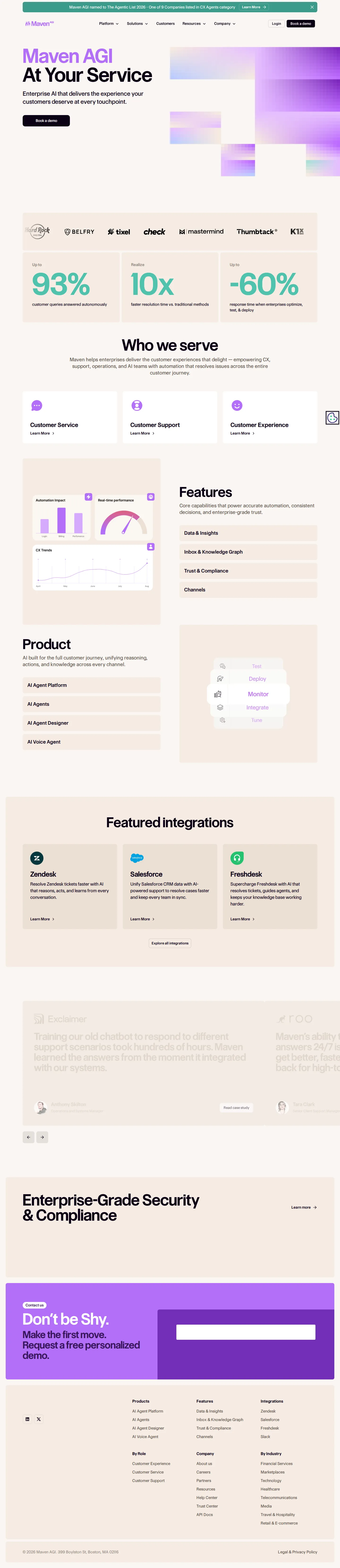
Maven AGI is an enterprise AI agent platform for customer support, founded by former HubSpot executive Jonathan Corbin and headquartered at 399 Boylston St, Boston. It sells autonomous AI agents that resolve customer queries across chat, email, voice, and web from a single reasoning engine, taking real actions such as refunds, account updates, and verification rather than just answering FAQs.
The company has raised 78M in total funding, anchored by a 50M Series B announced June 18, 2025 and led by Dell Technologies Capital, with participation from Cisco Investments, SE Ventures, Lux Capital, M13, and E14 Fund. Its pitch leans heavily on outcome metrics: the homepage advertises up to 93% of customer queries answered autonomously, 10x faster resolution time versus traditional methods, and up to a 60% reduction in response time once enterprises optimize, test, and deploy. Compliance is a stated buying criterion — the platform page claims 9 certifications, naming ISO 42001, ISO 27001:2022, PCI DSS 4.0 Level 1, and SOC 2 Type II.
For the most current information, visit Maven AGI.
Pricing summary : How Maven AGI’s pricing model works
Maven AGI is sales-led with no public list price, and as of this check the site carries no pricing page at all — mavenagi.com/pricing renders a “404 — Page Not Found” error and no “Pricing” link appears in the top navigation (Platform · Solutions · Customers · Resources · Company · Login · Book a demo) or in the footer. There is no self-serve signup, no free tier, and no published per-seat, per-resolution, or per-month rate. Every commercial path on the site is “Book a demo.”
The dimensions a quote is scoped against, based on what Maven itself exposes publicly:
- Ticket / conversation volume — the ROI calculator’s primary input is “Monthly Support Tickets,” defaulted to 10,000/mo.
- Autonomous resolutions — the calculator’s “Maven AI Target Resolution Rate” is defaulted to 93% “based on median customer outcomes,” and outputs “Tickets Deflected/mo.”
- Channels enabled — chat, email, voice, and web, all driven by one reasoning engine.
- Deployment and integration scope — white-glove onboarding with “a dedicated implementation team — not a self-serve setup guide,” and a stated 6-week time to implement, test, and go live.
The only public cost surface Maven publishes is the AI agents ROI calculator, and notably it models your support costs, not Maven’s price: it takes your ticket volume, your fully-loaded cost per ticket (defaulted to $22), your self-resolution rate, your FTE count, and your fully-loaded agent cost (defaulted to $65,000) and returns savings, not a subscription fee.
What makes this different: Maven has replaced the pricing page with a savings model. Rather than anchoring a buyer on a rate card, it anchors them on displaced labor cost — which is the purest expression of the outcome-based pricing posture that support-AI vendors like Sierra, Decagon, and Intercom Fin have converged on, and it sits at the opposite end of the transparency spectrum from peers who publish a per-resolution rate. The contract itself is an annual enterprise commitment scoped to volume and channels, not licensed agent seats.
Pricing by product
Maven AGI sells one platform under a custom enterprise contract. The product menu on the site is a set of modules inside that platform, not separately-priced SKUs, and none of them carries a published tier or rate.
AI Agent Platform (all modules, single enterprise contract)
| Module | Price | Included | Key mechanics |
|---|---|---|---|
| AI Agent Platform | Contact sales | Single reasoning engine automating support across chat, email, voice, and web; deploys “in days” and integrates with the existing helpdesk | Outcome/usage-scoped annual contract; no published rate card |
| AI Agents (Agent Maven) | Contact sales | Autonomous, secure multi-step actions across CRM, CS platforms, telephony, internal systems and product APIs — “updates, refunds, calculations, approvals” — plus graceful escalation where the human agent receives a pre-filled brief | The resolution volume these agents close is the value metric a quote is scoped against |
| Agent assist (“Copilot”) | Contact sales | Human-in-the-loop assist positioned as “augments agents, doesn’t replace them”: drafts responses, pre-fills context, handles follow-ups. One named customer cites Copilot “embedded natively in ticketing” driving +25% more resolutions/hour | Bundled into the platform contract; no separately published seat price. Note Maven’s own headline is “Not a chatbot. Not a copilot.” — assist is a feature, not the SKU |
| AI Agent Designer | Contact sales | Full agent development lifecycle — simulation and testing environments, continuous monitoring and analytics, tunable governance per release stage | Bundled; governance is positioned as an enterprise term, not an upsell SKU |
| AI Voice Agent | Contact sales | Native voice automation running on the same reasoning engine as chat, email, and web | Bundled; channel mix is a scoping variable in the quote |
Platform features bundled into the contract
| Feature | Price | Included | Key mechanics |
|---|---|---|---|
| Data & Insights | Included in contract | Real-time dashboard tracking “every deflection, escalation, and cost saved” | Doubles as the usage/outcome record behind a consumption-scoped contract |
| Inbox & Knowledge Graph | Included in contract | Proprietary retrieval over the customer’s own product knowledge, versioned content and context | Positioned as accuracy compounding over time, not a metered add-on |
| Trust & Compliance | Included in contract | 9 stated certifications including ISO 42001, ISO 27001:2022, PCI DSS 4.0 Level 1, and SOC 2 Type II | Enterprise terms; no security-tier upcharge is published |
| Channels | Included in contract | Chat, email, voice, and web from one reasoning engine | ”No rebuilding workflows per channel” — channel breadth is bundled, volume is what scales |
| Integrations | Included in contract | Zendesk, Salesforce, Freshdesk, Slack, plus prebuilt/custom API integrations and vendor-agnostic LLM support | Deployment scope, not a listed connector fee |
Public cost surface: the ROI calculator
Maven publishes no price, but it does publish a savings model. The AI agents ROI calculator accepts your support metrics and returns projected savings — every number below is a Maven-supplied default input or a computed output of your costs, not a Maven rate.
| Calculator field | Default shown | Role |
|---|---|---|
| Monthly Support Tickets | 10,000/mo | Input — total inbound per month |
| Avg. Fully-Loaded Cost per Ticket | $22 | Input — salary + benefits + tools |
| Current Self-Resolution Rate | 50% | Input — resolved without escalation |
| Support Team Size (FTE) | 25 FTE | Input — full-time equivalent agents |
| Avg. Agent Annual Cost (Fully Loaded) | $65,000 | Input — fully loaded per agent |
| Maven AI Target Resolution Rate | 93% | Input — “based on median customer outcomes” |
| Year 1 Savings | $2.5M | Output — “That’s $211K saved every month” |
| Monthly Savings | $210,700 | Output — vs current costs |
| Tickets Deflected/mo | 9,300 | Output — resolved by Maven AI |
| Additional tickets resolved/mo | 4,650/mo | Output — shown under “How we calculated this” |
| Ticket cost savings / year | $1,495,000/yr | Output — shown under “How we calculated this” |
| Agent capacity freed (FTE) | 23 | Output — shown under “How we calculated this” |
| Total Year 1 ROI Multiple | 23X | Output — the only figure that implies a Maven cost, and the implied cost is never stated |
Sales motions across products: 100% sales-led. Every surface — homepage, platform page, product pages, ROI calculator — terminates in “Book a demo”; there is no self-serve purchase, no trial, and no pricing page. See choosing the right usage metric and usage-based pricing strategy for relevant frameworks.
Hidden costs : What Maven AGI users actually pay
Because Maven does not publish rates, the real cost depends on what you negotiate. The variables that move an outcome/usage-scoped support contract are conversation volume, the channels enabled (voice typically carries higher unit cost than chat), and integration/onboarding scope.
| Line item | What drives it |
|---|---|
| Base platform commitment | Annual contract floor scoped to expected volume |
| Resolution / conversation volume | Primary consumption driver across chat + voice |
| Voice automation | Voice channel typically priced above chat |
| Integration & onboarding | Connectors (Zendesk, Salesforce, Freshdesk) and implementation scope |
Want to estimate your own Maven AGI bill? Use the Maven AGI pricing calculator to model your costs based on usage patterns.
Pricing evolution : Maven AGI pricing history and changes
Cadence
| Quarter | Price changes | Product / SKU additions | Notes |
|---|---|---|---|
| 2024 H2 | n/a | Platform launch | Sales-led from day one |
| 2025 Q2 | 0 | 0 | 50M Series B; model unchanged |
| 2026 Q2 | 0 | 0 | Still sales-only, no public pricing |
Tracked range: 2024–present. Maven has never published list pricing, so there is no rate history to track via Wayback.
Notable changes
- 2024 H2 — Maven AGI brings its autonomous customer-support agent platform to market; pricing sales-led.
- 2025-06-18 — 50M Series B led by Dell Technologies Capital (78M total raised); commercial model stays outcome/usage-oriented and sales-led.
What’s unique : Maven AGI’s distinctive pricing mechanics
1. Priced around autonomous resolution, not seats. Maven leads with “up to 93% of queries answered autonomously” — the value metric its enterprise contracts are scoped against, putting it firmly in the outcome/usage camp rather than per-seat SaaS.
2. Action-taking agents change the value story. Because Maven’s agents execute refunds, updates, and verification end-to-end, the buyer is paying for completed work, which supports a usage/outcome model over assistance-style seat licensing.
3. Full opacity by design. No tiers, no list price, no trial — a pure “book a demo” motion that keeps pricing negotiable and tied to each enterprise’s volume and channel mix.
Strengths & weaknesses
| Strengths | Weaknesses |
|---|---|
| Outcome-aligned model — buyers pay for resolutions/volume, not idle seats | Zero pricing transparency; no list price or trial to anchor evaluation |
| Strong outcome proof points (up to 93% autonomous, ~10x faster) | Usage/outcome contracts can be hard to forecast and budget |
| Deep integrations (Zendesk, Salesforce, Freshdesk) reduce switching friction | Voice + chat consumption can scale cost unpredictably at high volume |
Billing UX : Maven AGI billing controls and transparency
- Data & Insights dashboard — Maven’s named in-product analytics module, described as a “real-time dashboard [that] tracks every deflection, escalation, and cost saved. No vanity metrics.” This is the usage record behind any consumption- or outcome-scoped contract.
- AI Agent Designer — the named governance surface: simulation and testing environments, continuous monitoring and analytics, and “tunable governance at every release stage,” so a buyer can gate what agents are allowed to resolve autonomously before that volume becomes billable work.
- AI agents ROI calculator — the only public, self-serve cost tool: six input sliders (monthly tickets, cost per ticket, self-resolution rate, FTE count, agent annual cost, Maven target resolution rate) with a “How we calculated this” breakdown. It models your savings, never Maven’s invoice.
- Trust Center (
trust.mavenagi.com) — a separate, publicly linked compliance surface backing the 9 certifications claimed on the platform page. - Login / app portal (
app.mavenagi.com,accounts.mavenagi.com) — authenticated product access only; no public self-serve billing portal, plan-change screen, or card checkout is exposed anywhere on the marketing site. - Payment options — invoiced enterprise billing negotiated through sales. No published overage rate, no published commitment floor, and no public trial.
Strategic wins : Why Maven AGI’s pricing decisions worked
1. Anchoring to autonomous resolution
By making “93% autonomous” the headline, Maven sells the outcome buyers actually want — deflected tickets — and lets price follow value rather than headcount. See outcome-based pricing trends.
2. Selling work, not software
Action-taking agents reframe the purchase from “a tool my agents use” to “work the AI completes,” which supports premium usage/outcome economics. Related: how AI companies structure pricing.
3. Sales-led control in a fast-moving category
Keeping pricing private lets Maven tailor each deal to volume and channels in a category where unit economics are still being discovered. See choosing the right usage metric.
Areas to improve : Gaps in Maven AGI’s pricing approach
1. No anchor for self-serve buyers
The complete absence of any published rate or trial raises the evaluation bar versus peers that publish a per-resolution figure. See bill shock and cost unpredictability.
2. Forecasting risk
Usage/outcome contracts without published unit rates make it hard for finance teams to model spend before signing.
3. Transparency vs. competitors
As peers like Intercom Fin publish a clear per-resolution price, Maven’s opacity may become a competitive liability for mid-market buyers comparing options.
Monetization stack & signals : how Maven AGI builds & buys its revenue engine
Buys 0 Builds 0 4 open roles
Maven AGI's revenue org is overwhelmingly a sales-led, forward-deployed customer-success motion rather than a billing-platform build-out: of the 8 live Ashby reqs (re-pulled 2026-06-16), the GTM hiring skews to account executives, solutions/forward-deployed engineers and CXM-style roles, with the only finance/ops req a Finance Associate — no monetization-, billing-, or metering-engineering roles are open. The public ATS (Ashby) names no internal billing, CPQ, or revenue-tooling vendor: the recurring "founded by executives from HubSpot, Google and Stripe" line is founder pedigree, not a tooling disclosure, and the Salesforce/Zendesk/ServiceNow mentions are customer-support systems Maven integrates with or wants candidates familiar with, not its own stack. The outcome/usage commercial model (priced on autonomous resolutions) implies an internal resolution-metering layer, but no vendor is named and no engineering blog discloses an in-house build, so that layer is left unknown/inferred.
- Resolution/outcome metering (unnamed) Metering inferred
- Strategic Account Executive Customer success Jun 16, 2026
- Senior Forward Deployed Engineer Customer successRetention Jun 16, 2026
- Finance Associate Customer successRevOps Jun 16, 2026
- Field & Events Marketer Customer successRevOps Jun 16, 2026
- +2 more matched roles
Signals reviewed · derived from public job posts
Job postings fill and close over time — once a posting is filled we keep it as a dated citation (the quoted evidence remains); use View open roles for current listings.
Key takeaways
- Sales-only. Maven AGI publishes no list price; every deal is quoted through a demo.
- Outcome-oriented. The model is scoped to autonomous resolutions and conversation volume, not seats.
- Action agents justify usage pricing. Agents that complete refunds/updates support paying for work done.
- Voice + chat. Channel mix is a real cost lever in any quote.
- Category signal. Maven reinforces the support-AI shift from per-seat to per-resolution/outcome economics.
UBP implications
- Outcome metrics sell. Leading with autonomous-resolution percentage shows how to anchor UBP to a value the buyer already tracks.
- Opacity is a tradeoff. Sales-only pricing preserves flexibility but cedes the transparency advantage to competitors that publish a unit rate.
- Channel-aware metering. Pricing voice and chat differently is a useful pattern for multi-channel usage-based models.
Sources
- Maven AGI official website (accessed 2026-07-21)
- Maven AGI AI Agent Platform (accessed 2026-07-21)
- Maven AGI demo request page (accessed 2026-07-21)
- Maven AGI AI agents ROI calculator (accessed 2026-07-21)
- Maven AGI Trust Center (accessed 2026-07-21)
- Series B funding coverage — 50M led by Dell Technologies Capital, June 18 2025 (accessed 2026-06-11)
Bottom line
Maven AGI is a well-funded enterprise customer-support AI agent platform with a 100% sales-led, outcome/usage-oriented commercial model. It publishes no list price; cost is quoted against autonomous-resolution and conversation volume across chat and voice. Browse the pricing blueprint for more fully-researched company profiles.
Want to compare Maven AGI against other customer-service AI companies? Browse the pricing blueprint.
Pricing timeline : Major events on a vertical axis
Each milestone below corresponds to a public pricing change, product launch, or material adjustment. Major events use a filled marker; minor adjustments use a faded one.
50M Series B (Dell Technologies Capital)
Maven AGI raised a 50M Series B led by Dell Technologies Capital (78M total raised), funding product development and go-to-market. Commercial model remained outcome/usage-oriented and sales-led.
Maven AGI launches enterprise AI agent platform
Maven AGI brought its 'Business AGI' customer-support agent platform to market, positioning around autonomous resolution of customer queries across chat and voice. Pricing kept sales-led from launch.
- · Maven AGI was founded by Jonathan Corbin, a former senior HubSpot executive, and pitches itself as 'the enterprise AI company unifying the full customer journey' with 'Business AGI.'
- · Maven advertises that its agents answer up to 93% of customer queries autonomously and resolve issues roughly 10x faster than traditional support — the outcome metrics its commercial model is built around.
- · Maven raised a 50M Series B in June 2025 led by Dell Technologies Capital, with Cisco Investments, Lux Capital, M13 and others, bringing total funding to 78M.
Questions & answers
- What is Maven AGI's pricing model?
- Maven AGI is sales-led with no public list price. Pricing is quoted per customer and structured around the AI agent platform's autonomous-resolution volume and channels (chat and voice), rather than per-seat licensing. You book a demo to get a custom quote.
- Does Maven AGI offer a free tier?
- No. Maven AGI does not publish a free or self-serve tier. The buying motion is a sales-led demo and a custom enterprise contract.
- How much does Maven AGI cost per month?
- Maven AGI does not publish monthly pricing. Cost depends on conversation/resolution volume, channels (chat, voice), and enterprise requirements, all negotiated through sales.
- Is Maven AGI pricing usage-based or subscription?
- Maven AGI's model is consumption- and outcome-oriented: it ties value to autonomous resolutions and conversation volume across channels, typically delivered as an annual enterprise platform contract rather than a flat per-seat subscription.