AI Summary
About
Midjourney is a San Francisco-based AI research lab and image generation platform founded in 2021 by David Holz, co-founder of Leap Motion. It offers subscription-based access to a proprietary diffusion model that generates high-quality images and, since June 2025, short videos from text prompts and reference images. The service was originally built entirely on Discord — users typed /imagine commands in a shared server — before adding a web interface at midjourney.com.
The company is unusual in the AI industry for its pure bootstrapped model: it has never raised external venture capital, is entirely self-funded, and has been profitable since shortly after launch. With an estimated $300–500M in annual recurring revenue and roughly 107 employees as of 2026, Midjourney achieves one of the highest revenue-per-employee ratios in the AI industry. The r/midjourney subreddit has over 680,000 members, making it one of the largest AI community gathering points.
Midjourney competes primarily with DALL-E 3 (integrated into ChatGPT Plus at $20/mo), Adobe Firefly (bundled in Creative Cloud), and Stable Diffusion (open-source self-hosted). Its differentiation is image quality and community — it pioneered the aesthetic that many now associate with “AI art” and maintains a large Discord community used both for generation and discovery.
Pricing summary : How Midjourney’s GPU-hour subscription model works
Midjourney uses a pure subscription model built around a single metered dimension: fast GPU hours. Each tier bundles a monthly allotment of priority compute — 3.3, 15, 30, or 60 hours — plus unlimited queue-based “Relax mode” generation on Standard and above. There are no per-image fees; costs are driven by plan tier and optional top-up fast hours ($4/hr).
The model has two distinct usage tracks:
- Fast mode — uses your monthly GPU-hour budget, generates in ~30–60 seconds, priority access to GPU clusters
- Relax mode — unlimited but queued, no GPU-hour consumption, generates in 1–10 minutes depending on load
What makes this different: Midjourney denominates value in compute time rather than image counts, making usage naturally self-regulating — heavier prompts (upscales, high-resolution, video) cost proportionally more GPU time without the platform needing per-feature pricing. This lets Midjourney maintain a single simple subscription grid while implicitly charging more to power users who consume compute-intensive features. See GPU-hour billing as a pricing unit and how it contrasts with credit-based billing.
Pricing by product
Image generation (all plans)
| Tier | Price | Included | Key mechanics |
|---|---|---|---|
| Basic | $10 / mo | 3.3 fast GPU hours (~200 standard images); no Relax mode | Entry point; hard cap, no queue fallback |
| Standard | $30 / mo | 15 fast GPU hours (~900 images) + unlimited Relax-mode images | Best value for most users; Relax absorbs overflow |
| Pro | $60 / mo | 30 fast GPU hours + unlimited Relax images/video; Stealth Mode | 12 concurrent fast jobs; required for privacy |
| Mega | $120 / mo | 60 fast GPU hours + unlimited Relax images/video; Stealth Mode | 12 concurrent fast jobs; best for batch workflows |
Annual pricing (20% discount)
| Tier | Monthly equiv. | Annual total |
|---|---|---|
| Basic | $8 / mo | $96 / yr |
| Standard | $24 / mo | $288 / yr |
| Pro | $48 / mo | $576 / yr |
| Mega | $96 / mo | $1,152 / yr |
GPU consumption by operation type
| Operation | Approx. GPU time consumed | Notes |
|---|---|---|
| Standard image (grid) | ~1 minute | Default generation produces a 4-image grid |
| Upscale | ~1–2 minutes additional | Higher resolution upscaling consumes more |
| Turbo mode image | ~0.5 minutes (2× rate) | 3.5× faster but charges 2× GPU hours |
| Video (V1, 5 sec) | ~8× image equivalent | Produces 4 video clips; extend up to 21 sec |
Group and corporate billing
Organizations needing 50+ yearly Pro or Mega plans can contact Midjourney billing support for bulk arrangements. No standard published bulk discount rate; no free plans for non-profits or educational institutions.
Sales motions across products: PLG / self-serve for all four tiers; sales-assisted bulk billing for 50+ seat organizations (no standard discount rate published).
Hidden costs : What Midjourney users actually pay beyond the plan price
The advertised $10–$120 headline understates what active users pay once they hit their fast-hour cap or need privacy features.
Archetype 1 — Freelance designer on Basic plan
A designer generating 20 hero images per day (each requiring a grid + one upscale) hits ~3.3 fast hours in fewer than 5 days on the Basic plan, then has no queue fallback since Relax mode is not included. In practice this user either upgrades or purchases top-up hours.
| Line item | Monthly cost |
|---|---|
| Basic plan | $10.00 |
| Top-up fast hours (6 extra hrs × $4) | $24.00 |
| Estimated total | $34.00 |
At that spend level, upgrading to Standard ($30) with unlimited Relax mode is cheaper and removes the hard cap.
Archetype 2 — Agency on Pro plan running client work at scale
An agency generating 500+ images/month for clients needs Stealth Mode and high concurrent job throughput. Video production for social content adds significant GPU-hour draw.
| Line item | Monthly cost |
|---|---|
| Pro plan | $60.00 |
| Additional fast hours for video (5 hrs × $4) | $20.00 |
| Estimated total | $80.00 |
Companies earning over $1M/year in gross revenue must use Pro or Mega for a compliant commercial license — making the $60 Pro plan the baseline for commercially active agencies regardless of usage volume.
Want to estimate your own Midjourney bill? Use the Midjourney pricing calculator to model your monthly cost based on image volume, upscale frequency, and video usage.
Pricing evolution : From Discord free-for-all to pay-only GPU subscriptions
Cadence
| Quarter | Price changes | Product / SKU additions | Notes |
|---|---|---|---|
| 2022 Q3 | 0 | 4 | Launch with Basic/Standard/Pro tiers + 25-image free trial; plan prices set at $10/$30/$60 |
| 2023 Q2 | 0 | 0 | April 2023: Free trial permanently suspended due to deepfake abuse; no pricing change |
| 2023 Q3 | 0 | 1 | Mega plan ($120/mo) added; 60 fast hours + 12 concurrent jobs |
| 2024 Q4 | 0 | 0 | October 2024: 60-day expiration introduced on purchased fast-hour top-ups |
| 2025 Q2 | 0 | 1 | June 2025: V1 video generation launched; video included in all plans via fast-hour consumption |
Tracked range: 2022 Q3–2026 Q2. Quarters not listed above were verified stable (0 price changes, 0 SKU additions). Subscription tier prices ($10/$30/$60/$120) have not changed since July 2022 launch.
Notable changes
- 2022-07 — Midjourney launched on Discord with four paid tiers ($10/$30/$60/mo) and a 25-image free trial. The Discord-only model was unique among AI tools at the time.
- 2023-04 — Free trial suspended indefinitely. Founder David Holz cited “extraordinary demand and trial abuse” on Discord after viral deepfakes (Trump arrest images, Pope Francis puffer-jacket images) created reputational risk. (Decrypt, April 2023)
- 2023-07 — Mega plan ($120/mo) added, completing the current four-tier lineup and targeting high-volume professional users.
- 2024-10 — Purchased fast-hour top-ups gained a 60-day expiration policy, ending the prior indefinite rollover. This created urgency around top-up purchases and implicitly encourages subscription upgrades over hourly top-ups.
- 2025-06 — V1 video model launched (image-to-video, 5-second clips extendable to 21 seconds). Video uses ~8× the GPU hours of a comparable image job. Unlimited Relax-mode video restricted to Pro and Mega; SD quality only in Relax mode.
The free trial suspension in detail
The April 2023 suspension was one of the most-discussed pricing decisions in early generative AI. Within days of realistic deepfakes going viral, Holz announced the change on Discord — not via a press release or blog post — marking Midjourney’s characteristically informal communications style. The decision was framed as temporary (“until we have our next improvements to the system deployed”) but has never been reversed. The r/midjourney community noted at the time that requiring payment introduced accountability that deterred misuse, and the move was widely credited with cleaning up abuse faster than content moderation alone could.
What’s unique : Midjourney’s distinctive pricing mechanics
1. GPU hours as the billing unit — not images, not tokens. Most AI image generators charge per image or per API call. Midjourney charges by compute time, which means heavier operations (upscales, video, high-res) cost proportionally more without requiring a per-feature price card. This single dimension keeps the pricing grid simple (four tiers) while naturally capturing more revenue from power users. It also means the per-image cost varies by feature complexity — a standard grid costs ~$0.033 (Standard plan fast), while a video clip costs roughly $0.26 in fast-hour equivalent.
2. The Relax mode safety valve — unlimited output for engaged subscribers. Standard and above plans include unlimited queue-based Relax generation that doesn’t touch fast-hour budgets. This is a retention mechanic: users never hit a hard creative ceiling. The trade-off (wait time vs. immediacy) self-selects power users into higher tiers when they need throughput, while keeping standard users happy with unlimited (slower) access. It’s a structural choice that closely resembles the freemium fallback pattern — the free dimension (Relax) keeps users engaged, while the paid dimension (Fast) drives upsell.
3. Discord-native launch — community as distribution, not just support. Midjourney built its first million users inside Discord, where generations appeared in public channels by default. This made every image a public sample of the product, driving organic growth without a marketing budget. The public-gallery default (overridden only by Stealth Mode on Pro+) continues this flywheel: generations are indexed on midjourney.com and serve as social proof. No other major AI company built its initial pricing model around Discord’s social mechanics.
4. Bootstrapped, no VC, pure subscription economics. Midjourney has never raised external funding. With ~107 employees and ~$300–500M ARR, it generates $3–4M revenue per employee — exceptional even by AI company standards. The subscription model creates predictable cash flow without the pressure to pursue enterprise or platform revenue. This lets Midjourney optimize pricing for user value rather than investor-driven growth metrics, explaining the unusual price stability since 2022. See subscription pricing strategy for context on why stability can be a competitive advantage.
5. Commercial license bundled into all paid plans (with a revenue threshold). Unlike some AI image tools that require separate commercial licensing, every Midjourney paid subscription includes commercial use rights. The carve-out — companies earning over $1M/year must use Pro or Mega — is a natural revenue-based upgrade trigger that doesn’t penalize small creators while capturing value from commercial-scale operators.
Strengths & weaknesses
| Strengths | Weaknesses |
|---|---|
| Price stability since 2022 — users can plan budgets confidently | No free tier — highest barrier to trial among major AI image tools |
| Relax mode provides unlimited output safety valve on Standard+ | Basic plan has no Relax fallback — $10 users hit hard cap in days of use |
| GPU-hour billing naturally scales revenue with compute usage | GPU-hour unit is opaque — users don’t know cost until they run out |
| Bootstrapped, profitable — no VC pressure to raise prices | No API for programmatic access (contrast: DALL-E 3, Stable Diffusion APIs) |
| Commercial license included in all paid plans | Top-up fast hours expire in 60 days — discourages stocking up vs. upgrading |
| Strong community flywheel via Discord and public gallery | No team/organization billing — each seat is an individual subscription |
Billing UX : Midjourney subscription controls and usage visibility
- Manage Subscription page (midjourney.com/account) — Self-serve hub for plan upgrades/downgrades, annual/monthly toggle, and purchasing extra fast-hour top-ups. Accessible directly in the web app.
/infocommand in Discord — Shows remaining fast GPU hours, lifetime usage stats, and current plan. Predates the web dashboard; still the fastest way to check hours mid-session on Discord./fastand/relaxtoggle commands — In-chat commands to switch between fast and Relax mode on a per-session basis. No UI; purely text-driven for Discord users.- Fast hours purchase flow — Top-up fast hours are purchased in whole-hour increments at $4/hour, billed immediately on the account page. No minimum quantity stated; hours are available until the 60-day expiry.
- Stealth Mode toggle — Accessible in account settings for Pro and Mega subscribers; applies to all future generations until disabled. No per-image toggle.
- Subscription renewal — Plans renew on the same calendar date each month. There is no mid-cycle proration stated in public documentation; billing support is email/ticket only (no live chat).
- Annual commitment — Full year billed upfront with no refund policy published for unused months. The 20% savings is prominent in pricing UI.
Strategic wins : Why Midjourney’s pricing decisions worked
1. Anchoring on time rather than images locked in durable pricing stability
By billing GPU hours rather than images, Midjourney avoided the pricing pressure that competitors face when model efficiency improves. When the same model generates the same image faster, per-image pricing erodes revenue — but per-hour pricing holds as long as users fill their available hours. This structural choice means Midjourney has held prices stable since 2022 while many AI API providers have cut per-token or per-image rates repeatedly. See choosing the right usage metric for how this plays out across the industry.
2. Free trial suspension turned a liability into a moat
Removing the free tier in April 2023 was a risk — it closed off the top-of-funnel entry that had driven viral growth. In practice, it converted Midjourney’s user base into a confirmed-intent subscriber pool, dramatically reducing abuse and improving the community signal-to-noise ratio. Competing tools that maintained free tiers faced persistent deepfake and content-policy challenges. The move also framed Midjourney as a professional tool, attracting designers and agencies who value a curated, paid community over a free-for-all. This mirrors patterns discussed in AI pricing strategy.
3. Relax mode as a churn-prevention mechanic at no marginal cost
Adding unlimited queue-based generation (Relax mode) to the $30+ plans gave subscribers an always-available outlet that prevented churn during fast-hour scarcity. Users who run out of fast hours don’t cancel — they switch to Relax and wait. The queue also acts as a load-balancing mechanism for Midjourney’s infrastructure. This is an example of usage-based pricing with a floor — the floor is unlimited slow access, which keeps MRR stable even when usage patterns are lumpy.
4. Bootstrapped model eliminated investor pressure on monetization timeline
Because Midjourney has no VC investors, the pricing strategy is optimized for sustainable unit economics rather than growth-at-all-costs. This contrasts with VC-backed AI tools that have undergone rapid pricing changes to satisfy investors — a dynamic explored in how AI companies manage pricing pressure. This explains the unusual stability of the $10/$30/$60/$120 grid since 2022, even as AI infrastructure costs have dropped significantly. The company has been able to add value (V1 video, turbo mode, web platform) without repricing the core subscription, building strong user trust in price predictability.
Areas to improve : Gaps in Midjourney’s pricing approach
1. Basic plan’s lack of Relax mode creates a bad first paid experience
The $10 Basic plan hits its 3.3 GPU-hour limit in roughly 5 days of regular use (20+ image sessions), with no fallback to Relax mode. This means Basic subscribers either churn or immediately upgrade — there’s no sticky middle ground. A proposed fix: add limited Relax-mode access (e.g., 50 images/month) to Basic to give new paying users a taste of the unlimited-output experience, converting them to Standard over time rather than forcing an immediate choice. This pattern mirrors freemium conversion mechanics used by tools like Notion and Figma.
2. GPU-hour unit opacity causes “bill shock” at end of fast hours
Users can’t see how many GPU hours a specific operation will consume before executing it. Running out of fast hours mid-project is a jarring experience — the platform either stops Fast-mode access entirely (Basic) or switches silently to Relax. Concrete fix: add a per-operation GPU-time estimate before generation begins (similar to how API platforms show estimated token cost), and proactive alerts at 80% and 95% fast-hour consumption. See AI cost unpredictability and bill shock for patterns from other platforms.
3. No API access means no developer ecosystem or programmatic workflows
Competitors like DALL-E 3, Stability AI, and open-source Stable Diffusion all offer API access for programmatic integration. Midjourney has no public API, forcing power users and agencies to use unofficial Discord bot automations (which violate terms of service). An official API tier — even at a premium per-GPU-hour rate — would open a large developer-tooling and workflow-automation segment that is currently underserved. This would also create a new pricing dimension (API vs. consumer) that could support higher-margin revenue from commercial integrations.
Monetization stack & signals : how Midjourney builds & buys its revenue engine
Buys 1 Builds 2
Buys only the payments rail (Stripe) and builds the rest itself: the Fast GPU-time meter behind its own usage pricing is application-level, not a Metronome/Orb vendor meter. With ~107 staff and no public ATS, the revenue engine is deliberately thin — one in-house meter, billed monthly via Stripe.
-
“GPU time is only used when Midjourney is actively working to create images/videos for you. Each time your subscription renews, your Fast time is reset. So, it's smart to use up your Fast time before the month ends, because any unused time doesn't carry over to the next month.”
-
“Relax Mode for images is only available to those with Standard, Pro, and Mega Plans; Relax Mode for SD videos is limited to the Pro and Mega Plans — the tier→Fast-hour allotment→Relax/Stealth gating is enforced in Midjourney's own app, with no entitlements vendor named.”
-
“Midjourney uses Stripe as our payment processor, which means you can only use payment methods that Stripe accepts — major cards (Visa, Mastercard, American Express) and wallets like Apple Pay, Amazon Pay, Alipay, Google Pay and Link in certain regions.”
Signals reviewed · derived from product docs
Key takeaways
- GPU hours beat image counts as a billing unit for generative AI. Midjourney’s time-based billing stays durable when model efficiency improves, whereas per-image pricing creates deflation pressure. Teams pricing generative AI tools should evaluate compute-time as their metering dimension.
- Removing a free tier can be a quality signal, not just a growth sacrifice. Midjourney’s 2023 free-trial suspension reduced abuse and reinforced its professional positioning, without apparent long-term damage to subscription growth. The decision validated that some markets prefer a paid-entry community over a free-for-all.
- Unlimited slow access (Relax mode) is a high-value churn-prevention mechanism at low marginal cost. Queue-based generation is cheap to provide and prevents the “I ran out, time to cancel” moment that plagues usage-capped subscriptions. Products with variable-cost generation should consider adding a throttled unlimited tier rather than hard caps.
- Bootstrapped pricing is structurally different from VC-backed pricing. Without investor pressure, Midjourney has held prices stable for three years while adding features — a posture that builds customer trust and reduces the risk of the pricing-change backlash that has hurt other AI tools.
- A commercial-revenue threshold (e.g., >$1M/year requires Pro or Mega) is an elegant enterprise upsell trigger. It lets small creators use the basic plan legitimately, while capturing value from commercial-scale users without a complex sales process.
UBP implications
- Compute-time billing creates natural alignment between vendor cost and user value. As Midjourney demonstrates, GPU-hour billing means heavy users (who consume more compute for upscales, video, and high-res outputs) pay proportionally more — without a complex per-feature pricing matrix. This is a blueprint for any AI service where inference cost varies significantly by operation type.
- The fast/Relax dual-mode pattern is a reusable framework for usage-based pricing with a safety valve. By separating “priority compute” (fast, limited, paid) from “background compute” (Relax, unlimited, included), Midjourney avoids the binary choice between hard caps and fully unlimited plans. This pattern — metered premium tier plus unlimited budget tier — could apply to many AI inference services where background processing is economically viable.
- Price stability is itself a competitive advantage in volatile AI pricing markets. While other AI tools have changed pricing repeatedly, Midjourney’s unchanged $10/$30/$60/$120 grid since 2022 functions as a trust signal. For practitioners designing usage-based pricing strategy, predictability may matter as much as price optimization — especially in a market where customers have been burned by sudden AI pricing changes.
Sources
- Midjourney pricing page (accessed 2026-05-29)
- Comparing Midjourney Plans — Midjourney Docs (accessed 2026-05-29)
- GPU Speed (Fast, Relax, Turbo) — Midjourney Docs (accessed 2026-05-29)
- Purchasing Extra Fast Time — Midjourney Docs (accessed 2026-05-29)
- Group Plans and Corporate Billing — Midjourney Docs (accessed 2026-05-29)
- Subscription Fast Time Expiration — Midjourney Docs (accessed 2026-05-29)
- Midjourney V1 Video Model launch — updates.midjourney.com (accessed 2026-05-29)
Bottom line
Midjourney built a $300–500M ARR business on a pricing model that has not changed since 2022: four subscription tiers denominated in GPU hours, with a queue-based unlimited mode that prevents churn and a no-free-tier stance that keeps the community commercially accountable. Its unusual bootstrapped independence means pricing is optimized for user trust and sustainable unit economics rather than investor-driven growth — making it one of the most durable and studied subscription models in generative AI.
Want to compare Midjourney against other AI image and generative model pricing? Browse the pricing blueprint.
Pricing timeline : Major events on a vertical axis
Each milestone below corresponds to a public pricing change, product launch, or material adjustment. Major events use a filled marker; minor adjustments use a faded one.
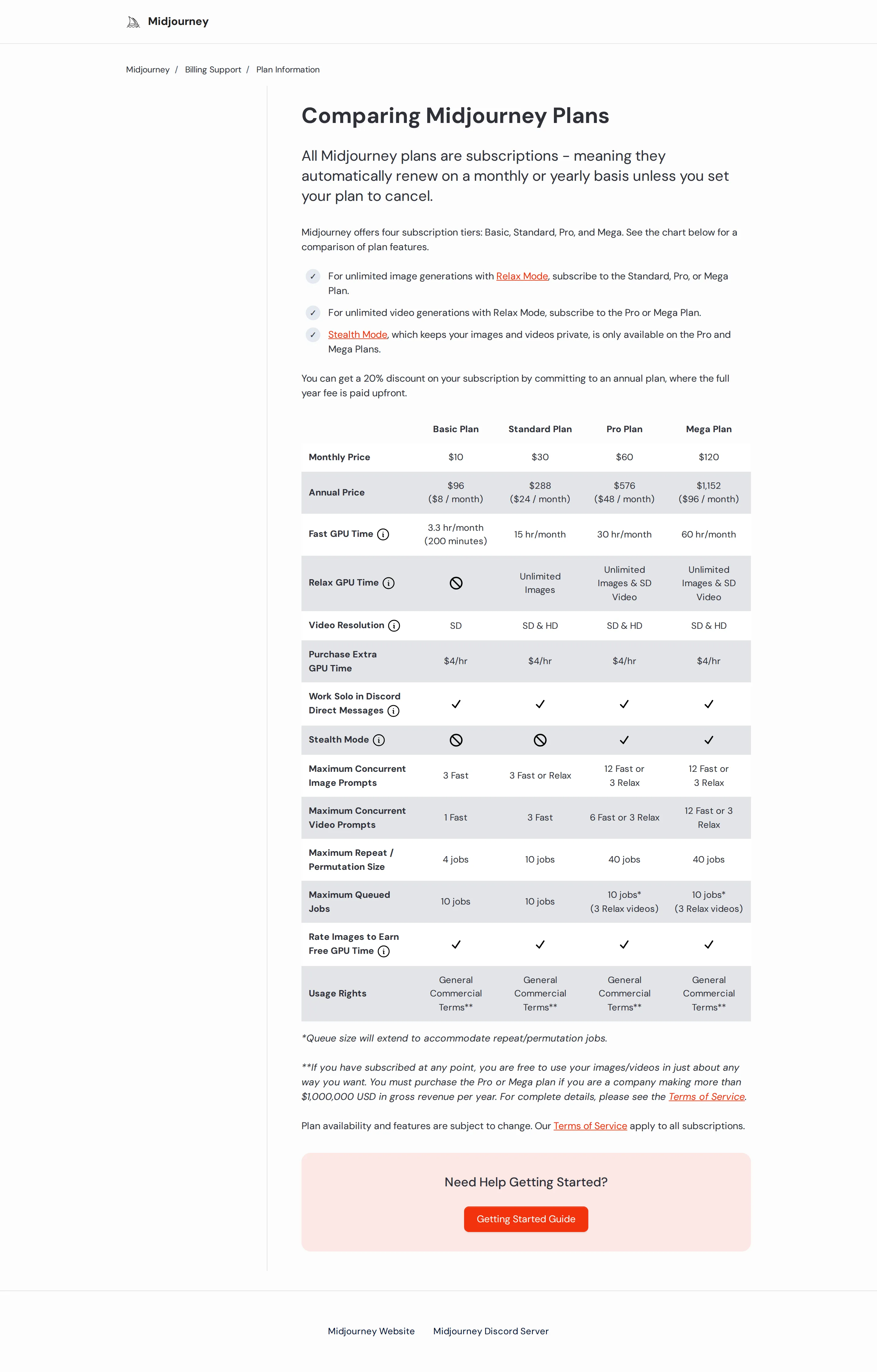
Plan table reorganized around video; prices unchanged
By September 2025 the archived plan-comparison page added dedicated video rows — Video Resolution, Maximum Concurrent Video Prompts, and Maximum Queued Jobs — integrating the V1 video model into the standing four-tier grid. Subscription prices, annual discounts, and fast-hour allotments remained identical to the pre-video baseline.
V1 video generation launched; video included in all plans
Midjourney launched its first video model (V1, image-to-video) on June 19, 2025. Video generation uses roughly 8× the GPU hours of a comparable image job. Unlimited Relax-mode video is available only on Pro and Mega plans; Basic and Standard get limited video via fast hours.
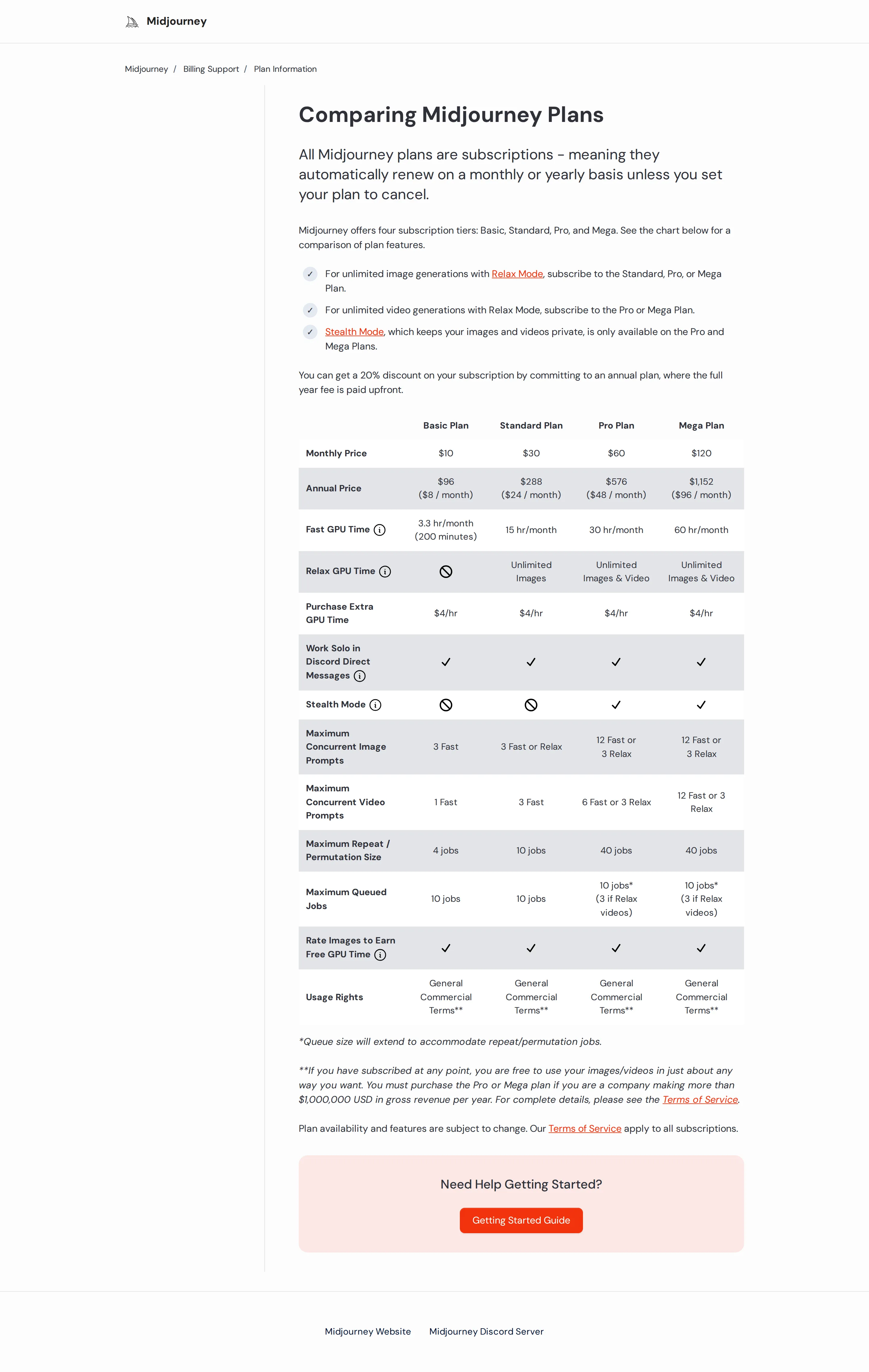
Four-tier grid stable; top-ups at $4/8/20/48 (pre-video baseline)
The February 2025 archived plan-comparison page confirms the four-tier grid unchanged from launch — Basic $10, Standard $30, Pro $60, Mega $120 monthly ($96/$288/$576/$1,152 annual) with 3.3/15/30/60 fast GPU hours. Extra fast time sold at $4/$8/$20/$48 for 1/2/5/12 hours with 60-day expiry. No video rows appear in the plan table at this point.
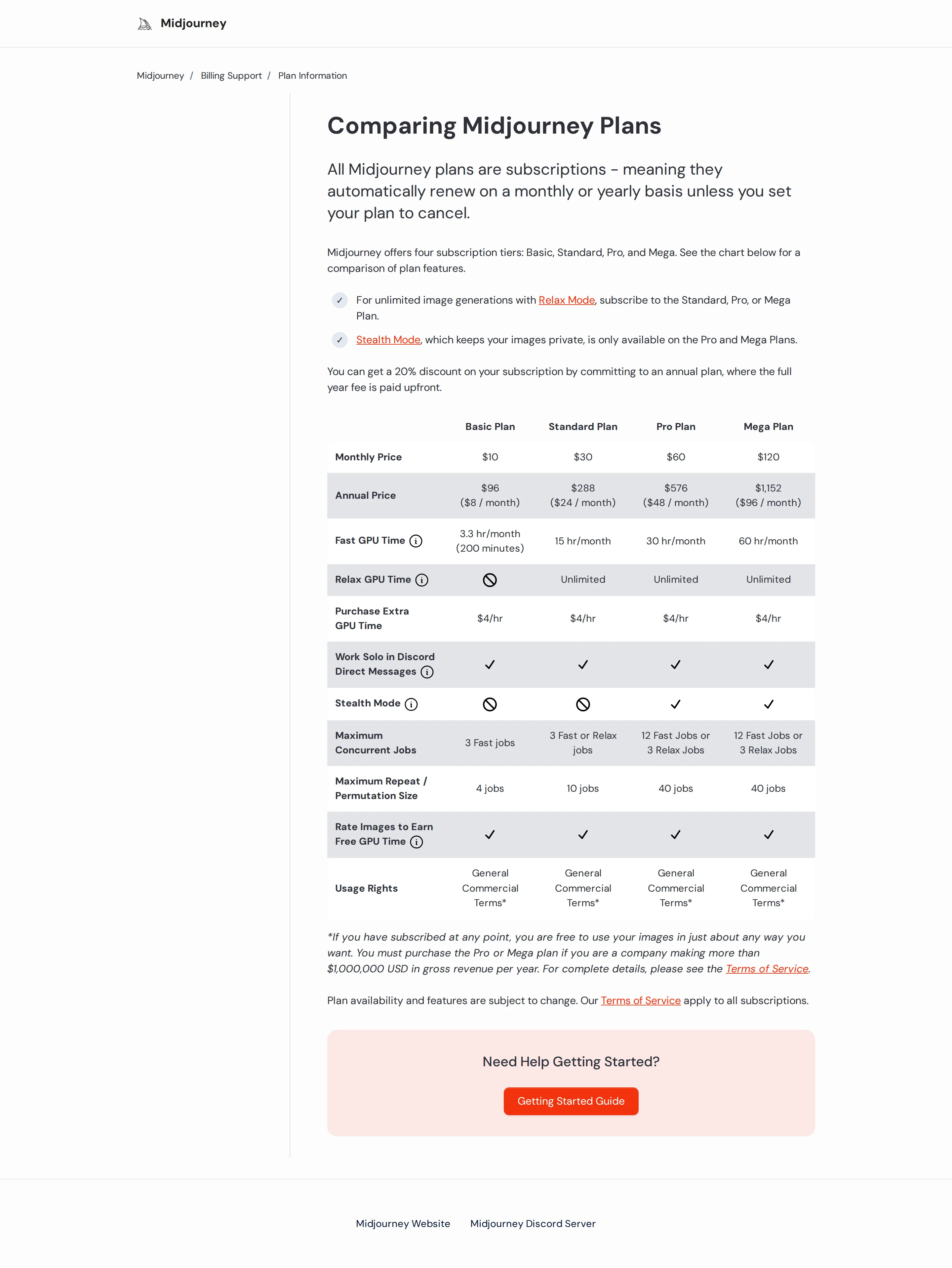
Purchased fast hours expiration policy introduced
Effective October 1, 2024, Midjourney introduced a 60-day expiration on top-up fast hours purchased at $4/hour. Hours bought before September 30, 2024, expired November 30, 2024. Monthly plan hours still reset each billing cycle without rolling over.
Mega plan ($120/mo) added
Midjourney introduced the Mega plan at $120/month (or $96/mo billed annually), offering 60 fast GPU hours per month and 12 concurrent fast jobs — doubling the capacity of the Pro plan for high-volume professional users.
Free trial permanently suspended
Midjourney founder David Holz announced the indefinite suspension of free trials on Discord in April 2023, citing 'extraordinary demand and trial abuse' after viral deepfakes of Donald Trump and Pope Francis created reputational risk. This made Midjourney pay-only and has not been reversed.
Launch with free trial + four paid tiers
Midjourney launched in July 2022 on Discord with 25 free image generations for new users. Paid plans were immediately available at $10, $30, $60, and $120/month, structured around GPU-hour bundles with fast/relax modes.
- · Midjourney employs roughly 107 people yet generates an estimated $300–500M in annual revenue — one of the highest revenue-per-employee ratios in AI at ~$3–4M per employee.
- · Midjourney has never raised external venture capital; founder David Holz bootstrapped the company to profitability from day one, rejecting VC funding even at a ~$10B implied valuation.
- · The free trial was killed in April 2023 specifically because deepfake images of Donald Trump being arrested and Pope Francis in a Balenciaga puffer jacket went viral — not because of cost pressures.
Questions & answers
- How much does Midjourney cost per month?
- Midjourney costs $10/mo (Basic), $30/mo (Standard), $60/mo (Pro), or $120/mo (Mega). Annual billing saves 20% on each tier: $96, $288, $576, or $1,152/year respectively.
- What are fast GPU hours and how many do I get?
- Fast GPU hours determine how many priority images you can generate. Basic gets 3.3 hours (~200 images), Standard 15 hours (~900 images), Pro 30 hours, and Mega 60 hours per month. Fast hours reset monthly and do not roll over.
- What is Relax mode and which plans include it?
- Relax mode puts your generation into a shared queue processed when GPU capacity is free — it's slower but unlimited and doesn't consume your fast hours. Standard, Pro, and Mega plans include unlimited Relax-mode image generation. Only Pro and Mega include unlimited Relax-mode video.
- Does Midjourney offer a free trial?
- No. Midjourney permanently suspended its free trial in April 2023 due to deepfake abuse. There is currently no free tier or free trial; access requires a paid subscription starting at $10/month.
- What is Stealth Mode and which plans include it?
- Stealth Mode prevents your generated images from appearing in Midjourney's public gallery. It is only available on the Pro ($60/mo) and Mega ($120/mo) plans.
- Can I buy extra fast hours if I run out?
- Yes. Additional fast hours can be purchased at $4 per hour from your account page. Purchased hours expire after 60 days (policy since October 2024) and require an active subscription to use.