AI Summary
About
Mintlify is the AI-native developer documentation platform. You point it at a Git repo, write in MDX, and it publishes fast, searchable, beautifully themed docs — with an AI assistant, a writing agent, workflows, and an MCP server baked in so both humans and AI agents can read your docs. It is the docs layer behind a long list of developer-facing companies: Perplexity, X, Cognition, Together AI, Replit, Lovable, Anaconda, Laravel, Kalshi, Loops, and Fidelity.
The company was founded by Han Wang and Hahnbee Choi and went through Y Combinator’s W22 batch. In April 2026 it raised a $45 million Series B at a $500 million valuation, led by Andreessen Horowitz and Salesforce Ventures, with Bain Capital Ventures, Y Combinator, HubSpot Ventures, and others — bringing total funding to $67 million. Mintlify says it serves 20,000+ companies and that its docs reach more than 100 million people a year. The headline metric that explains its pricing direction: roughly 50% of traffic to Mintlify-hosted docs now comes from AI agents rather than humans.
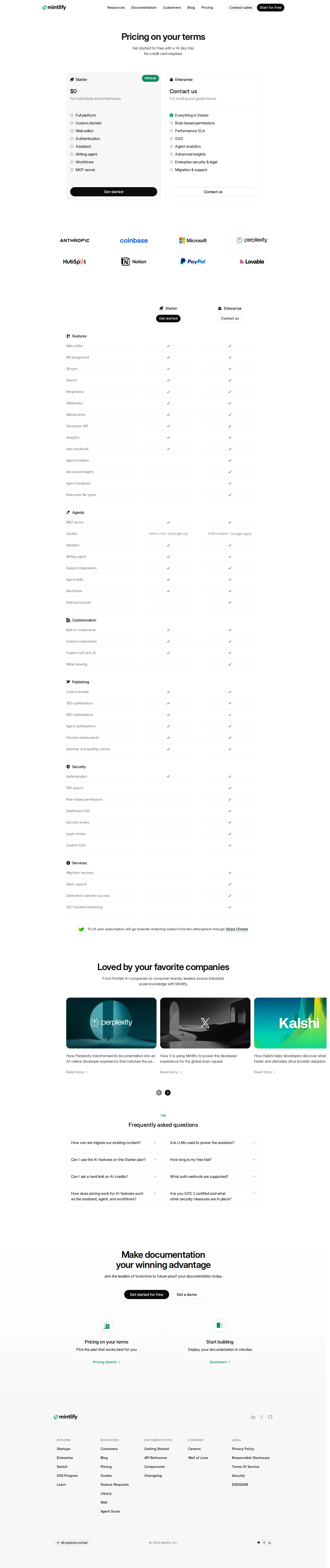
As of August 2026, Mintlify’s live pricing page shows a three-tier structure — Starter, Pro, and Enterprise — after a period running just Starter plus custom Enterprise. The Pro tier is where the AI assistant, writing agent, agent skills, and automations now live; Starter remains a genuinely free publishing platform but without those AI features.
For the current rate card, see Mintlify pricing.
Pricing summary : How Mintlify’s pricing model works
Mintlify runs a three-tier structure: a free publishing plan, a paid Pro plan that unlocks AI, and custom Enterprise.
- Starter — $0/mo. For individuals and small teams, capped at 5 editor seats. Includes the full publishing platform: custom domain, web editor, authentication (Mintlify Auth only), the MCP server, and the API playground. It does not include the AI assistant, writing agent, agent skills, or automations — those are gated to Pro and above. The page’s top-level offer is “your first month of credits on us,” no credit card required.
- Pro — $450/mo billed annually, or $540/mo billed monthly. For startups and growing teams, with unlimited editor seats. Everything in Starter, plus the AI assistant, writing agent, agent skills, and automations; adds preview deployments, admin APIs, and password-based authentication. Includes 10,000 AI credits per month, with $0.01 per credit for overages and credit packs available.
- Enterprise — Contact us. For scaling and global teams, unlimited seats. Everything in Pro, plus SSO, SCIM, role-based permissions, a performance SLA, advanced insights, enterprise security and legal review, custom SLAs, self-hosting, EU hosting, custom developer portals, and migration & dedicated-support services. AI credits are custom with committed-volume discounts (vs. Pro’s flat 10,000/month).
The meter sits on AI usage, but only for paying tiers. The assistant, writing agent, agent skills, and automations consume credits: every Pro deployment contributes 10,000 credits/month to a single organization-wide balance (an org running two Pro deployments starts each month with 20,000 pooled credits — Mintlify’s own docs note credits “were previously tracked per deployment” and “now pool at the organization level”), billed at $0.01 per credit beyond the balance; Enterprise negotiates a custom allotment with committed-volume discounts. Self-serve credit add-ons top up the Pro balance at 15,000 credits for $145/mo, 40,000 for $370/mo, or 90,000 for $800/mo (each cheaper per-credit than the $0.01 overage rate); beyond 90,000/mo you need Enterprise’s custom package. Unused credits roll over, capped at 150% of the monthly balance. Mintlify publishes average per-action credit costs — an assistant response runs ~23 credits, an editor-agent run ~115, a Slack-agent run ~110, and automations range from ~180 credits (update from code changes) up to ~913 credits (translations) — and you can set a hard cap or per-deployment overage toggle so AI spend can’t surprise you.
What makes this different: Mintlify still gives away the core publishing platform for free — custom domain, web editor, MCP server — but has moved the AI layer (the thing that actually costs it inference money) behind a paid Pro tier rather than metering it inside a free plan. This is a reversal from the structure Mintlify ran earlier in 2026, when Starter itself included the AI assistant and workflows for free (with credits metered from the first dollar). The current shape looks more like a conventional freemium-to-paid ladder — free for the docs platform, pay for the agentic AI on top of it — with Enterprise still reserved for governance and scale needs.
Pricing by product
| Tier | Price | Included | Key mechanics |
|---|---|---|---|
| Starter | $0/mo (free) | Full platform, custom domain, web editor, MCP server, API playground; 5 editor seats | No AI assistant/writing agent/automations; Mintlify Auth only; no credits |
| Pro | $450/mo billed annually ($540/mo billed monthly) | Everything in Starter + AI assistant, writing agent, agent skills, automations, preview deployments, admin APIs; unlimited editor seats | 10,000 AI credits/month included; $0.01/credit overage; credit packs available; password auth |
| Enterprise | Contact us (custom) | Everything in Pro + SSO, SCIM, RBAC, performance SLA, advanced insights, security/legal review, self-hosting, EU hosting, migration & support | Sales-quoted; OAuth/JWT/SSO auth; custom AI credits with committed volume discounts |
AI features (assistant, writing agent, agent skills, automations) are exclusive to Pro and Enterprise — Starter is a docs-publishing-only free tier with no AI credit allotment. Credits contribute per Pro deployment (10,000/deployment/month) into one shared organization-wide balance, per Mintlify’s own credit-pricing documentation.
Mintlify Pro — Credit add-ons
| Extra credits/month | Monthly cost |
|---|---|
| 15,000 | $145 |
| 40,000 | $370 |
| 90,000 | $800 |
Add-ons stack on top of the 10,000 credits/deployment included with Pro; each is priced below the $0.01/credit overage rate, and 90,000/month is the largest self-serve add-on — beyond that requires an Enterprise custom credit package. Rollover caps unused credits at 150% of the monthly balance.
Sales motions across products: self-serve and product-led for Starter and Pro (sign up, ship docs, upgrade for AI); sales-led for Enterprise, which is quoted, not listed.
Hidden costs : What Mintlify users actually pay
The base platform is genuinely free, so the only variable cost on Starter is AI credit consumption. Where bills grow is heavy use of the assistant, writing agent, and workflows once you blow past the 5,000 included credits — at $0.01 per credit, an AI-heavy docs site that lets agents answer thousands of questions a month can run up a real overage line. The good news: there is a hard-cap control, so this is opt-in spend rather than a surprise.
| Line item | Monthly cost |
|---|---|
| Starter base plan | $0 |
| First 5,000 AI credits | $0 (included) |
| AI credit overages | $0.01 per credit beyond 5,000 (tiered packages available) |
| Enterprise governance (SSO, RBAC, SLA, migration) | Custom quote |
| Estimated total (Starter, light AI use) | $0 |
The real “hidden cost” is not on the rate card at all: it’s the jump from free Starter to custom-quoted Enterprise once you need SSO, RBAC, or a performance SLA. There is no published middle tier, so any governance requirement puts you into a sales conversation.
Want to estimate your own Mintlify bill? Use the Mintlify pricing calculator to model credit overages against your AI assistant traffic.
Pricing evolution : Mintlify pricing history and changes
Cadence
| Quarter | Price changes | Product / SKU additions | Notes |
|---|---|---|---|
| 2024–2025 | Iterative | Pro, Growth self-serve tiers + editor add-ons | Tiered seat-priced rate card |
| 2026 Q2 | Major restructure | Collapsed to free Starter + Enterprise | Series B; AI-credit metering |
Tracked range: 2024–present. The current live capture (2026-06-15) is the primary evidence; legacy tier figures are described approximately, not asserted as current rates.
Notable changes
- 2024–2025 — Mintlify ran a multi-tier self-serve rate card: a free Hobby tier, a Pro tier (reported at roughly $150/month with capped editor seats), and a Growth tier (reported at roughly $550/month with a custom domain and more editors plus per-editor add-ons), alongside custom Enterprise. These legacy figures are cited as approximate and historical, not as a current rate-card line.
- 2026-04-14 — Series B: $45M at a $500M valuation (a16z, Salesforce Ventures). Around this period Mintlify simplified self-serve.
- 2026-06-15 — Live pricing page shows only Starter ($0) and Enterprise (Contact us), with 5,000 AI credits included and $0.01/credit overages. The Pro and Growth self-serve tiers are gone, replaced by a free Starter and a credit meter.
What’s unique : Mintlify’s distinctive pricing mechanics
1. The whole platform is free; only AI is metered. Custom domains, web editor, auth, and the MCP server — the things competitors gate behind paid seats — are all in the $0 Starter plan. Mintlify charges where its own marginal cost lives: AI inference, via the $0.01 credit meter.
2. Credits with a hard cap. AI features bill in credits ($0.01 each, 5,000 included) and you can set a hard spend cap. That converts the usual usage-pricing anxiety (bill shock) into opt-in, bounded spend — a deliberate trust move for a free-led funnel.
3. No published middle tier. There’s a clean two-step ladder: free Starter, then custom Enterprise. Mintlify removed the in-between Pro/Growth pricing entirely, betting that governance needs (SSO, RBAC, SLA) are the real upsell trigger, not feature-gating mid-market teams.
Strengths & weaknesses
| Strengths | Weaknesses |
|---|---|
| Full platform free at $0 — exceptional for adoption | No published mid-tier; any governance need = sales call |
| AI metered transparently at $0.01/credit with a hard cap | Credit consumption can be hard to forecast for AI-heavy docs |
| Credit meter aligns price with Mintlify’s real AI cost | Enterprise pricing is opaque (Contact us only) |
| Git-native, MDX, MCP server — strong DX | Advanced auth (OAuth/JWT/SSO) locked to Enterprise |
| Backed by a16z + Salesforce; 20,000+ customers | Migration off the platform means re-theming/re-hosting docs |
Billing UX : Mintlify billing controls and transparency
- Billing controls — Credits can be hard-capped, so AI overage spend is bounded by you, not discovered after the fact. Tiered credit packages let heavier Pro users pre-buy at better rates.
- Monthly/Annual toggle — The Pro plan card carries a Monthly/Annual pill toggle on the pricing page itself: $540/mo billed monthly vs. $450/mo billed annually (a ~17% annual discount), switched client-side with no page reload.
- Usage page — A dashboard page shows the organization-wide shared credit balance plus a per-deployment usage breakdown; each deployment’s plan and overage setting live alongside it. Advanced insights (Enterprise) expose deeper consumption analytics.
- Credit packages section — Buy or change a credit add-on (15,000/$145, 40,000/$370, 90,000/$800 per month) directly from the Usage page; changes apply immediately and are prorated to the current billing cycle.
- Spending controls — Two named sub-controls: an Overages toggle (per deployment, off by default, $0.01/credit when on) and Usage alerts (email when the org balance crosses a set percentage).
- Export usage activity — CSV export of the organization’s credit activity log (date, product, credits consumed per event) from the Usage page, with a download link that expires after 72 hours.
- Payment options — Starter requires no credit card to start. Enterprise is invoiced via a sales quote. Mintlify also routes 1% of subscription revenue to carbon removal via Stripe Climate, signalling Stripe-based billing.
Strategic wins : Why Mintlify’s pricing decisions worked
1. Free distribution as the moat
By making the full platform free, Mintlify turned pricing into a distribution engine: developers ship docs at $0, those docs rank and get cited, and Mintlify becomes the default. With ~50% of docs traffic now coming from AI agents, owning the docs surface is strategically valuable beyond the subscription line. See usage-based pricing strategy.
2. Pricing aligned to actual cost
Metering AI in credits ($0.01 each) ties revenue to the one thing that genuinely costs Mintlify money — inference — instead of seats. That keeps the free tier economically sane and makes the model scale with value delivered. Related: how AI companies are shifting from per-user licenses and outcome-based pricing trends.
3. Collapsing the funnel
Removing Pro and Growth simplified the buying decision to free-or-Enterprise, reducing friction for self-serve and concentrating sales effort on accounts that need governance. See choosing the right usage metric for why credits fit AI features better than seats.
Areas to improve : Gaps in Mintlify’s pricing approach
1. The free-to-Enterprise gap
There’s no published step between $0 and “Contact us.” A growing team that needs SSO or RBAC — but isn’t a true enterprise — has no self-serve path and lands in a sales cycle. A published mid-tier (the role the old Growth plan filled) would smooth that cliff. See bill shock and cost unpredictability.
2. Credit forecastability
Credits are transparent per-unit ($0.01) but hard to forecast in aggregate: how many credits does an AI assistant answering customer questions actually burn? Clearer per-action credit costs (per assistant query, per workflow run) would help teams budget before they hit overages.
3. Enterprise opacity
Enterprise is entirely quote-based. Even an indicative starting price or a published list of what drives the quote would help buyers self-qualify rather than enter a black-box negotiation.
Monetization stack & signals : how Mintlify builds & buys its revenue engine
Buys 5 Builds 0 2 signal roles
Buys the go-to-market layer outright — Stripe for payments, HubSpot plus a visitor-ID/outbound cluster for pipeline — but names no billing or metering system anywhere; the Financial Controller hire puts usage- and credit-contract reconciliation on finance.
-
“All payment data is stored by Stripe. You may find their privacy notice link(s) here: https://stripe.com/privacy .”
-
“Marketing / advertising — Google Tag Manager (tag management, which may load Google Analytics and similar tags), HubSpot (marketing and customer relationship management), Unify, Attribution, RB2B, and Common Room (visitor and account identification, intent, and attribution).”
-
“Marketing / advertising — Google Tag Manager (tag management, which may load Google Analytics and similar tags), HubSpot (marketing and customer relationship management), Unify, Attribution, RB2B, and Common Room (visitor and account identification, intent, and attribution).”
-
“Marketing / advertising — Google Tag Manager (tag management, which may load Google Analytics and similar tags), HubSpot (marketing and customer relationship management), Unify, Attribution, RB2B, and Common Room (visitor and account identification, intent, and attribution).”
-
“Marketing / advertising — Google Tag Manager (tag management, which may load Google Analytics and similar tags), HubSpot (marketing and customer relationship management), Unify, Attribution, RB2B, and Common Room (visitor and account identification, intent, and attribution).”
- Metering Metering inferred Job post Jun 2026
“Overseeing revenue recognition and billing reconciliation across usage-based, credit-based, and multi-year contracts”
- Financial Controller Billing engineering seen Jun 16, 2026
Rev-rec and billing reconciliation across usage-based, credit-based and multi-year contracts sit with finance, and now span two entities after Mintlify acquired Helicone in March 2026 — the JD names no billing or metering system, so the plumbing underneath is undisclosed.
“Overseeing revenue recognition and billing reconciliation across usage-based, credit-based, and multi-year contracts … Managing standalone financial reporting, intercompany accounting, and billing infrastructure for Helicone”
- Product Marketing Manager Monetization seen May 14, 2026
There is no standalone monetization or pricing PM — pricing and packaging questions route through a team-of-one product marketer as sales enablement, with pricing-decision experience listed only as a bonus.
“Being the go-to for sales on objection handling, pricing and packaging questions, competitive intel, and sales collateral … Bonus points: Experience with pricing and packaging decisions”
Signals reviewed · derived from public job posts, product docs
Job postings fill and close over time — once a posting is filled we keep it as a dated citation (the quoted evidence remains); use View open roles for current listings.
Key takeaways
- Mintlify gives the platform away and meters AI. Starter is a real $0 with custom domain, editor, auth, and MCP server; only AI features (5,000 credits, then $0.01/credit) cost money.
- The rate card collapsed to two tiers. Pro (
$150/mo) and Growth ($550/mo) are gone; it’s free Starter or custom Enterprise. - Credits, not seats, are the meter. AI usage bills at $0.01/credit with a hard cap — aligning price to inference cost and defusing bill-shock anxiety.
- Enterprise is governance-gated. SSO, RBAC, SLAs, and advanced auth live only behind a sales quote.
- Free distribution is the strategy. With ~50% of docs traffic from AI agents and 20,000+ customers, owning the docs surface matters more than middle-tier subscription revenue.
UBP implications
- Meter the cost driver, not the user. Mintlify prices AI credits because inference is its marginal cost; seats would have mis-aligned price and cost. Pick the meter that tracks your real COGS.
- Pair usage metering with a hard cap. The $0.01-per-credit-plus-hard-cap pattern shows how to offer usage pricing without scaring buyers — bounded, opt-in overage beats open-ended metering.
- Free + usage + enterprise can replace a tier ladder. Collapsing mid-tiers into a free base plus a usage meter plus custom Enterprise is a viable structure when distribution is the goal and AI is the variable cost.
Sources
- Mintlify pricing page (accessed 2026-08-26)
- Mintlify credit pricing docs (accessed 2026-08-26)
- Mintlify Series B announcement (accessed 2026-06-15)
- Mintlify official website (accessed 2026-06-15)
- Local capture:
public/images/blueprint/mintlify/2026-06-15-main.txtand-main-validated.txt
Bottom line
Mintlify made a clean pricing bet: give the entire documentation platform away for free, meter only the AI features that actually cost it money ($0.01 per credit, 5,000 included, with a hard cap), and reserve everything else for a custom Enterprise quote. The old Pro ($150/mo) and Growth ($550/mo) self-serve tiers are gone. For most teams that means Mintlify is effectively free until you either go AI-heavy or need enterprise governance — a model built for distribution in a world where half your docs readers are AI agents.
Browse the pricing blueprint for more fully-researched company profiles.
Want to compare Mintlify against other developer-tools companies? Browse the pricing blueprint.
Pricing timeline : Major events on a vertical axis
Each milestone below corresponds to a public pricing change, product launch, or material adjustment. Major events use a filled marker; minor adjustments use a faded one.
Live capture: free Starter + Enterprise + $0.01 credit overages
Pricing page shows two public tiers — Starter ($0) and Enterprise (Contact us) — with 5,000 AI credits included and $0.01/credit overages. The prior Pro (~$150/mo) and Growth (~$550/mo) self-serve tiers are no longer listed.
Series B and self-serve simplification
Raised $45M Series B at a $500M valuation (a16z, Salesforce Ventures). Around this period Mintlify consolidated its self-serve rate card into a single free Starter plan with credit-metered AI overages, pushing teams above it to Enterprise.
- · Mintlify's free Starter plan is unusually generous — it ships the full platform, custom domain, and MCP server at $0, where most docs platforms paywall those.
- · Roughly 50% of documentation traffic on Mintlify-hosted docs now comes from AI agents, not humans — which is why GEO and agent optimizations are first-class features.
- · Mintlify came out of Y Combinator's W22 batch and reached a $500M valuation on its $45M Series B in April 2026, with 20,000+ companies including Perplexity, X, Cognition, and Anaconda.
Questions & answers
- How much does Mintlify cost?
- Mintlify has three tiers: Starter is free ($0/mo) with 5 editor seats and no AI features; Pro is $450/mo billed annually (or $540/mo billed monthly) with unlimited editor seats, the AI assistant/writing agent/automations, and 10,000 AI credits per month ($0.01/credit overage); Enterprise is custom-quoted by sales.
- Does Mintlify have a free tier?
- Yes. The Starter plan is permanently free at $0/mo with no credit card required, up to 5 editor seats, and the full publishing platform (custom domain, web editor, Mintlify authentication, MCP server, API playground). It does not include the AI assistant, writing agent, agent skills, or automations — those require Pro or Enterprise.
- How does Mintlify charge for AI features?
- AI features (the assistant, writing agent, agent skills, and automations) are only available on Pro and Enterprise — they are not included on Starter. Pro includes 10,000 AI credits per month; usage beyond that is billed at $0.01 per credit, with credit packs available. Enterprise gets a custom credit allotment with committed volume discounts.
- What do you get on Enterprise vs Pro?
- Enterprise (Contact us) layers on SSO, SCIM, role-based permissions, a performance SLA, advanced insights, enterprise security and legal review, custom SLAs, self-hosting, EU hosting, custom developer portals, and migration & dedicated support on top of everything in Pro. Auth methods: Starter gets Mintlify Auth only, Pro adds password auth, and Enterprise adds OAuth, JWT, and SSO.