AI Summary
About
Parloa is a Berlin-founded enterprise software company building an AI Agent Management Platform (AMP) for contact centers — software that designs, tests, deploys, and monitors AI agents that handle customer conversations over phone, chat, messaging, and click-to-call. The platform positions itself around delivering “the AI agent experience your customers expect”: immediate real-time responses, multichannel reach, and natural, human-like conversation. Rather than selling seats or plan tiers, Parloa frames its product around an AI agent lifecycle — Design and Integrate, Test and Iterate, Deploy and Scale, Monitor and Improve.
Founded in 2018 in Berlin by Malte Kosub and Stefan Ostwald, Parloa has scaled fast: it raised a $120M Series C at a $1 billion valuation in May 2025 (Durable Capital, Altimeter, General Catalyst) and then a $350M Series D at a $3 billion valuation in January 2026, tripling its valuation in eight months on more than $50M in annual recurring revenue and revenue that quadrupled since its 2024 ~$66M Series B. Parloa sells to large enterprises and mid-market contact-center operations. Its published customers include Decathlon, Swiss Life, TUI, KPMG, W&W Gruppe, BarmeniaGothaer, Allianz, Booking.com, and HealthEquity, and the company highlights a strategic investment, partnership, and integration with SAP aimed at bringing AI agents to enterprise CX. The buyer is a CX or contact-center leader at a large organization, not an individual developer — consistent with the company’s fully sales-led, quote-only go-to-market.
Parloa’s positioning has evolved markedly. In its 2021–2023 incarnation it was a “Conversational AI platform for automating omni-channel customer service” — phonebots, website chatbots, Messenger chatbots, even Alexa Skills and Google Actions. By late 2023 it had rebranded around generative AI and a low-code contact-center frontend, and by 2025–2026 it had consolidated into the AI Agent Management Platform (AMP) for the agentic contact center. Through every era the pricing has stayed off the public site.
Parloa operates from Berlin, Munich, and New York and competes in the crowded AI contact-center category alongside vendors such as Sierra, Decagon, Cresta, and PolyAI. Like several of those peers, Parloa keeps its pricing entirely off the public site, treating price as a negotiated, account-specific number rather than a published list — though independent reviews now put the entry contract at roughly $300,000 per year.
Pricing summary : how Parloa’s sales-led, usage-based model works
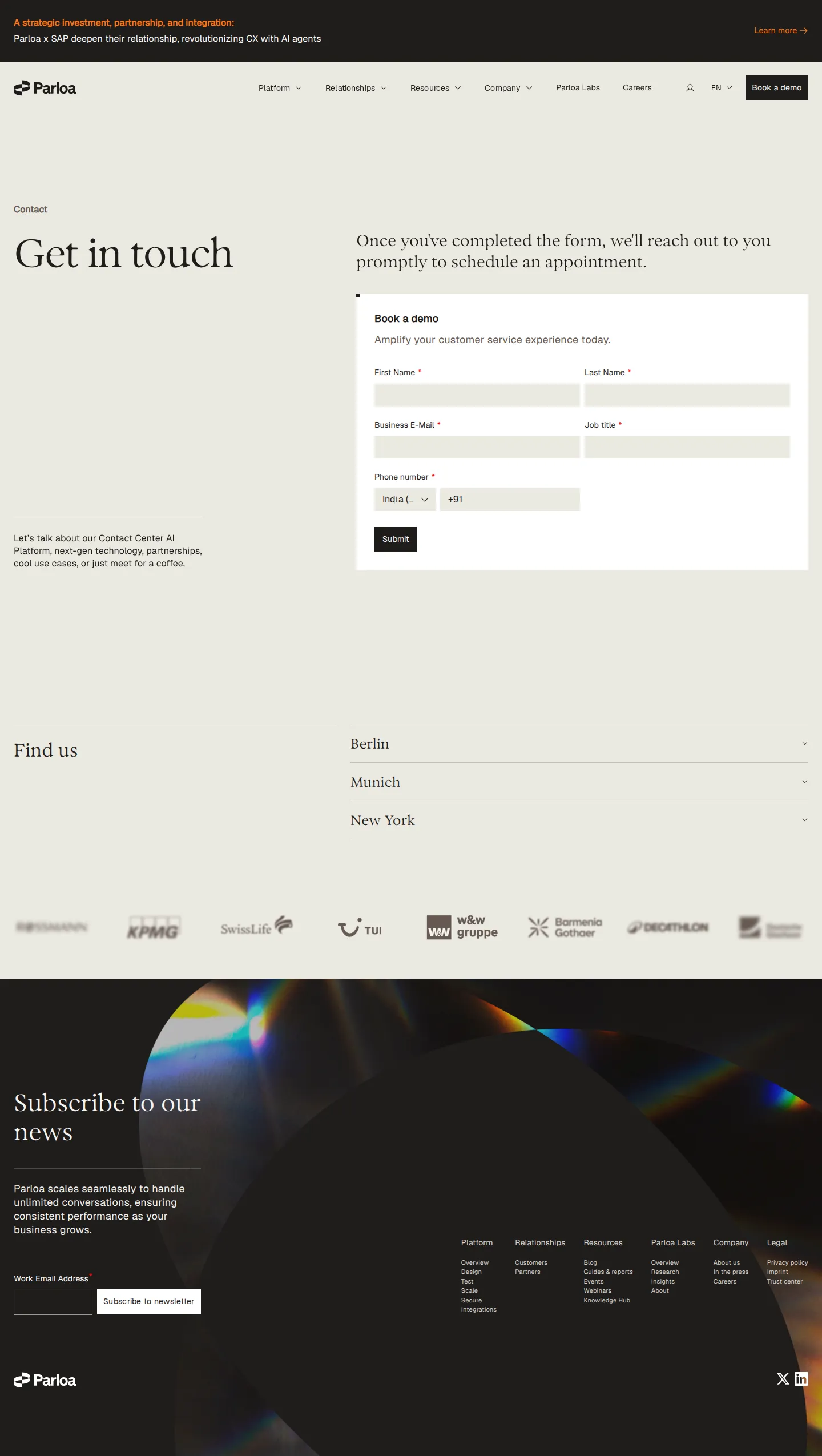
Parloa publishes no prices on its own site. There is no public pricing page (the /pricing path 404s), no plan tiers, no per-minute rate card, and no free tier. The only pricing-intent surface on parloa.com is a “Book a demo” / “Contact sales” form. Pricing is therefore sales-led and quote-only, structured as a negotiated annual enterprise contract rather than a self-serve subscription. This places Parloa among the most fully gated vendors in the contact-center AI corpus, in the same sales-led pricing camp as Sierra and Decagon.
What we can recover is a third-party indicative floor. Multiple independent reviews — eesel AI’s Parloa pricing guide, Synthflow’s Parloa review, Zeeg, and Software Finder — converge on a minimum of roughly $300,000 per year, with average contract value above $350,000, excluding implementation and professional services. These are indicative figures from resellers and review sites, not a first-party Parloa rate card, and should be treated as a directional anchor until a quote confirms them.
The model dimensions that can be inferred from the platform are:
- Usage-based, conversation-volume metering. The platform is built to “handle unlimited conversations” across phone, chat, and messaging, so the value metric is consumption — voice/agent minutes and per-interaction resolution — rather than seats. This aligns it with pure usage-based pricing and the broader usage-based pricing playbook.
- Enterprise commitment. A sales-led motion at this customer size wraps usage in an annual commitment or platform fee; the ~$300K/yr floor is consistent with that structure. A financing partnership with Capchase further suggests large, upfront annual contracts.
- No self-serve, no free tier. Every prospect goes through the demo gate.
What makes this different: Parloa frames the product around an agent lifecycle, not a plan ladder — there is nothing for a buyer to compare on a pricing page, so the entire pricing conversation happens in the sales motion. Any specific number remains third-party indicative until a quote confirms it.
Pricing by product
Parloa exposes a single product — the AI Agent Management Platform (AMP) — and publishes no first-party price for it. The table below records what the company discloses (the value metric and the buying motion) plus the third-party indicative floor recovered from reseller and review sites. Every figure marked indicative is from third parties, not from Parloa.
AI Agent Management Platform (Enterprise)
| Tier | Price | Included | Key mechanics |
|---|---|---|---|
| Platform | ~$300K/yr min (indicative) | Full AMP: design, simulate/evaluate, deploy, and monitor AI agents across phone, chat, and messaging | Sales-led, quoted; usage-based on interaction volume |
| Book a demo | Contact sales | Custom scoping per use case, channels, and languages; SAP integration available | Only entry point — no self-serve, no free tier |
The ~$300K/yr figure (>$350K average contract value) is third-party indicative — reported consistently by eesel, Synthflow, Zeeg, and Software Finder — and excludes implementation and professional services. Parloa itself publishes neither the unit nor the rate. Value-metric signals from the platform page: the product is built to “handle unlimited conversations” and to “scale seamlessly as your business grows,” spanning phone, messaging, chat, click-to-call, and multimodal channels with model orchestration and BYO STT / TTS / LLM. That consumption surface — voice/agent minutes and per-interaction resolution — is what a usage-based contract meters, but the per-unit rate stays sales-gated.
Sales motions across products: sales-led for the entire AI Agent Management Platform; there is no PLG or self-serve tier.
Hidden costs : what a sales-gated quote can hide
Because Parloa publishes no first-party rates, the biggest hidden cost is the lack of price transparency itself: a buyer cannot model spend before entering the sales process. The third-party indicative floor — ~$300K/yr minimum, >$350K average contract value — is also the headline hidden cost, because that figure excludes the implementation, professional-services, and integration fees that review sites repeatedly flag as extras on top of the platform license. With a usage-based contact-center model, the recurring bill is driven by conversation volume (voice/agent minutes and per-interaction resolution), so peak-season call spikes, multichannel expansion, and multilingual coverage all push spend above the floor.
Archetype A: a mid-market voice deployment near the entry floor
A contact center automating a single voice line at the entry tier. The platform license is third-party indicative; per-unit overage is sales-gated.
| Line item | Annualized cost |
|---|---|
| Platform license / annual commitment (indicative) | ~$300,000 (third-party) |
| Implementation + professional services (extra) | unknown (flagged as add-on) |
| Voice/agent minutes overage beyond commitment | unknown (usage-metered) |
| Total | ~$300K+ (indicative floor) |
Archetype B: a large enterprise scaling multichannel
A large brand running voice plus chat and messaging across multiple languages, where average contract value sits above the floor.
| Line item | Annualized cost |
|---|---|
| Platform / annual commitment (indicative ACV) | >$350,000 (third-party) |
| Multichannel expansion (chat + messaging) | unknown (usage-metered) |
| Multilingual + higher interaction volume | unknown (usage-metered) |
| Integration + professional services | unknown (flagged as add-on) |
| Total | >$350K (indicative ACV) |
The lesson: the ~$300K floor is only the starting point — implementation fees and volume-driven overage sit on top, and none of those rates are published, so the full bill is discoverable only through the sales process.
Want to estimate a contact-center AI bill? Use the Parloa pricing calculator to model monthly cost once usage rates are known, and see our usage-invoicing and billing-cycles guide for how consumption contracts are structured.
Pricing evolution : a model that has never published a list price
Parloa has never published a list price, so there is no list-price history to track. What has changed is the product’s positioning — from conversational-AI phonebots to the agentic AI Agent Management Platform — and the company’s scale, which the funding record makes legible. The cadence below tracks those packaging and positioning shifts, not rate moves (there are none to observe).
Cadence
| Quarter | Price changes | Product / SKU additions | Notes |
|---|---|---|---|
| 2023 Q4 | 0 | 1 | Rebrand to a generative-AI contact-center platform (low-code frontend, augment-agents framing); still sales-gated. |
| 2025 Q2 | 0 | 1 | 2025-05-06 — $120M Series C ($1B valuation); “AI Agent Management Platform” (AMP) positioning launched. |
| 2026 Q1 | 0 | 0 | 2026-01-15 — $350M Series D ($3B valuation) on $50M+ ARR; go-to-market stays fully sales-gated. |
| 2026 Q2 | 0 | 0 | 2026-06-07 — confirmed fully sales-gated, quote-only; /pricing 404s; ~$300K/yr indicative floor (third-party). |
Tracked range: 2021–2026 (Wayback). No public pricing page has ever been observed in any snapshot, so all “price changes” are 0; the changes that occur happen inside negotiated contracts.
Notable changes
- 2021–2023 — Parloa positioned as a “Conversational AI platform” (phonebots, website chatbots, Messenger chatbots, Alexa Skills, Google Actions); contact-form gate from the start, no public price.
- 2023-12 — Rebranded around generative AI and a low-code contact-center frontend; still no rate card.
- 2025-05-06 — $120M Series C at a $1B valuation; AMP (AI Agent Management Platform) launched as agentic AI for enterprise contact centers (Parloa press, BusinessWire).
- 2026-01-15 — $350M Series D at a $3B valuation on $50M+ ARR, tripling valuation in eight months (TechCrunch, 2026-01-15).
- 2026-06-07 — Live capture confirms no public pricing page, no plan tiers, no per-minute rate card; third-party reviews put the floor at ~$300K/yr.
What’s unique : lifecycle framing instead of a plan ladder
1. There is no pricing page at all. Even the /pricing path 404s. Parloa is among the most fully gated vendors in the contact-center AI corpus — the entire pricing conversation happens inside the sales-led motion, with nothing for a buyer to self-compare. The only price signal is third-party (~$300K/yr floor), not first-party.
2. A high entry floor as a positioning filter. At a ~$300K/yr minimum and >$350K average contract value, Parloa effectively prices out SMB and self-serve buyers by design, concentrating on large-enterprise accounts. The gating and the floor work together: there is no cheap on-ramp, so only buyers with a top-down mandate to replace legacy IVRs enter the funnel.
3. The product is sold by agent lifecycle, not by tier. Parloa frames its platform around Design and Integrate, Test and Iterate, Deploy and Scale, and Monitor and Improve — an operational lifecycle rather than a Good/Better/Best ladder. This reinforces a consultative, usage-based sale.
4. SAP as a strategic investor and integration partner. The platform is positioned for deep enterprise CX integration, which biases the model toward large, negotiated accounts over self-serve adoption — and a $3B valuation on $50M+ ARR signals investors are betting on enterprise land-and-expand, not volume.
Strengths & weaknesses
| Strengths | Weaknesses |
|---|---|
| Usage-based model aligns cost to actual conversation volume | Zero public price transparency — no rate card, no tiers, no calculator |
| Enterprise-grade compliance posture (GDPR, ISO 27001, SOC 2) | No free tier or self-serve trial; every buyer must enter the sales motion |
| Strong enterprise logos (Decathlon, Swiss Life, TUI, Allianz) + SAP | High ~$300K/yr entry floor excludes SMB and mid-market on price |
| $3B valuation on $50M+ ARR signals strong enterprise traction | Buyers cannot benchmark spend before committing to a sales process |
| Multichannel (voice, chat, messaging) consumption surface | Per-unit rate is still gated; implementation/services are extra |
Billing UX : what a buyer interacts with before a quote
Because pricing is fully gated, the “billing UX” that a prospect encounters is a sales-intake experience, not a checkout or usage console. The named controls visible on the public surfaces are:
- “Book a demo” form — the primary pricing-intent surface. It collects First Name, Last Name, Business E-Mail, Job title, and Phone number (with country selector), then schedules an appointment. No pricing is shown before or after submission.
- “Contact Sales” call-to-action — repeated on the platform page (e.g. under “Why Parloa?”) as the route to a quote.
- “Book a Demo” closing CTA — a second demo prompt at the foot of the platform page (“Ready to turn conversations into lasting loyalty?”).
- Newsletter “Subscribe to our news” — an email-capture control, distinct from the demo gate, framed around the platform’s ability to “handle unlimited conversations.”
- Trust center — linked in the footer; relevant to enterprise procurement (the platform advertises GDPR, ISO 27001, and SOC 2 compliance), which typically gates the security review that accompanies a negotiated contract.
There is no public usage dashboard, no billing portal, no plan-selector, and no in-product pricing calculator exposed to non-customers — consistent with a quote-only enterprise model.
Strategic wins : where the gated model works in Parloa’s favor
1. Usage-based metering aligns price with delivered value
By tying cost to conversation volume rather than seats, Parloa lets enterprise buyers pay in proportion to the customer interactions automated — the natural value metric for a contact center. This is the usage-based pricing thesis applied to CX, and our analysis of the value-metric problem in AI pricing explains why volume-based metrics resonate with this buyer.
2. Sales-led gating fits a high-touch enterprise sale
For complex, multichannel contact-center deployments, a consultative sale lets Parloa scope per use case and protect margin. The sales-led pricing playbook is the right motion for this account size.
3. Compliance posture de-risks the enterprise procurement review
Advertising GDPR, ISO 27001, and SOC 2 compliance upfront clears the security review that typically stalls enterprise CX deals. Pairing that trust signal with the SAP integration story shortens the path from demo to negotiated contract — a dynamic we explore in our look at the outcome-based pricing revolution.
4. A high floor concentrates revenue in large, expandable accounts
By setting the entry contract at roughly $300K/yr, Parloa filters out low-value, support-heavy SMB accounts and focuses sales energy on enterprises that can land and expand. Tripling its valuation to $3B in eight months on $50M+ ARR suggests this concentration is paying off — the usage-based pricing for SaaS and AI thesis works best when each account has room to grow its consumption.
Areas to improve : where the gating costs Parloa pipeline
1. Publish at least a directional rate or “starting at” anchor
With zero public pricing, Parloa loses early-funnel buyers who self-disqualify or comparison-shop on price — and because reviewers have already published the ~$300K/yr floor, Parloa has ceded the framing of its own price to third parties. Publishing a directional “starting at” anchor itself (e.g. a representative per-minute or per-resolution range) would capture intent and let Parloa control the narrative — see our guide to usage-based pricing for SaaS and AI and the broader usage-based pricing guide.
2. Offer a self-serve sandbox or pilot tier
A low-friction pilot would let CX teams validate agent quality before committing to the full sales process, shortening the consultative cycle. This mirrors how developer-first vendors use free tiers to seed adoption — see our guide to choosing the right usage metric.
3. Publish the value metric explicitly
Even without rates, naming the meter (e.g. voice minutes vs. resolved interactions) would let buyers reason about cost drivers before the sales call. Ambiguity around the unit forces a discovery conversation that some early-funnel buyers will avoid entirely.
Monetization stack & signals : how Parloa builds & buys its revenue engine
Buys 5 Builds 0 3 signal roles
Buys its monetization systems of record (Salesforce CRM, SAP invoicing & rev-rec, Rocketlane PS, Gong, Databricks) and builds only the GTM-automation layer on top — a textbook sales-led quote-to-cash spine. The signal worth watching is the Senior Value Consultant hire below: Parloa monetizes via CFO-grade ROI cases, so price is negotiated against per-deal value, not a published meter.
-
“Own PS demand forecasting in Salesforce: pipeline signals and services attach rates... Own the integration layer between Salesforce, Rocketlane, SAP, Jira, and reporting tools”
- SAP Revenue recognition Job post Jun 2026
“Manage invoicing workflows and revenue recognition accuracy in SAP; flag and resolve discrepancies proactively”
-
“Own resource planning and allocation in Rocketlane - ensure the right people are on the right projects... Co-own design of project health and hygiene in Rocketlane: milestone tracking, status updates, budget vs. actuals”
-
“Our Sales Tech-stack: LinkedIn Sales Navigator, Gong Engage, Salesforce, Clay, Nooks, Notion, Asana”
- Databricks Data platform Job post Jun 2026
“Own the Internal-facing Databricks workspace end-to-end: configuration, compute, access controls, and cost management”
- Metering Metering inferred
- Senior Value Consultant Monetization seen Jun 22, 2026
Parloa staffs dedicated value engineering — not packaging — to justify its gated ~$300K/yr deals: it sells outcomes (cost reduction, deflected interactions) via CFO-grade ROI models, so the 'price' is negotiated against a per-deal business case, not a rate card.
“Build robust, CFO-grade ROI models that quantify impact across cost reduction, productivity, revenue, and customer experience... shaping value narratives for positioning, pricing, and expansion”
- Operations Manager, Solution Engineering & Services RevOps seen Jun 22, 2026
The quote-to-cash spine is bought, not built: Salesforce (CRM/forecasting) + Rocketlane (PS delivery) + SAP (invoicing & rev-rec) stitched by a BizOps hire. Classic sales-led enterprise plumbing for a quote-only model.
“Own the integration layer between Salesforce, Rocketlane, SAP, Jira... Manage invoicing workflows and revenue recognition accuracy in SAP”
- GTM Engineer RevOps seen Jun 22, 2026
Above the bought QTC stack, Parloa builds bespoke GTM automation in-house (TypeScript/Node/Python + Claude/Cursor) rather than buying RevOps SaaS — the revenue-operations layer is a build, the systems of record beneath it are a buy.
“This is not a role focused on configuring SaaS tools... You will design and build custom solutions from the ground up that directly improve how GTM operates across the full lifecycle... from lead flow through customer expansion”
3 more matched roles — supporting evidence
- Senior Strategic Engagement Manager Monetization seen Apr 24, 2026
- Sr Partner Success Manager Monetization seen Apr 24, 2026
- Senior Enterprise Engagement Manager Customer success seen Mar 30, 2026
Signals reviewed · derived from public job posts
Job postings fill and close over time — once a posting is filled we keep it as a dated citation (the quoted evidence remains); use View open roles for current listings.
Key takeaways
- Full gating is a deliberate choice, not an omission. Parloa exposes no first-party price anywhere — but third-party reviewers have filled the vacuum with a ~$300K/yr floor, so gating controls the buyer journey without truly hiding the number. Teams choosing this trade pipeline breadth for deal control.
- Lifecycle framing replaces the plan ladder. Selling by Design/Test/Deploy/Monitor avoids tier anchoring and supports a consultative, usage-based AI sale.
- Usage metering suits volatile contact-center volume. Conversation-volume billing flexes with call traffic better than seat licenses.
- Enterprise compliance is part of the pricing surface. GDPR/ISO 27001/SOC 2 posture is what unlocks the procurement review that precedes a quote.
- Strategic-investor integrations (SAP) reinforce the enterprise-only motion. Deep platform integrations bias the model away from self-serve.
UBP implications
- Usage-based does not require public rates. Parloa shows a vendor can run a consumption model entirely behind sales, metering conversation volume without ever publishing a unit price.
- The value metric can be implied by the product, not the price page. A “handle unlimited conversations” product framing signals volume-based metering even when no rate is shown.
- Gating shifts price discovery into the deal — but not entirely. When the meter is voice minutes and resolutions, buyers must model spend with the vendor, yet review sites still surface an indicative floor (~$300K/yr). This raises the bar for tools like pricing calculators and for the sales-led pricing playbook to recover and structure those rates.
Sources
- Parloa contact / book-a-demo page (accessed 2026-06-07)
- Parloa AI Agent Management Platform overview (accessed 2026-06-07)
- Parloa homepage (accessed 2026-06-07)
Want to compare Parloa against other contact-center AI pricing? Browse the pricing blueprint.
Bottom line
Parloa runs one of the most fully gated pricing models in the contact-center AI corpus: no price page, no tiers, no free trial — just a “Book a demo” form in front of a usage-based, conversation-volume contract negotiated per enterprise account. The value metric (voice minutes, per-interaction resolution) is legible from the platform, and while Parloa publishes no first-party rate, independent reviews converge on a ~$300K/yr minimum (>$350K average contract value) excluding implementation. Treat that as a directional floor, not a quote — the per-unit rate and the real all-in bill are still discoverable only through sales.
Want to compare Parloa against other contact-center AI pricing? Browse the pricing blueprint.
Pricing timeline : Major events on a vertical axis
Each milestone below corresponds to a public pricing change, product launch, or material adjustment. Major events use a filled marker; minor adjustments use a faded one.
Sales-gated, quote-only — ~$300K/yr indicative floor (third-party)
Parloa exposes no public pricing page (the /pricing path 404s); the only surface is a 'Book a demo' form. Multiple independent third-party reviews (eesel, Synthflow, Zeeg, Software Finder) converge on a ~$300K/yr minimum and >$350K average contract value, metered on interaction volume. These figures are third-party indicative — Parloa publishes no first-party rate.
Series D ($350M, $3B valuation) on $50M+ ARR
Parloa raised a $350M Series D led by General Catalyst, tripling its valuation to $3B in eight months on more than $50M ARR. The go-to-market remained fully sales-gated; no public price table was added.
Series C ($120M, $1B valuation) — AMP positioning
Parloa raised a $120M Series C at a $1B valuation (Durable Capital, Altimeter, General Catalyst), launching the 'AI Agent Management Platform' (AMP) as agentic AI for enterprise contact centers. Revenue had quadrupled since the 2024 ~$66M Series B. Pricing stayed sales-led and quote-only.
Rebrand to generative-AI contact-center platform
The site shifts to an 'award-winning AI platform' framing built around generative AI, a low-code frontend, and augmenting agents — a heavier enterprise-CX pitch. Pricing remains entirely gated behind 'Contact Sales'; still no public rate card.

Conversational AI / phonebot era — sales-gated from the start
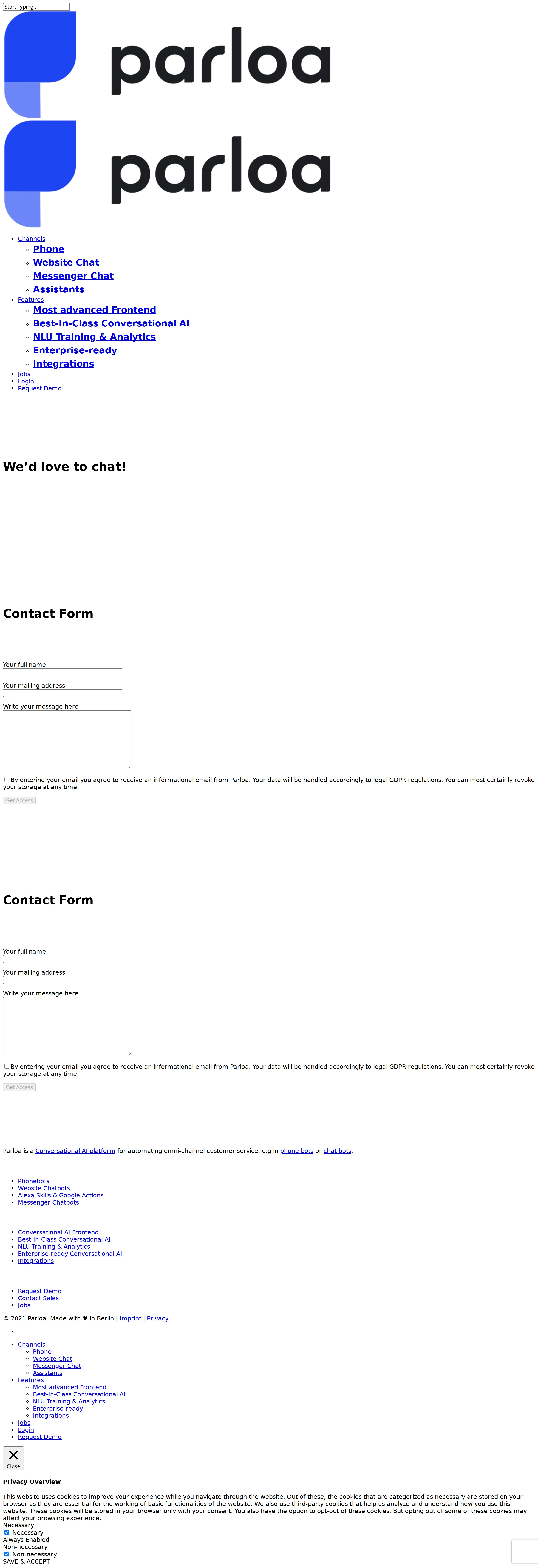
Wayback snapshots show Parloa positioned as a 'Conversational AI platform for automating omni-channel customer service' — phonebots, website chatbots, Messenger chatbots, even Alexa Skills and Google Actions. No price was ever published; the only surface was a 'Get in touch' / 'Get Access' contact form.
- · Parloa publishes no price table anywhere on its site — even the /pricing path 404s. Multiple third-party reviews put the minimum enterprise contract at roughly $300,000 per year, with average contract value above $350,000, making it one of the most expensive and most fully gated vendors in the contact-center AI corpus.
- · Parloa tripled its valuation in eight months: a $120M Series C at a $1B valuation in May 2025, then a $350M Series D at a $3B valuation in January 2026, on $50M+ ARR and revenue that quadrupled since its 2024 Series B.
- · Parloa started in 2018 as a 'Conversational AI' phonebot/chatbot platform — its 2021 site even advertised Alexa Skills and Google Actions — before rebranding the product into the 'AI Agent Management Platform' (AMP) for agentic contact centers.
Questions & answers
- How much does Parloa cost?
- Parloa publishes no prices — pricing is sales-led and quote-only. Multiple independent third-party reviews put the minimum enterprise contract at roughly $300,000 per year, with average contract value above $350,000, before implementation and professional services. Those figures are indicative; Parloa discloses no first-party rate card.
- Does Parloa have a free tier or self-serve signup?
- No. There is no free tier, no free trial, and no self-serve signup. The only entry point is a 'Book a demo' contact form, and contracts are negotiated with the sales team.
- What does Parloa charge for — what is the value metric?
- Parloa's platform automates contact-center conversations, so the model is usage-based and metered on interaction volume — voice minutes and per-interaction resolution across phone, chat, and messaging. The exact unit and per-unit rate are not published; cost scales with volume, complexity, and integrations.
- Is Parloa aimed at small businesses or enterprises?
- Parloa targets large enterprises and mid-market contact-center operations. Its customers include Decathlon, Swiss Life, TUI, KPMG, Allianz, and Booking.com, and SAP is a strategic investor and integration partner.
- How big is Parloa and how much funding has it raised?
- Parloa was founded in 2018 in Berlin by Malte Kosub and Stefan Ostwald. It raised a $120M Series C at a $1 billion valuation in May 2025 and a $350M Series D at a $3 billion valuation in January 2026, on more than $50 million in annual recurring revenue.