AI Summary
About
Pipedream is a developer-first workflow-automation and integration platform. It lets engineers build event-driven workflows that connect 3,000+ integrated apps, run arbitrary Node.js, Python, Go, or Bash code between steps, and expose those workflows as APIs, schedules, or webhook handlers. Its self-serve, code-friendly positioning places it between low-code automation tools (Zapier, Make) and raw serverless platforms — it markets itself to the million-plus developers who want programmability without managing infrastructure.
The product has two faces. The core is workflow automation: hosted, event-driven pipelines billed on compute. The second is Pipedream Connect, a managed-authentication and tool-execution layer that developers embed in their own applications and AI agents — handling OAuth for end users and exposing 10,000+ pre-built tools, an API proxy, and deployable MCP servers. Connect is sold as its own plan tier, reflecting a deliberate move to monetize Pipedream as embeddable infrastructure for agentic products, not just a standalone automation console.
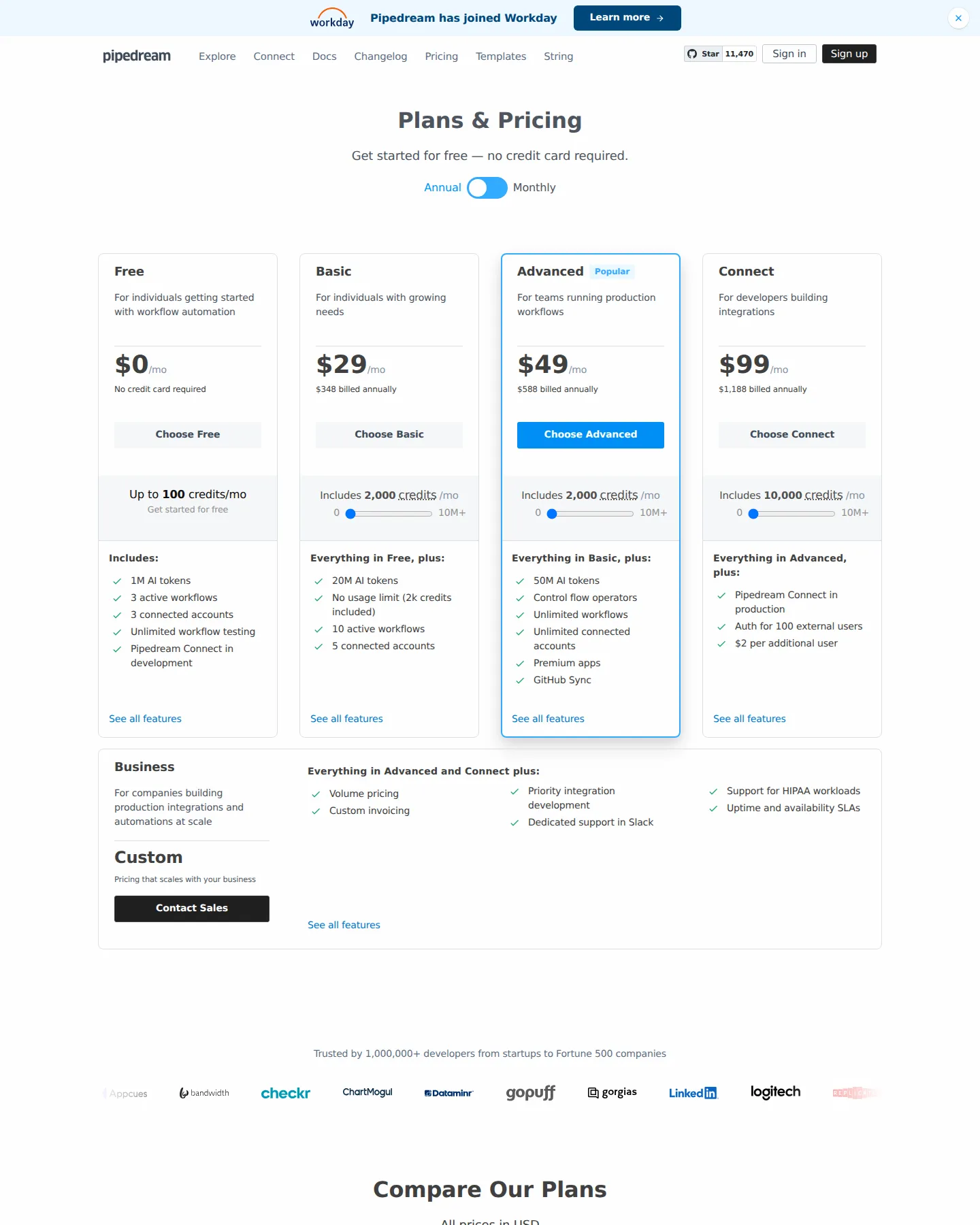
Pipedream operates out of San Francisco and reports being trusted by 1,000,000+ developers from startups to Fortune 500 companies. The company was acquired by Workday (the “Pipedream has joined Workday” banner sits atop the live pricing page as of June 2026), folding a usage-priced, developer-led automation and embeddable-integration platform into a large enterprise HR and finance suite. Notably, the acquisition has not (yet) collapsed Pipedream’s self-serve pricing: the public Free → Business tiers, the credit meter, and the embeddable Connect product all remain live and unchanged. For the live pricing surface this blueprint analyzes, see Pipedream’s pricing page.
Pricing summary : credit-metered compute under a tiered subscription
Pipedream runs a hybrid pricing model: a tiered recurring subscription on top of credit-based billing for compute. Each plan bundles a monthly credit allowance, and credits deplete as workflows run — one credit covers 30 seconds of execution at the default 256MB of memory, so cost tracks duration and memory, not step count. A separate, bundled AI-token allowance (1M to 50M tokens/mo) covers built-in AI actions, layering a second token-based meter on top of the credit meter. The free tier converts via product-led, self-serve sign-up; the top Business tier is sales-led.
The model has these dimensions:
- Plan fee — five tiers: Free ($0), Basic ($29/mo annual, $45/mo monthly), Advanced ($49/mo annual, $74/mo monthly), Connect ($99/mo annual, $150/mo monthly), and Business (custom).
- Included credits/mo — 100 (Free, hard-capped) · 2,000 (Basic) · 2,000 (Advanced) · 10,000 (Connect) · Custom (Business). Paid plans remove the usage cap; the Free plan stops at 100.
- Included AI tokens/mo — 1M (Free) · 20M (Basic) · 50M (Advanced) · 50M (Connect) · Custom (Business), for built-in AI steps.
- Embedded-integration seats — the Connect tier authenticates 100 external end-users and charges $2 per additional external user.
- Capacity limits — active workflows (3 → unlimited), connected accounts (3 → unlimited), max memory (up to 10GB), and max execution duration (300s on Free, 750s on paid) all step up by tier.
What makes this different: the meter is compute time × memory expressed as credits, decoupled from both invocation count and workflow complexity — a developer can chain 50 steps and pay the same as a single long-running step, because only elapsed compute matters. Pipedream also splits its embeddable “Connect” product into its own paid tier, monetizing the auth-and-tools layer that powers other companies’ AI agents.
Pricing by product
Workflow automation (Individual plans)
| Tier | Price | Included | Key mechanics |
|---|---|---|---|
| Free | $0/mo | 100 credits/mo (hard cap), 1M AI tokens, 3 active workflows, 3 connected accounts, up to 300s execution | No credit card; usage stops at the 100-credit cap |
| Basic | $29/mo annual ($45 monthly) | 2,000 credits/mo (no usage cap), 20M AI tokens, 10 active workflows, 5 connected accounts | Entry paid step; “$348 billed annually” |
Workflow automation (Team plans)
| Tier | Price | Included | Key mechanics |
|---|---|---|---|
| Advanced | $49/mo annual ($74 monthly) | 2,000 credits/mo (no usage cap), 50M AI tokens, unlimited workflows & connected accounts | Most popular tier; adds control-flow operators, premium apps, GitHub Sync; “$588 billed annually” |
| Business | Custom | Everything in Advanced + Connect, plus volume pricing | Sales-led; HIPAA, SOC 2 Type II, GDPR, SSO, VPCs, SCIM, custom contract/invoicing, SLAs |
Pipedream Connect (embeddable integration product)
| Tier | Price | Included | Key mechanics |
|---|---|---|---|
| Connect | $99/mo annual ($150 monthly) | 10,000 credits/mo, Pipedream Connect in production, managed auth for 100 external users, 10k pre-built tools, API proxy, deployable MCP servers | $2 per external user beyond 100; sold as embeddable infra for apps and AI agents; “$1,188 billed annually” |
Sales motions across products: PLG / self-serve for Free, Basic, Advanced, and Connect (sign up and pay online); sales-led for Business (custom quote, contract, and invoicing).
Hidden costs : What Pipedream users actually pay
The sticker price on a Pipedream plan is rarely the full bill, because the plan fee buys a credit allowance, not unlimited compute. Three things quietly move your real cost above the headline number: metered credit overages once you exhaust the included pool, AI-token consumption beyond the bundled allowance, and per-external-user charges on the Connect tier.
The trap most teams hit is that credits are billed on compute time × memory, not per run. A workflow that polls an API every minute and runs for 20 seconds at 256MB looks cheap, but bump the memory to 2GB to handle a large payload and the same 20 seconds now burns ~8× the credits. Because development and testing are free, the credit burn only shows up once a workflow is live and firing on real volume — so the bill arrives a step removed from the moment you built the thing.
Here is what a representative team actually pays on the Advanced plan ($49/mo annual, 2,000 included credits, 50M AI tokens):
| Line item | Monthly cost |
|---|---|
| Advanced base plan (annual billing) | $49 |
| Credit overage (above 2,000 included; metered, no hard cap) | Usage-dependent |
| Additional AI tokens (above 50M bundled) | Usage-dependent |
| Estimated floor (light usage within allowances) | $49 |
A few cost notes:
- No overage rate on the rate card. The pricing page advertises included credits and “no usage limit” on paid tiers but does not publish a per-credit overage price — additional credits and additional AI tokens are metered (“Use additional AI tokens” is a feature row), so true overage cost is visible only inside the usage dashboard, not the public page.
- Connect adds per-user cost. The Connect tier ($99/mo annual) bundles managed auth for 100 external end-users; beyond that it is $2 per additional external user — a real per-seat-style line item that scales with your customers, not your team.
- Annual lock-in is the cheaper path. Switching from monthly to annual saves $192 (Basic), $300 (Advanced), and $612 (Connect) per year — the monthly convenience premium is roughly 50%.
Want to estimate your own Pipedream bill? Use the Pipedream pricing calculator to model your costs based on usage patterns.
Pricing evolution : Pipedream pricing history and changes
Pipedream’s pricing has evolved through one defining structural shift: a move away from pure consumption pricing (early Pipedream metered raw “invocations” and compute seconds) toward the current credit + tier model that normalizes compute time × memory into a single credit unit. The other landmark is corporate, not commercial — the Workday acquisition — which has so far left the rate card untouched.
Cadence
| Period | Price changes | Product / SKU additions | Notes |
|---|---|---|---|
| ~2024–2025 | Restructure | Credit-metered model | Compute meter normalized to credits (1 credit = 30s @ 256MB) |
| 2025 (H2) | 0 | Connect tier | Embeddable managed-auth + 10k-tool product carved into its own $99/mo plan |
| 2025 (H2) | 0 | 0 | Pipedream acquired by Workday; self-serve pricing left intact |
| 2026 Q2 | 0 | 0 | Rate card verified live: Free/Basic $29/Advanced $49/Connect $99/Business custom |
Tracked range: 2024–present. Earlier per-invocation pricing predates the current credit model.
Notable changes
- ~2024–2025 — Shift from raw consumption (invocations / compute-seconds) to the credit meter, where one credit covers 30 seconds of execution at the default 256MB and scales with memory. This made cost predictable per-unit while keeping it usage-based.
- 2025 — Pipedream Connect carved out as a distinct paid tier ($99/mo annual), monetizing the managed-authentication and 10,000-tool layer that powers embedded integrations and AI agents — a deliberate productization of infrastructure other companies build on.
- 2025 — Acquired by Workday. The standalone developer pricing (Free → Business), the credit meter, and Connect all remained live and unchanged through the transition.
- 2026-06-16 — Live rate card verified: Free $0 (100 credits, hard cap), Basic $29/mo, Advanced $49/mo, Connect $99/mo (all annual), Business custom; month-to-month $45/$74/$150.
What’s unique : Pipedream’s distinctive pricing mechanics
1. The meter is compute time × memory, not invocations or steps. Most automation tools charge per task, per run, or per step — Zapier counts “tasks,” Make counts “operations.” Pipedream instead bills a single credit = 30 seconds at 256MB, and memory scales it linearly. A developer can chain 50 steps into one workflow and pay the same as a single long step, because only elapsed compute matters. This rewards efficient code and punishes long-running or memory-hungry workflows — a pricing shape that looks far more like a serverless platform (Lambda’s GB-seconds) than like a no-code automation tool.
2. Connect is a product sold as a pricing tier. Pipedream took the managed-authentication and tool-execution layer that powers embedded integrations — OAuth for your end users, 10,000+ pre-built tools, an API proxy, deployable MCP servers — and made it its own $99/mo plan with a per-external-user meter ($2 beyond the first 100). Few competitors price the embeddable-infrastructure use case as a distinct SKU; most bury it in enterprise. This is a bet that AI-agent builders will pay for auth-and-tools as a primitive.
3. Bundled AI tokens as a second, separate meter. On top of the credit meter, every tier bundles an AI-token allowance (1M → 50M/mo) for built-in AI steps, with additional tokens metered separately. Pipedream is effectively reselling model inference inside the workflow product, layering a token meter on a credit meter — two usage dimensions in one bill, each with its own included allowance.
Strengths & weaknesses
| Strengths | Weaknesses |
|---|---|
| Generous, genuinely usable free tier (100 credits, 1M AI tokens, 3 workflows) — no credit card, real product-led entry | Credit overage rate is not published on the rate card; true cost above the included pool is only visible in the usage dashboard |
| Low, transparent paid entry points ($29 / $49 / mo) versus per-task automation tools that escalate fast on volume | The compute-time × memory meter is harder for non-developers to predict than a simple per-task count |
| Step-count-independent pricing rewards complex, multi-step workflows — bundle 50 steps for the price of the compute they use | Two stacked meters (credits + AI tokens) plus connected-account and external-user limits make the bill multi-dimensional |
| Annual billing is materially cheaper (~33–50% off monthly), and the discount is shown inline as concrete dollar savings | Memory-scaled credits can produce surprise burn when a workflow is bumped to higher RAM for large payloads |
| Connect productizes embeddable auth + 10k tools as a clean, separately priced SKU for AI-agent builders | Workday acquisition introduces medium-term uncertainty about whether self-serve pricing survives long-term |
Billing UX : credit allowances, usage dashboards, and invoicing controls
- Annual / Monthly billing toggle — the pricing page exposes a switch between annual and month-to-month billing; annual is the default and is materially cheaper (Basic $29/mo vs $45/mo, Advanced $49/mo vs $74/mo, Connect $99/mo vs $150/mo).
- Credit allowance + included-credits slider — each plan card shows the included monthly credits (100 → 10,000) on a 0-to-10M+ usage slider, signaling that paid plans meter additional usage above the included pool rather than hard-stopping.
- Free-tier hard cap — the Free plan enforces a 100-credit/month usage cap (no overage), an explicit guardrail against runaway spend for non-paying accounts.
- Usage breakdown view — Pipedream’s FAQ confirms a per-account usage breakdown (“Where can I see a breakdown of my usage?”) so customers can attribute credit and token consumption.
- Invoicing and payment options — paid plans bill by credit/debit card by default; the Business tier adds pay-by-invoice, pay-by-bank-transfer, custom invoicing, and the ability to edit billing email, VAT, and company details tied to invoices.
- Event History retention — execution/event history is retained 7 days (Free/Basic), 30 days (Advanced/Connect), and custom (Business), governing how far back users can inspect billed activity.
Strategic wins : Why Pipedream’s pricing decisions worked
1. Picking compute, not tasks, as the value metric
By metering on compute time × memory rather than per-task, Pipedream aligned its pricing with what it actually pays for (hosted execution) and with how developers think about cost (serverless GB-seconds). This neutralizes the biggest objection to no-code automation tools — that complex multi-step workflows get expensive fast — and lets power users build elaborate pipelines without watching a task counter. It is a textbook case of choosing a value metric that scales with the customer’s value, not their headcount. See usage-based pricing strategy for the framework.
2. A free tier built to convert, not just to demo
The Free plan is unusually complete: 100 credits, 1M AI tokens, 3 live workflows, and unlimited testing, with no credit card. That is enough to ship a real automation, which makes the upgrade to Basic ($29) a natural step once you outgrow the credit cap or need a fourth workflow — classic product-led growth sequencing. The hard 100-credit cap on Free (the only tier with a cap) is the deliberate friction that triggers the upgrade.
3. Productizing the infrastructure layer as Connect
Carving managed auth + 10,000 tools into a standalone $99/mo Connect tier turns a feature into a revenue line and positions Pipedream as embeddable infrastructure for the wave of AI-agent products — exactly the outcome of agent-driven demand other tooling vendors are chasing. The $2-per-external-user meter lets that revenue scale with the customer’s own user base.
Areas to improve : Gaps in Pipedream’s pricing approach
1. Publish the credit overage rate
The page advertises included credits and “no usage limit” on paid tiers, but the actual per-credit (and per-extra-AI-token) overage price is not on the rate card — you only see it once you’re inside the dashboard and consuming. For a usage-priced product, leaving the marginal rate off the public page is the classic setup for bill shock and cost unpredictability. A simple “additional credits: $X / 1,000” line would let buyers self-model.
2. Give buyers a credit-to-dollars estimator
Because a credit is an abstract compute-time × memory unit, most prospects cannot translate “2,000 credits” into “how many workflow runs will that cover for me.” A worked example or an on-page estimator (“a 10-second, 256MB workflow run = ~1/3 credit”) would close the gap between the abstract meter and a real-world bill — the same predictability problem covered in choosing the right usage metric.
3. Clarify the post-acquisition pricing roadmap
With Workday now the owner, self-serve customers have no public signal on whether the Free tier, the credit meter, or month-to-month billing will persist, or whether pricing will migrate toward enterprise contracts. A short commitment statement would reduce the churn risk that uncertainty creates for the developer base that drove Pipedream’s adoption.
Monetization stack & signals : how Pipedream builds & buys its revenue engine
Buys 0 Builds 1
Builds its own meter: the "1 credit = 30s @ 256MB" unit is a first-party primitive in Pipedream's docs, not a bought metering vendor, sold self-serve. The live signal is corporate — Workday's definitive agreement to acquire it (Nov 2025, expected close Jan 2026) — and the open question is whether that self-serve meter survives the move into a sales-led enterprise suite.
Signals reviewed · derived from press & filings, product docs
Key takeaways
- Pipedream prices compute, not tasks. The core meter is a credit = 30 seconds of execution at 256MB, scaling with memory — so cost tracks duration and RAM, never step count or number of runs alone. This is serverless-style pricing wearing an automation-tool UI.
- The tiers are an allowance wrapper around the meter. Free $0 (100 credits, hard cap), Basic $29/mo (2,000), Advanced $49/mo (2,000 + unlimited workflows), Connect $99/mo (10,000), Business custom — each plan fee buys an included credit pool plus a bundled AI-token allowance, with metered overage above it.
- Connect monetizes embeddable infrastructure. Auth for end users + 10,000 tools + MCP servers are sold as a $99/mo tier with a $2-per-external-user meter — a clean example of turning a platform capability into its own priced SKU for AI-agent builders.
- Annual billing is the real price. Month-to-month carries a ~33–50% premium ($45/$74/$150 vs $29/$49/$99); Pipedream surfaces the savings as concrete dollar figures to steer buyers to commit.
- A complete free tier is the growth engine. The Free plan ships real workflows with no card; the 100-credit hard cap is the only deliberate friction, engineered to convert active users to Basic.
UBP implications
- Normalize your raw cost driver into one legible unit. Pipedream had at least three cost dimensions (time, memory, invocations) and collapsed them into a single “credit.” If your usage meter exposes multiple raw drivers, packaging them into one synthetic unit makes pricing comprehensible — but only if you also publish the conversion so buyers can self-model.
- An allowance-plus-overage hybrid de-risks usage pricing for buyers. Bundling a generous included pool into each tier gives customers a predictable floor while preserving usage upside. The lesson for UBP teams: the included allowance is your churn insurance; the metered overage is your expansion revenue.
- Productize the platform layer your customers already lean on. Connect shows that an embeddable capability (auth, tools, MCP) can become a separately priced tier rather than an enterprise feature buried in a contract — capturing the AI-agent buyer with a self-serve price point and a per-end-user meter that scales with their success.
Sources
- Pipedream pricing page (accessed 2026-06-16) — primary rate-card evidence (annual + monthly billing states)
- Pipedream pricing docs — credit definition (accessed 2026-06-16) — “one credit per 30 seconds of compute at 256MB (the default) per workflow segment,” memory-scaled
- Pipedream Connect docs (accessed 2026-06-16) — managed auth, 10k tools, MCP servers, per-external-user pricing
- Pipedream official website (accessed 2026-06-16) — “Pipedream has joined Workday” banner
Bottom line
Pipedream prices like a serverless platform dressed as an automation tool: a tiered subscription (Free $0 → Business custom) wrapped around a credit meter where one credit = 30 seconds of compute at 256MB, scaling with memory rather than step count. The Free tier is complete enough to ship real work, paid entry is cheap ($29–$49/mo), and the Connect tier turns embeddable auth-and-tools into its own $99/mo SKU for AI-agent builders. The model’s strengths — predictable per-unit cost, complexity-agnostic billing, a conversion-grade free tier — are partly offset by an unpublished overage rate and a credit unit that’s abstract for non-developers. The Workday acquisition leaves the rate card intact for now but adds long-term uncertainty for the self-serve base.
Want to compare Pipedream against other developer-tools and automation companies? Browse the pricing blueprint.
Pricing timeline : Major events on a vertical axis
Each milestone below corresponds to a public pricing change, product launch, or material adjustment. Major events use a filled marker; minor adjustments use a faded one.
Facts captured — credit-metered hybrid model, five tiers
Captured the live pricing page: Free $0, Basic $29/mo, Advanced $49/mo, Connect $99/mo on annual billing and Business custom, with credit-metered compute (1 credit = 30 seconds at 256MB, memory-scaled) plus bundled AI-token allowances. Month-to-month rates are $45, $74, and $150.
Pipedream joins Workday
Pipedream is acquired by Workday, folding a developer-led, credit-metered automation and embeddable-integration platform into Workday's enterprise HR and finance suite. The standalone self-serve pricing page and tiers remain live and unchanged at acquisition.
- · A Pipedream credit equals just 30 seconds of compute at 256MB of memory — so a workflow's cost depends on how long it runs and how much RAM it uses, not how many steps it has.
- · The Free plan's 100 credits/mo is a hard usage cap, but every paid plan removes the cap entirely — Basic and Advanced both include 2,000 credits with no overage ceiling.
- · The 'Connect' tier is a product, not just a plan: it sells Pipedream's managed-auth layer and 10,000-tool API to developers embedding integrations in their own apps, at $2 per external user beyond the first 100.
Questions & answers
- What is Pipedream's pricing model?
- Pipedream uses a hybrid model: a tiered subscription (Free, Basic, Advanced, Connect, Business) layered on credit-metered compute. Each plan includes a monthly credit allowance, and a credit equals 30 seconds of workflow compute at 256MB of memory.
- Does Pipedream offer a free tier?
- Yes. The Free plan is $0/mo and includes 100 credits per month (a hard usage cap), 1M AI tokens, 3 active workflows, and 3 connected accounts, with no credit card required.
- How much does Pipedream cost per month?
- On annual billing, Basic is $29/mo, Advanced is $49/mo, and Connect is $99/mo. On month-to-month billing the same plans are $45, $74, and $150 respectively. The Business plan is custom-quoted.
- What is a Pipedream credit?
- A credit is Pipedream's compute meter: one credit covers 30 seconds of workflow execution at the default 256MB of memory. Credits scale with execution duration and memory allocation, not with the number of steps in a workflow.
- What does the Pipedream Connect plan include?
- Connect ($99/mo annual, $150/mo monthly) is aimed at developers embedding Pipedream into their own apps. It includes Pipedream Connect in production, 10,000 credits/mo, managed authentication for 100 external users, and $2 per additional external user.