AI Summary
About
Poe is Quora’s multi-model AI chat aggregator: one app (and one subscription) that puts ChatGPT, Claude, Gemini, Grok, plus image, video, and audio models — and tens of thousands of user-built bots — behind a single login. Instead of juggling separate subscriptions to OpenAI, Anthropic, Google, and xAI, you pay Poe once and route each question to whichever model fits.
Poe is owned and operated by Quora, the Q&A company, which raised $75M from Andreessen Horowitz (announced 2023) largely to scale Poe. Poe’s reported revenue contribution roughly doubled from ~$30M in 2024 to ~$65M in 2026, making it Quora’s clearest AI-era growth engine. Poe launched the subscription in early 2023 and added creator monetization later that year.
The pricing question Poe answers is a real one: if you use several frontier models, paying for each provider separately is expensive and fragmented. Poe’s bet is that a single metered subscription — where a flat fee buys a pool of compute points you spend across every model — is simpler and, for mixed usage, cheaper.
For the most current information, visit Poe.
Pricing summary : How Poe’s pricing model works
Poe is subscription plus a shared compute-points meter — a hybrid model. You pick a monthly tier; that tier grants a compute-points allowance; every message, image, video, or audio generation spends points from that allowance at a rate that depends on the model you chose.
The ladder (USD, verified 2026-07-28):
- Free — ~300 compute points per day (about 15-30 short messages), lighter models only — cut roughly 90% from ~3,000/day since around March 2026 (Poe’s own help center no longer states an exact figure; the current number is independently corroborated by third-party trackers).
- $4.99/mo — 10,000 compute points per day (a daily allowance, not monthly).
- $19.99/mo — 660,000 compute points per month (the headline plan — cut from 1,000,000/month); $199.99/year (~$16.67/mo).
- $49.99/mo — ~1.65 million compute points per month.
- $99.99/mo — ~3.3 million compute points per month.
- $249.99/mo — ~8.25 million compute points per month (marketed “up to ~12.5M” in some regions/promos).
All paid plans are roughly 17% cheaper billed annually. The genius — and the catch — is that points map to model cost: a lightweight text model costs ~10–20 points per message, while frontier models cost hundreds to thousands, and image/video generations cost the most. So $19.99 stretches to tens of thousands of cheap messages or only a few hundred frontier-video generations.
What makes this different: Most AI apps sell either a flat “unlimited-ish” subscription (ChatGPT Plus) or raw per-token API billing. Poe sits in between: one flat fee, but metered access across many vendors’ models on a single currency. You never see a token bill, yet you still feel usage — when points run low you upgrade or buy more.
Pricing by product
| Tier | Price | Compute points | Best for |
|---|---|---|---|
| Free | $0 | ~300 points/day (~15-30 short msgs; down from ~3,000/day) | Trying multi-model AI |
| Starter | $4.99/mo | 10,000 points/day | Budget light users |
| Premium | $19.99/mo ($199.99/yr) | 660,000 points/mo (down from 1,000,000) | Daily multi-model users (headline plan) |
| Premium Plus | $49.99/mo | ~1.65M points/mo | Heavier multi-model use |
| Pro | $99.99/mo | ~3.3M points/mo | Power users / developers |
| Pro Max | $249.99/mo | ~8.25M points/mo | Maximum throughput, automation |
Add-on points (for users who exhaust their allowance, or API users) cost $30 per 1,000,000 points, with no transaction fees; add-on points are usable for one year and are non-refundable and non-transferable.
Beyond subscriptions, Poe runs a creator marketplace: bot creators set a per-message price (in points), users pay from their own points budget, and creators are paid in US dollars. Creators also earn up to $20 per new subscriber their bot brings in. An enterprise/business arrangement exists for organizations (custom, sales-quoted — not a public rate card).
Sales motions across products: self-serve / PLG for the entire consumer ladder — every tier is purchasable in-app with a card, no sales call. Enterprise is the only sales-led path.
Hidden costs : What Poe users actually pay
The headline $19.99/mo looks flat, but the real spend is governed by which models you use. Points are the hidden meter.
| Line item | Typical impact |
|---|---|
| Base plan (Premium) | $19.99/mo → 660,000 points/mo (cut from 1,000,000 points/mo) |
| Lightweight text chat (~10–20 pts/msg) | Tens of thousands of messages fit easily |
| Frontier model chat (hundreds–thousands pts/msg) | Burns the allowance far faster |
| Image / video generation (most expensive) | A handful can consume a large slice of the monthly pool |
| Add-on / extra points | $30 per 1M points, bought when allowance runs dry, or upgrade a tier |
| Real cost driver | Model mix, not message count |
The trap is that a single high-end video generation can cost more points than thousands of cheap text messages. Users who lean on image/video models or frontier reasoning models exhaust a million points faster than they expect and either upgrade or buy add-on points — turning a “flat” $19.99 plan into variable spend.
Want to estimate your own Poe bill? Use the Poe pricing calculator to model points spend by your model mix.
Pricing evolution : Poe pricing history and changes
Cadence
| Period | Price changes | Product / SKU additions | Notes |
|---|---|---|---|
| 2023 Q1 | New | Poe Subscription (~$19.99/mo) | Subscription + points model established |
| 2023 Q4 | 0 | Creator subscription bounty | Up to $20 per new subscriber |
| 2024 Q2 | 0 | Creator price-per-message | Marketplace layer; USD payouts |
| 2024–2026 | Tier expansion | 6-step ladder ($4.99→$249.99) | Higher tiers + add-on points added as model costs rose |
| 2026 Q1 | 0 (sticker) | 0 | Free tier’s daily points allowance cut from ~3,000 to ~300 (-90%) around 2026-03-30 — undisclosed by Poe (no changelog or help-center notice); date and magnitude corroborated by three independent third-party sources, not vendor-confirmed |
| 2026 Q3 | 0 (sticker) | 0 | Premium’s ($19.99/mo) monthly points allowance cut from 1,000,000 to 660,000 (-34%), sticker price unchanged — a quiet ~51% price-per-point increase on the headline plan; the other four tiers are unchanged |
Tracked range: 2023–present. Points allowances and tier counts have shifted as Poe added higher-throughput tiers, as frontier/video models raised the cost of a “message,” as Poe quietly cut the Free tier’s daily allowance by ~90% around March 2026, and — as of July 2026 — as Poe resized the Premium tier’s allowance downward without changing its price. The pattern across both 2026 cuts is the same: resize the meter, leave the sticker alone.
Notable changes
- 2023-02 — Poe Subscription launches at ~$19.99/mo, establishing the subscription-plus-points model.
- 2023-11 — Creator monetization v1: subscription bounty (up to $20 per new subscriber).
- 2024-04-08 — Creator price-per-message launches (US first); creators paid in USD, users charged in points.
- 2024–2026 — Ladder broadened to six tiers ($4.99, $19.99, $49.99, $99.99, $249.99) plus add-on points, scaling allowances for power users.
- ~2026-03-30 — Free tier’s daily points allowance falls from ~3,000 to ~300 (-90%) — Poe never announced the change, and its own help center no longer states an exact free-tier figure; the date and magnitude are corroborated by three independent third-party sources (carletontorpin.com, toolchase.com, appliedai.tools), not a vendor confirmation.
- 2026-07-28 — Premium’s monthly points allowance falls from 1,000,000 to 660,000 (-34%), per Poe’s own subscription-plans product data — the $19.99/mo sticker price holds, making this a quiet ~51% price-per-point increase on Poe’s headline plan; the other four tiers are unchanged.
What’s unique : Poe’s distinctive pricing mechanics
1. One currency across every vendor’s models. Compute points abstract away the wildly different per-token costs of GPT, Claude, Gemini, Grok, and image/video models into a single budget. You pay Poe once and Poe settles with the underlying providers — a true aggregator pricing play.
2. Subscription that’s secretly metered. The flat tier feels like ChatGPT Plus, but it’s a points budget, not unlimited access. This lets Poe offer frontier and video models (which it could never give away unlimited) on a consumer-friendly flat price, while protecting margin via the meter.
3. A two-sided marketplace baked into the meter. Creator bots charge per message in the same points users already hold, and Poe pays creators in dollars. The points currency is simultaneously the consumer’s spend budget and the creator’s revenue rail — a rare consumer-AI monetization loop.
4. The lever Poe pulls is the allowance, not the sticker price. When Poe needs to protect margin as model costs shift, it resizes how many points a tier grants rather than touching the advertised price. This happened twice in 2026: around 2026-03-30 the Free tier’s daily allowance fell ~90% (~3,000 → ~300 points/day, per third-party trackers, since Poe never announced it), and on 2026-07-28 Premium’s monthly allowance fell from 1,000,000 to 660,000 points (a ~51% rise in price-per-point) while the “$19.99/mo” headline stayed exactly where it was. Two entitlement resizes in five months, at two different tiers, is a pattern rather than a one-off: adjust the meter, not the marketing number.
Strengths & weaknesses
| Strengths | Weaknesses |
|---|---|
| One subscription replaces several frontier-model subscriptions | Compute-points spend is hard to predict, especially with image/video |
| Six-tier ladder + free tier fits casual to power users | Points can run out mid-month, forcing upgrades or add-ons |
| Always-current model roster (new models appear fast) | Per-message point costs change as models/providers update |
| Creator marketplace pays real USD, drawing supply | Heavy single-model users may be cheaper going direct to that vendor |
| Transparent public rate card and free entry | ”Flat” pricing is really variable usage in disguise |
| Current allowances are always publicly checkable on the live rate card | The $19.99 Premium tier’s allowance was cut 34% (1M→660K points) in July 2026 with no price change or visible notice — a stealth price-per-point increase |
| Free tier still exists at all, letting users trial the full model roster | The Free tier’s daily allowance was cut ~90% (~3,000→~300 points/day) around March 2026 — a bigger cut than Premium’s, disclosed nowhere by Poe and only discoverable via third-party trackers |
Billing UX : Poe billing controls and transparency
- Billing controls — Self-serve in-app subscription; monthly or annual (annual ~17% off). Upgrade/downgrade between the six tiers; buy add-on points when an allowance runs dry.
- Usage visibility — Points balance is shown in-app, and every bot’s “Info” button displays that model’s exact per-message point cost before you send — unusually transparent metering for a consumer app.
- Creator dashboard — Creators get an analytics dashboard tracking earnings across paywalls, subscriptions, and per-message revenue; payouts are monthly, 30–45 days after period close.
- Payment options — Card-based consumer checkout (and app-store billing on mobile); enterprise arrangements are sales-quoted.
Strategic wins : Why Poe’s pricing decisions worked
1. The aggregator wrapper turns model chaos into one bill
By pricing in a neutral compute-points currency, Poe absorbs the complexity of dozens of providers’ per-token rates and sells one simple subscription. That’s the same first-click simplicity that powers the shift away from per-seat AI licenses — buyers want one predictable entry point, not five vendor invoices.
2. Metered subscription protects margin while feeling flat
A flat fee that secretly buys a usage budget lets Poe offer expensive frontier and video models on a consumer price without unlimited-use blowups. It’s a textbook case of choosing the right usage metric: points track real cost-to-serve while staying legible to non-technical users. Poe used the same mechanism twice in 2026: around 2026-03-30 it cut the Free tier’s daily allowance ~90% (containing the cost of non-paying users), and on 2026-07-28 it trimmed Premium’s monthly allowance from 1,000,000 to 660,000 points while leaving the $19.99 sticker untouched. Both moves show the mechanism in action: when costs need managing, Poe resizes the budget rather than the price, keeping headline numbers stable marketing anchors.
3. Points double as a creator revenue rail
Because creator bots charge in the same points users already hold, Poe built a two-sided marketplace with zero new currency friction — and reports a “tens of millions” annual creator-payout run rate. See outcome-based and marketplace pricing trends for why this matters.
Areas to improve : Gaps in Poe’s pricing approach
1. Points are opaque until you’ve spent them
Even with the “Info” button, mapping “1 million points” to “how many Claude Opus messages or how many videos” is hard for new users. The result is classic bill-shock and cost unpredictability — users hit a wall mid-month and feel surprised.
2. Heavy single-model users can beat the price elsewhere
If you only ever use one model heavily, going direct to that provider (or its native subscription) is often cheaper than Poe’s metered allowance. Poe wins on breadth, not single-model depth — and doesn’t always signal that clearly.
3. Shifting per-message costs erode trust
Because point costs track underlying model prices, the “value” of a tier silently changes when providers reprice. Clearer change communication and per-tier “what you can do” estimators would reduce the feeling that the meter moves under you. This isn’t hypothetical, and it’s now happened twice in 2026: around 2026-03-30 the Free tier’s daily allowance fell from ~3,000 to ~300 points (-90%) with no changelog entry, help-center update, or in-app notice — it is only documented at all because three independent third-party sources happened to catch it, and Poe’s own current FAQ has quietly stopped stating a daily figure rather than correcting it. Then on 2026-07-28, Premium’s monthly allowance fell from 1,000,000 to 660,000 points (-34%) — a roughly 51% stealth increase in price-per-point — again with no visible in-app notice, while Poe’s own /pricing URL was returning a 404, leaving /subscription_plans as the only place to discover the new number. A changelog entry or banner at the moment of either cut would have cost Poe nothing and preserved trust; two silent entitlement cuts in five months invites the assumption the pattern is designed to go unnoticed.
Monetization stack & signals : how Poe builds & buys its revenue engine
Buys 2 Builds 1
Buys the money-movement rail (Stripe for web subscriptions and add-on points; Apple/Google IAP on mobile) but builds the part that matters — the in-house compute-points meter that prices every vendor's model against its own inference cost and clears two-sided settlement (user points in, creator USD out).
-
“Our intent is to cover all model inference costs and any other significant per-message costs involved in operating any bot on Poe... The payouts can be set in code for fully customizable payouts based on the inference cost, or they can be set inside of Poe's website as flat rates per message.”
-
“Once you make your selection, you will be redirected to our 3rd party payment processor, Stripe, in order to add your payment information and complete the subscription process... To purchase add-on points, navigate to the 'Poe API Key' page, click 'Buy add-on points,' and complete the purchase flow via Stripe.”
-
“Poe has subscription options in the Apple store, Google Play store, and Poe website... If you subscribed on the iOS or Android app, your subscription is managed through either Apple or Google only. If you subscribed on Poe's website, you can only manage your subscription on the Poe website.”
Signals reviewed · derived from product docs
Key takeaways
- Poe is subscription + a shared compute-points meter — a flat fee buys a usage budget, not unlimited access.
- The ladder runs Free → $4.99 → $19.99 → $49.99 → $99.99 → $249.99/mo, with ~17% off annual; the $19.99 Premium plan is the headline tier — but its included allowance fell from 1M to 660K points/month in July 2026 with no price change, and the Free tier’s daily allowance was separately cut ~90% (~3,000→~300 points/day) around March 2026, a reminder that a stable sticker price doesn’t guarantee stable value.
- Model mix is the real cost driver — frontier and image/video models burn points orders of magnitude faster than lightweight text.
- Points are a two-sided currency — the same units users spend are how creators earn (paid out in USD, plus up to $20/subscriber).
- The aggregator value is breadth — one bill for many vendors’ models; less compelling if you only use one model heavily.
UBP implications
- A neutral usage currency lets you aggregate disparate vendor costs into one clean subscription — points abstract per-token chaos the way credits do in many UBP designs.
- “Flat fee buys a budget” is a powerful hybrid for AI products: legible like a subscription, margin-safe like usage billing. It also hands vendors a repricing lever seat-based SaaS doesn’t have — Poe used it twice in 2026, cutting the Free tier’s daily allowance ~90% around 2026-03-30 and Premium’s monthly allowance from 1M to 660K points (same $19.99 price, ~51% higher price-per-point) on 2026-07-28, showing how the entitlement, not the sticker, can absorb rising model costs at any tier, paid or free. The predictability cost is real and needs mitigating with visible metering and change communication — see our introduction to usage-based pricing for the tradeoffs.
- The same meter can power both buyer spend and creator earnings, turning a consumption currency into a marketplace rail — a pattern worth studying for any platform building a creator/partner economy on top of usage.
Sources
- Poe pricing page (accessed 2026-07-28) — returning 404, route removed
- Poe subscription plans (accessed 2026-07-28)
- Poe Purchases FAQ — Help Center (accessed 2026-07-28)
- Poe FAQs — Help Center (accessed 2026-07-29)
- Poe Creator Monetization FAQ — Help Center (accessed 2026-06-16)
- New on Poe: Creator monetization via price per message (accessed 2026-06-16)
Bottom line
Poe sells one of the cleanest aggregator pricing models in consumer AI: a flat subscription ($4.99 to $249.99/mo, headline $19.99/mo) that buys a pool of compute points you spend across ChatGPT, Claude, Gemini, Grok, and image/video models — plus a creator marketplace that pays bot builders in real dollars from that same points pool. The strength is breadth and simplicity; the weakness is that “flat” pricing is really metered usage that Poe itself can resize, quietly, on either side of the paywall — around March 2026 it cut the Free tier’s daily allowance by ~90% (~3,000 → ~300 points/day), and in July 2026 it cut the $19.99 Premium plan’s monthly allowance by 34% (1M → 660K points), neither time touching a sticker price or posting a notice. Best for people who genuinely use many models; less compelling for single-model power users or anyone relying on the free tier for more than light sampling.
Want to compare Poe against other AI platform companies? Browse the pricing blueprint.
Pricing timeline : Major events on a vertical axis
Each milestone below corresponds to a public pricing change, product launch, or material adjustment. Major events use a filled marker; minor adjustments use a faded one.
Premium plan's monthly points allowance cut from 1M to 660K
The $19.99/mo Premium tier's included compute points fell from 1,000,000/month to 660,000/month (a 34% cut) — same sticker price, less usage included. Confirmed via Poe's own subscription-plans product data; the other four tiers are unchanged.
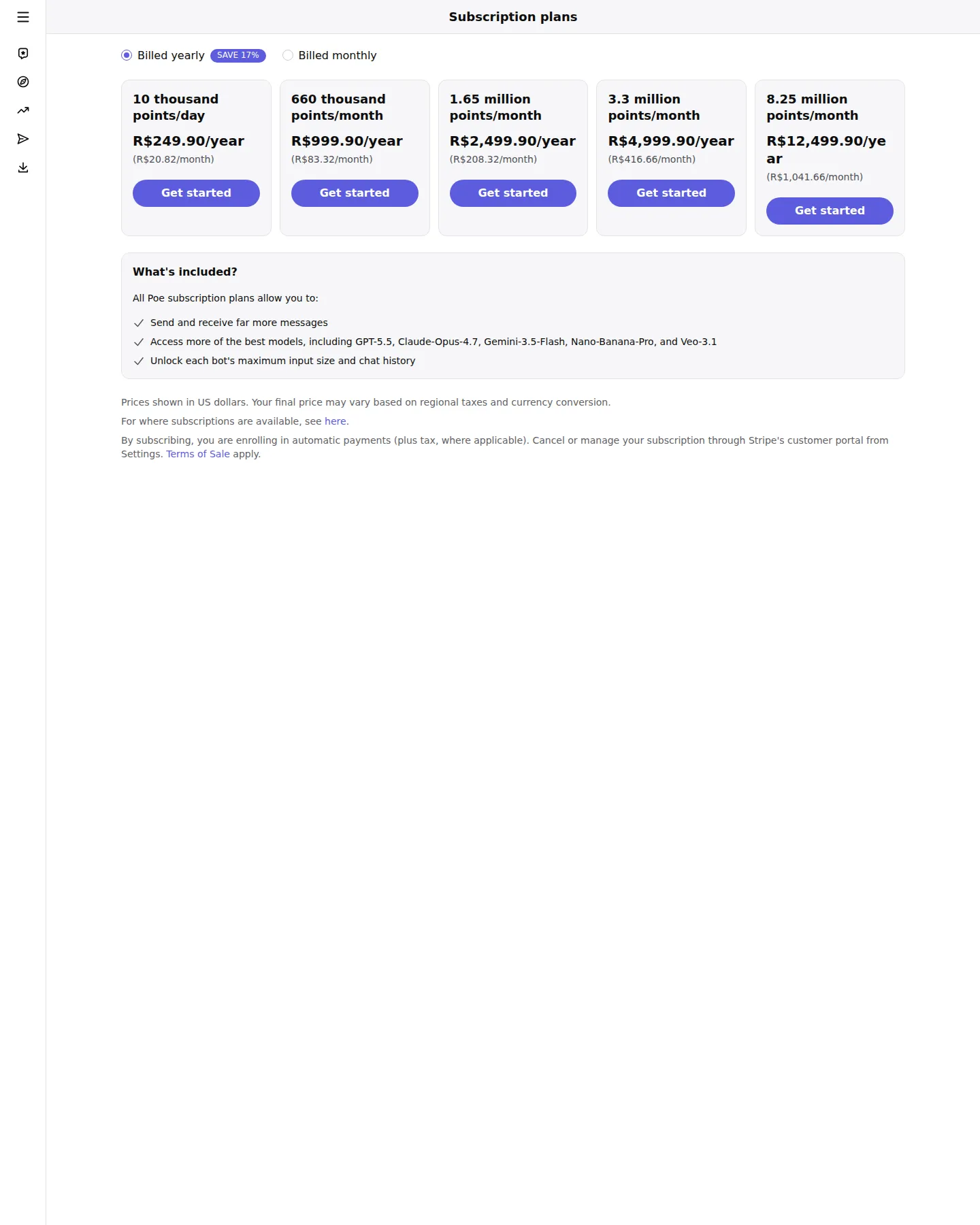
Six-tier compute-points ladder, $4.99 to $249.99
Poe's current ladder spans Free (~3,000 points/day), $4.99/mo (10k points/day), $19.99/mo (1M points/mo), $49.99, $99.99, and $249.99/mo (~8.25M points/mo). All paid tiers ~17% cheaper billed annually.
Free tier's daily allowance cut ~90%, from ~3,000 to ~300 points
Poe's Free tier's daily compute-points allowance fell from ~3,000/day to ~300/day around this date — a ~90% cut Poe never announced. Not vendor-confirmed: the date and magnitude are corroborated by three independent third-party sources (carletontorpin.com, toolchase.com, appliedai.tools), since Poe's own help center no longer publishes an exact free-tier figure.
Creator price-per-message monetization launches
Poe let bot creators set a per-message price (charged to users in points, paid out to creators in USD), adding a marketplace layer on top of the subscription and a 'tens of millions' annual creator-payout run rate.
Creator monetization program announced
Poe's first creator revenue path: a subscription-sharing bounty paying creators up to $20 per new subscriber their bots bring to the platform.
Poe Subscription introduced (~$19.99/mo)
Quora launched a paid Poe Subscription at ~$19.99/month (or ~$199.99/year) for expanded access to premium models, establishing the subscription-plus-allowance structure.
- · Poe is built and owned by Quora — the same Q&A company — and Quora raised $75M from a16z largely to fund Poe's growth.
- · One $19.99/mo Poe subscription can talk to GPT-5.x, Claude Opus, Gemini, Grok, and image/video models, so you don't pay (or manage) five separate AI subscriptions.
- · Poe pays bot creators in real dollars: a per-message price plus up to $20 per new subscriber, with the company reporting a 'tens of millions of dollars' annual creator-payout run rate.
Questions & answers
- How much does Poe cost per month?
- Poe's headline subscription is $19.99/month (or $199.99/year, ~$16.67/mo) for 660,000 compute points per month — down from the 1,000,000 points/month this plan granted previously. Cheaper and higher tiers exist: $4.99/mo (10,000 points/day), $49.99/mo (~1.65M points/mo), $99.99/mo (~3.3M points/mo), and $249.99/mo (~8.25M points/mo).
- Does Poe offer a free tier?
- Yes. The free plan gives roughly 300 compute points per day — about 15-30 short messages — with access to lighter models. That's down about 90% from the ~3,000 points/day free users had before a reduction around March 2026. Frontier models (GPT-5.x, Claude Opus, Gemini 3.x) and image/video generation burn points quickly, so heavy use pushes you to a paid plan almost immediately.
- What are Poe compute points and how do they work?
- Compute points are Poe's universal currency. Each message to each bot/model costs a published number of points: a lightweight text model may cost ~10–20 points, while frontier models cost hundreds to thousands and image/video generations cost the most. Your subscription buys a monthly (or, on the $4.99 tier, daily) points allowance you spend across all models. The 'Info' button on any bot shows its exact per-message cost.
- Can you make money as a Poe bot creator?
- Yes. Creators set a per-message price (expressed in points) for their bots and are paid in US dollars whenever users message them, drawing from those users' existing points budgets. Creators also earn up to $20 for each new subscriber their bot brings to Poe. Payouts are monthly, 30–45 days after the period closes.
- Is Poe pricing usage-based or subscription?
- Both. You pay a flat monthly subscription, but what you can actually do is metered in compute points — a hybrid model. The flat fee buys a usage budget rather than unlimited access, so a $19.99 plan stretches very far on cheap models but only a handful of frontier video generations.