AI Summary
About
PromptLayer is a prompt-management, evaluation, and observability platform for teams building with large language models and AI agents. Its product surface spans prompt management, evaluations, observability, dataset management, and prompt chaining — positioned as a “workbench for AI engineering.” The company is headquartered in New York City and integrates with the major model providers (OpenAI, Anthropic, Google Gemini, Amazon Bedrock, Azure OpenAI, Mistral, Cohere, xAI, Hugging Face) and agent frameworks (Claude Code, Pydantic AI, Vercel AI SDK, OpenAI Agents SDK, LangChain, LiteLLM, LlamaIndex, OpenRouter, OpenTelemetry, LiveKit).
The company was founded in 2021 by Jared Zoneraich and Jonathan Pedoeem — high-school hackathon partners — under the legal entity Magniv, Inc., which still appears in the pricing-page copyright footer. PromptLayer started as a free, open-source Python library that logged, tracked, and replayed OpenAI requests, and posted a “Show HN: PromptLayer – Track, debug, and maintain GPT prompts in prod” on 2023-02-01 (29 points, 11 comments). In February 2025 it announced a $4.8M seed round led by ScOp VC and Stellation Capital, with an angel roster that included OpenAI’s Romain Huet, Google AI Studio’s Logan Kilpatrick, and DoNotPay’s Joshua Browder — capital that funded the expansion from prompt logging into evaluations and observability.
PromptLayer’s marketing cites 1,000+ companies using the platform, an average of 10+ hours per week saved per team, and an average team size of 20 on the platform — logos shown on the contact page include Abridge, Apollo, Speak, and Topline Pro. It targets a ladder of buyers from solo “hackers” on the Free tier, through small and growing teams on Pro and Team, up to regulated enterprises that need self-hosting and compliance controls.
In the LLMOps landscape, PromptLayer competes with prompt-and-eval tooling such as LangSmith, Langfuse, Braintrust, and Helicone. Its pricing positions it as transparent and self-serve at the low end (a published $49 Pro and $500 Team) while reserving security, compliance, and deployment-governance features (RBAC, deployment approvals, SSO, HIPAA/BAA) for a sales-led Enterprise tier — a hybrid pricing model common across developer-tool companies.
Pricing summary : How PromptLayer’s flat-tier-plus-per-txn model works
PromptLayer uses a hybrid model that combines a flat monthly plan tier with pay-as-you-go overage. The model has two dimensions:
- Flat plan tier: Free ($0/mo), Pro ($49/mo), Team ($500/mo), and Enterprise (custom). Each tier bundles a fixed allotment of seats, monthly requests, agent-node executions, eval-cell executions, workspaces, and dataset storage.
- Per-transaction overage: On paid tiers, usage above the included quota is billed pay-as-you-go per transaction (txn). Pro is $0.003/txn and Team is $0.002/txn. A single “txn” meter covers requests, agent-node runs, and eval-cell runs.
What makes this different: PromptLayer collapses three distinct meters (requests, agent runs, eval runs) into one normalized “transaction” unit, and the per-txn rate falls as you move up the tier ladder ($0.003 to $0.002), so the volume discount is built into the plan rather than negotiated. It pairs a generous freemium pricing entry point with per-seat pricing caps on every tier — see the introduction to usage-based pricing for how flat-plus-metered hybrids like this are constructed.
Pricing by product
PromptLayer platform (Individual & team plans)
| Tier | Price | Included | Key mechanics |
|---|---|---|---|
| Free | $0 | 10 prompts, 5 users, 2.5k requests/mo, 750 agent-node runs/mo, 250 eval-cell runs/mo, 1 workspace, 10 playground runs/day, 10MB max per dataset, basic support | Overage rate shown as ”—”; hard caps, “for hackers” |
| Pro | $49 / mo | Unlimited prompts, 5 users, 2.5k+ requests/mo, 750+ agent-node runs/mo, 250+ eval-cell runs/mo, unlimited workspaces & playground runs, 150MB max per dataset | Pay-as-you-go overage at $0.003/txn; “for small teams” |
| Team | $500 / mo | Unlimited prompts, 25 users, 100k+ requests/mo, 10k+ agent-node runs/mo, 7.5k+ eval-cell runs/mo, unlimited workspaces & playground runs, webhooks, 1GB max per dataset | Marked “Popular”; pay-as-you-go overage at $0.002/txn |
PromptLayer platform (Enterprise plan)
| Tier | Price | Included | Key mechanics |
|---|---|---|---|
| Enterprise | Custom | Custom limits on everything: unlimited prompts, unlimited users, unlimited workspaces, custom requests / agent-node / eval-cell volumes, custom playground runs & datasets, webhooks, RBAC, deployment approvals, SSO, HIPAA with BAA, dedicated support, data-retention control | Sales-led (contact form or +1 (201) 464-0959); overage rate custom; self-hosted managed single-tenant on GCP/AWS/Azure, cloud-hosted EU, or cloud-hosted single-tenant |
Sales motions across products: PLG / self-serve for Free, Pro, and Team (sign up and pay online); sales-led for Enterprise (custom quote via contact form).
Per-transaction overage rates
| Plan | Included request quota | Overage rate | Notes |
|---|---|---|---|
| Free | 2.5k/mo | — (no overage) | Hard cap; no pay-as-you-go available |
| Pro | 2.5k+/mo | $0.003 / txn | Requests, agent-node runs, and eval-cell runs share the meter |
| Team | 100k+/mo | $0.002 / txn | Lower per-txn rate than Pro at higher volume |
| Enterprise | Custom | Custom | Negotiated |
Hidden costs : What heavy-usage teams actually pay beyond the flat fee
The advertised $49 Pro and $500 Team headlines understate what high-volume teams pay once per-transaction overage kicks in — requests, agent-node runs, and eval-cell runs all draw from the same metered txn pool, so a single busy agent workflow can consume the pool in multiple ways at once.
Archetype 1 — a small team on Pro that outgrows the 2.5k base. Pro includes only 2,500 requests/month (the same base as Free), so an active product team logging real traffic will spill into overage quickly. Suppose a 4-person team runs 30,000 requests, 8,000 agent-node executions, and 2,000 eval-cell executions in a month — every unit above the small Pro base is a billable txn at $0.003.
| Line item | Monthly cost |
|---|---|
| Pro plan (flat) | $49 |
| ~30,000 requests over base @ $0.003/txn | ~$90 |
| ~8,000 agent-node runs over base @ $0.003/txn | ~$24 |
| ~2,000 eval-cell runs over base @ $0.003/txn | ~$6 |
| Estimated total | ~$169 |
At this volume the overage (~$120) already exceeds the $49 base nearly 2.5×, and the team is still well short of Team’s 25-seat / 100k-request inclusions — the classic mid-tier squeeze.
Archetype 2 — a growing team on Team running heavy evals. Team includes 25 users, 100k+ requests, 10k+ agent-node runs, and 7.5k+ eval-cell runs, with a lower $0.002/txn overage. A team running a large nightly eval suite — say 250,000 requests and 40,000 eval-cell executions — pushes well past those inclusions.
| Line item | Monthly cost |
|---|---|
| Team plan (flat) | $500 |
| ~150,000 requests over base @ $0.002/txn | ~$300 |
| ~32,500 eval-cell runs over base @ $0.002/txn | ~$65 |
| Estimated total | ~$865 |
So a heavy-eval Team customer can pay roughly 1.7× the $500 sticker — the lower $0.002 rate softens the blow versus Pro, but high-frequency evaluation is the dimension most likely to drive a surprise bill. (Included quotas use the published ”+” floors; exact thresholds above the floors are quoted per account.)
Want to estimate your own PromptLayer bill? Use the PromptLayer pricing calculator to model your monthly cost based on seats, included requests, and per-transaction overage. For more on metered overage design, see our guide to thresholding and alerting in usage-based pricing.
Pricing evolution : From prompt logging to a governed LLMOps platform
PromptLayer began life in 2021 as a free, open-source prompt-logging library before layering a hosted platform and, eventually, paid plans on top. Its pricing page is a server-rendered JavaScript app, and the Wayback Machine did not archive a readable promptlayer.com/pricing until 2025-12-12. Across every archived snapshot since then, the four-tier ladder and per-txn overage rates have held steady — the only visible movement has been a redesign and a footer rebrand.
Cadence
| Quarter | Price changes | Product / SKU additions | Notes |
|---|---|---|---|
| 2025 Q1 | 0 | 0 | $4.8M seed round announced 2025-02-09 (ScOp VC + Stellation Capital), funding the push from logging into evaluations and observability. |
| 2025 Q4 | 0 | 0 | Earliest archived /pricing (2025-12-12): Free $0, Pro $49, Team $500 (Popular), Enterprise custom; $0.003/txn and $0.002/txn overage. |
| 2026 Q2 | 0 | 0 | Pricing-page redesign and footer rebrand from “Magniv, Inc.” to “PromptLayer ©”; prices and per-txn rates unchanged. |
Tracked range: 2025-12–2026-06 (the full archived window for the pricing page). Plan prices and per-txn overage rates were verified stable (0 price changes, 0 SKU additions) across every captured snapshot. No /pricing snapshot exists before 2025-12, so earlier price points cannot be confirmed and are not asserted.
Notable changes
- 2025-02-09 — PromptLayer announced a $4.8M seed round led by ScOp VC and Stellation Capital, with angels from OpenAI, Google AI Studio, and DoNotPay (per the PromptLayer fundraise blog post).
- 2025-12-12 — First archived pricing page shows the current four-tier ladder (Free $0 / Pro $49 / Team $500 / Enterprise custom) with $0.003/txn (Pro) and $0.002/txn (Team) overage, a “7-day Team trial” banner, and a “Copyright 2025 Magniv, Inc.” footer.
- 2026 Q2 — The pricing page was redesigned to a lighter layout, the Team-trial banner was dropped, and the footer copyright changed to “PromptLayer ©”; no plan price or overage rate moved.
What’s unique : Single txn meter and tier-baked volume discount
1. One “transaction” meter for three workloads. PromptLayer bills requests, agent-node executions, and eval-cell executions through a single normalized “txn” unit rather than metering each separately. This simplifies overage forecasting at the cost of cross-subsidizing cheap and expensive operations.
2. Volume discount baked into the tier, not negotiated. The per-txn overage rate drops from $0.003 on Pro to $0.002 on Team. Moving up the ladder lowers your marginal cost automatically, without a sales conversation — a soft commitment mechanic that rewards expansion the way prepaid credit models reward upfront purchase, but without locking the buyer in.
3. Free and Pro share a base; you pay for headroom, not volume. Free and Pro both start at 5 users and 2,500 requests/month — the $49 Pro fee buys unlimited workspaces, unlimited playground runs, a 150MB-vs-10MB dataset ceiling, and (critically) the right to spill into pay-as-you-go overage rather than hard-capping. Pro is sold as access to elasticity, not as a bigger included bucket, which is unusual for a paid first step and a deliberate funnel into metered usage.
4. Governance is the Enterprise fence, not a price knob. RBAC, deployment approvals, SSO, HIPAA-with-BAA, and self-hosted single-tenant deployment are reserved entirely for Enterprise. PromptLayer uses compliance and deployment-governance — not raw capacity — as the line between its $500 self-serve ceiling and its sales-led tier, mirroring the shift away from per-user licenses seen across developer platforms.
Strengths & weaknesses
| Strengths | Weaknesses |
|---|---|
| Transparent, self-serve pricing all the way up to $500/mo Team | Large $49 → $500 (10×) jump between Pro and Team |
| Single txn overage meter simplifies forecasting and reconciliation | Compliance/governance (RBAC, SSO, HIPAA/BAA) gated entirely to Enterprise |
| Per-txn rate falls with tier ($0.003 → $0.002) — built-in volume discount | Free and Pro share the same low 2.5k-request base quota |
| Prices held stable across the entire archived window (Dec 2025 onward) | One blended unit can cross-subsidize cheap vs. expensive operations |
| Generous Free tier (5 users) as a credible PLG on-ramp | Pro’s value is “elasticity,” not more included volume — easy to miss |
| Backed by a $4.8M seed with marquee AI-operator angels | ”+” floors on Team quotas mean exact thresholds are quoted, not published |
Billing UX : Pay-as-you-go overage, plan comparison, and hosting controls
- Pay-as-you-go overage — Pro and Team bill usage above the included quota per transaction ($0.003/txn and $0.002/txn respectively); Free has no overage and hard-caps instead.
- Compare Plans table — the pricing page renders a full Free / Pro / Team / Enterprise feature matrix covering prompts, users, requests, agent-node executions, eval-cell executions, workspaces, webhooks, RBAC, deployment approvals, support, hosting, SSO, playground runs, datasets, and overage rate.
- Dataset storage caps — explicit per-dataset size ceilings shown per tier (10MB Free, 150MB Pro, 1GB Team, custom Enterprise).
- Hosting / deployment selector (Enterprise) — Enterprise customers choose self-hosted single-tenant on GCP/AWS/Azure, cloud-hosted EU, or cloud-hosted single-tenant; Free/Pro/Team are SaaS cloud-hosted in the US.
- Data-retention controls (Enterprise) — Enterprise plans expose data-retention configuration alongside RBAC and deployment approvals.
Strategic wins : Pricing decisions that work in PromptLayer’s favor
1. Transparent published Team price
Publishing a concrete $500/mo Team price (rather than “contact us”) removes friction for growing teams and signals confidence in the value at that tier. In a category where LangSmith, Braintrust, and others lean heavily on gated quotes, a visible price is a differentiator — and it has held steady across the entire archived window, reinforcing a predictable-pricing message that resonates with engineering budget owners.
2. One transaction meter simplifies the bill
Folding requests, agent-node runs, and eval-cell runs into a single per-txn unit gives buyers one number to forecast instead of three separate meters to reconcile. This is a textbook application of choosing the right usage metric: one normalized unit is far easier for a customer to model in a spreadsheet than three correlated ones, even if it sacrifices some cost precision.
3. Volume discount built into the tier
The per-txn rate falling from $0.003 (Pro) to $0.002 (Team) rewards expansion automatically, so growing teams see their marginal cost drop without a renegotiation. It is a soft commitment lever that nudges expansion the way usage-based pricing for SaaS and AI products generally tries to align price with realized value.
4. Free tier sized as a real PLG on-ramp
Free includes 5 users and a full workspace, not a crippled single-seat demo — enough for a small team to genuinely adopt the product before paying. That generosity is the top of a product-led funnel that converts on elasticity (overage headroom) rather than on a paywall, which suits a developer audience that resists hard gates.
Areas to improve : Gaps in PromptLayer’s pricing structure
1. The $49 → $500 gap leaves a mid-tier hole
The 10× jump from Pro to Team gives no intermediate option for a team that has outgrown 5 users but is far from needing 25 seats and 100k requests. A “Growth” tier around $150–$200 with 10–15 seats and a meaningfully larger included request bucket would smooth the upgrade path and capture teams that currently sit on Pro racking up overage. The mid-market cost-monitoring segment is exactly the buyer this gap strands.
2. Free and Pro share the same low request quota
Both Free and Pro start at the 2.5k-request base, so Pro buyers pay $49 mainly for unlimited workspaces and pay-as-you-go headroom rather than more included volume — and Archetype 1 above shows overage can hit ~$120 before a team is anywhere near Team. Raising Pro’s included requests (say to 25k) would make the upgrade feel like more value, not just an overage unlock, and reduce bill-shock complaints from small teams. Pair it with proactive thresholding and alerting so customers see overage coming.
3. Governance features are entirely gated to Enterprise
RBAC, SSO, deployment approvals, and HIPAA/BAA are Enterprise-only, leaving mid-market Team buyers with no self-serve access to basic access controls. Offering RBAC or SSO as a Team add-on — priced separately rather than bundled into a custom quote — would serve security-conscious teams that are not yet ready for a sales-led Enterprise conversation, and would create a softer step than the current self-serve-to-sales cliff.
Key takeaways
- A single normalized usage unit can simplify a multi-meter product. PromptLayer folds requests, agent runs, and eval runs into one “txn,” trading precision for forecastability — the same trade-off discussed in choosing the right usage metric.
- Baking volume discounts into tiers avoids negotiation. Dropping the per-txn rate from $0.003 to $0.002 at the Team tier rewards growth automatically, without a sales touch or an annual commit.
- Publishing the team price builds trust. A visible $500 Team tier lowers buyer friction versus a gated quote, and price stability over time reinforces it.
- Compliance can anchor the Enterprise upsell. RBAC, SSO, and HIPAA/BAA are the natural fence between self-serve and sales-led — capacity is not the only way to gate a top tier.
- Watch the gap between tiers. A 10× price step can strand mid-sized teams; a missing intermediate tier sends real revenue into overage on a lower plan instead.
UBP implications
- Unit normalization is a UBP design lever. Collapsing several meters into one transaction unit makes usage-based pricing legible, but can mask cost differences between operations — a tension every usage-based pricing for SaaS and AI product has to weigh.
- Tier-baked rate reductions are a soft commitment mechanic. Lower marginal rates at higher tiers nudge expansion without an explicit annual commit, an alternative to prepaid credit models for rewarding scale.
- Hybrid flat+overage suits dev-tool buyers. A predictable base fee plus metered overage matches how engineering teams budget for tooling, which is why the hybrid model dominates the LLMOps category.
Sources
- PromptLayer pricing page (accessed 2026-06-04)
- PromptLayer contact / enterprise sales (accessed 2026-06-04)
- PromptLayer documentation (accessed 2026-06-04)
Bottom line
PromptLayer keeps its low end refreshingly transparent — a $0 Free, $49 Pro, and $500 Team published outright — then layers a single per-transaction overage meter on top and reserves governance and compliance for a sales-led Enterprise tier. The result is a hybrid LLMOps pricing model that is easy to forecast and easy to grow into, with a notable 10× gap between Pro and Team as its main rough edge.
Want to compare PromptLayer against other LLMOps and developer-tool pricing? Browse the pricing blueprint.
Pricing timeline : Major events on a vertical axis
Each milestone below corresponds to a public pricing change, product launch, or material adjustment. Major events use a filled marker; minor adjustments use a faded one.
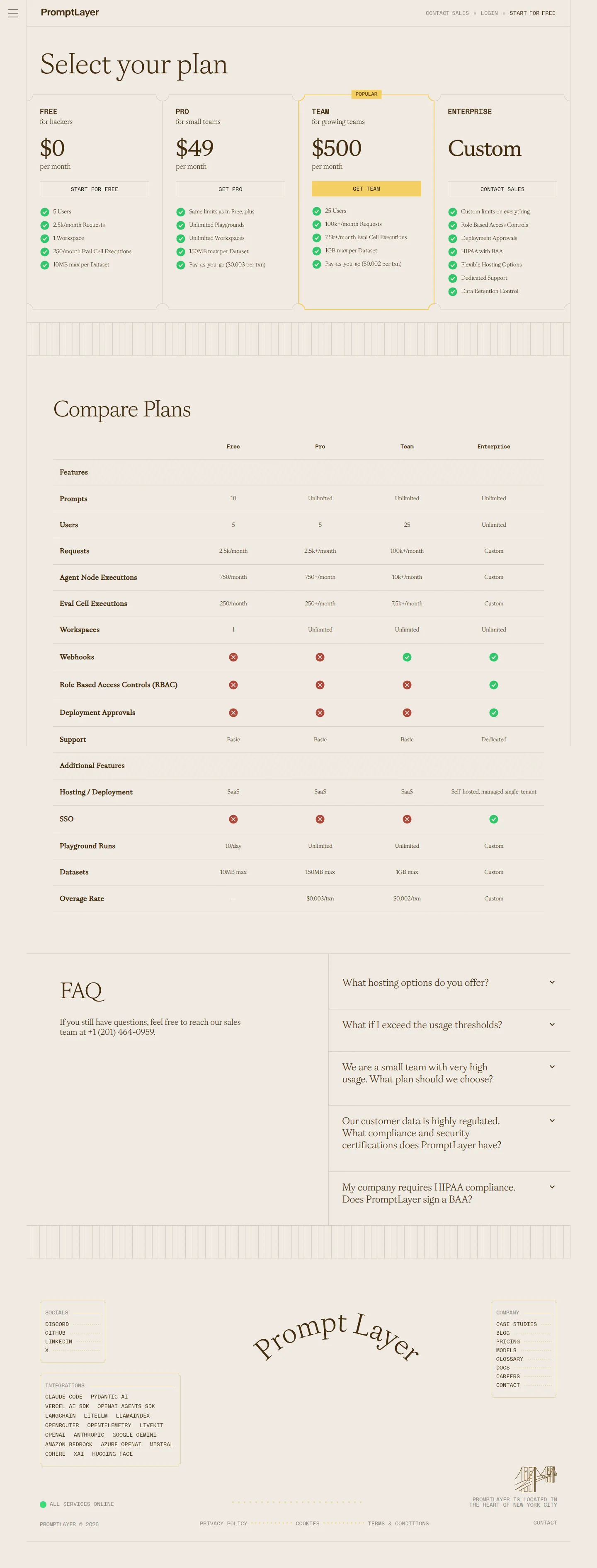
Redesign and PromptLayer rebrand — same prices
By mid-2026 the pricing page was redesigned (light layout, products/integrations footer) and the footer copyright changed from 'Magniv, Inc.' to a plain 'PromptLayer ©', while the 7-day Team-trial banner was dropped. Plan prices and per-txn overage rates are unchanged: Free $0, Pro $49, Team $500, Enterprise custom; $0.003/txn and $0.002/txn.
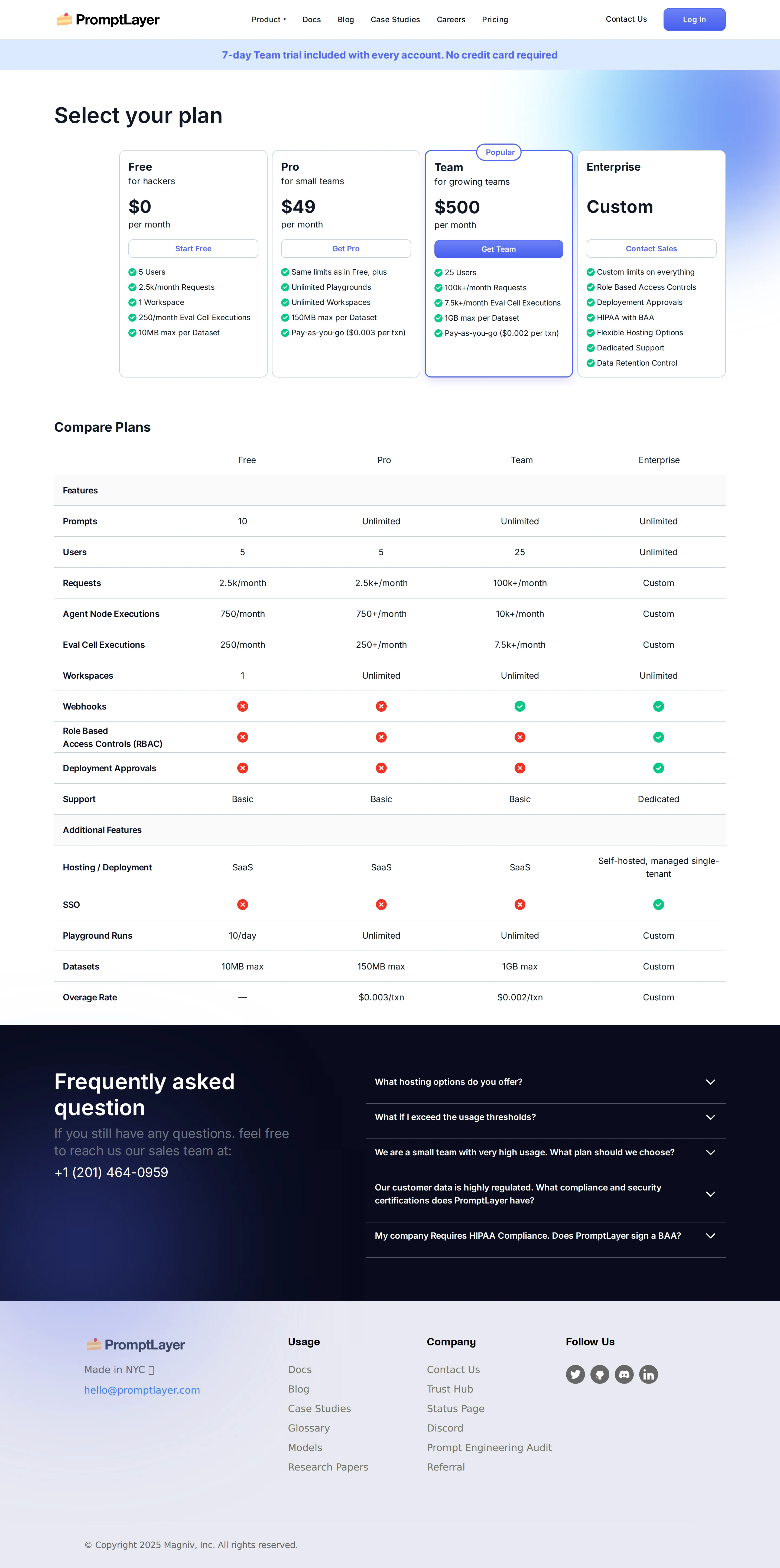
Earliest archived /pricing — four-tier ladder with per-txn overage
First Wayback snapshot of promptlayer.com/pricing (2025-12-12): Free $0, Pro $49/mo, Team $500/mo (Popular), Enterprise custom; overage $0.003/txn (Pro) and $0.002/txn (Team). Page carried a 'Copyright 2025 Magniv, Inc.' footer and a '7-day Team trial included with every account' banner. The dollar figures match the current page — no price change is visible across the archived window.
$4.8M seed round announced
PromptLayer announced a $4.8M seed led by ScOp VC (Ivan Bercovich) and Stellation Capital (Peter Boyce II), with angels including OpenAI's Romain Huet, Google AI Studio's Logan Kilpatrick, and DoNotPay's Joshua Browder. The raise funded the expansion from prompt logging into a full evaluation/observability platform.
Show HN launch of the hosted platform
PromptLayer posted 'Show HN: PromptLayer – Track, debug, and maintain GPT prompts in prod' (29 points, 11 comments). The promptlayer.com site was a client-rendered JavaScript app; the Wayback Machine captured only an empty JS skeleton, so no pricing from this period is archived.
Open-source prompt-logging library (no paid tiers)
PromptLayer launched as a free, open-source Python library to log, track, and replay OpenAI requests, with a hosted dashboard. No archived /pricing page exists from this era — the product was free while it built its wedge. Founded 2021 under the Magniv, Inc. entity by Jared Zoneraich and Jonathan Pedoeem.
- · PromptLayer meters overage in a single unit it calls a transaction (txn) — requests, agent-node runs, and eval-cell runs all draw from the same per-txn meter.
- · The per-txn overage rate actually drops as you move up: Pro pays $0.003/txn, Team pays $0.002/txn — volume discounting baked into the tier, not negotiated.
- · PromptLayer's legal entity is Magniv, Inc.; archived pricing pages carried a 'Copyright 2025 Magniv, Inc.' footer into 2026 before rebranding to a plain 'PromptLayer ©' line.
Questions & answers
- How much does PromptLayer cost?
- PromptLayer has four plans: Free at $0/month, Pro at $49/month, Team at $500/month, and Enterprise at a custom quote. Pro and Team also bill pay-as-you-go overage per transaction.
- What is a transaction (txn) on PromptLayer?
- A transaction is PromptLayer's unit of overage billing. Requests, agent-node executions, and eval-cell executions beyond your plan's included quota are each charged per txn — $0.003/txn on Pro and $0.002/txn on Team.
- Does PromptLayer have a free tier?
- Yes. The Free plan is $0/month and includes 5 users, 2,500 requests/month, 1 workspace, 250 eval-cell executions/month, and 10MB max per dataset.
- What do PromptLayer Enterprise plans include?
- Enterprise adds custom limits on everything plus RBAC, deployment approvals, SSO, HIPAA with BAA, self-hosted single-tenant or EU hosting options, dedicated support, and data-retention controls. Pricing is quoted by sales.
- Has PromptLayer's pricing changed over time?
- Across every archived snapshot of promptlayer.com/pricing from December 2025 onward, the four tiers (Free $0, Pro $49, Team $500, Enterprise custom) and the per-txn overage rates have been stable. The pricing page is a JavaScript app and was not archived before December 2025, so earlier price points cannot be confirmed.
- Who funds PromptLayer and when was it founded?
- PromptLayer was founded in 2021 by Jared Zoneraich and Jonathan Pedoeem under the Magniv, Inc. entity, and raised a $4.8M seed round in February 2025 led by ScOp VC and Stellation Capital, with angels from OpenAI, Google AI Studio, and DoNotPay.