AI Summary
About
Recraft is an AI image and vector generation platform built around Recraft Studio - a browser-based design tool that combines its own raster and vector models (Recraft V2 through V4.1 Pro) with a roster of third-party image and video models including Nano Banana, Flux, GPT Image, Seedream, Kling, Veo, and Sora. The product targets graphic designers, print-on-demand sellers, marketers, and visual artists who need brand-consistent, commercially-licensable output at production scale, including native vector (SVG) generation that few competitors match.
The company monetizes through two parallel surfaces. Recraft Studio runs on a four-tier freemium subscription (Free, Basic, Pro, Teams) where every plan carries a monthly pool of “credits” that are consumed as images are generated and edited. Separately, the Recraft API exposes the same models to developers on pure per-image usage, metered in “API units” sold at a flat $1 = 1,000 units. An Enterprise track layers SOC 2 Type II, GDPR alignment, SSO, and SLA-backed reliability on top for large design organizations.
Founded by Anna Veronika Dorogush (creator of the CatBoost library and former head of ML systems at Yandex) and originally based in London, Recraft drew attention in late 2024 when its Recraft V3 model - codenamed “red_panda” - topped the Artificial Analysis text-to-image leaderboard ahead of Midjourney, DALL-E 3, and FLUX. It raised a $12M Series A led by Khosla Ventures in 2024 and a $30M Series B led by Accel in May 2025, reporting 4M+ users and $5M+ in ARR at the time.
Recraft competes directly with image-generation peers such as Ideogram, Midjourney, and the image arms of the large foundation labs, and overlaps with creative-suite incumbents adding generative features. Its differentiator is the combination of native vector output, an in-browser design studio, and a transparent dual-rail pricing model that serves both no-code creators (credits) and developers (API units) without forcing either into the other’s billing model - a credits-and-entitlements split increasingly common in AI tooling.
Pricing summary : how Recraft’s dual credit-pool and per-image API model works
Recraft runs a hybrid model with two distinct billing rails:
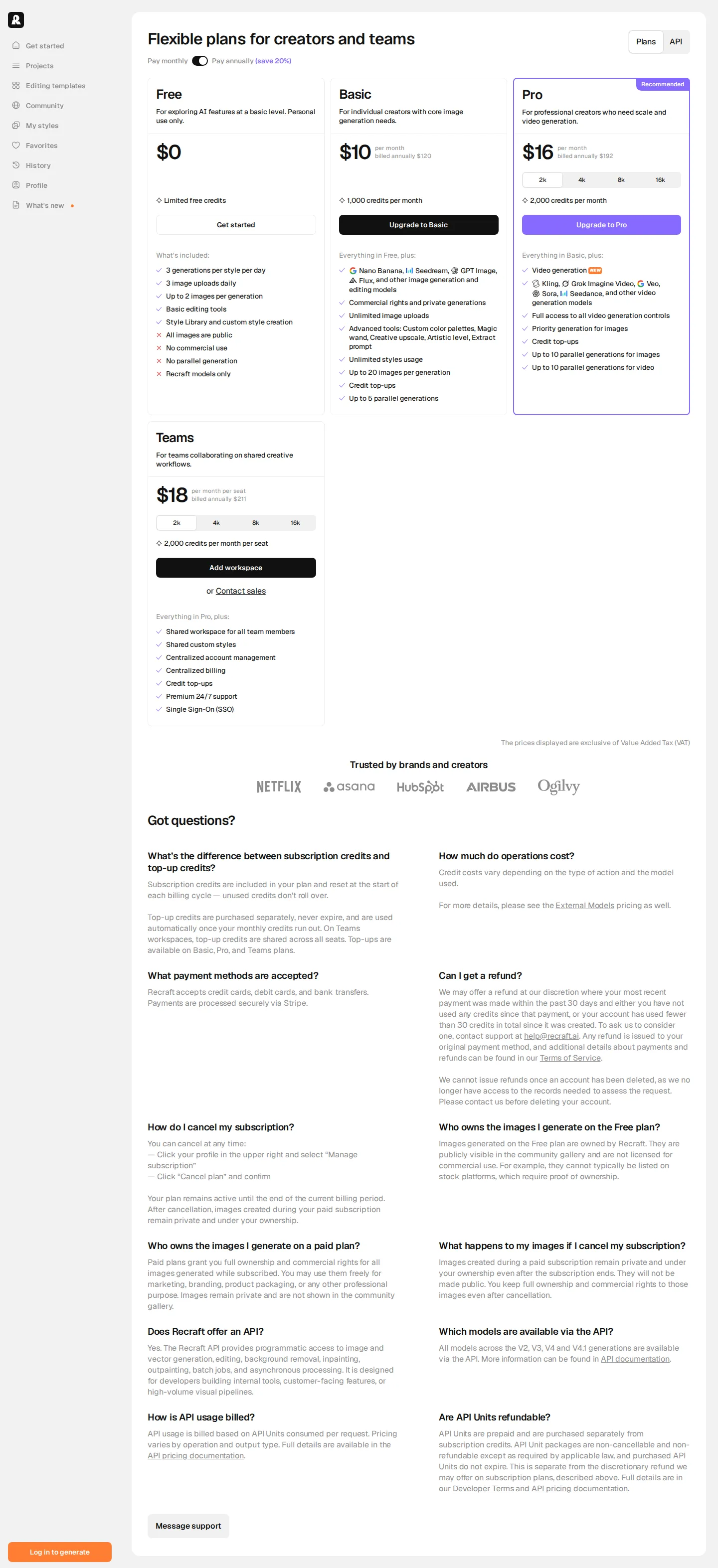
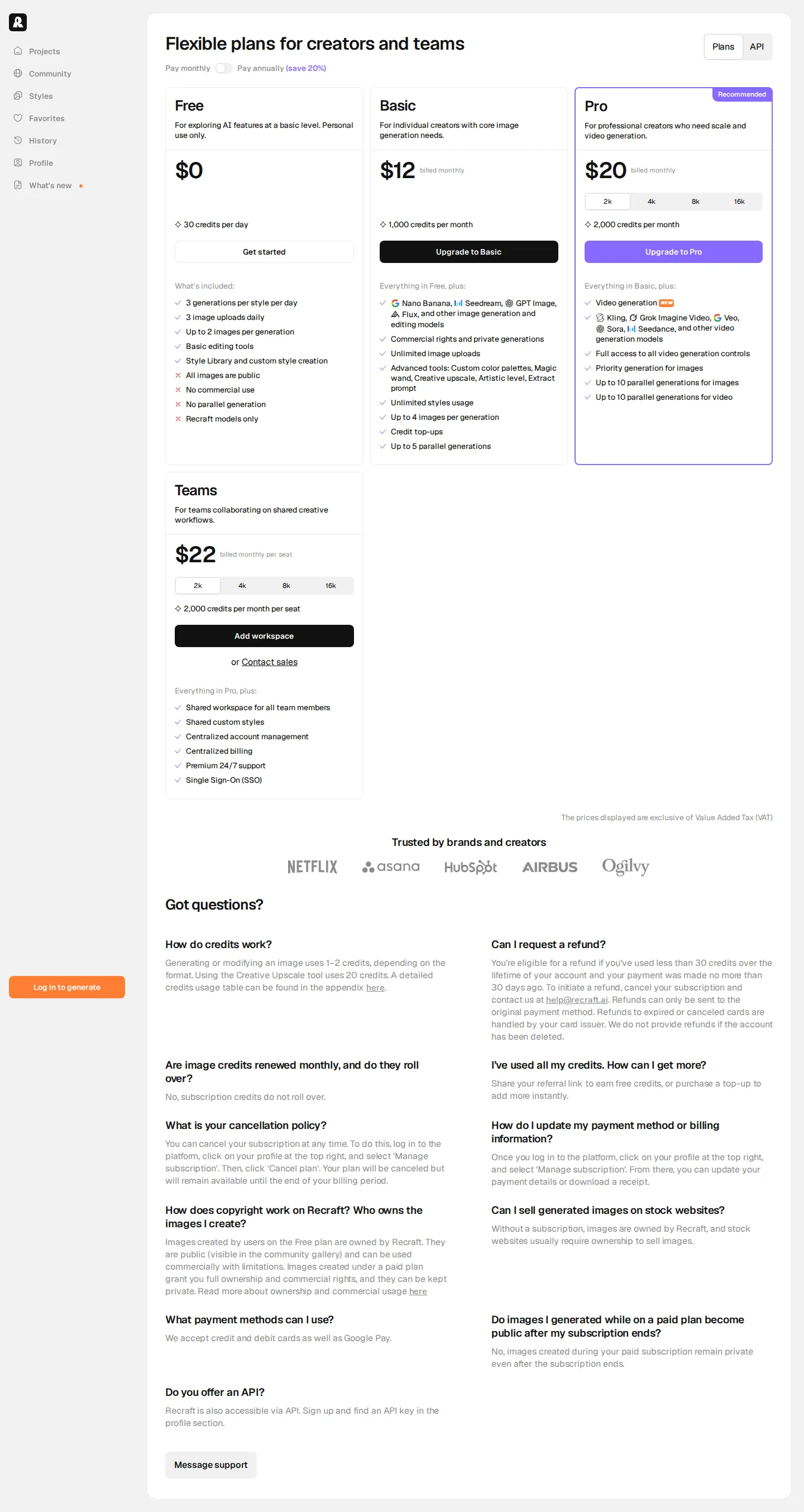
- Studio subscription credits: Free ($0, “limited free credits” - Recraft removed the specific “30 credits per day” figure from both the pricing page and its docs as of the 2026-08-28 capture, without stating a replacement number), Basic ($12/mo, 1,000 credits/mo), Pro ($20/mo, 2,000 credits/mo), and Teams ($22/seat/mo, 2,000 credits/seat). Each image generation or edit consumes 1-2 credits; a Creative Upscale costs 20. Annual billing cuts ~20% off every paid tier. Pro and Teams let you scale the monthly credit pool from 2,000 up to 16,000 credits at proportional prices.
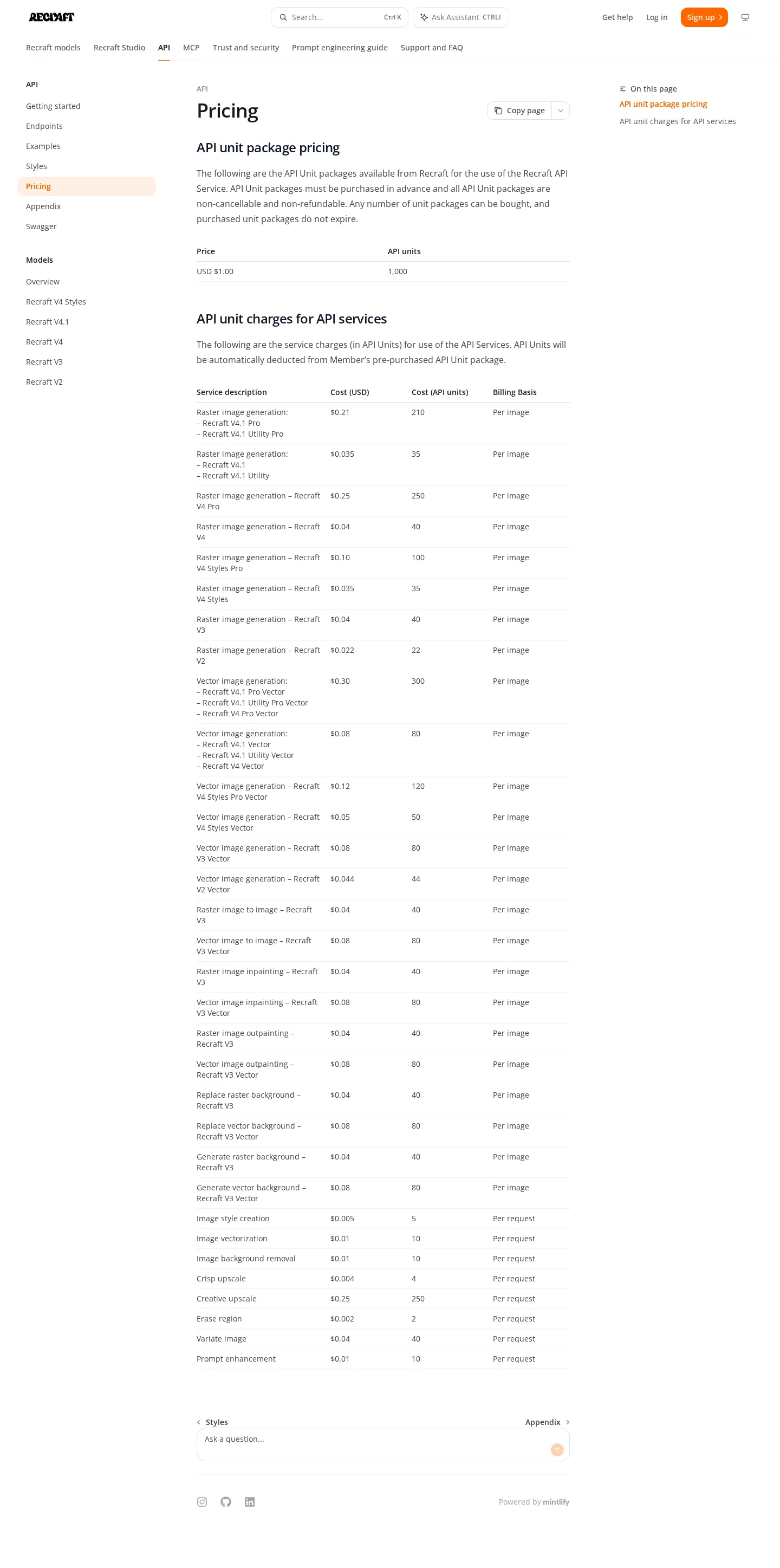
- API usage (separate wallet): Developers pre-purchase API units at $1 = 1,000 units, then each operation deducts units - from $0.022 per Recraft V2 raster image to $0.30 per V4 Pro Vector image, plus per-request editing charges. On 2026-08-26 Recraft added a new “V4 Styles” model family (turns 1-10 reference images/SVGs into a reusable style) priced at $0.035-$0.12/image. Units never expire and are non-refundable.
What makes this different: the same models are sold through two non-interchangeable wallets with opposite expiry rules - Studio credits renew monthly and do not roll over, while API units (and Studio top-ups) never expire. This is a textbook hybrid pricing model that cleanly separates the no-code creator from the developer, and the Studio side follows the prepaid-credits model pattern of selling capacity up front. For a broader view of where this fits, see our primer on usage-based pricing for SaaS and AI.
Pricing by product
Recraft Studio (Individual plans)
| Tier | Price | Included | Key mechanics |
|---|---|---|---|
| Free | $0 | ”Limited free credits” (no daily quota number published as of Aug 2026); 3 generations/style/day, 3 image uploads/day, max 2 images/generation, all images public | No commercial rights; images owned by Recraft |
| Basic | $12/mo ($10/mo billed annually) | 1,000 credits/mo, commercial rights, private generations, all third-party models, up to 20 images/generation, top-ups | Entry to commercial use; up to 5 parallel generations |
| Pro | $20/mo ($16/mo billed annually) | 2,000 credits/mo (scales to 16k), video generation, priority generation | ”Recommended” tier; up to 10 parallel generations |
Recraft Studio (Business plans)
| Tier | Price | Included | Key mechanics |
|---|---|---|---|
| Teams | $22/seat/mo ($18/seat/mo annually) | Everything in Pro plus shared workspace, shared custom styles, centralized billing, SSO | Self-serve “Add workspace” or contact sales |
| Enterprise | Custom | Everything in Teams plus SOC 2 Type II, GDPR, AIUC-1, RBAC, audit logs, SLA-backed API | Sales-led - “Request a demo” |
Pro / Teams credit-pool scaling (monthly billing)
| Credits/mo | Pro price (monthly) | Pro (annually) | Teams price/seat (monthly) | Teams/seat (annually) |
|---|---|---|---|---|
| 2,000 | $20 | $16 | $22 | $18 |
| 4,000 | $40 | $32 | $44 | $35 |
| 8,000 | $80 | $64 | $70 | $88 |
| 16,000 | $160 | $128 | $176 | $141 |
Recraft API - per-image unit pricing ($1 = 1,000 units)
| Operation | Cost (USD) | API units | Billing basis |
|---|---|---|---|
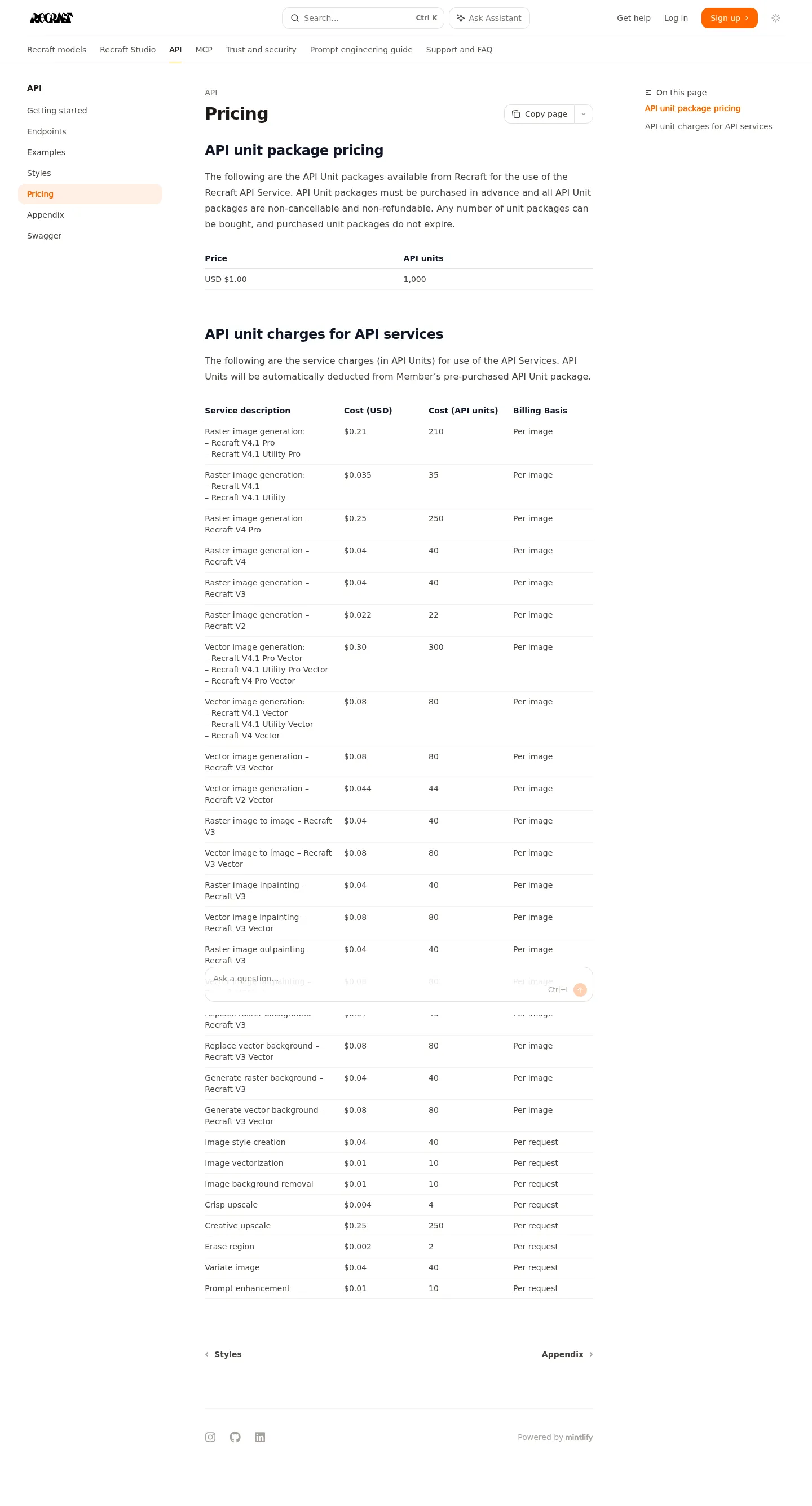
| Recraft V4.1 Pro / V4.1 Utility Pro raster | $0.21 | 210 | Per image |
| Recraft V4 Pro raster generation | $0.25 | 250 | Per image |
| Recraft V4.1 / V4.1 Utility raster | $0.035 | 35 | Per image |
| Recraft V4 / V3 raster generation | $0.04 | 40 | Per image |
| Recraft V4 Styles Pro raster (new, 2026-08-26) | $0.10 | 100 | Per image |
| Recraft V4 Styles raster (new, 2026-08-26) | $0.035 | 35 | Per image |
| Recraft V2 raster generation | $0.022 | 22 | Per image |
| Recraft V4.1 Pro / V4.1 Utility Pro / V4 Pro vector | $0.30 | 300 | Per image |
| Recraft V4.1 / V4.1 Utility / V4 / V3 vector | $0.08 | 80 | Per image |
| Recraft V4 Styles Pro Vector (new, 2026-08-26) | $0.12 | 120 | Per image |
| Recraft V4 Styles Vector (new, 2026-08-26) | $0.05 | 50 | Per image |
| Recraft V2 vector generation | $0.044 | 44 | Per image |
| V3 image-to-image, inpainting, outpainting, background replace/generate | $0.04 raster / $0.08 vector | 40 / 80 | Per image |
| Creative upscale | $0.25 | 250 | Per request |
| Image style creation (see note below) | $0.005-$0.04 | 5-40 | Per request |
| Image vectorization / background removal | $0.01 | 10 | Per request |
| Crisp upscale | $0.004 | 4 | Per request |
| Erase region | $0.002 | 2 | Per request |
| Variate image | $0.04 | 40 | Per request |
| Prompt enhancement | $0.01 | 10 | Per request |
Note on “Image style creation”: Recraft’s two live pricing surfaces disagree as of the 2026-08-28 capture - the API docs pricing table (/docs/api-reference/pricing) lists it at $0.005 (5 units), while the marketing pricing page’s API tab (/pricing?tab=api) still lists it at $0.04 (40 units). Both were captured the same day; we can’t confirm which is current, so both are shown here rather than guessing.
Sales motions across products: PLG / self-serve for Free, Basic, Pro, Teams, and the API; sales-led for Enterprise.
Hidden costs : what heavy creators and API teams actually pay beyond the headline tier
The $12-$20 headline subscription understates real spend for two common archetypes - a high-volume Studio user who burns through the monthly credit pool, and an API team whose per-image rates compound at scale.
Heavy Studio creator (Pro, upscale-heavy month)
| Line item | Monthly cost |
|---|---|
| Pro base (2,000 credits) | $20 |
| Scaled credit pool to 8,000 credits | +$60 |
| Credit top-ups (extra renders past 8k pool) | ~$15 |
| Total | ~$95 |
Because a Creative Upscale costs 20 credits - roughly 10-20 generations’ worth - a single upscale-heavy workflow can exhaust the base 2,000-credit pool quickly, pushing users up the credit-pool ladder or into non-rolling top-ups.
API production team (V4 Pro at volume)
| Line item | Monthly cost |
|---|---|
| 10,000 V4 Pro raster images @ $0.25 | $2,500 |
| 2,000 V4 Pro vector images @ $0.30 | $600 |
| 5,000 background removals @ $0.01 | $50 |
| Total | $3,150 |
The API’s flat $1 = 1,000-unit conversion looks simple, but model choice is the real cost lever: switching the same 10,000 raster images from V4 Pro ($0.25) to standard V4 ($0.04) drops that line from $2,500 to $400 - a 6x swing that never appears on the subscription page.
Want to estimate your own Recraft bill? Use the Recraft pricing calculator to model your monthly cost based on credit consumption, plan tier, and API image volume.
Pricing evolution : from a single image model to a dual credit-and-API platform
Recraft’s pricing has been rebuilt twice in eighteen months. It began as a flat two-tier model, flipped to credit pools the moment Recraft V3 topped the image-generation leaderboards in late 2024, then reorganized again into the current Free/Basic/Pro/Teams shape during 2025.
Cadence
| Quarter | Price changes | Product / SKU additions | Notes |
|---|---|---|---|
| 2024 Q2 | 0 | 0 | Earliest archived state: two cards only - Free ($0) and ‘Early Recrafter’ ($20/mo flat), with a Yearly/Monthly ‘Save 20%’ toggle. |
| 2024 Q4 | 1 | 3 | Credit-pool overhaul after Recraft V3 (red_panda) launched 2024-10-30: Free/Basic ($10)/Advanced ($27)/Pro ($48) credit tiers. |
| 2025 Q2 | 0 | 5 | Feature layering on stable prices: external models, artistic-level control, prompt extraction, color palettes, Magic wand. |
| 2025 Q3 | 2 | 1 | Restructure to Free / Pro / Teams; Free trimmed 50 to 30 daily credits; new Teams tier ($55/mo annual) with centralized billing. |
| 2026 Q1 | 1 | 1 | Recraft V4 ships (2026-02-18); Pro adds video generation (Kling, Veo, Sora, Grok, Seedance) as its headline differentiator. |
| 2026 Q2 | 1 | 1 | Studio prices held (Free/Basic $12/Pro $20/Teams $22/seat, 2026-05-31); on 2026-06-30 the newest V4.1 models split into a separate, cheaper API tier (raster $0.035 vs $0.04 for V4) plus new V4.1 Utility variants. |
| 2026 Q3 | 0 | 4 | V4 Styles API model family launches 2026-08-26 (4 new reference-to-style models, $0.035-$0.12/image); on 2026-08-28 the Free plan’s explicit “30 credits per day” quota disclosure disappeared from both the pricing page and docs - no confirmed underlying price change, only reduced disclosure. |
Tracked range: 2024-05 to 2026-08 (archived Wayback snapshots plus first-party API-pricing captures). Quarters not listed had no observed price or SKU change; several mid-period snapshots rendered as client-side skeletons and were excluded rather than interpolated.
Notable changes
- 2024-05 - Earliest archived pricing: Free ($0, public/Recraft-owned images, 5,000 AI requests/mo) plus a single flat ‘Early Recrafter’ plan at $20/mo for private images and faster generation - no credit metering yet.
- 2024-10-30 - Recraft V3 (“red_panda”) launches and tops the Artificial Analysis text-to-image leaderboard, holding #1 for over five months.
- 2024-12 - Pricing rebuilt into a four-tier credit-pool model (Free/Basic $10/Advanced $27/Pro $48 annual), introducing the 1-2 credits/image metering, 20-credit Creative Upscale, and the $4-per-400-credit top-up.
- 2025-05-05 - Recraft raises a $30M Series B led by Accel (after a 2024 $12M Series A led by Khosla), reporting 4M+ users and $5M+ ARR.
- 2025-09 - Individual tiers consolidated into Free / Pro / Teams; the Free pool dropped from 50 to 30 daily credits and a Teams plan ($55/mo annual) appeared.
- 2026-02-18 - Recraft V4 launches and video generation enters the Pro tier.
- 2026-06-30 - Recraft broke its newest V4.1 models out of the shared V4 API tier into a distinct, cheaper one: V4.1 raster fell to $0.035 (from $0.04) and V4.1 Pro raster to $0.21 (from $0.25), with new V4.1 Utility / Utility Pro variants at the same rates - while vector rates and every Studio subscription price held.
- 2026-08-26 - Recraft launches a new “V4 Styles” API model family that turns 1-10 reference images or SVGs into a reusable style: V4 Styles ($0.035/image), V4 Styles Vector ($0.05), V4 Styles Pro ($0.10), and V4 Styles Pro Vector ($0.12) - all priced within the existing $1 = 1,000-unit system, with no change to Studio subscription prices or existing API rates.
- 2026-08-28 - Recraft removes the explicit “30 credits per day” figure from the Free plan’s pricing card and docs, now stating only “Limited free credits” with no numeric daily allowance - a disclosure regression rather than a confirmed quota cut.
The credit-pool overhaul in detail
Recraft’s most consequential pricing decision was discarding the flat “Early Recrafter” $20/mo plan in favor of credit pools at the exact moment Recraft V3 (codenamed “red_panda”) topped the image-generation leaderboards in late October 2024. The archived November 2024 snapshot caught the page mid-migration - the plan grid rendered only an empty “Individuals / Teams” tab shell and a spinner - but by December 2024 the four-tier credit model (Free, Basic, Advanced, Pro) was fully live with 50 daily / 1,000 / 4,000 / 8,400-credit pools. Moving from flat-unlimited to metered credits let Recraft capture the surge in demand from a leaderboard-topping model without leaving margin on the table, and it set up the later credit-pool-scaling selector (2k/4k/8k/16k) that defines today’s Pro and Teams tiers.
What’s unique : dual-wallet billing, native vector pricing, and copyright as a paywall
1. Two non-interchangeable wallets with opposite expiry rules. Studio meters in “credits” (1-2 per image) that renew monthly and do not roll over, while the API meters in “API units” sold at $1 = 1,000 units that never expire. Top-up credits in Studio also never expire. A buyer therefore has to reason about three different expiry behaviors inside one company.
2. Native vector generation is a distinct, higher-priced SKU. Most image-gen competitors only output raster. Recraft prices vector generation as its own line - V4 vector is $0.08 vs $0.04 raster, and V4 Pro Vector tops the table at $0.30 - making vector a deliberate premium tier rather than a free side-effect.
3. Copyright is the paywall. On the Free plan, images are owned by Recraft, public in the community gallery, and non-commercial. Ownership, privacy, and commercial rights only unlock at paid Basic. Recraft monetizes the legal right to use the output, not just the compute to generate it.
4. The newest models are priced below the previous generation. On 2026-06-30 Recraft split its latest V4.1 family into its own API tier priced under V4 - V4.1 raster at $0.035 vs $0.04 for V4, and V4.1 Pro raster at $0.21 vs $0.25 for V4 Pro. Rather than charging a premium for its best models, Recraft passes falling inference costs through as a lower rate, which both rewards developers for adopting the newest models and quietly steers API demand onto them. The pattern held with the 2026-08-26 launch of the V4 Styles family: rather than pricing a genuinely new capability - turning reference images into a reusable style - at a premium, Recraft set it at or below its existing Pro-tier raster/vector rates ($0.035-$0.12 vs up to $0.30 for V4 Pro Vector), extending the same low-friction, adoption-first pricing logic to net-new SKUs, not just newer model generations.
Strengths & weaknesses
| Strengths | Weaknesses |
|---|---|
| Transparent, public pricing across both Studio and API | Two separate wallets (credits vs API units) add cognitive overhead |
| Clean creator-vs-developer split serves both audiences natively | Non-rolling Studio credits penalize bursty usage patterns |
| Native vector (SVG) generation differentiates from raster-only rivals | Free tier’s no-commercial-use + public-images model is restrictive |
| 20% annual discount is consistent across every paid tier | Model-choice cost spread (11x) is opaque until you read the API table |
| Enterprise security (SOC 2 Type II, GDPR, SSO) for large teams | Enterprise pricing is fully gated behind a sales demo |
| New “V4 Styles” API family (launched 2026-08-26) extends model diversity without raising the $1 = 1,000-unit price floor | Free tier’s exact daily credit quota is no longer disclosed (as of 2026-08-28), a step back from the transparency the rest of the page delivers |
Billing UX : the named controls Recraft exposes for plans, credits, and refunds
- Pay monthly / Pay annually toggle - a single switch on the pricing page flips every tier between monthly and annual (save 20%) pricing.
- Credit-pool selector (2k / 4k / 8k / 16k) - Pro and Teams cards expose buttons to scale the monthly credit allowance, with price updating proportionally.
- Credit top-ups - purchasable in increments of 200, 400, 800, and 1,600 credits; they never expire and are consumed only after the monthly subscription credits are used up (top-ups are available on Basic and Pro plans).
- Manage subscription - reached via Profile then “Manage subscription”, where users update payment details, download receipts, and cancel (“Cancel plan” keeps access until the end of the billing period).
- API unit packages - pre-purchased in advance from the API tab; non-cancellable, non-refundable, and never-expiring, with units auto-deducted per operation.
- Lifetime-usage refund rule - refunds are only possible if fewer than 30 credits have been used over the account’s lifetime and payment was within 30 days.
Strategic wins : why Recraft’s dual-rail and copyright decisions worked
1. Separating creator credits from developer API units avoids billing-model collisions
By giving no-code creators a credit pool and developers a pure per-image API, Recraft never forces a designer to think in API units or a developer to manage a monthly subscription. This mirrors the hybrid pricing playbook where each buyer persona gets the metering model that matches how they actually consume.
2. Using copyright and privacy as the free-to-paid trigger
Rather than throttling quality, Recraft gates ownership: Free images are public and Recraft-owned. This makes the upgrade decision about a concrete business need (the right to sell or privately use the work), a cleaner conversion lever than a blurry watermark - see our analysis of the value-metric problem in AI pricing.
3. Pricing vector generation as a premium SKU
Native SVG output is genuinely differentiated, and Recraft prices it accordingly (vector costs roughly 2x the equivalent raster operation). Capturing that value explicitly - rather than bundling it free - turns a technical capability into a margin line.
Areas to improve : the credit-wallet friction and opaque cost levers to fix
1. Two wallets with three expiry rules is confusing
Studio credits expire monthly, top-ups never expire, API units never expire - a new buyer has to internalize all three. A unified “Recraft balance” view that shows credits, top-ups, and API units side-by-side with their expiry status would reduce the support burden documented in their own FAQ.
2. The 11x model-cost spread is hidden until the API docs
The headline “$1 = 1,000 units” hides that an image can cost anywhere from $0.022 to $0.30. Surfacing a per-image cost estimate inline - the kind of metric-selection discipline we cover in choosing the right usage metric - at model-selection time would prevent bill shock for API teams. The 2026-08-26 addition of four more V4 Styles models only grows this table further, adding new price points ($0.035-$0.12) without any comparison tooling to help developers pick the cheapest model that fits their need.
3. Non-rolling Studio credits penalize bursty creators
Designers work in project spikes, not even monthly cadences. Allowing limited credit rollover (as top-ups already do) would better fit real creative workflows and reduce churn at the Basic/Pro boundary.
4. Free-tier pricing disclosure just got less specific
As of the 2026-08-28 capture, Recraft removed the “30 credits per day” figure from the Free plan and now states only “Limited free credits.” Whatever the underlying reason, this is a step backward for the same transparency Recraft otherwise leads with elsewhere on the page - restoring a concrete number (or explaining why it varies) would keep the Free tier legible for prospective users trying to gauge whether it’s usable before they pay.
Key takeaways
- Match the metering model to the buyer, not the product. Recraft sells the same models through credits (creators) and API units (developers) because each persona reasons about cost differently - a lesson any platform with mixed audiences should copy.
- Copyright can be a cleaner paywall than quality. Gating commercial rights and privacy behind the paid tier converts on a concrete business need rather than artificially degrading output.
- Price differentiated capabilities as their own SKU. Native vector generation is sold at a premium rather than bundled, turning a technical edge into explicit margin.
- Watch expiry-rule sprawl. Three different expiry behaviors (monthly credits, never-expiring top-ups, never-expiring API units) is the kind of complexity that quietly erodes trust and raises support load.
- Annual discounts work best when uniform. A flat 20% off every paid tier is easy to communicate and removes the per-tier guessing that fragmented discounts create.
UBP implications
- Dual-wallet billing is a viable answer to mixed-persona usage-based pricing. Recraft shows you can serve prosumers and developers from one model catalog without merging their billing - a pattern more AI platforms will need as they straddle no-code and API audiences.
- Per-unit transparency is a competitive necessity, not a courtesy. When the same operation spans an 11x cost range by model, the vendors that surface per-call cost at decision time will win developer trust over those that bury it in a docs table. Recraft’s own August 2026 captures show the risk of not doing this consistently: its docs pricing table and marketing pricing page list two different rates ($0.005 vs $0.04) for the same “Image style creation” operation on the same day - exactly the kind of surface-level inconsistency that erodes the trust per-unit transparency is supposed to buy.
- Non-rolling credits trade simplicity for friction. A monthly-reset credit pool is easy to forecast for the vendor but penalizes the bursty consumption typical of creative work - a tension every credit-based UBP model has to resolve deliberately.
Sources
- Recraft pricing page (accessed 2026-08-28)
- Recraft API pricing docs (accessed 2026-08-28)
- Recraft paid plans docs (accessed 2026-08-28)
- Recraft free plan docs (accessed 2026-08-28)
- Recraft credits docs (accessed 2026-05-31)
- Recraft enterprise page (accessed 2026-08-28)
- Recraft blog (accessed 2026-08-28)
Bottom line
Recraft runs a disciplined dual-rail model: a four-tier freemium credit subscription for no-code creators (Free to Teams at $22/seat) and a separate pure-usage API at $1 = 1,000 units for developers, with copyright and commercial rights as the free-to-paid trigger. The clean persona split and transparent per-image rates are its strengths; the three-expiry-rule wallet sprawl and hidden 11x model-cost spread are where the model adds friction. Recent moves cut both ways: the August 2026 V4 Styles launch keeps extending that low-friction, non-premium new-model pricing pattern, while the same month’s quiet removal of the Free tier’s daily credit quota is a small but real step away from the transparency the rest of the page delivers.
Want to compare Recraft against other AI image-generation pricing? Browse the pricing blueprint.
Pricing timeline : Major events on a vertical axis
Each milestone below corresponds to a public pricing change, product launch, or material adjustment. Major events use a filled marker; minor adjustments use a faded one.
Free plan's daily credit quota disclosure removed from Studio and docs
The pricing page's Free card, which explicitly listed '30 credits per day' as of the 2026-05-31 capture, now shows only 'Limited free credits' with no numeric daily quota. Recraft's own docs (Free plan page) likewise dropped any specific daily-credit figure, stating only 'limited credits' plus 'up to three images per day' uploads and 'up to two images at a time' per prompt. No other Free-tier feature or Studio subscription price changed.
Recraft V4 Styles model family launches on the API
Recraft added a new 'V4 Styles' model family (announced on its blog as 'Meet Recraft V4 Styles') that turns 1-10 reference images or SVGs into a reusable style: Recraft V4 Styles ($0.035/image, 35 units), V4 Styles Vector ($0.05, 50 units), V4 Styles Pro ($0.10, 100 units), and V4 Styles Pro Vector ($0.12, 120 units). All other Studio and API prices were unchanged. Every remaining Studio subscription price (Free / Basic $12 / Pro $20 / Teams $22/seat) held.
V4.1 models split into a separate, cheaper API tier
Recraft broke its newest V4.1 model family out of the shared V4 API pricing group into a distinct, lower tier: V4.1 raster dropped to $0.035 per image (from $0.04) and V4.1 Pro raster to $0.21 (from $0.25), with new V4.1 Utility / Utility Pro variants added at the same rates. Vector rates ($0.08 standard, $0.30 Pro) and every Studio subscription price (Free / Basic $12 / Pro $20 / Teams $22/seat) were unchanged - so the newest flagship raster is now priced below the previous generation.
Current four-tier studio + per-image API
Recraft Studio runs on Free / Basic ($12/mo, $10 annual) / Pro ($20/mo, $16 annual) / Teams ($22/seat/mo, $18 annual) credit-pool plans with a 2k/4k/8k/16k pool selector and a ~20% annual discount, alongside a separate per-image API at $1 = 1,000 units. Pro headlines video generation; Basic adds third-party models, commercial rights and private generation.
Recraft V4 launch and video generation enter the lineup
Recraft V4 ('design taste meets image generation') shipped in February 2026, and the Pro tier added video generation (Kling, Veo, Sora, Grok Imagine, Seedance) as its headline differentiator over Basic.
Restructure to Free / Pro / Teams; Free trimmed to 30 daily credits
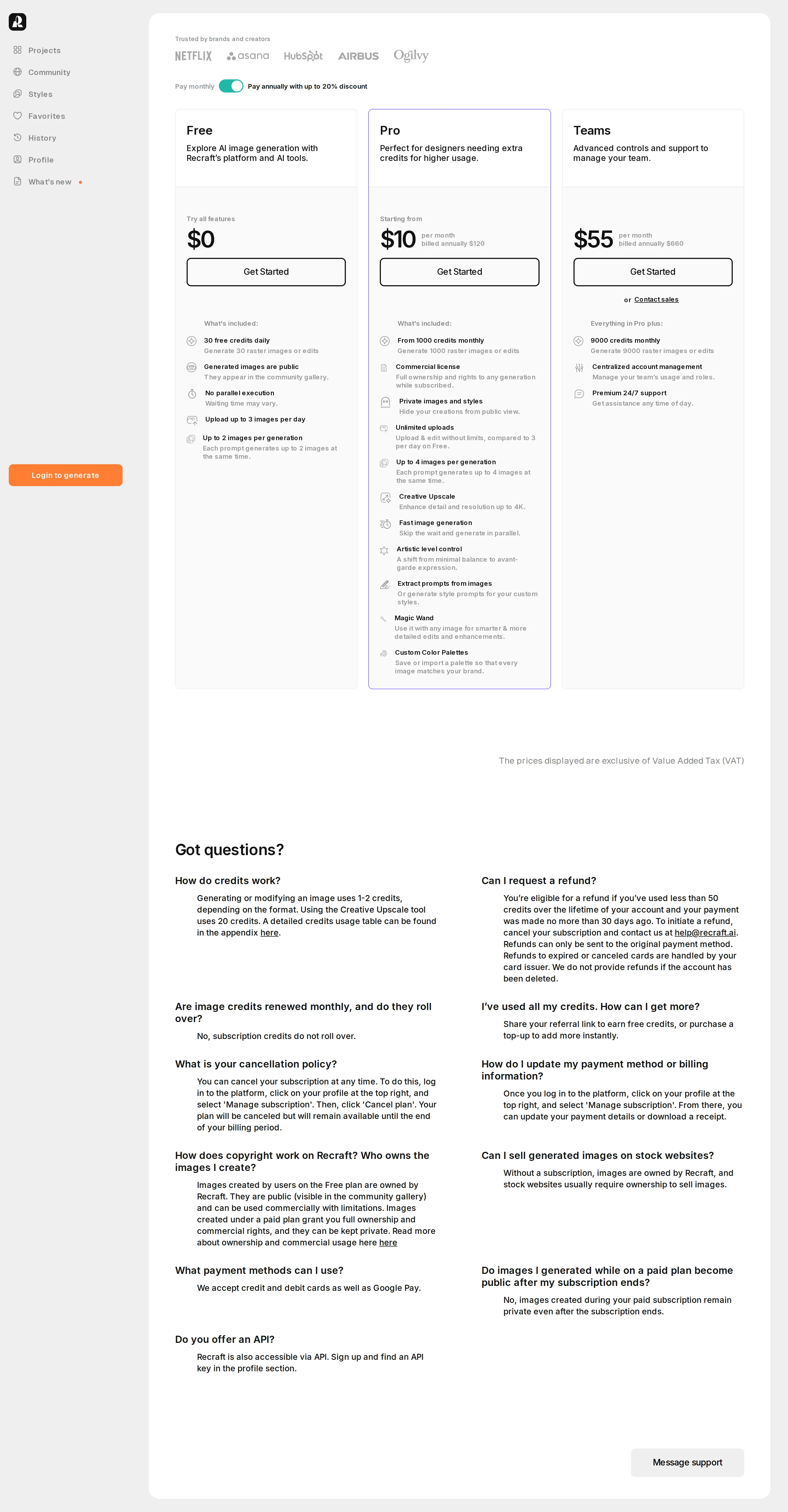
Recraft collapsed the individual tiers into Free / Pro / Teams: Free dropped from 50 to 30 daily credits, Pro became 'Starting from $10/mo' with a scalable credit pool, and a new Teams tier appeared at $55/mo (annually $660, 9,000 credits) with centralized account management, premium 24/7 support and a 'Contact sales' option. Free-tier copyright copy softened to 'commercial use with limitations'.
Feature layering on the four-tier credit model
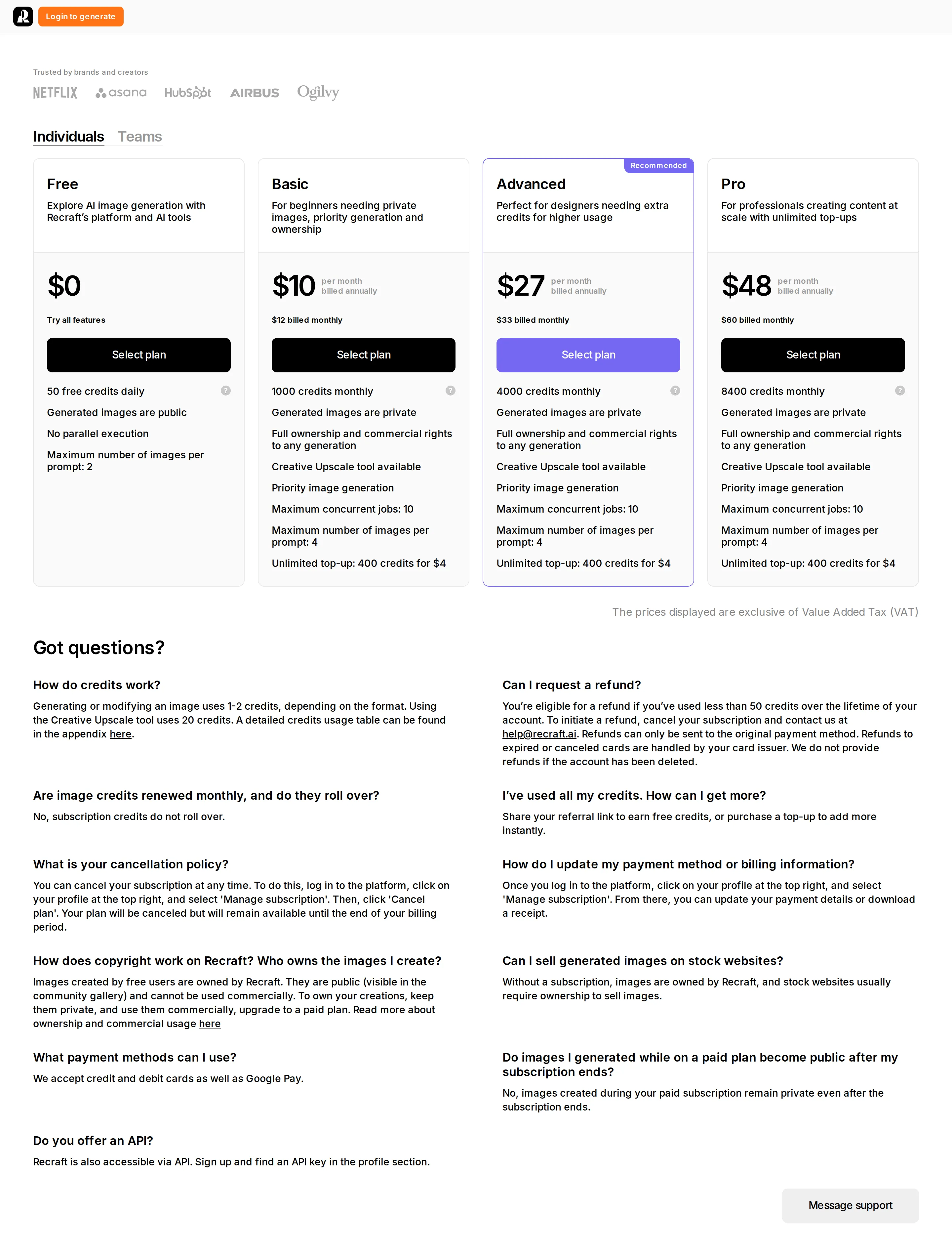
Prices held (Free/$10/$27/$48 annual) while paid tiers accreted features: External (third-party) models, Artistic level control, Extract detailed prompts, custom color palettes, and a Magic wand for smart edits. The credit pools (50 daily / 1,000 / 4,000 / 8,400) and the $4-per-400-credit top-up stayed constant through mid-2025.
Credit-pool overhaul: Free/Basic/Advanced/Pro after Recraft V3
Following the Recraft V3 ('red_panda') launch on 2024-10-30, the page was rebuilt into a four-tier credit-pool model: Free ($0, 50 daily credits), Basic ($10/mo annual, $12 monthly, 1,000 credits), Advanced ($27/$33, 4,000 credits, 'Recommended'), and Pro ($48/$60, 8,400 credits). Introduced the 1-2 credits/image and 20-credit Creative Upscale metering plus 'Unlimited top-up: 400 credits for $4'.
Two-tier flat model: Free + 'Early Recrafter' $20/mo
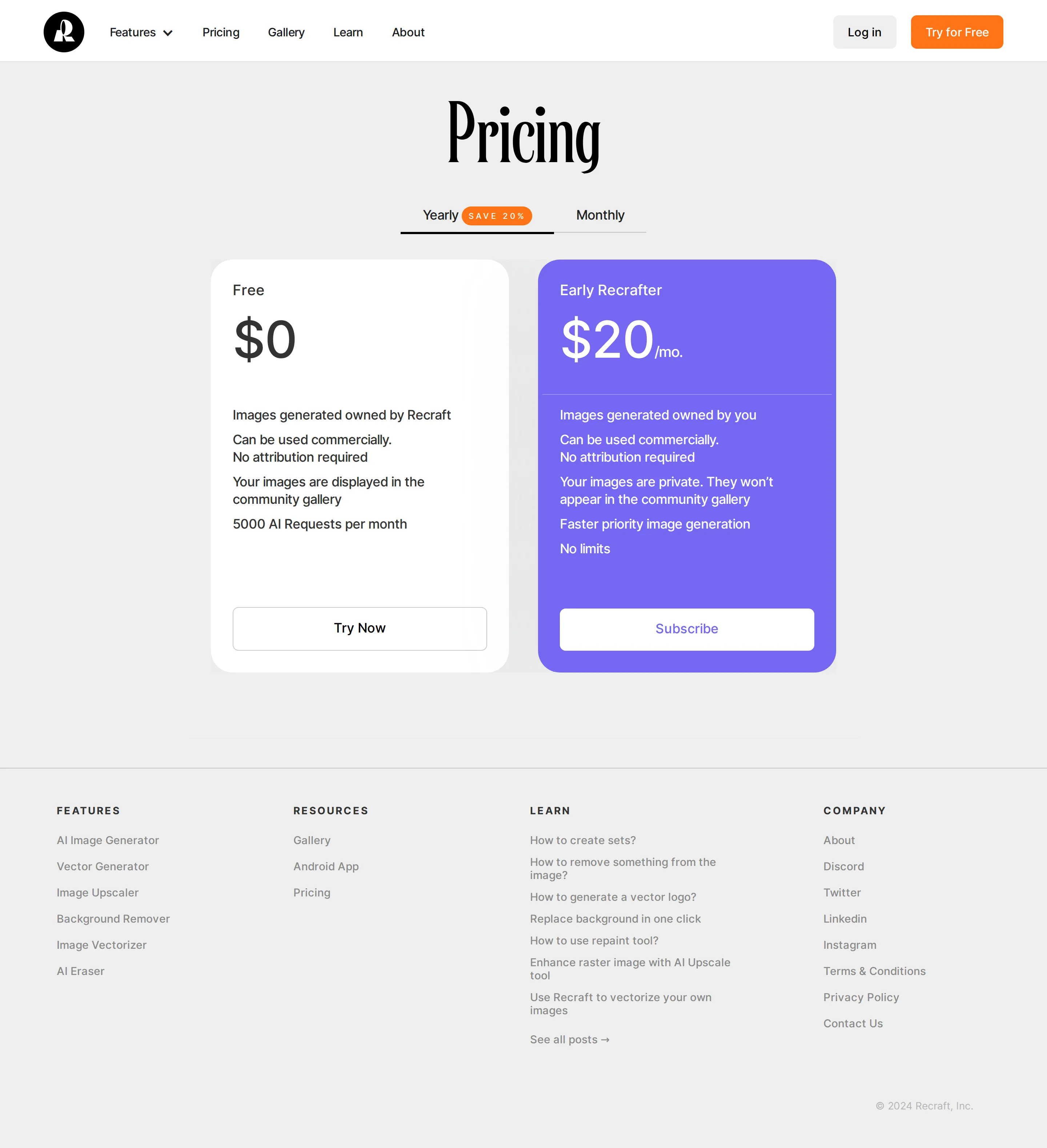
Earliest archived structure: a simple two-card page with Free ($0, images public, owned by Recraft, 5,000 AI requests/mo) and a single paid 'Early Recrafter' plan at $20/mo (private images, faster generation, no limits). A Yearly/Monthly toggle already advertised 'Save 20%'. No credit metering yet - paid was flat unlimited.
- · Recraft's API and Studio use two completely different units: the Studio meters in 'credits' (1-2 per image) while the API meters in 'API units' priced at a flat $1 = 1,000 units.
- · The same image can cost wildly different amounts by model: a Recraft V2 raster render is $0.022 via API while a V4 Pro Vector render is $0.30 - a ~14x spread inside one product. Recraft even prices its newest V4.1 raster ($0.035) below V4 ($0.04).
- · Recraft's Free plan keeps the copyright: images generated on the $0 tier are owned by Recraft, public in the community gallery, and carry no commercial rights until you pay.
Questions & answers
- How much does Recraft cost per month?
- Recraft Studio has four tiers: Free ($0, limited daily credits - Recraft no longer publishes an exact daily quota), Basic ($12/mo for 1,000 credits), Pro ($20/mo for 2,000 credits), and Teams ($22/seat/mo for 2,000 credits per seat). Annual billing lowers these to $10, $16, and $18/seat respectively.
- How do Recraft credits work?
- Generating or editing an image costs 1-2 credits depending on format, and a Creative Upscale costs 20 credits. Subscription credits renew monthly and do not roll over, but purchased top-up credits never expire.
- How is the Recraft API priced?
- The API is billed separately on usage. You pre-purchase API units at $1 = 1,000 units, then each operation deducts units - for example $0.035 (35 units) per newest Recraft V4.1 raster image, $0.04 (40 units) per V4 raster image, or $0.21 (210 units) per V4.1 Pro raster image. As of June 2026 the newest V4.1 models sit in their own cheaper tier below V4, and in August 2026 Recraft added a separate 'V4 Styles' family - which turns reference images into a reusable style - priced from $0.035 to $0.12 per image within the same unit system. Unit packages are non-refundable and never expire.
- Does the Recraft free plan allow commercial use?
- No. Images created on the Free plan are owned by Recraft, remain public in the community gallery, and carry no commercial rights. Commercial ownership and private generation start with the paid Basic plan.
- Does Recraft offer annual billing discounts?
- Yes. Paying annually saves up to 20% on every paid tier: Basic drops to $10/mo ($120/yr), Pro to $16/mo, and Teams to $18/seat/mo.
- What does Recraft Enterprise include?
- Enterprise adds SOC 2 Type II certification, GDPR-aligned data handling, SSO and role-based access, audit logs, and SLA-backed API reliability. It is sold via a sales-led 'Request a demo' motion rather than self-serve.