AI Summary
About
Runway is a generative-media company whose web app and API generate and edit video, images and audio from a single creative AI platform. Its flagship models include Gen-4.5, Gen-4 and Gen-4 Turbo and Aleph 2.0 for video, Gen-4 Image and Nano Banana Pro for images, Lyria 3 / Seed Audio / Text-to-Speech for audio, and Act-Two for performance capture, plus third-party models (Veo 3.1, Seedance 2.0, Kling 3.0, Gemini 3 Pro) surfaced inside the same workspace. The product targets individual creators, studios and agencies, with an enterprise tier and a developer API for embedding the models into other products.
Runway monetizes through subscriptions that bundle a monthly credit allowance, with credits acting as the metered unit across every generation type. Four self-serve tiers (Free, Standard, Pro, Max) sit alongside a sales-led Enterprise tier and a separate usage-based API priced in credits with spend-gated usage tiers. As of the 2026-06-24 capture, the former “Unlimited” top tier has been replaced by “Max,” which keeps the $95/mo ($76 annual) price point but raises the bundled allowance to 9,500 credits/mo and adds one-month credit roll-over. Company financials (ARR, headcount, valuation) are left for wiki-research.
For the most current information on Runway’s pricing and market position, visit Runway.
Pricing summary : How Runway’s pricing model works
Runway runs a subscription-plus-credits model. You buy a subscription (Free, Standard, Pro, Max) and each plan bundles a monthly credit allowance; credits are the single metered unit consumed by every video, image and audio generation, with cost varying by model (e.g. 625 credits ≈ 52s of Gen-4.5, 104s of Gen-4 Turbo, or 78 Gen-4 images). Paid plans refresh credits monthly and let you buy more à la carte. The separate Runway API is pure usage-based: you prepay credits and move through spend-gated usage tiers (1–5) that raise concurrency and daily/monthly limits as cumulative spend grows.
Billing dimensions captured:
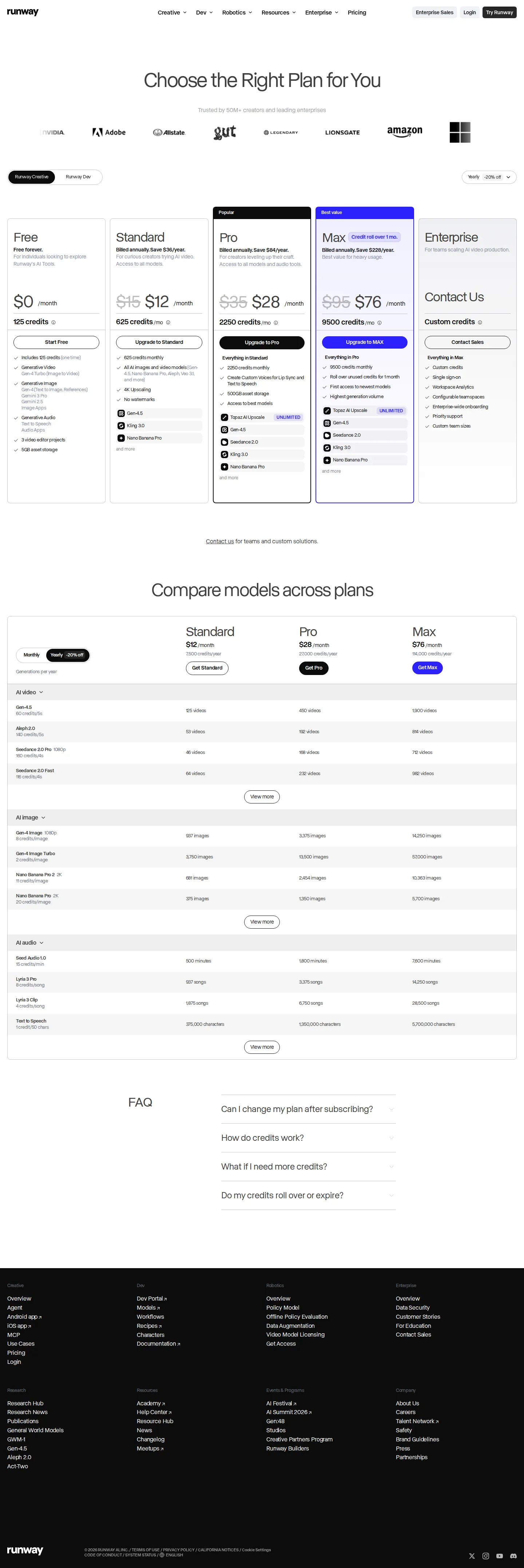
- Subscription — Standard $15/mo, Pro $35/mo, Max $95/mo (monthly billing); each ~20% cheaper billed annually ($12 / $28 / $76 per month, i.e. save $36 / $84 / $228 per year). Free is $0/month.
- Credits — monthly allowance per plan (Free 125 one-time; Standard 625; Pro 2,250; Max 9,500), metered per generation at published per-model rates (e.g. Gen-4.5 12 credits/sec = 60 credits/5s, Gen-4 Image 8 credits/image, Nano Banana Pro 20 credits/image, Text-to-Speech 1 credit/50 chars). Extra credits are purchasable à la carte with a 1,000-credit minimum top-up; purchased credits never expire.
- Max credit roll-over — the Max plan rolls over unused credits for 1 month (the only tier with roll-over; Standard/Pro credits still expire monthly).
- API usage tiers — pay-per-credit with spend-triggered tier upgrades governing concurrency (1→20), max gens/day (50→25,000) and monthly spend caps ($100→$100,000).
- API per-model rates — the developer platform now publishes per-model dollar pricing (Gen-4.5 $0.12/sec, Aleph 2.0 $0.28/sec, Seedance 2.0 from $0.36/sec, Gemini Omni Flash $0.10/sec; images from $0.01/image), billed as usage-based credits under one invoice.
- Storage — bundled per tier (Free 5GB; Pro 500GB asset storage shown on the card).
What makes this different: Runway meters everything in one credit currency whose per-generation cost is published as model-specific time/output equivalents — a textbook credit-based billing layer wrapped around a subscription. Its top tier (Max) keeps the $95/mo price of the former Unlimited plan but swaps the old “unmetered Explore mode at a relaxed rate” mechanic for a far larger 9,500-credit allowance plus 1-month credit roll-over — a shift from a slow-queue “unlimited” story to a bigger-bucket-plus-roll-over story.
Pricing by product
Runway app (subscription plans)
| Plan | Price (USD) | Included | Key mechanics |
|---|---|---|---|
| Free | $0 /month | 125 credits one-time; 3 video editor projects; 5GB storage | Free forever; generative video, image & audio (Gen-4 Turbo, Gen-4, TTS) to explore |
| Standard | $15 /mo ($12 billed annually, save $36/yr) | 625 credits/mo (≈52s Gen-4.5, 104s Gen-4 Turbo, or 78 Gen-4 images at 1080p) | All AI image & video models; 4K upscaling; no watermarks; credits refresh monthly |
| Pro | $35 /mo ($28 billed annually, save $84/yr) | 2,250 credits/mo (≈187s Gen-4.5 or 281 Gen-4 images); 500GB storage | Custom voices for lip sync & TTS; access to best models; everything in Standard |
| Max | $95 /mo ($76 billed annually, save $228/yr) | 9,500 credits/mo (≈791s Gen-4.5, 1,187 Gen-4 images at 1080p, or 475 Nano Banana Pro images at 2K) | “Best value for heavy usage”; rolls over unused credits for 1 month; first access to newest models; highest generation volume; everything in Pro |
| Enterprise | Contact Us | Custom credit packages; all Max features | Sales-led; SSO, workspace analytics, configurable teamspaces, enterprise-wide onboarding, priority support, custom team sizes |
Extra credits are purchasable à la carte from the dashboard’s Plans & Billing page with a 1,000-credit minimum top-up; purchased credits never expire (unlike the monthly plan allowance).
Per-model credit rates (published on the pricing page)
The pricing page’s “Compare models across plans” table now publishes the credit cost of each generation, so buyers can map an allowance to output before subscribing.
| Model | Modality | Credit rate |
|---|---|---|
| Gen-4.5 | Video | 60 credits / 5s (12 credits/sec) |
| Aleph 2.0 | Video | 140 credits / 5s |
| Seedance 2.0 Pro (1080p) | Video | 160 credits / 4s |
| Seedance 2.0 Fast | Video | 116 credits / 4s |
| Gen-4 Image (1080p) | Image | 8 credits / image |
| Gen-4 Image Turbo | Image | 2 credits / image |
| Nano Banana Pro (2K) | Image | 20 credits / image |
| Seed Audio 1.0 | Audio | 15 credits / min |
| Lyria 3 Pro | Audio | 8 credits / song |
| Lyria 3 Clip | Audio | 4 credits / song |
| Text to Speech | Audio | 1 credit / 50 chars |
Runway API (usage-based)
API access is priced per credit (prepaid, autobilling recharges) with organization-level “usage tiers” that upgrade automatically once cumulative spend thresholds are met. Limits are per model, per organization.
| Tier | Max concurrency | Max gens/day | Max spend/mo | Criteria to reach |
|---|---|---|---|---|
| 1 | 1 | 50 | $100 | Default on signup |
| 2 | 3 | 500 | $500 | After $50 purchased |
| 3 | 5 | 1,000 | $2,000 | After $100 purchased |
| 4 | 10 | 5,000 | $20,000 | After $1,000 purchased |
| 5 | 20 | 25,000 | $100,000 | After $5,000 purchased |
The redesigned developer platform page now publishes per-model dollar rates alongside the credit system, billed as usage-based credits under one invoice with cost visible per model, per endpoint and per team:
| Model | Published API rate |
|---|---|
| Gen-4.5 | $0.12 /sec |
| Aleph 2.0 | $0.28 /sec |
| Seedance 2.0 | from $0.36 /sec |
| Gemini Omni Flash | $0.10 /sec |
| Seedream 5.0 Pro | from $0.05 /image |
| GPT Image 2 | from $0.01 /image |
| Gemini 3 Pro | from $0.20 /image |
Custom/higher limits and guaranteed concurrency are handled via enterprise partnerships (exception request from the dev portal). The API product page lists two paths: a self-serve Build plan and a sales-led Enterprise plan.
Sales motions across products: PLG / self-serve for Free, Standard, Pro, Max and the API Build tier; sales-led for Enterprise and custom API concurrency/limits.
Hidden costs : What Runway users actually pay
The sticker price on a Runway plan is the seat fee, but the number that actually moves your bill is how fast your credit allowance evaporates. Because credits do not roll over and reset within 24 hours of the billing date, the real cost driver is the gap between your bundled allowance and your actual generation volume — and that gap is filled either with à-la-carte top-up credits or by jumping a tier.
Archetype A — a solo creator on Pro who renders past the allowance. Pro bundles 2,250 credits/mo (about 90 seconds of Gen-4.5, or 281 Gen-4 images). A creator iterating on a 60-second cut at full quality burns the allowance in days and tops up to finish the project.
| Line item | Monthly cost |
|---|---|
| Pro seat (1 user) | $35 |
| Bundled 2,250 credits | included |
| Top-up credits to finish the cut (purchased à la carte) | variable (overage) |
| Effective monthly total | $35 + every credit past 2,250 |
The lesson: on Standard and Pro, the seat fee is a floor, not a ceiling. Heavy video work at full quality pushes you into recurring top-ups, which is exactly the upsell path into Max.
Archetype B — a 5-person agency team weighing Pro vs Max. Five Pro seats are $175/mo (or $140/mo annual) and bundle 5 × 2,250 = 11,250 credits, but every full-quality second past that is a top-up. Five Max seats are $475/mo ($380/mo annual) and bundle 5 × 9,500 = 47,500 credits with one month of roll-over — over 4× the per-seat allowance, which absorbs heavy months and lets unused credits carry forward instead of being forfeited.
| Line item | Monthly cost (annual billing) |
|---|---|
| 5 × Pro seats | $140 |
| Heavy top-ups across the team | variable, can exceed seat cost |
| 5 × Max seats (47,500 credits, roll-over 1 mo) | $380 |
The lesson: Max is not a flat “unlimited everything” plan — it is a much larger fixed allowance (9,500 credits/seat) with one month of roll-over that smooths bursty, project-based usage. Teams that need predictable cost at high volume pay the ~2.7× seat premium for the 4.2× allowance step, then bank unused credits for a month instead of paying recurring top-ups on full-quality generations.
Want to estimate your own Runway bill? Use the Runway pricing calculator to model your monthly cost based on seat count, credit allowance and top-up volume.
Pricing evolution : Runway pricing history and changes
Cadence
| Quarter | Price changes | Product / SKU additions | Notes |
|---|---|---|---|
| 2022 Q1 | 0 | 0 | Archived pricing shows a four-tier seat ladder — Free $0, Standard $15, Pro $35, Pro Plus $90 — with a credit-style compare grid already present |
| 2026 Q2 | 1 | 0 | 2026-06-24 top-tier repackage: the $95 top plan is rebranded Unlimited → Max, dropping the unmetered Explore-mode mechanic for a 9,500-credit/mo allowance (4.2× the old 2,250) plus 1-month credit roll-over; price held at $95/$76. Standard $15 / Pro $35 and the spend-gated API unchanged |
Tracked range: 2022–2026. Standard ($15) and Pro ($35) have held their headline prices since the 2022 capture; the only structural move in the tracked window is the 2026-06-24 top-tier repackage (Unlimited → Max). Intermediate quarters are not yet individually snapshot-verified on this network; the interval between the 2022 four-tier ladder and the current structure is being backfilled in a later snapshot pass.
Notable changes
- 2022-02 — Archived
runwayml.compricing shows Free $0 / Standard $15 / Pro $35 / Pro Plus $90, with a “compare all plans” credit grid already in place — establishing that today’s $15 Standard and $35 Pro price points are long-standing, not 2026 introductions (source: captured Wayback screenshot,wayback-2022-02-main). - By 2026-05-31 — Top tier is Unlimited at $95/user/mo ($76 annual), occupying the old Pro Plus position and adding unmetered Explore-mode generation at a relaxed, lower-priority rate on top of a 2,250-credit allowance (source: captured
runwayml.com/pricing). - By 2026-05-31 — A separate developer API is live with pure usage-based credit billing and five spend-gated usage tiers (concurrency 1→20, monthly spend cap $100→$100,000), upgrading automatically on cumulative spend (source: captured
docs.dev.runwayml.com/usage/tiers/). - 2026-06-24 — The $95 top tier is rebranded Unlimited → Max, price held at $95/mo ($76 annual). Max retires the unmetered Explore-mode “relaxed rate” mechanic and replaces it with a fixed 9,500 credits/mo allowance (up 4.2× from 2,250) plus 1-month credit roll-over, “first access to newest models” and “highest generation volume.” Free, Standard ($15/$12, 625 credits), Pro ($35/$28, 2,250 credits), Enterprise and the API tiers are unchanged (source: captured
runwayml.com/pricing).
The Unlimited → Max repackage in detail
For most of Runway’s recent history the top tier was sold as “Unlimited,” and community signal consistently flagged the gap between that label and its mechanics: per Runway’s own help docs, unmetered generation ran only in Explore mode at a relaxed rate — a lower-priority queue — while a 2,250-credit allowance still governed full-speed, full-quality output. Third-party reviews and Trustpilot complaints reported account suspensions for heavy use of the $95 plan (Runway citing scripts or account-sharing in disputed cases) and noted that credits “disappear quickly.” None of this reached a strict trust-event threshold (no HN story above 50 points or Reddit thread above 2,000 upvotes was found for Runway ML pricing specifically), so it sat as recurring community signal rather than a single discrete incident.
On 2026-06-24 Runway resolved that mismatch directly: it dropped the “Unlimited” name and the relaxed-rate Explore mechanic entirely, replacing the top tier with Max at the same $95/mo. Max is a clean fixed-allowance plan — 9,500 credits/mo (4.2× the prior 2,250) with 1-month credit roll-over — so the headline is now a number a buyer can reason about rather than an “unlimited-with-an-asterisk” promise. The trade is a real one: heavy users no longer get genuinely unbounded slow-queue volume, but they get a far larger full-speed budget, the ability to bank one month of unused credits, and a label that no longer overstates what they bought. The repackage is the substantive answer to the trust complaints above — Runway chose to right-size the promise rather than re-explain the asterisk.
What’s unique : Runway’s distinctive pricing mechanics
1. One credit currency, published in multiple output “languages.” Runway meters every modality — video, image, audio — in a single credit unit, then translates that unit into model-specific equivalents right on the pricing page. The same 625-credit Standard allowance is shown as ”25s of Gen-4.5, 52s of Gen-4, 125s of Gen-4 Turbo, 78 Gen-4 Images, or 62s of Gen-3 Alpha.” This is credit-based billing done well: customers reason in their own deliverable (seconds of video, number of images) while Runway keeps a single internal accounting unit it can re-price per model without changing the plan.
2. The top tier walked back “unlimited” in favour of a bigger bucket plus roll-over. Until mid-2026 Runway’s top plan was sold as “Unlimited,” but the unmetered volume lived only in a relaxed-rate Explore queue while a 2,250-credit allowance still governed full-speed work — a hybrid the name oversold. On 2026-06-24 Runway replaced it with Max at the same $95/mo: it dropped the unmetered-but-relaxed mechanic and instead bundles 9,500 credits/mo (4.2× the old allowance) with 1-month credit roll-over. The distinctive move is the direction — most GPU-bound vendors lean into “unlimited” marketing to protect margins via deprioritization; Runway did the opposite, trading an ambiguous flat-rate promise for a large, legible fixed budget that buyers can map to output. Roll-over also makes Max the only tier where unused allowance is not forfeited, turning credit retention into the top tier’s differentiator.
3. A subscription web app and a pure-usage API priced in the same currency. The self-serve app is seat-plus-bundled-credits; the developer API is pure prepaid usage with five spend-gated tiers. Both meter in credits, so Runway runs one metering ledger across two completely different go-to-market motions — PLG seats for creators, usage-based credits for developers — without maintaining two pricing systems.
4. Tier upgrades on the API are spend-triggered and automatic. API limits do not require a sales conversation to lift: cross a cumulative-spend threshold ($50, $100, $1,000, $5,000 purchased) and the organization auto-upgrades to the next tier with “no waiting period,” raising concurrency and the monthly spend cap. Spend is the qualification signal, which keeps the developer funnel entirely self-serve until genuinely enterprise-scale concurrency is needed.
5. A hard monthly spend cap is a first-class billing primitive. Each API organization has a maximum monthly spend; autobilling refuses to recharge past the remaining cap and throttled tasks return THROTTLED/429 rather than silently overspending. Runway treats the spend ceiling as a safety rail customers can rely on, not just an abuse limit — a notable contrast to credit systems where auto-recharge is the bill-shock vector.
Strengths & weaknesses
| Strengths | Weaknesses |
|---|---|
| Credit cost is published as concrete output per model (seconds of video, image counts), so buyers can self-estimate before paying | Standard and Pro credits still do not roll over and reset within 24h of billing — unused allowance is forfeited every cycle, penalizing bursty usage on the lower tiers |
| Clean four-tier self-serve ladder with a visible monthly/annual toggle (−20%) and transparent public prices through Max | Roll-over is now a Max-only perk; Standard/Pro buyers with lumpy, project-based workflows get no relief from the monthly forfeiture |
| Single credit currency spans web app and API, and the API funnel is fully self-serve via spend-triggered tier upgrades | Heavy full-quality work on Standard/Pro still forces top-ups or a jump to Max; the lower-tier seat fee is a floor, not a predictable ceiling |
| The 2026 Max repackage retired the over-promising “Unlimited” label for a legible 9,500-credit/mo budget with 1-month roll-over — fixing the top tier’s headline trust gap | Top-up credit pricing and exact per-credit API rates are still not surfaced on the main pricing page (must dig into product/dev portal) |
| Max bundles 4.2× the prior allowance at the same $95 price, materially improving full-speed value for heavy users | Max drops the genuinely unmetered (slow-queue) volume the old Unlimited plan offered, so the very heaviest slow-queue users lose an unbounded option |
Billing UX : Runway billing controls and transparency
- Monthly / Yearly toggle — the pricing page has a Monthly vs Yearly switch (default Yearly, “-20% off”), exposing both rates side by side before purchase; annual cards state the exact saving (Standard save $36/yr, Pro $84/yr, Max $228/yr).
- Credit allowance with monthly refresh — paid plans show an explicit per-model credit budget (625, 2,250 or 9,500 credits/mo) that refreshes monthly; the page translates credits into concrete output (seconds of each model, image counts at 1080p/2K).
- Per-model credit-cost comparison table — the pricing page now carries a “Compare models across plans” table publishing each model’s credit rate (e.g. Gen-4.5 60 credits/5s, Gen-4 Image 8 credits/image, Text-to-Speech 1 credit/50 chars) and the resulting generations-per-month/year for each plan, so buyers can size an allowance before purchase.
- À-la-carte top-ups from Plans & Billing — extra credits are bought from the dashboard’s Plans & Billing page with a 1,000-credit minimum purchase; purchased credits never expire, unlike the monthly plan allowance.
- Max credit roll-over badge — only the Max plan carries a “Credit roll over 1 mo.” badge and an explicit “Roll over unused credits for 1 month” line; Standard and Pro credits still expire each cycle.
- API autobilling with spend caps — the API auto-recharges credits and enforces a maximum monthly spend per organization; autobilling caps recharges at the remaining monthly spend, and throttled tasks return a
THROTTLED/429status rather than overspending. - Usage tiers visible in dev portal — API concurrency, daily-generation and monthly-spend limits, plus a limits-exception request form, are surfaced on the developer portal usage page.
- Enterprise quote flow — Enterprise routes to a “Contact Us / Contact Sales” form (no public price) for custom credit packages, SSO, configurable teamspaces and custom team sizes.
Strategic wins : Why Runway’s pricing decisions worked
1. Translating credits into deliverables instead of leaving them abstract
Runway’s biggest pricing-page win is refusing to make customers do credit math. Every allowance is shown as concrete output — “625 credits = 25s of Gen-4.5… or 78 Gen-4 Images” — so a creator can map their project to a plan before paying. This is the right answer to the value-metric problem in AI pricing: the internal unit stays a credit (cheap to re-price per model), but the customer-facing unit is the thing they actually want. See choosing the right usage metric for why this dual framing works.
2. Running one metering ledger across two go-to-market motions
By pricing both the seat-based app and the developer API in the same credit currency, Runway avoids maintaining two billing systems while serving two very different buyers. The PLG creator funnel and the usage-based developer funnel share metering, which keeps operational complexity down and lets the company reprice model costs once. It mirrors the multi-motion approach other AI platforms are converging on as they shift away from per-user licenses.
3. Making the API funnel self-serve with spend-triggered tiers
Runway’s API tiers upgrade automatically on cumulative spend ($50 → $100 → $1,000 → $5,000 purchased) with no waiting period and no sales call until genuinely enterprise-scale concurrency. Spend becomes the qualification signal, so developers can scale from a $100/mo cap to a $100,000/mo cap entirely self-serve. That removes the classic friction of usage-based products where raising limits requires a human, and it keeps the prepaid-credit model frictionless right up to enterprise.
4. Treating the spend cap as a feature, not just an abuse limit
The hard monthly spend cap, autobilling that refuses to recharge past the remaining cap, and explicit THROTTLED/429 semantics give API customers a real guarantee against runaway bills. In a category where auto-recharge credit systems are a notorious bill-shock and cost-unpredictability vector, shipping a dependable ceiling is a trust win that directly addresses developer anxiety about embedding a usage-metered model in production.
Areas to improve : Gaps in Runway’s pricing approach
1. Extend Max’s credit roll-over (or a low-balance nudge) down to Standard and Pro
The 2026-06-24 repackage shipped 1-month roll-over — but only on Max. That leaves the all-or-nothing monthly forfeiture fully in place for the Standard and Pro creators whose lumpy, project-based workflows it punishes most: a month of heavy rendering followed by a quiet month still wastes half the allowance. A concrete fix: offer a smaller roll-over cap on the paid lower tiers (e.g. carry up to one week, or a fixed credit ceiling), or at minimum a clear in-product “credits expiring soon” nudge so users can pace work. Tools like thresholding and alerting on usage are the standard pattern here and would soften the reset for the tiers that just missed out on roll-over.
2. Publish the Max vs Pro crossover so the 4.2× allowance jump is legible
Max now bundles 9,500 credits/mo against Pro’s 2,250 at $95 vs $35 — a 2.7× price step for a 4.2× allowance step, which is genuinely good value for heavy users but invisible unless a buyer does the arithmetic. With the old “unlimited” hook gone, Max has to win on math, so Runway should show the breakeven directly: roughly the monthly credit volume at which Max beats Pro-plus-top-ups. Surfacing that crossover (the same logic the Runway pricing calculator models) turns the repackage from a rename into a clear upgrade trigger and reduces the unpredictable-cost anxiety that pushes heavy users to over-buy or churn.
3. Surface top-up and per-credit API rates on the main pricing page
Today the plan prices are transparent through Max, but the two numbers that determine a heavy user’s real bill — the cost of à-la-carte top-up credits and the effective per-credit API rate — are not on the main pricing page; you have to dig into the product or dev portal. Publishing a simple per-credit rate and a top-up table would let buyers model overages up front and reduce the unpredictable-cost anxiety that pushes them to abandon or over-buy.
Monetization stack & signals : how Runway builds & buys its revenue engine
Buys 4 Builds 0 11 open roles
Runway is standing up a top-of-funnel-to-enterprise revenue operating system rather than a billing-platform team: the open Director/VP Revenue Operations role explicitly governs a bought GTM stack — Salesforce (CRM), Gong (revenue intelligence) and Clay (data enrichment) — and owns a deal desk with "pricing guardrails, discount authority levels, and custom quote governance" as it builds the PLG-to-Enterprise motion. Product analytics is Mixpanel (named in-use in the mobile-engineering posting). No vendor is disclosed for the credit-metering ledger that meters every video/image/audio generation across the app and usage-based API, and the only ERP signal is a "Netsuite a plus" line on a Senior Accountant req — so the rev-rec and metering layers are recorded as unknown, not asserted. The hiring weight sits in RevOps/deal-desk and customer-success/retention (API Deployment Manager, enterprise creative support), consistent with a self-serve creator base now being layered with an enterprise and developer-API sales motion.
-
“Govern the GTM tech stack (Salesforce, Gong, Clay, Slack, Claude, etc.) and evaluate new additions”
-
“Govern the GTM tech stack (Salesforce, Gong, Clay, Slack, Claude, etc.) and evaluate new additions”
-
“Manage the outbound data infrastructure (Clay enrichment, sequencing, intent) and optimize BDR productivity at the systems level”
-
“We integrate LiveKit for real-time video, Mixpanel for analytics, and Sentry for error monitoring”
-
“High proficiency in Excel; experience with Netsuite a plus”
-
“Collaborate with backend and web engineers to design and consume APIs that power generative AI tools, asset management, billing, and in-app purchases”
- API Deployment Manager Customer successRetention seen Jun 9, 2026
- Creative Support Specialist, Enterprise Customer successRetention seen Jun 9, 2026
- Founding Growth & Deployment Lead, Japan Retention seen Jun 9, 2026
- Member of Technical Staff, Mobile Engineer Retention seen Jun 9, 2026
- Director/ VP Revenue Operations RevOpsDeal deskGrowth seen Jun 3, 2026
- Product Marketing Manager, Enterprise & Developers MonetizationGrowth seen Jun 3, 2026
- Product Marketing Manager, Prosumer Growth seen Jun 3, 2026
- Director, Sales Development RevOps seen Jun 1, 2026
- Sr/Staff Product Manager, ML Research RevOps seen Jun 1, 2026
- Staff Product Analytics Engineer Data platform seen Apr 17, 2026
- Creative Workflow Architect (Fluent in Japanese) Customer success seen Mar 17, 2026
Signals reviewed · derived from public job posts
Job postings fill and close over time — once a posting is filled we keep it as a dated citation (the quoted evidence remains); use View open roles for current listings.
Key takeaways
- Meter in an internal unit, sell in the customer’s unit. Runway keeps a single credit ledger but presents it as seconds of video and image counts per model. Other usage-priced teams should decouple the billing unit from the displayed unit so they can re-price model costs without renaming the plan.
- A bundled allowance turns usage pricing into a predictable subscription — until it doesn’t. Seat-plus-bundled-credits feels like flat-rate right up to the allowance, then becomes pure overage. Be explicit about where that line is, because the moment a customer crosses it is where churn and bill-shock risk concentrate.
- When an “unlimited” label outruns its mechanics, right-sizing the promise beats re-explaining the asterisk. Runway sold a relaxed-rate “Unlimited” tier for years and absorbed steady trust complaints; in 2026 it fixed the gap not by clarifying the fine print but by replacing the tier with Max — a large, legible fixed allowance plus roll-over. The lesson for other teams: if a flat-rate name keeps generating disputes, a credible bigger-bucket number can buy back more trust than any amount of card-level disclosure.
- Spend-triggered tier upgrades scale a usage funnel without sales friction. Using cumulative spend (not a sales call) to auto-lift concurrency and spend caps keeps developers self-serve from $100/mo to $100,000/mo, reserving humans for genuinely enterprise concurrency.
- A hard spend cap is a differentiator, not just a guardrail. In a credit/auto-recharge world where overspending is the default failure mode, shipping a dependable monthly ceiling with explicit throttling semantics is a marketable trust feature for any usage-based product.
UBP implications
- Credit currencies let GPU-bound businesses re-price the cost-of-goods layer continuously. Because Runway meters in abstract credits and only the per-model conversion changes, it can absorb shifts in inference cost (new models, cheaper hardware) without re-papering every plan — a structural advantage credit-based billing gives compute-heavy AI products.
- A legible “bigger bucket” can beat an ambiguous “unlimited” promise. Runway tried unmetered volume on a deprioritized queue under an “Unlimited” label, then in June 2026 walked it back to a large fixed Max allowance (9,500 credits/mo) with one-month roll-over. The UBP lesson: in capacity-constrained categories, a generous but bounded allowance buyers can map to output often buys more trust than an “unlimited-with-an-asterisk” plan that invites disputes.
- The same metered unit can power both PLG and developer GTM if the cap mechanics differ. Runway runs identical credits through seat-bundled self-serve and spend-capped API tiers. The lesson for UBP strategy: the metering unit can be shared across motions, but the governance layer (allowances vs. spend caps vs. tier gates) is what you tailor per buyer.
Sources
- Runway pricing page (accessed 2026-06-24)
- Runway API usage tiers & limits (developer docs) (accessed 2026-06-24)
- Runway API product page (accessed 2026-06-24)
- Runway Enterprise page (accessed 2026-06-24)
- Runway Help Center — How do credits work? (accessed 2026-05-31)
Bottom line
Runway runs one of the cleaner credit-based pricing systems in generative media: a transparent four-tier ladder that translates an abstract credit currency into concrete seconds-of-video and image counts, paired with a fully self-serve, spend-capped API. Its longest-running liability — the over-promising “Unlimited” tier whose unmetered volume hid in a relaxed-rate queue — was retired in June 2026 and replaced by Max, a $95 plan that swaps the asterisk for a 9,500-credit budget and one-month roll-over. The result is a pricing story that is now honest where it once oversold, which makes Runway a useful case study in how a credit model self-corrects: when the name gets ahead of the mechanics, a bigger, legible number is the fix.
Want to compare Runway against other generative-media and AI-platform companies? Browse the pricing blueprint.
Pricing timeline : Major events on a vertical axis
Each milestone below corresponds to a public pricing change, product launch, or material adjustment. Major events use a filled marker; minor adjustments use a faded one.
Model-lineup refresh + per-model credit/API-rate transparency (prices held)
Captured runwayml.com/pricing (USD): plans, prices and credit allowances unchanged — Free $0, Standard $15/$12 (625 credits), Pro $35/$28 (2,250), Max $95/$76 (9,500, 1-month roll-over), Enterprise contact. New on the page: a 'Compare models across plans' table now publishes per-model credit costs (Gen-4.5 60 credits/5s = 12 credits/sec, Gen-4 Image 8 credits/image, Nano Banana Pro 20 credits/image, Text-to-Speech 1 credit/50 chars) and the FAQ states a 1,000-credit minimum top-up. Model lineup expanded (Gen-4.5, Nano Banana Pro, Aleph 2.0, Seedance 2.0, Kling 3.0, Lyria 3, Seed Audio, Gemini 3 Pro). The redesigned developer platform page now publishes per-model API dollar rates (Gen-4.5 $0.12/sec, Aleph 2.0 $0.28/sec, Seedance from $0.36/sec, Gemini Omni Flash $0.10/sec, images from $0.01/image). API usage tiers unchanged.
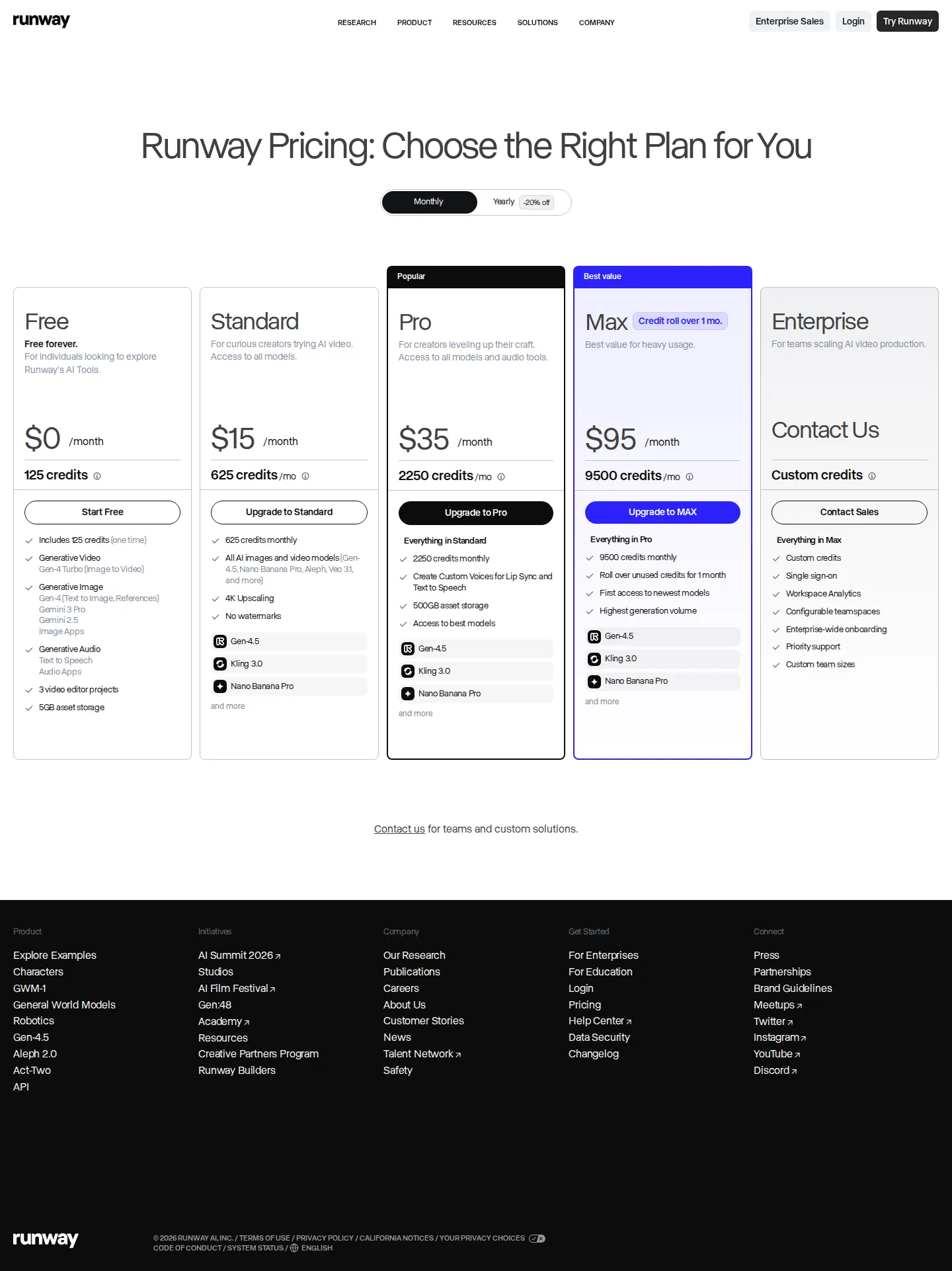
Top tier rebranded Unlimited → Max (9,500 credits + roll-over)
Captured runwayml.com/pricing (USD): the former Unlimited plan is replaced by Max at the same $95/mo ($76 annual). Max drops the unmetered Explore-mode mechanic and instead bundles 9,500 credits/mo (up from 2,250) with 1-month credit roll-over, first access to newest models and highest generation volume. Free ($0), Standard ($15/$12, 625 credits), Pro ($35/$28, 2,250 credits) and Enterprise (contact) unchanged on price. Usage-based API tiers unchanged.
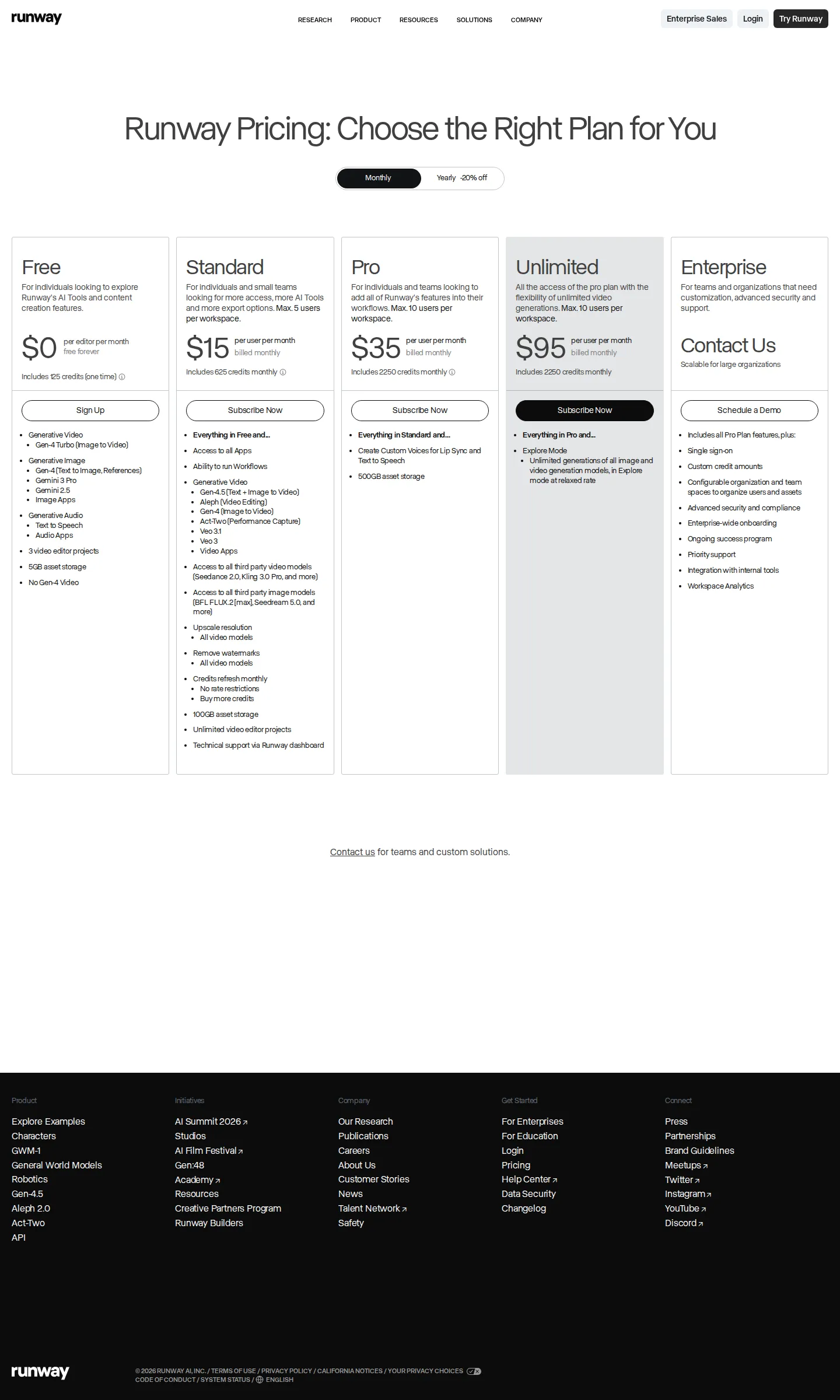
Four-tier app (Unlimited top tier) + usage-based API
Captured runwayml.com/pricing (USD): Free $0, Standard $15/user/mo ($12 annual), Pro $35 ($28 annual), Unlimited $95 ($76 annual) with Explore-mode unmetered generation and a 2,250-credit allowance, Enterprise contact. Separate developer API priced per credit with five spend-gated usage tiers ($100-$100k/mo caps).
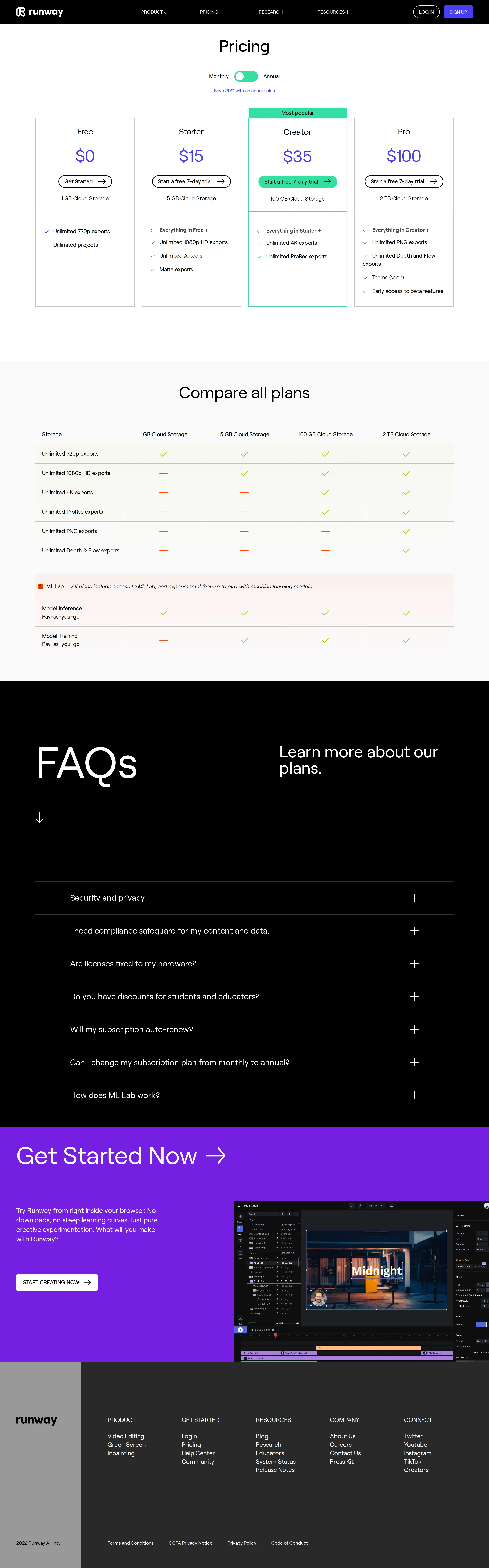
Four-tier seat pricing (pre-Unlimited)
Archived runwayml.com pricing showed a four-tier seat ladder — Free $0, Standard $15, Pro $35 and Pro Plus $90 — with a credit-style 'compare all plans' grid already in place. The current $15 Standard / $35 Pro price points predate 2026; the top tier was then Pro Plus rather than today's Unlimited.
- · Runway prices the same credit currency in two output languages at once: 625 credits is published as both '25s of Gen-4.5 video' and '78 Gen-4 images', so the metered unit means different things per model.
- · In June 2026 Runway retired the 'Unlimited' plan and replaced it with 'Max' at the same $95/mo — swapping the old unmetered-but-relaxed-rate Explore mode for a 9,500-credit monthly allowance (4.2× the old 2,250) plus 1-month credit roll-over.
- · Runway's $15 Standard and $35 Pro price points predate 2026: archived pricing from early 2022 shows the same two figures, when the top tier was 'Pro Plus' at $90 rather than today's Max at $95.
Questions & answers
- What is Runway's pricing model?
- Runway uses a per-seat subscription where each plan bundles a fixed monthly credit allowance; credits are the single metered unit consumed by every video, image and audio generation. A separate developer API is pure usage-based, billed per credit with spend-gated usage tiers.
- Does Runway offer a free tier?
- Yes. The Free plan is $0 per month and includes 125 one-time credits to explore Runway's AI tools (generative video, image and audio), 3 video editor projects and 5GB asset storage.
- How much does Runway cost per month?
- Paid plans are Standard ($15/mo), Pro ($35/mo) and Max ($95/mo) at monthly billing. Annual billing cuts roughly 20 percent, to $12, $28 and $76 per month respectively (saving $36, $84 and $228 per year). Enterprise is custom-quoted.
- Is Runway pricing usage-based or subscription?
- It is a hybrid. The web app is a subscription with a bundled monthly credit pool (usage-metered within the plan), while the developer API is purely usage-based credits with five auto-upgrading spend tiers.
- Do Runway credits roll over each month?
- Only on the Max plan, which rolls over unused credits for one month. On Standard and Pro the monthly credit allowance does not roll over; unused credits expire each cycle, so any allowance you do not use is forfeited.
- What is Runway's Max plan?
- Max is Runway's top self-serve tier at $95/mo ($76 billed annually), replacing the former Unlimited plan. It bundles 9,500 credits per month (about 791 seconds of Gen-4.5 or 1,187 Gen-4 images), rolls over unused credits for one month, and adds first access to newest models and the highest generation volume.