AI Summary
About
Sana is a Stockholm-based enterprise AI company (Sana Labs AB, founded 2016) that sells two things under one brand. Sana Agents is an AI assistant for work — it joins your meetings, searches across your connected tools (Notion, Drive, Slack, Zendesk and more), and runs agentic tasks. Sana Learn is an AI-first enterprise LMS/LXP that authors courses, runs adaptive learning, and tracks completion. Customers include Merck, Electrolux, Hinge Health and Svea Solar, and the platform crossed 1M+ users.
The corporate story matters for pricing. Sana raised $130M+ total, capped by a $55M Series C in October 2024 (led by NEA, with Menlo Ventures) at a $500M valuation, alongside acquiring workflow-automation startup CTRL. Then Workday acquired Sana for approximately $1.1 billion — announced September 2025, closed November 4, 2025 — and relaunched it as a Workday AI platform in March 2026, adding a Sana Self-Service Agent (300+ HR/finance skills) and Sana Enterprise. So you are now buying from a public enterprise-software vendor, which reinforces the sales-led posture on the high end.
For current pricing, the two live rate surfaces are Sana Agents pricing and Sana Learn pricing.
Pricing summary : How Sana AI’s pricing model works
Sana runs two pricing models in parallel. Sana Agents is per-seat with a public rate card: a Free plan at zero dollars, a Team plan at $30 per user per month, and a custom-quoted Enterprise plan. Sana Learn is per-user/month but quote-only — the page shows “indicative pricing” only after you pick a region and seat band, requires booking an intro for a real number, and enforces a 300-user minimum.
That split is the whole story: the assistant is productized and self-serve up to 50 members; the LMS and anything enterprise-grade is sales-led. There is a genuine free tier on Agents (10 meetings/month, up to 5 members), but no free tier on Learn.
What makes this different: most enterprise AI workspaces are gated end-to-end. Sana publishes a clean, low-friction $30/seat assistant card while keeping its higher-ACV LMS behind sales — a deliberate two-speed motion now sitting inside Workday.
Pricing by product
| Product / Tier | Price | Included | Key mechanics |
|---|---|---|---|
| Sana Agents — Free | $0 | 10 meetings/mo, up to 5 members, 1,000 docs/integration | Self-serve, work-email signup |
| Sana Agents — Team | $30 per user / month | Unlimited queries & recordings, up to 50 members, OpenAI + Claude, 10,000 docs/integration | Self-serve, per-seat |
| Sana Agents — Enterprise | Custom (quote) | Unlimited members & docs, SAML SSO, SCIM, DPA, analytics, MCP client, SLA | Sales-led |
| Sana Learn | Quote-only (per user/mo) | Full LMS/LXP, AI authoring, content library, analytics, SSO, 24/7 support | Sales-led, 300-user minimum |
Sales motions across products: Sana Agents Free and Team are self-serve; Sana Agents Enterprise and all of Sana Learn are sales-led. Sana Learn enforces a 300-seat floor, so even the entry deal is an enterprise-sized commitment.
Hidden costs : What Sana AI users actually pay
On Sana Agents, the real costs are the caps, not surprise fees. Free stops at 10 meetings/month and 5 members; Team stops at 50 members and 10,000 documents per integration. Hit either and you are pushed into a custom Enterprise quote — there is no published overage rate, so the “next dollar” is a sales conversation, not a meter.
On Sana Learn, the hidden cost is the 300-user minimum. Even if you only need 120 learners, you pay for 300. Sana does not publish a per-seat number, but third parties model it: educate-me.co estimates a Sana Learn Core baseline around $46,800/year (300 licenses x roughly $13/user x 12) and teachfloor.com cites an overall enterprise band of roughly $50,000 to $100,000 per year depending on seats and features. Treat both as editorial estimates, not a Sana rate card. Advanced SSO/SCIM, extra LLM models, premium connectors and analytics are the usual upsell drivers.
| Line item | Monthly cost |
|---|---|
| Sana Agents Team, 20 seats | $600 (20 x $30) |
| Sana Learn, 300-seat minimum (est. ~$13/user, third-party) | ~$3,900 (estimate, not official) |
| Enterprise add-ons (SSO/SCIM, analytics, connectors) | Quoted |
| Typical Learn entry total | ~$46,800/year baseline (est.) |
Want to estimate your own Sana AI bill? Use the Sana AI pricing calculator to model your costs based on usage patterns.
Pricing evolution : Sana AI pricing history and changes
Cadence
| Quarter | Price changes | Product / SKU additions | Notes |
|---|---|---|---|
| 2024 Q4 | 0 published | Agentic AI features, CTRL acquisition | $55M Series C at $500M valuation |
| 2025 Q4 | 0 published | — | Workday acquires Sana (~$1.1B, closed Nov 4) |
| 2026 Q1 | 0 published | Sana Self-Service Agent (300+ skills), Sana Enterprise | Relaunched as a Workday AI platform |
Tracked range: 2024–present. Sana has kept its public Agents rate card ($0 / $30 / custom) stable through the ownership change; the LMS has stayed quote-only with a 300-seat minimum throughout.
Notable changes
- 2024-10-30 — $55M Series C at a $500M valuation (NEA); acquired CTRL; pushed agentic features.
- 2025-11-04 — Workday closed its ~$1.1B acquisition of Sana Labs.
- 2026-03-17 — Workday relaunched Sana as an AI knowledge/automation platform with new agent SKUs; public Sana Agents and Sana Learn pricing surfaces remained live.
What’s unique : Sana AI’s distinctive pricing mechanics
1. Two-speed pricing under one brand. Sana publishes a frictionless $30/seat assistant and hides an enterprise LMS behind a 300-seat sales motion. Most competitors pick one posture; Sana runs both at once.
2. A real free tier as a top-of-funnel for an enterprise product. “Sign up free with your work email” plus 10 meetings/month is unusual for a company whose core revenue is six-figure LMS deals — the free Agents plan exists to seed the org before sales arrives.
3. The 300-seat floor as the de facto price. Sana never lists a Learn per-seat rate, but the 300-user minimum is the published mechanic that sets the real entry cost — the number is implied by the floor, not a sticker.
Strengths & weaknesses
| Strengths | Weaknesses |
|---|---|
| Transparent, self-serve $30/seat assistant card | Sana Learn is fully quote-only — no public per-seat rate |
| Genuine free tier with usable document limits | 300-user minimum prices out smaller teams on Learn |
| Model choice (OpenAI + Claude) baked into Team | No published overage rates; caps force a sales call |
| Backed/owned by Workday post-acquisition (durability, integration) | Reviewers cite cost as “insurmountable” vs other LMSs |
Billing UX : Sana AI billing controls and transparency
- Billing controls — Sana Agents Team is straightforward per-seat self-serve; you add members up to the 50-seat cap. Enterprise and all of Learn are contract-based, so spend is set at the deal, not adjusted in-app.
- Usage visibility — The Enterprise tier adds an analytics dashboard; Free/Team expose meeting and document caps rather than spend meters (there is no per-unit overage to watch).
- Payment options — Self-serve Team is card/subscription; Enterprise and Sana Learn run on annual contracts and invoicing via a sales agreement (MSA / enterprise DPA), per the signup terms.
Strategic wins : Why Sana AI’s pricing decisions worked
1. A productized assistant funnels into enterprise
Publishing a clean $30/seat assistant lets teams adopt Sana bottoms-up, then converts into the higher-ACV LMS and Enterprise deals. It is a classic land-and-expand wrapper around a sales-led core. See usage-based pricing strategy for the framework.
2. Per-seat simplicity in a noisy AI-pricing market
While many AI workspaces experiment with credits and token meters, Sana kept the assistant on a flat per-seat price — predictable and easy to approve. Related: how AI companies structure pricing and outcome-based pricing trends.
3. The 300-seat floor protects deal economics
A 300-user minimum on Learn ensures every LMS deal clears an enterprise threshold, keeping support and implementation costs viable. It self-selects for buyers who can absorb six-figure contracts. See choosing the right usage metric.
Areas to improve : Gaps in Sana AI’s pricing approach
1. Sana Learn pricing is opaque
There is no public per-seat number for the LMS — buyers must book an intro to learn the price, which slows evaluation. Reviewers repeatedly flag cost as a barrier (“insurmountable compared to other LMSs”). See bill shock and cost unpredictability.
2. No middle tier between $30 self-serve and enterprise
The jump from the $30 Team plan (50-member cap) straight to custom Enterprise leaves mid-market buyers with nowhere to land short of a sales call. A published mid-tier would reduce friction.
3. The 300-seat floor excludes smaller orgs
Teams that want Sana Learn but have fewer than 300 learners simply cannot buy it at list. That is deliberate, but it cedes the SMB learning segment to cheaper, self-serve LMS competitors.
Monetization stack & signals : how Sana AI builds & buys its revenue engine
2 open roles
Signals are thin and consistent with a small company absorbed into a larger parent: Workday closed its ~$1.1B acquisition of Sana Labs on 2025-11-04 (confirmed by Workday's own newsroom) and relaunched the product in March 2026, so the revenue/billing engine is increasingly Workday's rather than a standalone Sana stack. On a 2026-06-17 re-pull of Sana's Ashby board the listing had shrunk to 12 roles (from ~30 earlier), tilted toward Go-To-Market and Engineering; on the go-to-market side only two customer-success roles remain live (an Engagement Associate in New York and a Stockholm/London Emerging-Talent posting). No billing, metering, deal-desk or revenue-data-platform engineering roles are open, and no engineering-blog or filing discloses an in-house monetization build. The single Growth Marketing req that earlier named Salesforce/HubSpot (CRM + marketing automation) and Looker Studio (BI) — only ever as "nice-to-have" / "tools like" examples, never a verbatim in-use disclosure — has since been delisted, removing the sole source for those tools, so no monetization-stack vendors are recorded.
- Engagement Associate Customer success Jun 17, 2026
- Future Opportunities (Emerging Talent) Customer success Jun 17, 2026
Signals reviewed · derived from public job posts
Job postings fill and close over time — once a posting is filled we keep it as a dated citation (the quoted evidence remains); use View open roles for current listings.
Key takeaways
- Sana Agents is the only public price: Free $0, Team $30/user/mo, Enterprise custom.
- Sana Learn is quote-only with a 300-user minimum — the floor is the real entry cost (~$46,800/year by third-party estimate, not official).
- The free tier is genuine but capped (10 meetings/month, 5 members) and exists to seed enterprise adoption.
- Sana is now a Workday platform (~$1.1B acquisition, closed Nov 2025; relaunched March 2026) — buy with that durability and integration in mind.
- Two-speed pricing is the signature: productized self-serve assistant on top of a sales-led, high-ACV LMS.
UBP implications
- A public per-seat card can coexist with a sales-led core — Sana uses the cheap assistant as a transparent on-ramp to an opaque LMS, a useful pattern for teams nervous about going fully gated.
- Seat minimums substitute for a published price. When you won’t list a rate, a credible floor (300 users) still signals the real cost and qualifies buyers — relevant for any UBP team weighing transparency vs. deal control.
- Per-seat beats meters for AI buyer trust. Sana’s flat $30/seat is easier to approve than token/credit meters, even as it bundles OpenAI + Claude usage — a reminder that predictability often wins procurement.
Sources
- Sana Agents pricing (accessed 2026-06-15)
- Sana Learn pricing (accessed 2026-06-15)
- educate-me.co — Sana Labs Pricing analysis (accessed 2026-06-15)
- teachfloor.com — Sana Labs Review 2026 (accessed 2026-06-15)
- Sana reaches $130M in total funding (accessed 2026-06-15)
- Orrick — Workday to Acquire Sana for $1.1 Billion (accessed 2026-06-15)
- SiliconANGLE — Workday introduces Sana platform (accessed 2026-06-15)
Bottom line
Sana sells a transparent $30/seat AI assistant (Sana Agents, with a real free tier) sitting on top of a quote-only enterprise LMS (Sana Learn) that enforces a 300-user minimum — a deliberate two-speed model. The list price you can see is the assistant; the LMS and anything enterprise-grade is sales-quoted, with third parties pegging entry deals around $46,800/year. As of late 2025 Sana is a Workday company (~$1.1B), relaunched in 2026 as a Workday AI platform. Browse the pricing blueprint for fully-researched company profiles.
Want to compare Sana AI against other enterprise AI and learning platforms? Browse the pricing blueprint.
Pricing timeline : Major events on a vertical axis
Each milestone below corresponds to a public pricing change, product launch, or material adjustment. Major events use a filled marker; minor adjustments use a faded one.
Relaunched as a Workday AI platform
Workday relaunched Sana as an AI knowledge-discovery and work-automation platform, introducing the Sana Self-Service Agent (300+ skills) and Sana Enterprise. Public Sana Agents rate card (Free / $30 Team / custom Enterprise) and Sana Learn 300-seat-minimum quote model remain live on sanalabs.com.
Acquired by Workday for ~$1.1 billion
Workday closed its acquisition of Sana Labs (announced September 2025) for approximately $1.1 billion, folding Sana's AI knowledge, agents and learning into the Workday platform.
$55M Series C at a $500M valuation; acquires CTRL
Sana raised $55M led by NEA (Menlo Ventures participating) at a $500M valuation, taking total funding past $130M, and acquired workflow-automation startup CTRL while pushing agentic AI features.
- · Workday bought Sana for ~$1.1 billion in 2025 — roughly 2.2x the $500M valuation it carried at its Series C just a year earlier.
- · Sana runs two pricing worlds at once: a transparent, self-serve $30/user/mo rate card for Sana Agents and a quote-only, 300-seat-minimum LMS in Sana Learn.
- · The Sana Agents free plan caps you at 10 meetings a month and 5 workspace members — generous on documents (1,000/integration) but tight on people.
Questions & answers
- How much does Sana AI cost?
- Sana Agents (the AI assistant) is published: a Free plan at $0 (10 meetings/month, up to 5 members), a Team plan at $30 per user per month (up to 50 members), and a custom-quoted Enterprise plan. Sana Learn (the LMS) is quote-only with a 300-user minimum.
- Does Sana AI offer a free tier?
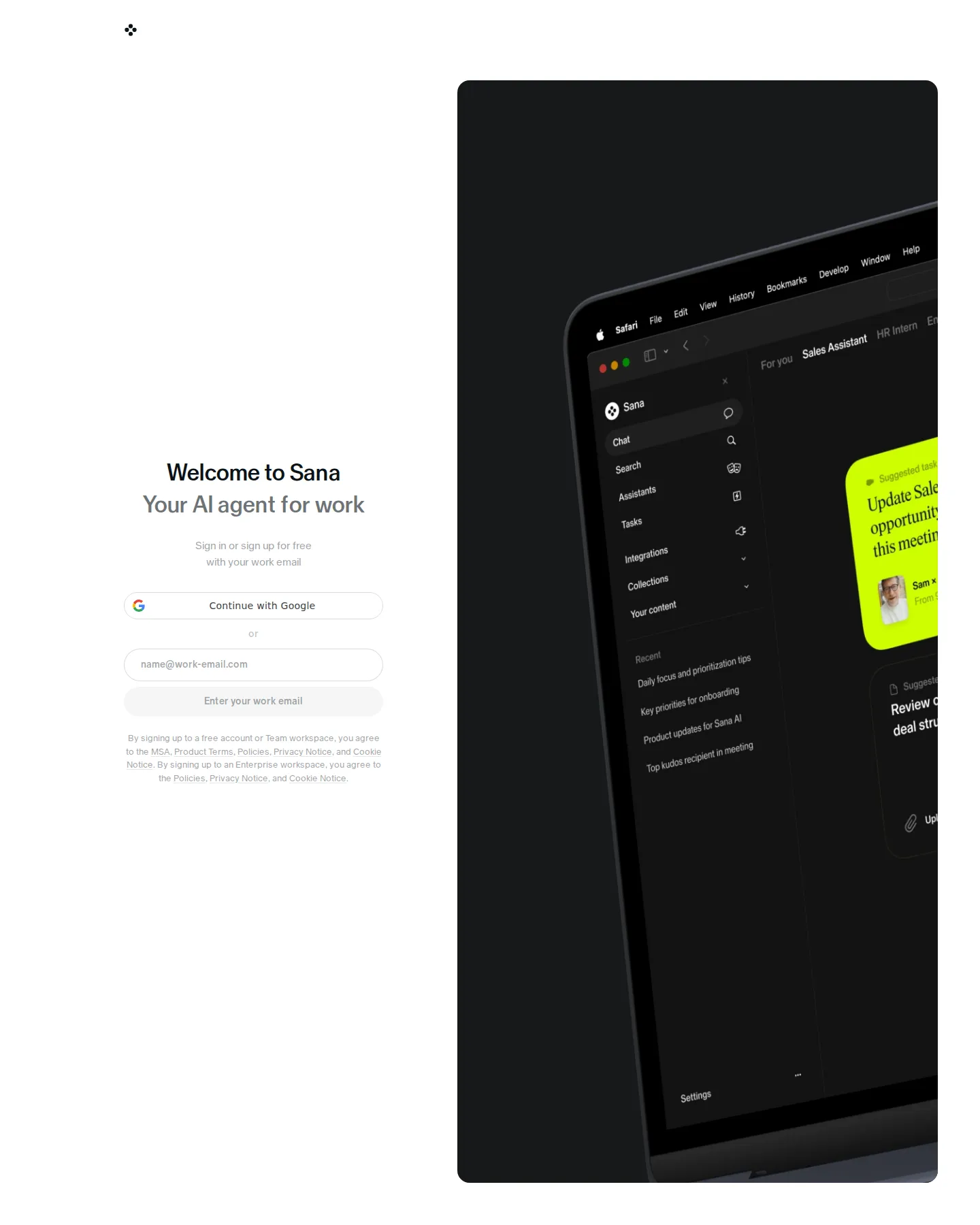
- Yes. Sana Agents has a genuine free plan at $0 with 10 meetings per month, up to 5 workspace members, unlimited assistants, and 1,000 documents per integration. You can sign up with a work email. Sana Learn does not have a free tier.
- Why can't I find Sana Learn's per-seat price?
- Sana Learn (the enterprise LMS) is sold sales-led. The pricing page shows 'indicative pricing' only after you select a region and seat band, and quotes require booking an intro. Third parties estimate roughly $13/user/month with a 300-seat minimum (~$46,800/year baseline), but Sana does not publish an exact rate card.
- Is Sana still an independent company?
- No. Workday acquired Sana Labs for about $1.1 billion (deal closed November 4, 2025) and relaunched it as a Workday AI platform in March 2026, adding a Sana Self-Service Agent with 300+ HR/finance skills and Sana Enterprise.