AI Summary
About
SerpApi is an Austin, Texas–based developer-infrastructure company (SerpApi, LLC) that sells a real-time search-engine results API. A single HTTP request returns structured JSON for Google, Bing, Baidu, DuckDuckGo, Yandex, Yahoo, and dozens of vertical and marketplace engines — Google Maps, Shopping, Scholar, Trends, Amazon, eBay, Walmart, the App Store, YouTube, and more than a hundred named APIs in total. The company absorbs the hard parts of web scraping (proxies, CAPTCHA solving, parser maintenance, and legal exposure) so customers receive clean, parsed results without operating their own scraping stack.
Its buyers are developers, data teams, SEO and market-intelligence vendors, and AI companies that need fresh search data to ground models or power rank-tracking and competitive-intelligence products. SerpApi positions transparency and legal cover as differentiators: it publicly publishes its full plan ladder (all the way to a $106,050/month tier) and bundles a U.S. Legal Shield — assuming legal responsibility for parsing and scraping, with up to $2M of coverage — on its Production plan and above.
The company markets itself on “full transparency and painful honesty,” and competes with other SERP-scraping APIs (Bright Data’s SERP API, Oxylabs, Zenserp, DataForSEO, and ScraperAPI) chiefly on result fidelity, breadth of supported engines, and the legal-indemnity angle.
Pricing summary : search-volume subscription tiers with successful-search metering
SerpApi uses a volume-tiered subscription model metered by the number of successful searches per month. There is no seat fee and — on the standard self-serve plans — no per-search overage; you buy a monthly bucket and step up to the next tier when you need more.
- Monthly plan tiers (the meter): A public ladder starting at Free ($0 / 250 searches), then Starter $25 (1,000), Developer $75 (5,000), Production $150 (15,000, “Most popular”), and Big Data $275 (30,000). The same table continues through Searcher ($725 / 100,000), Volume ($1,475 / 250,000) and a long “Cloud” series up to Cloud 54M at $106,050/month (54M searches).
- Throughput (the rate limit): Each tier raises requests-per-hour alongside the monthly bucket — 50/hr on Free up to 200/hr (Starter), 1,000/hr (Developer), 3,000/hr (Production) and 6,000/hr (Big Data). A “Speed mode” toggle (Best Effort / Ludicrous Speed / Ludicrous Speed Max) trades faster delivery for higher per-search cost on Enterprise.
- Enterprise (custom + usage): A base of $3,750/month bundling 100,000 complimentary searches, then per-1,000-search billing — on-demand at $7.50 / $15.00 / $30.00 per 1,000 (by speed mode) or reserved (committed) at $2.75 / $5.50 / $11.00 per 1,000.
What makes this different: Only fully successful searches count — blocked, errored, and CAPTCHA’d responses are not billed (though legitimately empty results and pagination queries are) — and standard plans carry no overage line at all; exceeding a bucket simply early-renews the plan rather than charging a per-unit premium.
Pricing by product
Self-serve search plans (entry ladder)
| Tier | Price | Included | Key mechanics |
|---|---|---|---|
| Free | $0 / mo | 250 searches/mo · 50 req/hr · Legal Shield | Month-to-month evaluation; ZeroTrace + priority support listed |
| Starter | $25 / mo | 1,000 searches/mo · 200 req/hr | Lowest paid step; cancel anytime |
| Developer | $75 / mo | 5,000 searches/mo · 1,000 req/hr | Production prototypes |
| Production | $150 / mo | 15,000 searches/mo · 3,000 req/hr | Labeled “Most popular”; U.S. Legal Shield auto-activates at this tier |
| Big Data | $275 / mo | 30,000 searches/mo · 6,000 req/hr | Last “named” card before the high-volume table |
High-volume search plans (public table)
| Tier | Price | Included | Key mechanics |
|---|---|---|---|
| Searcher | $725 / mo | 100,000 searches/mo · 20,000 req/hr | First table-only tier |
| Volume | $1,475 / mo | 250,000 searches/mo · 50,000 req/hr | Self-serve at scale |
| Infrastructure | $2,750 / mo | 500,000 searches/mo · 100,000 req/hr | — |
| Cloud 1M | $3,750 / mo | 1,000,000 searches/mo · 110,000 req/hr | Start of the “Cloud” per-million series |
| Cloud 54M | $106,050 / mo | 54,000,000 searches/mo · 640,000 req/hr | Top published self-serve tier |
Enterprise (custom contract + per-1,000 metering)
| Tier | Price | Included | Key mechanics |
|---|---|---|---|
| Enterprise | From $3,750 / mo | 100,000 complimentary searches/mo; 99.97% SLA, 100% uptime target | Custom U.S. contract, sales-led, flexible (pre/post-pay) |
Enterprise meters extra searches per 1,000 by mode: on-demand (no commitment) at $7.50 (Best Effort), $15.00 (Ludicrous Speed), or $30.00 (Ludicrous Speed Max) per 1,000; reserved (committed) at $2.75, $5.50, or $11.00 per 1,000. Unused reserved credits do not roll over.
U.S. Legal Shield (bundled coverage, not a separate SKU)
| Coverage | Price | Included | Key mechanics |
|---|---|---|---|
| Legal Shield | Bundled | Up to $2M coverage; Fair Use / First Amendment basis; worldwide | Auto-applies on Production plan and above; no configuration required |
Sales motions across products: PLG / self-serve for Free through the entire Cloud table (sign up and pay online, cancel anytime); sales-led for Enterprise (custom U.S. contract, on-demand vs. reserved metering, SLAs).
Hidden costs : failed-bucket waste, early renewals, and the no-overage trap
SerpApi’s bill is unusually predictable — there is no per-search overage on standard plans — but the no-overage design hides two real costs: wasted unused searches (buckets don’t roll over) and early-renewal double-billing when you exceed a tier mid-cycle.
Archetype A — a rank-tracking SMB on Production ($150 / 15,000 searches) that spikes mid-month.
| Line item | Monthly cost |
|---|---|
| Production plan (15,000 searches) | $150.00 |
| Mid-month spike to ~22,000 searches → auto early renewal of the plan | +$150.00 |
| Net effect: ~22,000 searches used, two full Production cycles billed | $300.00 |
Because standard plans have no per-unit overage, the 7,000 extra searches do not cost a marginal rate — they force a second full $150 cycle (and reset the date). At that volume the next tier up, Big Data ($275 / 30,000), would have been cheaper than paying for Production twice, so right-sizing the plan matters more here than on a metered competitor.
Archetype B — an AI startup grounding a model on Enterprise on-demand at Ludicrous Speed.
| Line item | Monthly cost |
|---|---|
| Enterprise base (includes 100,000 complimentary searches) | $3,750.00 |
| 400,000 extra on-demand searches at $15.00 / 1,000 (Ludicrous Speed) | +$6,000.00 |
| Total | $9,750.00 |
The same 400,000 extra searches at the reserved committed rate ($5.50 / 1,000) would cost $2,200 instead of $6,000 — so the on-demand-vs-reserved choice and the speed mode are the two biggest cost levers at Enterprise scale. Unused reserved credits, though, do not roll over, so over-committing wastes money the same way an oversized standard bucket does.
Want to estimate your own SerpApi bill? Use the SerpApi pricing calculator to model your monthly cost based on search volume, speed mode, and on-demand vs. reserved metering.
Pricing evolution : from a flat three-tier ladder to a Starter-anchored search meter
SerpApi started life as a deliberately “simple,” month-to-month three-card ladder and has steadily added a free tier, raised headline prices, and then re-anchored the bottom of the range with a cheaper Starter plan — while keeping the same core meter (successful searches).
Cadence
| Quarter | Price changes | Product / SKU additions | Notes |
|---|---|---|---|
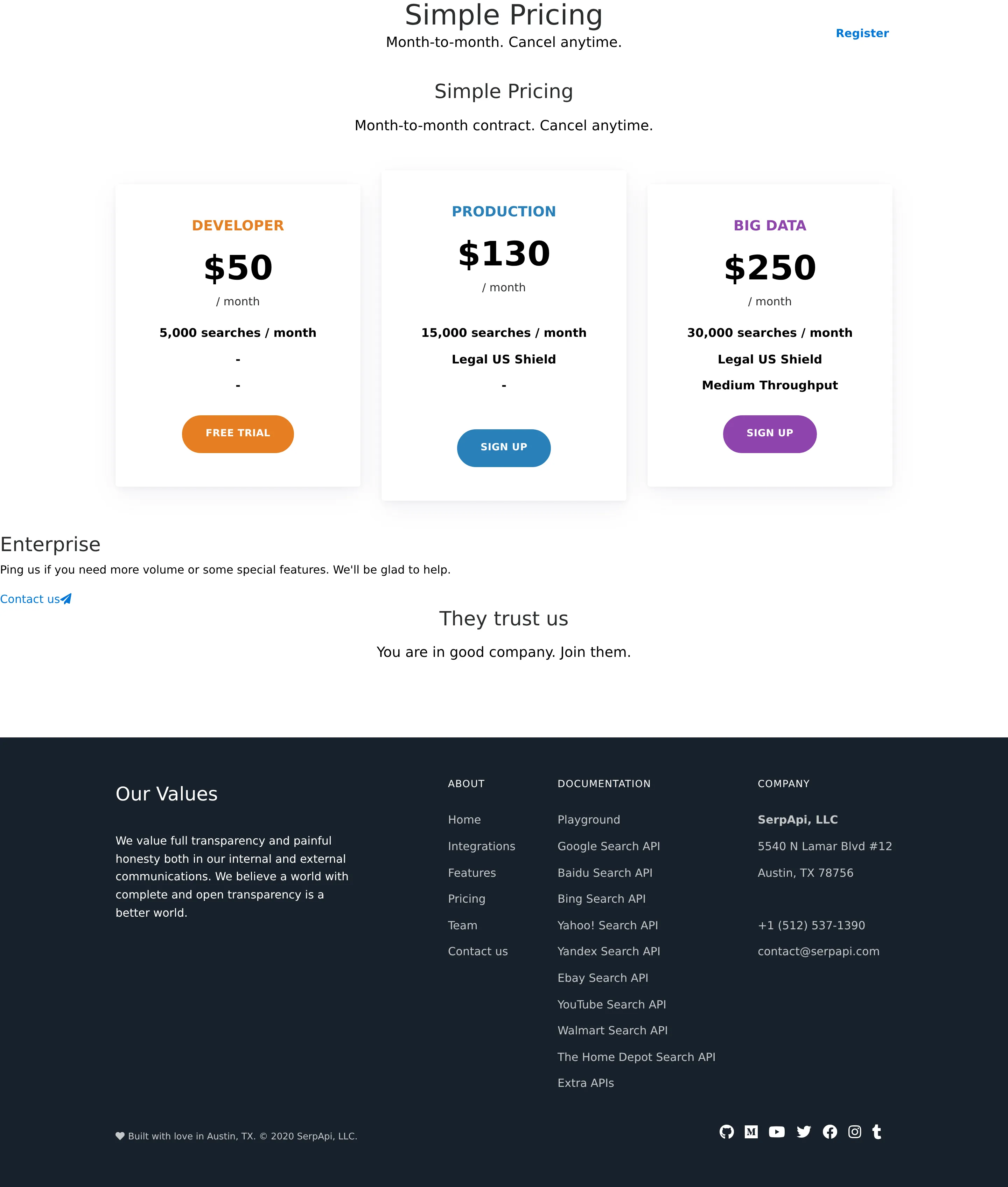
| 2020 Q3 | 0 | 0 | Baseline: Developer $50 / 5,000, Production $130 / 15,000, Big Data $250 / 30,000; Legal US Shield on Production and Big Data only. |
| 2021 Q3 | 0 | 1 | $0 Free plan (100 searches/mo, “No Legal US Shield”, “No Commercial Use”) appears alongside the three paid tiers. |
| 2022 Q4 | 0 | 0 | ”No Commercial Use” restriction dropped from the free-plan card; paid ladder unchanged. |
| 2024 Q2 | 3 | 1 | Paid tiers raised to Developer $75 / Production $150 / Big Data $275 at the same volumes; a Standard vs. Enterprise toggle splits the page. |
| 2026 Q2 | 2 | 2 | New Starter $25 / 1,000 tier added below Developer; free plan grows 100 → 250 searches; Legal Shield extends to all tiers; full public “Cloud” ladder to $106,050/mo, ZeroTrace Mode and speed modes surfaced. |
Tracked range: 2020-09–2026-06. Exact dates inside the 2022-10→2024-06 and 2024-06→2026-06 gaps could not be pinned from available archives and are marked unknown in pricingHistory.
Notable changes
- 2020-09 — Earliest tracked Wayback snapshot: three-card ladder at $50 / $130 / $250, no self-serve free plan (
serpapi.com/pricing). - 2021-07 — A $0 Free plan (100 searches, no commercial use, no Legal Shield) appears; paid prices unchanged (
serpapi.com/pricing). - 2024-06 — Paid tiers had risen to $75 / $150 / $275 at unchanged search volumes; Standard/Enterprise toggle present (
serpapi.com/pricingWayback snapshot 2024-06-15). - 2026-06 — Starter $25 / 1,000 added, free plan up to 250 searches, Legal Shield on every plan, Cloud ladder to $106,050/mo, ZeroTrace Mode and Best Effort / Ludicrous Speed / Ludicrous Speed Max speed modes (
serpapi.com/pricing).
The Google v. SerpApi lawsuit in detail
On 2025-12-19, Google filed suit against SerpApi alleging it circumvented Google’s “SearchGuard” anti-bot system to scrape and resell Search results at scale, framing it as a DMCA-circumvention case (the suit drew a 66-point, 102-comment Hacker News thread). SerpApi responded publicly that “the crawling and parsing of public data is protected by the First Amendment,” citing hiQ v. LinkedIn, and filed a motion to dismiss in February 2026. A parallel Reddit, Inc. v. SerpApi action prompted a similar First-Amendment defense in October 2025. The litigation matters to pricing because SerpApi’s bundled U.S. Legal Shield — the up-to-$2M indemnity it attaches to plans — is the commercial embodiment of exactly this legal posture: customers are buying insulation from the scraping-legality risk SerpApi is now litigating on their behalf.
What’s unique : successful-search metering, bundled legal indemnity, and radical price transparency
Only successful searches are billed. Unlike most scraping APIs that charge per request regardless of outcome, SerpApi does not count searches that are blocked, error out, or return a CAPTCHA. The vendor — not the customer — eats the cost of proxy churn and anti-bot defenses. This pairs naturally with a pure-usage pricing model softened into discrete monthly buckets.
No overage line — exhaustion triggers an early renewal instead. Standard plans never charge a marginal per-search rate. Run out and the plan auto early-renews at the full price, refreshing the allowance and resetting the cycle. This makes bills bursty-but-predictable and pushes buyers to right-size their tier rather than absorb a creeping overage — a deliberately different posture from per-API-call billing competitors, and a cautionary case study in how overage design shapes trust.
A bundled U.S. Legal Shield, not an add-on. SerpApi assumes legal responsibility for scraping and parsing on the customer’s behalf, with up to $2M of coverage, on a Fair Use / First Amendment basis. With Google and Reddit both litigating against the company in 2025–2026, this indemnity is the productized form of its legal stance — a differentiator competitors like Bright Data, Oxylabs, and DataForSEO don’t package as cleanly.
Radical price transparency. SerpApi publishes its entire ladder — including a $106,050/month “Cloud 54M” tier — instead of hiding high volumes behind “contact sales.” Only the truly custom Enterprise plan is quote-based, and even its base ($3,750/mo) and per-1,000 rates are published on the Enterprise page.
Speed modes as a price axis. Best Effort, Ludicrous Speed, and Ludicrous Speed Max trade latency for cost on Enterprise (e.g., $7.50 → $15 → $30 per 1,000 on-demand), making delivery speed an explicit, separately-priced dimension rather than a fixed SLA.
Strengths & weaknesses
| Strengths | Weaknesses |
|---|---|
| Bills only successful searches — customer never pays for blocked/CAPTCHA’d calls | Unused searches don’t roll over; over-provisioning is pure waste |
| No per-search overage; bills are predictable and capped to the plan price | Mid-cycle spikes force a full early-renewal (double-billing) rather than a marginal charge |
| Full price ladder published to $106,050/mo — near-total transparency | Standard tiers are coarse 5–6× volume jumps; little granularity between steps |
| Bundled up-to-$2M U.S. Legal Shield productizes scraping-legality cover | Legal Shield is U.S.-centric and now actively tested by Google/Reddit litigation |
| Generous, low-friction free + $25 Starter on-ramp for developers | Headline tier prices have crept up ~10–50% since 2020 at unchanged volumes |
| 150+ named engine APIs (Google, Bing, Amazon, Maps, Scholar, AI Overview) | Speed/cost coupling (Ludicrous modes) adds Enterprise pricing complexity |
Billing UX : successful-search metering, early renewal, and speed-mode controls
- Successful-searches-only metering — only fully successful searches count against the monthly bucket; searches that are blocked, error out, or return CAPTCHAs are not billed. Legitimately empty queries and pagination queries are counted as searches.
- Automatic Early Renewal — instead of a per-search overage charge, exhausting the monthly bucket can auto-trigger an early renewal that re-bills the plan and refreshes the full search allowance (resetting the billing cycle); manual renewal does the same on demand.
- Speed mode toggle — Best Effort / Ludicrous Speed / Ludicrous Speed Max, surfaced on the pricing table and Enterprise; faster modes raise the per-1,000 Enterprise rate (e.g. $7.50 → $15 → $30 on-demand).
- On-demand vs. reserved (Enterprise) — on-demand requires no monthly commitment with pre- or post-pay invoicing; reserved commits to a monthly volume at roughly one-third the per-1,000 rate, with no rollover of unused credits.
- Month-to-month, cancel anytime — every self-serve plan is no-contract; the page documents explicit upgrade, downgrade, and cancellation behavior (downgrades and cancellations take effect per the plan’s billing rules).
- U.S. Legal Shield auto-activation — coverage attaches automatically once you are on the Production plan or higher, with no configuration step required.
Strategic wins : pricing decisions that compounded SerpApi’s moat
1. Billing only successful searches turned reliability into a pricing promise
By not charging for blocked, errored, or CAPTCHA’d requests, SerpApi converts its core operational burden — beating anti-bot systems — into a customer-facing guarantee. Buyers don’t pay for SerpApi’s bad days, which de-risks adoption far more than a discount would. It’s a sharper version of the outcome-aligned metering other infrastructure vendors only talk about.
2. Publishing the full ladder built trust in a low-trust category
Web scraping is a category buyers approach warily. SerpApi’s choice to publish every tier to $106,050/month — rather than gate volume behind sales — signals “full transparency and painful honesty” and removes a major friction point. Transparent pricing is itself a conversion lever, especially against rivals who hide enterprise rates.
3. Productizing legal indemnity created a defensible differentiator
Bundling a U.S. Legal Shield (up to $2M coverage) packages the single scariest objection in scraping — “is this legal?” — into the product. With Google and Reddit both suing in 2025–2026, that bundled indemnity is now a live, demonstrable value, not a marketing line. Few competitors monetize trust this directly.
4. A cheap Starter tier widened the funnel without cannibalizing scale
Adding a $25 / 1,000-search Starter below the $75 Developer tier (with Production now the “Most popular” plan above it) captures hobbyists and first integrations who balked at $75, while the 5–6× volume jumps between tiers still push growing teams up the ladder. It’s textbook good-better-best laddering applied to a usage meter.
Areas to improve : where the no-overage model leaves money and goodwill on the table
1. Replace early-renewal double-billing with a true overage or rollover
Forcing a full early renewal when a bucket runs out can mean paying for two cycles to use 1.5× the searches — a regressive surprise. A published per-search overage band (capped at the next tier’s price) or limited rollover of unused searches would remove the “use-it-or-lose-it / pay-it-twice” trap that recurs in third-party reviews. See usage thresholds and overage design.
2. Add intermediate tiers between the coarse 5–6× jumps
The gap from Starter (1,000) to Developer (5,000) to Production (15,000) leaves teams over-buying. A few mid-points — or a “pay $X for the next 1,000 within your tier” smoothing rate — would let customers right-size without jumping a full step, reducing the waste the current ladder creates.
3. Extend legal cover beyond the U.S.
The Legal Shield is U.S.-centric. As scraping litigation globalizes, EMEA and APAC buyers carry uncovered exposure. A clearly-scoped international tier of the Shield would convert a regional perk into a global differentiator — and de-risk the company’s own expansion.
4. Make speed-mode cost trade-offs estimable before commit
Best Effort vs. Ludicrous Speed vs. Ludicrous Speed Max quadruples per-1,000 cost ($7.50→$30) but the latency benefit is qualitative. Publishing expected latency ranges per mode would let Enterprise buyers price the trade-off instead of guessing, the same way they can already model usage-based bills.
Monetization stack & signals : how SerpApi builds & buys its revenue engine
Buys 1 Builds 1
Pure self-serve PLG spine: it builds its own search-credit meter — the successful-only counter behind its usage pricing, exposed via the Account API — and buys only payments, running Stripe Billing for self-serve subscriptions. The meter, its core moat, is in-house; the money-movement is bought.
-
“Account API allows you to check the number of searches you made in this month, your plan's monthly limit, your plan's monthly searches left, your account's hourly throughput limit, and if you have an account with no monthly plan then you can also check the remaining credits.”
-
“Not able to subscribe serp api — getting error 'Payment for this subscription requires additional user action... using the PaymentIntent associated with subscription.latest_invoice. Additional information is available here: https://stripe.com/docs/billing/subscriptions/overview' — SerpApi's own subscribe-flow surfaces a Stripe Subscriptions requires-action error linking Stripe Billing docs, so its self-serve subscriptions run on Stripe Billing.”
Signals reviewed · derived from engineering blogs, product docs
Key takeaways
- Bill for outcomes you control, not requests you don’t. SerpApi only charges for successful searches, turning its hardest operational problem into a customer guarantee — a pattern any infrastructure vendor with variable success rates should study.
- Transparency is a pricing feature in low-trust categories. Publishing the full ladder to six figures, rather than gating volume behind sales, lowers friction and differentiates in a category buyers distrust.
- No-overage models trade predictability for waste. Early-renewal-instead-of-overage caps bills but punishes spiky usage; the right-sizing burden shifts to the customer, which review sites consistently flag.
- You can productize trust. A bundled legal indemnity converts the category’s biggest objection into a line-item benefit — and litigation makes it more valuable, not less.
- Re-anchor the bottom of the range to widen the funnel. Adding a cheap Starter tier below the popular plan captured price-sensitive entrants years after launch without disturbing the scale tiers above it.
UBP implications
- Success-based metering reframes the unit. Charging per successful result rather than per request aligns price with delivered value and is a credible model for any API where failure rates are the vendor’s responsibility, not the buyer’s.
- Discrete buckets can stand in for pure metering. SerpApi approximates pure-usage pricing with monthly search buckets and no overage — predictable for buyers, but only if tier granularity and rollover are handled well, or waste erodes the value story.
- Bundled indemnity is an emerging value metric. As data-access litigation grows, “legal coverage included” becomes a quantifiable part of the price — a signal that usage-based vendors in contested categories can package risk transfer as part of the offer.
Sources
- SerpApi pricing page — full plan ladder, search counts, throughput, speed modes; “Most popular” badge on Production ($150 / 15,000), successful-searches-only and Automatic Early Renewal wording independently re-verified (accessed 2026-08-28)
- SerpApi Enterprise page — $3,750/mo base with 100,000 complimentary searches, on-demand $7.50/$15.00/$30.00 and reserved $2.75/$5.50/$11.00 per 1,000, 100% uptime / 99.97% SLA, no rollover — independently re-verified (accessed 2026-08-28)
- SerpApi U.S. Legal Shield page — coverage scope, up-to-$2M indemnity, Fair Use / First Amendment basis (accessed 2026-08-28)
- SerpApi pricing page — Wayback snapshots 2020-09 through 2024-06 — historical tier prices and free-plan introduction (accessed 2026-06-04)
- SerpApi blog — company statements on the Google and Reddit litigation (accessed 2026-06-04)
Explore more usage-based pricing teardowns in the UsagePricing blueprint corpus.
Bottom line
SerpApi prices a hard, legally-fraught problem — real-time search scraping — with disarming simplicity: buy a monthly bucket of searches, pay only for the ones that succeed, and let the vendor carry the legal risk. The model’s strength is predictability and trust; its weakness is waste, since unused searches vanish and spikes trigger full early renewals rather than smooth overages. As Google and Reddit test SerpApi’s legal posture in court, the bundled Legal Shield it sells is being priced in real time — making this one of the corpus’s clearest examples of risk transfer as a pricing feature. See how it compares across the blueprint corpus.
Pricing timeline : Major events on a vertical axis
Each milestone below corresponds to a public pricing change, product launch, or material adjustment. Major events use a filled marker; minor adjustments use a faded one.
Starter $25 added, free plan to 250, Legal Shield on all tiers, full Cloud ladder
A new low-end Starter tier ($25 / 1,000 searches) sits below Developer; Production ($150 / 15,000) now carries the 'Most popular' badge; the free plan grows from 100 to 250 searches; U.S. Legal Shield now lists on every plan including Free and Starter. The public 'All plans' table ladders from $25 up to Cloud 54M at $106,050/mo, with ZeroTrace Mode and Best Effort / Ludicrous Speed / Ludicrous Speed Max speed modes. Enterprise: $3,750/mo base with 100,000 complimentary searches and per-1,000 on-demand ($7.50/$15/$30) or reserved ($2.75/$5.50/$11) billing. Exact dates of the Starter add and free-plan bump between 2024-06 and 2026-06 are unknown.

Paid tiers raised: Developer $75, Production $150, Big Data $275
By this snapshot the three paid tiers had risen from $50/$130/$250 to $75/$150/$275 at the same search volumes (5,000 / 15,000 / 30,000) — roughly a doubling on Developer, ~15% on Production, ~10% on Big Data. Free plan still $0 / 100 searches. A Standard vs. Enterprise toggle now splits the page. Exact change date between 2022-10 and 2024-06 is unknown.
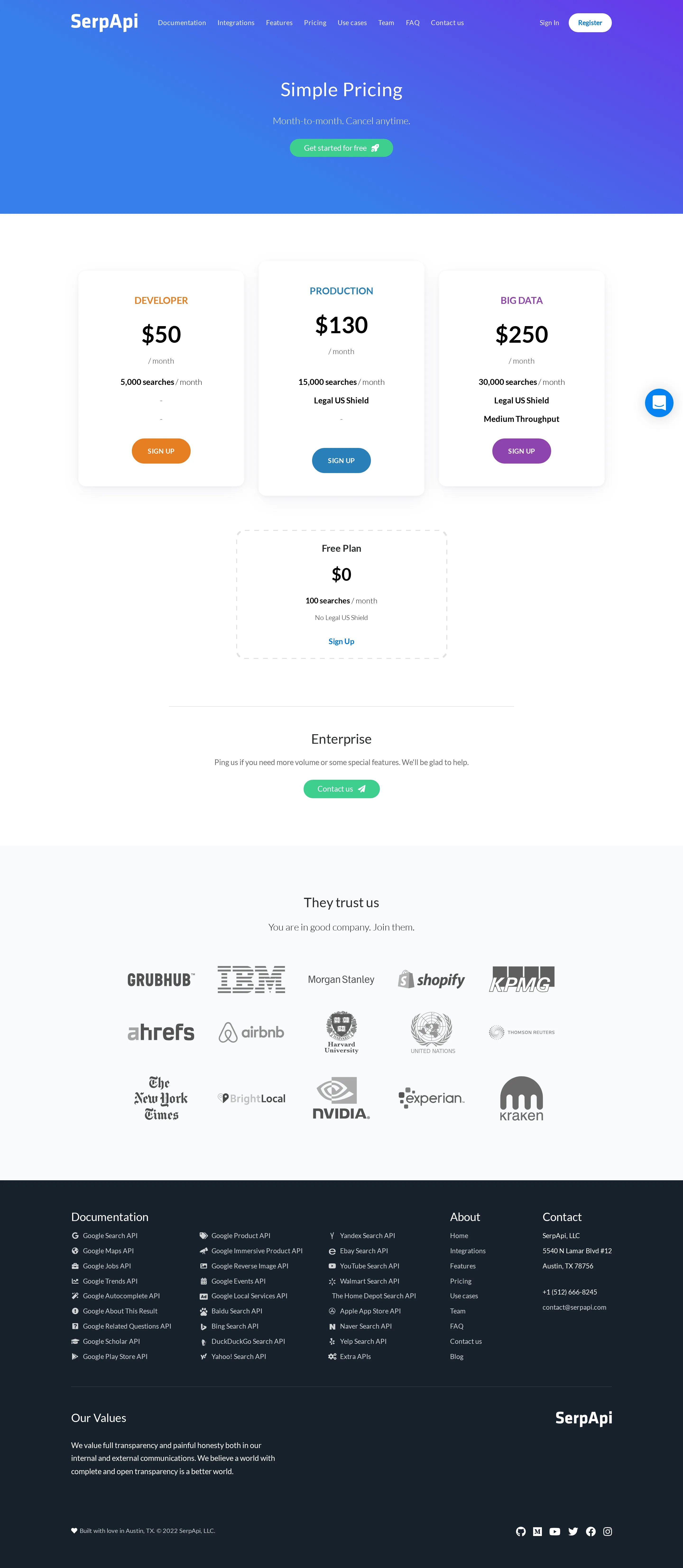
Free plan added ($0 / 100 searches, no commercial use)
A $0 Free Plan appears alongside the three paid tiers — 100 searches/month, 'No Legal US Shield', 'No Commercial Use'. The paid ladder ($50 / $130 / $250) is unchanged. The 'No Commercial Use' restriction was later dropped from the free-plan card by 2022-10.
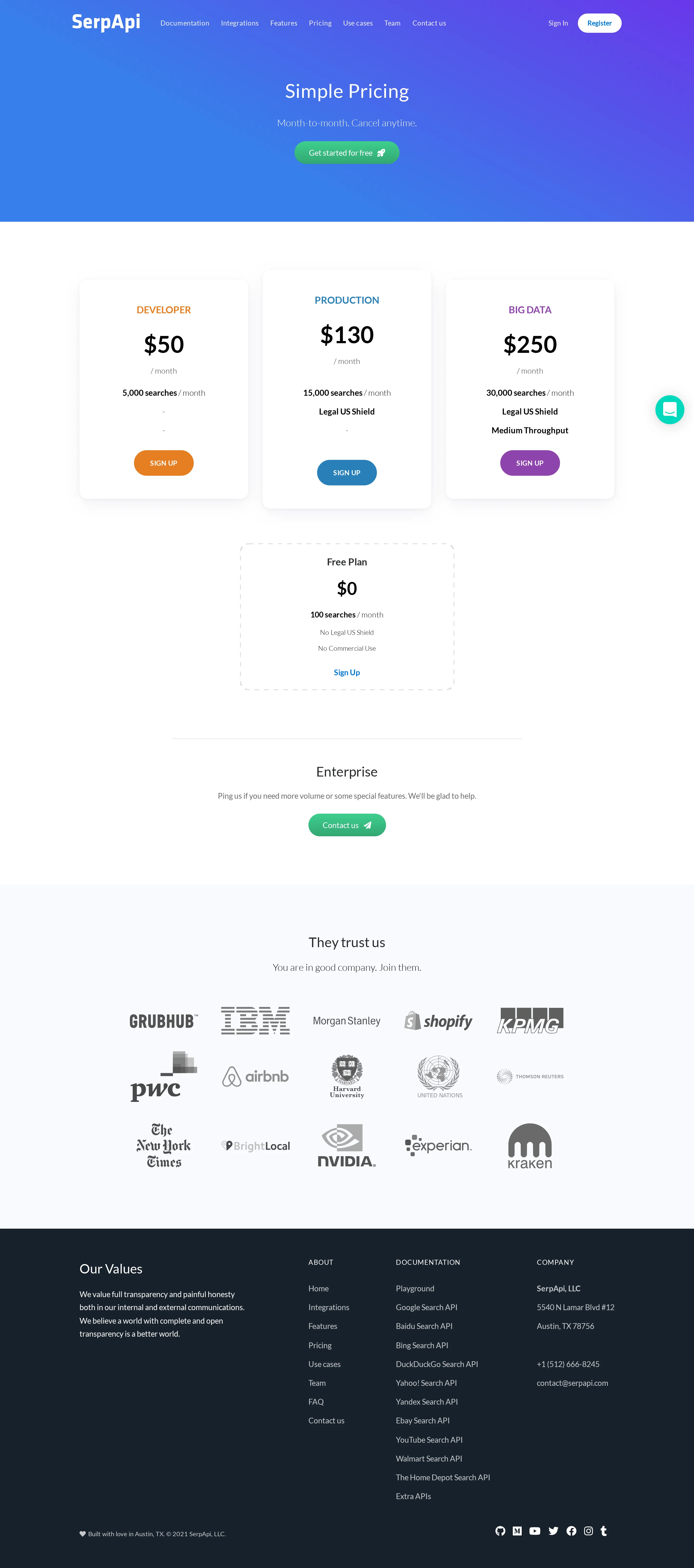
Three-tier ladder: Developer $50, Production $130, Big Data $250
Earliest tracked snapshot shows a simple month-to-month, three-card ladder: Developer $50/mo (5,000 searches), Production $130/mo (15,000), Big Data $250/mo (30,000). No self-serve free plan; Legal US Shield listed on Production and Big Data only. Enterprise was a bare 'contact us' note.
- · SerpApi only bills for fully successful searches — requests that are blocked, error out, or return a CAPTCHA cost nothing, a meter most SERP-scraping rivals don't offer.
- · Standard plans carry no per-search overage line at all: run out of searches and the plan auto early-renews (re-billing the full price and refreshing the bucket) instead of charging per extra call.
- · SerpApi bundles a 'U.S. Legal Shield' — assuming legal responsibility for scraping and parsing with up to $2M of coverage — across all current plans, framed on Fair Use and First Amendment grounds.
Questions & answers
- How does SerpApi count searches?
- Only fully successful searches count against your monthly plan. Searches that are blocked, error out, or return CAPTCHAs are not billed, but legitimately empty result pages and each pagination query do count as separate searches.
- What happens if I run out of searches in a month?
- Standard self-serve plans have no per-search overage. Exhausting your bucket can trigger an automatic early renewal that re-bills the full plan price and refreshes the full search allowance, resetting the billing cycle. Only Enterprise bills per extra 1,000 searches.
- Is there a free SerpApi plan?
- Yes. The Free plan is $0/month and includes 250 searches per month, 50 requests per hour, ZeroTrace Mode, priority support, and the U.S. Legal Shield. It is intended for evaluation and hobby projects.
- How much does SerpApi cost at scale?
- The public ladder runs from Starter $25 (1,000 searches) up through Searcher $725 (100,000), Volume $1,475 (250,000) and a 'Cloud' series to Cloud 54M at $106,050/month for 54 million searches. Enterprise starts at $3,750/month plus per-1,000 usage.
- What is the U.S. Legal Shield?
- SerpApi assumes legal responsibility for the scraping and parsing it performs on your behalf, with up to $2M of coverage, on a Fair Use and First Amendment basis. It is bundled with current plans rather than sold as a separate SKU.
- What's the difference between on-demand and reserved Enterprise searches?
- On-demand requires no monthly commitment and bills $7.50/$15.00/$30.00 per 1,000 searches by speed mode. Reserved commits to a monthly volume at roughly one-third the rate ($2.75/$5.50/$11.00 per 1,000) but unused reserved credits do not roll over.