AI Summary
About
Spellbook (spellbook.com, formerly spellbook.legal) sells an AI suite for commercial legal work that runs primarily as a Microsoft Word add-in, letting lawyers review, draft, ask questions, benchmark, and apply playbooks against contracts without leaving their document. Its agentic product, Spellbook Associate, is described as “the first AI agent that can work through multi-document legal matters, with your oversight.” The pricing page states Spellbook is “Trusted by 4,500 legal teams worldwide,” and the trial signup module at the foot of the page repeats the number (“Join over 4,500 legal teams using Spellbook”).
The company targets two buyer segments — law firms (drafting, redlining, communication) and in-house legal teams (reducing reliance on outside counsel) — and positions security as a differentiator, citing Zero Data Retention agreements, SOC 2 Type II compliance, and HIPAA/GDPR/EU AI Act posture.
Spellbook is built by Rally (Rally Inc.), a Canadian legal-tech company headquartered in Saint John and Toronto, and it launched what it billed as the first generative-AI contract-drafting tool in September 2022. In January 2024 it raised a $20M USD Series A (~C$27M) led by Inovia Capital with Thomson Reuters Ventures participating — bringing total financing past $30M — on the back of roughly 10x revenue growth and ~300% customer growth over the prior seven months. Its public “trusted by” counter has climbed from 3,000+ legal teams in mid-2025 to 4,400 in June 2026 and 4,500 by July 2026.
Spellbook competes in the fast-consolidating legal-AI category alongside Harvey, Robin AI, and Legora. Where Harvey targets large-firm and enterprise legal work with a platform sold top-down, Spellbook’s wedge is the Word-native add-in for transactional lawyers at firms of all sizes, with a self-serve trial as the on-ramp. All four converge on the same commercial posture: per-seat, sales-led, no public list price.
Pricing summary : Custom per-seat legal-AI pricing, quoted by demo
Spellbook uses a seat-based, sales-only model. Its pricing page lists no public dollar figures; instead it states that “our pricing is structured around the number of team members on your license” and directs buyers to book a demo for personalized pricing. This is the classic per-seat SaaS default applied to legal AI — the model whose strength is budget predictability and whose weakness is that the meter has no direct link to value delivered (see our guide to usage-based pricing models).
- Per-seat licensing: Pricing scales with the number of team members on the license — the page’s FAQ states plainly that “Pricing is determined by the number of team members on a license.” Exact per-seat rates are not disclosed publicly (
unknown— quote-only). - Two segment packages: A Law Firms package and an In-House Teams package, each bundling the Spellbook Suite (Word Add-In + Associate agent) with segment-specific support and training.
- Free trial: A self-serve free trial is offered (“Start Free Trial”). The FAQ scopes it precisely: lawyers and legal teams can “try Spellbook free for 7 days,” and “for larger organizations, extended trials may be available” — book a demo. It is a trial, not a standing free tier.
- Academic free access: Spellbook “offers free access to academic institutions to help students and educators gain hands-on experience,” routed through an Academic Partnerships inquiry rather than a self-serve education SKU.
- Seat threshold: Both packages advertise “Dedicated Support for Teams over 10” — the only quantified license threshold visible anywhere on the page.
What makes this different: Spellbook bundles its multi-document Associate agent into the same per-seat license as the Word add-in rather than metering agent runs separately, and keeps all price points behind a demo.
Pricing by product
Spellbook Suite (segment packages)
| Tier | Price | Included | Key mechanics |
|---|---|---|---|
| Law Firms | Custom | Spellbook Suite (Word Add-In & Associate); Group Training Sessions; Online Customer Support; Dedicated Support for Teams over 10 | Per-seat license, quoted via demo; card CTA is Start Free Trial (self-serve entry) |
| In-House Teams | Custom | Spellbook Suite (Word Add-In & Associate); Team Training Sessions and Online Support; Playbook Build Service; Dedicated Support for Teams over 10 | Per-seat license, quoted via demo; card CTA is Book a Demo (no self-serve path) |
The Word Add-In covers Review, Draft, Ask, Benchmarks, and Playbooks; Associate is the multi-document legal agent, flagged on the page as the “Highlight Product” for law firms, with Playbooks flagged as the “Highlight Feature” for in-house teams. Both segment packages bundle the full Suite; the difference is the support/training and onboarding services attached, not the core feature set. The site’s product menu lists additional surfaces (ACM, Compare, Integrations) that the pricing page does not price or scope separately — everything on this page is sold as one Suite seat.
Non-priced access paths
| Path | Price | Included | Key mechanics |
|---|---|---|---|
| Free trial | $0 | 7 days of Spellbook for lawyers and legal teams to test features and workflows | Self-serve, business-email + “Are you a legal professional?” gate; “for larger organizations, extended trials may be available” — via demo only |
| Academic partnerships | $0 | ”Free access to academic institutions to help students and educators gain hands-on experience” | Inquiry-based (Academic Partnerships), not a self-serve education SKU |
Sales motions across products: sales-led / quote-only for both Law Firms and In-House Teams packages; a self-serve 7-day free trial provides low-friction entry, but every paid seat is quoted via a book-a-demo motion.
Hidden costs : What teams actually pay beyond the headline seat
Because Spellbook publishes no list price, the “hidden cost” here is structural: you cannot self-qualify on budget. Every number below is a third-party estimate, not a Spellbook-published figure — Spellbook’s own pricing page and Facts above keep all prices Custom. We show the ranges only to illustrate how a per-seat legal-AI bill scales, and we round to whole-dollar bands rather than imply precision Spellbook has not disclosed.
The biggest unmodeled line items in this category are annual commitment (monthly billing is widely reported to carry a premium over annual, so the headline “per month” you hear in a demo may not be the rate you can actually buy at), the 10-seat threshold that unlocks “dedicated support” (and, per reports, can change the effective per-seat quote), and onboarding services like the In-House Teams “Playbook build service,” which is bundled into that package rather than priced as a line item.
Archetype A — a 5-lawyer transactional boutique. A small firm buying 5 seats at a mid-tier estimate sits in roughly the four-figures-per-month band before any annual discount:
| Line item | Monthly cost (third-party estimate) |
|---|---|
| 5 seats × ~$149/user/mo (estimated mid-tier) | ~$745 |
| Annual-billing discount (reported ~20% off monthly) | −~$149 |
| Estimated effective monthly (annual plan) | ~$596 |
Archetype B — a 25-person in-house legal department. At the 25-seat scale the In-House Teams package (Playbook build service, dedicated support over 10) applies, and the bill is dominated by seat count:
| Line item | Monthly cost (third-party estimate) |
|---|---|
| 25 seats × ~$179/user/mo (estimated, dedicated-support tier) | ~$4,475 |
| Playbook build service | Bundled in package |
| Estimated effective monthly (before negotiated discount) | ~$4,475 |
The lesson: with a pure per-seat meter, headcount is the bill — there is no usage line to absorb a heavy-using lawyer or to discount a light one, which is exactly the predictability/value-alignment trade-off we cover in the value-metric problem in AI pricing.
Want to estimate your own Spellbook bill? Use the Spellbook pricing calculator to model your monthly cost based on the number of licensed seats.
Pricing evolution : From Word add-in seats to a bundled agent suite
Cadence
| Quarter | Price changes | Product / SKU additions | Notes |
|---|---|---|---|
| 2025 Q2 | 0 (visible) | 0 | Earliest archived pricing snapshot (2025-06-09, spellbook.legal): already fully gated — no public prices, two segment cards, “Custom pricing for modern legal teams,” 3,000+ teams. |
| 2026 Q1 | 0 (visible) | 0 | Snapshots through early 2026 unchanged: same quote-only, per-seat structure on spellbook.legal. |
| 2026 Q2 | unknown | 0 | spellbook.legal → spellbook.com domain migration; identical gated model; public counter now 4,400+ legal teams. |
Tracked range: 2025 Q2 – 2026 Q2. No public dollar figure appears in any archived snapshot of the pricing page, so SKU-level price changes within this window are unknown rather than confirmed zero. The Wayback archive holds no pricing-page snapshot before June 2025, so any earlier public→gated transition cannot be verified from screenshots and is not asserted here.
Notable changes
- 2022-09 — Spellbook launches what it bills as the first generative-AI contract-drafting tool, as a Microsoft Word add-in (Spellbook, Reuters coverage).
- 2024-01-24 — $20M Series A led by Inovia Capital (Thomson Reuters Ventures participating); reported ~10x revenue and ~300% customer growth in the prior seven months.
- 2025-06-09 — Earliest archived pricing-page snapshot: already quote-only and per-seat, with “Trusted by 3,000+ legal teams.”
- 2026 Q2 — Domain migration from spellbook.legal to spellbook.com; pricing model unchanged; public customer count shown as 4,400+ legal teams.
The public→gated question, in detail
A common claim is that Spellbook once published per-seat list prices (figures around $99–$240/user/mo circulate in third-party write-ups) before moving to a quote-only page. We could not verify this from primary evidence: the Wayback Machine holds no snapshot of the Spellbook pricing page before June 2025, and every snapshot from June 2025 onward is already fully gated. The only first-party dollar figure Spellbook currently advertises is a “$99 for the first month” CLE-attendee promo on its /99 landing page — a promotional first-month rate, not a standing per-seat list price. Per our sourcing rules, the historical list prices remain unknown; we do not assert them as fact.
What’s unique : Bundled agent, Word-native, fully gated pricing
1. The Associate agent ships inside the seat license. Rather than metering multi-document agent runs as a separate usage line, Spellbook bundles Associate into the same per-seat Suite license as the Word add-in. This is a deliberate counter-move to the outcome-based and per-action agent pricing that many AI vendors are racing toward — Spellbook keeps the meter on named users, not agent work done, so a lawyer who runs the agent constantly costs the same as one who barely touches it. That insulates customers from the token-cost volatility we describe in pricing AI products with unpredictable costs, at the cost of leaving heavy-usage value on the table.
2. Word-native distribution, not a destination app. Spellbook lives inside Microsoft Word — the surface where transactional lawyers already draft and redline. That distribution choice doubles as a pricing moat: the value is felt per drafting session, which maps cleanly onto a per-seat license and makes the seat the obvious value metric. It is the inverse of platform-style legal AI that pulls work into a separate web app and then has to justify a platform fee.
3. Total price opacity as positioning, not just sales hygiene. Spellbook has run a fully gated pricing page in every archived snapshot since June 2025 — no anchor price, no published tiers, only “Custom pricing for modern legal teams.” For a per-seat product this is a strong choice: it removes a public negotiation anchor, lets the rep price to the firm’s size and willingness-to-pay, and keeps competitors from undercutting a listed number. The trade-off is buyer friction — a small firm cannot self-qualify on budget, which is precisely the gap third-party “Spellbook pricing” aggregators have rushed to fill.
Strengths & weaknesses
| Strengths | Weaknesses |
|---|---|
| Word-native workflow lands exactly where transactional lawyers already draft and redline | Fully gated pricing — buyers cannot self-qualify on cost or compare anchors |
| Per-seat license is predictable: budget = headcount × seat price | Seat meter has no link to value delivered; heavy vs light users pay the same |
| Associate agent bundled into the seat, insulating customers from token-cost volatility | No published list price means third-party aggregators (often inaccurate) shape the “Spellbook pricing” search narrative |
| Self-serve 7-day free trial gives a low-friction on-ramp before any sales conversation | Monthly billing reportedly carries a premium over annual, so the demo “per month” number may not be buyable at face value |
| Strong security posture (Zero Data Retention, SOC 2 Type II) reduces enterprise objection | 10-seat “dedicated support” threshold can change the effective quote — opaque to small buyers |
Billing UX : Demo-gated, per-seat license controls
- Book a Demo — the primary path to a quote, present in the top nav and as the In-House Teams card CTA; the pricing page routes all paid-seat buyers through a demo for “personalized pricing.”
- Start Free Trial — self-serve trial entry (the Law Firms card CTA) via a business-email signup form with an “Are you a legal professional?” qualifier dropdown, gating the trial to legal buyers. Trial length is stated as 7 days; “for larger organizations, extended trials may be available” — only by booking a demo.
- Per-license seat count — pricing is “determined by the number of team members on a license,” with Dedicated Support for Teams over 10 called out on both cards as the one visible license threshold.
- Academic Partnerships inquiry — the footer’s Community column links an Academic Partnerships path; free access for academic institutions is granted through that inquiry, not through a plan selector.
- Refund Policy — a standing refund-policy link sits in the page footer alongside Terms of Service and Privacy Policy, the only self-serve billing-terms surface exposed from the pricing page.
Strategic wins : Decisions that worked
1. Picking the seat as the value metric — and defending it
For a Word-native drafting tool, the seat is the cleanest possible value metric: value is felt per lawyer per drafting session, and that maps one-to-one onto a named user. Spellbook resisted the temptation to bolt a usage meter onto the agent, keeping budgeting dead simple for legal buyers who hate variable bills. That predictability is a real differentiator in a category where buyers are nervous about AI products whose costs are unpredictable.
2. Bundling the agent instead of metering it
Launching the Associate agent as a bundled capability inside the existing per-seat license — rather than a separate per-run charge — protected Spellbook’s customers from token-cost swings and protected Spellbook from having to defend a confusing dual meter. It also reinforced the “one suite, one license” story, which is easier to sell than a platform fee plus consumption, a packaging discipline we explore in usage-based pricing for SaaS and AI.
3. Self-serve trial as the top of a sales-led funnel
Spellbook keeps a 7-day free trial gated to legal professionals as a low-friction on-ramp, then routes paid conversion through a demo. This hybrid lets the product sell itself to individual lawyers while the sales team captures the firm-level expansion — a land-and-expand motion that fits the migration from flat SaaS toward usage-aware models without forcing variable pricing on a reluctant buyer.
4. Opacity that protects pricing power
By never publishing a number, Spellbook removes a public negotiation anchor and keeps competitors from undercutting a listed price. For a sales-led, enterprise-leaning motion, gated pricing is a defensible choice — it lets reps price to firm size and willingness-to-pay rather than to a webpage.
Areas to improve : Gaps with proposed fixes
1. Publish at least a starting anchor price
Total opacity cedes the “Spellbook pricing” search narrative to third-party aggregators whose estimates ($99–$200+/user/mo) are inconsistent and sometimes wrong. A single published “from $X/user/mo” anchor — even with “custom for teams over 10” beneath it — would let small firms self-qualify, reduce wasted demo cycles, and reclaim the buyer’s first click. The /99 CLE promo shows Spellbook is willing to show a number when it serves acquisition; the same logic should apply to the main page.
2. Add a usage-aware expansion lever for heavy agent use
A pure per-seat meter leaves value on the table when the Associate agent does heavy multi-document work. Spellbook could keep seats as the base but add an optional usage component for agent-heavy matters — matters processed, documents reviewed, or agent-hours — so that the firms getting the most value pay proportionally, without imposing variable cost on light users.
3. Make the annual-vs-monthly and 10-seat mechanics transparent
Reports that monthly billing carries a premium and that the 10-seat “dedicated support” threshold changes the effective quote create avoidable distrust. Spellbook should state the annual discount and the 10-seat threshold plainly — clear billing-cycle mechanics are a trust signal, as we cover in usage invoicing and billing cycles.
Monetization stack & signals : how Spellbook builds & buys its revenue engine
Buys 3 Builds 0 2 open roles
Buys its revenue stack off the shelf — Stripe for payments (first-party disclosed), likely HubSpot as CRM — with no in-house metering or billing build. The open CS and SMB-expansion roles show the spend going into the land-and-expand layer, not the meter.
-
“Any payment card information you use to make a purchase on the Spellbook AI Platform is collected and processed directly by our payment processor, Stripe.”
-
“Familiarity with HubSpot and Stripe.”
-
“Proficiency in tools like MixPanel for data analysis.”
- Customer Success Manager Customer success Jun 24, 2026
- Growth Account Manager, SMB Growth Jun 24, 2026
Signals reviewed · derived from public job posts, product docs
Job postings fill and close over time — once a posting is filled we keep it as a dated citation (the quoted evidence remains); use View open roles for current listings.
Key takeaways
- Match the meter to where value is felt. Spellbook’s value lands per lawyer per drafting session, so a per-seat meter is honest and predictable. If your value is felt per user, don’t manufacture a usage meter just because AI vendors are trending that way.
- Bundling can beat metering for buyer trust. Folding the Associate agent into the seat license — instead of a separate per-run charge — removed token-cost anxiety for legal buyers. A simple “one suite, one license” story often converts better than a technically purer dual meter.
- A self-serve trial can sit in front of a sales-led motion. Spellbook lets the product win the individual lawyer with a 7-day trial, then captures the firm via demo. You can have low-friction acquisition and sales-led expansion at once.
- Gated pricing protects power but cedes the narrative. Opacity removes a negotiation anchor, but it hands the “X pricing” search results to third-party aggregators who will publish some number — often wrong. Decide which cost you’d rather pay.
- Verify pricing history against primary evidence, not lore. Widely-repeated figures ($99–$240/user/mo) about Spellbook’s “old” public prices could not be confirmed from any archived snapshot. Treat aggregator numbers as unverified until a screenshot or primary source backs them.
UBP implications
- Per-seat is a legitimate endpoint, not a way-station. The reflex that “every AI company must move to usage-based” doesn’t hold for tools where value is genuinely per-user. Spellbook shows a per-seat legal-AI product can scale to thousands of teams and a $20M Series A without a usage meter.
- Bundling absorbs token-cost volatility from the customer. By pricing the seat and eating the inference cost, Spellbook converts variable LLM economics into a fixed customer bill — a vendor-side bet that gross margin holds as model costs fall, the opposite of pass-through token pricing.
- Price transparency is itself a UBP design decision. Choosing to publish nothing is a strategic lever with the same weight as choosing a meter. For sales-led enterprise motions it can be optimal; for self-serve land-and-expand it usually backfires by raising buyer friction at the exact moment of intent.
Sources
- Spellbook pricing page (accessed 2026-06-06)
- Spellbook “$99 first month” CLE promo (/99) (accessed 2026-06-06)
- Spellbook blog (accessed 2026-06-06)
- Spellbook pricing page, archived 2025-06-09 (Wayback, spellbook.legal) (accessed 2026-06-06)
Browse the full pricing blueprint to compare Spellbook with other legal-AI vendors such as Harvey.
Bottom line
Spellbook keeps every price behind a demo: a per-seat license that bundles the Word add-in and the Associate agent into two segment packages for law firms and in-house teams, with no public dollar figures in any snapshot since June 2025. It is a clean per-seat bet — predictable for buyers, opaque on cost, and a deliberate counter to the agent-metering trend — backed by a $20M Series A and 4,400+ legal teams.
Pricing timeline : Major events on a vertical axis
Each milestone below corresponds to a public pricing change, product launch, or material adjustment. Major events use a filled marker; minor adjustments use a faded one.
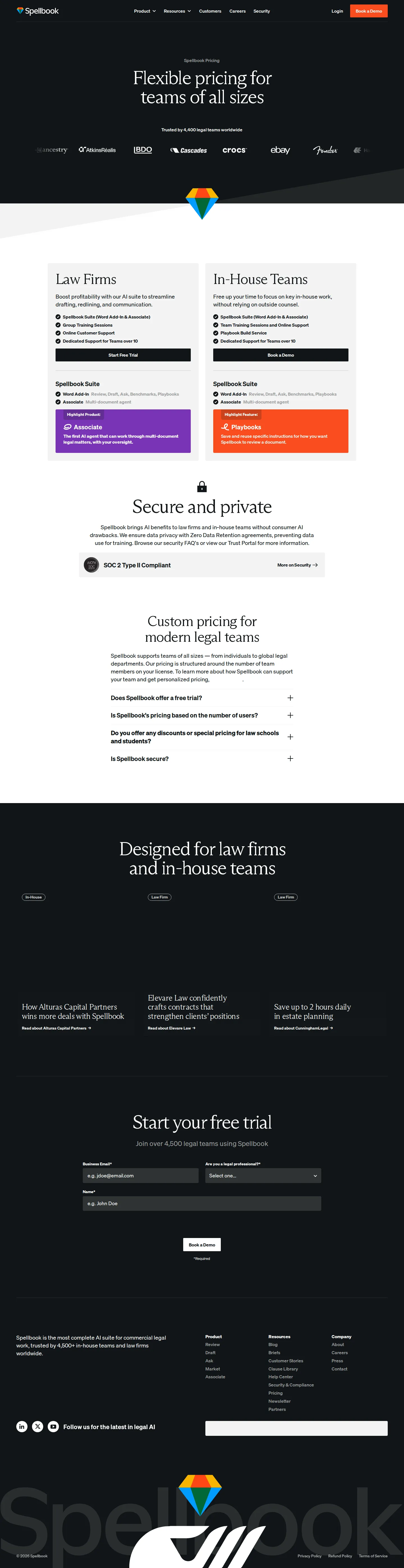
Same gated model on spellbook.com; 4,400+ teams
Current snapshot (spellbook.com/pricing) keeps the identical quote-only, per-seat structure across Law Firms and In-House Teams packages bundling the Suite and Associate agent. spellbook.legal now redirects to spellbook.com, and the public 'trusted by' counter has risen to 4,400+ legal teams.
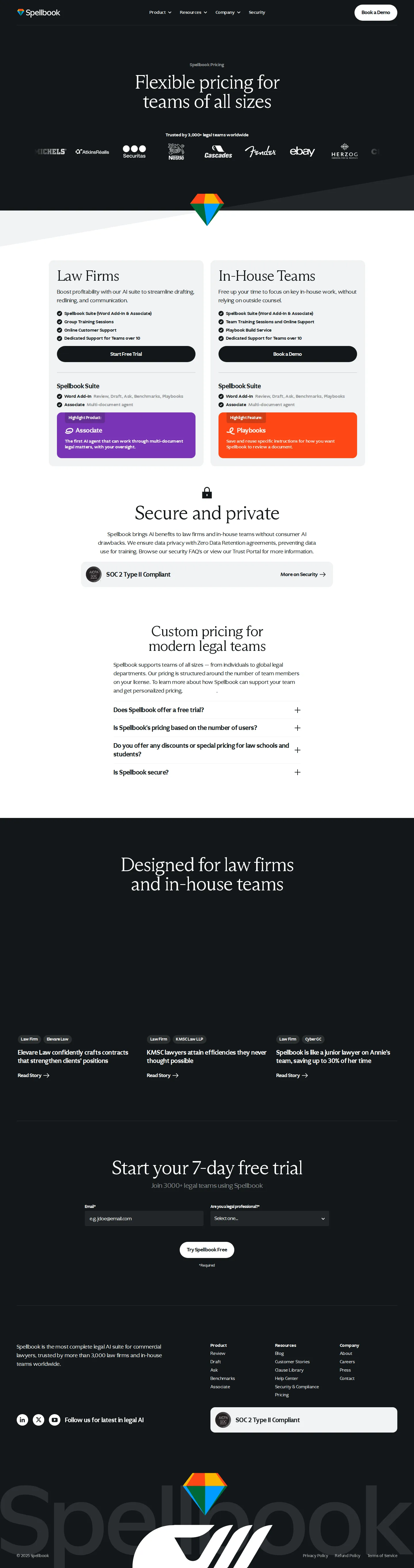
Already gated: quote-only per-seat pricing (3,000+ teams)
Earliest archived Spellbook pricing-page snapshot (spellbook.legal, 2025-06-09) shows no public prices — two segment cards (Law Firms, In-House Teams) bundling the Spellbook Suite (Word Add-In + Associate), 'Custom pricing for modern legal teams' structured around the number of team members, a 7-day free trial, and 'Trusted by 3,000+ legal teams.' No public-price snapshot predates this in the Wayback archive.
- · Spellbook launched what it called the first generative-AI contract-drafting tool in September 2022, running inside Microsoft Word rather than as a standalone web app.
- · Spellbook is built by Rally (Rally Inc.), a Canadian company headquartered in Saint John and Toronto; the legal AI product carried the spellbook.legal domain before migrating to spellbook.com.
- · Spellbook's pricing page has shown no public dollar figures in every Wayback snapshot from June 2025 onward — the only public price the company advertises is a '$99 for the first month' CLE-attendee promo on its /99 landing page.
Questions & answers
- How much does Spellbook cost?
- Spellbook does not publish list prices. It uses a custom, per-seat, quote-only model structured around the number of team members on your license, with pricing given after a demo. Third-party sources estimate roughly $99 to $200+ per user per month, but these are not official figures.
- Does Spellbook have a free trial?
- Yes. Spellbook offers a self-serve 7-day free trial gated to legal professionals via a business-email signup form. It is a trial, not a standing free tier.
- Is Spellbook priced per user?
- Yes. Spellbook states its pricing is structured around the number of team members on your license. There is no public per-seat rate, and dedicated support is called out for teams over 10 seats.
- What is included in a Spellbook license?
- Both the Law Firms and In-House Teams packages bundle the full Spellbook Suite — the Word Add-In (Review, Draft, Ask, Benchmarks, Playbooks) and the Associate multi-document agent — differing mainly in training, support, and onboarding services.
- Has Spellbook changed its pricing?
- Spellbook's pricing page has been quote-only in every archived snapshot since June 2025, so no public price change is documented in that window. The most visible shift is the spellbook.legal to spellbook.com domain migration and a rising public customer count (3,000+ to 4,400+ teams).
- Who owns Spellbook?
- Spellbook is built by Rally (Rally Inc.), a Canadian legal-tech company. It raised a $20M Series A led by Inovia Capital in January 2024, with Thomson Reuters Ventures among the investors.