AI Summary
About
Tabnine is a private, deployable-anywhere AI coding platform — completions, in-IDE chat, autonomous agents, and an organizational Context Engine — positioned for security-conscious engineering teams that cannot send their code to a shared cloud assistant. Its defining promise is deployment flexibility (SaaS, VPC, on-premises, or fully air-gapped) combined with zero code retention, no training on customer code, and enterprise compliance (GDPR, SOC 2, ISO 27001). In 2026 Tabnine was named a Visionary in the Gartner Magic Quadrant, and it describes itself as “the original AI coding platform, trusted by millions of developers and thousands of companies.”
Tabnine competes with GitHub Copilot, Cursor, and Claude Code, but differentiates on privacy and bring-your-own-LLM control rather than on a single hosted model. Customers can run Tabnine against their own LLM (on-prem or their own cloud endpoint) for unlimited usage, or use Tabnine-provided model access metered at the provider’s price plus a 5% handling fee — an unusually transparent pass-through arrangement for the category.
Founded in 2018 (and merged with code-completion company Codota in 2019), Tabnine is one of the oldest AI coding assistants — it launched on Hacker News to 607 points and 188 comments in November 2018, years before GitHub Copilot existed. It has raised roughly $102M across five rounds, with backers including Khosla Ventures (2017 seed), Qualcomm Ventures (2022 Series B), and Atlassian Ventures and Telstra Ventures (a $25M Series B in November 2023). That investor mix — a chipmaker, a developer-platform vendor, and a telco — mirrors Tabnine’s pivot from a consumer-grade autocompleter to an enterprise platform sold on privacy and deployment control.
Pricing summary : per-seat platforms plus a capacity-tiered headless add-on
Tabnine’s core pricing is seat-based: the Code Assistant Platform is $39 per user per month and the Agentic Platform is $59 per user per month, both billed annually and quoted through “Get a quote” rather than online self-serve checkout. On top of seats sit two usage dimensions — making the overall model a hybrid: LLM token consumption and headless-agent processing capacity.
- Seats — $39/user/mo (Code Assistant) or $59/user/mo (Agentic Platform), annual.
- LLM tokens — unlimited when you bring your own model on-prem or via your own cloud endpoint; Tabnine-provided model access is metered at the actual provider price plus a 5% handling fee.
- Headless Agent capacity — an optional add-on licensed by monthly token-processing capacity, not seats: $1,200/mo for up to 5B tokens/mo (Business) or $5,000/mo for up to 50B tokens/mo (Enterprise).
- Enterprise Context Engine — sold separately at a custom price; agent-agnostic across Cursor, GitHub Copilot, and Claude Code.
What makes this different: Tabnine separates the AI tooling fee (the seat) from the model-inference fee (tokens), and lets customers zero out the latter entirely by running their own LLM — a privacy-and-cost lever most hosted assistants do not offer. Its headless add-on is also metered by token-processing capacity rather than per developer, reflecting that autonomous CI/CD agents do not map to seats.
Pricing by product
Tabnine coding platform (per-seat plans)
| Tier | Price | Included | Key mechanics |
|---|---|---|---|
| Code Assistant Platform | $39 /user/mo | AI completions + multi-line full-function code, in-IDE chat using leading LLMs, Jira integration, private deployment (SaaS/VPC/on-prem/air-gapped), SSO, priority ticket support | Annual subscription; quoted via “Get a quote” |
| Agentic Platform | $59 /user/mo | ”Everything in Code Assistant plus:” autonomous agents with optional user-in-the-loop, Tabnine CLI, Tabnine Context Engine included, MCP tool access, coaching guidelines, MCP governance controls | Annual subscription; quoted via sales |
Enterprise Context Engine (sold separately)
| Tier | Price | Included | Key mechanics |
|---|---|---|---|
| Enterprise context | Custom | Continuously updated knowledge graph of architecture, dependencies, and standards; hybrid graph + vector reasoning; multi-agent coordination; agent-agnostic across Cursor, GitHub Copilot, Claude Code, and Tabnine agents | Sales-led, custom quote |
Headless Agents (optional add-on — capacity-tiered)
| Tier | Price | Included | Key mechanics |
|---|---|---|---|
| Business | $1,200 /mo | Up to 5B tokens/mo processing capacity; autonomous agents in CI/CD; compatible with all major CI/CD platforms | Licensed by processing capacity, not per seat; annual |
| Enterprise | $5,000 /mo | Up to 50B tokens/mo processing capacity; scales automation across many pipelines and environments | Capacity-tiered; customer pays their own LLM provider token costs; annual |
Sales motions across products: sales-led / “Get a quote” for every tier (Code Assistant, Agentic, Context Engine, and both Headless Agent tiers) — Tabnine publishes list prices but routes all checkout through sales; there is no online self-serve purchase.
Hidden costs : What Tabnine users actually pay
Because there is no free tier and no self-serve checkout, the headline seat price is the floor, not the whole bill. The extras that move the total are (1) per-seat multiplication across a team, (2) Tabnine-provided LLM tokens when you do not bring your own model, and (3) the Headless Agent capacity add-on for CI/CD automation. Two archetypes show how different those bills look.
Archetype A — 25-developer team on the Agentic Platform, bring-your-own model. Seats dominate; token spend is zero because the customer runs its own LLM on-prem or via its own cloud endpoint.
| Line item | Monthly cost |
|---|---|
| Agentic Platform — 25 seats @ $59 | $1,475 |
| Tabnine-provided LLM tokens (BYO model used) | $0 |
| Headless Agents | not used |
| Estimated total | $1,475/mo (~$17,700/yr, annual) |
Archetype B — 25-developer team, Tabnine-provided LLM + one Headless Agent tier. Now there are three meters: seats, pass-through token cost (provider price + 5% handling fee), and the capacity add-on for pipeline automation.
| Line item | Monthly cost |
|---|---|
| Agentic Platform — 25 seats @ $59 | $1,475 |
| Tabnine-provided LLM tokens | provider price + 5% (variable) |
| Headless Agents — Business (up to 5B tokens/mo) | $1,200 |
| Estimated total | $2,675+/mo before token pass-through |
The non-obvious costs:
- No monthly option in practice. All published tiers are annual subscriptions quoted through “Get a quote,” so the real commitment is the annual figure, not the per-month sticker.
- Token pass-through is variable. The 5% handling fee is small, but the underlying provider token cost is uncapped unless you bound it with a reserved quota — and it disappears entirely only if you bring your own model.
- Headless Agents are billed by capacity, not usage. You pay $1,200/mo for the 5B-token Business tier even if you process far less; the jump to the 50B Enterprise tier is $5,000/mo. There is no listed pay-as-you-go rate between the two.
- The Enterprise Context Engine is a separate line item at a custom price on top of seats.
Want to estimate your own Tabnine bill? Use the Tabnine pricing calculator to model seats, token pass-through, and the Headless Agent add-on.
Pricing evolution : Tabnine pricing history and changes
Tabnine’s pricing arc is one of the clearest “free-to-enterprise” migrations in the AI coding category. It spent roughly four years as a $12-tier freemium tool, then retired its free plan and roughly tripled the entry price to chase privacy-conscious enterprise budgets.
Cadence
| Quarter | Price changes | Product / SKU additions | Notes |
|---|---|---|---|
| 2018 Q4 | Launch | Cross-language autocompleter | Show HN: 607 points, 188 comments (2018-11-06); personal license reportedly moved $30→$99 by 2018-11-20 |
| 2020 Q2 | — | Free forever / Professional $15 / Enterprise | Wayback 2020-06 confirms a $15/mo Professional tier with 14-day trial |
| 2022 Q1 | Pro repriced to ~$12 | Free / Team / Enterprise repackage | Wayback 2022-02 shows three-column Free / Team / Enterprise cards |
| 2024 Q1 | Free tier retired; entry → $39 | Enterprise $39 / Agentic $59 split | Repositioning to privacy-first enterprise platform (devtoolsreview, eesel trackers) |
| 2025 Q2 | — | Free Basic officially ended (Apr 2025) | Last vestige of freemium removed |
| 2026 Q2 | — | Headless Agents + Enterprise Context Engine | Capacity-tiered add-on ($1,200/$5,000/mo) and agent-agnostic Context Engine |
Tracked range: 2018–present, via Wayback snapshots (2020-06, 2022-02) and corroborating secondary pricing trackers for the 2024 repackage where the live page rendered prices dynamically.
Notable changes
- 2018-11 — Public launch as a free + paid autocompleter; Show HN hits 607 points and 188 comments, an early signal of strong developer demand.
- 2020-06 — Freemium structure documented: Free forever, Professional $15/month, Enterprise “Contact us” self-hosted.
- 2022 — Repackage to Free / Team / Enterprise; the paid Pro/Team tier sits at roughly $12/user/mo. Qualcomm Ventures joins the Series B.
- 2024 — The pivotal move: Tabnine retires its free tier and roughly triples the entry price, splitting into Code Assistant ($39/user/mo) and an Agentic Platform ($59/user/mo). The product is now sold on privacy, deployment flexibility, and compliance rather than as a budget completion tool.
- 2025-04 — The Free Basic plan is officially ended, completing the move to paid-only.
- 2026 — Two newer monetization surfaces appear: a capacity-tiered Headless Agent add-on ($1,200/mo for 5B tokens, $5,000/mo for 50B tokens) and a separately sold, agent-agnostic Enterprise Context Engine.
The free-tier removal in detail
Retiring the free tier is the single most consequential pricing decision in Tabnine’s history, and it cuts both ways. For Tabnine it aligned the business with where its revenue actually came from — security-conscious enterprises that value on-prem and air-gapped deployment, not individual hobbyists. The same move stranded the long tail of individual developers who had used Tabnine free for years; with GitHub Copilot, Cursor, and several free-tier rivals available, the floor for “AI completions at $0” did not disappear from the market, only from Tabnine. The roughly 3× jump from a ~$12 Pro seat to a $39 Code Assistant seat made Tabnine one of the more expensive seats in the category, a position it can only defend on privacy and deployment control rather than raw completion quality.
What’s unique : Tabnine’s distinctive pricing mechanics
1. The seat fee and the model fee are unbundled — and you can zero out the model fee. Most hosted assistants fold inference into a single per-seat price. Tabnine separates the AI-tooling seat ($39/$59) from LLM inference, and lets customers bring their own model (on-prem or their own cloud endpoint) for unlimited token usage at no incremental Tabnine charge. This is a concrete instance of the broader shift toward outcome- and usage-aligned AI pricing: the seat covers tooling, while the variable model cost is exposed transparently rather than marked up opaquely. Only customers who use Tabnine-provided model access pay for tokens — and even then it is a transparent pass-through: the actual provider price plus a flat 5% handling fee. That is an unusually honest meter in a category where most vendors bury their model margin.
2. Deployment flexibility is the value metric, not completion volume. Tabnine prices the right to run the platform privately — SaaS, VPC, on-premises, or fully air-gapped — with zero code retention and no training on customer code (SOC 2, ISO 27001, GDPR). The premium over Copilot/Cursor seats is justified by where the software can run and what it promises not to do with your code, not by how many completions you consume.
3. Autonomous agents are priced by capacity, not seats. The Headless Agent add-on recognizes that CI/CD automation does not map to developers: it is licensed by monthly token-processing capacity ($1,200/mo for 5B tokens, $5,000/mo for 50B tokens). And the Enterprise Context Engine is sold separately and deliberately agent-agnostic — it feeds organizational context to Cursor, GitHub Copilot, and Claude Code, not just Tabnine’s own agents, turning a differentiator into a standalone product line.
Strengths & weaknesses
| Strengths | Weaknesses |
|---|---|
| Transparent token pass-through (provider price + 5%) and a true zero-token path via bring-your-own-model | No free tier and no self-serve checkout — every tier routes through “Get a quote,” raising friction for small teams |
| Privacy/deployment is a defensible, premium value metric (on-prem, VPC, air-gapped, zero retention, SOC 2 / ISO 27001 / GDPR) | Entry seat ($39) is roughly 3× the old $12 Pro and among the most expensive in the category |
| Capacity-priced Headless Agents and an agent-agnostic Context Engine open monetization beyond seats | Headless Agent pricing is coarse: a $1,200→$5,000/mo cliff with no listed pay-as-you-go rate between tiers |
| List prices for every tier are public despite the sales-led motion | Token cost when using Tabnine-provided LLM is uncapped unless bounded by a reserved quota — potential for bill drift |
Billing UX : governance, usage metrics, and spend controls
- Set pricing thresholds per user/team — the Agentic Platform exposes spend thresholds at the user and team level, letting admins cap consumption before it runs away.
- Centralized analytics for adoption, cost, and compliance — a usage dashboard surfaces per-user and per-team usage metrics, code-generation provenance, and adoption data.
- Control LLM access by user/team — administrators govern which LLMs each user or team can call, and gate MCP tool access (MCP governance controls).
- Reserved token-consumption quota — when using Tabnine-provided LLM access, spend is bounded by a reserved quota billed at the actual provider price plus a 5% handling fee; bringing your own LLM removes the meter entirely.
- Auditability for all usage — every usage event is auditable, with code-generation provenance viewable per user and team for compliance review.
Strategic wins : Why Tabnine’s pricing decisions worked
1. Choosing privacy as the value metric instead of completion volume
Rather than compete on price-per-completion against Copilot and Cursor, Tabnine picked a value metric it could defend at a premium: the right to run AI coding privately, with zero code retention and no training on customer code. That reframing is what lets a $39–$59 seat survive next to cheaper or free rivals — buyers in regulated industries are paying for a compliance posture, not raw tokens. For why the value-metric choice matters more than the headline number, see choosing the right usage metric.
2. Retiring the free tier to align price with where revenue actually was
Killing the free plan in 2024 and tripling the entry seat was a deliberate move upmarket. It traded the long tail of individual hobbyists for enterprise accounts that value deployment control — the customers Qualcomm, Atlassian, and Telstra had invested behind. The decision mirrors a broader category shift away from per-seat freemium toward enterprise platforms; see how AI companies are shifting from per-user licenses.
3. Unbundling inference so customers can zero out the model bill
By separating the seat fee from the LLM fee and offering a transparent pass-through (provider price + 5%) plus an unlimited bring-your-own-model path, Tabnine turned a cost center into a trust signal. Enterprises that already run their own model endpoints pay Tabnine only for tooling — a pricing structure that reinforces the privacy story instead of fighting it. For the mechanics of separating tooling from inference, see the introduction to usage-based pricing.
Areas to improve : Gaps in Tabnine’s pricing approach
1. No self-serve path for small teams
Every tier — even the published $39 Code Assistant — checks out through “Get a quote,” with no online purchase and no free tier as an on-ramp. For a five-person startup that just wants to try the product, that is a high-friction wall compared to Copilot or Cursor’s instant sign-up. A self-serve annual or monthly option at the lower tiers would recover demand Tabnine currently cedes to freemium rivals.
2. The token meter can drift when using Tabnine-provided models
When customers do not bring their own model, Tabnine-provided LLM access is metered at provider price + 5%, and that underlying cost is uncapped unless bounded by a reserved quota. Without a hard default cap or clearer in-product spend alerts, teams can face the same unpredictability that plagues other token-billed tools — see AI cost unpredictability and bill shock. Making the reserved quota the default, rather than opt-in, would tighten the story.
3. The Headless Agent tiers leave a wide gap
The add-on jumps from $1,200/mo (5B tokens) straight to $5,000/mo (50B tokens) with nothing in between and no published overage rate. A team that outgrows 5B tokens but is nowhere near 50B has no graduated option and may overpay 4× or be pushed to negotiate. A mid-tier or a per-billion overage rate would smooth the cliff and make the add-on easier to adopt incrementally.
Key takeaways
- Two per-seat platforms, both quoted via sales. Code Assistant is $39/user/mo and the Agentic Platform is $59/user/mo, billed annually; there is no free tier and no self-serve checkout.
- Inference is unbundled from the seat. Bring your own model for unlimited token usage at no Tabnine charge, or use Tabnine-provided access at the provider’s price plus a flat 5% handling fee.
- Tabnine moved upmarket by killing freemium. It spent four years as a ~$12 Pro tool, then retired the free tier in 2024 and roughly tripled the entry seat to chase enterprise privacy budgets.
- Privacy and deployment are the value metric. The premium is justified by on-prem / VPC / air-gapped delivery, zero code retention, and SOC 2 / ISO 27001 / GDPR compliance — not by completion volume.
- New surfaces extend beyond seats. Capacity-priced Headless Agents ($1,200–$5,000/mo) and a separately sold, agent-agnostic Enterprise Context Engine monetize automation and organizational context independently of developer count.
UBP implications
- Pass-through token billing can be a trust feature, not just a cost. Tabnine’s “provider price + 5%” meter shows that exposing your inference cost transparently — and letting customers bypass it entirely with their own model — can reinforce a privacy brand instead of eroding margin perception. The 5% is honest about handling cost without hiding model markup.
- Capacity tiers fit autonomous agents better than seats. As agents do work without a human in the loop, per-seat pricing breaks down. Tabnine’s Headless Agent capacity tiers (token-processing/month) are a cleaner mapping — but the wide $1,200→$5,000 gap is a cautionary example of pricing autonomy without graduated steps.
- Removing a free tier is a packaging decision, not just a price hike. Tabnine’s 2024 move shows that retiring freemium and re-anchoring on a defensible value metric (privacy/deployment) can reposition a product upmarket — at the cost of the individual-developer funnel, which then has to be defended on differentiation rather than price.
Sources
- Tabnine pricing page (accessed 2026-06-09)
- Tabnine Enterprise Context Engine pricing (accessed 2026-06-09)
- Tabnine Headless Agent pricing (accessed 2026-06-09)
- Tabnine blog (accessed 2026-06-09)
- Tabnine official website (accessed 2026-06-09)
- Wayback snapshot — Tabnine pricing, 2020-06-09 (Free / Professional $15 / Enterprise) (accessed 2026-06-09)
- Wayback snapshot — Tabnine pricing, 2022-02-19 (Free / Team / Enterprise) (accessed 2026-06-09)
Bottom line
Tabnine is the privacy-first option in AI coding: two per-seat platforms ($39 Code Assistant, $59 Agentic, annual, sales-quoted), inference unbundled from the seat (bring your own model for free, or pay provider price + 5%), and newer capacity-priced Headless Agents plus an agent-agnostic Context Engine. Its defining move was retiring the free tier in 2024 and roughly tripling the entry seat to anchor on deployment control and compliance rather than completion volume — a deliberate trade of the individual-developer funnel for enterprise privacy budgets.
Want to compare Tabnine against other coding assistants and developer tools? Browse the pricing blueprint, or model your own bill with the Tabnine pricing calculator.
Pricing timeline : Major events on a vertical axis
Each milestone below corresponds to a public pricing change, product launch, or material adjustment. Major events use a filled marker; minor adjustments use a faded one.
Two-platform structure: Code Assistant $39, Agentic $59 + Headless Agents
Tabnine prices two per-seat platforms — Code Assistant at $39/user/mo and the Agentic Platform at $59/user/mo (annual) — plus a separately sold Enterprise Context Engine (custom) and a capacity-tiered Headless Agent add-on ($1,200/mo for 5B tokens, $5,000/mo for 50B tokens). LLM usage is BYO-model unlimited or Tabnine-provided at provider cost + 5%.
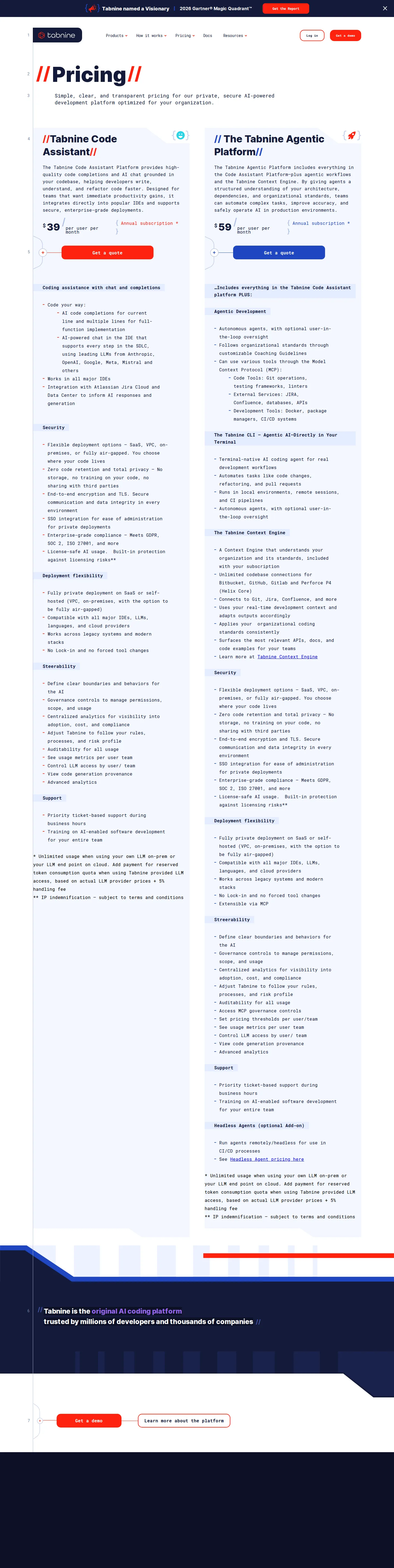
Free tier retired; upmarket repackage to Enterprise $39 / Agentic $59
Tabnine discontinues its free plan during 2024 and repositions away from the $12 freemium model toward a privacy-first enterprise platform: Code Assistant (formerly Enterprise) at $39/user/mo and an Agentic Platform at $59/user/mo. Free Basic was officially ended by April 2025. Corroborated by devtoolsreview.com and eesel.ai pricing trackers. Source: https://devtoolsreview.com/pricing/tabnine-pricing/
Repackage to Free / Team / Enterprise; Pro at $12/user/mo
By 2022 the lineup is Free Basic, a paid Pro/Team tier, and Enterprise self-hosting (Wayback 2022-02-19 shows the three-column Free / Team / Enterprise plan cards). Secondary sources price the Pro plan at $12/user/mo through this freemium era. Qualcomm Ventures joins the Series B (2022-06-15). Source: https://web.archive.org/web/20220219133957/https://www.tabnine.com/pricing

Free forever + Professional $15/month
Wayback snapshot (2020-06-09) shows a freemium structure: 'Free forever' local completions, a Professional plan at $15/month with a 14-day free trial, and an Enterprise 'Contact us' self-hosted tier. Source: https://web.archive.org/web/20200609224434/https://www.tabnine.com/pricing
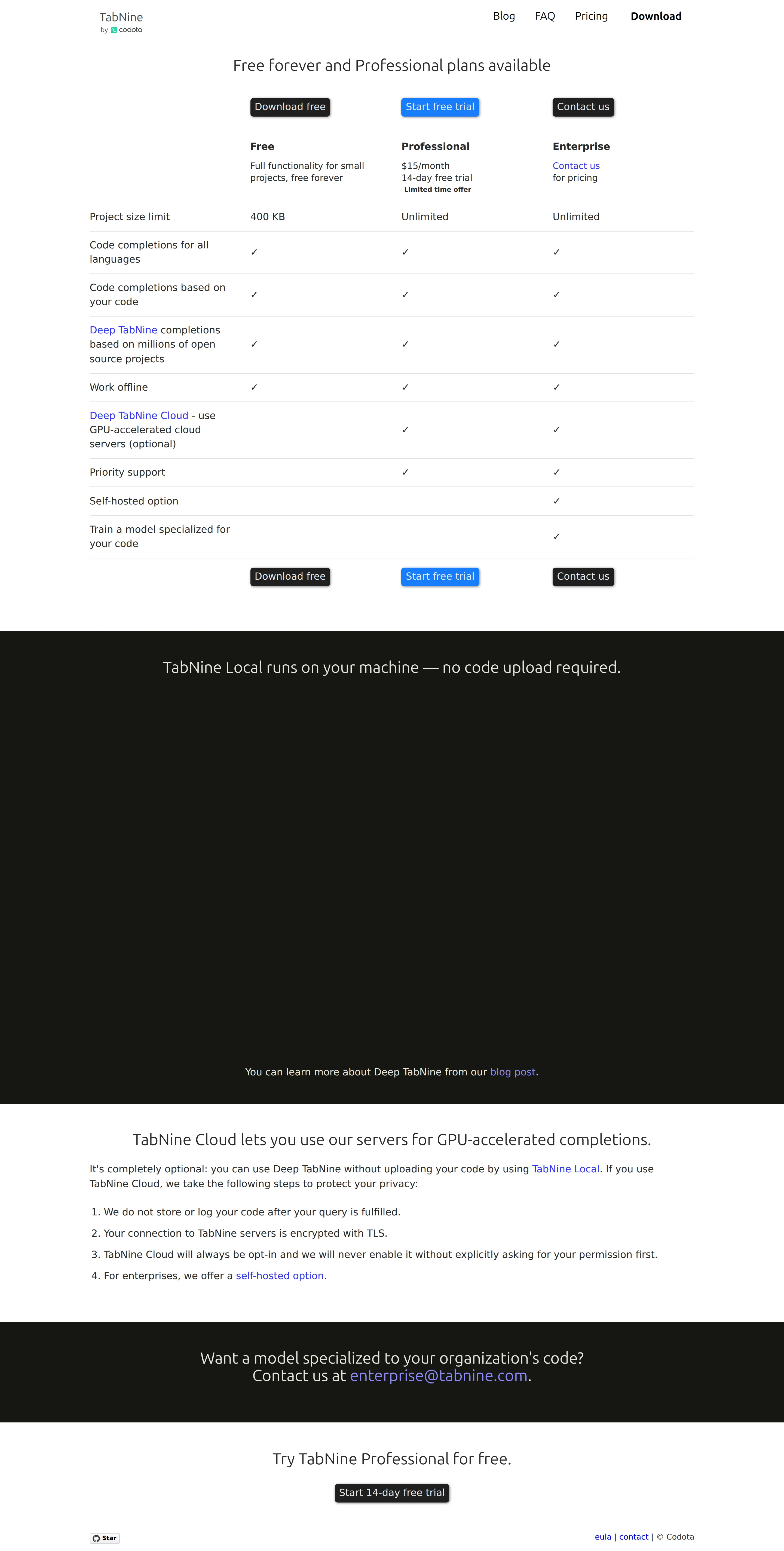
Show HN launch: free + paid personal licenses
Tabnine launches publicly as a cross-language autocompleter (Show HN: 607 points, 188 comments, 2018-11-06). Early personal licenses were paid (a 2018-11-20 HN post flags a move from $30 to $99 for personal licenses), alongside a free local tier. Source: https://news.ycombinator.com/item?id=18372883
- · Tabnine sells two per-seat platforms — Code Assistant at $39/user/mo and the Agentic Platform at $59/user/mo (annual) — with every tier checked out via 'Get a quote' rather than online self-serve.
- · LLM token usage is unlimited when you bring your own model on-prem or your own cloud endpoint; only Tabnine-provided LLM access carries a metered charge — the actual provider price plus a 5% handling fee.
- · Tabnine's Headless Agent add-on is priced by token-processing capacity, not seats: $1,200/mo buys up to 5B tokens/mo and $5,000/mo buys up to 50B tokens/mo for autonomous CI/CD agents.
Questions & answers
- How much does Tabnine cost per month?
- The Tabnine Code Assistant Platform is $39 per user per month and the Agentic Platform is $59 per user per month, both billed annually and quoted through sales.
- What is the difference between Tabnine's Code Assistant and Agentic platforms?
- The Code Assistant Platform ($39/user/mo) provides AI completions and in-IDE chat. The Agentic Platform ($59/user/mo) includes everything in Code Assistant plus autonomous agents, the Tabnine CLI, and the Tabnine Context Engine.
- Does Tabnine offer a free tier?
- Tabnine's current pricing page shows no free plan; all tiers are paid annual subscriptions quoted via sales. Code Assistant starts at $39 per user per month.
- How are Tabnine's token / LLM costs billed?
- LLM usage is unlimited when you use your own model on-prem or your own cloud endpoint. When using Tabnine-provided LLM access, you pay a reserved token-consumption quota at the actual LLM provider price plus a 5% handling fee.
- How is Tabnine's Headless Agent add-on priced?
- Headless Agents are licensed by monthly token-processing capacity rather than per seat: Business is $1,200/mo for up to 5B tokens/mo and Enterprise is $5,000/mo for up to 50B tokens/mo, both annual.