AI Summary
About
Udio is an AI music-generation platform — a direct rival to Suno — that turns text prompts into full songs with vocals, instruments, and arrangement. The product is consumer-first and self-serve: anyone can sign up and start generating on a free tier, with paid tiers unlocking higher generation limits, longer songs, and a suite of editing tools (Voice Control, lyric/music editing, audio-to-song, style references, custom cover art).
Udio was founded by former Google DeepMind researchers — including contributors to Google’s Lyria music model — and launched publicly in April 2024 with a $10M seed round led by Andreessen Horowitz (a16z), backed by will.i.am, Common, and UnitedMasters CEO Steve Stoute, followed by a reported ~60M Series A that lifted its valuation north of 200M. Pricing is organized around three plans — Free, Standard, and Pro — all metered in song-generation credits, with à-la-carte add-on credit packs for overflow.
Udio’s defining story is its legal turn: after major labels sued it (and Suno) over training data in 2024, Udio settled with Universal Music Group in October 2025 and signed a licensing and product partnership, then settled with Warner Music in November 2025. The settlement reshaped what a Udio subscription buys — moving the service toward a “walled garden” where users stream their creations rather than freely download them.
For the most current information, see Udio’s pricing page.
Pricing summary : credit-metered subscription tiers with add-on credit packs
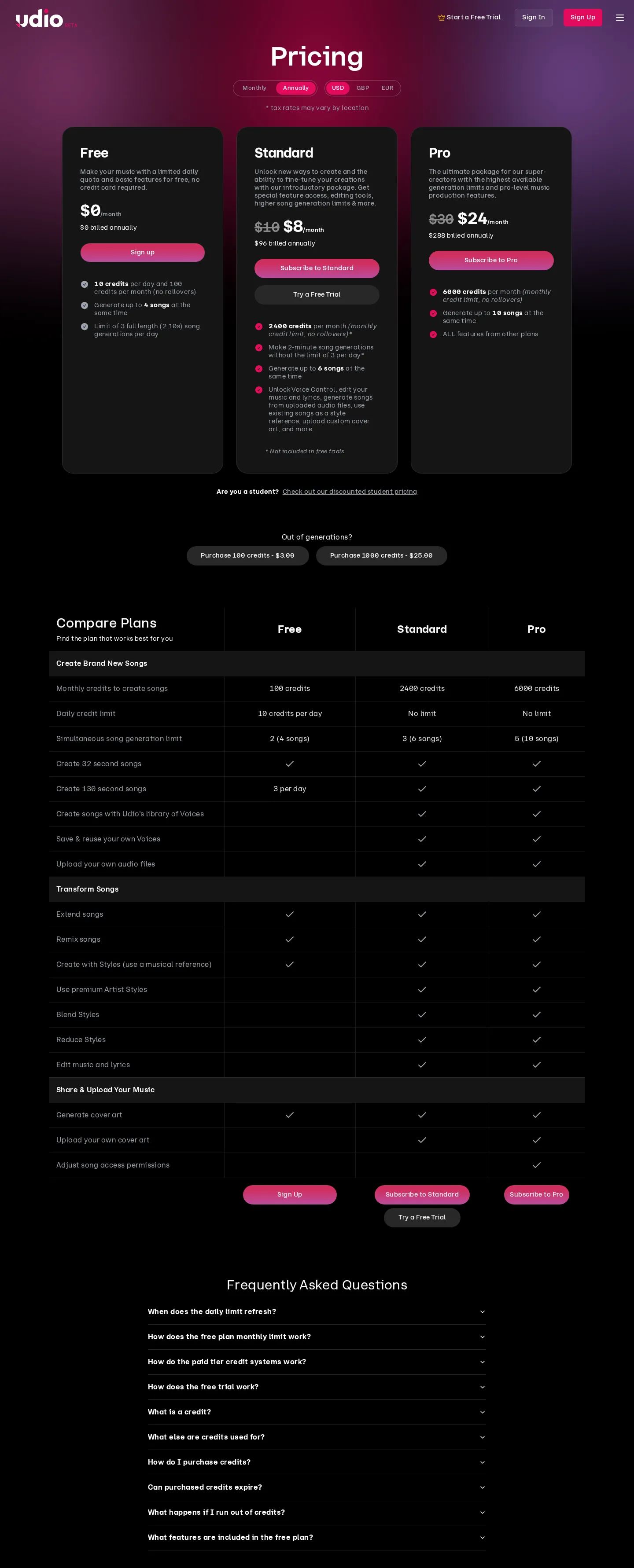
Udio runs a freemium subscription model with credits as the core billing unit, plus a pure-usage add-on for overflow. Each plan grants a credit allotment that powers song generation; the Free plan refreshes 10 credits daily against a 100-credit monthly ceiling, while paid plans grant a larger monthly allotment. Two paid tiers sit above free: Standard at $10/mo (2,400 credits) and Pro at $30/mo (6,000 credits). Annual billing discounts every paid tier by 20% (Standard $8/mo, Pro $24/mo).
- Billing unit: credits (1 credit ≈ a song-generation unit; plans quote a monthly credit count).
- Free tier: $0, 10 credits per day and 100 credits per month (no rollovers), up to 4 songs at the same time, limit of 3 full length (2:10s) song generations per day, no credit card required.
- Standard — $10/mo (or $8/mo annual): 2,400 credits per month (no rollovers), no 3-songs-per-day limit, up to 6 songs at the same time, plus Voice Control, editing, audio-to-song, style references and custom cover art.
- Pro — $30/mo (or $24/mo annual): 6,000 credits per month (no rollovers), up to 10 songs at the same time, ALL features from other plans.
- Add-on credits: purchasable when out of generations — 100 credits for $3.00 and 1,000 credits for $25.00.
- Credit expiry: subscription credits do not roll over day-to-day or month-to-month.
What makes this different: Udio caps the Free tier on both a daily (10) and a monthly (100) credit ceiling — stingier than Suno’s 50 daily credits — and pairs flat subscriptions with à-la-carte credit packs, making it a subscription-plus-usage hybrid. The larger wrinkle is rights: post-UMG, the subscription increasingly buys streaming inside Udio rather than freely downloadable, commercially usable output.
Pricing by product
| Tier | Price | Included (credits) | Key mechanics |
|---|---|---|---|
| Free | $0 | 10 credits per day and 100 credits per month (no rollovers) | Up to 4 songs at the same time; limit of 3 full length (2:10s) song generations per day; no credit card |
| Standard | $10/mo ($8/mo annual, $96 billed annually) | 2,400 credits per month (no rollovers) | “Most Popular”; no 3-songs-per-day limit; up to 6 songs at once; Voice Control, editing, audio-to-song, style refs, custom cover art |
| Pro | $30/mo ($24/mo annual, $288 billed annually) | 6,000 credits per month (no rollovers) | Highest limits; up to 10 songs at once; ALL features from other plans |
Add-on credit packs
| Pack | Price | Mechanics |
|---|---|---|
| 100 credits | $3.00 | Available when out of generations (paid plans) |
| 1,000 credits | $25.00 | Better per-credit rate; available when out of generations |
Sales motions across products: PLG / self-serve across all tiers (Free, Standard, Pro) — sign up, generate, and upgrade or buy add-on credits in-app. No sales-led or enterprise-quoted tier is offered on the public pricing page. Udio also advertises discounted student pricing.
Hidden costs : credit exhaustion, add-on top-ups, and the post-UMG download gate
Udio’s headline prices are clean, but the real monthly cost depends on generation volume because subscription credits do not roll over, and on the add-on rate once you exhaust your allotment. Using Udio’s published add-on packs, the effective per-credit cost is roughly $0.03/credit (100 for $3.00) or $0.025/credit (1,000 for $25.00) — the bigger pack is about 17% cheaper per credit.
| Add-on math (computed) | Pack price | Effective per-credit cost |
|---|---|---|
| 100-credit pack | $3.00 | ~$0.030 per credit |
| 1,000-credit pack | $25.00 | $0.025 per credit |
Two archetypes show where the bill actually lands.
Archetype 1 — the prolific creator who outruns Standard’s 2,400 credits. A creator iterating heavily exhausts the monthly allotment mid-month. Credits do not carry over, so overflow comes from add-on packs. Buying roughly 2,000 extra credits via two 1,000-packs adds about $50 on top of the $10 base.
| Line item | Monthly cost (illustrative) |
|---|---|
| Standard plan (2,400 credits) | $10.00 |
| ~2,000 extra credits (2 × 1,000-pack) | ~$50.00 |
| Base + overage | ~$60.00 |
The lesson: at this volume the upgrade math favors Pro (6,000 credits for $30) over stacking Standard add-ons — a classic credit-pool tier-jump incentive.
Archetype 2 — the “I just want to release this track” cost (post-UMG). Historically a user could download a generated song and use it commercially. After the UMG deal, Udio moved toward streaming-only access, so the practical “hidden cost” is no longer dollars — it is the uncertainty over whether you can export and monetize your output at all. Budget for the possibility that downloads and commercial use are restricted or evolving, and check the current terms before relying on them.
Want to estimate your own Udio bill? Use the Udio pricing calculator to model your monthly cost based on songs generated, plan tier, and add-on credits.
Pricing evolution : Udio pricing history and changes
Udio’s headline subscription prices have been stable ($0 / $10 / $30), but its most consequential “pricing” change was not a number — it was the October 2025 UMG settlement that altered the rights bundled with a subscription, shifting Udio from downloadable, commercially usable output toward a streaming “walled garden.”
Cadence
| Period | Price changes | Product / SKU additions | Notes |
|---|---|---|---|
| 2024 Q2 | Launch | Free / Standard / Pro credit tiers | Public launch April 2024; $10M a16z seed; credit-metered freemium established |
| 2025 Q4 | 0 | 0 | UMG settlement + licensing deal (2025-10-30); downloads removed → “walled garden”; 48-hour download window Nov 3–5; Warner deal Nov 19 |
| 2026 Q2 | 0 | Add-on packs visible | Free $0 / Standard $10 / Pro $30 held; add-on packs (100/$3.00, 1,000/$25.00) on the pricing page; student pricing advertised |
Tracked range: 2024 Q2–2026 Q2. No headline tier price change has been observed; the material change was to output rights (downloads/commercial use), not tier price. (Archive backfill via Wayback Machine pending; milestones above are attributed to launch coverage, live capture, and dated press reporting.)
Notable changes
- 2024-04 — Udio launches publicly with credit-metered freemium (Free daily credits + paid monthly-credit tiers); $10M seed led by a16z. Source: Music Business Worldwide.
- 2025-10-30 — Udio settles UMG’s copyright suit and announces a licensing/product partnership for a new licensed AI music platform; free downloads are removed in favor of a streaming “walled garden.” Source: Music Ally, PR Newswire.
- 2025-11-03 to 11-05 — After mass-cancellation backlash, Udio opens a 48-hour window letting users download songs made under the prior terms. Source: Billboard, Digital Music News.
- 2025-11-19 — Warner Music settles its suit and signs a deal with Udio. Source: industry coverage. Sony remained the lone unsettled major into 2026.
What’s unique : dual-cap free tier, credit packs, and a rights-driven repackaging
1. A dual daily-and-monthly free cap.
Udio’s Free plan is gated on both 10 credits per day and a 100-credit monthly ceiling, with a hard limit of 3 full-length (2:10) songs per day. That double cap is deliberately stingier than rival Suno’s 50 daily credits, shortening the runway before a serious creator must upgrade — a tighter freemium funnel.
2. À-la-carte credit packs layer pure-usage onto subscriptions.
Beyond the monthly allotment, paid users can buy 100 credits for $3.00 or 1,000 credits for $25.00, turning Udio into a subscription-plus-usage hybrid. The volume discount on the larger pack (17% cheaper per credit) gently steers heavy buyers toward bigger top-ups — or, past a point, toward the Pro tier.
3. Rights, not price, became the lever.
Udio’s most distinctive pricing move is that the UMG deal repackaged the product without touching tier prices — the same $10/$30 now buys a different (streaming-first) set of output rights. For a generative-media tool, that is a stark reminder that the value metric can be the rights to the output, and that a licensing deal can silently change what a subscription is worth.
4. Feature-gated editing suite.
Voice Control, lyric/music editing, audio-to-song, style references and custom cover art are all gated above Free. Udio uses a feature wall (not just a credit wall) to justify the first paid step, so the Free→Standard jump is about capability, not just capacity.
Strengths & weaknesses
| Strengths | Weaknesses |
|---|---|
| Dead-simple three-tier ladder ($0 / $10 / $30) — instantly legible to consumers | Free tier’s dual daily+monthly cap is notably stingy vs rivals, frustrating casual users |
| Transparent add-on credit packs (100/$3.00, 1,000/$25.00) let heavy users top up predictably | Credits never roll over, so under-used months are pure waste with no banking |
| 20% annual discount clearly surfaced ($96 / $288 billed annually) | Add-on stacking gets expensive fast — overflow nudges users to re-buy or jump tiers |
| Feature-gated editing suite gives a clear reason to leave Free | Post-UMG “walled garden” removes free downloads — the core value prop changed under users |
| Student pricing widens the funnel for the prosumer/creator base | UMG/Warner deals (and unsettled Sony) leave commercial-use rights in flux |
Billing UX : billing-period toggle, currency choice, and add-on top-ups
- Monthly / Annual toggle — The pricing page exposes a billing-period switch; selecting Annually shows the discounted monthly-equivalent ($8 Standard, $24 Pro) alongside the annual total ($96 / $288 billed annually).
- Multi-currency display — The pricing page lets users switch between USD, GBP, and EUR, with a note that “tax rates may vary by location.”
- Credit allotment metering — Plans are quoted in monthly credits (100 / 2,400 / 6,000), and the comparison table breaks out daily limits, simultaneous-generation limits, and per-song-length capabilities.
- Add-on credit purchases — An “Out of generations?” prompt offers 100 credits for $3.00 or 1,000 credits for $25.00 directly at the point of exhaustion.
- Free trial entry — Standard advertises a free trial path (“Try a Free Trial”), though some Standard features are explicitly “Not included in free trials.”
- Student discount — A “Are you a student?” link routes to discounted student pricing.
- Compare Plans table — An expandable feature-by-feature grid (song creation, transform, share & upload) lets users diff tiers before subscribing.
Strategic wins : Why Udio’s pricing decisions worked
1. A clean three-tier consumer ladder.
$0 / $10 / $30 with round credit numbers (100 / 2,400 / 6,000) is instantly legible to non-technical creators — no per-token math at sign-up. This packaging discipline mirrors the consumer-friendly clarity that helps AI companies move away from opaque per-user licenses.
2. Transparent add-on packs reduce bill-shock.
Unlike rivals that hide the per-credit overage rate, Udio publishes its top-up packs (100/$3.00, 1,000/$25.00) right on the pricing page, so heavy users can self-serve the overflow decision with full information — a direct counter to cost unpredictability.
3. Settling with the labels bought survival and a moat.
The UMG and Warner deals turned an existential copyright threat into a licensed-platform moat: a “walled garden” of licensed catalogs that unlicensed rivals cannot legally replicate. Painful for users in the short term, but it repositions Udio’s subscription around legitimacy. See outcome-based pricing trends for how value framing shifts under new constraints.
Areas to improve : Gaps in Udio’s pricing approach
1. Clarify what a subscription actually buys post-UMG.
The biggest gap is rights clarity. After the deal, users were unsure whether they could download or commercially use their output. Spelling out, per tier, exactly what export and commercial rights a subscription grants would rebuild trust eroded by the abrupt change. See choosing the right usage metric.
2. Loosen the dual free cap or reframe it as a trial.
A 10/day-and-100/month cap with a 3-full-songs-per-day limit is exhausted quickly, so Free functions more like a trial than a durable plan. A clearer “this is a trial” framing — or a modestly higher cap — would set expectations better and reduce churn-on-arrival.
3. Let subscription credits roll over (at least partially).
Because credits never carry over, under-used months are pure waste. A small rollover or banking allowance would soften the bill-shock-and-waste perception for irregular creators and improve the felt value of an annual commitment — see the usage-based pricing playbook on aligning capacity to actual consumption.
Key takeaways
- Rights can be the real pricing lever. Udio’s most consequential change was not a price move but the UMG deal that altered what a subscription buys — proof that in generative media, output rights are part of the price.
- Simplicity wins the consumer market. A $0/$10/$30 ladder with round credit numbers removes pre-purchase math and lowers decision friction in a prosumer market.
- Transparent overage builds trust. Publishing add-on pack prices (100/$3.00, 1,000/$25.00) lets users model overflow cost — a direct contrast to rivals that hide the rate.
- A stingy free tier is a deliberate funnel. Udio’s dual daily-and-monthly free cap shortens the runway to a paid upgrade, trading goodwill for conversion velocity.
- Licensing deals reshape the category. Settling with UMG and Warner converts a legal threat into a licensed-platform moat — but only if buyers understand the new terms.
UBP implications
- Output rights are a pricing dimension. Udio shows that a credit-metered subscription can be silently revalued by a rights change; UBP teams in generative media should treat export/commercial rights as an explicit, communicated part of the package.
- Hybrid credit-plus-pack models need rollover thinking. Pairing a no-rollover subscription with à-la-carte packs maximizes monetization but penalizes irregular usage; partial rollover or banking improves perceived fairness without abandoning metering.
- Free-tier cap design is a conversion knob. A dual daily-and-monthly cap is a sharper funnel than a single cap; the trade-off is goodwill, so UBP teams should tune free generosity to the desired upgrade velocity.
Sources
- Udio pricing page (accessed 2026-06-11) — live capture: Free/Standard/Pro credits, prices, add-on packs
- UMG settles Udio lawsuit; companies plan new AI-music service together — Music Ally (accessed 2026-06-11)
- Udio Says Users Can Download AI Songs for 48 Hours After Backlash — Billboard (accessed 2026-06-11)
- Udio Opens Downloads for 48 Hours Following UMG Deal — Digital Music News (accessed 2026-06-11)
- New AI music-making app Udio raises $10m; launches with backing from will.i.am, a16z — Music Business Worldwide (accessed 2026-06-11)
Bottom line
Udio turns AI music generation into a clean three-tier ladder — Free, Standard $10, Pro $30 — metered in song-generation credits, with transparent add-on packs (100 credits $3.00, 1,000 credits $25.00) for overflow and a 20% annual discount. Its defining pricing story, though, is not a number: the October 2025 Universal Music Group settlement repackaged the product into a streaming “walled garden,” removing free downloads and reshaping what a subscription actually buys. The wins are simplicity, transparent overage, and a hard-won licensed-platform moat; the gaps are a stingy dual-capped free tier, no credit rollover, and unresolved clarity over commercial-use rights against a backdrop of label litigation.
Want to compare Udio against other generative-media companies like Suno? Browse the pricing blueprint.
Pricing timeline : Major events on a vertical axis
Each milestone below corresponds to a public pricing change, product launch, or material adjustment. Major events use a filled marker; minor adjustments use a faded one.
Current tiers: Free / Standard $10 / Pro $30
Captured live from udio.com/pricing (USD, monthly view): Free ($0, 10 credits/day + 100 credits/month, no rollovers, 3 full-length songs/day), Standard ($10/mo or $8/mo annual = $96 billed annually, 2,400 monthly credits), Pro ($30/mo or $24/mo annual = $288 billed annually, 6,000 monthly credits). Add-on packs: 100 credits for $3.00, 1,000 credits for $25.00. Annual billing saves 20%.
UMG settlement + 'walled garden' rights shift
Udio settled Universal Music Group's copyright lawsuit and announced a licensing and product partnership to build a new licensed AI music platform. The deal removed free downloads of generated songs, moving Udio toward a 'walled garden' where users stream rather than export creations; user backlash drove mass cancellations and a 48-hour download window (Nov 3–5, 2025) for songs made under the prior terms. Warner Music followed with its own settlement and deal on Nov 19, 2025. No headline subscription price change accompanied the deal — the lever was output rights, not tier price. Source: Music Ally, Billboard, Digital Music News, 2025.
Public launch with credit-metered freemium
Udio launched publicly in April 2024 (after a $10M seed led by a16z with will.i.am, Common, and UnitedMasters) with a credit-metered freemium structure: a free daily-credit tier plus paid subscription tiers granting monthly credit allotments. The per-song credit cost and the no-rollover rule were established at launch. Source: launch press coverage (Music Business Worldwide).
- · Udio's October 2025 settlement with Universal Music Group flipped its core value proposition: songs that were once downloadable and commercially usable became stream-only inside a planned 'walled garden,' and Udio had to open a 48-hour emergency download window (Nov 3–5, 2025) so users could export work made under the old terms.
- · Udio's Free plan refreshes 10 credits every day on top of a 100-credit monthly ceiling — a dual daily-and-monthly cap that is stingier than rival Suno's 50 daily credits, nudging serious creators to paid tiers faster.
- · Udio was founded by former Google DeepMind researchers (contributors to Google's Lyria music model) and launched in April 2024 with a $10M seed led by a16z, backed by will.i.am, Common, and UnitedMasters CEO Steve Stoute.
Questions & answers
- What is Udio's pricing model?
- Udio uses a freemium subscription model metered in credits. A Free plan refreshes 10 credits daily (100/month), while paid Standard ($10/mo) and Pro ($30/mo) plans grant larger monthly credit allotments. Paid subscribers can also buy add-on credit packs (100 for $3.00, 1,000 for $25.00).
- Does Udio offer a free tier?
- Yes. The Free plan costs $0, requires no credit card, and grants 10 credits per day and 100 credits per month (no rollovers). It allows up to 4 songs generated at the same time but limits you to 3 full-length (2:10) song generations per day.
- How much does Udio cost per month?
- Standard is $10/month (2,400 credits) and Pro is $30/month (6,000 credits). Annual billing cuts these to $8/mo ($96/yr) and $24/mo ($288/yr) respectively — a 20% saving. Both paid tiers drop the 3-songs-per-day full-length limit.
- Is Udio pricing usage-based or subscription?
- It is a subscription metered in credits, with optional pure-usage add-ons. Each plan includes a fixed monthly credit allotment that does not roll over; when you run out, Standard and Pro users can top up with à-la-carte credit packs (100 credits for $3.00 or 1,000 for $25.00), making the model a subscription-plus-usage hybrid.
- Can I download and commercially use songs made on Udio?
- This changed materially. Before Udio's October 2025 UMG settlement, generated songs belonged to the prompt author and were downloadable for personal and commercial use. After the deal, Udio began moving to a 'walled garden' model where users stream their creations rather than freely download them; Udio opened a 48-hour download window (Nov 3–5, 2025) for songs made under the old terms. Always check Udio's current terms before relying on commercial rights.