AI Summary
About
Vapi is voice AI infrastructure for developers — an API and platform for building, deploying, and scaling conversational voice agents that handle phone calls in real time. It orchestrates the full voice stack (speech-to-text, an LLM, text-to-speech, and telephony) behind a single API, letting builders mix and match providers, bring their own model keys, and wire agents into existing phone systems. CEO Jordan Dearsley frames it as “the Twilio for AI agents,” and the company invokes AWS, Datadog, and Twilio as the infrastructure analogues it wants to be for voice.
Founded in 2023 (originally as “Superpowered”) and based in San Francisco, Vapi raised a ~$2.1M seed (Kleiner Perkins, Abstract Ventures), then a $20M Series A in December 2024 led by Bessemer Venture Partners at a $130M valuation (with Y Combinator, AI Grant, Saga Ventures, and Michael Ovitz). In May 2026 it raised a $50M Series B led by Peak XV Partners at a **$500M valuation** (M12, Kleiner Perkins, Bessemer participating), bringing total funding to roughly $72M. By the Series B, Vapi reported more than 1 million developers, 2.7M+ agents created, and over 1 billion calls — alongside roughly 10x enterprise ARR growth into the eight figures.
For the most current information, visit Vapi.
Pricing summary : How Vapi’s pricing model works
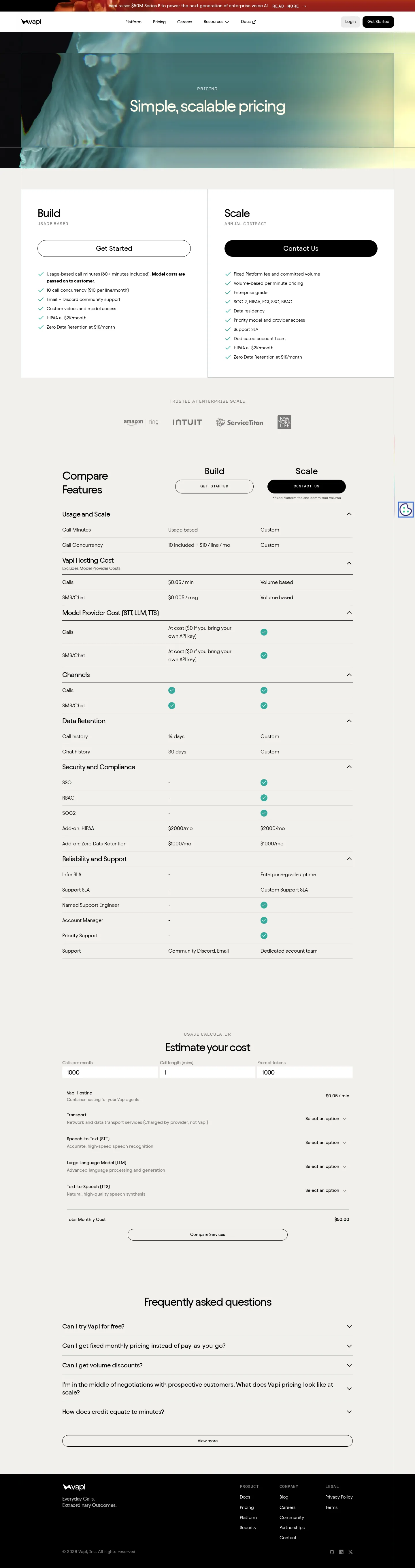
Vapi is usage-based with no base subscription on its self-serve Build plan. You pay $0.05 per minute for Vapi’s own hosting layer — the container that runs your agent and orchestrates the call — and the underlying speech-to-text, LLM, text-to-speech, and telephony costs are passed through at cost (and drop to $0 if you bring your own API keys). The plan includes 60+ call minutes and 10 concurrent call lines, after which concurrency is $10 per line/month. Messaging is metered separately at $0.005 per SMS/chat message. New accounts get $10 in free credits to experiment; there is no ongoing free tier.
Compliance is sold as flat monthly add-ons available on both plans: HIPAA at $2,000/month and Zero Data Retention (ZDR) at $1,000/month. The enterprise Scale plan is a quoted annual contract — a fixed platform fee plus committed volume at volume-based per-minute pricing — and layers on SOC 2, PCI, SSO, RBAC, data residency, priority model/provider access, a support SLA, and a dedicated account team.
What makes this different: Vapi separates its margin (the $0.05/min hosting fee) from the provider costs it passes through at cost. That makes Vapi cheap to start and transparent about where the money goes, but it also means the advertised $0.05/min is only a floor — real all-in deployments commonly run roughly 13 to 33 cents per minute once you add a transcriber, an LLM, a voice, and telephony.
Pricing by product
| Tier | Price | Included | Key mechanics |
|---|---|---|---|
| Build | $0.05/min Vapi hosting | 60+ minutes, 10 concurrency lines | Usage-based, no subscription; provider costs at cost ($0 with own keys); +$10/line/mo; SMS $0.005/msg |
| Scale | Custom (annual contract) | Committed volume | Fixed platform fee + volume-based per-minute; SOC 2/PCI/SSO/RBAC, SLA, dedicated team |
| HIPAA add-on | $2,000/mo | — | Available on Build and Scale |
| Zero Data Retention add-on | $1,000/mo | — | Available on Build and Scale |
Sales motions across products: self-serve PLG for Build (sign up, get $10 credit, pay per minute), and sales-led for the Scale annual contract. Vapi’s at-cost pass-through means buyers can null out model spend entirely by supplying their own provider keys.
Hidden costs : What Vapi users actually pay
The $0.05/min is the least of a real Vapi bill. The model and telephony providers you plug in — passed through at cost — usually dominate. A typical assistant pairs a transcriber (e.g. Deepgram), an LLM (e.g. GPT/Claude), a TTS voice (e.g. ElevenLabs), and a phone number, each metered per minute or per token. That stacks the effective rate well above the hosting fee.
| Line item | Cost (illustrative) |
|---|---|
| Vapi hosting | $0.05 / min |
| Speech-to-text (STT) | at cost (≈ $0.01–$0.02/min) |
| LLM (prompt + completion tokens) | at cost (varies by model) |
| Text-to-speech (TTS) | at cost (≈ $0.05–$0.10/min on premium voices) |
| Telephony / transport | at cost (≈ $0.01–$0.02/min) |
| Concurrency above 10 lines | $10 / line / mo |
| Effective all-in per minute | roughly 0.13–0.33 dollars / min (estimate) |
Other things to budget for: compliance is a hard monthly floor — HIPAA adds $2,000/mo and ZDR adds $1,000/mo regardless of usage; data retention is short by default (14 days call history, 30 days chat history) so longer retention requires the custom Scale contract; and bringing your own API keys zeroes the pass-through but means you manage and pay providers directly.
Want to estimate your own Vapi bill? Use the Vapi pricing calculator to model your costs based on usage patterns.
Pricing evolution : Vapi pricing history and changes
Cadence
| Period | Price changes | Product / SKU additions | Notes |
|---|---|---|---|
| 2024 | $0.05/min usage | Build (pay-as-you-go) | $10 free credits; 10 included lines; custom enterprise |
| 2026 | $0.05/min held | Scale annual contract; HIPAA/ZDR add-ons formalized | Volume-based per-minute at scale; compliance priced flat |
Tracked range: 2024–present. Vapi’s pricing page is a single-page React app and historical Wayback renders are sparse, so the timeline anchors on the December 2024 Series A coverage and the live 2026-06-09 capture.
Notable changes
- 2024-12 — At the $20M Series A, Vapi’s public model is pay-as-you-go: $0.05/min Vapi hosting + at-cost model/telephony pass-through, 10 included concurrency lines, $10 free starter credits, and a custom enterprise contract. Over 100,000 developers on the platform.
- 2026-05 — $50M Series B at a ~$500M valuation; enterprise ARR up ~10x and 1 billion calls crossed — the commercial backdrop for a hardened Scale enterprise contract.
- 2026-06 — Live capture confirms two named tiers: Build (usage) and Scale (annual contract, volume-based per-minute), with HIPAA $2,000/mo and ZDR $1,000/mo add-ons on both, and SMS/chat at $0.005/msg.
What’s unique : Vapi’s distinctive pricing mechanics
1. At-cost pass-through of providers. Vapi only marks up its own hosting layer ($0.05/min) and passes STT/LLM/TTS/telephony through at cost — even dropping them to $0 if you bring your own keys. That is unusually transparent for an orchestration platform and turns Vapi into a thin, predictable margin on top of provider spend the buyer can independently audit.
2. No subscription on the self-serve plan. Build has no monthly base fee at all — pure per-minute usage plus $10/line for concurrency. The only recurring charges are optional compliance add-ons. This removes the commitment barrier that per-seat or platform-fee competitors impose on early developers.
3. Compliance as a flat monthly meter. Rather than gating HIPAA and Zero Data Retention behind an opaque enterprise quote, Vapi prices them as published flat add-ons ($2,000 and $1,000/mo). Regulated buyers can self-serve into compliance on the Build plan without negotiating a contract first.
Strengths & weaknesses
| Strengths | Weaknesses |
|---|---|
| Transparent: Vapi’s margin ($0.05/min) is separated from at-cost provider pass-through | Headline $0.05/min understates real all-in cost (estimated 0.13–0.33 dollars/min) |
| No base subscription on Build — pure usage lowers the entry barrier | Costs are spread across 4–5 metered providers, hard to forecast |
| Bring-your-own-keys zeroes the model pass-through | Short default retention (14d calls / 30d chat) pushes you to Scale |
| Compliance is self-serve and flatly priced (HIPAA $2K, ZDR $1K) | Compliance add-ons are a steep flat floor for small workloads |
| Volume-based per-minute on Scale rewards committed enterprise volume | Scale per-minute rates and platform fee are quote-only (not published) |
Billing UX : Vapi billing controls and transparency
- Billing controls — Self-serve signup with $10 in starter credits; pay-as-you-go on Build with no contract. Concurrency lines and compliance add-ons are toggled per account. Scale moves to an annual contract with a fixed platform fee and committed volume.
- Usage visibility — The pricing page ships an interactive usage calculator that models calls/month × call length × tokens across Vapi hosting, transport, STT, LLM, and TTS — strong forward visibility into the multi-provider stack. Vapi also exposes per-call logs and cost breakdowns in the dashboard.
- Payment options — Card-based self-serve for Build (credits and metered usage); Scale is invoiced under an annual enterprise contract with a dedicated account team. HIPAA/ZDR add-ons bill as flat monthly line items.
Strategic wins : Why Vapi’s pricing decisions worked
1. Thin, transparent margin on top of provider cost
By charging only $0.05/min for hosting and passing providers through at cost, Vapi made itself trivially cheap to adopt and easy to trust — the buyer can see exactly what Vapi earns versus what the models cost. That positioning (“the Twilio for AI agents”) helped it cross 1 billion calls and 1M+ developers. See how AI companies structure pricing.
2. Usage-first, contract-later
Build’s pure per-minute model removed the commitment barrier for developers, while Scale converts proven, high-volume accounts into committed annual contracts with volume-based per-minute rates. That land-and-expand motion underpinned the ~10x enterprise ARR growth cited at the Series B. Related: outcome-based pricing trends.
3. Pricing compliance as a product
Publishing HIPAA ($2K/mo) and ZDR ($1K/mo) as flat self-serve add-ons let regulated buyers (healthcare, finance) adopt without a sales cycle — turning a common enterprise blocker into a checkbox. See choosing the right usage metric.
Areas to improve : Gaps in Vapi’s pricing approach
1. The $0.05/min anchor undersells true cost
Because the headline rate excludes the dominant model and telephony spend, new buyers routinely under-budget and hit a “real cost is 3–6x the sticker” surprise. Surfacing a default all-in estimate up front would close that expectation gap. See bill shock and cost unpredictability.
2. Multi-provider metering is hard to forecast
A single voice call is metered across five dimensions (hosting, STT, LLM, TTS, transport), each with its own unit and provider. The calculator helps, but predictability suffers versus a single blended per-minute rate — a tradeoff for the transparency Vapi gains.
3. Opaque Scale economics
Build is fully transparent, but the Scale platform fee and volume-based per-minute rates are quote-only. Buyers can’t reason about where the usage-to-commit crossover sits without a sales conversation, which slows mid-market self-qualification.
Monetization stack & signals : how Vapi builds & buys its revenue engine
Buys 4 Builds 1 13 open roles
Vapi runs a bought GTM/RevOps stack and builds its usage meter itself. Open RevOps roles describe maintaining "Salesforce architecture, workflow automation, data enrichment pipelines and integrations," and a Marketing-Ops role tasks the hire with auditing "our GTM stack (Clay, Hubspot, Salesforce, Hockeystack, & Tofu)" — confirming Salesforce + HubSpot as the CRM/marketing layer, Clay for enrichment and HockeyStack for revenue analytics. A separate live ABM role independently names Clay, HubSpot and Salesforce again ("Fluent in the ABM tech stack: HubSpot/Salesforce, Clay"), so those three are double-sourced; HockeyStack rests on the single GTM-stack audit line. There is no vendor named for billing or metering: the per-minute hosting fee plus at-cost provider pass-through is metered in Vapi's own dashboard (Settings → Billing → Reserved Concurrency), pointing to an in-house usage-metering/billing layer rather than a Metronome/Orb/Stripe-Billing buy. The revenue org is staffing up post-Series B — two RevOps managers plus a "GTM Engineering" mandate, a VP of Customer Engagement and several post-sales/retention roles — i.e. building the human + Salesforce-centered revenue engine while keeping metering in-house.
-
“open the Vapi Dashboard, navigate to Settings → Billing, find Reserved Concurrency (Call Lines), and increase the limit or purchase add-on concurrency lines — changes apply immediately”
-
“Audit our GTM stack (Clay, Hubspot, Salesforce, Hockeystack, & Tofu): map data flows, identify enrichment gaps”
-
“Audit our GTM stack (Clay, Hubspot, Salesforce, Hockeystack, & Tofu): map data flows, identify enrichment gaps”
-
“Audit our GTM stack (Clay, Hubspot, Salesforce, Hockeystack, & Tofu): map data flows, identify enrichment gaps, and ship your first quick wins on lead quality”
-
“Audit our GTM stack (Clay, Hubspot, Salesforce, Hockeystack, & Tofu): map data flows”
- Revenue Operations Senior Manager RevOps Jun 16, 2026
- Revenue Operations Manager RevOps Jun 16, 2026
- Director of Sales RevOps Jun 16, 2026
- Sr. Marketing Operations Manager RevOps Jun 16, 2026
- VP of Customer Engagement RevOpsCustomer successRetention Jun 16, 2026
- GTM Recruiter/Sourcer RevOps Jun 16, 2026
- Enterprise Account Executive Customer successGrowth seen Apr 30, 2026
- Agent Strategist - SF Customer success seen Apr 30, 2026
- Agent Strategist - NYC Customer success seen Apr 30, 2026
- Incident and Escalation Manager Customer successRetention seen Apr 30, 2026
- Customer Support Engineer, Senior Manager Retention seen Apr 24, 2026
- Product Manager - Enterprise & Governance Agents Retention seen Apr 24, 2026
- Director of Demand Generation Growth seen Nov 18, 2025
- +5 more matched roles
Signals reviewed · derived from public job posts, product docs
Job postings fill and close over time — once a posting is filled we keep it as a dated citation (the quoted evidence remains); use View open roles for current listings.
Key takeaways
- Separate your margin from your pass-through. Vapi marks up only its $0.05/min hosting layer and passes providers through at cost — a transparency move that built trust at developer scale.
- No subscription can be a feature. Pure per-minute Build pricing removed the commitment barrier and fed a land-and-expand funnel into committed Scale contracts.
- Price compliance, don’t gate it. Flat HIPAA ($2K) and ZDR ($1K) add-ons let regulated buyers self-serve into compliance without a sales cycle.
- Watch the headline-vs-all-in gap. A low advertised rate that excludes the bulk of the bill ($0.05 vs $0.13–$0.33 all-in) risks bill shock and erodes trust.
- Voice AI infra is consolidating around per-minute orchestration. Vapi’s $500M valuation and 1B-call milestone signal per-minute, multi-provider orchestration as the category’s emerging pricing default.
UBP implications
- Pass-through pricing builds trust in orchestration layers. When you sit between a buyer and multiple paid providers, billing those providers at cost (or letting buyers bring keys) makes your own margin defensible and transparent.
- Per-minute is the natural value metric for voice. Minutes map directly to the work performed and to the underlying provider meters — but the platform must expose an all-in estimate so the metric stays honest. See usage-based pricing strategy.
- Productize compliance as flat add-ons. Pricing HIPAA/ZDR as published monthly line items converts an enterprise blocker into self-serve revenue and shortens the path from developer to regulated production.
Sources
- Vapi pricing page (live capture, accessed 2026-06-09)
- Vapi raises $50M Series B as it reaches 1 billion calls (GlobeNewswire) (accessed 2026-06-09)
- AI voice startup Vapi hits $500M valuation after winning Amazon Ring (TechCrunch) (accessed 2026-06-09)
- Vapi raises $20M to serve explosive demand for voice AI (Vapi blog) (accessed 2026-06-09)
- Vapi valuation, funding & news (Sacra) (accessed 2026-06-09)
- Vapi AI pricing breakdown (Callpod) (accessed 2026-06-09)
Bottom line
Vapi is usage-based voice AI infrastructure — “the Twilio for AI agents” — that charges only $0.05/minute for its own hosting layer and passes speech-to-text, LLM, text-to-speech, and telephony costs through at cost (or $0 with your own keys). The self-serve Build plan has no base subscription (just $10/line/month concurrency over 10 lines and $0.005/SMS), while compliance is sold as flat HIPAA ($2K/mo) and ZDR ($1K/mo) add-ons; the enterprise Scale plan is a quoted annual contract with committed volume and volume-based per-minute rates. The transparent thin-margin model helped Vapi cross 1 billion calls and reach a ~$500M valuation at its May 2026 Series B — though the headline rate understates real all-in cost of roughly $0.13–$0.33/minute. Browse the pricing blueprint for more fully-researched company profiles.
Want to compare Vapi against other voice and conversational AI companies? Browse the pricing blueprint.
Pricing timeline : Major events on a vertical axis
Each milestone below corresponds to a public pricing change, product launch, or material adjustment. Major events use a filled marker; minor adjustments use a faded one.
Build (usage) + Scale (annual contract) with compliance add-ons
Current structure: Build is usage-based ($0.05/min hosting + at-cost STT/LLM/TTS/telephony, 60+ min included, 10 concurrency lines then $10/line/mo, SMS $0.005/msg). Scale is a quoted annual contract (fixed platform fee, committed volume, volume-based per-minute, SOC 2/HIPAA/PCI/SSO/RBAC, SLA). HIPAA $2K/mo and ZDR $1K/mo add-ons on both.
Series A pricing — $0.05/min usage, $10 free credits
By the December 2024 $20M Series A, Vapi's public model was already pay-as-you-go: $0.05/minute Vapi hosting plus at-cost pass-through of model and telephony providers, 10 included concurrency lines, $10 free starter credits, and a custom enterprise contract. Over 100,000 developers on the platform.
- · Vapi started in 2023 as 'Superpowered' before pivoting to voice AI infrastructure; CEO Jordan Dearsley positions it as 'the Twilio for AI agents.'
- · In May 2026 Vapi raised a $50M Series B led by Peak XV Partners at a ~$500M valuation (total funding ~$72M) after enterprise ARR grew roughly 10x, and reported crossing 1 billion calls.
- · Amazon's Ring reportedly chose Vapi over 40 rival voice-AI platforms, a marquee enterprise win cited around the Series B.
Questions & answers
- What is Vapi's pricing model?
- Vapi is usage-based. The self-serve Build plan has no base subscription: you pay $0.05/minute for Vapi's hosting layer plus the at-cost pass-through of your speech-to-text, LLM, text-to-speech, and telephony providers (free if you bring your own API keys). Concurrency includes 10 lines, then $10/line/month. The Scale plan is a quoted annual contract with a fixed platform fee and committed volume.
- Does Vapi offer a free tier?
- There is no ongoing free tier, but new accounts receive $10 in free credits to experiment. After that, all usage is billed at $0.05/minute plus pass-through provider costs.
- How much does Vapi cost per minute?
- Vapi's own hosting fee is $0.05 per minute. That is only part of the bill — speech-to-text, LLM, text-to-speech, and telephony are passed through at cost on top, so real all-in deployments commonly land in the range of roughly 13 to 33 cents per minute depending on the models and providers you choose.
- Is Vapi pricing usage-based or subscription?
- It is usage-based. The Build plan charges per minute with no monthly subscription (only $10/line/month for concurrency above 10 lines and optional compliance add-ons). The Scale tier converts that into a fixed annual platform fee plus committed volume at volume-based per-minute rates.
- What do HIPAA and Zero Data Retention cost on Vapi?
- HIPAA compliance is a $2,000/month add-on and Zero Data Retention (ZDR) is a $1,000/month add-on, available on both the Build and Scale plans. SOC 2, PCI, SSO and RBAC come with the enterprise Scale contract.