AI Summary
About
Vellum started life as something else entirely. Founded by Akash Sharma, Noa Flaherty, and Sidd Seethepalli (who built LLM features together at Dover, YC S19), it launched out of Y Combinator’s W23 batch as a developer platform for building production LLM applications — prompt engineering, evaluations, deployments, monitoring. It raised a $5M seed in July 2023 (Rebel Fund, Eastlink Capital, Pioneer Fund, Y Combinator) with 40 paying customers, and a $20M Series A led by Leaders Fund in July 2025, by which point it counted Swisscom, Redfin, Drata, and Headspace among customers of its enterprise AI workflow platform.
Then, on May 7, 2026, Vellum relaunched as a personal AI assistant — “Your own Personal Intelligence” — announcing $25M raised from Dharmesh Shah, Arash Ferdowsi, Rebel Fund, and Y Combinator. The new product is an MIT-licensed open-source assistant (25K+ commits on GitHub) with persistent associative memory, its own identity, and proactive reach-outs across macOS, Telegram, and Slack. The hosted version is priced as a configurator: a free Base plan, a Pro plan built from a platform fee plus machine and storage tiers, and pay-as-you-go credits for AI usage. No public announcement documents what happened to the enterprise platform; its legacy product pages remain live, but the site is now entirely repositioned around the assistant.
For the most current information, visit Vellum.
Pricing summary : How Vellum’s pricing model works
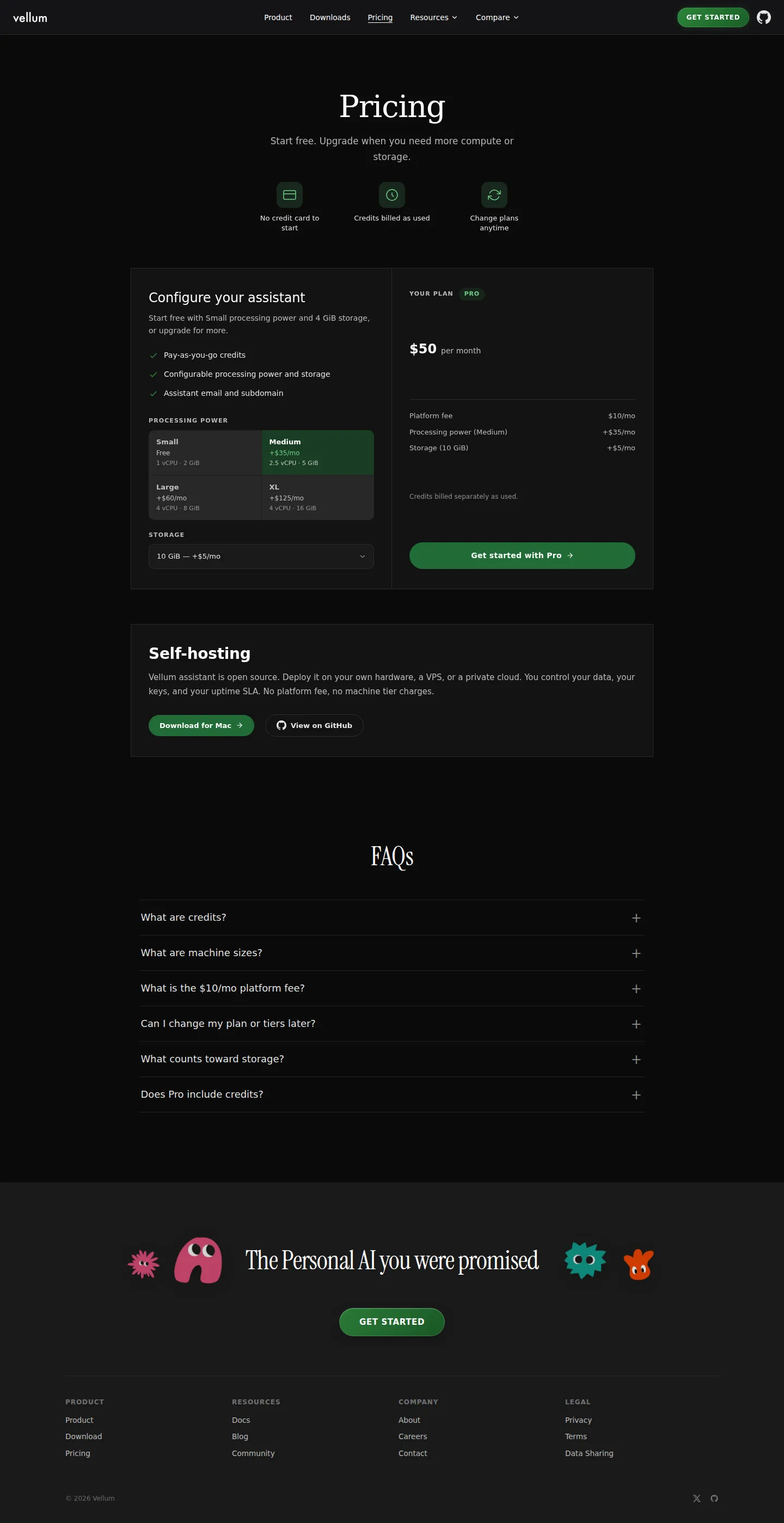
Vellum prices the hosted assistant like a tiny cloud provider, not a chatbot subscription. The Base plan is free — no credit card — and includes a Small machine (1 vCPU, 2 GiB RAM) and 4 GiB of persistent storage. Pro is a configurator: a $10/mo platform fee (custom subdomain, static IP, priority support) plus a machine tier — Medium +$35/mo (2.5 vCPU, 5 GiB), Large +$60/mo (4 vCPU, 8 GiB), XL +$125/mo (4 vCPU, 16 GiB) — plus a storage tier from 10 GiB (+$5/mo) to 500 GiB (+$120/mo). Vellum’s own anchor configuration is $50/mo (fee + Medium + 10 GiB); a maxed-out build stacks the +$125 XL machine and +$120 storage tier on the $10 fee before any usage.
AI consumption rides on a second meter: credits, where $1 = 1 credit, consumed by LLM inference, web search, image generation, and paid third-party APIs. No plan bundles credits — they are pay-as-you-go on Base and Pro alike, and Vellum states it passes LLM costs through at cost, with no markup.
What makes this different: Vellum deliberately takes zero margin on inference and monetizes compute, storage, and convenience instead — and because the assistant is MIT-licensed and free to self-host, the hosted plans sell hosting rather than the capability itself.
Pricing by product
| Tier | Price | Included | Key mechanics |
|---|---|---|---|
| Base | Free | Small machine (1 vCPU, 2 GiB RAM), 4 GiB storage, assistant email + subdomain | No card to start; credits pay-as-you-go |
| Pro — platform fee | $10/mo | Custom subdomain, static IP, priority support | Flat fee on all Pro subscriptions |
| Pro — machine tier | +$35 to +$125/mo | Medium 2.5 vCPU / 5 GiB; Large 4 vCPU / 8 GiB; XL 4 vCPU / 16 GiB | Resize anytime; prorated |
| Pro — storage tier | +$5 to +$120/mo | 10 / 30 / 60 / 120 / 250 / 500 GiB persistent disk | Grows online, no restart |
| Credits | $1 = 1 credit | LLM inference, web search, image generation, third-party APIs | Pay-as-you-go; passed through at cost |
| Self-host (OSS) | Free | Full assistant, no platform fee or machine charges | MIT license; you run the infrastructure |
Sales motions across products: entirely self-serve PLG — free Base signup, self-serve Pro upgrades and credit top-ups, and an open-source self-host path. The current pricing page has no sales-led tier at all, a sharp break from the 2024-2025 quote-only era.
Hidden costs : What Vellum users actually pay
The subscription is the predictable half of a Vellum bill; credits are the variable half, and they accrue even when you are not chatting. Background operations — memory consolidation, conversation summarization, hourly heartbeat check-ins, and filing agents — all consume credits, though Vellum lets you reduce their frequency or route them to cheaper models. Credits are prepaid in $10-$100 increments, with optional auto-reload below a threshold you set ($1-$100) and a monthly spending cap ($25-$10,000) as a guardrail.
| Line item | Monthly cost |
|---|---|
| Pro base (fee + Medium machine + 10 GiB) | $50 |
| Credits — LLM inference, search, image generation | usage-based ($1 = 1 credit, at cost) |
| Background operations (memory, heartbeats, summarization) | credits, varies with settings |
| Larger machine / storage upgrades | XL +$125/mo; 500 GiB +$120/mo |
| Estimated total (typical Pro user) | $50 + credits used |
Want to estimate your own Vellum bill? Use the Vellum pricing calculator to model your costs based on usage patterns.
Pricing evolution : Vellum pricing history and changes
Cadence
| Period | Price changes | Product / SKU additions | Notes |
|---|---|---|---|
| 2023 | Launch tiers | Free / Starter / Growth / Pro / Enterprise | $0 / $49 per user / $249 / $699 / custom |
| 2024-2025 H1 | Prices pulled | Quote-only Growth / Pro / Enterprise | Sales-led ‘Request Demo’ era; $20M Series A (2025-07) |
| 2025 H2 | Self-serve returns | Free / Pro $25 / Business $79 per user + credits | Credit meter introduced |
| 2026 Q1 | Business $79 per user → $50 flat | Workflow-server sizing | Last enterprise-era structure |
| 2026 Q2 | Full reset | Personal assistant configurator | Pivot: Base free, Pro from $50, credits at cost |
Tracked range: 2023-present, via Wayback Machine snapshots (2023-06, 2024-08, 2025-07, 2025-12, 2026-03) and a live 2026-06-10 capture.
Notable changes
- 2023-06 — Launch-era public pricing for the LLM dev platform: Free $0 / Starter $49 per user/mo / Growth $249/mo / Pro $699/mo / Enterprise custom, limited by LLM production requests per week, deployments, and seats.
- 2024-08 — Every dollar figure removed. The page becomes quote-only (Growth / Pro / Enterprise, all ‘Request Demo’) as Vellum chases enterprise AI teams.
- 2025-07-10 — $20M Series A led by Leaders Fund (with YC, Socii Capital, Rebel Fund, Pioneer Fund, Eastlink Capital). Pricing stays gated.
- 2025 H2 — Self-serve pricing returns with a credit meter: Free $0 (50 credits), Pro $25/mo (200 builder credits), Business $79 per user/mo (500 builder credits), Enterprise custom.
- 2026-03 — Repack around workflow servers: Free (30 credits/mo), Pro $25/mo, Business drops from $79 per user to $50 flat, Enterprise custom.
- 2026-05-07 — Pivot: ‘Introducing Vellum: Your own Personal Intelligence’, with $25M announced from Dharmesh Shah, Arash Ferdowsi, Rebel Fund, and YC.
- 2026-06-10 — Current configurator pricing captured: free Base, Pro from ~$50/mo ($10 fee + machine + storage), pay-as-you-go credits at $1 = 1 credit, free MIT self-hosting.
What’s unique : Vellum’s distinctive pricing mechanics
1. At-cost credit pass-through. Vellum states that when you spend $1 of credits on LLM tokens, the full dollar goes to the model provider — no inference markup. The margin lives in the $10 platform fee, machine tiers, and storage. That is close to unique among assistant products, which typically resell inference at 2-5x or hide it in a flat subscription.
2. Cloud-style configurator instead of plan tiers. There is no Good/Better/Best ladder. You assemble your own bill — platform fee + vCPU/RAM tier + storage tier — like sizing a VPS, with prorated resizes anytime. The ‘plan’ is whatever you configured, and the pricing page is literally a calculator.
3. Open-source escape hatch on every axis. The assistant is MIT-licensed: self-host and the platform fee, machine charges, and storage tiers all disappear — you bring your own hardware and API keys. The hosted product competes with its own free version purely on convenience, which disciplines every hosted price.
Strengths & weaknesses
| Strengths | Weaknesses |
|---|---|
| At-cost inference pass-through builds unusual trust | Credits burn in the background (memory, heartbeats) — idle costs surprise new users |
| Fully public, self-serve pricing — no quotes anywhere | Dual meters (subscription + credits) complicate the mental model |
| Free Base plan plus free MIT self-hosting | $10 platform fee on Pro feels arbitrary next to transparent compute pricing |
| Configurator maps price directly to resources used | Three pricing resets in three years (public → gated → credits → pivot) strain trust |
| Auto-reload with hard monthly spending caps | Enterprise-platform customers’ path post-pivot is publicly undocumented |
Billing UX : Vellum billing controls and transparency
- Billing controls — No credit card to start on Base. All plan changes live in Settings, with upgrades active immediately, machine and storage changes prorated, and downgrades or cancellations taking effect at period end. Credit top-ups come in $10-$100 increments; auto-reload triggers below a user-set threshold ($1-$100) and can be bounded by a monthly spending cap from $25 to $10,000.
- Usage visibility — The pricing page is itself an interactive configurator that totals your plan in real time, and the docs enumerate exactly what consumes credits (inference, web search, image generation, third-party APIs, and background operations like memory consolidation and heartbeats) plus how to tune their cost down.
- Payment options — Standard self-serve card checkout for Pro and credit purchases. Self-hosters pay nothing to Vellum and bring their own model API keys.
Strategic wins : Why Vellum’s pricing decisions worked
1. Zero-margin inference as a trust wedge
A personal assistant sees your email, calendar, files, and memory — trust is the entire purchase decision. Pricing inference at cost removes the suspicion that the vendor profits from your assistant thinking more, and aligns Vellum’s revenue with resources users can verify (vCPU, GiB). It also future-proofs the model against token-price deflation. See choosing the right usage metric.
2. Selling compute and convenience, not capability
With the assistant MIT-licensed, Vellum cannot charge for the software — so the configurator monetizes exactly what self-hosters would otherwise provide themselves: a machine, a disk, an always-on subdomain. That is an honest split that converts the open-source funnel instead of fighting it. Related: how AI companies structure pricing.
3. A full pricing reset to match a full pivot
Rather than dragging enterprise SKUs into a consumer product, Vellum rebuilt pricing from zero — free Base, one configurable paid plan, one usage meter. After two years of quote-only enterprise pricing, the relaunch shipped with every price public and self-serve, which is what the prosumer audience it now courts expects. See usage-based pricing strategy and outcome-based pricing trends.
Areas to improve : Gaps in Vellum’s pricing approach
1. Make idle credit burn predictable
Background operations — memory consolidation, summarization, hourly heartbeats — consume credits even when you are not using the assistant, and the pricing page does not quantify them. A published ‘typical idle cost per day’ figure (or an idle-cost estimate in the configurator) would prevent the classic first-bill surprise. See bill shock and cost unpredictability.
2. Justify or fold in the platform fee
The $10/mo fee buys a subdomain, a static IP, and priority support — items with near-zero marginal cost next to transparently-priced compute. Folding it into machine tiers (Medium +$45 instead of $10 + $35) would simplify the bill without changing the total; keeping it invites the question of what exactly it pays for.
3. Close out the enterprise era publicly
Wayback snapshots show paying self-serve customers on the agent platform as late as March 2026, yet no public migration or sunset notice exists for the enterprise product. For a company now selling trust to individuals, documenting how it treated its previous customer base is pricing-adjacent reputation work left undone.
Key takeaways
- A pivot deserves a pricing reset. Vellum did not retrofit enterprise SKUs onto a consumer product — it rebuilt the model around the new buyer: free Base, one configurable Pro, one meter.
- At-cost pass-through is a positioning weapon. Taking zero margin on inference reframes the vendor as being on the user’s side, and shifts monetization to resources buyers can verify.
- Open source forces honest pricing. When self-hosting is free and MIT-licensed, hosted pricing must map to real costs (compute, storage, uptime) — capability rents are off the table.
- Configurators beat tiers when usage varies by hardware. Letting users assemble fee + machine + storage prices the actual resource envelope instead of forcing three artificial personas.
- Pricing whiplash has a memory. Public tiers, then two years of quotes, then credits, then a pivot — each reset was individually defensible, but the sequence is a trust tax Vellum now has to pay down with transparency.
UBP implications
- Split the meter from the subscription. Vellum charges fixed monthly for capacity (machine, storage) and pure usage for consumption (credits) — a clean separation that keeps the subscription predictable while usage scales honestly.
- Pass-through pricing only works if you monetize something else. Zero-margin inference is sustainable here because compute tiers and the platform fee carry the margin; copying the pass-through without a margin carrier is a race to zero.
- Spending caps belong in the product, not the FAQ. Auto-reload bounded by a user-set monthly cap ($25-$10,000) is the kind of guardrail every credit-based AI product should ship on day one. See usage-based pricing strategy.
Sources
- Vellum pricing page — live capture (accessed 2026-06-10)
- Vellum pricing docs — credits, machine tiers, auto-reload (accessed 2026-06-10)
- Introducing Vellum: Your own Personal Intelligence — 2026-05-07 (accessed 2026-06-10)
- vellum-ai/vellum-assistant on GitHub (MIT) (accessed 2026-06-10)
- Announcing our $20M Series A — Vellum, 2025-07-10 (accessed 2026-06-10)
- TechCrunch: Vellum.ai raises $5M seed, 2023-07-11 (accessed 2026-06-10)
- Y Combinator — Vellum (W23) (accessed 2026-06-10)
- Wayback Machine snapshots: vellum.ai/pricing — 2023-06, 2024-08, 2025-07, 2025-12, 2026-03 (accessed 2026-06-10)
Bottom line
Vellum is the corpus’s clearest example of a pricing model rebuilt to match a pivot: the YC W23 enterprise LLM-platform company ($5M seed, $20M Series A) relaunched in May 2026 as an open-source personal AI assistant with $25M announced, and replaced years of quote-heavy enterprise pricing with a fully public configurator — free Base, Pro from about $50/mo ($10 platform fee + machine tier + storage tier), and pay-as-you-go credits passed through to model providers at cost. The MIT self-host path keeps hosted prices honest; the open questions are idle credit burn and the undocumented fate of its enterprise customers. Browse the pricing blueprint for more fully-researched company profiles.
Want to compare Vellum against other AI assistant and agent companies? Browse the pricing blueprint.
Pricing timeline : Major events on a vertical axis
Each milestone below corresponds to a public pricing change, product launch, or material adjustment. Major events use a filled marker; minor adjustments use a faded one.
Pivot pricing — personal AI assistant configurator
After the May 7, 2026 'Personal Intelligence' relaunch ($25M announced), pricing becomes a configurator: free Base (Small machine, 4 GiB storage), Pro from ~$50/mo ($10 platform fee + machine tier +$35 to +$125 + storage +$5 to +$120), credits pay-as-you-go at $1 = 1 credit, and free MIT self-hosting.
Agent-platform repack: Business drops to $50 flat
Tiers reframed around workflow servers and concurrent runs: Free $0 (30 credits/mo), Pro $25/mo (100 credits), Business $50/mo flat (12 concurrent runs), Enterprise custom. Last enterprise-era pricing before the pivot.
Self-serve credit pricing returns
Public prices return with a credit meter: Free $0 (50 credits), Pro $25/mo (200 builder credits), Business $79/user/mo (up to 5 users, 500 builder credits), plus custom Enterprise — pricing now anchored on hosted agent apps.
$20M Series A; pricing stays gated
Days after announcing a $20M Series A led by Leaders Fund (July 10, 2025), the page still shows quote-only Startup / Pro / Enterprise plans with 'Book a Demo' CTAs and no public prices.
Prices pulled — quote-only 'Request Demo' era
All published prices removed. Pricing page restructured to Growth / Pro / Enterprise with 'Request Demo' CTAs and no dollar figures — a fully sales-led motion aimed at enterprise AI teams.
Launch-era public tiers for the LLM dev platform
Five public tiers with a 7-day free trial: Free $0, Starter $49/user/mo, Growth $249/mo, Pro $699/mo, and custom Enterprise — limits set by LLM production requests per week, deployments, and seats.
- · Vellum is one of the rare full pivots in the corpus: the same YC W23 company went from a $20M-Series-A enterprise LLM development platform (July 2025) to an open-source personal AI assistant (May 2026) on the same domain.
- · Vellum's credits are pass-through at cost: when you spend $1 of credits on LLM tokens, the full dollar goes to the model provider — Vellum's margin comes from machine tiers, storage, and the $10 platform fee instead.
- · The 2023 launch page had a $699/mo Pro tier for enterprise LLM teams; today's Pro anchor is $50/mo for individuals configuring a personal assistant.
Questions & answers
- What is Vellum's pricing model?
- Vellum uses a configurator: the Base plan is free with a Small machine (1 vCPU / 2 GiB RAM) and 4 GiB storage, while Pro stacks a $10/mo platform fee with a machine tier (Medium +$35, Large +$60, XL +$125/mo) and a storage tier (+$5 to +$120/mo). AI usage is billed separately as pay-as-you-go credits where $1 = 1 credit.
- Does Vellum offer a free tier?
- Yes. The Base plan is free with no credit card required — you get a Small machine (1 vCPU / 2 GiB RAM) and 4 GiB of storage, and only pay for the credits your assistant consumes. The assistant is also MIT-licensed open source, so you can self-host it for free with no platform fee.
- How much does Vellum cost per month?
- The Base plan is $0 plus credits used. Pro starts around $50/month — Vellum's example configuration is the $10 platform fee plus the Medium machine (+$35) and 10 GiB storage (+$5). Heavier configurations stack the XL machine (+$125/mo) and 500 GiB storage (+$120/mo) on the $10 fee before credits.
- What are Vellum credits and do plans include them?
- Credits are Vellum's usage meter: $1 = 1 credit, consumed by LLM inference, web search, image generation and paid third-party APIs. No plan includes credits — they are purchased pay-as-you-go on both Base and Pro, in $10-$100 top-ups with optional auto-reload and monthly spending caps. Vellum passes LLM costs through at cost with no markup.
- Is this the same Vellum that built the LLM developer platform?
- Yes. Vellum (YC W23) raised a $5M seed in 2023 and a $20M Series A in July 2025 as an enterprise platform for building LLM applications. In May 2026 it relaunched as a personal AI assistant, announcing $25M raised. The old enterprise pricing was largely quote-based; the new product is fully self-serve.