AI Summary
About
Waymo is Alphabet’s autonomous-driving subsidiary and the operator of Waymo One, the largest fully driverless commercial robotaxi service in the United States. Spun out of the Google self-driving car project (started 2009) and established as Waymo in 2016, the company now runs a paid, no-human-driver ride-hailing service that, as of a 2026-08-26 site check, is actively serving riders in 11 markets — San Francisco Bay Area, Los Angeles, Phoenix, San Antonio, Dallas, Houston, Nashville, Orlando, Miami, and (via Uber dispatch) Austin and Atlanta — with a much longer “up next” list (Baltimore, Boston, Charlotte, Chicago, Denver, Detroit, Las Vegas, Minneapolis, New Orleans, New York, Philadelphia, Pittsburgh, Portland, Sacramento, San Diego, Seattle, St. Louis, Tampa, Washington DC) plus London and Tokyo for international expansion. Waymo’s marketing site now cites 20M+ rides served with a 93% rider satisfaction rate, and a claimed 10X-plus safety record versus the average human driver.
The commercial model is unusual for this corpus: where almost every other embodied / physical-world AI company sells nothing to the public and quotes everything via sales, Waymo runs a true consumption meter you can buy from your phone. Each trip is a dynamic per-ride fare — a minimum plus distance, duration and live demand — shown only as an in-app estimate at the moment of booking. There is no public rate card and no per-mile price list; you see your specific fare, accept it, and pay by card in the app.
Two things make the 2026 picture sharper. First, funding and scale: Waymo raised a $5.6B Series C at ~$45B (Oct 2024) and then a $16B round at ~$126B (Feb 2026, Alphabet ~$13B), while weekly paid rides roughly doubled from ~250k/week (Apr 2025) to ~500k/week (Mar 2026), with a 1,000,000 rides/week target for 2026. Second, a brand-new subscription: on 2026-06-11 Waymo launched Waymo One Premier, a $29.99/month invite-only membership — its first-ever recurring price point — turning a pure per-ride meter into a hybrid of usage plus optional subscription. This page documents that structure exactly as Waymo surfaces it, citing real figures only where a source exists and never inventing a per-mile rate Waymo has never published.
Pricing summary : a dynamic per-ride meter with no public rate card
Waymo One runs a pure per-ride consumption model, now wrapped in an optional subscription. The dimensions, as Waymo actually surfaces them:
- Per-ride dynamic fare (the meter) — every trip is priced from a minimum + distance + duration, exactly like a rideshare. Waymo’s official “Trip pricing” help article (confirmed live 2026-08-26, previously unreachable) additionally names the modifiers that can move the price: canceling a ride, changing your destination mid-trip, dirtying/damaging the car, applicable tolls/fees/surcharges (e.g. an airport access fee), special or promotional pricing, booking in advance, and time-of-day/demand level and demand-availability around pickup and dropoff. Late-cancel or no-show fees can also apply. The fare is computed dynamically and shown as an estimate in the Waymo app before you confirm. Crucially, there is no published rate card — you cannot read a per-mile price anywhere on
waymo.com, only the live estimate for your route. - Waymo One Premier (the subscription) — $29.99/month, invite-only at launch (SF, LA, Phoenix). It does not discount the base fare directly; instead it adds priority pickups, 10% Waymo Cash back on all trips (more during busy hours, credits expire after 90 days), up to 5 free cancellations/month, and early access to new cities. This is Waymo’s first recurring revenue line.
- Uber-dispatched markets — in Austin and Atlanta, Waymo rides are booked through the Uber app, and Uber sets the fare. The same vehicle is priced by a different company depending on the city.
What makes this different: unlike the sales-only labs elsewhere in this wave — Figure, Apptronik, or the research-only Physical Intelligence — Waymo is the one embodied-AI company with an observable, self-serve, per-transaction price. Yet that price is gated: it exists and you pay it, but it’s quoted per trip in-app rather than listed publicly. It’s the rideshare pricing pattern applied to an autonomous fleet, which is why understanding usage-based pricing and dynamic value metrics matters here far more than for a sales-only humanoid lab.
Pricing by product
| Surface | Price | Included | Key mechanics |
|---|---|---|---|
| Waymo One per-ride (standard) | In-app estimate (no rate card) | Driverless ride; insurance, remote assistance & support bundled | Dynamic: minimum + distance + duration; modified by cancellations, mid-trip destination changes, tolls/fees/surcharges (e.g. airport access fee), promo pricing, advance booking, and time/demand; surge shown before confirming; pay by card in app |
| Waymo One Premier | $29.99 / month (invite-only) | Priority pickups, 10% Waymo Cash back on all trips, 5 free cancellations/mo, early-access cities | Recurring subscription; cash back applied to Wallet after a successful trip, credits expire 90 days; cancel anytime |
| Uber-dispatched (Austin, Atlanta) | Uber sets the fare | Same Waymo vehicle, booked via Uber | Fare quoted & collected by Uber; not in the Waymo app |
Sales motions across products: fully self-serve — riders download the app, get a fare estimate, and pay by card with no sales conversation. Premier is also self-serve once invited. The only intermediated channel is the Uber-dispatched markets, where Uber owns the transaction.
Hidden costs : What Waymo riders actually pay
Because there’s no rate card, the “real bill” question is genuinely unknowable in advance for a given route — you only learn your fare when the app quotes it. That said, Waymo’s structure has notably fewer add-on line items than legacy ride-hail.
The base mechanic. Your fare is dynamic. In quiet conditions it tracks a minimum-plus-distance-plus-time formula; in busy conditions a surge multiplier (reported in the ~1.2x–1.8x range by third parties) lifts it — but the surged fare is shown before you confirm, so there’s no after-the-fact surprise. Reported averages give a feel for magnitude — a roughly $20 San Francisco average in 2025 per third-party sampling — but these are not a Waymo-published rate and vary trip to trip.
What’s bundled (and not charged extra). Unlike typical ride-hail, Waymo folds insurance, safety monitoring, and 24/7 remote assistance into the fare, and reporting notes no airport/congestion surcharges and no cancellation fee after the early-cancel window. So the “hidden costs” that plague Uber/Lyft bills (booking fees, surcharges, late-cancel fees) are largely absent.
Premier math. Premier costs $29.99/month and returns 10% cash back on base fares. The break-even is straightforward: a rider would need roughly $300/month in base fares for the cash-back alone to offset the membership — so Premier is really priced for priority and convenience (faster pickups, free cancellations, early cities), not as a pure discount. Promotions and credits can lower effective cost but aren’t a published, guaranteed rate.
| Line item | Cost |
|---|---|
| Standard ride | Dynamic in-app estimate — minimum + distance + duration + demand (no public per-mile rate) |
| Surge (peak/weather/low supply) | Multiplier shown before you confirm (third-party reports ~1.2x–1.8x) |
| Airport / congestion surcharge | None reported (bundled / not charged) |
| Insurance, remote assistance, support | Included in the fare |
| Premier membership | $29.99/month (optional, invite-only) — returns 10% base-fare cash back |
| Estimated total | Route-dependent and unquotable in advance — only the in-app estimate is authoritative |
Want to reason about per-trip robotaxi economics versus a rideshare or a monthly membership? There’s no public rate to plug in, but you can sketch break-even scenarios with the Waymo pricing calculator, and see how other AI products meter usage in the pricing blueprint.
Pricing evolution : Waymo pricing history and changes
Waymo’s pricing history is short on list-price changes (there has never been a public rate card to revise) but rich on structure: years of pure dynamic per-ride fares, then — in June 2026 — its first recurring subscription. The milestones below come from primary announcements and a live 2026-06-14 site check.
Cadence
| Quarter | Price changes | Product / SKU additions | Notes |
|---|---|---|---|
| 2024 Q4 | 0 (no public rate card) | 0 | $5.6B Series C at ~$45B; dynamic per-ride fares only |
| 2025 Q2 | Dynamic (no published change) | 0 | ~250k paid rides/week; ~$20 SF average per third-party sampling |
| 2026 Q1 | Dynamic (fares trending down vs Uber/Lyft) | 0 | $16B round at ~$126B; ~500k rides/week; price gap narrowing |
| 2026 Q2 | 0 | 1 (Premier subscription) | Waymo One Premier launches at $29.99/mo (invite-only); first recurring price point |
Tracked range: 2024 Q4–2026 Q2. Per-ride fares are continuously dynamic, so “price changes” are not discrete list-price events; the one structural SKU addition is Premier. Quarters not listed had no relevant public pricing event.
Notable changes
- 2024-10 — $5.6B Series C at ~$45B (Alphabet-led) funds the per-ride scale-up; fares remain dynamic and in-app (Yahoo Finance).
- 2025-04 — Crosses ~250k paid rides/week; third-party sampling shows a ~$20 SF average, higher than Uber/Lyft at the time — but Waymo publishes no per-mile rate (SingularityHub).
- 2026-02 — $16B round at ~$126B; weekly paid rides near ~500k and reporting notes Waymo’s fares converging toward Uber/Lyft (CNBC, TechCrunch).
- 2026-06-11 — Waymo One Premier launches at $29.99/month, invite-only (SF, LA, Phoenix) — priority pickups, 10% cash back, 5 free cancellations, early-access cities. Waymo’s first recurring subscription (Waymo Help, CNBC).
- 2026-06-14 — Live check confirms no public rate card:
waymo.com/waymo-oneshows cities and a “Ride on Uber” link for Austin/Atlanta but no per-mile price; fares are in-app estimates only.
What’s unique : Waymo’s distinctive pricing mechanics
1. A real meter, but a gated price. Waymo is the rare AI company whose product is genuinely metered and self-serve — you buy rides per trip from your phone — yet it publishes no rate card. The price exists and you pay it, but it’s quoted per trip, in-app, dynamically. That puts Waymo in a different bucket from both the public-rate-card token sellers (e.g. Mistral AI) and the fully sales-only labs in this wave: it’s gated, not public and not sales-only.
2. The fare is the surge model. Waymo applies demand-based dynamic pricing — the same lever rideshare uses — but with a fleet it fully controls. Because Waymo owns supply (no driver incentives to balance), it can in principle smooth surge differently than Uber/Lyft. The fare shown before you confirm already bakes in distance, time, and demand; there is no separate “rate” the rider reconciles against later.
3. Premier monetizes priority, not discount. Most loyalty subscriptions front-load a discount. Waymo’s $29.99/month Premier instead sells fleet-level priority (faster matching) plus a modest 10% base-fare cash back — a benefit only an operator that controls the vehicles can credibly offer. For a fleet business where the scarce resource is an available car, prioritizing members is the value metric; the cash back is a sweetener. (On choosing what to actually meter and reward, see choosing the right usage metric.)
Strengths & weaknesses
| Strengths | Weaknesses |
|---|---|
| True self-serve consumption meter — riders buy per trip from the app, no sales call | No public rate card — you can’t know a route’s price until the app quotes it |
| Dynamic fare shown before you confirm, so surge isn’t an after-the-fact surprise | Dynamic pricing means fares can swing with demand; hard to budget a recurring commute |
| Fewer add-on line items than legacy ride-hail (insurance/assistance bundled, no airport surcharge) | Through 2025 fares often ran above Uber/Lyft; value depends on city and time |
| Premier adds a clean recurring revenue line and rewards the most valuable (frequent) riders | Premier at $29.99 is 3x Uber One/Lyft Pink and invite-only — limited reach, steep break-even |
| Operator-controlled fleet enables priority benefits rivals can’t structurally match | Split pricing authority — Uber sets fares in Austin/Atlanta — fragments the experience |
Billing UX : Waymo billing controls and transparency
- Billing controls — Entirely in the Waymo app. You add a card, get a fare estimate before booking, and are charged for the completed trip. Premier is managed from the Account tab (subscribe, see eligibility, cancel anytime with benefits through the current period).
- Usage visibility — The app shows the per-trip estimate up front (including any surge) and trip history. Premier surfaces Waymo Cash balance and earned credits (which expire after 90 days). There is no enterprise-style spend dashboard — this is a consumer product.
- Payment options — Credit/debit card and digital payment in-app. In Austin and Atlanta, billing runs through Uber instead, under Uber’s payment and fare rules.
- Transparency — High at the moment of purchase (you see your exact fare before confirming) but low in advance (no published per-mile rate to plan against). Waymo Help now publishes a “Trip pricing” article (
waymo.com/pricingredirects here) that names the price factors and modifiers in plain language, without giving a number. That’s the defining trait: transparent per-transaction, opaque as a rate card — i.e. gated.
Strategic wins : Why Waymo’s pricing decisions worked
1. Dynamic per-ride pricing matches an inherently variable cost
A robotaxi’s cost-to-serve varies with distance, time, and how busy the fleet is — so a dynamic per-ride fare aligns price with the actual unit of value (a completed trip) far better than a flat rate would. By quoting the fare in-app at booking, Waymo captures demand-based willingness-to-pay without committing to a public number it would have to defend across every route and city. This is textbook usage-based pricing applied to physical mobility.
2. Bundling the scary stuff into the fare builds trust
Folding insurance, remote assistance, and safety monitoring into the fare — with no airport or congestion surcharges and no late-cancel fee after the early window — removes exactly the surprise line items that erode trust in ride-hail bills. For a service whose biggest adoption barrier is trust, a clean, all-in fare is a pricing decision doing double duty as a safety message. Compare how surprise charges drive bill-shock anxiety elsewhere.
3. Premier rewards the right customer with the right lever
Launching Premier invite-only to the most frequent riders in three mature cities is disciplined: it tests a recurring price on the cohort most likely to value priority access, using a benefit (fleet prioritization) only a fleet owner can offer. The 10% cash back keeps it from feeling purely extractive while the real product is convenience. It’s a measured move from a pure usage meter toward a hybrid model — the same direction many AI companies are taking as they rethink per-unit-only pricing.
Areas to improve : Gaps in Waymo’s pricing approach
1. Give riders some a-priori price signal
A fully dark rate card maximizes uncertainty for anyone deciding whether to even open the app. A published “fares start at” anchor, a typical per-mile band by city, or a simple fare-estimator on the website (without booking) would let riders self-qualify and plan commutes — reducing the cost-unpredictability anxiety that dynamic-only pricing invites, without giving up demand-based flexibility.
2. Make Premier’s value legible beyond frequent riders
At $29.99/month — triple Uber One/Lyft Pink — Premier’s break-even on cash-back alone needs roughly $300/month of fares, so its real value is priority and convenience. A clearer, public “is Premier worth it for me?” breakdown (and eventually non-invite access) would help riders self-select instead of relying on an opaque invite. A tiered or commute-oriented plan could widen the base.
3. Resolve the split pricing authority
Having Uber set the fare in Austin/Atlanta while Waymo sets it elsewhere fragments the rider experience and the brand’s pricing story. As Waymo scales toward a million weekly rides, a clearer policy on where Waymo owns the fare versus where a partner does — and how members are treated in partner markets — would reduce confusion.
Monetization stack & signals : how Waymo builds & buys its revenue engine
Buys 1 Builds 3 5 signal roles
Waymo builds the whole rider-side revenue engine in-house — billing, wallets, loyalty, and now the dynamic-fare algorithm itself — buying only the payment rails and SAP's back office. The tell is below: a founding "Waymo for Business" AE, its first sales-led B2B channel.
-
“building the infrastructure that powers all financial transactions and user identity management for Waymo, ensuring that every ride is billed correctly and every payment is processed securely... build systems for promotions, credits, and automated financial reporting... billing and payment capabilities end-to-end, from payment flows and wallet management to fraud controls and reconciliation”
-
“Architect and scale rider retention frameworks, including subscription services, commuter packages, and loyalty programs... Build backend systems that distribute personalized, budget-capped promotions to shape rider demand and maximize incremental ridership”
-
“The Pricing team drives Waymo's revenue and business strategy by developing dynamic pricing algorithms that balance supply and demand in real-time... Implement and scale Waymo's core dynamic pricing engine to drive revenue and business strategy across all operating markets... productionize innovative pricing models, such as route-specific and session-based pricing solutions”
-
“Act as a subject matter expert in SAP FICO modules, BRIM, RAR, Group Reporting, and Planning/Consolidation modules... ensuring alignment with best practices, regulatory compliance (e.g., IFRS 15/ASC 606), and internal controls”
-
“You will help us handle integrations with multiple payment providers, support diverse payment methods... Work with third-party payment providers to ensure a seamless user experience”
-
The customer-facing meter is in-house, but rev-rec and finance ops run on SAP — and this role shows the SAP footprint widening past the original FICO/BRIM/RAR billing scope into Ariba procurement and S/4HANA Group Reporting consolidation, still explicitly framed around "complex monetization models."
“own the multi-year technology roadmap across our SAP S/4HANA, Group Reporting, Ariba. Sitting at the intersection of complex monetization models, compliance, and enterprise automation”
-
A dedicated Pricing team, distinct from Payments & Identity, owns the ML models that set the dynamic fare itself — confirming the per-ride price you see in the app is an in-house real-time algorithm (balancing supply, demand and price sensitivity), not a third-party pricing/rating engine.
“Implement and scale Waymo's core dynamic pricing engine to drive revenue and business strategy across all operating markets... route-specific and session-based pricing solutions”
-
Waymo is standing up its first sales-led B2B channel — corporate commute programs and business travel sold by a founding AE owning a full sales cycle and revenue target — a genuine hybrid inflection layered on top of the self-serve consumer meter this page otherwise documents.
“The Waymo for Business team is bringing the power of Waymo to corporations... As a founding member of the sales team, you will focus on mid-market and enterprise accounts... Own a revenue target and all aspects of the sales cycle from first touch... through to close”
- Software Engineer, Payment BE Billing engineering seen Jun 22, 2026
Waymo builds the meter behind its per-ride dynamic fare in-house. A dedicated Payments & Identity team owns billing correctness, wallets, fraud and reconciliation — buying only the underlying payment rails — which is why there's no off-the-shelf billing vendor behind the fare you see in the app.
“join the Waymo Payments & Identity team... build systems for promotions, credits, and automated financial reporting... payment flows and wallet management to fraud controls and reconciliation”
- Engineering Manager, Rider Growth Monetization seen Jun 22, 2026
This team is building Waymo's subscription/loyalty/promotions layer in-house — the engineering home of the just-launched $29.99/mo Premier membership and the "commuter packages" likely to follow. Monetization at Waymo is demand-shaping built by engineers and economists, not a packaging exercise.
“Architect and scale rider retention frameworks, including subscription services, commuter packages, and loyalty programs that incentivize frequent, habitual riding... budget-capped promotions to shape rider demand and maximize incremental ridership”
1 more matched role — supporting evidence
- Strategic Partner Development Manager, Payments Partnerships Monetization Sep 2, 2026
Signals reviewed · derived from public job posts
Job postings fill and close over time — once a posting is filled we keep it as a dated citation (the quoted evidence remains); use View open roles for current listings.
Key takeaways
- No public rate card is the headline. Waymo One is a real, self-serve, per-ride meter — but the price is gated, quoted in-app at booking from a dynamic minimum + distance + duration + demand formula. You can’t read a per-mile rate anywhere public.
- It just became a hybrid. The $29.99/month Premier membership (2026-06-11, invite-only) is Waymo’s first recurring price point, layering an optional subscription on top of the per-ride meter.
- Premier sells priority, not discount. With only 10% base-fare cash back, the membership’s real product is fleet-level priority and convenience — a benefit only an operator that owns the cars can offer.
- The fare is the surge model. Dynamic, demand-based pricing is shown before you confirm, so surge isn’t a billing surprise — and Waymo’s full fleet control gives it a structurally different surge lever than Uber/Lyft.
- Pricing authority is split by city. In Austin and Atlanta, Uber sets the fare; everywhere else Waymo does — the same robotaxi, two pricing owners.
UBP implications
- Dynamic per-transaction pricing can fit physical, variable-cost services — not just software tokens. Waymo shows the rideshare surge model applied to an AI fleet: price the completed trip, vary by demand, and reveal the number at the point of sale. UBP practitioners selling anything with variable cost-to-serve should consider metering the outcome unit (a ride) rather than a flat rate.
- “Gated” is a legitimate transparency posture between public and sales-only. Waymo proves you can be fully self-serve and metered while still publishing no rate card — quoting price per transaction in-app. The lesson: transparency at purchase can substitute for a public rate card when the unit price is genuinely variable.
- A usage meter and a subscription can coexide as a deliberate hybrid. Waymo kept its per-ride meter and added Premier to monetize priority and loyalty — not to discount usage. UBP designers moving toward hybrids should be clear about what the subscription actually sells (here: access and convenience), so it complements rather than cannibalizes the meter. See how AI companies are shifting their pricing.
Sources
- Waymo One — official service page (cities; “Ride on Uber” for Austin/Atlanta; no rate card) (accessed 2026-06-14)
- Waymo One Premier membership — official Waymo Help (accessed 2026-06-14)
- Waymo launches Premier subscription at $29.99/month (CNBC) (accessed 2026-06-14)
- Waymo Premier membership with priority pickups and cashback (Electrek) (accessed 2026-06-14)
- Waymo closes in on Uber and Lyft prices (SingularityHub) (accessed 2026-06-14)
- The price gap between Waymo and Uber is narrowing (TechCrunch) (accessed 2026-06-14)
- Waymo announces $16B round at ~$126B valuation (CNBC) (accessed 2026-06-14)
- Waymo closes $5.6B Series C from Alphabet, others (Yahoo Finance) (accessed 2026-06-14)
- Waymo’s metric for 2026: one million weekly rides (Automotive World) (accessed 2026-06-14)
- Browse the pricing blueprint corpus
Bottom line
Waymo is the embodied-AI corpus’s one true consumption business: Alphabet’s robotaxi unit (~$126B valuation, ~500k paid rides/week heading toward a 1M/week target) sells rides per trip, self-serve, from an app. But it publishes no rate card — every fare is a dynamic in-app estimate (minimum + distance + duration + demand) revealed only at booking, which is why its transparency is gated, not public. On 2026-06-11 it added its first recurring price point, the $29.99/month invite-only Waymo One Premier membership, monetizing priority and loyalty rather than discounting fares — turning a pure per-ride meter into a deliberate hybrid. The one wrinkle: in Austin and Atlanta, Uber, not Waymo, sets the fare.
Want to compare Waymo against the rest of the embodied-AI cohort? See the sales-only labs Figure and Apptronik, or browse the full pricing blueprint.
Pricing timeline : Major events on a vertical axis
Each milestone below corresponds to a public pricing change, product launch, or material adjustment. Major events use a filled marker; minor adjustments use a faded one.
Live check: Premier price steady at $29.99/mo; /pricing now explains fare factors; footprint expands to 11 markets
Verified 2026-08-26: Waymo One Premier remains $29.99/month with the same four benefits — no price change. waymo.com/pricing, previously a 404, now redirects to a Waymo Help 'Trip pricing' article that names fare modifiers (cancellations, mid-trip destination changes, tolls/fees/surcharges incl. an airport access fee, promo pricing, advance booking, time/demand) without publishing a numeric rate card. The marketing site now shows Waymo actively serving 11 markets (up from ~6) — SF Bay Area, LA, Phoenix, San Antonio, Dallas, Houston, Nashville, Orlando, Miami, plus Uber-dispatched Austin and Atlanta — alongside a much longer 'up next' list, and cites 20M+ rides served at a 93% satisfaction rate.
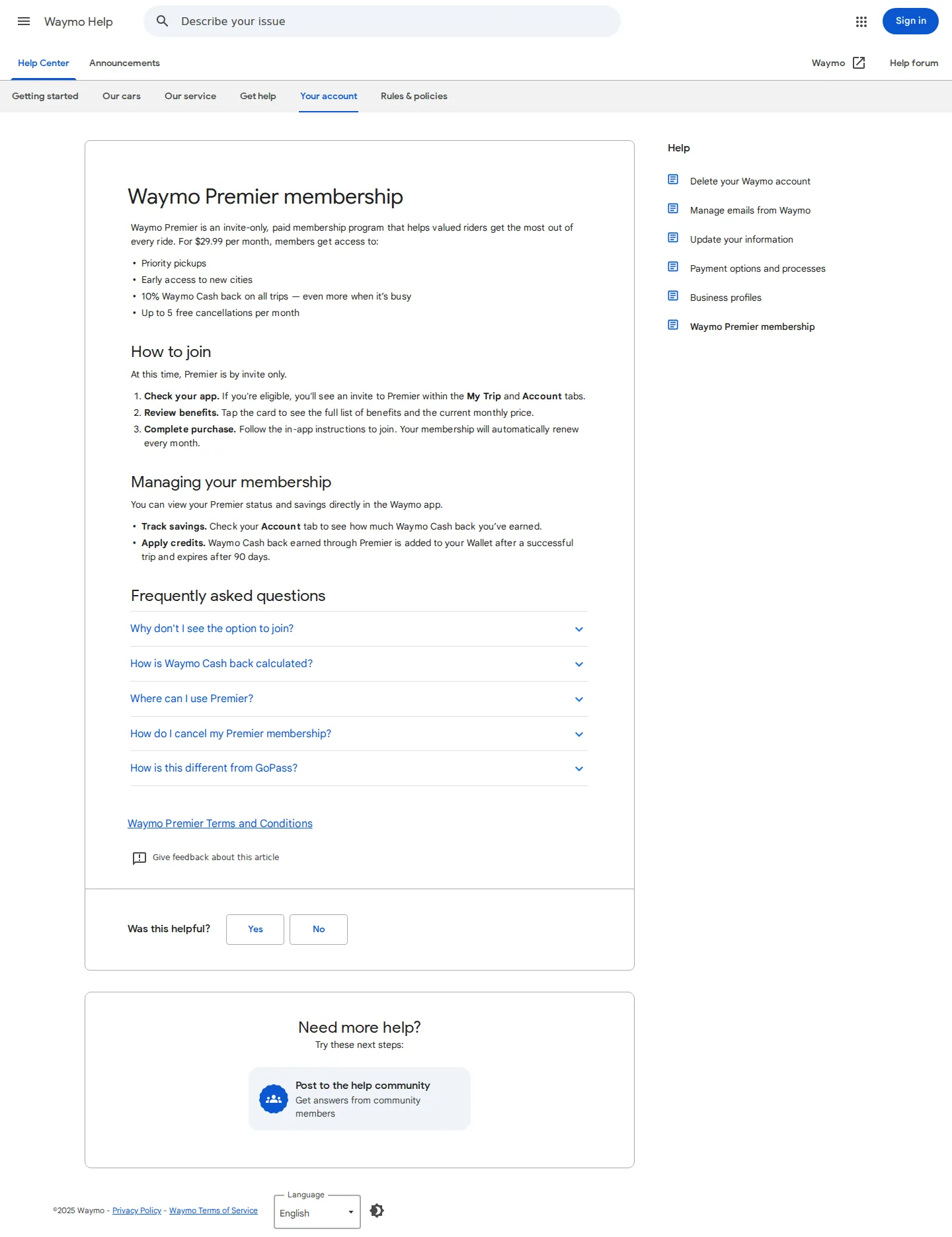
Live check: per-ride fares stay in-app; no public rate card
Verified 2026-06-14: waymo.com/waymo-one shows operating cities and a 'Ride on Uber' link for Austin and Atlanta, but no rate card — fares are dynamic and shown only as an in-app estimate at booking. The $29.99/mo Premier membership is confirmed via the official Waymo Help page and multiple outlets. price_transparency = gated; has_free_tier = false. (Evidence: 2026-06-14-pricing-validated.txt second source.)
Waymo One Premier launches — first recurring subscription
Waymo introduces Waymo One Premier, a $29.99/month invite-only loyalty membership (priority pickups, 10% Waymo Cash back, 5 free cancellations, early-access cities), rolled out to tens of thousands of frequent riders in SF, LA and Phoenix. This is Waymo's first recurring price point and turns the model into a hybrid of per-ride usage plus an optional subscription. (Source: Waymo Help, CNBC, Electrek.)
$16B round at ~$126B valuation; price gap to Uber narrowing
Waymo announces a $16B raise at a ~$126B post-money valuation (Alphabet ~$13B), as weekly paid rides approach ~500k and reporting notes Waymo's fares converging toward Uber/Lyft levels. Still no public rate card; fares stay dynamic and in-app. (Source: CNBC, TechCrunch, Feb 2026.)
Crosses 250k paid rides/week — meter is purely per-ride
Waymo One reaches roughly 250,000 paid rides per week across its live markets, all billed as dynamic per-ride fares quoted in-app. Third-party sampling pegs the San Francisco average around $20 a ride in this period — higher than Uber/Lyft averages at the time — but Waymo itself publishes no per-mile rate. (Source: Waymo, Obi rideshare data via press.)
$5.6B Series C at ~$45B valuation funds the per-ride scale-up
Waymo closes a $5.6B Series C led by Alphabet (with a16z, Fidelity, Silver Lake, Tiger Global, T. Rowe Price and others) at roughly a $45B valuation, capitalizing a rapid expansion of the per-ride Waymo One robotaxi service. Fares remain dynamic and in-app — no public rate card is introduced. (Source: NBC Bay Area / Yahoo Finance, Oct 2024.)
- · Waymo publishes no per-mile rate card at all — the only price a rider ever sees is the dynamic fare estimate the app quotes at the moment of booking, making one of the world's most-watched AI products effectively a gated-price service.
- · For its first ~16 years Waymo had no subscription of any kind; its very first recurring price point arrived 2026-06-11 with the $29.99/month invite-only Premier membership — which at launch cost three times Uber One or Lyft Pink ($9.99).
- · In Austin and Atlanta you don't book a Waymo in the Waymo app at all — rides are dispatched through Uber, and Uber sets the fare, so the same robotaxi can be priced by two different companies depending on the city.
Questions & answers
- What is Waymo's pricing model?
- Waymo One charges a dynamic per-ride fare, like a rideshare. The fare combines a minimum, distance, trip duration and live demand, and is shown only as an estimate inside the Waymo app at the moment you book — there is no public rate card. Since 2026-06-11 there is also an optional $29.99/month Waymo One Premier membership, so the overall model is a hybrid of per-ride usage plus an optional subscription.
- Does Waymo publish a price per mile?
- No. Waymo does not publish a fixed per-mile or per-minute rate card. Pricing is dynamic — determined by distance, time, and supply/demand — and surfaced as an in-app fare estimate before you confirm the ride. Any per-mile figures you see (for example a roughly $20 average San Francisco fare in 2025) come from third-party sampling, not from an official Waymo price list.
- How much is Waymo One Premier and what do you get?
- Waymo One Premier costs $29.99 per month. It launched 2026-06-11 and is invite-only to start (San Francisco, Los Angeles, Phoenix). Benefits include priority pickups, 10% Waymo Cash back on base trip price (more during busy hours; credits expire after 90 days), up to 5 free cancellations a month, and early access to new cities. You can cancel anytime and keep benefits through the current billing period.
- Does Waymo offer a free tier?
- No. Waymo One is a paid robotaxi service — every ride costs money, billed to a card in the app. There is no free ride tier. Promotional credits and the Premier membership's 10% cash-back can lower effective cost, but there is no zero-cost usage tier the way many software products have.
- Is Waymo cheaper than Uber or Lyft?
- It depends on the city, time, and demand. Through 2025 Waymo often priced at or above Uber and Lyft (a 2025 sample showed Waymo averaging higher than both), but reporting in early 2026 found the gap narrowing as Waymo's average fares trended down. Because fares are dynamic and quoted per trip, the only reliable comparison is to check the live estimate in each app for your specific route.
- Who owns Waymo and how is it funded?
- Waymo is Alphabet's autonomous-driving subsidiary. It raised a $5.6B Series C in October 2024 at roughly a $45B valuation, then a $16B round in February 2026 that valued it at about $126B post-money, with Alphabet contributing roughly $13B. Total external funding to date is around $27B.