AI Summary
About
Writer (writer.com) is a full-stack generative AI platform built for the enterprise. It started as an on-brand writing assistant and has since repositioned as an agentic platform: a single interface (WRITER Agent) that turns multi-step work into repeatable, governed workflows called Playbooks, grounded in a company’s own data through its Knowledge Graph. Crucially, Writer trains its own Palmyra family of LLMs rather than reselling someone else’s, which lets it pitch data residency, zero data retention, and domain-specific models (Finance, Healthcare) as first-class governance features.
The company raised a $200M Series C at a $1.9B valuation in November 2024, co-led by Premji Invest, Radical Ventures, and ICONIQ Growth, bringing total funding to roughly $326M. Strategic investors include Adobe Ventures, Salesforce Ventures, IBM Ventures, and Workday Ventures — the same incumbent systems Writer’s agents are designed to automate work across. Its buyers skew large and regulated: healthcare, retail, and financial-services teams that need compliance (HIPAA, SOC 2 Type II) and brand control more than raw model access.
For current details, see Writer.
Pricing summary : How Writer’s pricing model works
Writer runs a deliberately bimodal structure: a cheap, capped self-serve plan to seed teams, and a custom-quoted platform deal where the real money is.
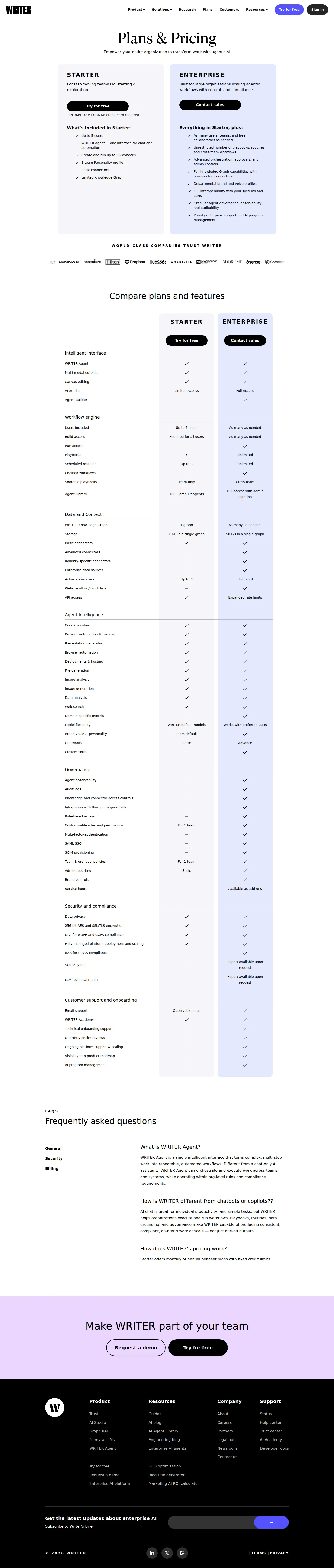
- Starter — $39 per user per month billed monthly, or $29 per user per month billed annually (about a 26% discount). Hard-capped at 5 Pro seats. Includes WRITER Agent, up to 5 Playbooks, 3 scheduled routines, one Knowledge Graph with 1 GB storage, and up to 3 active connectors. A 14-day free trial needs no credit card. This is the rebranded, pricier successor to the old ~$18/user Team plan.
- Enterprise — custom, sales-quoted. Unlimited Pro seats plus unlimited free Lite (run-only) seats, unlimited Playbooks and connectors, the full Knowledge Graph (50 GB), domain-specific Palmyra models, and the full governance stack (SAML SSO, SCIM, audit logs, RBAC, HIPAA BAA, SOC 2 Type II). Pricing blends per-seat charges with usage and agent metering plus optional solution packs and services.
- AI Studio API — a separate pure pay-as-you-go track that meters Palmyra models per token (e.g. Palmyra X5 at $0.60 input / $6.00 output per 1M tokens), Knowledge Graph hosting at $0.085/GB/day, and extraction at $0.00015/page.
What makes this different: the self-serve plan exists mainly to demonstrate the platform, not to monetize it. The 5-seat ceiling guarantees that any team with real ambition lands in a sales conversation, where Writer can price the agentic usage (agent runs, credits, Knowledge Graph scale) that flat per-seat pricing can’t capture.
Pricing by product
| Tier | Price | Included | Key mechanics |
|---|---|---|---|
| Free trial | $0 for 14 days | Starter feature set, up to 5 users | No credit card; converts to paid Starter |
| Starter | $39/user/mo monthly · $29/user/mo annual | WRITER Agent, 5 Playbooks, 3 routines, 1 Knowledge Graph (1 GB), 3 connectors | Flat per-seat with fixed credit limits; capped at 5 Pro seats |
| Enterprise | Custom (sales-quoted) | Unlimited Pro + free Lite seats, 50 GB graph, domain models, full governance | Per-seat + usage/agent metering + optional solution packs |
| AI Studio API | Pay-as-you-go | Palmyra models, Knowledge Graph hosting/extraction | Per-token, per-GB-day, per-page metering |
Sales motions across products: self-serve for Starter (credit card, instant), sales-led for Enterprise (custom quote, annual commitment). There is no published mid-market tier — the jump from 5 seats to Enterprise is intentional.
Hidden costs : What Writer users actually pay
On Starter the surprises are mostly ceilings, not surcharges: 5 seats, 1 GB of graph storage, 3 connectors, and fixed credit limits mean a team that actually adopts agentic workflows hits a wall fast and gets routed to Enterprise. On Enterprise the cost is genuinely hard to predict from the outside because per-seat is only one component — agent runs, credit consumption, Knowledge Graph scale, solution packs, and professional services all stack on top, and none of it is published.
| Line item | Monthly cost |
|---|---|
| Starter base (5 seats, annual) | 5 × $29 = $145/mo |
| Starter base (5 seats, monthly) | 5 × $39 = $195/mo |
| Service hours / onboarding | Add-on (Enterprise) |
| Usage / agent metering overage | Quoted (Enterprise) |
| Enterprise total | Custom — sales-quoted |
Watch-outs to budget for: annual billing locks the ~26% discount but commits you for the year; payment is credit/debit only on Starter (no ACH, invoicing, or PayPal); refunds are case-by-case, not guaranteed; and non-profits/education can claim a 20% discount on both plans.
Want to estimate your own Writer bill? Use the Writer pricing calculator to model seats, plan, and annual-vs-monthly billing.
Pricing evolution : Writer pricing history and changes
Cadence
| Quarter | Price changes | Product / SKU additions | Notes |
|---|---|---|---|
| 2024 Q4 | 0 | 0 | $200M Series C at $1.9B; pivot to agentic platform begins |
| 2025 | 1 | Agentic repackage | Team plan retired; Starter introduced at a higher list price |
| 2026 Q2 | 0 | 0 | Starter $39/$29 per seat, 5-seat cap; Enterprise custom |
Tracked range: 2024–present. Live pages render prices behind a bot wall; list prices verified via second-source trackers.
Notable changes
- 2024-11-12 — $200M Series C at a $1.9B valuation; total funding ~$326M. Capital earmarked for agentic AI and vertical apps (healthcare, retail, financial services).
- ~2025 — The self-serve Team plan (historically ~$18/user/mo annual, 5-seat cap) was retired and rebuilt as the agentic Starter tier centered on WRITER Agent, Playbooks, and the Knowledge Graph, with the list price rising to $39/mo ($29 annual).
- 2026-06-15 — Current state: Starter at $39/$29 per user (5 Pro seats), 14-day trial; Enterprise custom-quoted with unlimited Pro seats, free Lite seats, and usage/agent metering.
What’s unique : Writer’s distinctive pricing mechanics
1. The 5-seat tripwire. Writer’s self-serve plan is capped at 5 Pro seats with no mid-tier above it. That isn’t an accident — it’s a funnel. The cap converts any serious adopter into an Enterprise sales conversation, where Writer can price the agentic usage that flat per-seat pricing leaves on the table.
2. Free Lite seats as a land-and-expand meter. On Enterprise, unlimited free Lite (run-only) seats let an entire org touch the product — viewing and running playbooks — while only the people who build workflows consume paid Pro seats. Writer monetizes creation, not consumption, then lets adoption pull more Pro seats in.
3. It prices its own models. Because Writer trains the Palmyra LLMs, its AI Studio API is a genuine pay-as-you-go token business (Palmyra X5 at $0.60/$6.00 per 1M tokens) sitting alongside the seat business — a vertically integrated cost structure most “AI for teams” vendors, who resell OpenAI or Anthropic, don’t have.
Strengths & weaknesses
| Strengths | Weaknesses |
|---|---|
| Clear, low-friction self-serve entry ($39/$29, 14-day trial, no card) | Hard 5-seat cap forces a sales motion early, with no mid-tier |
| Owns its models (Palmyra) → margin control + a real API business | Enterprise pricing is fully opaque; usage/agent metering hard to forecast |
| Governance-first (HIPAA, SOC 2, zero data retention) fits regulated buyers | Big list-price jump from the old ~$18 Team plan to $39 Starter |
| Free Lite seats lower the bar to org-wide adoption | Credit/debit only on Starter; no ACH or invoicing for growing teams |
Billing UX : Writer billing controls and transparency
- Billing controls — Self-serve admins manage seats and cancellation from Org settings → Billing → Manage Plan; only the billing admin can add or remove users. Cancel before renewal and you keep paid features until the period ends.
- Usage visibility — Starter runs on fixed credit limits; Enterprise adds agent observability, audit logs, and admin reporting so usage and agent runs are auditable — important given the metered components.
- Payment options — Major credit and debit cards only on Starter; no ACH, invoicing, or PayPal. Offline invoicing and annual terms come with Enterprise. Refunds are case-by-case, not guaranteed.
Strategic wins : Why Writer’s pricing decisions worked
1. The seat cap as a qualification engine
By capping self-serve at 5 seats, Writer turns its cheapest plan into a lead-qualifier. Teams self-select into a trial, prove value, then have to talk to sales to grow — exactly when Writer can attach usage and agent metering. It’s the land-and-expand pattern executed through a hard ceiling rather than soft upsell nudges.
2. Monetizing creation, not consumption
Free Lite seats mean adoption is cheap to spread but value capture stays tied to the people who build. That decouples reach from revenue in a way flat per-seat pricing can’t, and it sidesteps the political friction of charging for every viewer. See choosing the right usage metric.
3. Owning the model layer
Training Palmyra gives Writer cost control over the most volatile line in any AI P&L — inference — and turns it into a sellable API. That vertical integration is what lets Writer pitch outcome- and agent-based pricing on Enterprise without bleeding margin to a third-party model vendor.
Areas to improve : Gaps in Writer’s pricing approach
1. Opaque Enterprise pricing
Enterprise blends seats, usage, agent metering, and solution packs with zero published anchors. Buyers can’t ballpark a deal without sales, which slows evaluation and invites bill-shock anxiety once metered usage scales. A public “starting at” figure or a usage estimator would lower the activation energy.
2. The mid-market gap
The leap from a 5-seat, $29/user plan to “call sales” leaves growing teams (10–50 seats) with no self-serve path. Competitors that offer a published Business tier capture that segment before it’s ready for a full enterprise commitment.
3. The Team→Starter price jump
More than doubling the self-serve list price (~$18 → $39/mo) while adding agentic features is defensible, but it raises the entry bar for the small teams that historically seeded Writer adoption — a risk if cheaper agentic-writing rivals undercut at the bottom.
Monetization stack & signals : how Writer builds & buys its revenue engine
Buys 3 Builds 0 16 open roles
Writer buys the revenue spine — Salesforce for CRM and support, Stripe for self-serve subscription billing, dbt in the analytics stack — and builds only a thin admin layer mapping seats to internal cost centers. No usage-metering vendor is disclosed.
-
“Own the triage and resolution of complex customer production issues through Salesforce, email, Slack, and Zoom”
-
“Stripe | Billing | United States”
-
“Design and build new ELT-based data models using SQL and dbt, implementing efficient testing and validation to ensure the accuracy and integrity of the data.”
-
“Billing groups allow Writer org admins to map users to internal budgets ... org admins can track the number of licenses used by each cost center.”
- Senior commercial counsel RevOps Aug 29, 2026
- Enterprise AI transformation lead (UK) Monetization Jul 30, 2026
- Enterprise AI transformation lead (Central) Monetization Jul 30, 2026
- Enterprise AI transformation lead (East) Monetization Jul 30, 2026
- Enterprise AI transformation lead (West) Monetization Jul 30, 2026
- Strategic AI transformation lead (UK) Monetization Jul 30, 2026
- Strategic AI transformation lead (Central) Monetization Jul 30, 2026
- Strategic AI transformation lead (East) Monetization Jul 30, 2026
- Strategic AI transformation lead (West) Monetization Jul 30, 2026
- VP, customer success (EMEA) Retention Jul 30, 2026
- Enterprise AI adoption lead (East) Customer success Jul 30, 2026
- AI deployment engineer (West) Customer success Jul 30, 2026
- Support engineer Customer success Jul 30, 2026
- Strategic AI adoption lead (UK) Customer success Jul 30, 2026
- Software engineer, generative AI Billing engineering seen Jun 3, 2026
- Software engineer, generative AI (UK) Billing engineering seen Jun 3, 2026
- +19 more matched roles
Signals reviewed · derived from public job posts, product docs
Job postings fill and close over time — once a posting is filled we keep it as a dated citation (the quoted evidence remains); use View open roles for current listings.
Key takeaways
- A capped self-serve plan can be a sales funnel. Writer’s 5-seat ceiling is a deliberate tripwire that routes serious adopters into a usage-priced Enterprise deal.
- Charge for creation, give away consumption. Free Lite seats spread reach while paid Pro seats capture the value of building workflows.
- Owning the model changes the pricing math. Palmyra lets Writer run a real per-token API business and control its biggest cost line.
- Opaque platform pricing is the trade-off for metered agentic value — flexible for Writer, hard to forecast for buyers.
- Repackaging can justify a price hike — but doubling the entry price risks the small-team adoption that built the brand.
UBP implications
- Seat caps + usage metering is a clean hybrid. Flat per-seat covers predictable access; metering captures the variable, high-value agentic work — a template for any team selling AI agents.
- Decouple reach from revenue. Free run-only seats are a usage-pricing lever that drives adoption without giving away the monetizable action (creation).
- Vertical model ownership enables outcome/agent pricing. Controlling inference cost is what lets a vendor experiment with agent-run and outcome-based meters without margin risk — relevant to anyone weighing usage-based pricing fundamentals.
Sources
- Writer Plans & Pricing (accessed 2026-06-15) — prices render behind a bot wall
- eesel AI — Writer.com pricing in 2026 (accessed 2026-06-15)
- eesel AI — A complete guide to Writer AI pricing (accessed 2026-06-15)
- Writer Series C press release — $200M at $1.9B (accessed 2026-06-15)
- TechCrunch — Writer raises $200M at $1.9B valuation (accessed 2026-06-15)
Bottom line
Writer prices like a company that knows where its money is. The $39/$29 self-serve Starter plan is a 5-seat shop window, not the business — it exists to qualify teams and hand them to sales, where Writer’s real model lives: a custom Enterprise platform blending Pro seats, free Lite seats, and usage/agent metering, all running on its own Palmyra models. The cost of that flexibility is opacity — Enterprise buyers can’t ballpark a deal without a call — and a doubled entry price that raises the bar for the small teams that once seeded adoption. For practitioners, it’s a sharp case study in hybrid seat-plus-usage pricing and in monetizing creation while giving away consumption.
Want to compare Writer against other AI platform companies? Browse the pricing blueprint.
Pricing timeline : Major events on a vertical axis
Each milestone below corresponds to a public pricing change, product launch, or material adjustment. Major events use a filled marker; minor adjustments use a faded one.
Starter at $39/$29 per user, Enterprise custom
Live pricing: Starter $39/user/mo monthly or $29/user/mo annual, capped at 5 Pro seats with a 14-day trial; Enterprise is a custom sales-quoted platform with unlimited Pro seats, unlimited free Lite seats, and usage/agent metering.
Team plan repackaged into agentic Starter tier
The earlier $18/user/mo self-serve Team plan was retired and rebuilt as the agentic Starter tier (WRITER Agent, Playbooks, Knowledge Graph), with the self-serve list price rising to $39/mo ($29 annual).
$200M Series C at $1.9B valuation
Writer raised a $200M Series C co-led by Premji Invest, Radical Ventures, and ICONIQ Growth at a $1.9B valuation (total funding ~$326M), funding the pivot from a writing-assistant to a full agentic enterprise AI platform.
- · Writer's self-serve plan is hard-capped at 5 seats — once you outgrow it, the only way up is a custom-quoted Enterprise deal, with no mid-tier in between.
- · Enterprise customers get unlimited *free* Lite seats that can run (but not build) playbooks — a land-and-expand lever that lets a whole org touch the product before anyone buys a Pro seat.
- · Writer trains and sells its own Palmyra family of LLMs, so its AI Studio API competes directly with OpenAI and Anthropic on token pricing (Palmyra X5 at $0.60/$6.00 per 1M tokens).
Questions & answers
- How much does Writer cost?
- Writer's self-serve Starter plan is $39 per user per month billed monthly, or $29 per user per month billed annually (about a 26% discount), capped at 5 Pro seats. The Enterprise plan is custom-quoted by sales. A 14-day free trial requires no credit card.
- Does Writer have a free tier?
- There is no permanent free tier on the self-serve plan — only a 14-day free trial of Starter (no credit card). On Enterprise, customers get unlimited free Lite seats that can view and run existing playbooks and use WRITER Agent in a limited monthly capacity, but creating workflows requires a paid Pro seat.
- Is Writer usage-based or seat-based?
- Both. The self-serve Starter plan is flat per-seat ($39/$29 per user) with fixed credit limits. Enterprise blends regular Pro seats with usage and agent metering, and Writer's separate AI Studio API is pure pay-as-you-go per token (Palmyra X5 at $0.60 input / $6.00 output per 1M tokens).
- What's the difference between Pro and Lite seats on Writer?
- Pro seats are the standard paid seat with full create-and-automate access. Lite seats exist only on Enterprise and are free run-only seats: a Lite user can view and run existing playbooks and use WRITER Agent in a limited monthly capacity, then must upgrade to a Pro seat for more.