AI Summary
About
You.com is an AI search company that has repositioned itself as an API-first developer platform. Its public pricing page at you.com/pricing now presents the “Web Search API” suite — a set of usage-billed endpoints (Search, Contents, Answer, Research, and Finance Research) designed to ground AI agents and RAG systems in live, source-backed web and financial knowledge. The endpoints share infrastructure that is SOC 2 certified, supports zero data retention, and is positioned for enterprise developers who need reliable retrieval without model training on their data.
The platform’s five products map to a retrieval-to-synthesis spectrum. The Search API returns structured, LLM-ready web and news results; the Contents API extracts clean page text from known URLs; the Answer API — added August 2026 — collapses search and synthesis into a single call, returning a citation-grounded answer directly rather than raw results; the Research API runs a multi-step, agentic search-and-synthesis pipeline that returns cited natural-language answers; and the Finance Research API applies that same pipeline to a purpose-built financial index covering fundamentals, market data, SEC filings, and macro indicators. You.com markets benchmark wins across the ladder — 93.48% accuracy on SimpleQA for the new Answer API, “#1 in DeepSearchQA” for Research, and “#1 on FinSearchComp” (87.29%) for Finance Research.
You.com’s consumer-facing products have receded from public view. Founded in 2021 by Richard Socher and Bryan McCann (both ex-Salesforce AI), the company spent 2022–2025 selling consumer subscriptions at you.com/plans — a Free tier plus Pro ($20/mo) and Team ($30/mo) seats, later restructured to a $200 “Max” tier. After its September 2024 Series B ($50M led by Georgian, with NVIDIA and Salesforce Ventures), TechCrunch reported You.com “refocuses from AI search to deeper productivity agents,” and the company progressively pivoted to the API platform. Today there is no public pricing page for the consumer plans — they are surfaced only through the in-app upgrade flow — so the company’s externally documented pricing is now entirely the usage-based developer API. For the full timeline, see Pricing evolution.
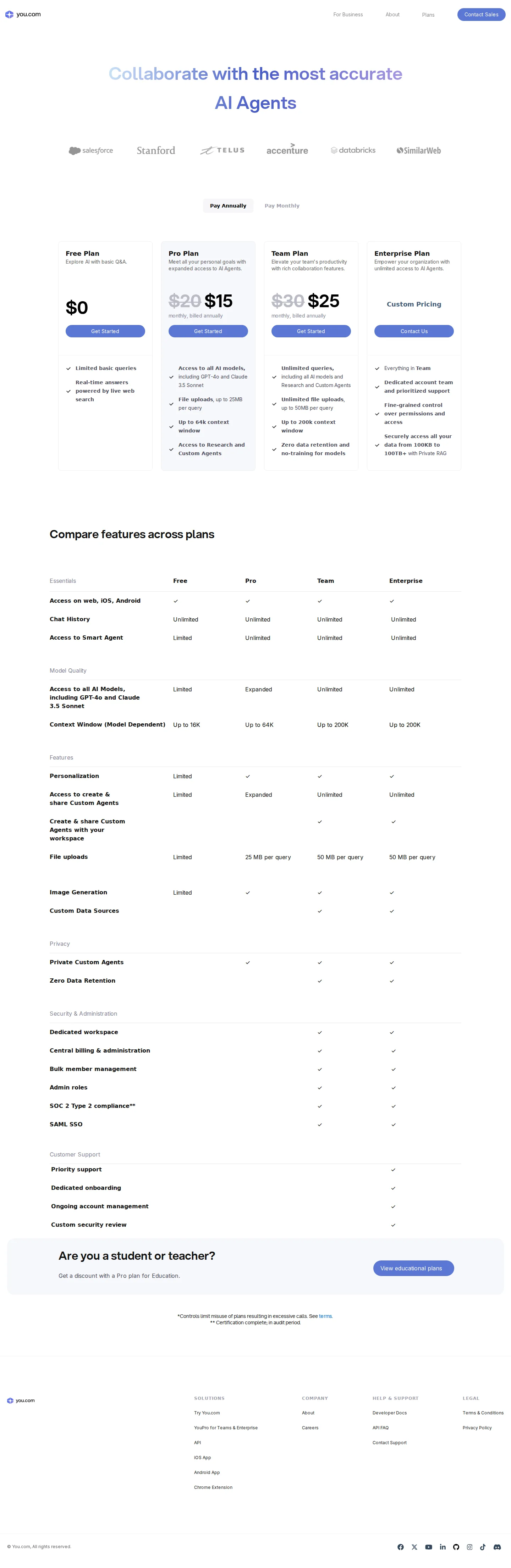
Recovered consumer-era pricing (you.com/plans, 2024–2025)
The consumer subscription pricing below is reconstructed from Wayback Machine snapshots of you.com/plans. It is no longer offered at a public URL.
| Plan | Monthly | Annual (per mo) | Highlights (as listed) |
|---|---|---|---|
| Free | $0 | $0 | Limited basic queries; live web search |
| Pro | $20 | $15 | All models (GPT-4o, o1, Claude 3.5 Sonnet), 25MB uploads, 64k context, Research & Custom Agents |
| Team (until 2025-09) | $30 | $25 | Unlimited queries, 50MB uploads, 200k context, zero data retention |
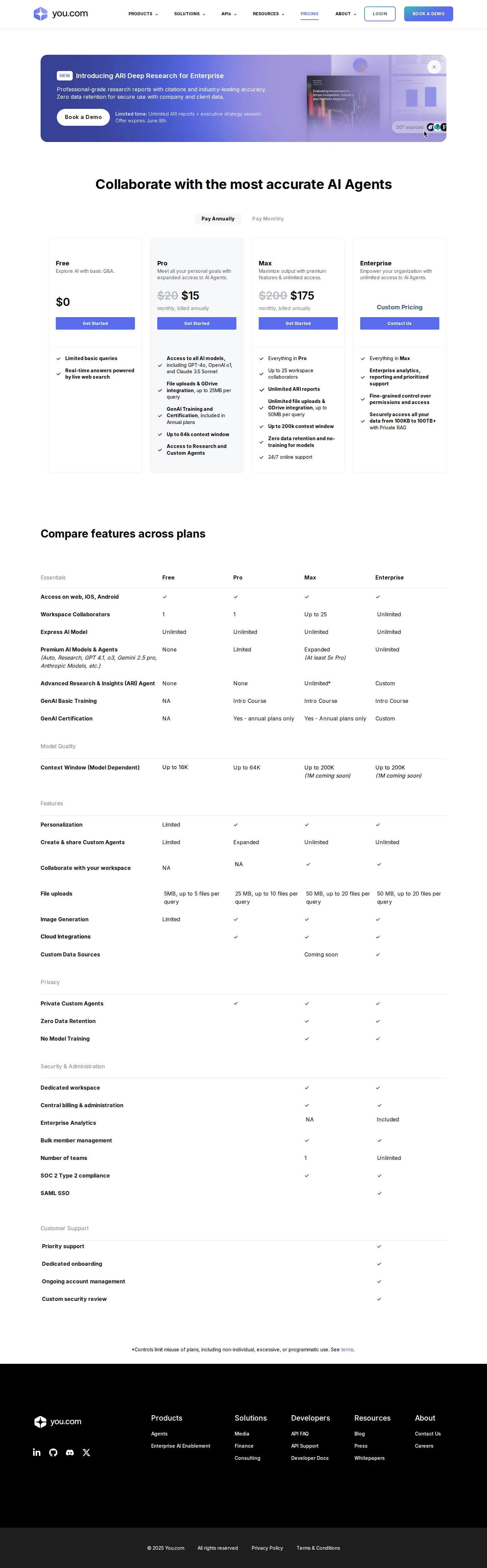
| Max (from 2025-09) | $200 | $175 | Everything in Pro, 25 collaborators, unlimited ARI reports, 24/7 support |
| Enterprise | Custom | Custom | Private RAG (100KB–100TB+), SAML SSO, SOC 2, admin controls |
Pricing summary : How You.com’s pure-usage API metering works
You.com uses a pure usage-based model with no seats, no platform fee, and no minimum spend — you pay only for the calls and pages you consume, across five independently metered endpoints. It pairs a freemium on-ramp ($100 free credit) with research-depth pricing that behaves like an outcome metric — the billable unit is a synthesized, cited answer, not a seat. See related usage-based pricing models and self-serve sales motions.
The five billing dimensions:
- Search API — free for the first 100 calls/day, then $5.00 / 1,000 calls (up to 100 results per call). News results are included at no extra cost. The optional livecrawl add-on bills full page extraction separately at $1.00 / 1,000 pages.
- Contents API — $1.00 / 1,000 pages. Batch up to 10 URLs per request; returns clean Markdown or raw HTML.
- Answer API — $5.00 / 1,000 calls. New as of the 2026-08-11 capture: a single-call endpoint that returns a synthesized, citation-grounded answer (not raw results) at the same rate as the base Search API, claiming 93.48% accuracy on SimpleQA.
- Research API — effort-tiered per 1,000 calls: lite $12, standard $50 (default), deep $100, exhaustive $450, and a Contact-Sales Frontier tier at $1,200.
- Finance Research API — effort-tiered per 1,000 calls: deep $110 (default), exhaustive $500.
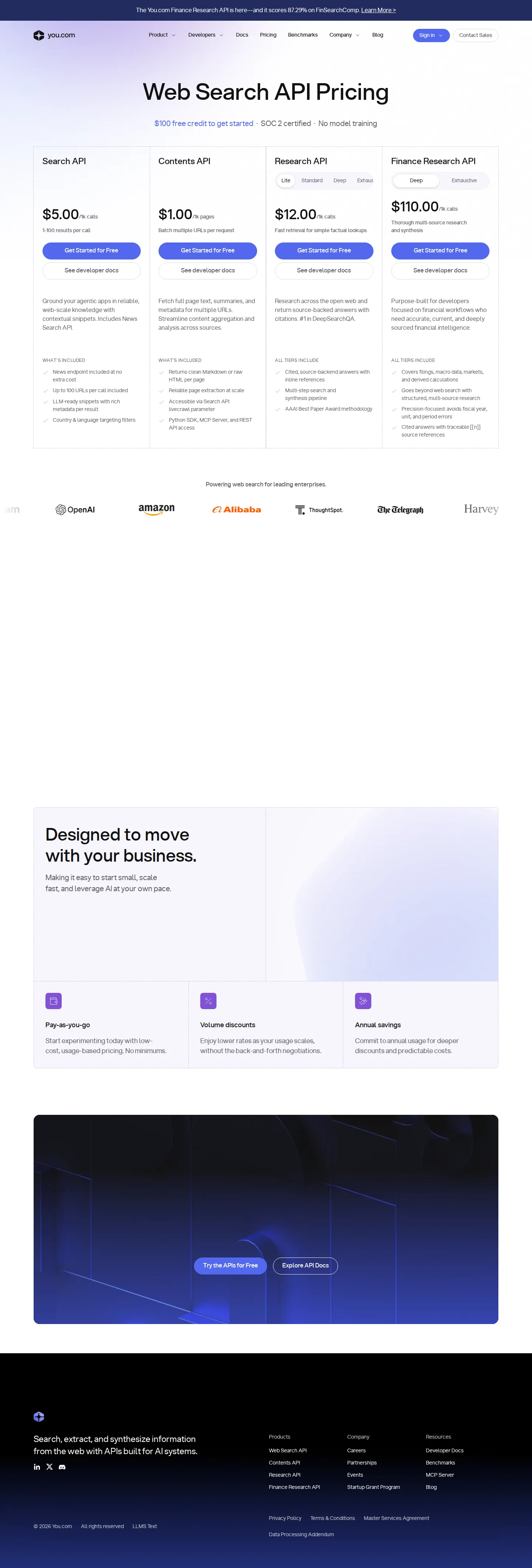
As of the 2026-07-22 capture, Frontier’s price became concrete: the pricing card shows $1,200.00 / 1k calls where earlier captures showed only an open-ended “greater-than” figure with no firm price (see Pricing evolution). The CTA is still “Contact Sales”. As of the 2026-07-29 capture, two further changes were visible: the Research API docs’ effort-level table added Frontier ($1,200/1k, “Background only,” 30s–12,000s latency with a 300s p50), and the Web Search API card was restructured to lead with Free / 100 calls per day, with the existing $5.00/1,000-calls rate applying only after that daily quota. As of the 2026-08-11 capture, the Answer API launched (see above), and two billing-UX items changed: the pricing-page subheader dropped its prior “No model training” claim for “ZDR available”, and the Web Search and Finance Research API docs now describe machine payments — agents can pay per call in USDC from a funded wallet without an account, bypassing the $100 credit entirely (see Billing UX). As of the 2026-08-14 capture, every price on every product held exactly steady; the only change was mechanical — the Search/Contents/Research docs renamed the livecrawl parameter to an extraction object (extraction_mode: "full_page", plus a new no-extra-charge "highlights" mode), and machine payments expanded to also cover /v1/agents/search — while the you.com/pricing page itself was not updated to match the new terminology (see Pricing by product and Billing UX).
What makes this different: You.com prices a research outcome (a synthesized, cited answer) on a single per-call meter that scales 100x from lite ($12) to Frontier ($1,200) purely on compute “research effort” — the buyer chooses depth, not a seat plan, and the same endpoint spans hobbyist-cheap to enterprise-grade without changing the integration. The new Answer API extends that idea downward: a synthesized, cited answer priced identically to a raw search call.
Pricing by product
Retrieval APIs (per-call / per-page)
| Tier | Price | Included | Key mechanics |
|---|---|---|---|
| Search API | Free for first 100 calls/day, then $5.00 / 1k calls | ”1-100 results per call”; news endpoint included at no extra cost; LLM-ready snippets with rich metadata; country & language targeting filters | Daily free quota shown on the pricing page since the 2026-07-29 capture; the docs pricing section still states a flat $5.00/1k with no mention of the daily allowance. Docs also describe machine payments — agents can pay per call in USDC from a funded wallet without an account (2026-08-11 capture); as of the 2026-08-14 capture this covers both GET /v1/search and both verbs of /v1/agents/search |
| Search API — Full page extraction add-on | $1.00 / 1k pages | Full page content for search results, via extraction_mode: "full_page" (renamed from the livecrawl parameter in the 2026-08-14 docs refresh, which also added a no-extra-charge extraction_mode: "highlights" mode for query-relevant passages only) | Billed separately from the base $5 search rate: docs price a search + 20 extracted pages at $0.005 + $0.020 = $0.025. The you.com/pricing page’s Contents API card still says “Accessible via Search API livecrawl parameter” — the marketing page has not caught up to the docs rename |
| Contents API | $1.00 / 1k pages | Full page text, summaries and metadata for known URLs; batch multiple URLs per request; clean Markdown or raw HTML | Python SDK, MCP Server, and REST API access — no query needed |
Answer API NEW | $5.00 / 1k calls | Single-call web search + synthesis; returns a synthesized, citation-grounded answer using the same operators as Web Search | New as of the 2026-08-11 capture (launch banner: “You.com announces the Answer API”); 93.48% accuracy on SimpleQA; answer generated only from retrieved passages (no ungrounded generation) |
Research API (effort-tiered, per 1k calls)
| Tier | Price | Included | Key mechanics |
|---|---|---|---|
| Lite | $12 / 1k calls | Fast retrieval for simple factual lookups (<10s) | Cited answers; no output_schema support |
| Standard | $50 / 1k calls | Balanced depth for most production use (~10–30s) | Default tier; structured output supported |
| Deep | $100 / 1k calls | Complex multi-source research and synthesis (<120s) | Cross-references multiple sources |
| Exhaustive | $450 / 1k calls | Comprehensive analysis across dozens of sources (<300s) | Up to 1,000+ reasoning turns, ~10M tokens |
| Frontier | $1,200 / 1k calls | ”Maximum depth—our most powerful research tier” | Contact Sales CTA on the pricing page; as of 2026-07-29 also listed in the docs effort-level table, which requires background: true (async only, 30s–12,000s latency, p50 300s) |
Finance Research API (effort-tiered, per 1k calls)
| Tier | Price | Included | Key mechanics |
|---|---|---|---|
| Deep | $110 / 1k calls | Multi-source analysis on a finance-optimized index (<120s) | Default tier; SEC filings, fundamentals, market data |
| Exhaustive | $500 / 1k calls | Deep due diligence, full 10-K analysis, cross-market research (<300s) | No source_control or output_schema |
Sales motions across products: PLG / self-serve for all metered tiers (sign up, get $100 free credit, pay per use); sales-led for the Research Frontier tier, volume discounts, annual commitments, and enterprise features (custom QPS, DPA).
Hidden costs : What an agentic app actually pays per workflow
The headline per-call rates understate the real cost of an agentic workflow, because a single user action often fans out into many billed calls across multiple endpoints — and the Research tiers charge per call regardless of how many internal searches each call performs.
Archetype: a RAG agent running 50,000 grounded answers / month
| Line item | Monthly cost |
|---|---|
| Search API — 50,000 calls × $5.00 / 1k | $250 |
| Full page extraction (formerly “livecrawl”) — 200,000 pages × $1.00 / 1k | $200 |
| Research API (standard) — 10,000 calls × $50 / 1k | $500 |
| Total | $950 |
The lesson: full-page extraction and the Research effort tier — not the base $5 search rate — are where the bill concentrates, so the choice of research_effort and how aggressively you extract full pages matter more than search volume itself. This fan-out dynamic is the classic usage-based cost-forecasting trap, and it makes value-metric selection the central pricing decision for any agentic platform.
Want to estimate your own You.com bill? Use the You.com pricing calculator to model your monthly cost based on calls per endpoint, livecrawl pages, and research-effort tier.
Pricing evolution : From consumer AI search subscription to usage-based API platform
You.com’s pricing splits cleanly into two eras: a consumer subscription era (You Pro / Team / Max at you.com/plans, 2022–2025) and the current API-first developer platform (you.com/pricing, live since late 2025). The pivot tracks the company’s strategic refocus — first signalled when its September 2024 Series B reframed it “from AI search to deeper productivity agents,” then realised through ARI (its research agent) and ultimately a usage-billed API suite.
Cadence
| Quarter | Price changes | Product / SKU additions | Notes |
|---|---|---|---|
| 2024 Q3 | 0 | 0 | Consumer tiers: Free $0, Pro $20/$15, Team $30/$25, Enterprise custom. |
| 2025 Q1 | 0 | OpenAI o1 added to Pro | Prices held; model roster expanded. |
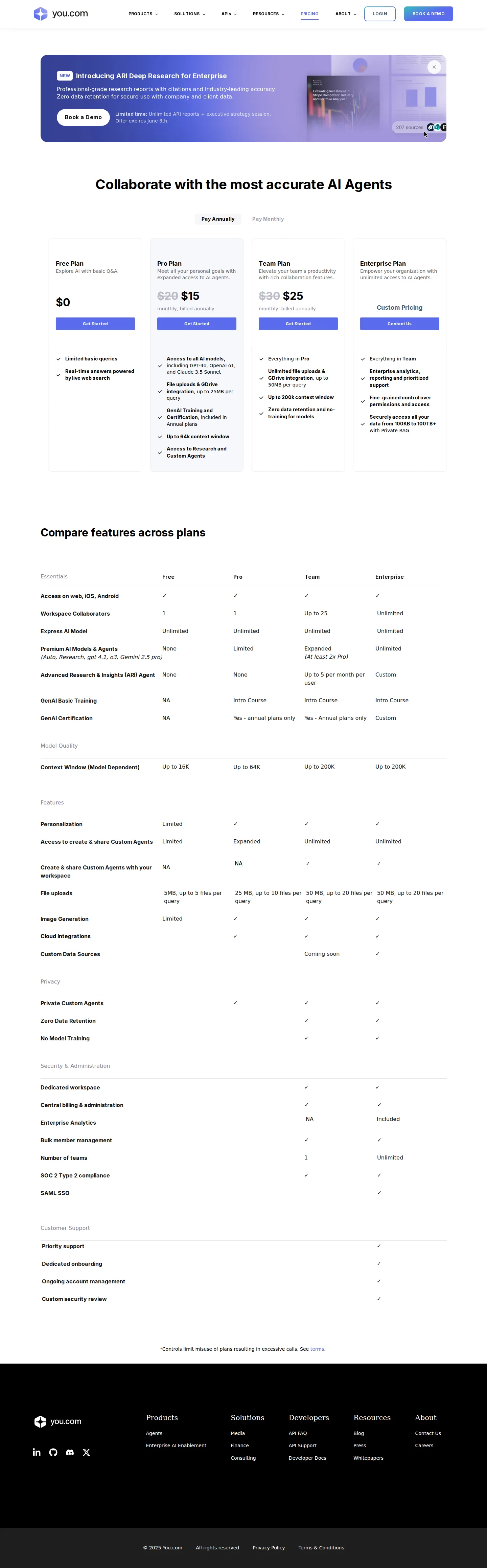
| 2025 Q2 | 0 | ARI Deep Research banner | Research-agent positioning begins on the plans page. |
| 2025 Q3 | 1 (Team → Max) | Max $200/$175 replaces Team $30/$25 | Top consumer tier repriced ~6.7x for unlimited ARI reports. |
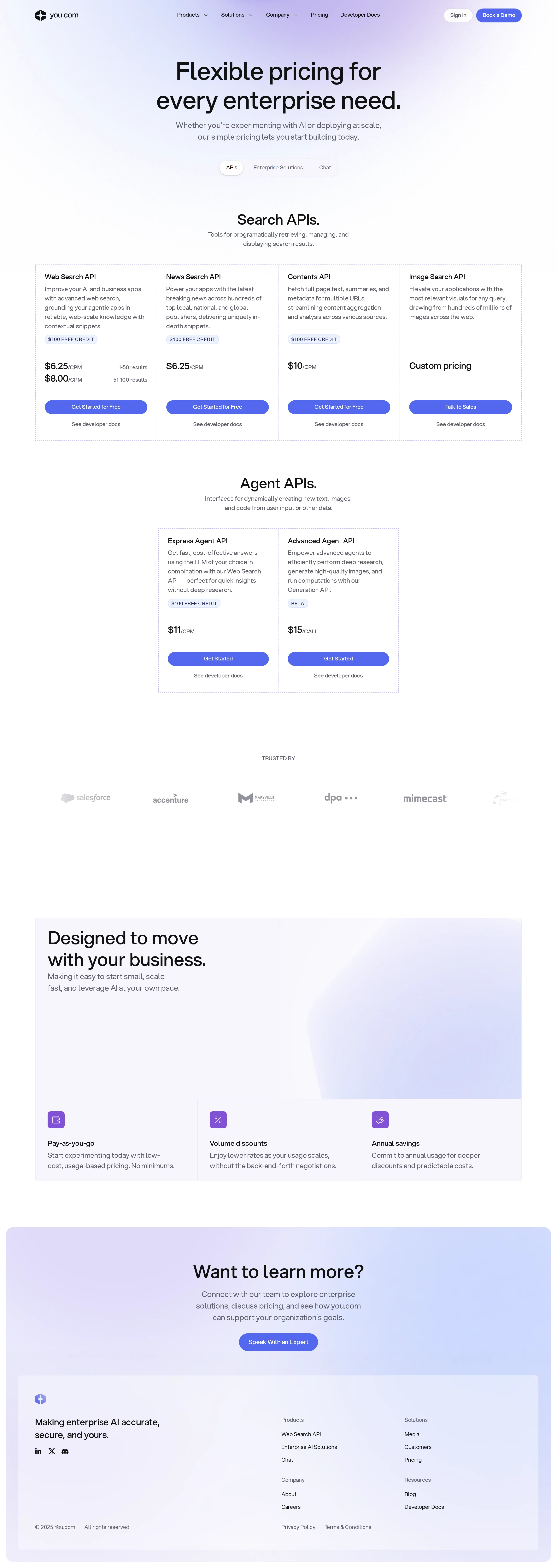
| 2025 Q4 | new platform | API platform launches | Web Search $6.25/$8.00, News $6.25, Contents $10, Express Agent $11, Advanced Agent $15/call. |
| 2026 Q1 | 0 | 0 | API CPM pricing held steady through February. |
| 2026 Q2 | Search $6.25→$5, Contents $10→$1, Research lite $6.50→$12 | Research API effort tiers; Finance Research API | Agent APIs replaced by effort-tiered Research; finance index added. |
| 2026 Q3 | Research Frontier >$2,000 → $1,200; Search adds a 100-calls/day free quota | 0 | Top tier gets a firm published price; Search API restructured with a daily free allowance ahead of its $5/1k rate; Research docs add Frontier to the effort table. |
Tracked range: 2024-09 – 2026-07. Consumer-era pricing (2024-09 onward) recovered from Wayback snapshots of you.com/plans; 2022–early-2024 snapshots were JS skeletons that never rendered pricing in the archive, so those values are not reconstructed.
Notable changes
- 2024-09 — Consumer plans: Free $0, Pro $20/mo ($15 annual), Team $30/mo ($25 annual), Enterprise custom. Same month as the $50M Series B (Georgian, NVIDIA, Salesforce Ventures).
- 2025-02 — OpenAI o1 added to Pro’s model list; prices unchanged.
- 2025-06 — “ARI Deep Research for Enterprise” banner appears on the plans page; consumer prices unchanged.
- 2025-09 — Team $30 plan removed, replaced by Max $200/mo ($175 annual) with unlimited ARI reports — a ~6.7x reprice of the top published consumer tier.
- 2025-10 — API platform launches at you.com/pricing: Web Search $6.25/$8.00, News Search $6.25, Contents $10 per 1k, Express Agent $11/1k, Advanced Agent $15/call (BETA).
- 2026-03 — Research API with effort tiers (lite $6.50 → exhaustive $300, Frontier >$2,000) replaces the Agent APIs.
- 2026-04 — Price cuts: Search $6.25/$8.00 → flat $5.00/1k; Contents $10 → $1.00/1k pages.
- 2026-06 — Research lite raised $6.50 → $12/1k (exhaustive → $450); Finance Research API added (deep $110, exhaustive $500).
- 2026-07-22 — Research Frontier repriced from an open-ended ”>$2,000/1k” label to a firm $1,200/1k — a ~40% cut at the top of the range that also converts the tier from unquotable to quotable. Contact Sales CTA retained; every other rate unchanged.
- 2026-07-29 — Web Search API restructured to Free for the first 100 calls/day, then $5.00/1k calls after (previously a flat $5.00/1k with no separate daily allowance). Separately, the Research API docs’ effort-level table added Frontier ($1,200/1k, requires
background: true, async only). All other rates — Contents $1/1k, Research lite $12/standard $50/deep $100/exhaustive $450, Finance Research deep $110/exhaustive $500 — held. - 2026-08-14 — No prices changed on any product. The Search, Contents, and Research API docs renamed the
livecrawlparameter to anextractionobject (extraction_mode: "full_page", plus a new no-extra-charge"highlights"mode), and machine payments expanded fromGET /v1/searchalone to also cover both verbs of/v1/agents/search. The you.com/pricing page’s Contents API card still uses the old “livecrawl parameter” wording, one release behind the docs.
The consumer-to-API pivot in detail
You.com spent 2022–2025 as a consumer AI-search subscription. As late as June 2025, you.com/plans still sold a $0 Free tier, a $20 Pro tier, and a $30 Team tier — classic seat-priced SaaS. The hinge was ARI, You.com’s research agent: ARI Enterprise launched in May 2025 (BusinessWire; VentureBeat reported it beating OpenAI Deep Research in head-to-head tests), and by September 2025 the company had replaced the $30 Team plan with a $200 Max plan built around unlimited ARI reports. Within a month it launched the developer API platform, and over the next two quarters it converted the Agent APIs into a usage-billed Research API priced by “research effort” — the same ARI capability, now sold per call. By mid-2026 the consumer plans had no public pricing page at all, completing the shift from a seat-priced search product to a usage-based retrieval-and-research API.
The July 2026 Frontier reprice reads as the next phase of that same shift. Between October 2025 and June 2026, every change moved the meter — new endpoints, new effort tiers, and cuts to the rates self-serve developers actually pay. The 2026-07-22 change moved only the ceiling, and it moved it in a direction that costs You.com list-price headroom (>$2,000 down to $1,200) in exchange for a number a buyer can put in a spreadsheet. That is the behaviour of a vendor whose self-serve rate card has settled and whose remaining friction is at the enterprise end of the same endpoint — not of one still searching for its meter.
What’s unique : Effort-tiered per-call research pricing
1. Research priced by “effort,” not by seat or by token. The Research and Finance Research APIs expose a single research_effort parameter that maps directly to a per-1k-call price. The buyer dials depth (lite → exhaustive → Frontier) and accepts the latency/cost tradeoff, rather than selecting a plan. This makes a synthesized, cited answer the billable unit — closer to an outcome-based pricing model than to classic API metering, a shift explored in our analysis of how AI products migrate to usage-based billing.
2. A bounded 100x intra-endpoint price spread. On the identical Research endpoint, lite costs $12/1k and the Contact-Sales Frontier tier is $1,200/1k. One integration covers hobbyist experimentation and enterprise-grade deep research without re-platforming — and since 2026-07-22 the top of that range is a published number rather than an open-ended ”>$2,000”, so a buyer can size the whole ladder before talking to anyone.
3. No seats, no platform fee, and two free on-ramps. Pricing is entirely per-call / per-page, paired with a $100 signup credit and, since 2026-07-29, a renewing 100-calls/day free quota on the Search API — a one-time credit for sampling the pricier endpoints plus an ongoing free allowance for the cheapest, highest-frequency one. That combination keeps the developer-buyer motion fully self-serve until volume discounts or annual commitments warrant a sales conversation.
Strengths & weaknesses
| Strengths | Weaknesses |
|---|---|
| Pure usage, no seats or platform fee — low barrier to start | Per-call Research pricing hides how many internal searches each call costs |
| $100 free credit lowers experimentation risk, layered since 2026-07-29 with a renewing 100-calls/day free quota on Search | Frontier is documented in the effort table (2026-07-29) but still gated behind Contact Sales / background: true — no self-serve purchase path |
| Every tier now carries a published price, including Frontier ($1,200/1k, 2026-07) | No public consumer (You Pro/Team) pricing reduces transparency |
Single research_effort knob spans a bounded 100x cost range | Livecrawl and effort tiers can make bills hard to forecast |
| Finance Research index is a genuine differentiator (#1 FinSearchComp) | Four separately metered endpoints add billing complexity |
| SOC 2 + zero data retention appeals to enterprise developers | Frequent repricing (5 changes in ~10 months) still makes forward budgeting a guess |
| Price moves have run downward for buyers (Contents 10x, Search ~25%, Frontier ~40%) | A ~40% top-tier cut one quarter after listing suggests the ”>$2,000” label was never a real price |
| Docs usually reconcile with the pricing page within about a week (Frontier gap closed 2026-07-22 → 2026-07-29) | Search API docs still describe a flat $5/1k rate — the pricing-page free quota (2026-07-29) hasn’t propagated to you.com/docs/search/overview |
Billing UX : Self-serve credit, usage metering, and enterprise controls
- $100 free credit — “$100 free credit to get started,” applied automatically to every new account; “you only pay for what you use,” with no minimums.
- 100 calls/day free (Search API) — as of the 2026-07-29 capture the Web Search API pricing card leads with “Free / 100 calls per day,” with the existing $5.00/1,000-calls rate applying only after that daily quota; not yet reflected in the API docs’ pricing section.
- Install Free Skill — a new CTA button on the Web Search API card (alongside “Get Started For Free” and “See developer docs”) for installing You.com search as an agent/IDE skill.
- Pay-as-you-go — the pricing page’s first commitment control: “Start experimenting today with low-cost, usage-based pricing. No minimums.”
- Volume discounts — “Enjoy lower rates as your usage scales, without the back-and-forth negotiations.”
- Annual savings — “Commit to annual usage for deeper discounts and predictable costs.”
- No-signup MCP free profile — the docs now advertise a zero-friction trial path: every API is reachable at
https://api.you.com/mcp(new accounts get the $100 credit), and “Search is free to try viahttps://api.you.com/mcp?profile=free, no signup required.” This was not present in the May 2026 capture. - Startup Grant Program — a dedicated credit/discount program linked from the pricing-page footer.
- Custom QPS limits — enterprise-grade concurrency and performance tuning available for high-volume usage.
- Account & Billing console — the developer platform exposes Account, Billing, and API Keys administration sections (docs: Administration → Billing).
- SOC 2 / ZDR / DPA-ready — as of the 2026-08-11 capture the pricing-page header reads “SOC 2 certified · ZDR available” (previously “SOC 2 certified · No model training,” a claim that no longer appears anywhere on the pricing page or in the captured docs); a Data Processing Addendum is linked in the footer alongside the Master Services Agreement.
- Zero Data Retention (ZDR) add-on — new as of the 2026-08-11 capture: the Web Search API docs describe ZDR as something organizations “can add … to an enterprise agreement” that “restricts retention of Web Search API request and response content account-wide and requires no changes to your integration,” with its own Administration → Zero Data Retention doc page.
- Machine payments (USDC, no account required) — new as of the 2026-08-11 capture: the Web Search API docs state “Agents can also pay per call without an account. GET /v1/search accepts machine payments, settling each request in USDC from a funded wallet instead of drawing down credits.” The Finance Research API docs describe the same mechanic for
POST /v1/finance_research“at the same per-tier prices.” Every docs page’s sidebar now lists an Administration → Machine Payments section (x402, MPP submenus); Contents and Research API docs surface the same nav item but did not state the mechanic in-page as of this capture. As of the 2026-08-14 capture the Web Search API docs wording expanded from “GET /v1/search” to “GET /v1/search and both verbs of /v1/agents/search” — machine payments now also cover the Agent Search endpoint. livecrawlrenamed toextraction_mode, new “highlights” mode — new as of the 2026-08-14 capture: the Search, Contents, and Research API docs replaced thelivecrawlparameter with anextractionobject.extraction_mode: "full_page"behaves like the old livecrawl (still $1.00/1k pages); a newextraction_mode: "highlights"mode returns only the passages relevant to the query, included in the base per-call rate at no extra charge. The you.com/pricing page has not been updated to match — its Contents API card still reads “Accessible via Search API livecrawl parameter.”- Direct pricing contact — the docs route volume, annual, and enterprise requests to
you.com/pricingor[email protected]rather than a quote form.
Strategic wins : Why the API-first usage pivot works
1. Selling research depth as a per-call knob removes plan-design friction.
By collapsing tiering into a single research_effort parameter, You.com lets one integration serve a 100x range of use cases. Developers never have to migrate plans as needs grow, which is a textbook usage-based growth advantage and reduces churn risk at the low end. Publishing the Frontier rate on 2026-07-22 completed the ladder: the entire range from $12 to $1,200 is now a rate card a developer can reason about, so the knob sells itself all the way up instead of stopping at the tier where the price disappeared.
2. A $100 free credit is a cleaner PLG on-ramp than a free tier.
Credit-based trials let prospects exercise the expensive endpoints (deep research, livecrawl) during evaluation, not just the cheap ones — a more honest preview of value than a capped free tier. It mirrors the credit on-ramp pattern used by other AI infrastructure vendors, and connects to how teams model prepaid credit pools. Since 2026-07-29 the Search API also carries a renewing 100-calls/day free quota layered under that credit — a capped free tier for the cheapest, highest-volume endpoint, while the credit still does the work of letting prospects sample the pricier Research and Finance Research calls. The two mechanisms are complementary rather than redundant: the quota removes friction for ongoing low-volume Search use, the credit remains the only way to trial the endpoints where price varies by effort.
3. The Finance Research index is a defensible premium SKU.
Charging $110–$500/1k for finance research — versus $12–$450 for general research — is justified by a proprietary index (SEC filings, fundamentals, 42 exchanges). It gives You.com a vertical price point competitors using the open web can’t easily match.
Areas to improve : Transparency gaps to close
1. Close the Search API’s new docs lag — and finish making Frontier self-serve.
The Frontier docs gap flagged in the prior review is resolved: the Research API docs’ effort-level table added Frontier ($1,200/1k, requiring background: true, async-only) on 2026-07-29, one week after the pricing page had already published the $1,200 rate on 2026-07-22. What Frontier still lacks is a self-serve path — the CTA remains Contact Sales, so a developer can now read about the tier but still can’t turn it on without a call. The same 2026-07-29 capture opened a mirror-image gap on a different endpoint: the Search API’s own docs page (you.com/docs/search/overview) still describes a flat $5.00/1,000-calls rate and doesn’t mention the new 100-calls/day free quota that now leads the pricing-page card. A developer relying on the docs instead of the pricing page will misjudge what they get for free. Closing both — letting qualified accounts self-enable Frontier, and syncing the Search docs to the pricing page — would remove the last two points where the docs undersell what’s actually on offer.
2. Expose per-call internal-search cost or a budget estimate.
Because each Research call can fan out to many internal searches, buyers can’t easily forecast spend. A usage estimator or a returned “searches consumed” field would help teams model bills — exactly the gap a pricing calculator fills.
3. Restore some public visibility for consumer plans.
Removing the You Pro/Team pricing page entirely hurts comparability and SEO. Even an archived or “see in-app” reference price would reduce confusion for users arriving from search.
Monetization stack & signals : how You.com builds & buys its revenue engine
Buys 0 Builds 0 2 signal roles
Buys no monetization stack it discloses — the per-call meter behind its usage pricing is first-party and unnamed. The signal worth watching is the product hire below: new price points come from new vertical-index API SKUs, not re-tiering the meter.
- Metering Metering inferred
- Developer Marketing Lead Growth seen Jun 8, 2026
Confirms the self-serve / PLG motion behind the $100-free-credit meter: the first dedicated developer-marketing/DevRel hire owns the API activation funnel (first-call → production), not enterprise sales — You.com is investing in the top of a self-serve developer funnel rather than a quote-to-cash org.
“Own developer awareness across the full funnel: from first exposure on X or HN to first API call to production deployment... Instrument the developer funnel and use data to identify where awareness or activation breaks down.”
- Senior Product Manager Monetization seen May 15, 2026
Monetization for You.com is now product-led, not packaging-led: this PM productizes vertical indexes into priced API SKUs (the $110–$500/1k Finance Research API is the first instance), so the next price points come from new vertical-index products — legal, news — not from re-tiering the existing meter.
“We are looking for a Product Manager to lead our AI Web Infrastructure product line: domain-specific, deeply crawled, high-freshness data infrastructure... how we go deep in specific verticals (financial data, news, legal, and beyond) and how we expose that infrastructure as API products customers can build on.”
Signals reviewed · derived from public job posts
Job postings fill and close over time — once a posting is filled we keep it as a dated citation (the quoted evidence remains); use View open roles for current listings.
Key takeaways
- Make depth a parameter, not a plan. You.com’s
research_effortknob shows how to span a 100x price range ($12 to $1,200 / 1k calls) on one endpoint without forcing plan migrations — a pattern worth copying for any synthesis-style API. - Credit beats a capped free tier for high-value APIs. A $100 credit lets prospects test the expensive paths, giving a truer preview of value than a free tier that only exposes cheap calls.
- Vertical indexes justify vertical prices. The Finance Research SKU charges 2–9x the general Research rate purely on the strength of a proprietary financial index.
- Pure usage lowers entry but raises forecasting risk. No seats and no minimums maximize adoption, but per-call research pricing makes bills hard to predict — pair it with estimators.
- An open-ended top tier is a placeholder, not a price — and docs lag the pricing page, not the reverse. You.com’s Frontier tier went from ”>$2,000/1k calls” to a firm $1,200 on 2026-07-22, a ~40% cut showing unbounded top tiers are negotiable by default, and its docs only added Frontier to the effort table a week later on 2026-07-29 — the same capture that opened a mirror-image gap on the Search API side, where the docs still show a flat $5.00/1k rate with no mention of the new 100-calls/day free quota. Treat the pricing page, not the docs, as the source of truth for what’s actually billed.
UBP implications
- Outcome-shaped units can ride a simple per-call meter. You.com bills a synthesized, cited answer as one call, proving that “outcome-like” value metrics don’t require complex resolution-counting — a single effort parameter does the work.
- Effort tiers are a clean way to price compute variance. When a single endpoint’s cost varies 100x+ by depth, exposing that as named tiers (lite/deep/exhaustive) is more legible to buyers than raw token/compute metering.
- Free credit is the natural freemium primitive for usage-based APIs. Replacing a feature-capped free tier with a dollar-denominated credit aligns the trial with the actual billing model and removes packaging guesswork. You.com’s 2026-07-29 addition of a renewing 100-calls/day free quota on the Search API shows the two primitives aren’t mutually exclusive: a capped free tier works for a single, cheap, high-frequency endpoint where usage is predictable, while a dollar credit remains necessary wherever price varies by effort or endpoint (Research, Finance Research) and a fixed call count wouldn’t map to a fair trial.
Sources
- You.com API platform pricing (accessed 2026-08-14)
- You.com Search API docs (pricing) (accessed 2026-08-14)
- You.com Contents API docs (pricing) (accessed 2026-08-14)
- You.com Research API docs (effort levels & pricing) (accessed 2026-08-14)
- You.com Finance Research API docs (effort levels & pricing) (accessed 2026-08-14)
- You.com docs — Administration → Billing (consolidated rate summary) (accessed 2026-07-29)
- You.com Research API guide, markdown mirror (effort-level price table) (accessed 2026-07-29)
- You.com Finance Research API guide, markdown mirror (effort-level price table) (accessed 2026-07-29)
- You.com Research API reference (
research_effortallowed values) (accessed 2026-07-23)
Browse more usage-based API pricing in the pricing blueprint.
Bottom line
You.com has become a clean case study in pure usage-based API pricing: four separately metered endpoints, no seats, a $100 free credit (now paired with a renewing 100-calls/day free quota on Search, added 2026-07-29), and a single research_effort knob that scales one Research endpoint from $12 to $1,200 per 1,000 calls. Since the July 2026 Frontier reprice, that ladder is fully published — every tier has a number, and the ~40% cut at the top suggests the old ”>$2,000” ceiling was positioning rather than cost. What remains is mostly a forecasting problem, not a disclosure one: rates are visible on the pricing page, but per-call research fan-out and livecrawl volume still make the monthly bill hard to predict before you run it. The one recurring wrinkle is docs drift — the Research API docs caught up to the Frontier price on 2026-07-29, the same week the Search API’s own docs page fell behind by still showing the old flat $5/1k rate with no mention of the new free daily quota.
Want to compare You.com against other API and AI-platform pricing? Browse the pricing blueprint.
Pricing timeline : Major events on a vertical axis
Each milestone below corresponds to a public pricing change, product launch, or material adjustment. Major events use a filled marker; minor adjustments use a faded one.
Livecrawl parameter renamed to extraction_mode; machine payments extend to Agent Search
The Search, Contents, and Research API docs replaced the livecrawl parameter with an extraction object: extraction_mode 'full_page' for whole-page content (same behavior, same $1.00/1k-page rate) plus a new extraction_mode 'highlights' mode that returns only the passages relevant to the query, included in the base per-call rate at no extra charge. No prices moved: Search stayed $5.00/1k calls (free for the first 100/day), Contents/full-page extraction $1.00/1k pages, Research $12-$1,200/1k by effort tier, Finance Research $110/$500/1k. Machine payments (pay-per-call in USDC without an account) expanded from GET /v1/search alone to also cover both verbs of /v1/agents/search. The main you.com/pricing page's Contents API card was not updated to match — it still reads 'Accessible via Search API livecrawl parameter.' Read from live capture of you.com/pricing and the API docs.
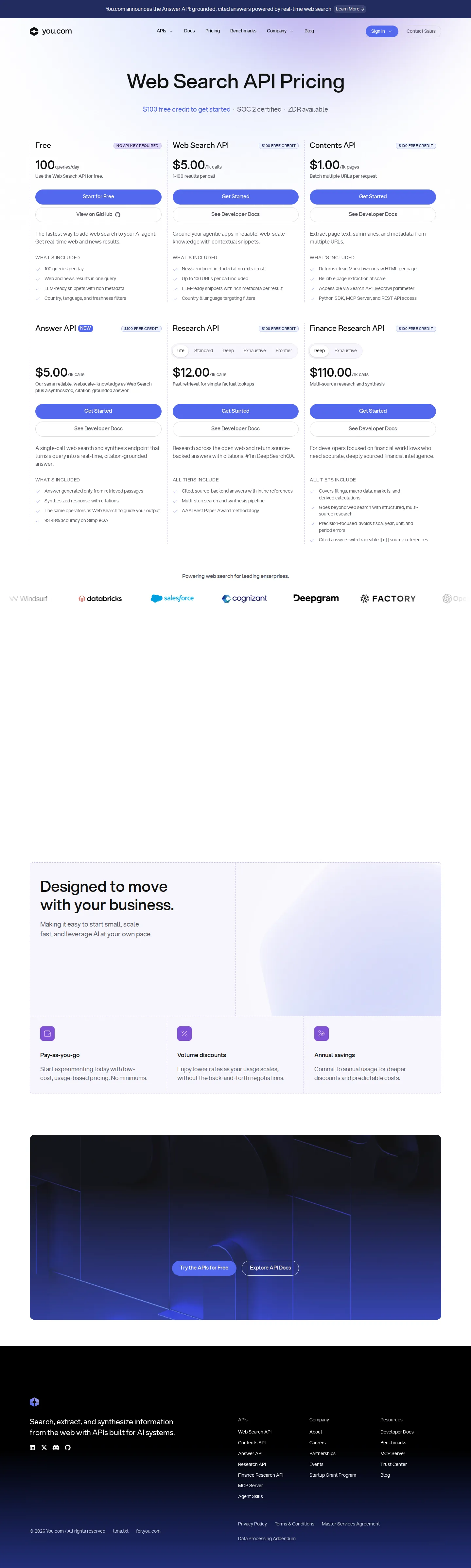
Answer API launches: single-call search + synthesis at $5/1k calls
A new Answer API appeared on the pricing page (banner: 'You.com announces the Answer API: grounded, cited answers powered by real-time web search'), priced at the same $5.00/1,000-calls rate as the Web Search API rather than as a premium tier. It returns a synthesized, citation-grounded answer from one call, claims 93.48% accuracy on SimpleQA, and carries the $100 free-credit badge like every other endpoint. Separately, the pricing-page subheader dropped its prior 'No model training' claim in favor of 'ZDR available,' and the API docs now describe a Zero Data Retention enterprise add-on plus machine payments (agents paying per call in USDC from a funded wallet, without an account) on the Web Search and Finance Research API docs. All other rates held: Search $5/1k, Contents $1/1k, Research lite $12/standard $50/deep $100/exhaustive $450/Frontier $1,200, Finance Research deep $110/exhaustive $500. Read from live capture of you.com/pricing and the API docs.
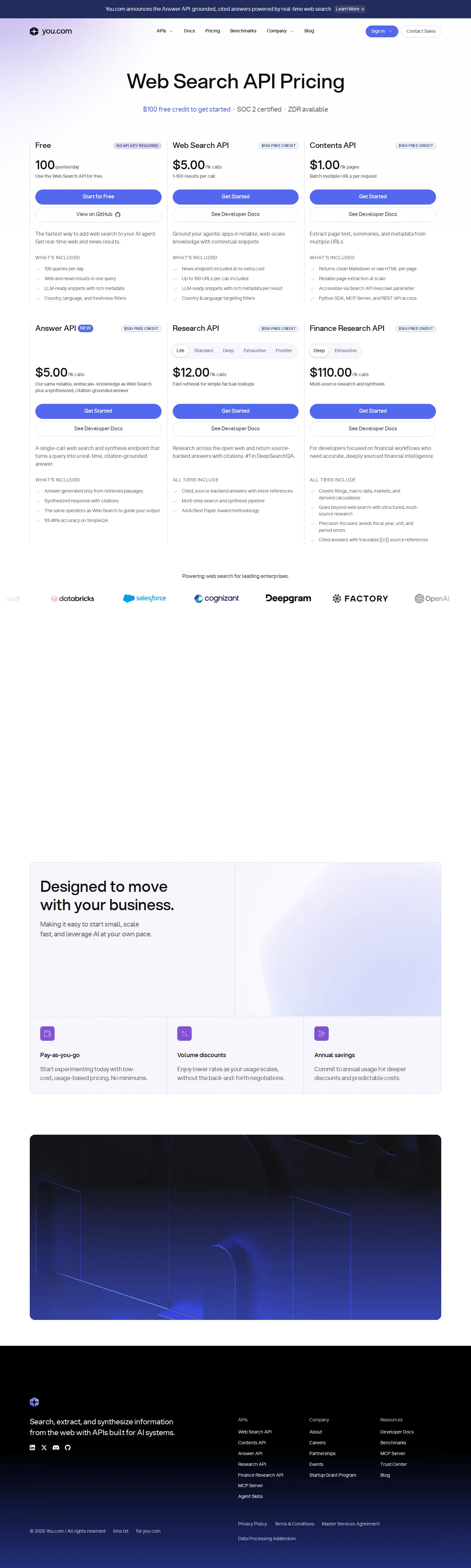
Web Search API adds a 100-calls/day free tier; Research docs add Frontier
The Web Search API pricing card was restructured from a flat $5.00/1k-calls rate to 'Free / 100 calls per day' with the $5.00/1k rate applying only after that daily quota. Separately, the Research API docs' effort-level table added the Frontier tier ($1,200/1k, requires background: true), closing the docs gap noted in the prior capture. Every other rate held: Contents $1/1k, Research lite $12 / standard $50 / deep $100 / exhaustive $450 / Frontier $1,200, Finance Research deep $110 / exhaustive $500, $100 account credit. Read from live capture of you.com/pricing and the API docs.
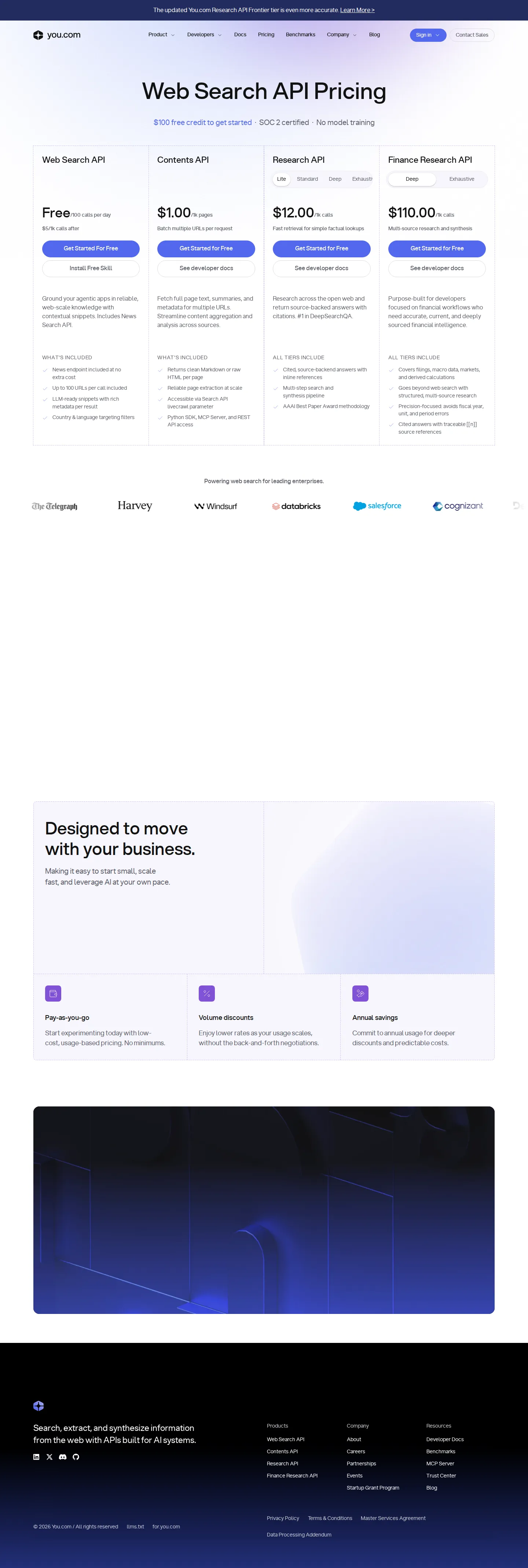
Frontier gets a firm price: >$2,000 becomes $1,200 / 1k calls
The Research API's Contact-Sales Frontier tier replaced its open-ended '>$2,000.00 /1k calls' label with a concrete $1,200.00 /1k calls — roughly a 40% cut at the top of the range and, more importantly, the first quotable price for the tier. Every other rate held: Search $5/1k, Contents $1/1k, livecrawl $1/1k pages, Research lite $12 / standard $50 / deep $100 / exhaustive $450, Finance Research deep $110 / exhaustive $500, $100 free credit. The Contact Sales CTA is retained and Frontier still does not appear in the Research API docs' effort-level table. The docs separately added a no-signup trial path for Search over MCP. Read from live capture of you.com/pricing.
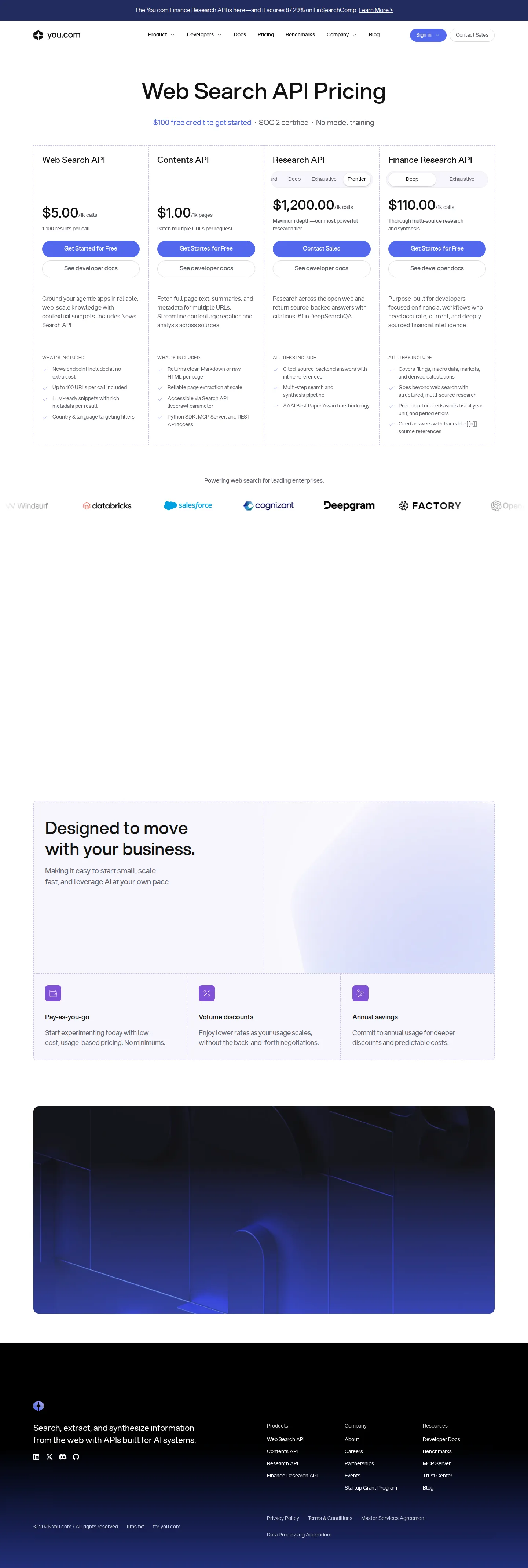
Research lite raised to $12; Finance Research API added
Current pricing: Search $5/1k, Contents $1/1k. Research API lite rose from $6.50 to $12/1k (standard $50, deep $100, exhaustive $450, Frontier >$2,000). A new Finance Research API was added on a dedicated financial index — deep $110, exhaustive $500/1k (#1 on FinSearchComp, 87.29%). $100 free credit, SOC 2, zero data retention. Consumer You Pro/Max plans no longer have a public pricing page. Read from live capture of you.com/pricing.
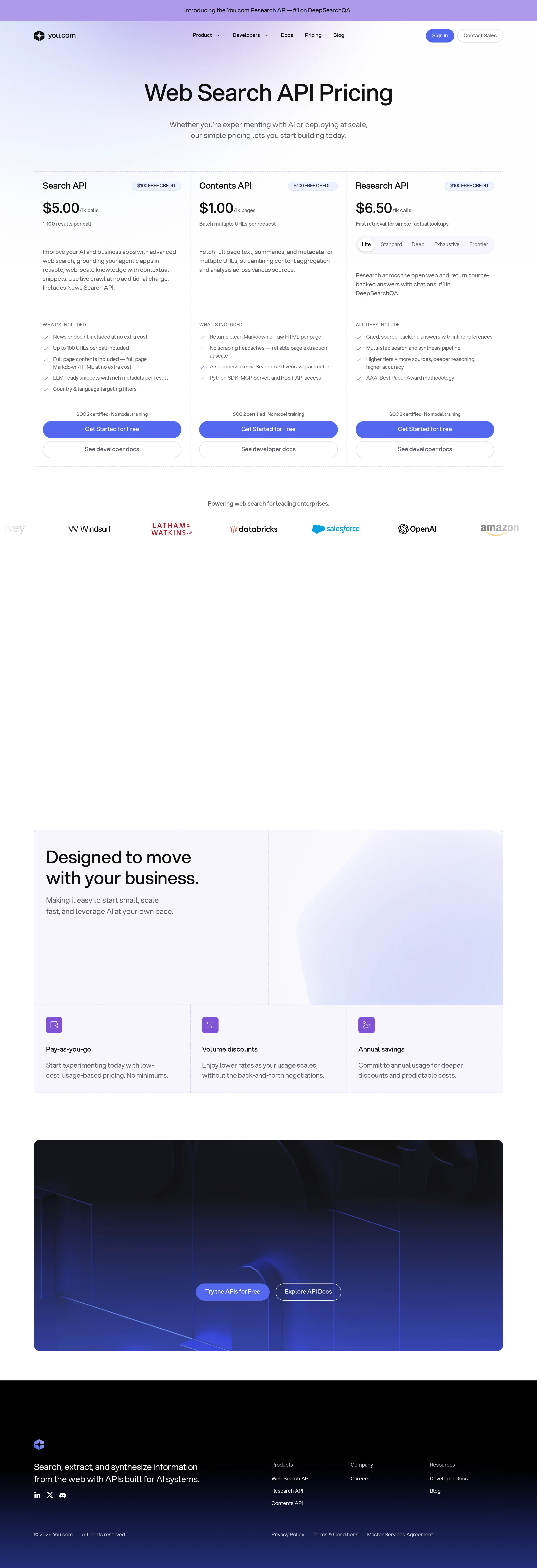
Major price cuts: Search to $5, Contents to $1; page retitled
The page was retitled 'Web Search API Pricing' and consolidated to three cards. Search API dropped from $6.25/$8.00 to a flat $5.00/1k (1–100 results, news + livecrawl included at no extra charge); Contents API dropped from $10 to $1.00/1k pages; Research API lite shown at $6.50/1k with the lite/standard/deep/exhaustive/frontier tabs. Read from Wayback snapshot of you.com/pricing.
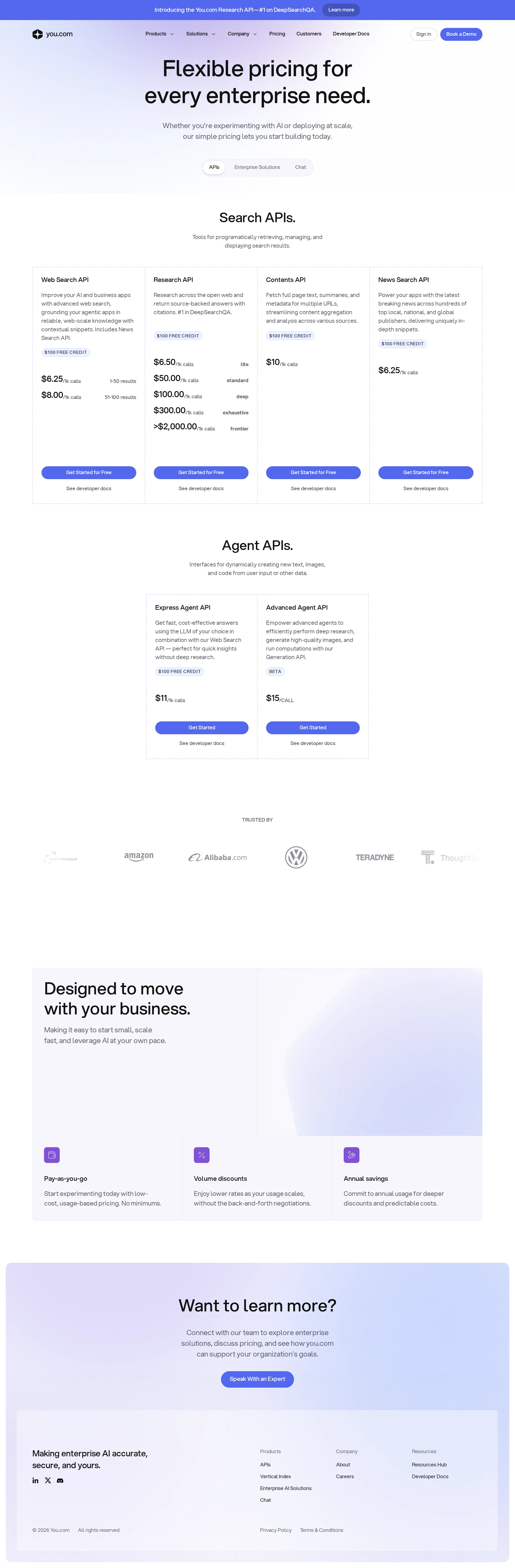
Research API with effort tiers replaces the Agent APIs
A new 'Research API' appeared with effort-tiered per-1k pricing: lite $6.50, standard $50, deep $100, exhaustive $300, and a Contact-Sales Frontier tier listed at >$2,000. Web Search ($6.25/$8.00), News Search ($6.25), and Contents ($10) were still at their 2025 rates. Page header promoted 'You.com Research API — #1 on DeepSearchQA.' Read from Wayback snapshot of you.com/pricing.
API CPM pricing held steady
Web Search $6.25/$8.00, News Search $6.25, Contents $10 per 1k, Image Search custom, Express Agent $11/1k, Advanced Agent $15/call (BETA) — unchanged from the October launch. Read from Wayback snapshot of you.com/pricing.
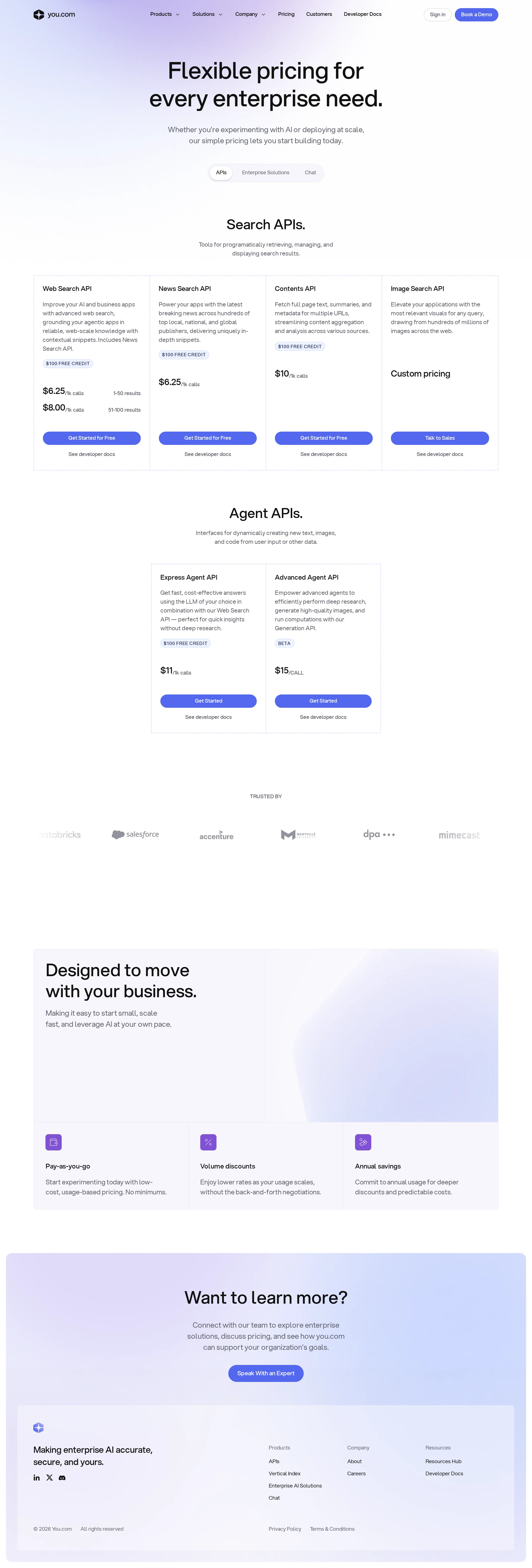
API platform launches at you.com/pricing (per-1k CPM)
you.com/pricing went live as a developer API platform under 'Flexible pricing for every enterprise need,' split into Search APIs and Agent APIs. Web Search API $6.25/1k (1–50 results) or $8.00/1k (51–100); News Search API $6.25/1k; Contents API $10/1k; Image Search API custom. Agent APIs: Express Agent $11/1k and Advanced Agent $15/call (BETA). $100 free credit. Read from Wayback snapshot of you.com/pricing.
Team $30 replaced by Max $200 — top consumer tier repriced ~6.7x
The $30 Team plan was removed and replaced by a 'Max' plan at $200/mo ($175 billed annually): Everything in Pro plus up to 25 workspace collaborators, Unlimited ARI reports, 50MB uploads, 200k context, and 24/7 support. Free ($0) and Pro ($20/$15) were retained. This repriced the top published consumer tier from $30 to $200 — driven by unlimited ARI research access. Read from Wayback snapshot of you.com/plans.
ARI Deep Research for Enterprise surfaces on the plans page
Consumer Pro ($20/$15) and Team ($30/$25) tiers were unchanged, but the plans page now led with an 'Introducing ARI Deep Research for Enterprise' banner ('professional-grade research reports with citations, zero data retention') — the first visible step toward the research/API repositioning. ARI Enterprise had launched in May 2025 (BusinessWire / VentureBeat). Read from Wayback snapshot of you.com/plans.
Consumer prices held; OpenAI o1 added to Pro
Pro stayed $20/mo ($15 annual) and Team $30/mo ($25 annual). The Pro tier's model list expanded to include OpenAI o1 alongside GPT-4o and Claude 3.5 Sonnet — a feature add without a price change. Read from Wayback snapshot of you.com/plans.
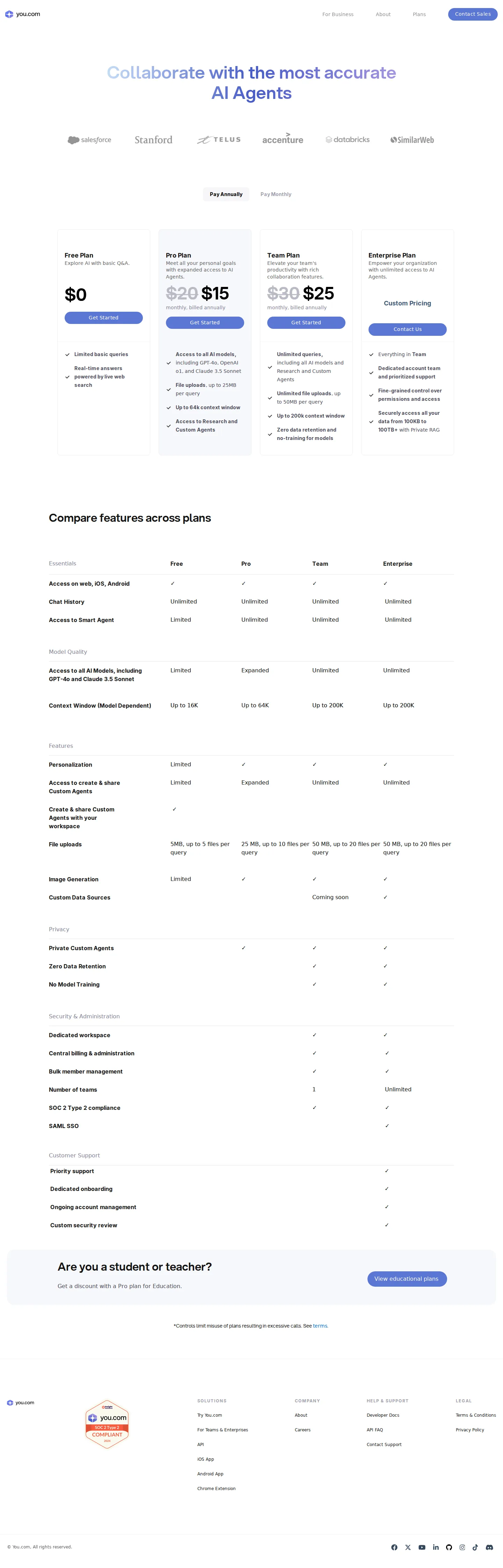
Consumer subscription era: Free / Pro $20 / Team $30
you.com/plans sold four consumer tiers: Free ($0), Pro ($20/mo or $15 billed annually), Team ($30/mo or $25 annually), and Enterprise (custom). Pro unlocked all AI models (GPT-4o, Claude 3.5 Sonnet), 25MB file uploads, 64k context, and Research/Custom Agents; Team added unlimited queries, 200k context, and zero data retention. Read from Wayback snapshot of you.com/plans. This is the same month You.com closed its $50M Series B (Georgian, with NVIDIA and Salesforce Ventures) and TechCrunch reported it 'refocuses from AI search to deeper productivity agents.'
- · You.com once sold a $30/mo Team plan; in September 2025 it replaced Team with a $200/mo 'Max' plan built around unlimited ARI research reports — a ~6.7x reprice of its top consumer tier, recovered from Wayback snapshots of you.com/plans.
- · Between March and April 2026 You.com cut its API prices sharply: the Contents API dropped from $10 to $1 per 1,000 pages (10x) and Search dropped from $6.25/$8.00 to a flat $5 per 1,000 calls.
- · You.com was founded in 2021 by Richard Socher and Bryan McCann, both former Salesforce AI researchers; its September 2024 Series B ($50M, led by Georgian) drew investment from NVIDIA, Salesforce Ventures, and even rival search engine DuckDuckGo.
Questions & answers
- How much does the You.com Search API cost?
- As of the 2026-07-29 pricing-page capture, the You.com Search API is free for the first 100 calls per day, then $5.00 per 1,000 calls (up to 100 results per call). Live-crawled full page content via the livecrawl parameter is billed separately at $1.00 per 1,000 pages. Note: the API docs' pricing section has not yet been updated to mention the daily free quota.
- How is the You.com Research API priced?
- The Research API is metered per 1,000 calls by research-effort tier: lite $12, standard $50 (default), deep $100, exhaustive $450, and Frontier $1,200 (Contact Sales). The four self-serve tiers are also documented in the Research API docs; Frontier appears only on the pricing page.
- Is there a free tier on You.com's API?
- Yes. Every new You.com API account receives $100 in free credit to get started, with no minimums and no platform fee — you only pay for the calls and pages you use.
- How much did You Pro cost, and does You.com still sell it?
- Historically (recovered from Wayback snapshots of you.com/plans) You Pro was $20/month or $15 billed annually, with a $30/month Team plan that was replaced by a $200/month Max plan in September 2025. Today the public pricing page covers only the developer APIs; the consumer plans no longer have a public pricing page and are available through the in-app upgrade flow.
- Why did You.com switch from consumer subscriptions to API pricing?
- After its September 2024 Series B, You.com refocused from consumer AI search toward research agents (ARI) and enterprise developers. Through 2025–2026 it launched a usage-billed Web Search API platform and converted its ARI research capability into the per-call Research API, ultimately retiring the public consumer pricing page.
- What is the You.com Finance Research API and how much does it cost?
- The Finance Research API answers financial questions against a purpose-built financial index. It is priced per 1,000 calls by effort tier: deep $110 (default) and exhaustive $500.