AI Summary
About
Zenskar makes an AI-native order-to-cash platform — a single system for billing, metering, invoicing, revenue recognition, collections (accounts receivable) and SaaS metrics aimed at modern B2B finance teams. The pitch is to replace “rigid tools, spreadsheets and manual workarounds”: your finance team can stand up usage-based pricing, prepaid credits, subscriptions, hybrid models, custom contracts, multi-entity and multi-currency billing without leaning on engineers, and Zenskar layers AI on top (AI contract ingestion, auto-generated revenue-recognition performance obligations, no-code aggregation). It explicitly markets itself as a replacement for Maxio, Zuora and Chargebee.
Zenskar was founded in 2022 by Apurv Bansal and is headquartered in New York (169 Madison Avenue). In April 2026 it raised a $15M Series A led by Susquehanna Venture Capital, Bessemer Venture Partners, Shine Capital and Rho, on reported 5x year-over-year revenue growth, and repositioned around “AI-native revenue automation” with agentic capabilities. Customers cite outcomes like 70% faster month-end close, 200+ hours/quarter saved on invoicing, and 90% less engineering bandwidth spent on billing.
For the most current information, visit Zenskar.
Pricing summary : How Zenskar’s pricing model works
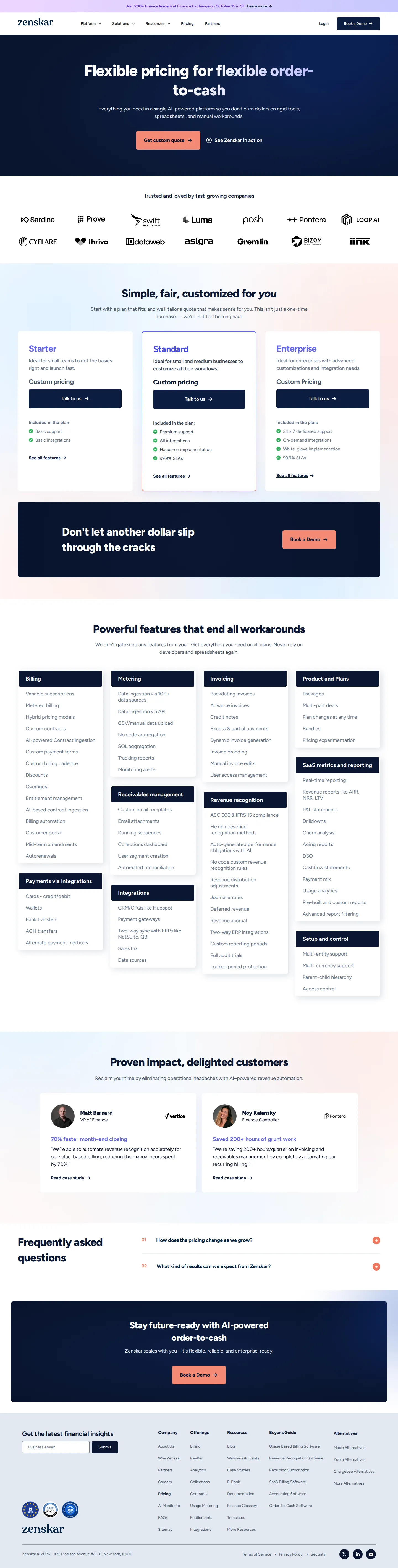
Zenskar’s own pricing is a sales-led platform subscription with three tiers — Starter, Standard and Enterprise — and every tier shows “Custom pricing” with a “Talk to us” CTA. There are no dollar figures anywhere on the page. The tiers are differentiated by support and implementation, not by features: Zenskar says it “doesn’t gatekeep any features,” so billing, metering, revenue recognition, collections and analytics are included on all plans. Starter adds basic support and basic integrations; Standard adds premium support, all integrations, hands-on implementation and 99.9% SLAs; Enterprise adds 24x7 dedicated support, on-demand integrations and white-glove implementation.
The single most distinctive thing about how Zenskar charges: its pricing FAQ states, verbatim, “We don’t charge a % of your revenue.” That is a deliberate swipe at the dominant billing-vendor model — Stripe Billing, Zuora and Chargebee all take fees that scale with the money you bill — and Zenskar frames itself instead as “an enterprise platform built for automation and scale” whose “usage and rate limits are generous and grow with you,” revisiting pricing as your business grows rather than skimming a percentage.
What makes this different: Zenskar sells flexibility but prices itself opaquely. The product can bill your customers any way imaginable (usage, credits, subscriptions, hybrid), yet Zenskar sells itself through demo-and-quote with zero published numbers — a sales-only posture. The redeeming twist is the explicit no-revenue-share promise, which makes the (quoted) cost a flat platform fee rather than a tax on your growth.
Pricing by product
| Tier | Price | Included | Key mechanics |
|---|---|---|---|
| Starter | Custom (quoted) | Full product; basic support; basic integrations; sandbox + free pilot | Sales-led “Talk to us”; tiered by support, not features |
| Standard | Custom (quoted) | Full product; premium support; all integrations; hands-on implementation; 99.9% SLAs | Sales-led “Talk to us”; most-customizable workflows |
| Enterprise | Custom (quoted) | Full product; 24x7 dedicated support; on-demand integrations; white-glove implementation; 99.9% SLAs | Sales-led “Talk to us”; advanced customization & integration |
Sales motions across products: sales-led across all three tiers — every plan is “Custom pricing / Talk to us,” entered via “Book a Demo” or “Get custom quote.” There is no self-serve or PLG path to a paid plan; Zenskar offers a sandbox and a flexible free pilot to evaluate, then quotes a platform subscription. Notably, no tier is priced as a percentage of billed revenue.
Hidden costs : What Zenskar users actually pay
Because Zenskar quotes a flat platform subscription and explicitly does not charge a percentage of your revenue, the “hidden cost” risk here is the opposite of the usual billing-vendor trap: there is no fee that scales with the money you bill, so a hyper-growth customer is not penalized. The real unknowns are which tier you land in (support/implementation level) and what the quote actually is — since nothing is published, you cannot self-qualify, and budgeting requires a sales conversation.
Third-party software directories report indicative, unconfirmed and contradictory figures. One directory lists roughly 15,000 dollars/year for a startup tier, about 35,000 dollars/year mid-market, and around 100,000 dollars/year enterprise; another reports a starting price near 20,000 dollars (described as one-time). These do not agree and are not confirmed by Zenskar, so the illustrative table below is a rough model only — get a quote for a real number.
| Line item (illustrative, third-party-reported) | Approx. annual cost |
|---|---|
| Starter / startup tier (reported) | ~$15,000/yr (unconfirmed) |
| Standard / mid-market tier (reported) | ~$35,000/yr (unconfirmed) |
| Enterprise tier (reported) | ~$100,000/yr (unconfirmed) |
| Percentage of your billed revenue | $0 — Zenskar explicitly does not charge this |
| Implementation (Standard hands-on / Enterprise white-glove) | Bundled in tier (quoted) |
To compare a flat platform fee against a revenue-share competitor, model your own billed volume: a vendor taking even ~0.5% of recurring billings costs more than a flat fee once you bill enough — which is precisely the comparison Zenskar wants buyers to run.
Want to estimate your own Zenskar bill? Use the Zenskar pricing calculator to model a flat platform fee against revenue-share billing vendors.
Pricing evolution : Zenskar pricing history and changes
Cadence
| Period | Price changes | Product / SKU additions | Notes |
|---|---|---|---|
| 2022–2025 | None published | Order-to-cash suite (billing, metering, rev-rec, AR) | Sales-led, custom-quoted from launch; no public price list |
| 2026 Q2 | None published | AI-native / agentic repositioning; AI contract ingestion | $15M Series A (Apr 2026); three custom tiers; “no % of revenue” made explicit |
Tracked range: 2022–present. Zenskar has never published a price list — all tiers are quoted — so the timeline anchors on the 2022 founding, the live 2026-06-10 pricing-page capture, and the April 2026 Series A repositioning rather than on dated price moves.
Notable changes
- 2022 — Zenskar founded by Apurv Bansal as a developer-free billing-automation platform for complex B2B pricing (usage, subscriptions, custom contracts), positioned against Zuora / Chargebee / Maxio — sales-led and custom-quoted from day one.
- 2026-04 — $15M Series A (Susquehanna VC, Bessemer, Shine Capital, Rho) on reported 5x YoY growth; repositioned as AI-native, agentic order-to-cash (AI contract ingestion, auto-generated rev-rec obligations). Pricing model unchanged.
- 2026-06 — Pricing page shows three “Custom pricing” tiers (Starter / Standard / Enterprise) differentiated by support/implementation, with the FAQ making the “We don’t charge a % of your revenue” stance explicit.
What’s unique : Zenskar’s distinctive pricing mechanics
1. No percentage of your revenue.
The defining mechanic. Most billing platforms (Stripe Billing, Zuora, Chargebee) charge fees that scale with the money you bill. Zenskar’s FAQ states flatly “We don’t charge a % of your revenue,” selling a flat platform subscription instead — so your bill does not grow just because your revenue does.
2. Tiered by support, not features.
Zenskar does not gatekeep features: billing, metering, revenue recognition, collections and analytics ship on all plans. Starter, Standard and Enterprise differ only by support depth, integrations and implementation (basic → premium/hands-on → 24x7/white-glove). That removes the usual “you need the next tier to unlock X” upsell.
3. Sells flexibility, prices opaquely.
The product’s whole pitch is pricing flexibility for your customers — usage, credits, subscriptions, hybrid, multi-entity, multi-currency. Yet Zenskar prices itself the legacy way: three “Custom pricing / Talk to us” tiers with no published number, entered only via demo or quote.
4. Free pilot and sandbox, but no self-serve.
There is a sandbox to test the platform and a flexible free pilot to evaluate it — but no self-serve paid signup. Evaluation is generous; conversion is sales-led.
Strengths & weaknesses
| Strengths | Weaknesses |
|---|---|
| Flat platform fee — explicitly no % of your billed revenue | No published prices; all tiers are “Custom pricing / Talk to us” |
| No feature gating — full product on every tier | Can’t self-qualify or budget without a sales conversation |
| Tiers differ by support/implementation, not paywalled features | Third-party price figures are unconfirmed and contradictory |
| Sandbox + flexible free pilot to evaluate before buying | No self-serve / PLG path to a paid plan |
| AI-native order-to-cash (contract ingestion, auto rev-rec) | Younger (2022) vs entrenched Zuora/Chargebee incumbents |
Billing UX : Zenskar billing controls and transparency
- Billing controls — Entry is demo-and-quote (“Book a Demo” / “Get custom quote”); there is no online checkout. Once contracted, you license a tier (Starter / Standard / Enterprise) with the full product; the lever is support/implementation level, not feature unlocks. A sandbox and a flexible free pilot let you trial before signing.
- Usage visibility — Zenskar does not meter you on usage and does not take a percentage of your revenue, so there is no consumption dashboard for your own spend to watch. (The product gives your finance team deep usage analytics, SaaS metrics and revenue reports for billing your customers — that is product functionality, not Zenskar’s charge to you.)
- Payment options — Zenskar’s own subscription is invoiced under a quoted contract (no published self-serve card billing). Pricing terms are not disclosed publicly, so cadence and payment specifics are quote-stage.
Strategic wins : Why Zenskar’s pricing decisions worked
1. “No % of revenue” as a wedge against incumbents.
By refusing revenue-share, Zenskar gives high-growth and high-volume customers a concrete reason to switch off Stripe Billing / Zuora / Chargebee — a flat fee beats a percentage once you bill enough. It turns its own pricing into a competitive talking point. See how AI companies structure pricing.
2. No feature gating removes upsell friction.
Shipping the full product on every tier means buyers never hit a “you need the next plan to do X” wall — the friction that stalls billing migrations. Differentiating on support instead keeps the product story clean. Related: choosing the right usage metric.
3. Sandbox + free pilot de-risk a scary migration.
Billing migrations are high-stakes; a sandbox and a flexible free pilot let finance teams prove Zenskar works before committing, lowering the barrier to a sales-led purchase. See outcome-based pricing trends.
Areas to improve : Gaps in Zenskar’s pricing approach
1. Zero published prices.
Every tier is “Custom pricing / Talk to us,” so buyers can’t self-qualify or budget without sales. For a vendor that champions pricing transparency for its customers, an opaque own-price list is an awkward look — even a “starts at” figure would shorten the funnel. See bill shock and cost unpredictability.
2. Contradictory third-party numbers fill the vacuum.
Because Zenskar posts nothing, directories publish conflicting figures (~$15K–$100K/yr vs ~$20K one-time). That misinformation becomes the buyer’s first impression — a published range would reclaim the narrative.
3. No self-serve path for smaller teams.
The Starter tier targets “small teams,” yet there is no self-serve signup — even the smallest buyer must go through a demo and quote, which adds friction for exactly the segment most likely to want to just try and buy.
Monetization stack & signals : how Zenskar builds & buys its revenue engine
Buys 2 Builds 0 1 signal role
Zenskar buys only contracts and product analytics — Docusign, PostHog — and discloses no billing, metering or payments vendor of its own, never saying whether it bills itself on its own product. Its one live req: a founding AE.
- Founding Enterprise Account Executive RevOps seen Mar 26, 2025
Still published 18 months after it opened, and the JD says why: a "20-member lead generation team: BDRs, Marketers and RevOps" feeds just "2 Account Executives," and this is the third. Zenskar funnels enormous top-of-funnel volume into a handful of humans who quote every $75k+ deal by hand — the custom-quote model is the machine, not a placeholder for a price page.
“The primary objective is to convert high ACV ($75k+) accounts in our existing and new pipelines into paying customers, and to establish a process for closing mid-6-figure deals over time.”
Signals reviewed · derived from public job posts, product docs
Job postings fill and close over time — once a posting is filled we keep it as a dated citation (the quoted evidence remains); use View open roles for current listings.
Key takeaways
- Refusing revenue-share is the whole pitch. Zenskar’s “We don’t charge a % of your revenue” turns its pricing into a competitive weapon against Stripe Billing, Zuora and Chargebee, whose fees scale with your billings.
- Differentiate on support, not paywalled features. Putting the full product on every tier removes upsell friction — the tier you buy reflects how much support and implementation you need, not which features you unlock.
- Opaque pricing is the cost of the model. A flat-fee, no-revenue-share promise still hides behind three “Custom pricing” tiers — buyers cannot self-qualify, and contradictory third-party figures fill the gap.
- A sandbox and free pilot soften a sales-led motion. Letting finance teams trial a high-stakes billing migration before committing lowers the barrier even without self-serve checkout.
- AI-native is the new positioning, not a new price. The April 2026 Series A rebranded Zenskar as agentic order-to-cash, but the pricing model — sales-led, custom-quoted, no revenue share — did not change.
UBP implications
- A flat platform fee can beat usage-based vendor pricing at scale. Zenskar’s no-revenue-share stance shows that billing infrastructure can credibly reject consumption pricing for itself — a flat fee wins once a customer’s billed volume is large enough. See usage-based pricing strategy.
- What you sell and how you price yourself can diverge. Zenskar sells maximal pricing flexibility (usage, credits, hybrid) yet prices itself as an opaque tiered subscription — a reminder that a vendor’s product model and its own monetization are separate decisions.
- Transparency you demand for buyers should apply to your own price. A platform built to make customers’ billing clearer publishing no price list is a trust gap worth closing — relevant for any infrastructure vendor monetizing through sales-led quotes.
Sources
- Zenskar pricing page (accessed 2026-06-10) — three “Custom pricing” tiers; “We don’t charge a % of your revenue”; full feature list across plans
- Zenskar homepage / AI-native revenue automation (accessed 2026-06-10) — product scope, $15M Series A banner, customer outcomes
- Zenskar Raises $15 Million Series A — Businesswire (accessed 2026-06-10) — investors, agentic repositioning
- Zenskar raises $15m Series A for agentic B2B finance — FinTech Global (accessed 2026-06-10) — 5x revenue growth, founded 2022
- Zenskar Pricing — Capterra (accessed 2026-06-10) — third-party-reported ~$15K/$35K/$100K/yr ranges (unconfirmed)
- Zenskar — SoftwareSuggest (accessed 2026-06-10) — third-party-reported ~$20K starting price (unconfirmed)
Bottom line
Zenskar is an AI-native order-to-cash platform — billing, metering, invoicing, revenue recognition, collections and SaaS metrics — sold through a sales-led, custom-quoted subscription. Its three tiers (Starter, Standard, Enterprise) all show “Custom pricing / Talk to us” and differ by support and implementation rather than features, because Zenskar deliberately does not gatekeep features. Its defining choice is what it refuses to do: its FAQ states “We don’t charge a % of your revenue,” positioning a flat platform fee against the revenue-share model of Stripe Billing, Zuora and Chargebee. The trade-off is opacity — no prices are published (third-party figures around $15K–$100K/yr are unconfirmed and contradictory), so buyers must go through a demo and quote, softened by a sandbox and a flexible free pilot. Browse the pricing blueprint for more fully-researched company profiles.
Want to compare Zenskar against other billing and monetization infrastructure companies? Browse the pricing blueprint.
Pricing timeline : Major events on a vertical axis
Each milestone below corresponds to a public pricing change, product launch, or material adjustment. Major events use a filled marker; minor adjustments use a faded one.
Three custom-quoted tiers; 'no % of revenue' made explicit
Current shape: Starter / Standard / Enterprise, all 'Custom pricing / Talk to us', differentiated by support and implementation (not features — Zenskar does not gatekeep features). The pricing FAQ explicitly states 'We don't charge a % of your revenue,' positioning against Stripe Billing / Zuora-style revenue-share fees. Sandbox + flexible free pilot offered; no self-serve paid tier.
$15M Series A; pivot to 'AI-native revenue automation'
Zenskar raises a $15M Series A (led by Susquehanna Venture Capital, Bessemer Venture Partners, Shine Capital and Rho) on reported 5x YoY revenue growth, repositioning as an AI-native, agentic order-to-cash platform (AI contract ingestion, auto-generated revenue-recognition obligations). Pricing model unchanged: sales-led, three custom-quoted tiers.
Zenskar founded — usage-based billing automation
Apurv Bansal founds Zenskar in 2022 in New York to automate complex B2B billing (usage-based, subscriptions, custom contracts) without engineering. From the start it positions against legacy order-to-cash tools (Zuora, Chargebee, Maxio) with a sales-led, custom-quoted platform subscription rather than a published price list.
- · Zenskar is a billing vendor that refuses to bill on a percentage of your revenue: its pricing FAQ flatly states 'We don't charge a % of your revenue' — a direct jab at Stripe Billing, Zuora and Chargebee, whose fees scale with the money you bill.
- · Every Zenskar plan ships the full product. The company says it does not gatekeep any features — billing, metering, revenue recognition, collections and analytics are all included on Starter, Standard and Enterprise; tiers differ only by support, integrations and implementation.
- · Zenskar sells the ability to charge customers any way they want (usage, credits, subscriptions, hybrid, multi-entity, multi-currency) — yet sells itself the old-fashioned way: three opaque 'Custom pricing / Talk to us' tiers with no number anywhere on the page.
Questions & answers
- What is Zenskar's pricing model?
- Zenskar is sold as a sales-led platform subscription with three tiers — Starter, Standard and Enterprise — all of which show 'Custom pricing' and a 'Talk to us' CTA. Pricing scales with your size, support level and implementation needs rather than with features (Zenskar puts the full billing, metering, revenue-recognition and analytics feature set on every plan). Notably, Zenskar explicitly does not charge a percentage of your revenue. No dollar figures are published, so any specific number is a quote.
- Does Zenskar offer a free tier?
- There is no free or self-serve paid tier. Zenskar is demo-and-quote: every plan is 'Custom pricing,' and the entry points are 'Book a Demo' / 'Get custom quote.' It does offer a sandbox to explore and test, and a flexible free pilot, but you cannot sign up and pay online — paid access goes through sales.
- How much does Zenskar cost per month?
- Zenskar does not publish prices, so there is no official monthly figure — all three tiers are quoted. Third-party software directories report indicative annual figures (one lists roughly $15,000/yr for a startup tier rising to about $100,000/yr for enterprise; another reports about $20,000 as a starting price), but these sources contradict each other and are not confirmed by Zenskar. Treat them as rough estimates and get a quote for a real number.
- Is Zenskar pricing usage-based or subscription?
- Zenskar's own pricing is a quoted platform subscription, tiered by scale and support — not consumption-metered, and explicitly not a percentage of your billed revenue. (The product itself lets your finance team bill your customers on usage, credits, subscriptions or hybrid models — but that is what you charge your users, not what Zenskar charges you.)