AI Summary
About
11x (11x.ai) builds autonomous AI “digital workers” for sales, RevOps, and go-to-market teams. Its two products are personified as named workers rather than software seats: Alice, an outbound AI SDR that researches prospects and books meetings across email, phone, social, and SMS; and Julian, an inbound AI sales agent that engages site visitors via an on-site chatbot, calls back inbound leads within 60 seconds (phone, SMS, email, WhatsApp), qualifies them against an ICP, and routes them to human reps — and, as of the July 2026 product page, also runs lead nurture, consented outbound, and customer-onboarding conversations (the site’s homepage card still labels Julian an “AI Phone Agent,” but its product page now brands it an “AI Inbound Sales Agent”). Both run on the shared “11x Platform” (Identify · Research · Personalize · Engage), which the company markets as covering the full pipeline “from first touch to Closed Won.”
The company is venture-backed, advertising “$70M+ raised from a16z and Benchmark” in its own site banner — a $24M Series A led by Benchmark and a $50M Series B led by Andreessen Horowitz in November 2024 (reported ~$350M valuation) — with offices in San Francisco and London. It targets SMB through enterprise revenue teams, leaning on enterprise-readiness signals — SOC-2 compliance, end-to-end encryption, 105+ language coverage, and bi-directional CRM sync with Salesforce and HubSpot. It positions directly against AI-SDR rival Artisan, maintaining a dedicated “11x vs Artisan” page linked from its own footer.
11x’s scale claims have also been contested. In March 2025 TechCrunch reported that several companies whose logos appeared on the 11x site — including ZoomInfo and Airtable — said they were not customers, and that 11x had counted break-clause (trial) contracts as full annual recurring revenue; founder-CEO Hasan Sukkar stepped down weeks later, in May 2025. Because 11x sells outcomes behind a gated price, that credibility question is inseparable from how buyers should read its pricing — covered in Pricing evolution below.
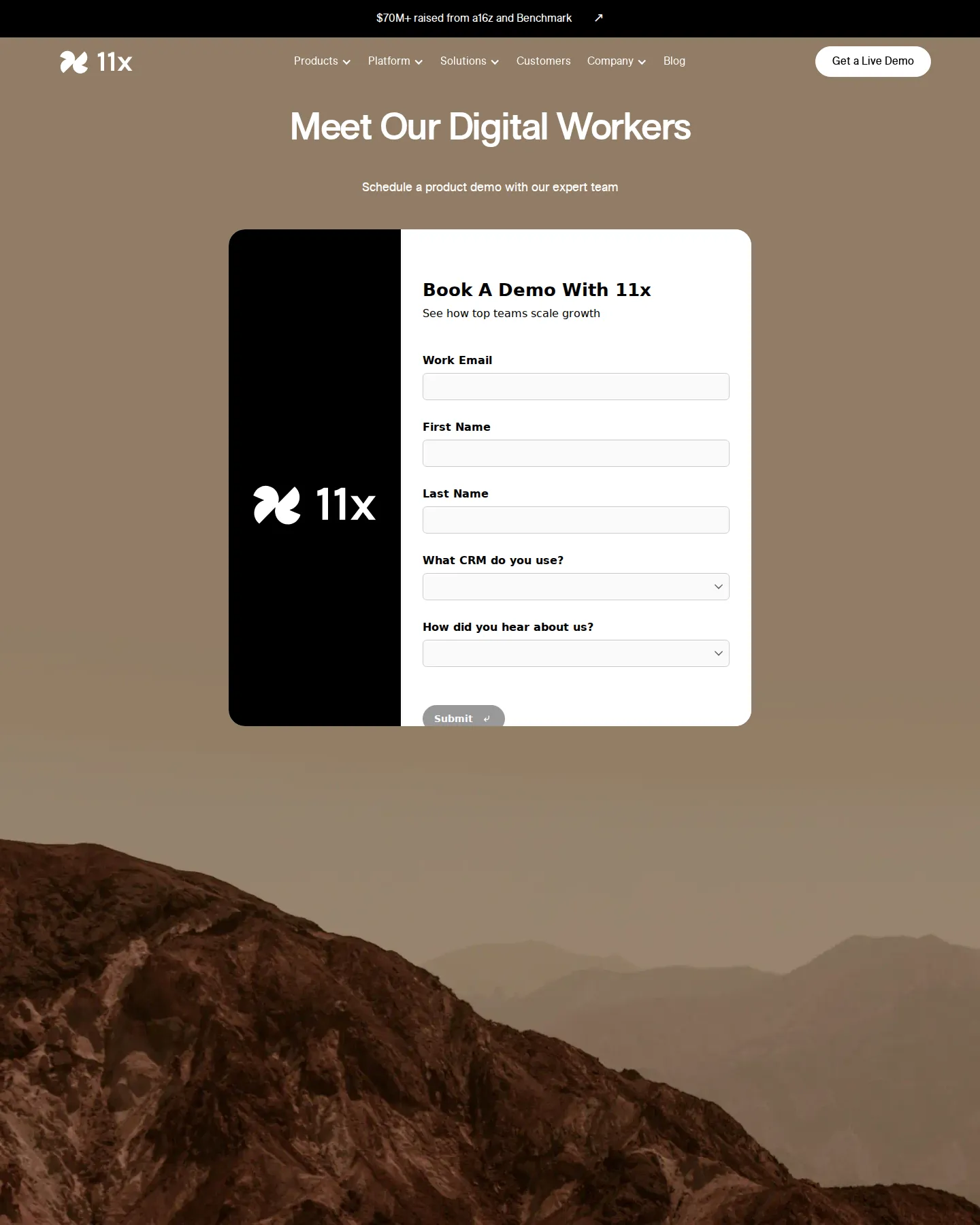
On pricing, 11x is deliberately opaque. It publishes no price table — the former 11x.ai/pricing URL now returns a 404, and every call-to-action across the site (“Hire Alice”, “Hire Julian”, “Get a Live Demo”) routes to a single Book-a-Demo lead-capture form. As a result, the concrete cost of Alice, Julian, or the platform is not public; this page records the packaging and positioning that are public and marks all dollar figures as unknown.
Pricing summary : why 11x is fully sales-led with no public price
11x runs a sales-only, gated pricing motion. There is no published price, no self-serve checkout, and no free tier — the only path to a number is the Book-a-Demo form. Its packaging is organized around named digital workers rather than per-seat licenses or metered API usage:
- Alice (AI SDR): outbound prospecting and meeting-booking — priced by quote, not published.
- Julian (AI inbound sales agent): inbound speed-to-lead, on-site chat, qualification, routing, nurture, and consented outbound — priced by quote, not published.
- 11x Platform: the bundled offering that runs both workers on one stack with enterprise controls — annual contract negotiated with sales.
The billing unit is not disclosed publicly; the “hire a worker” framing implies a per-worker (seat-like) annual platform fee, but 11x does not confirm the metering. This page treats 11x as a sales-led pricing company and an example of agent pricing where the value metric is a booked meeting, not a token.
What makes this different: 11x sells outcomes-framed “digital workers” with human names while keeping the actual price entirely behind a demo gate — the opposite of the transparent, self-serve token tables common elsewhere in the AI tooling market.
Pricing by product
11x publishes no prices for any product line. The tables below record what is publicly visible — the product, who it is for, and the documented capabilities — with price marked Contact sales because no figure is disclosed.
11x digital workers
| Worker / SKU | Price | Included | Key mechanics |
|---|---|---|---|
| Alice — AI SDR | Contact sales | Autonomous outbound across email, phone, social & SMS; ICP targeting over 50+ data sources; 105+ languages; deliverability engine | Sales-led, quoted via Book-a-Demo |
| Julian — AI Inbound Sales Agent | Contact sales | 60-second inbound callback + on-site AI chatbot; phone, chat, SMS, WhatsApp; real-time ICP scoring; lead nurture & consented outbound; smart routing (built-in or ChiliPiper) | Sales-led, quoted via Book-a-Demo |
| 11x Platform | Contact sales | Bundles Alice + Julian on the Identify · Research · Personalize · Engage stack; SOC-2; Salesforce / HubSpot sync | Annual platform contract, sales-led |
Sales motions across products: none are PLG or self-serve; all of Alice, Julian, and the 11x Platform are sales-led and quoted only through Book-a-Demo.
Hidden costs : what a gated AI-SDR contract can hide
Because 11x publishes no rate card, a real bill cannot be reconstructed from public information — the headline price itself is unknown. The structural cost drivers that buyers should probe during the demo are, however, visible from the product surfaces:
Outbound team adopting Alice (illustrative drivers — no public rates)
| Line item | Monthly cost |
|---|---|
| Alice platform / worker fee | Unknown (quoted) |
| Email-deliverability & mailbox infrastructure | Unknown (bundled vs add-on not disclosed) |
| Data / enrichment across 50+ sources | Unknown (included vs metered not disclosed) |
| Annual commitment vs monthly | Unknown (contract terms quoted) |
| Total | Unknown — quoted via sales |
The lesson is the cost-discovery process itself: with no published price, buyers must surface seat/worker count, data and deliverability inclusions, and annual-commit terms directly in the sales conversation, and benchmark them against transparent alternatives.
Want to estimate your own AI-SDR bill? Until 11x publishes rates, model comparable agent economics with the 11x pricing calculator, and read our guidance on usage-based pricing fundamentals and outcome-based AI pricing.
Pricing evolution : gated from day one, then a public ARR controversy
11x has been gated for its entire public history — there is no observed pricing page to trace. What did move was the company’s credibility: a $50M raise, then a high-profile reporting episode about inflated customer claims, then a founder-CEO exit. None of these were price changes, but together they are the most material pricing-adjacent events in 11x’s story, because they go to whether the headline revenue behind the gated model was ever real.
Cadence
| Quarter | Price changes | Product / SKU additions | Notes |
|---|---|---|---|
| 2024 Q2 | 0 (none public) | 0 | Earliest legible archive (2024-05-30): Alice + “Hire” CTAs, no pricing link, no /pricing, no dollar figures |
| 2024 Q4 | 0 (none public) | 0 | 2024-11 — $50M Series B led by a16z (~$350M valuation), following a $24M Benchmark-led Series A; no price published |
| 2025 Q1 | 0 (none public) | 0 | 2025-03-24 — TechCrunch reports 11x displayed logos of non-customers and counted break-clause contracts as ARR |
| 2025 Q2 | 0 (none public) | 0 | 2025-05-05 — founder-CEO Hasan Sukkar steps down (TechCrunch, Bloomberg); CTO Prabhav Jain becomes CEO |
| 2026 Q2 | 0 (none public) | 0 | 2026-06-05 — captured as fully sales-only; homepage has no pricing link, /pricing 404s, all CTAs route to Book-a-Demo |
Tracked range: 2024-05 to 2026-06-05. No public price has been observed in any archive; 11x has been sales-only/gated throughout.
Notable changes
- 2024-05 — Earliest archived homepage names Alice with “Hire” CTAs but shows no pricing link and no
/pricingpath; pricing was gated from the start. - 2024-11 — $50M Series B led by a16z (after a $24M Benchmark-led Series A); reported ~$350M valuation and a claim of approaching $10M ARR.
- 2025-03-24 — TechCrunch reported that 11x was claiming customers it did not have and inflating ARR — a trust event (detailed below).
- 2025-05-05 — Founder-CEO Hasan Sukkar stepped down; CTO Prabhav Jain took over as CEO.
The customer-logos and ARR controversy in detail
On 2025-03-24, TechCrunch reported that 11x — backed by a16z and Benchmark — was displaying logos of companies that said they were not customers. ZoomInfo, which ran a one-month trial, said “we did not give them permission to use our logo” and had its lawyer threaten action over deceptive trade practices and trademark infringement; Airtable said its logo was never authorized and the product “was never used in production.” Confirmed customers Pleo and Rho did use the product.
The reporting also questioned the revenue behind the gated model. 11x sold one-year contracts with a roughly 90-day break clause that functioned as a trial, but, per an employee, counted full annual contract value as ARR even after customers exercised that break clause — so a stated ~$14M ARR may have reflected only ~$3M of contracts that cleared the trial. The same employee estimated 11x was “losing 70–80% of customers that came through the door”; 11x countered that retention was “currently 79%” and said it uses “contracted ARR” investors understood, attributing the logo issues to “human error.” Roughly six weeks later, founder Hasan Sukkar stepped down as CEO (Bloomberg), moving to non-executive chairman. For a gated, sales-only vendor whose entire value proposition is “hire a worker that books real meetings,” this episode is the central buyer-trust risk — it is about whether the outcomes behind the quote are what they appear.
What’s unique : hiring named AI workers behind a demo gate
1. Pricing is sold as a hire, not a license. 11x personifies its products as Alice and Julian and uses “Hire” CTAs, framing the purchase as adding a worker to the team rather than buying seats or API credits — a packaging choice that pairs naturally with a value metric of booked meetings.
2. Zero public price, by design. The former /pricing page is gone (404), and every path funnels to a Book-a-Demo form that asks for CRM and attribution before any number is shared. The opacity is a deliberate sales-led posture, not an oversight.
3. Two-worker, full-funnel bundle. Alice covers outbound and Julian covers inbound, both on one platform — letting 11x sell pipeline coverage end-to-end rather than a single point tool.
Strengths & weaknesses
| Strengths | Weaknesses |
|---|---|
| Clear, memorable packaging (named digital workers) | No public price — high friction for early-stage buyers |
| Full-funnel coverage (Alice outbound + Julian inbound) | No free tier or self-serve trial advertised |
| Enterprise signals: SOC-2, CRM sync, 105+ languages | Billing unit undisclosed; bill cannot be modeled publicly |
| Deep funding ($70M+ from a16z and Benchmark) backs the platform | 2025 TechCrunch reporting on disputed customer logos and break-clause-inflated ARR dented trust in its outcome claims |
| Outcome framing (booked meetings) anchors a clear value story | Demo-gate filters out buyers who want transparent pricing |
Billing UX : a single demo gate instead of a checkout
- Book-a-Demo form (
11x.ai/book-demo) — the sole commercial entry point; collects Work Email, First/Last Name, “What CRM do you use?”, and “How did you hear about us?” before sales engages. There is no online checkout. - “Hire Alice” / “Hire Julian” CTAs — product-page buttons that, despite the “Hire” label, route to the same demo form rather than a purchase flow.
- “Get a Live Demo” / “Call Me” CTAs — persistent header and in-page buttons; “Call Me” lets prospects trigger a live Julian voice call as a product trial, not a billing action.
- No public billing dashboard, plan selector, or usage meter — none is exposed pre-sale; account and contract management presumably live behind a sales-provisioned login that is not publicly documented.
Strategic wins : where the gated, worker-framed model pays off
1. “Hire a worker” framing anchors value to outcomes
By naming Alice and Julian and using “Hire” CTAs, 11x reframes the buy from software-licensing to workforce-augmentation, which supports outcome-anchored conversations (meetings booked, speed-to-lead) rather than seat math. This aligns with the broader shift toward outcome-based AI pricing and the autonomous AI workforce narrative the blueprint tracks.
2. Full-funnel bundle expands deal size
Selling outbound (Alice) and inbound (Julian) on one platform lets 11x pursue larger, consolidated contracts and position as the “execution layer” for revenue teams, rather than competing as a single point solution.
3. The demo gate concentrates high-intent pipeline
Funneling every CTA into one Book-a-Demo form filters out tire-kickers and routes only sales-qualified prospects to the team, which can lift conversion and average contract value — a defensible trade for a high-ACV sales-led product, even as it sacrifices self-serve reach. See the broader pricing blueprint for how peers balance this.
Areas to improve : the cost of total price opacity
1. No public price raises buyer friction
A fully gated model excludes self-directed buyers who screen vendors before booking a call. Publishing even an indicative “starting at” figure or a transparent pricing range — as some peers in the pricing blueprint do — would widen the top of the funnel without surrendering negotiating leverage, and would counter the perception of opacity that the outcome-based AI pricing shift is steadily eroding elsewhere.
2. Undisclosed billing unit blocks budgeting
Because 11x reveals neither the metering (per worker, per meeting, per seat) nor any rate, prospects cannot budget before sales contact. A published value-metric definition — see our guide to choosing the right usage metric — would build trust and shorten evaluation cycles, and would let buyers price-check against the value-metric problem in AI pricing that every agent vendor now faces.
3. Outcome claims need verifiable, contracted proof
The 2025 TechCrunch reporting on displayed-but-disputed customer logos and break-clause-inflated ARR is a direct cost of pairing a gated price with outcome marketing: when buyers cannot see the price or independently verify the outcomes, every published metric carries reputational risk. Distinguishing trial revenue from committed revenue — and tying the eventual quote to a contracted, auditable outcome (meetings accepted, opportunities created) rather than a logo wall — would rebuild the trust a fully gated motion depends on. Our note on pricing AI products with unpredictable costs covers why credible outcome accounting matters more for agents than for seat-based SaaS.
4. No free trial path limits product-led validation
Every “Hire” and “Get a Live Demo” CTA routes to a lead form, so prospects cannot self-validate Alice or Julian before talking to sales. Adding a constrained free trial or a transparent “starting at” tier would let high-intent buyers prove value first, complementing the demo gate rather than replacing it. See our guide to usage-based pricing fundamentals for how a low-friction entry tier can coexist with sales-led expansion.
Monetization stack & signals : how 11x builds & buys its revenue engine
Buys 2 Builds 0 3 open roles
Buys its CRM layer — Salesforce and HubSpot, the product's own sync targets — and discloses no metering vendor behind its gated annual contracts. Its open revenue-org reqs are CSM and growth, not monetization-platform builds.
-
“11x Alice and 11x Julian connect directly with both platforms and keep your CRM updated automatically without manual data entry.”
-
“11x Alice and 11x Julian connect directly with both platforms and keep your CRM updated automatically without manual data entry.”
- Metering Metering inferred
- Senior Customer Success Manager Customer success Jun 19, 2026
- Growth Lead Growth Jun 19, 2026
- Growth Engineer Growth Jun 19, 2026
Signals reviewed · derived from public job posts, engineering blogs
Job postings fill and close over time — once a posting is filled we keep it as a dated citation (the quoted evidence remains); use View open roles for current listings.
Key takeaways
- Personification can replace the price grid as the packaging hook. 11x leads with named workers (Alice, Julian) instead of a tier table, showing that strong product framing can carry the buying narrative even when no price is shown.
- A retired pricing page is a strategic signal. Moving from a public
/pricingpage to a 404 and a demo gate is a deliberate move up-market — worth noting for teams weighing transparency against deal control. - Gating filters the funnel. Routing every CTA to one lead form trades top-of-funnel volume for higher-intent, sales-qualified conversations.
- Outcome framing needs an outcome metric. “Hire a worker” framing works best when paired with a value metric (meetings, qualified opportunities) — which 11x emphasizes in its impact stats even while hiding price.
- Bundling inbound + outbound raises ACV. Two complementary workers on one platform support larger consolidated contracts than a single point tool.
UBP implications
- Agentic products can dodge per-token transparency. 11x prices the agent’s output (a booked meeting) conceptually, not its token consumption — a sign that agent vendors may anchor on business outcomes rather than usage meters.
- Sales-only motions persist in high-ACV AI. Even amid a transparent-pricing trend, complex, high-value AI agents still default to gated quotes, suggesting usage-based transparency is not yet table stakes at the enterprise agent tier.
- Value-metric disclosure is the next frontier. The biggest gap is not the dollar amount but the undisclosed unit; vendors that publish their value metric (per worker, per meeting) may win trust faster than those that hide it entirely.
Sources
- 11x homepage (accessed 2026-07-23)
- 11x Alice — AI SDR product page (accessed 2026-07-23)
- 11x Julian — AI Inbound Sales Agent product page (accessed 2026-07-23)
- 11x Book-a-Demo form (accessed 2026-07-23)
Note: 11x publishes no public pricing page; every CTA across the homepage, Alice, and Julian pages routes to the Book-a-Demo lead form (re-verified 2026-07-23).
Bottom line
11x sells autonomous AI “digital workers” — Alice for outbound and Julian for inbound — behind a deliberately gated, sales-only motion: there is no public price, no free tier, and the /pricing path 404s, leaving Book-a-Demo as the only way to a number. The packaging is memorable and the funding is deep ($70M+ from a16z and Benchmark), but two things should give buyers pause: the total price opacity makes 11x impossible to budget for without contacting sales, and the 2025 TechCrunch reporting on disputed customer logos and break-clause-inflated ARR means the outcome claims behind the quote deserve independent verification.
Want to compare 11x against other AI-agent and AI-SDR pricing? Browse the pricing blueprint.
Pricing timeline : Major events on a vertical axis
Each milestone below corresponds to a public pricing change, product launch, or material adjustment. Major events use a filled marker; minor adjustments use a faded one.
Re-captured — still gated; Julian repositioned as 'AI Inbound Sales Agent'
2026-07-23 re-capture: 11x remains fully sales-only with no public price — every CTA still routes to Book-a-Demo. Julian's product page now brands it an 'AI Inbound Sales Agent' (was 'AI Phone Agent'), adding an on-site AI chatbot, lead nurture, consented outbound, and customer-onboarding flows alongside the 60-second callback. No pricing disclosed; all figures remain 'Contact sales'.

Captured as sales-only / gated
11x exposes no public pricing. The homepage has no pricing link and the /pricing path returns 404; the homepage, Alice, and Julian pages carry only Book-a-Demo / Hire CTAs, and book-demo is a lead-capture form. Concrete prices recorded as unknown.
Founder-CEO Hasan Sukkar steps down
TechCrunch and Bloomberg reported founder Hasan Sukkar stepped down as CEO (moving to non-executive chairman); CTO Prabhav Jain became CEO. Leadership change followed the March transparency reporting. Pricing remained gated.
TechCrunch reports inflated-customer / ARR controversy
TechCrunch (2025-03-24) reported 11x displayed logos of companies that said they were not customers (ZoomInfo and Airtable denied being customers; ZoomInfo threatened legal action) and counted break-clause contracts as full ARR. An employee cited 70–80% churn of inbound customers; 11x said retention was 79%. A trust event, not a price change.
$50M Series B led by a16z (~$350M valuation)
11x announced a $50M Series B led by Andreessen Horowitz, following a $24M Benchmark-led Series A. Reported post-money valuation ~$350M; the company claimed it was approaching $10M ARR. No pricing was published alongside the raise.
No public price in the earliest archive
The earliest legible Wayback snapshot of the 11x homepage (2024-05-30) names Alice and uses 'Hire' CTAs but carries no pricing link, no /pricing path, and no dollar figures. No public price has ever been observed in the archive; pricing was gated from the start. Prices recorded as unknown.
- · 11x publishes no price anywhere — its homepage has no pricing link and the /pricing path 404s, so every quote runs through a Book-a-Demo form that asks which CRM you use before it talks numbers.
- · 11x sells 'digital workers' as named personas — Alice the outbound AI SDR and Julian the inbound AI phone agent — rather than as seats or API credits, framing the buy as hiring a worker, not licensing software.
- · 11x raised a $24M Series A led by Benchmark and a $50M Series B led by a16z (Nov 2024, ~$350M valuation), and advertises '$70M+ raised' in its own site banner.
Questions & answers
- How much does 11x cost?
- 11x does not publish pricing. The company runs a sales-only motion: there is no public price page (the former /pricing URL now 404s), and quotes are provided through the Book-a-Demo form after a sales conversation.
- Is there a free trial or free tier for 11x?
- No free tier or self-serve sign-up is advertised. Every entry point — Hire Alice, Hire Julian, Get a Live Demo — routes to the Book-a-Demo lead form rather than a checkout.
- What does 11x sell — Alice and Julian?
- 11x sells two AI 'digital workers': Alice, an outbound AI SDR that researches prospects and books meetings across email, phone, social, and SMS; and Julian, an inbound AI phone agent that calls back leads within 60 seconds and qualifies them against your ICP.
- How is 11x billed — per seat or per usage?
- 11x has not disclosed its billing unit publicly. The packaging is presented as hiring a digital worker (Alice or Julian), typically via an annual platform contract negotiated with sales; exact metering is not published. Reporting indicates contracts are annual with a roughly 90-day break clause.
- What was the 11x ARR / customer-logos controversy?
- In March 2025 TechCrunch reported 11x displayed customer logos for companies that said they were not customers (ZoomInfo and Airtable both denied being customers, and ZoomInfo threatened legal action), and that 11x counted full annual contract value as ARR even for customers who had exercised a 90-day break clause. 11x said it uses 'contracted ARR' and removes unauthorized mentions promptly.
- Who is the CEO of 11x?
- Founder Hasan Sukkar stepped down as CEO in May 2025 (reported by TechCrunch and Bloomberg) and moved to non-executive chairman; CTO Prabhav Jain took over as CEO.