AI Summary
About
Agility Robotics is a humanoid-robotics company founded in 2015 and headquartered in Salem, Oregon, led by CEO Peggy Johnson (formerly of Microsoft and Magic Leap). Its flagship product is Digit — a roughly 5’9” bipedal humanoid robot built for warehouse and factory work (moving totes, tending conveyors, repetitive material handling) — paired with Agility Arc, a cloud platform for orchestrating and managing fleets of Digits. Agility positions Digit as “the first humanoid robot in production deployment,” and its customer logos include Amazon, Toyota, GXO, Schaeffler, and Mercado Libre.
The company is well capitalized: it closed a $400M Series C in March 2025 at a reported ~$2.12B valuation, bringing total funding to roughly $641M, with backers including Amazon’s Industrial Innovation Fund, NVIDIA’s NVentures, Sony Innovation Fund, DCVC, and Playground Global. In June 2026 Agility announced it will go public through a merger with Churchill Capital Corp XI (a SPAC), filing a confidential Form S-4 draft registration statement in July 2026. To supply the robots, Agility built RoboFab in Salem — pitched as the first factory designed to mass-produce humanoids, using a modular “ARMS” assembly system — and in July 2026 opened a new Fremont, California facility to accelerate physical-AI development.
Crucially for a pricing blueprint: Agility Robotics publishes no pricing of any kind. The site (agilityrobotics.com) exposes Industries, Solutions, Company, Investors, Careers, and Resources, with a single commercial call-to-action — “Deploy Digit” — that routes into a multi-phase sales process (on-site assessment, a validation pilot, then an operational partnership). There is no plan grid, no per-hour rate card, and no self-serve checkout; agilityrobotics.com/pricing returns a 404. What is publicly known is the shape of the model — Digit is sold primarily as Robots-as-a-Service (RaaS), a managed per-hour subscription, with a direct-purchase alternative — but not the numbers. So this page documents what is honestly known: the company, its funding, its RaaS posture, and the GXO milestone, rather than inventing rates Agility has never published.
Pricing summary : a sales-led RaaS model with no published rate
Agility runs a sales-led, no-public-price commercial model. There is no published per-hour rate, no subscription tier to evaluate, and no self-serve sign-up. The dimensions, such as they can be observed, are:
- Digit RaaS (the primary model) — a fully-managed Robots-as-a-Service subscription: the customer pays for managed robot operating time (robot-hours) while Agility supplies the robot, the Agility Arc cloud platform, software, support, and uptime. No floor price, per-hour rate, or packaging is disclosed; the commercial path is “Deploy Digit.”
- Digit direct purchase — for operators that want to own the fleet, Agility also offers outright purchase plus software/service fees. Again, no unit price is published (third-party write-ups estimate ~150K USD/unit, but that is not an Agility figure).
- The “$30/hour” caveat — the most-cited number in any Digit pricing discussion is not Digit’s price. CEO Peggy Johnson framed it as the fully-loaded cost of a human worker that Digit’s RaaS targets for an “under 2-year ROI.” It is a value benchmark, routinely misquoted as a rate card.
What makes this different: unlike a software lab, Agility is selling physical labor by the hour. The RaaS model is genuinely usage-shaped — the natural meter is robot-hours of managed operation — which makes it one of the cleanest pure-usage stories in the embodied-AI corpus in concept. But because the product is bespoke industrial hardware, Agility keeps the actual rate entirely behind a sales conversation, exactly like sales-only peers such as Figure and Apptronik.
Pricing by product
| Surface | Price | Included | Key mechanics |
|---|---|---|---|
| Digit RaaS | Deploy Digit (no public rate) | Managed Digit fleet + Agility Arc cloud + software + support + uptime | Sales-led; usage-shaped per-hour subscription (robot-hours); bespoke quote per deployment |
| Digit direct purchase | Talk to sales (no public price) | Outright robot ownership + software / service fees + integration | Sales-led; quoted per unit; third-party estimate ~150K USD/unit (not Agility-published) |
| Agility Arc (cloud platform) | Bundled (not separately priced publicly) | Fleet orchestration, monitoring, management for Digit | Sold as part of a RaaS or purchase engagement; no standalone price disclosed |
Sales motions across products: fully sales-led for every surface. The “Deploy Digit” funnel runs a multi-phase onboarding (assessment → validation pilot → operational partnership) before any commercial terms are set. There is no self-serve motion and no public floor price anywhere.
Hidden costs : What Agility Robotics customers actually pay
Because Agility publishes no price, a prospective buyer cannot estimate cost without a sales engagement — and the “real bill” hides several components beyond a headline per-hour or per-unit number.
On the RaaS path, the subscription bundles the robot, Agility Arc, software, and support into managed operating time — but the effective per-hour cost depends heavily on fleet utilization. Digit runs on a charge-rotation ratio (roughly two robots working while one charges today), so the number of robots you must subscribe to in order to keep one continuously productive — and Agility’s target of pushing that ratio toward 4:1 and 10:1 — materially changes the math. There is also the multi-phase onboarding (assessment + a validation pilot) before steady-state pricing applies.
On the purchase path, the ~150K USD/unit figure that circulates in trade press is a third-party estimate, not an Agility quote, and it explicitly excludes the recurring software/service fees and Agility Arc subscription needed to actually operate the fleet.
| Line item | Cost |
|---|---|
| Digit RaaS subscription | Not disclosed — quoted per deployment (robot-hours of managed operation) |
| Validation pilot / onboarding | Not disclosed — multi-phase, precedes steady-state terms |
| Fleet sizing (charge-rotation overhead) | Implicit — utilization ratio drives effective per-productive-hour cost |
| Direct purchase (if chosen) | Not disclosed — third-party estimate ~150K USD/unit (not Agility-published) |
| Agility Arc + software / support | Bundled into RaaS; add-on fees on the purchase path |
| Estimated total | Unquantifiable from public data — depends entirely on the sales quote and fleet size |
Want to think through what a managed humanoid-labor deployment might cost against the human-labor it replaces? There’s no published rate to plug in, but you can sketch scenarios with the Agility Robotics pricing calculator, and see how outcome- and labor-replacing pricing is structured — Agility itself publishes no rate of its own.
Pricing evolution : Agility Robotics pricing history and changes
Agility has never had a public price to change. Its “pricing evolution” is really a commercial-model evolution: from a research/hardware company to the first vendor to put humanoids to work under a Robots-as-a-Service contract — all while keeping the actual rate behind “Deploy Digit.” The milestones below are reconstructed from primary announcements and live site checks through 2026-07-23.
Cadence
| Quarter | Price changes | Product / SKU additions | Notes |
|---|---|---|---|
| 2024 Q2 | 0 | 1 (RaaS commercialized) | GXO signs the first humanoid RaaS deal (Digit at Spanx); no rate disclosed |
| 2024 Q3 | 0 | 0 | CEO frames RaaS ROI vs a $30/hr human benchmark — a value claim, not a price |
| 2025 Q1 | 0 | 0 | $400M Series C at ~$2.12B valuation; funds RoboFab + Digit/Arc; still sales-led |
| 2026 Q2 | 0 | 0 | Live check: still no public pricing; site is Industries/Solutions/… + “Deploy Digit” |
| 2026 Q3 | 0 | 0 | Live check 2026-07-23: still no public pricing; Agility announces SPAC merger (Churchill Capital Corp XI) to go public + opens Fremont facility — corporate, not a pricing move |
Tracked range: 2024 Q2–2026 Q3. Zero public price changes across the company’s commercial life — there has never been a published RaaS rate or unit price to revise. Quarters not listed had no relevant public pricing event.
Notable changes
- 2024-06 — GXO Logistics signs what both call the industry’s first formal commercial humanoid deployment and first humanoid RaaS deal — Digit at a Spanx facility, multi-year, managed via Agility Arc. No terms disclosed (Agility / GXO release).
- 2024-07 — CEO Peggy Johnson frames Digit’s RaaS value as “an under 2-year ROI vs a human at a fully loaded $30 an hour” — a benchmark, not a Digit rate (The Robot Report).
- 2025-03 — $400M Series C at a reported ~$2.12B valuation (Amazon, NVIDIA’s NVentures, Sony, DCVC, Playground Global); total raised ≈ $641M (Sacra).
- 2026-06-14 — Live check confirms no public pricing:
agilityrobotics.com/pricing404s; the only commercial CTA is “Deploy Digit” (sales-led RaaS). - 2026-06-24 — Agility announces it will go public through a merger with Churchill Capital Corp XI (a SPAC); a confidential Form S-4 draft registration statement follows on 2026-07-14. Corporate/capital-structure news — the commercial model and (absent) pricing are unchanged.
- 2026-07-23 — Live re-check confirms still no public pricing:
agilityrobotics.com/pricingremains a 404 and Digit is still sold via the sales-led “Deploy Digit” RaaS motion; Agility separately opened a new Fremont, CA facility (2026-07-17).
What’s unique : Agility Robotics’s distinctive pricing mechanics
1. Selling physical labor by the hour — without publishing the hour’s price. Agility pioneered humanoid Robots-as-a-Service: instead of selling a robot, it rents managed operating time, with the robot, the Agility Arc cloud, software, and support bundled into the subscription. The natural value metric — robot-hours of productive work — is unusually clean and directly comparable to a human wage. Yet Agility never publishes the rate, so the cleanest usage meter in embodied AI lives entirely inside a quote.
2. The benchmark is the pitch (and the trap). The most-cited “price” — “$30/hour” — is not Digit’s rate at all; it’s the human-labor cost Agility positions Digit’s RaaS to beat with an “under 2-year ROI.” Pricing the robot implicitly against the loaded cost of the worker it replaces is a textbook value-metric move, but the constant misquoting of $30/hr as Digit’s price shows the cost of leaving the real number unpublished. (For how to anchor a price on the value delivered rather than the unit, see choosing the right usage metric.)
3. Utilization, not just rate, sets the economics. Because a Digit must rotate off-shift to charge (~2:1 working-to-charging today, targeting 4:1 then 10:1), the effective cost per productive hour depends on fleet sizing as much as on any headline per-hour figure. Agility’s roadmap of improving the charge ratio is, in effect, a roadmap of bringing the RaaS price down — a usage-economics lever most software vendors never have to think about.
Strengths & weaknesses
| Strengths | Weaknesses |
|---|---|
| RaaS converts a capital purchase into managed operating cost — low upfront barrier, aligns spend with productive robot-hours | Zero public pricing — no per-hour rate, no unit price, no calculator — so buyers can’t evaluate cost without a sales engagement |
| The value metric (robot-hours vs. a human wage) is intuitive and directly ROI-comparable for operators | The famous “$30/hr” is a human-cost benchmark, not Digit’s price — and the misquoting confuses the whole market |
| First-mover credibility: GXO signed the industry’s first humanoid RaaS deal, with Amazon/Toyota/NVIDIA validation | Effective cost depends on fleet utilization (charge-rotation overhead), which a single headline rate would hide |
| Vertically integrated RoboFab supply + ~$641M raised gives pricing-and-scale runway most humanoid peers lack | High evaluation friction — multi-phase pilot before any terms; no self-qualification for mid-market operators |
| Sales-led quoting lets each industrial deployment be scoped to the workflow, not boxed into rigid tiers | No transparency makes it impossible to benchmark against priced labor or peers like Figure or Apptronik |
Billing UX : Agility Robotics billing controls and transparency
- Billing controls — None are public. There is no self-serve dashboard, no published usage meter, and no plan-management UI on the site; commercial terms are handled entirely through a sales relationship and, presumably, the Agility Arc platform for operational fleet management.
- Usage visibility — The RaaS meter is conceptually robot-hours of managed operation, surfaced (for customers) through Agility Arc’s fleet monitoring rather than any public billing console. Spend visibility lives inside the contract, not on the website.
- Payment options — Not disclosed. RaaS subscriptions and direct purchases are invoiced under custom enterprise contracts negotiated via “Deploy Digit”; no card checkout or public billing portal exists.
- Transparency — Low on the commercial side (no rate, no floor, no SKU) but reasonably open about the model — Agility readily describes the RaaS structure, the GXO milestone, and the ROI thesis; it simply never attaches a number.
Strategic wins : Why Agility Robotics’s pricing decisions worked
1. RaaS removed the capital barrier to humanoids
By renting Digit as a managed service rather than selling a six-figure asset, Agility let operators trial humanoid labor as an operating expense tied to productive robot-hours — the same shift from licenses to consumption that other companies are making across software. The GXO/Spanx deal proved a Fortune-500 logistics operator would sign a multi-year humanoid RaaS contract, which is the harder thing to prove than any single price point.
2. Pricing against the worker, not the widget
Anchoring Digit’s value on the fully-loaded cost of a human worker (and an “under 2-year ROI”) reframes the buying decision from “is a robot worth $X” to “is this cheaper than the labor it replaces.” That outcome-shaped framing — value, not unit — mirrors the broader outcome-based pricing trend and is exactly the kind of pitch that resists a published rate card.
3. Vertical integration protects the pricing runway
RoboFab and the ~$641M war chest mean Agility controls its own robot supply and can absorb the falling per-hour operating cost (as the charge ratio improves) into either margin or a more competitive RaaS price. Owning the cost curve is what makes a future public rate even plausible. See usage-based pricing strategy for when metering the outcome beats metering the unit.
Areas to improve : Gaps in Agility Robotics’s pricing approach
1. Publish a RaaS anchor
A fully dark price page (a literal 404) maximizes evaluation friction and lets the misquoted “$30/hr” stand in for an official rate. Even a “starts at $X/robot-hour” anchor, or a clear statement of how RaaS is metered (per robot-hour? per shift? per managed robot per month?), would let operators self-qualify instead of needing a pilot to learn the shape of the bill. The total opacity invites the cost-unpredictability anxiety that slows industrial buyers. And the stakes are rising: the June-24-2026 SPAC merger with Churchill Capital Corp XI (confidential Form S-4 filed 2026-07-14) puts Agility on a path to the public markets, whose disclosure obligations make RaaS unit economics far harder to keep entirely behind a quote — Agility would do better to shape that anchor on its own terms before a filing does it for them.
2. Correct the “$30/hour” record
Because the human-cost benchmark is so widely repeated as Digit’s price, Agility could win clarity (and trust) simply by stating plainly what the RaaS includes and roughly what it costs relative to that benchmark — turning a confusing soundbite into a transparent value story.
3. Make the utilization math visible
Effective cost per productive hour hinges on the charge-rotation ratio and fleet sizing. Surfacing even a simple “robots needed for continuous coverage” guide (as the ratio improves toward 4:1 and 10:1) would help operators model real ROI rather than discovering the overhead only during a pilot. Compare how other AI companies stage enterprise transparency.
Monetization stack & signals : how Agility Robotics builds & buys its revenue engine
Buys 1 Builds 0 1 signal role
A sales-led RaaS vendor that buys light: NetSuite carries rev-rec, with no broader quote-to-cash spine. The pre-sales solutions-engineer tell-role below shows why — every deal is hand-scoped through PoCs, not sold off a rate card.
-
“Software Preference: NetSuite experience is preferred.”
-
The pre-sales hire's JD — 'scope complex deployments,' run 'proofs-of-concept… to accelerate deal closure,' then own 'onboarding and scaling' — is the revenue engine: every RaaS deal is hand-scoped per workflow, not sold off a rate card.
Signals reviewed · derived from public job posts
Job postings fill and close over time — once a posting is filled we keep it as a dated citation (the quoted evidence remains); use View open roles for current listings.
Key takeaways
- No public price is itself a pricing decision. Agility publishes zero commercial pricing and routes everything through “Deploy Digit” — a deliberate, sales-led posture. For bespoke industrial hardware deployed per workflow, opacity protects margin and lets each deal be scoped to value.
- RaaS is the real model — and it’s genuinely usage-shaped. Digit is rented by managed operating time (robot-hours), bundling robot + Agility Arc + software + support. The meter is intuitive; only the rate is hidden.
- “$30/hour” is not Digit’s price. It’s the human-labor benchmark Agility prices its ROI against — a value claim, persistently misquoted as a rate card. Treat any “$30/hr Digit” headline with skepticism.
- Utilization sets the economics as much as the rate. Charge-rotation overhead (≈2:1 today, targeting 4:1/10:1) means effective cost per productive hour depends on fleet sizing, not just a headline figure.
- Vertical integration + capital buy pricing optionality. RoboFab and a ~$641M raise let Agility own its cost curve, which is what would make a future transparent RaaS rate even possible.
UBP implications
- Robots-as-a-Service is usage-based pricing for physical labor. Agility shows that the consumption meter doesn’t have to be tokens or API calls — it can be robot-hours of managed work. The closer the meter sits to the value (productive operating time vs. a human wage), the more naturally the price defends itself, even when the rate stays private.
- A value benchmark is not a price — and the gap can hurt you. Pricing against the cost of the human worker replaced is a strong UBP framing, but leaving the actual rate unpublished let the benchmark (“$30/hr”) harden into a phantom price card. UBP designers should separate the ROI story from the meter, and publish enough of the meter to control the narrative.
- Utilization is a hidden term in any per-hour meter. When the unit being metered has duty-cycle overhead (charging, downtime), the headline per-hour rate understates true cost. UBP practitioners metering physical or compute resources should make the effective-utilization math explicit, because the buyer feels it the moment they size for continuous coverage.
Sources
- Agility Robotics — official site (no pricing page; “Deploy Digit” CTA) (accessed 2026-07-23)
- agilityrobotics.com/pricing — returns HTTP 404 (no pricing surface) (accessed 2026-07-23)
- GXO signs industry-first multi-year (first humanoid RaaS) agreement with Agility Robotics (accessed 2026-06-14)
- GXO investor release — first humanoid RaaS deployment (accessed 2026-06-14)
- The Robot Report — “Here’s what it could cost to hire a Digit humanoid” (CEO’s $30/hr benchmark) (accessed 2026-06-14)
- Sacra — Agility Robotics valuation, funding & news ($400M Series C, ~$2.12B) (accessed 2026-06-14)
- Browse the pricing blueprint corpus
Bottom line
Agility Robotics is a sales-only RaaS case in the embodied-AI corpus: a Salem, Oregon humanoid company (CEO Peggy Johnson, ~$641M raised, ~$2.12B valuation) that publishes no price for Digit. It pioneered humanoid Robots-as-a-Service — renting managed robot operating time (robot-hours), bundled with the Agility Arc cloud — and proved the model with GXO’s June-2024 deal, the industry’s first humanoid RaaS contract. But the actual rate sits entirely behind “Deploy Digit”: agilityrobotics.com/pricing is a literal 404, and the famous “$30/hour” is a human-labor benchmark, not Digit’s price. The bet: keep the usage-shaped rate private, sell each industrial deployment to value against the worker it replaces, and let vertical integration (RoboFab) drive the cost curve down. The cost of that bet is maximum buyer friction and a market that keeps misquoting a phantom price. That bet now faces its first real test: the June-2026 SPAC merger with Churchill Capital Corp XI is carrying Agility toward a public listing, and the disclosure obligations of the public markets may finally pull the sales-only rate into the light — whether Agility chooses to publish it or not.
Want to compare Agility against humanoid peers that are also sales-only? See Figure and Apptronik, or browse the full pricing blueprint.
Pricing timeline : Major events on a vertical axis
Each milestone below corresponds to a public pricing change, product launch, or material adjustment. Major events use a filled marker; minor adjustments use a faded one.
Agility to go public via SPAC merger — commercial model unchanged, still no published price
Verified 2026-07-23: agilityrobotics.com/pricing still returns a 404 and Digit remains a sales-led 'Deploy Digit' RaaS with no rate card, no plan grid, and no self-serve (deployment stays a 3-phase Solution Setup → On-Site Validation → Operational Impact motion). The material news is corporate, not commercial: Agility announced (June 24, 2026) it will go public through a merger with Churchill Capital Corp XI (a SPAC), filed a confidential Form S-4 draft registration statement (July 14, 2026), and opened a new Fremont, California facility to accelerate physical-AI development (July 17, 2026). No price or packaging move. (Evidence: 2026-07-23 homepage capture + /pricing 404.)
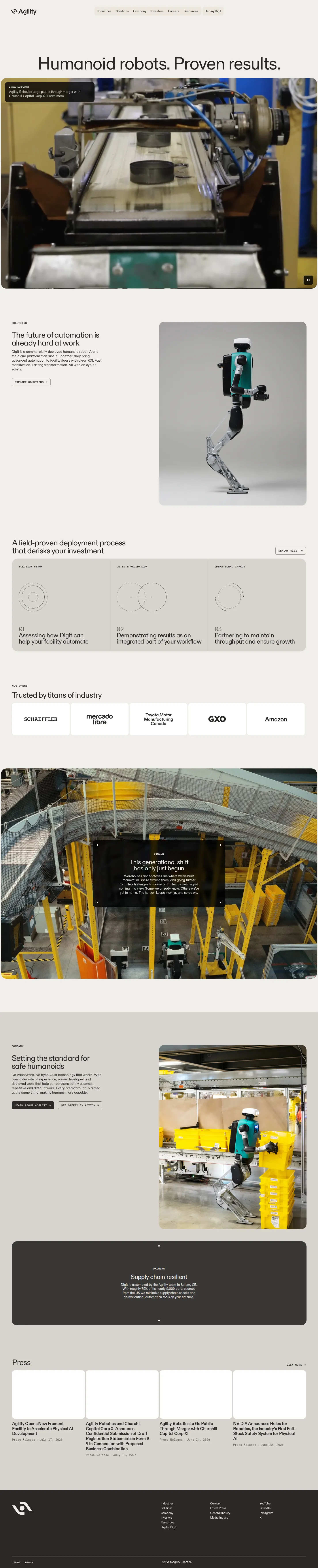
Live check: still no public pricing — sales-only RaaS
Verified 2026-06-14: agilityrobotics.com/pricing returns a 404. The site exposes Industries / Solutions / Company / Careers / Resources and a single 'Deploy Digit' CTA into a multi-phase sales process — no plan grid, no rate card, no self-serve. Digit remains a managed RaaS subscription (or direct purchase) quoted per deployment. price_transparency = sales-only; has_free_tier = false. (Evidence: 2026-06-14-pricing-validated.txt second source.)
$400M Series C at ~$2.12B valuation — still no public price
Agility closes a $400M Series C at a reported ~$2.12B valuation (backers include Amazon's Industrial Innovation Fund, NVIDIA's NVentures, Sony Innovation Fund, DCVC, Playground Global), bringing total raised to roughly $641M. Capital funds RoboFab scale-up and Digit/Arc R&D. The commercial model stays sales-led RaaS with no published rate. (Source: Sacra / press, 2025.)
CEO frames RaaS ROI against a $30/hr human benchmark — not a Digit price
CEO Peggy Johnson describes Digit's RaaS value as 'an under 2-year ROI vs a human at a fully loaded $30 an hour.' This $30/hr is the human-labor cost Agility benchmarks against, not a published Digit rate — though it is frequently misquoted as Digit's per-hour price. Agility still publishes no official RaaS figure. (Source: The Robot Report, 2024-07-17.)
GXO signs the first humanoid Robots-as-a-Service deal — no terms disclosed
GXO Logistics and Agility announce what both call the industry's first formal commercial deployment of humanoid robots and the first humanoid RaaS deal — a multi-year agreement deploying Digit at a Spanx facility (Georgia), following a late-2023 PoC, with the fleet run via Agility Arc. Digit moves totes from cobots onto conveyors. No dollar terms, robot count, or per-hour rate were disclosed; the deal validates the RaaS subscription model without publishing a price. (Source: Agility Robotics / GXO press release, 2024-06-27.)
- · GXO Logistics' June 2024 agreement with Agility was billed as the industry's first formal commercial humanoid deployment AND the first humanoid Robots-as-a-Service deal — Digit went to work moving totes at a Spanx facility, yet neither company disclosed the price or the number of robots.
- · The '$30/hour' everyone quotes for Digit is not Digit's price — CEO Peggy Johnson used it as the fully-loaded cost of a human worker the robot's RaaS aims to beat with an 'under 2-year' payback. Agility has never published an actual RaaS rate.
- · Agility built RoboFab in Salem, Oregon — pitched as the first factory designed to mass-produce humanoid robots — using a modular 'ARMS' assembly system, so its supply of priceless-on-the-website robots is vertically integrated.
Questions & answers
- What is Agility Robotics's pricing model?
- Agility Robotics publishes no public pricing. Digit is sold primarily as Robots-as-a-Service (RaaS) — a fully-managed per-hour subscription bundling the robot, the Agility Arc cloud platform, software and support — with a direct-purchase option for buyers wanting ownership. There is no plan grid or rate card: agilityrobotics.com/pricing returns a 404 and the only commercial path is the 'Deploy Digit' sales funnel, so every deployment is scoped and quoted individually.
- How much does it cost to hire an Agility Digit robot per hour?
- Agility does not publish a per-hour RaaS rate. The widely-repeated '$30/hour' figure is a misquote: CEO Peggy Johnson cited it as the fully-loaded cost of a human worker that Digit's RaaS targets for an 'under 2-year ROI', not as Digit's own price. Third-party analyst estimates (roughly $2,000-$4,000/month per robot, or about $150,000 to buy one outright) circulate, but none are official Agility figures.
- Does Agility Robotics offer a free tier?
- No. There is no free tier, trial robot, or self-serve sign-up. Digit is industrial hardware deployed through a sales-led, multi-phase process (on-site assessment, a validation pilot, then an operational RaaS partnership). Cost is established only through a quote.
- Is Agility Robotics pricing usage-based or subscription?
- Its flagship RaaS model is usage-shaped: customers pay for managed robot operating time (robot-hours) rather than buying the asset, so the meter is closest to consumption/per-hour. Agility also offers an outright purchase plus software/service fees, making the overall posture a hybrid — but neither path has a published price.
- What was the GXO Logistics deal with Agility Robotics?
- In June 2024 GXO Logistics signed what both companies called the industry's first formal commercial deployment of humanoid robots and the first humanoid Robots-as-a-Service deal. It is a multi-year agreement deploying Digit at a Spanx facility (following a late-2023 proof-of-concept), with the fleet managed via Agility Arc. The number of robots and the financial terms were not disclosed.
- How much funding has Agility Robotics raised?
- Agility has raised roughly $641M to date. Its most recent round was a $400M Series C closed in March 2025 at a reported ~$2.12B valuation, with backers including Amazon's Industrial Innovation Fund, NVIDIA's NVentures, Sony Innovation Fund, DCVC and Playground Global. In June 2026 Agility announced plans to go public through a SPAC merger with Churchill Capital Corp XI, filing a confidential Form S-4 in July 2026 — a capital-structure move that has not, as of this writing, changed Digit's sales-led, no-published-rate pricing.