AI Summary
About
AssemblyAI is a San Francisco-based AI company founded in 2017 that builds Speech AI APIs for developers and enterprises. The company’s core product is a suite of APIs that convert audio and video to text and extract structured intelligence from the resulting transcripts. Unlike general-purpose AI platforms, AssemblyAI is purpose-built for audio: every model, feature, and pricing dimension is designed around the economics of processing spoken language.
AssemblyAI’s customer base spans startups and Fortune 500 enterprises — the company has reported processing audio for hundreds of enterprise customers, including dozens in the Fortune 500. Customers include companies building products across call center analytics, meeting transcription, media captioning, voice agent platforms, and content intelligence.
The company raised a $50M Series C in January 2024 led by Accel with participation from Insight Partners, bringing total disclosed funding to approximately $143M. That round followed the November 2023 launch of Universal-1 — the company’s highest-accuracy English transcription model at the time — and positioned AssemblyAI as the leading independent speech AI infrastructure provider for developers, competing with Deepgram, Google Cloud Speech-to-Text, AWS Transcribe, and Microsoft Azure Speech.
AssemblyAI’s product suite now spans seven priced surfaces: the Pre-recorded (async) Speech-to-Text API, the Realtime (streaming) Speech-to-Text API, a new low-latency Sync Speech-to-Text API (finished transcripts returned in a single synchronous call), a Voice Agent API, Speech Understanding (structured analysis of the transcript), Guardrails (safety/compliance filtering), and the LLM Gateway (an LLM reasoning layer applied directly to audio context, billed per token). Each surface is priced separately and composably, letting developers pay only for the capabilities they use.
Pricing summary : pure per-second billing, no monthly seat fees
AssemblyAI runs a pure usage-based pricing model. There are no subscription tiers, no seat fees, and no monthly minimums for self-serve customers. You pay for what you process: async transcription is billed per hour at $0.15/hr (Universal-2) or $0.21/hr (Universal-3.5 Pro); realtime streaming from $0.15/hr (up to $0.45/hr for Universal-3.5 Pro Realtime); a new low-latency Sync Speech-to-Text API at $0.45/hr; a Voice Agent API at $4.50/hr ($0.075/min); incremental per-hour add-on fees for each Speech Understanding and Guardrails feature you enable; and separate per-token billing for the LLM Gateway.
This model mirrors how usage-based pricing works in cloud infrastructure — the bill expands proportionally with consumption, making it friendly for startups with variable audio volumes and potentially expensive for teams that underestimate usage. Unlike the flat-rate subscription models used by many AI tools (see the AI pricing shift away from per-user licenses), AssemblyAI’s pricing scales linearly with every hour of audio processed.
What makes this different: Most speech API vendors charge a single flat rate that hides model quality trade-offs. AssemblyAI separates model accuracy (Universal-2 vs. Universal-3.5 Pro) from feature add-ons (speaker ID, entities, translation, PII redaction, guardrails), giving developers granular control over the cost/capability trade-off. Stacking several Speech Understanding and Guardrails features can meaningfully raise the effective per-hour rate — a cost dynamic that is not obvious from the headline pricing.
Pricing by product
Pre-recorded Speech-to-Text API (Async)
| Model | Price per hour | Key mechanics |
|---|---|---|
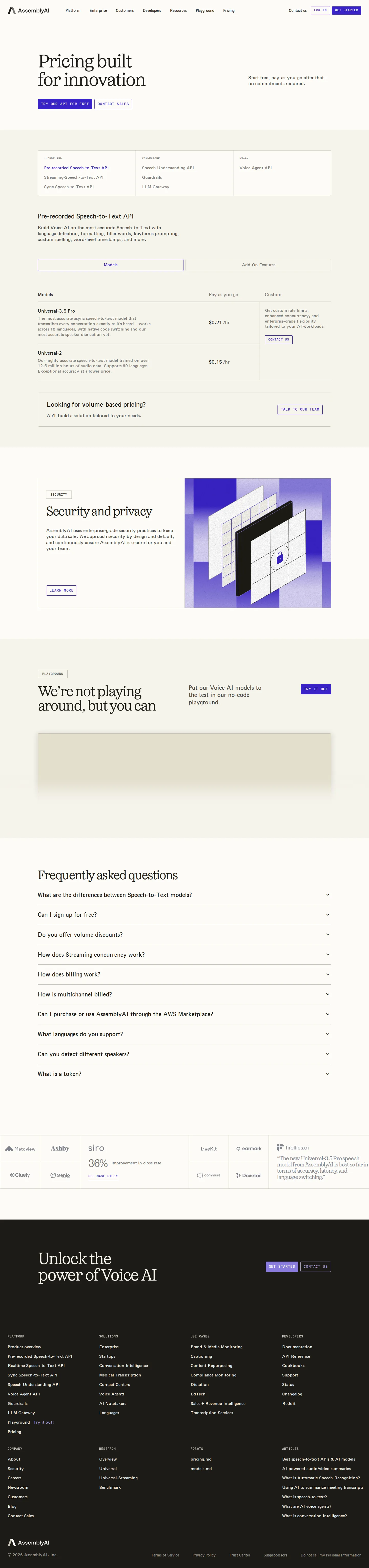
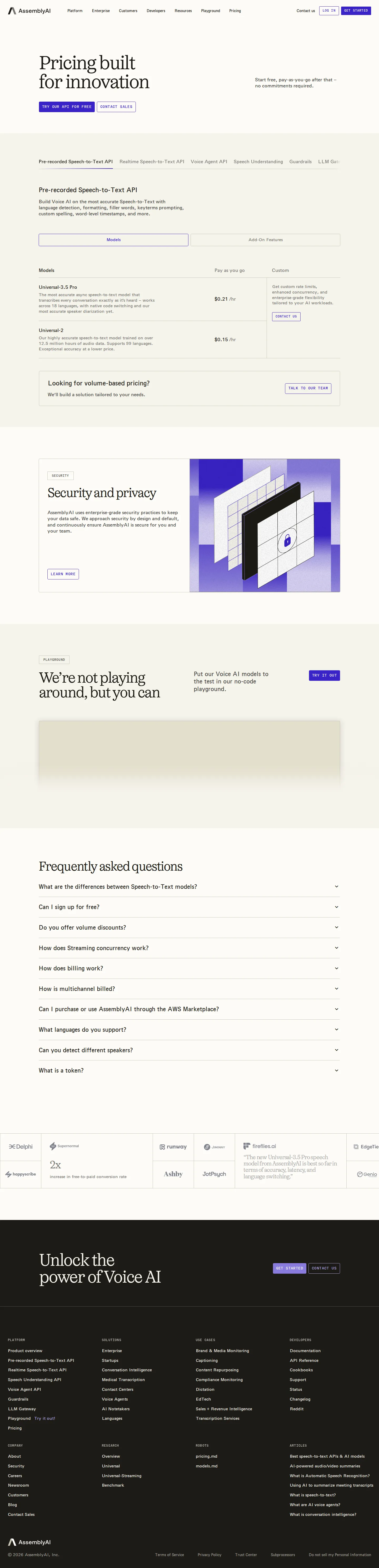
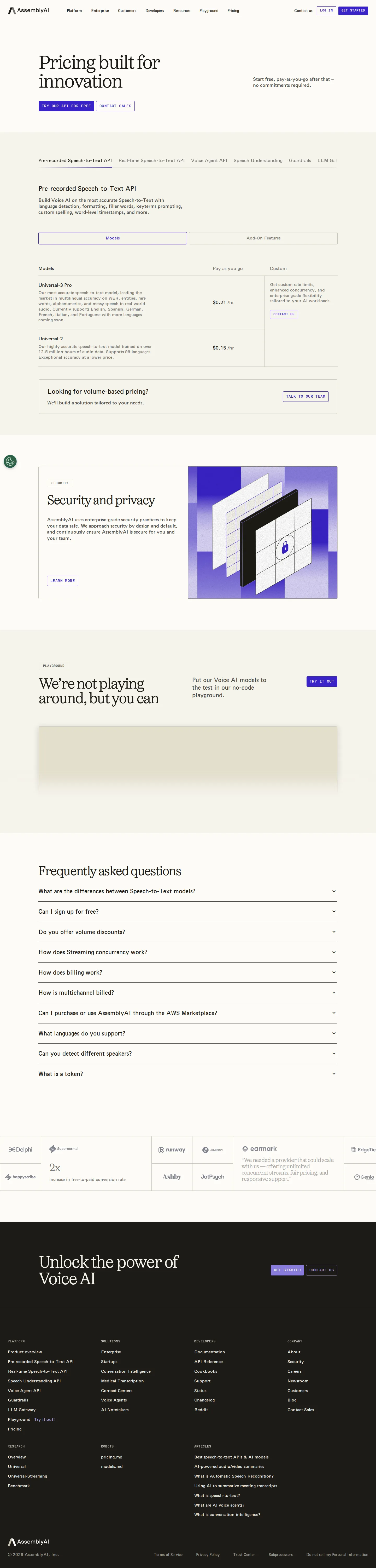
| Universal-3.5 Pro | $0.21 | Most accurate async model; native code switching, works across 18 languages, most accurate speaker diarization |
| Universal-2 | $0.15 | Excellent accuracy at a lower price; supports 99 languages; trained on 12.5M+ hours |
Custom rate limits, enhanced concurrency, and enterprise-grade flexibility are available via “Contact us” for high-volume workloads.
Pre-recorded add-on features (per-hour, on top of base)
| Add-on | Universal-3.5 Pro | Universal-2 |
|---|---|---|
| Keyterms Prompting | +$0.05/hr | Included |
| Prompting (beta) | +$0.05/hr | Not supported |
| Speaker Diarization | +$0.02/hr | +$0.02/hr |
| Medical Mode (new) | +$0.15/hr | +$0.15/hr |
Realtime Speech-to-Text API (Streaming)
| Model | Price per hour | Use case |
|---|---|---|
| Universal-3.5 Pro Realtime (new) | $0.45 | Highest-accuracy real-time transcription |
| Universal-Streaming | $0.15 | Cost-effective real-time, English-only |
| Universal-Streaming Multilingual | $0.15 | Multilingual at the speed and cost of Universal-Streaming (English, Spanish, German, French, Portuguese, Italian) |
Streaming is billed by WebSocket session duration. Concurrency scales automatically at no additional fee (pay-as-you-go starting limit is 100 sessions/min, auto-scaling up 10% whenever utilization hits 70%).
Sync Speech-to-Text API (new)
| Model | Price per hour | Key mechanics |
|---|---|---|
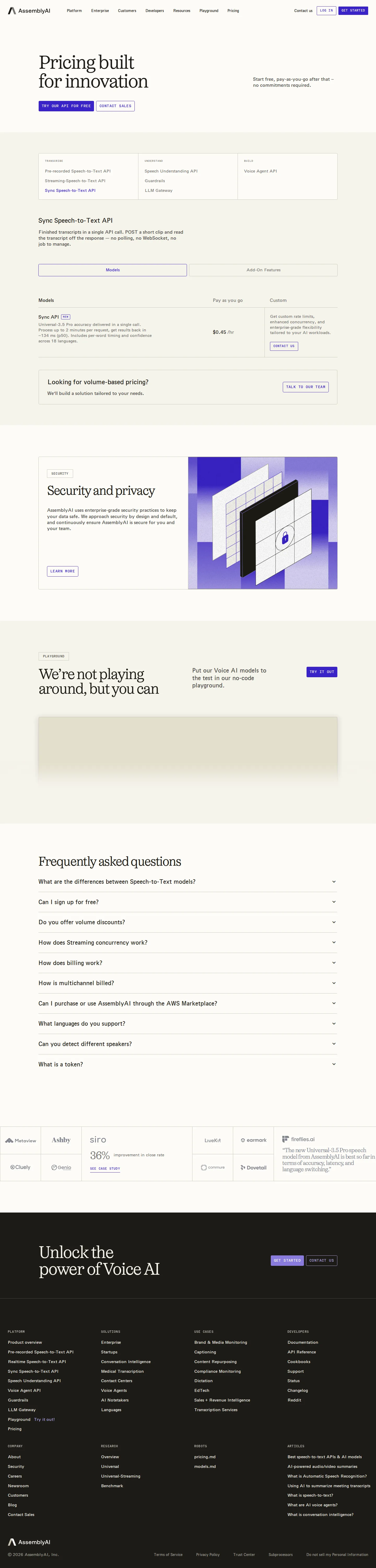
| Sync API | $0.45 | Universal-3.5 Pro accuracy delivered in a single synchronous call; process up to 2 minutes per request, results back in ~134 ms (p50); per-word timing and confidence across 18 languages |
The Sync API returns finished transcripts in one API call — POST a short clip and read the transcript off the response, with no polling, WebSocket, or job to manage. It is priced at $0.45/hr, the same rate as Universal-3.5 Pro Realtime, reflecting the low-latency infrastructure. Custom rate limits and enterprise flexibility are available via “Contact us.”
Voice Agent API
| Component | Pay-as-you-go | Notes |
|---|---|---|
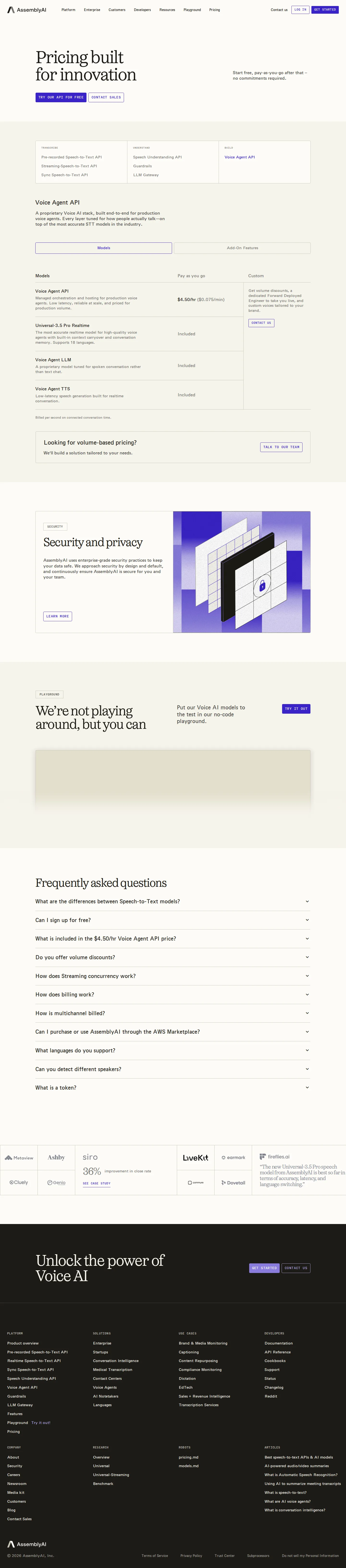
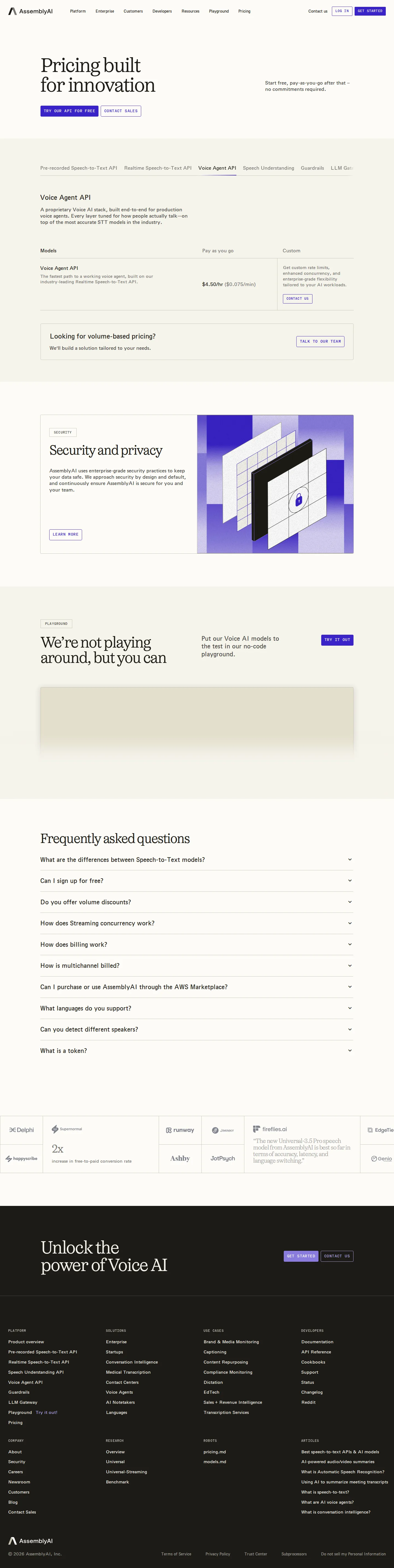
| Voice Agent API (all-in) | $4.50/hr ($0.075/min) | Managed orchestration and hosting for production voice agents; billed per second on connected conversation time |
| Universal-3.5 Pro Realtime (STT) | Included | Built-in context carryover and conversation memory; 18 languages |
| Voice Agent LLM | Included | Proprietary model tuned for spoken conversation rather than text chat |
| Voice Agent TTS | Included | Low-latency speech generation built for realtime conversation |
As of the August 2026 pricing-page update, AssemblyAI explicitly itemizes what the $4.50/hr covers: speech-to-text (Universal-3.5 Pro Realtime with prompting and Voice Focus), advanced turn detection, interruption detection, the Voice Agent LLM, TTS voices, and the WebSocket infrastructure hosting it all. Recordings and transcripts of every conversation are included and retrievable via dashboard or API. SIP trunking carries no markup — bring your own Twilio account and keep your existing carrier contract. AssemblyAI states there are no per-layer add-ons, concurrency fees, or per-agent subscriptions on top of the $4.50/hr rate. Volume discounts, a dedicated Forward Deployed Engineer, and custom voices are available via “Contact us.”
Speech Understanding (per-hour add-ons)
| Feature | Add-on pricing | Notes |
|---|---|---|
| Key Phrases | +$0.01/hr | Labels significant words and phrases |
| Speaker Identification | +$0.02/hr | Replaces “Speaker A/B” labels with real names or roles |
| Sentiment Analysis | +$0.02/hr | Detects sentiment of each sentence spoken |
| Custom Formatting | +$0.03/hr | Standardize and format specific types of information |
| Summarization | +$0.03/hr | Generate a summary of audio files at scale |
| Translation | +$0.06/hr | Convert content from one language to another |
| Entity Detection | +$0.08/hr | Identify entities that are spoken (names, emails) |
| Auto Chapters | +$0.08/hr | Time-based summary over audio/video |
| Topic Detection | +$0.15/hr | Label topics spoken in standardized IAB taxonomy |
Guardrails (per-hour add-ons)
| Feature | Add-on pricing | Notes |
|---|---|---|
| Profanity Filtering | +$0.01/hr | Filter out profanity from transcripts |
| PII Audio Redaction | +$0.05/hr | Identify and remove PII from the audio file |
| PII Text Redaction | +$0.08/hr | Identify and remove PII from the transcription text |
| Content Moderation | +$0.15/hr | Detect sensitive content in audio and video files |
LLM Gateway (LLM-over-audio layer, per 1M tokens)
The LLM Gateway page now lists all 31 routed models directly in one searchable, sortable, filterable table (filters: provider, input-rate band; sort: input price, output price, provider, or name) rather than the earlier per-provider tabs. Provider mix: OpenAI (11 models), Google (9), Anthropic (8), Qwen (3).
| Model | Provider | Input / 1M | Output / 1M |
|---|---|---|---|
| GPT-5 Nano | OpenAI | $0.05 | $0.40 |
| GPT OSS 20B | OpenAI | $0.07 | $0.30 |
| Gemini 2.5 Flash Lite | $0.10 | $0.40 | |
| Qwen3.5 4B Fast | Qwen | $0.10 | $0.50 |
| gemma-4-31b | $0.14 | $0.40 | |
| GPT OSS 120B | OpenAI | $0.15 | $0.60 |
| Qwen3 32B | Qwen | $0.15 | $0.60 |
| Qwen3 Next 80B A3B | Qwen | $0.15 | $1.20 |
| Gemini 3.1 Flash Lite | $0.25 | $1.50 | |
| GPT-5 mini | OpenAI | $0.25 | $2.00 |
| Gemini 2.5 Flash | $0.30 | $2.50 | |
| Gemini 3.5 Flash Lite | $0.30 | $2.50 | |
| Gemini 3.7 Flash | $0.75 | $3.75 | |
| GPT-5.6 Luna | OpenAI | $1.00 | $6.00 |
| Haiku 4.5 | Anthropic | $1.00 | $5.00 |
| Gemini 2.5 Pro | $1.25 | $10.00 | |
| Gemini 3.5 Flash | $1.25 | $9.00 | |
| GPT-5 | OpenAI | $1.25 | $10.00 |
| GPT-5.1 | OpenAI | $1.25 | $10.00 |
| Gemini 3.6 Flash | $1.50 | $7.50 | |
| GPT-5.2 | OpenAI | $1.75 | $14.00 |
| GPT-4.1 | OpenAI | $2.00 | $8.00 |
| GPT-5.6 Terra | OpenAI | $2.50 | $15.00 |
| Sonnet 4.5 | Anthropic | $3.00 | $15.00 |
| Sonnet 4.6 | Anthropic | $3.00 | $15.00 |
| Sonnet 5 | Anthropic | $3.00 | $15.00 |
| GPT-5.5 | OpenAI | $5.00 | $30.00 |
| Opus 4.5 | Anthropic | $5.00 | $25.00 |
| Opus 4.6 | Anthropic | $5.00 | $25.00 |
| Opus 4.7 | Anthropic | $5.00 | $25.00 |
| Opus 4.8 | Anthropic | $5.00 | $25.00 |
A token averages ~1.3 per English word; billing is on input + output tokens processed. The rates above are for global routing — in-region (US/EU) routing is 10% higher “due to provider cost increases” (add "model_region": "global" to API requests to get the rates shown). Model naming on the page has dropped vendor prefixes (e.g. “Opus 4.8” rather than “Claude 4.8 Opus”); the catalog composition changes frequently as upstream providers ship new models.
Sales motions across products: PLG / self-serve for all API products via API key; sales-led for Enterprise volume contracts, invoice billing, and AWS Marketplace. Speech Understanding, Guardrails, and the LLM Gateway are fully self-serve — no sales call required to enable.
Hidden costs : what surprises buyers when the bill arrives
Archetype A: Developer building a meeting transcription app
A developer processing 100 hours/month of meeting recordings on Universal-2, adding speaker identification and entity detection:
| Line item | Per-hour cost | Monthly (100 hrs) |
|---|---|---|
| Base async transcription (Universal-2) | approximately $0.15 | approximately $15.00 |
| Speaker identification add-on | approximately $0.02 | approximately $2.00 |
| Entity detection add-on | approximately $0.08 | approximately $8.00 |
| Estimated total | approximately $0.25/hr | approximately $25/mo |
The base headline rate of $0.15/hr is only the starting point. Common add-ons raise the effective rate meaningfully. Developers often build against the base rate and are surprised when the enriched transcript bill arrives. (Choosing Universal-3.5 Pro at $0.21/hr instead of Universal-2 adds roughly 40% to the base line item.)
Archetype B: Call center analytics platform at scale
A B2B SaaS company processing 2,000 hours/month of customer support calls on Universal-3.5 Pro with PII redaction, entity detection, and translation:
| Line item | Per-hour cost | Monthly (2,000 hrs) |
|---|---|---|
| Base async transcription (Universal-3.5 Pro) | approximately $0.21 | approximately $420 |
| PII text redaction | approximately $0.08 | approximately $160 |
| Entity detection | approximately $0.08 | approximately $160 |
| Translation | approximately $0.06 | approximately $120 |
| LLM Gateway summarization (per-token, varies by model) | varies | varies |
| Estimated total | approximately $0.43/hr | approximately $860/mo |
At higher volumes, the self-serve rate becomes worth an enterprise conversation. AssemblyAI’s sales team engages companies at high monthly volumes to offer volume pricing.
Want to model your own AssemblyAI spend? Use the AssemblyAI pricing calculator to estimate costs based on your audio volume, model selection, and feature mix.
Pricing evolution : how AssemblyAI’s pricing has changed since 2021
Cadence
| Quarter | Price changes | Product / SKU additions | Notes |
|---|---|---|---|
| 2021 Q2 | 1 | 1 | Public API launched with pay-per-second billing; Series A raised |
| 2022 Q4 | 0 | 2 | Series B raised; Audio Intelligence add-ons (sentiment, entity, IAB) launched |
| 2023 Q2 | 0 | 1 | LeMUR launched in beta — token-based LLM-over-audio pricing introduced |
| 2023 Q4 | 0 | 1 | Universal-1 launched — same pricing tier, higher accuracy model |
| 2024 Q1 | 0 | 1 | Series C raised; Universal-2 released with improved benchmarks |
| 2025 Q1 | 0 | 2 | Universal-3.5 Pro (async) and Universal-3.5 Pro Realtime streaming launched |
| 2026 Q2 | 0 | 0 | Pricing stable as of May 2026 research |
| 2026 Q3 | 0 | 4 | 2026-07-06: Voice Agent API launched ($4.50/hr); pricing page split into six product tabs; Guardrails broken out as a priced family; Medical Mode and Keyterms/Prompting add-ons added; Whisper-Streaming retired for Universal-Streaming Multilingual; async rates unchanged. 2026-07-23: new low-latency Sync Speech-to-Text API launched ($0.45/hr) as a seventh product surface. 2026-08-26: Voice Agent API’s $4.50/hr rate itemized into three “Included” components (STT, LLM, TTS) with a new FAQ confirming no per-layer add-on, concurrency, or SIP-markup fees; headline rate unchanged |
Tracked range: 2021 Q2–2026 Q3. Quarters not listed above were verified stable (0 price changes, 0 SKU additions). Historical pricing pre-2021 was invite-only and not publicly documented.
Notable changes
- 2026-08-26 — AssemblyAI itemized what its $4.50/hr Voice Agent API rate covers: the pricing table now lists Universal-3.5 Pro Realtime (STT), the Voice Agent LLM, and Voice Agent TTS as three separate rows, each marked “Included,” and a new FAQ (“What is included in the $4.50/hr Voice Agent API price?”) states there are no per-layer add-ons, concurrency fees, per-agent subscriptions, or SIP markup on top of the rate. The $4.50/hr headline itself did not change; all other product lines (async, realtime, sync, Speech Understanding/Guardrails, LLM Gateway) were re-verified unchanged in the same capture.
- 2021 Q2 — Public pay-per-second billing launched; first developer self-serve access. Pricing set at $0.00025/second for standard transcription.
- 2022 Q4 — Audio Intelligence feature suite launched: sentiment analysis, entity detection, IAB topic classification, and content safety added as incremental per-second fees on top of base transcription.
- 2023 Q2 — LeMUR announced at beta: the first commercially-available LLM-over-audio API. Token-based pricing (input + output) introduced as a third billing dimension separate from transcription and add-ons.
- 2023 Q4 — Universal-1 released as the new highest-accuracy English STT model. Positioned as the same pricing tier as prior models but with significantly lower word error rate.
- 2024 Q1 — Universal-2 released following $50M Series C. Universal-2 achieved further accuracy gains over Universal-1 on standard English benchmarks. No pricing increase; same per-second rate.
- 2025 Q1 — Universal-3.5 Pro (async) and Universal-3.5 Pro Realtime streaming launched. Streaming priced at a premium to async to reflect lower-latency infrastructure costs.
- 2026-07-23 — AssemblyAI launched a new low-latency Sync Speech-to-Text API at $0.45/hr — a seventh priced product surface that returns finished transcripts in a single synchronous call (POST a short clip, read the transcript off the response — no polling, WebSocket, or job to manage). It delivers Universal-3.5 Pro accuracy, processes up to 2 minutes per request with ~134 ms p50 latency, and includes per-word timing and confidence across 18 languages. Priced at the same $0.45/hr as Universal-3.5 Pro Realtime.
- 2026-07-06 — AssemblyAI restructured its pricing page into six product tabs (Pre-recorded STT, Realtime STT, Voice Agent, Speech Understanding, Guardrails, LLM Gateway) and launched a standalone Voice Agent API at $4.50/hr ($0.075/min) — its first packaged full-stack voice product and, at roughly 30× the base async rate, its most expensive priced surface. In the same move it broke Guardrails out as a distinct priced family (Profanity Filtering $0.01/hr through Content Moderation $0.15/hr), added Medical Mode ($0.15/hr) and Keyterms/Prompting ($0.05/hr) as pre-recorded add-ons, retired Whisper-Streaming in favor of Universal-Streaming Multilingual ($0.15/hr), and published explicit per-model token rates on the LLM Gateway (e.g. GPT-5.5 $5/$30, Claude 4.8 Opus $5/$25 per 1M). Base async rates were unchanged (Universal-2 $0.15/hr, Universal-3.5 Pro $0.21/hr).
The July 2026 pricing-transparency shift in detail
The most consequential thing about the July 6 restructure is not the new Voice Agent SKU — it is that AssemblyAI closed the exact transparency gaps this analysis previously flagged. Add-on and Guardrails rates, streaming rates, and per-model LLM Gateway token prices are now published on the public pricing page rather than buried in gated documentation. A buyer can now build a full total-cost model — base transcription plus every enrichment plus token spend — before creating an account or talking to sales. The move also reframes the product from “a transcription API with some add-ons” into six clearly-priced surfaces, and it pushes AssemblyAI up-stack: the Voice Agent API sells the finished voice-agent outcome (understand, reason, respond) rather than the raw transcript, which is where the pricing power in the audio-AI category is migrating.
What’s unique : differentiators in AssemblyAI’s pricing approach
1. Per-second granularity with no rounding penalty. AssemblyAI bills at the per-second level — a 90-second clip costs exactly $0.0225, not $0.03 (rounded to the minute). This is technically obvious but commercially significant: early speech API providers (and even current cloud incumbents) round up to the nearest 15 seconds or full minute. For developers processing large volumes of short clips — voicemails, social posts, support snippets — per-second billing can reduce costs by 30–50% versus per-minute rounding. See how usage metric design affects developer costs for why this matters in tool selection.
2. Composable Audio Intelligence: pay for features, not tiers. Unlike SaaS tools that gate feature sets behind plan tiers, AssemblyAI lets developers enable any combination of Audio Intelligence features per-request. Sentiment analysis on one request, speaker diarization + entity detection on another — each billed independently. This composable feature billing allows developers to precisely control costs and avoids paying for analysis they don’t need. It mirrors how AWS charges for individual cloud services rather than bundled “plans.”
3. LeMUR: the first token-billed audio LLM API. When LeMUR launched in 2023, it introduced a novel billing layer to the speech category: token-based LLM pricing applied to audio context. Developers could ask natural-language questions about a transcript — “summarize the action items from this meeting” — and pay per token for the answer. This created a new cost dimension that no other speech API offered, and it mirrors the outcome-based pricing trend where customers pay for derived value (the answer) rather than raw processing (the transcript).
4. Free playground before payment commitment. AssemblyAI’s dashboard playground lets developers test every model — including LeMUR — with real audio before entering any payment details. In a category where competitors often require API key purchase to begin testing, this friction-free evaluation path is a meaningful PLG differentiator. It reflects the shift toward product-led growth in AI infrastructure where developer trust is won at the keyboard before the wallet.
5. Model accuracy as a pricing anchor, not a pricing gate. AssemblyAI positions its model improvements (Universal-1 → Universal-2 → Universal-3.5 Pro) at the same pricing tier rather than charging premium rates for higher-accuracy models. This is the opposite of the tiered-model pricing strategy used by OpenAI (GPT-4 costs more than GPT-3.5) or Anthropic (Opus costs more than Haiku). AssemblyAI’s approach bets that accuracy leadership drives adoption volume, and volume drives enterprise upsell — the premium is captured at the contract level, not the per-token level. The one axis where AssemblyAI does charge a premium is delivery latency, not accuracy: Universal-3.5 Pro costs $0.21/hr as an async batch job but $0.45/hr the moment you need it live — either as a streaming session or, since the July 2026 Sync Speech-to-Text API, as a single low-latency call that returns the finished transcript in ~134 ms. Same model, same words; buyers pay for how fast they get the answer, not for a better answer.
6. A single all-in Voice Agent price on top of the à-la-carte stack. With the July 2026 launch of the Voice Agent API at $4.50/hr ($0.075/min), AssemblyAI now sells two shapes of the same underlying capability: the composable, pay-for-what-you-enable stack (transcription + Speech Understanding + Guardrails + LLM Gateway tokens) for teams that want control, and one bundled per-hour rate for teams that just want a working voice agent without assembling the pipeline. That $4.50/hr headline is roughly 30× the $0.15/hr base transcription rate — a deliberate signal that the value is in the finished full-duplex agent, not the words. It mirrors the broader outcome-based pricing move toward charging for the delivered result rather than the raw processing step. As of 2026-08-26, AssemblyAI backed that all-in framing with proof: the pricing table now itemizes the $4.50/hr rate into three “Included” components (Universal-3.5 Pro Realtime STT, the Voice Agent LLM, and Voice Agent TTS), and a new FAQ rules out per-layer add-ons, concurrency fees, per-agent subscriptions, or SIP markup on top of it — closing the one question a bundled-price model always invites (“what am I actually paying for?”) without moving the rate itself.
Strengths & weaknesses
| Strengths | Weaknesses |
|---|---|
| Per-second billing with no rounding eliminates penalty for short-clip processing | Multiple billing dimensions (transcription + per-feature add-ons + LeMUR tokens) make total cost hard to predict without calculator |
| Public pricing (as of the July 2026 restructure, sharpened by the August 2026 Voice Agent itemization) now lists every rate — Guardrails family, add-ons, streaming, per-model LLM Gateway tokens, and what the $4.50/hr Voice Agent bundle actually includes — so buyers can self-model total cost before signing up | Seven priced surfaces plus per-feature add-ons and per-model tokens make total cost hard to model by hand; a heavily-enriched transcript stacks many line items |
| Composable stack: enable exactly the transcription, Speech Understanding, Guardrails, and LLM Gateway calls you need per request | Voice Agent API at $4.50/hr is still ~30× the base transcription rate; the August 2026 itemization confirms no hidden per-layer fees ride on top, but the premium itself remains a step teams must budget for deliberately |
| Model improvements (Universal-1 → Universal-2 → Universal-3.5 Pro) at the same price tier | Enterprise volume pricing still opaque; sales process required for any discount |
| LLM Gateway uniquely enables LLM reasoning on audio without building a custom pipeline, now with published per-model token rates | No spend caps or budget alerts on self-serve accounts — surprise bills possible for high-volume batch jobs |
| Genuine accuracy leadership on English benchmarks vs. Whisper, Deepgram, Google STT | Pricing for non-English languages not prominently documented; accuracy benchmarks primarily cover English |
Billing UX : developer experience with AssemblyAI’s billing controls
- Monthly usage-based invoicing — bills are generated at the start of each month for the previous month’s actual usage; no minimum commitments, upfront fees, or contracts on the pay-as-you-go plan.
- No-credit-card free start — create an account and start transcribing immediately; the free tier includes up to 185 hours of pre-recorded transcription and up to 333 hours of streaming transcription.
- Automatic concurrency scaling — the free plan allows 5 new streaming connections/min; pay-as-you-go starts at 100 sessions/min and auto-increases 10% whenever utilization hits 70%, with no ceiling and no additional fee.
- Per-channel multichannel metering — a 1-hour stereo (2-channel) file is billed as 2 hours; each channel is transcribed independently.
- Playground — no payment required — The in-dashboard playground allows testing of all Voice AI models and the LLM Gateway with real audio before any billing is set up. This is the most developer-friendly evaluation UX in the category.
- No spend caps on self-serve — AssemblyAI does not currently expose configurable spending limits for self-serve accounts. A batch job that processes unexpectedly large audio volumes bills without notification — a known friction point for cost-sensitive developers.
- Billing granularity — Bills are itemized by API product (transcription, Speech Understanding feature, Guardrails feature, LLM Gateway tokens), showing the audio duration processed and features enabled per request.
- AWS Marketplace billing — usage can be consolidated through an existing AWS account (contact sales to set up); Enterprise accounts add invoice billing, purchase orders, and custom contract payment terms.
- Enterprise account management — Enterprise customers receive custom rate limits, enhanced concurrency, a dedicated account manager, and usage-forecasting support via the “Talk to our team” path on every product tab.
- Voice Agent bundle itemization — the Voice Agent API pricing table now breaks the $4.50/hr rate into its components (Universal-3.5 Pro Realtime STT, Voice Agent LLM, Voice Agent TTS, all marked “Included”) and a dedicated FAQ entry confirms no per-layer add-ons, concurrency fees, or per-agent subscriptions; SIP trunking passes through at no markup when a customer brings their own Twilio account.
Strategic wins : where AssemblyAI’s pricing decisions have paid off
1. Per-second billing made AssemblyAI the default choice for short-clip use cases
By charging at the per-second level rather than rounding to the minute, AssemblyAI structurally won the economics for developers processing short audio — voicemails (20–60 seconds), social media clips (15–60 seconds), podcast excerpts (30–90 seconds). A company processing 1 million 30-second clips per month pays AssemblyAI $7,500 versus $15,000 at a per-minute-rounded competitor — the same audio at 2× the cost. This per-second value metric is the single pricing decision that most clearly explains AssemblyAI’s developer adoption curve in media and social application categories.
2. Composable Audio Intelligence created a flywheel of feature adoption without tier lock-in
By pricing Audio Intelligence as per-request add-ons rather than plan tiers, AssemblyAI gave developers the freedom to start with base transcription and incrementally adopt higher-value features as product needs evolved. A developer who starts with basic transcription at $0.015/min naturally discovers speaker diarization when their users ask “who said what?” — and enables it at marginal cost. This composable model drives organic feature expansion that would not happen if features were gated behind fixed tiers requiring a plan upgrade. The result: higher feature adoption rates than a tier-gated model would produce, and higher average revenue per customer over time.
3. LeMUR differentiated AssemblyAI beyond the “just transcription” category
The 2023 launch of LeMUR moved AssemblyAI from being a transcription API vendor to being an audio intelligence platform — a category with significantly higher defensibility and pricing power. Before LeMUR, the main competitive variables were accuracy and price per minute. After LeMUR, AssemblyAI offered a capability that no other speech API could replicate: LLM-quality reasoning applied directly to audio content, without requiring a customer to build their own transcript → LLM pipeline. This outcome-based value layer — “what does this meeting mean?” rather than “give me the words” — justified enterprise conversations that raw transcription pricing alone could not support.
4. Accuracy leadership at parity pricing created switching cost without raising rates
AssemblyAI’s model release cadence (Universal-1 → Universal-2 → Universal-3.5 Pro) at unchanged per-second pricing created a powerful retention mechanism: customers who switched to AssemblyAI for Universal-2’s accuracy gains would be irrational to leave when Universal-3.5 Pro launches at the same rate. This is the inverse of the pricing strategy used by most AI model companies, where new model generations come with price increases. By keeping rates flat while improving accuracy, AssemblyAI accumulates a technical switching cost — the customer’s application is tuned to AssemblyAI’s output format, API behavior, and accuracy characteristics — without imposing a financial switching cost that might prompt re-evaluation. See how AI companies use model improvements as retention tools for the broader pattern.
Areas to improve : gaps and friction in AssemblyAI’s pricing approach
1. Seven priced surfaces now need a first-party cost estimator, not just a rate card
The July 2026 restructure closed the transparency gap this analysis previously flagged: add-on rates, the Guardrails family, streaming rates, and per-model LLM Gateway token prices are now all published on the public pricing page, so a buyer can finally self-qualify without an account. The new problem is the flip side of that transparency — with seven product tabs (the July 23 Sync Speech-to-Text API being the latest), per-feature add-ons, and per-model token pricing, a realistic voice-agent or call-analytics workload now spans many stacked line items that are tedious to total by hand. AssemblyAI publishes the rates but not a way to combine them. An interactive cost estimator on the pricing page — pick a model, toggle the add-ons and Guardrails you need, set expected volume — would let developers self-qualify their budget fit in one screen instead of spreadsheet arithmetic. Compare this against Perplexity AI’s fully public API pricing, which pairs transparent rates with a simpler mental model.
2. No spend caps create bill shock risk for self-serve developers
AssemblyAI’s self-serve accounts do not support configurable spending limits or threshold alerts. A developer who accidentally submits a batch of 10,000 long audio files will receive the bill without any real-time warning. AWS, Google Cloud, and Azure all offer budget alerts and spending caps as standard account management features — AssemblyAI’s absence of these controls is a category gap that creates anxiety for cost-sensitive development teams. Adding a simple “alert me when my monthly bill exceeds $X” setting would reduce developer anxiety and likely increase API adoption from teams that are currently cautious about unexpected charges.
3. The Voice Agent premium needs a “build-vs-buy” cost comparison
With the July 2026 launch, streaming rates are now published (Universal-Streaming and Universal-Streaming Multilingual at $0.15/hr, Universal-3.5 Pro Realtime at $0.45/hr), so the old streaming-opacity gap is resolved. The new decision buyers face is the Voice Agent API at $4.50/hr versus assembling the same outcome themselves from Realtime STT + LLM Gateway + a text-to-speech layer. At roughly 30× the base transcription rate, the bundled convenience price is easy to under-appreciate until volume scales. AssemblyAI’s 2026-08-26 update took a real step here — itemizing the bundle into three “Included” components and adding an FAQ that rules out per-layer add-on, concurrency, and SIP-markup fees — but it still only confirms what’s included, not what those three pieces would cost assembled à la carte. AssemblyAI would close the remaining gap — and defend the premium outright — by publishing a side-by-side of the bundled Voice Agent rate against the component stack’s standalone prices, so buyers can see exactly what the packaging is worth at their volume. See billing cycles and metering for usage-based APIs for why transparent per-workload cost modeling drives developer confidence.
Monetization stack & signals : how AssemblyAI builds & buys its revenue engine
Buys 0 Builds 2 2 signal roles
AssemblyAI builds the meter and the gateway behind its usage pricing in-house — no third-party billing vendor surfaces. The signal to watch is the founding Enterprise AE hire below: a sales-led enterprise motion forming on top of the self-serve API.
- LLM Gateway (in-house multi-provider API) In-house build Job post Jan 2026
“This role is focused on building and maintaining our LLM gateway service—a unified API platform that connects customers to multiple LLM providers ... Build and maintain integrations with multiple LLM providers and AI services (OpenAI, Anthropic, Google Vertex, AWS Bedrock etc.)”
-
“With the current version of multi-project support, rate limiting is applied at the account level, not at the project level. The rate limit is the maximum number of transcription jobs that can actively process simultaneously.”
- Founding Enterprise Account Executive Growth seen Jun 4, 2026
The "founding" enterprise AE owns strategic accounts and "positions value and pricing against alternatives" — the first dedicated sales hire layering a sales-led motion onto a self-serve, usage-priced API core.
- Senior Software Engineer, Go - LLM Team Billing engineering seen Jan 12, 2026
Staffing the in-house LLM Gateway — "a unified API platform that connects customers to multiple LLM providers" (OpenAI, Anthropic, Vertex, Bedrock). The metered token layer behind AssemblyAI's per-token pricing is a build, not a bought billing platform.
1 more matched role — supporting evidence
- Applied AI Engineer Customer success Jun 18, 2026
Signals reviewed · derived from public job posts, product docs
Job postings fill and close over time — once a posting is filled we keep it as a dated citation (the quoted evidence remains); use View open roles for current listings.
Key takeaways
-
Per-second billing is a competitive moat in short-clip categories. AssemblyAI’s per-second granularity systematically halves costs for developers processing sub-60-second audio compared to per-minute-rounded competitors. For any AI API, the choice of billing unit (per second, per minute, per request, per token) is a strategic decision that shapes which use cases become economically viable on your platform.
-
Composable feature pricing beats tier gating for developer adoption. By making Audio Intelligence add-ons opt-in per request rather than bundled into fixed tiers, AssemblyAI drives organic feature adoption as developer products mature. Developers discover features at the point of need, not at the point of plan selection — which is an earlier and lower-intent moment in the product lifecycle.
-
Model accuracy improvements at flat pricing create powerful retention without visible lock-in. Releasing Universal-2 and Universal-3.5 Pro at the same per-second rate as Universal-1 builds technical switching cost (tuned prompts, output parsing, latency expectations) without the financial switching cost that prompts re-evaluation. This is a sustainable retention mechanic that subscription-based tools with static feature sets cannot easily replicate.
-
A free playground with no payment commitment is the highest-leverage PLG investment for API products. AssemblyAI’s no-card-required playground gives every curious developer a zero-friction path to experience the product quality. In a category with strong alternatives (Google STT, AWS Transcribe, Deepgram), developer experience before purchase is often the decisive factor.
-
Adding LLM reasoning as a billing layer elevated the pricing conversation from commodity to platform. LeMUR transformed AssemblyAI from a transcription API (priced per minute of audio) to an audio intelligence platform (priced for the value of insights derived from audio). This layered value architecture — raw processing + structured analysis + LLM reasoning — is a model for how audio AI, and AI APIs broadly, will expand pricing power as capabilities mature.
UBP implications
-
Multi-dimensional usage billing (transcription + features + tokens) is the emerging standard for audio AI. AssemblyAI’s three-layer billing model — base per-second transcription, per-feature Audio Intelligence add-ons, and per-token LeMUR — represents the most granular usage billing in the speech API category. As audio AI capabilities compound (transcription → analysis → reasoning), each new capability layer will carry its own billing dimension. Teams building usage aggregation systems for audio AI products need to account for multi-dimensional metering from the start, not just per-minute billing.
-
Transparent public pricing accelerates developer self-qualification and shortens sales cycles. AssemblyAI’s July 2026 restructure — publishing every rate across six product tabs, from the Guardrails family to per-model LLM Gateway tokens — is a deliberate bet that full public pricing transparency reduces friction faster than a concierge sales motion. The UBP lesson: once your rate card is complex, the constraint shifts from disclosure to modelability — publishing the numbers is necessary but a self-serve cost estimator is what actually lets buyers self-qualify and convert without a sales call, at lower CAC.
-
Accuracy improvements at flat pricing are a usage-based growth strategy in disguise. When AssemblyAI releases Universal-3.5 Pro at the same rate as Universal-2, existing customers don’t churn — they simply produce better outputs at the same cost, which makes their products better, which drives more audio volume through AssemblyAI’s infrastructure. Higher accuracy → better customer products → more usage volume → more revenue at unchanged per-unit price. This usage-led expansion mechanic is a UBP growth pattern that pure subscription models cannot replicate.
Sources
- AssemblyAI pricing page (accessed 2026-08-26)
- AssemblyAI machine-readable pricing (pricing.md) (accessed 2026-08-26)
- AssemblyAI billing and pricing documentation (accessed 2026-08-26)
- AssemblyAI official documentation (accessed 2026-05-29)
- AssemblyAI Python SDK — GitHub repository (accessed 2026-05-29)
- AssemblyAI Node.js SDK — GitHub repository (accessed 2026-05-29)
Bottom line
AssemblyAI has built the most developer-friendly speech AI pricing structure in the market: pay-per-second with no rounding, composable Audio Intelligence add-ons, and a free playground that requires no payment commitment. Its model release cadence — Universal-1, Universal-2, Universal-3.5 Pro — at flat rates is a quiet retention machine that builds technical switching cost without triggering financial re-evaluation. The July 2026 restructure into six priced product tabs closed the old transparency gaps — every add-on, Guardrails, streaming, and per-model token rate is now public — and pushed the company up-stack with a bundled Voice Agent API at $4.50/hr that sells the finished outcome rather than the raw transcript. A follow-on low-latency Sync Speech-to-Text API ($0.45/hr, July 2026) took the lineup to seven priced surfaces — a reminder that the same model (Universal-3.5 Pro) is now priced by delivery mode, cheapest as an async batch job and at a premium the instant you need it live. The remaining gaps — no spend caps and no first-party estimator for what is now a genuinely seven-surface, multi-line-item bill — are fixable and do not undermine the core economic model. With $143M raised, Fortune 500 enterprise penetration, and the LLM Gateway as a differentiated platform layer, AssemblyAI is the clear default choice for developers building audio intelligence into production products.
Compare AssemblyAI with other AI infrastructure providers in the full pricing blueprint.
Pricing timeline : Major events on a vertical axis
Each milestone below corresponds to a public pricing change, product launch, or material adjustment. Major events use a filled marker; minor adjustments use a faded one.
Voice Agent API bundle itemized ($4.50/hr rate unchanged)
AssemblyAI did not change the Voice Agent API's $4.50/hr ($0.075/min) headline rate, but the pricing table now itemizes what it covers as three separate "Included" line items — Universal-3.5 Pro Realtime STT, the Voice Agent LLM, and Voice Agent TTS — and a new FAQ confirms there are no per-layer add-ons, concurrency fees, per-agent subscriptions, or SIP markup on top of the all-in rate. All other product lines (async, realtime, sync, Speech Understanding/Guardrails add-ons, LLM Gateway's 31-model table) were re-verified unchanged against the same capture.
Sync Speech-to-Text API launched ($0.45/hr)
AssemblyAI added a new low-latency Sync Speech-to-Text API at $0.45/hr — a seventh priced product surface. It returns finished transcripts in a single synchronous call (no polling, WebSocket, or job to manage), delivers Universal-3.5 Pro accuracy, processes up to 2 minutes per request with ~134 ms p50 latency, and includes per-word timing and confidence across 18 languages. All other rates unchanged (async $0.15/$0.21, streaming $0.15/$0.45, Voice Agent $4.50/hr).
Voice Agent API launched; pricing page restructured into six product tabs
Pricing page restructured into six product tabs (Pre-recorded STT, Realtime STT, Voice Agent, Speech Understanding, Guardrails, LLM Gateway). New Voice Agent API listed at $4.50/hr ($0.075/min). Async unchanged ($0.15 Universal-2, $0.21 Universal-3.5 Pro). Realtime lineup swapped Whisper-Streaming for Universal-Streaming Multilingual ($0.15/hr) alongside Universal-3.5 Pro Realtime ($0.45/hr). Guardrails broken out as a priced family (Profanity Filtering $0.01/hr → Content Moderation $0.15/hr); Medical Mode ($0.15/hr) and Keyterms/Prompting ($0.05/hr) added as pre-recorded add-ons.
Current Pricing (May 2026)
Current pricing: async transcription at $0.15/hr (Universal-2) and $0.21/hr (Universal-3.5 Pro); streaming at $0.15/hr (Universal-Streaming), $0.30/hr (Whisper-Streaming), and $0.45/hr (Universal-3.5 Pro Streaming). Speech Understanding add-ons billed per hour; LLM Gateway billed per million tokens. Free tier of up to 185 pre-recorded hours.
Universal-3.5 Pro and Streaming Models Released
Universal-3.5 Pro released as the most accurate async model; Universal-3.5 Pro Streaming joined Universal-Streaming and Whisper-Streaming for real-time use. Pricing moved to a per-hour structure across models.
Series C ($50M) — Universal-2 Released
Series C funding ($50M) led by Accel, bringing total funding to ~$143M. Universal-2 released, achieving further accuracy gains. Company reports processing audio for hundreds of enterprise customers including dozens of Fortune 500 companies.
Universal-1 Model Released
Universal-1 launched as AssemblyAI's flagship model for highest-accuracy English transcription, with accuracy benchmarks beating Whisper large-v3 and Google STT v2.
LeMUR Beta — LLM-over-Audio Layer
LeMUR launched in beta — the first LLM-over-audio layer in the speech API category. LeMUR adds token-based billing on top of transcription costs.
Series B ($72M) — Audio Intelligence Add-ons
Series B funding ($72M) led by Insight Partners. Usage-based API pricing at $0.00025/second confirmed for standard transcription. Audio Intelligence add-ons (sentiment, entities, IAB topics) launched as incremental per-second fees.
Series A ($28M) — Public API Launch
Series A funding ($28M) from Insight Partners. Public API access expanded; pay-per-second billing model launched publicly.
AssemblyAI Founded
AssemblyAI founded in San Francisco as a speech-to-text API startup. Early pricing was invite-only for select beta customers.
- · AssemblyAI bills transcription by the hour of audio processed — Universal-2 at $0.15/hr and the more accurate Universal-3.5 Pro at $0.21/hr — with no minimum commitment, upfront fee, or contract on the pay-as-you-go plan.
- · AssemblyAI's LLM Gateway lets developers call frontier models (OpenAI, Anthropic, Google) directly against a transcript, billed per million input and output tokens — the evolution of what AssemblyAI first shipped as LeMUR, its 'LLM-over-audio' layer.
- · AssemblyAI raised $50M in its Series C in January 2024, bringing total funding to approximately $143M. The round was led by Accel, with participation from Insight Partners, and came just two months after Universal-1 launched as the company's flagship accuracy benchmark.
Questions & answers
- How much does AssemblyAI cost per hour of audio?
- AssemblyAI bills async transcription by the hour: Universal-2 is $0.15/hr and the more accurate Universal-3.5 Pro is $0.21/hr. Real-time streaming ranges from $0.15/hr (Universal-Streaming) to $0.45/hr (Universal-3.5 Pro Realtime). A low-latency Sync Speech-to-Text API, which returns a finished transcript in a single call, is $0.45/hr. A Voice Agent API is $4.50/hr ($0.075/min); as of August 2026, AssemblyAI itemizes that rate into three "Included" components (speech-to-text, the Voice Agent LLM, and text-to-speech) and confirms there are no per-layer add-on, concurrency, or SIP-markup fees on top of it. Speech Understanding and Guardrails add-ons each carry an additional per-hour fee on top of the base rate.
- Does AssemblyAI have a free tier?
- Yes. You can create an account and start transcribing immediately with no credit card required. The free tier includes up to 185 hours of pre-recorded transcription and up to 333 hours of streaming. There is no monthly minimum — beyond the free tier you only pay for what you process.
- What is the LLM Gateway and how is it priced?
- The LLM Gateway is AssemblyAI's layer that lets developers run frontier LLMs from OpenAI, Anthropic, and Google directly against a transcript — summarization, Q&A, custom prompts. It is billed per million input and output tokens at each model's published rate, separately from transcription costs. It is the productized evolution of LeMUR.
- What is the difference between AssemblyAI's Universal-2 and Universal-3.5 Pro models?
- Universal-2 is the lower-cost async model at $0.15/hr, supporting 99 languages with excellent accuracy. Universal-3.5 Pro is the most accurate model at $0.21/hr, leading on multilingual word error rate. For real-time use, AssemblyAI offers Universal-Streaming and Universal-Streaming Multilingual (both $0.15/hr) and Universal-3.5 Pro Realtime ($0.45/hr).
- Does AssemblyAI offer enterprise pricing?
- Yes. Enterprise customers receive custom volume-discount pricing, dedicated support, and invoice billing, and AssemblyAI is available via the AWS Marketplace. Self-serve customers pay standard per-hour rates with no sales contact required.
- How do Speech Understanding add-ons affect AssemblyAI's pricing?
- Each Speech Understanding feature — speaker identification, entity detection, translation, PII redaction, and more — adds an incremental per-hour fee on top of base transcription. Enabling multiple features stacks those per-hour fees, so a heavily-featured transcript costs more than the base transcription rate.