AI Summary
About
Claude Code is Anthropic’s agentic coding tool — a terminal CLI, a set of IDE extensions, and a web surface that let Claude read, write, and run code across your repo with you in the loop. It is not a standalone product with its own price tag; it’s a capability that rides on top of two billing systems Anthropic already runs: the consumer/business Claude subscriptions and the Anthropic developer API.
Anthropic is a private AI lab founded in 2021, backed by Amazon and Google among others, and is one of the two or three labs at the frontier of large language models. Claude Code launched in 2025 as an API-only developer preview, then got bundled into the Pro and Max subscriptions through 2025 — which is the single most important fact about its pricing: the same tool costs wildly different amounts depending on which meter you put it on.
For current plans and rates, see Claude pricing and the Anthropic API rate card.
Pricing summary : How Claude Code’s pricing model works
Claude Code has two pricing paths, and the choice between them is the whole game.
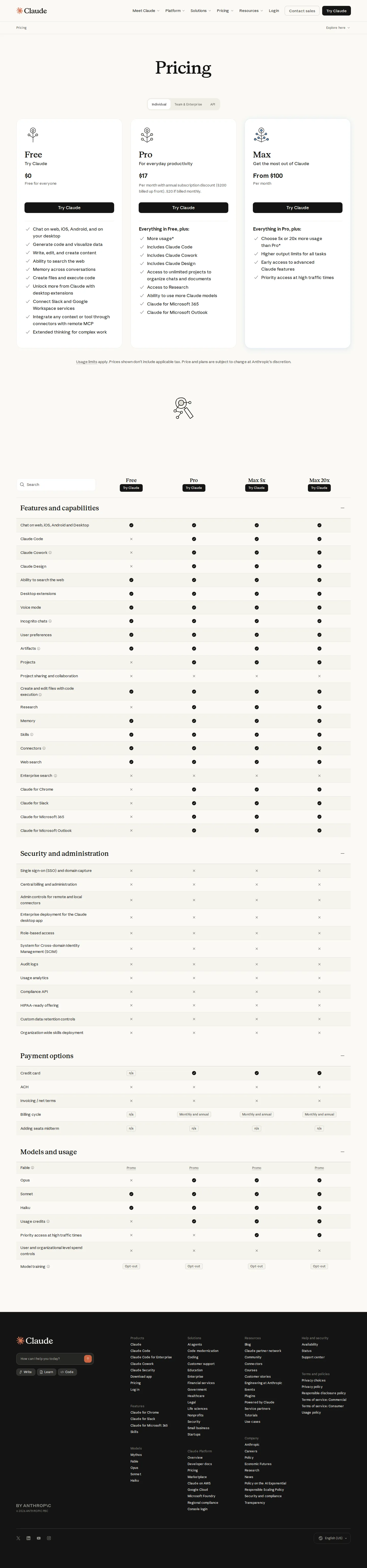
Path 1 — Bundled subscription (capped, predictable). You pay a flat monthly fee and get Claude Code with usage limits. The free Claude plan ($0) does not include Claude Code. The entry point is Pro at $20/mo ($17/mo if billed annually, $200 up front) — which now bundles Claude Code alongside three sibling products, Claude Cowork, Claude Design, and Claude Science. Above that, Max 5x runs from $100/mo and Max 20x is $200/mo — the multiplier refers to how much per-session usage you get versus Pro. All three run on a 5-hour rolling session limit plus weekly caps. For teams (2 to 150 seats), seats are $20/seat/mo (standard) or $100/seat/mo (premium) on annual billing; Enterprise is $20/seat plus usage billed at API rates, with a 500k-token context window on the default model.
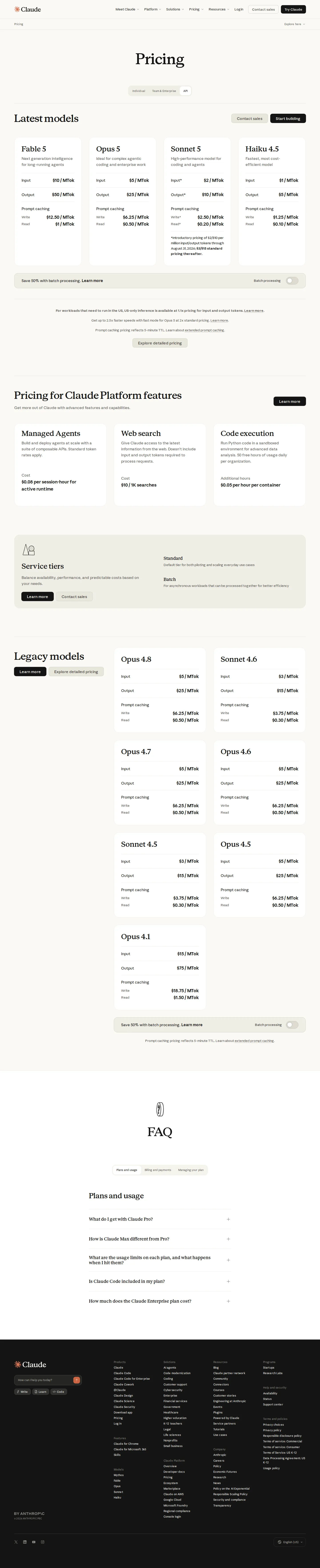
Path 2 — Pay-as-you-go API (uncapped, metered). You bring an Anthropic API key and pay per token by model, with no monthly minimum and no usage cap. Claude Opus 5 — the current flagship, launched 2026-07-29 — is $5 input / $25 output per million tokens (MTok); the model it replaced, Opus 4.8, stays live at the identical rate as a legacy model. Claude Sonnet 5 launched at an introductory $2 / $10 through August 31, 2026 — Anthropic has since confirmed that rate is now the permanent standard price, and the previously announced increase to $3 / $15 on September 1, 2026 will not happen; the prior-generation Sonnet 4.6 remains $3 / $15, and Haiku 4.5 is $1 / $5. A frontier tier — Fable 5 (and limited-availability Mythos 5) — sits above Opus at $10 / $50.
What makes this different: Most coding tools pick one model — seat-based SaaS (Copilot) or pure token metering (raw API wrappers). Claude Code deliberately offers both from the same vendor, and the day-rate math is simple: Max 5x at $100/mo and Max 20x at $200/mo work out to roughly $3.33/day and about $6.67/day respectively. Anthropic’s own data says the average developer spends ~$6/day on API billing, so the recommendation falls out cleanly — if your metered spend regularly beats the Max day-rate, switch to the subscription.
Pricing by product
Subscription path (bundled Claude Code)
| Plan | Price | Includes Claude Code? | Key mechanics |
|---|---|---|---|
| Free | $0/mo | No | Chat only; no Claude Code |
| Pro | $20/mo ($17/mo annual) | Yes | Bundles Claude Code, Cowork, Design & Science; 5-hour + weekly usage limits |
| Max 5x | from $100/mo | Yes | 5x Pro per-session usage |
| Max 20x | $200/mo | Yes | 20x Pro per-session usage; priority access |
| Team (standard) | $20/seat/mo annual ($25 monthly) | Yes | 2–150 seats; central billing; mix seat types |
| Team (premium) | $100/seat/mo annual ($125 monthly) | Yes | 5x more usage than a standard seat |
| Enterprise | $20/seat + usage at API rates | Yes | Self-serve or sales-assisted; 500k context on default model; SSO/SCIM, audit logs, HIPAA-ready |
A university-wide Education plan (discounted access, dedicated API credits, learning mode) is available for institutions; pricing is quoted per institution.
API path (pay-as-you-go, per MTok)
| Model | Input / MTok | Output / MTok | Notes |
|---|---|---|---|
| Fable 5 / Mythos 5 | $10 | $50 | Frontier tier (Mythos 5 is limited availability); 1M context at standard rate |
| Opus 5 | $5 | $25 | Current flagship coding model, launched 2026-07-29 |
| Sonnet 5 | $2 | $10 | New default; launched as an introductory rate, now confirmed permanent — the planned Sep 1, 2026 rise to $3/$15 will not occur |
| Haiku 4.5 | $1 | $5 | Fast, cheap, high-volume |
| Opus 4.8 / 4.7 / 4.6 / 4.5 (legacy) | $5 | $25 | Superseded by Opus 5 on 2026-07-29; same rate, still callable |
| Sonnet 4.6 / 4.5 (legacy) | $3 | $15 | Prior-generation balanced default |
| Opus 4.1 (deprecated) | $15 | $75 | Highest legacy rate still listed |
Prompt caching cuts input cost to 0.1x on cache hits (5-min write 1.25x, 1-hour write 2x); the Batch API takes 50% off both input and output. Fable 5, Mythos 5, Opus 4.6+, and Sonnet 4.6+ include the full 1M-token context window at standard rates.
API server tools and agent runtime
Server-side features are billed on top of tokens:
| Feature | Price | Notes |
|---|---|---|
| Web search | $10 per 1,000 searches | Plus standard token costs for search content |
| Code execution | 1,550 free hours/mo, then $0.05/hour per container | Free when paired with web search or web fetch |
| Fast mode (Opus 5 / Opus 4.8) | $10 / $50 per MTok | Research-preview premium for faster output; 2x standard Opus pricing |
| Managed Agents runtime | $0.08 per session-hour | Billed alongside token usage; metered only while a session is running |
US data residency (inference_geo: "us") | 1.1x multiplier | On Opus 4.6 / Sonnet 4.6 and later, across all token categories |
On AWS Marketplace and Microsoft Foundry, token usage is metered in Claude Consumption Units (CCU) at $0.01 per CCU rather than per MTok.
Sales motions across products: self-serve PLG for Individual/Pro/Max and the API (sign up, pay by card, no sales contact), shifting to sales-led for Team and Enterprise (invoicing, net terms, SSO, custom usage terms).
Hidden costs : What Claude Code users actually pay
On the subscription path there are no token surprises — the limit is your ceiling, and you hit a wall rather than a bigger bill. The hidden cost there is the opposite of bill shock: hitting a 5-hour or weekly cap mid-task and having to wait for the reset.
On the API path the meter never stops, and a few things inflate the bill beyond the headline rate:
| Line item | What it adds |
|---|---|
| Output tokens | 5x the input rate on Opus/Sonnet — agentic edits generate a lot of output |
| New tokenizer (Opus 4.7+) | Approximately 30% more tokens for the same text — a silent effective price rise |
| Context re-sends | Every turn re-sends the codebase context unless prompt caching is on |
| Server tools | Web search is $10 per 1,000 searches on top of tokens |
| US data residency | inference_geo “us” adds a 1.1x multiplier on Opus/Sonnet 4.6+ |
The two big discounts that cut real bills: prompt caching (cache reads cost 0.1x the input rate, so re-sending a large context is nearly free after the first hit) and the Batch API (50% off both input and output for non-interactive jobs). Anthropic reports the average Claude Code developer lands around $6/day on API billing, with 90% under $12/day — but Opus-heavy full-time use has been reported at $300–$500/mo before caching, which is exactly the regime where Max 20x at $200/mo becomes the cheaper choice.
Want to estimate your own Claude Code bill? Use the Claude Code pricing calculator to model subscription vs API cost based on your token usage.
Pricing evolution : Claude Code pricing history and changes
Cadence
| Period | Price changes | Product / SKU additions | Notes |
|---|---|---|---|
| 2025 H1 | — | Claude Code bundled into Max/Pro | Moved from API-only to subscription-included |
| 2025 H2 | Weekly caps added | — | Limits tightened to curb power users |
| 2026 H1 | 5-hour limits doubled; new model rate card | Opus 4.8, Fable 5 / Mythos 5 | Limits eased; frontier tier introduced |
| 2026 H2 | Sonnet 5 launched at $2/$10 per MTok, then confirmed permanent (planned Sep 1 rise to $3/$15 canceled) | Sonnet 5, Opus 5, Claude Cowork / Design / Science, Managed Agents | Sibling apps bundled into Pro/Max/Team; session-runtime billing ($0.08/session-hour) added; Opus 5 replaced Opus 4.8 as flagship at an identical rate; Sonnet 5’s scheduled price increase was canceled outright rather than taking effect |
Tracked range: 2025–present. API model rates are the moving piece; subscription headline prices (Pro $20, Max $100/$200) have held since the 2025 bundling — the 2026 H2 change added bundled products, not a price rise.
Notable changes
- 2026-08-26 — Anthropic confirmed Claude Sonnet 5’s introductory $2/$10 per-MTok rate is now the permanent standard price; the previously scheduled September 1, 2026 increase to $3/$15 will not occur — a pre-announced price hike canceled outright rather than allowed to take effect.
- 2026-07-29 — Claude Opus 5 launched as the new flagship Opus-tier model on both
claude.com/pricingand the API rate card, at the same $5/$25 per-MTok rate Opus 4.8 held; Opus 4.8 moved to the Legacy models list alongside Opus 4.7, 4.6, and 4.5 (all still $5/$25) — a model-lineup refresh, not a price change. - 2026-07-23 — Claude Pro, Max, and Team began bundling Claude Cowork, Design, and Science alongside Claude Code at unchanged headline prices; Claude Sonnet 5 launched on the API at an introductory $2/$10 per MTok (standard $3/$15 from Sep 1, 2026); Managed Agents added $0.08/session-hour runtime billing.
- 2026-06-16 — Current rate card: Opus 4.x family at $5/$25 per MTok, Sonnet 4.6 at $3/$15, Haiku 4.5 at $1/$5, plus a new Fable 5 / Mythos 5 frontier tier at $10/$50.
- 2026-05-06 — 5-hour session limits doubled, peak-hour reductions removed, Opus API rate limits raised.
- 2025-07-28 — Weekly usage caps introduced for Pro and Max to curb continuous-loop power users.
- 2025 H1 — Claude Code bundled into Max (5x $100, 20x $200) and Pro, creating the capped-cost alternative to API billing.
What’s unique : Claude Code’s distinctive pricing mechanics
1. Two meters, one tool, vendor-published break-even. Almost no competitor offers both a capped subscription and uncapped per-token billing for the same product and tells you the crossover point ($3.33/day for Max 5x, $6.67/day for Max 20x). That transparency turns a pricing decision into arithmetic.
2. Usage limits as the cap, not a bigger invoice. On subscriptions, going over doesn’t cost more — it stops you (5-hour reset, weekly cap). This is the opposite of classic usage-based bill shock and is the core reason developers pick Max over the API: predictability.
3. Token-level cost levers the buyer controls. Prompt caching (0.1x reads), Batch (50% off), and model choice (Haiku at 1/5th of Opus) mean the API bill is something you engineer, not just receive. The same task can cost 5–10x more or less depending on model and caching discipline.
4. Price stability is defended by adding capability, not by raising it. On 2026-07-23, Anthropic folded three sibling apps — Claude Cowork, Claude Design, and Claude Science — into Pro, Max, and Team at unchanged headline prices; on 2026-07-29, Opus 5 launched on the API at the identical $5/$25 per-MTok rate that Opus 4.5 through 4.8 already held. Both are the same mechanic on different meters — widen the subscription bundle, hold the flagship API rate flat — deepening value-per-dollar and switching cost without ever touching the rate card.
5. A session-runtime meter now sits on top of tokens. The new Claude Managed Agents product (launched 2026-07-23) bills $0.08 per session-hour of agent wall-clock time in addition to per-token cost — a time-based meter distinct from both seats and tokens. For long-running autonomous agents, runtime becomes a second variable cost the buyer has to model separately from consumption.
6. A pre-announced price increase got canceled instead of enacted. Sonnet 5 launched 2026-07-23 with an explicit, dated expiration on its $2/$10 introductory rate — a planned rise to $3/$15 on September 1, 2026. On 2026-08-26, Anthropic reversed that plan and made $2/$10 permanent. Holding a flagship rate flat at launch (point 4) is one form of restraint; walking back an already-published future hike is a stronger one, since it requires undoing a commitment buyers had already priced into their forecasts.
Strengths & weaknesses
| Strengths | Weaknesses |
|---|---|
| Both capped and metered billing from one vendor | Free Claude plan doesn’t include Claude Code — $20/mo minimum to start |
| Fully public, line-item API rate card | Subscription caps (5-hour/weekly) can interrupt long agentic runs |
| Aggressive discounts (caching 0.1x, Batch 50%) | New tokenizer (Opus 4.7+) raised effective cost without a rate change |
| Vendor-published break-even guidance | Opus-heavy API use gets expensive fast ($300–$500/mo reported) |
| Same model quality whether subscription or API | Two systems to understand; choosing wrong path overpays |
| Subscription bundle widened (Code, Cowork, Design, Science) at unchanged price | Managed Agents adds a third meter ($0.08/session-hour) on top of tokens |
| Flagship API rate has held flat across five Opus generations (4.5 → 5) | Legacy models (4 Opus, 2 Sonnet versions) pile up at unchanged prices with no economic signal to migrate off them |
| A pre-announced Sonnet 5 price hike ($2/$10 → $3/$15) was canceled outright on 2026-08-26, not just delayed | The cancellation shipped as a quiet doc edit, not a dated announcement — hard for buyers to pinpoint when it took effect |
Billing UX : Claude Code billing controls and transparency
- Billing controls — Subscriptions are flat monthly/annual; the API supports user- and organization-level spend controls and Start / Build / Scale usage tiers (plus custom Enterprise limits). Enterprise adds admin-set user and org spend limits, central billing, and seat administration.
- Usage visibility — The Claude Console shows real-time token usage and cost; API responses return per-request token counts (input, output, cache read/write, server-tool use) so you can attribute cost precisely.
- Marketplace billing — Purchased through AWS Marketplace or Microsoft Foundry, usage is metered in Claude Consumption Units (CCU) at $0.01 per CCU (100 CCU = $1.00), postpaid and invoiced monthly; a single CCU line item appears on the cloud bill.
- Payment options — Credit card for self-serve (Free/Pro/Max/API); ACH and invoicing / net terms for Team and Enterprise. Billing cycles are monthly or annual; Enterprise self-serve and sales-assisted are annual.
Strategic wins : Why Claude Code’s pricing decisions worked
1. Bundling Claude Code into Max removed the API-cost anxiety
By including Claude Code in Pro and Max, Anthropic gave developers a way to use an agentic coding tool heavily without watching a token meter — the single biggest adoption blocker for usage-based AI tools. The flat fee converts “I’m scared to let it run” into “let it run, I’ve already paid.”
2. Publishing the break-even disarmed the pricing objection
Telling buyers exactly when to switch ($3.33/$6.67 per day) is rare in a category that usually obscures cost. It signals confidence and reduces the analysis burden — see how AI companies are restructuring pricing.
3. Keeping the API fully transparent serves the builder segment
A complete, line-item rate card (with caching and batch math worked out in the docs) lets engineering teams model cost before committing — the practitioner-first move covered in choosing the right usage metric.
4. Widening the bundle instead of raising the price
The 2026-07-23 change folded three sibling apps (Cowork, Design, Science) into Pro/Max/Team at unchanged prices rather than pushing a price increase. Adding value to defend a flat price is a quieter retention lever than a hike: it raises perceived value-per-dollar and switching cost without triggering the churn a price rise invites — the same packaging-over-pricing logic many AI vendors are converging on.
5. Shipping the new flagship at the incumbent’s price avoided a stealth hike
Opus 5 (2026-07-29) launched at the exact $5/$25 per-MTok rate Opus 4.8 held, continuing a run of five same-priced Opus generations. AI labs often use a flagship-model relaunch as cover to reprice upward; holding the line instead means the break-even guidance buyers already learned (point 2, above) stays valid without them re-checking it — the cheapest possible way to keep a pricing promise.
6. Canceling a scheduled increase, rather than letting it land, banks trust with the default model
Sonnet 5 launched 2026-07-23 with a dated expiration on its introductory rate — $3/$15 was due to take effect September 1, 2026. On 2026-08-26, Anthropic reversed that plan and made $2/$10 the permanent price. Because Sonnet 5 is the default model across Pro, Max, and Team, this is the rate that matters most to the median buyer’s forecast — and undoing an already-published hike is a costlier, more credible signal than simply not raising a new launch price (point 5, above): it means walking back a number that was already on the record.
Areas to improve : Gaps in Claude Code’s pricing approach
1. The usage limits are opaque in concrete terms
Anthropic publishes the prices precisely but the limits vaguely — “5x Pro usage” and “weekly caps” without hard token or hour numbers on the pricing page itself. Community threads exist specifically to reverse-engineer the Opus-vs-Sonnet weekly caps, which is friction the page could remove. See bill shock and cost unpredictability.
2. The tokenizer change was a silent cost increase
Opus 4.7+ using approximately 30% more tokens for the same text is a real effective price rise that isn’t reflected on the per-MTok rate card. Surfacing effective cost-per-task, not just cost-per-token, would be more honest to buyers.
3. More meters means it’s easy to overpay
A daily developer who never re-evaluates can sit on API billing at $150/mo when Max 5x at $100 would cap it — or sit on Pro and keep hitting caps when Max would unblock them. The 2026-07-23 addition of a $0.08/session-hour Managed Agents runtime meter on top of per-token billing adds a third cost dimension, widening the gap between what a buyer models and what they actually pay. A usage-aware “you’d save by switching” nudge inside the Console — now spanning subscription caps, token spend, and session runtime — would close it.
4. No price signal to sunset legacy models
Opus 4.5, 4.6, 4.7, and 4.8 all remain callable at the identical $5/$25 rate as the new Opus 5 flagship (launched 2026-07-29), with no deprecation date and no price discount attached to any of the older versions. That gives an integration no economic reason to migrate off a stale model pin, and the rate card is quietly accumulating same-priced synonyms — a documented deprecation timeline (even without a price cut) would tell buyers which SKU a new build should actually target.
5. Canceling a scheduled price change deserves the same visibility as announcing one
Sonnet 5’s $3/$15 increase was originally announced with a specific effective date (September 1, 2026) at launch. Its cancellation, by contrast, surfaced as an undated paragraph added to the rate-card page sometime between an August 4 and August 26, 2026 capture — no blog post, no changelog entry, no “effective as of” date. Buyers who forecasted a September rate hike and want to know exactly when it stopped being real have no authoritative timestamp to point to. A vendor that publishes increases with dates should publish reversals with the same rigor.
Monetization stack & signals : how Claude Code builds & buys its revenue engine
Buys 7 Builds 1 7 signal roles
Buys the enterprise finance spine, then builds its own layer on top: a homegrown revenue ledger, and now a from-scratch partner-billing meter and unified wallet. Watch the new-markets monetization PM hire.
-
“The first thing you will inherit is our homegrown ledger application and the integrations that connect it to Workday, NetSuite, Zuora, Stripe, Tesorio, and Salesforce.”
-
“Build and maintain integrations across the Finance systems stack: Zuora, Stripe, Workday, NetSuite, Salesforce, Tesorio, BigQuery and Billing applications”
-
“Build and maintain integrations across the Finance systems stack: Zuora, Stripe, Workday, NetSuite, Salesforce, Tesorio, BigQuery and Billing applications”
-
“Optimize QTC solutions with Salesforce and other systems (Ironclad, Stripe and Metronome)”
-
“As a Salesforce Administrator at Anthropic, you will play a key role in building and maintaining world-class CRM systems for our GTM team.”
-
“Build and maintain integrations across the Finance systems stack: Zuora, Stripe, Workday, NetSuite, Salesforce, Tesorio, BigQuery and Billing applications”
-
“In this role, based on our recent go live on Workday Financials, you will serve as the internal functional lead for our Workday Financials”
-
“Build and maintain integrations across the Finance systems stack: Zuora, Stripe, Workday, NetSuite, Salesforce, Tesorio, BigQuery and Billing applications”
-
“Quarterback deals through internal processes — CPQ quote-building, approval routing, contract execution”
- Customer Success platform Customer success inferred Job post Jun 2026
“Experience with Customer Success platforms (Gainsight, Vitally, ChurnZero) and marketing automation tools”
- Product Finance & Strategy, Monetization Monetization seen Sep 1, 2026
A dedicated seat wiring token economics, inference and compute cost, and margin into list pricing, tiering and consumption mechanics across the model family — the per-model cost-to-price bridge, owned in finance rather than left to product.
“Own model monetization end to end: build and maintain the financial models that connect token economics, inference and compute costs, and margin to pricing and packaging decisions across our model family and API”
-
A director-level owner for order-to-cash architecture, tasked with automating ASC 606 revenue recognition for consumption billing and required to understand usage metering and marketplace billing — the seam where per-token usage becomes recognizable revenue.
“Build and maintain automated revenue recognition workflows ensuring ASC 606 compliance for complex subscription and consumption-based billing models”
-
Anthropic already runs Deal Desk in the Americas and is now standing up the equivalent for EMEA/APAC from scratch — a maturing sales-led motion handling consumption-based and non-standard pricing, not just flat seat contracts.
“You'll own Deal Desk for our international business — EMEA and APAC — and lead a team of three. You'll be the commercial partner sales teams come to when a deal doesn't fit the standard shape: multi-year and consumption structures, non-standard pricing and discounting, complex commit and ramp terms, and the approvals that go with them.”
-
A standing Compute Accounting team formalizing policy and controls over compute spend 'measured in the tens of billions of dollars' — the COGS base beneath the per-token rate card, now commitment-tracked and audit-ready.
“As Anthropic's compute footprint expands rapidly across multiple cloud service providers, you'll play a critical role in establishing the financial controls, accounting policy, and processes that enable us to manage compute spend measured in the tens of billions of dollars with precision and confidence.”
-
A dedicated TPM now owns cross-functional billing launch-readiness ('no new product or SKU launches without pricing, metering, invoicing, and reporting in place') spanning both self-serve and sales-led programs — billing readiness is a gate on shipping a new SKU, not a downstream cleanup.
“New products, new regions, and new channels all need to be metered, priced, invoiced, and reconciled, and the work to make that happen crosses billing engineering, GTM systems, finance, and support teams.”
-
The Billing Platform JD states the build-vs-buy posture outright: third-party billing/payment/tax platforms carry the load, and the in-house engineering job is deciding where to extend them versus build Anthropic's own primitives around them.
“Make build-vs-buy calls. We lean heavily on third-party billing, payment, and tax platforms, and you'll decide where to extend them and where to build our own primitives around them.”
-
A 0-to-1 PM posting whose named areas are partner/reseller usage metering and 'one login and one wallet across the API and Claude's subscriptions' — built on primitives owned by an internal Billing Platform team, and explicitly greenfield ('Almost none of this exists yet').
“Partner and platform billing. How usage that reaches Claude through a partner, reseller, or another platform is metered, attributed, and billed, and the program terms that go with it, so indirect volume can grow without our risk growing with it.”
10 more matched roles — supporting evidence
- Customer Success Manager, Top Accounts Customer success Sep 3, 2026
- Customer Success Manager, Industries Customer success Sep 3, 2026
- Manager, Customer Success - Beneficial Deployments Customer success Sep 3, 2026
- Head of Global Renewals Retention Aug 27, 2026
- Revenue Strategy & Operations Lead, Japan RevOps seen Jun 3, 2026
- Salesforce Administrator RevOps seen Jun 3, 2026
- Field Reporting Insights Manager RevOps seen Jun 3, 2026
- Finance & Strategy, Deal Desk - EMEA Deal desk seen Apr 28, 2026
- Renewals Leader Deal desk seen Apr 28, 2026
- Product Manager, GTM Experiences Deal desk seen Apr 28, 2026
Signals reviewed · derived from public job posts, press & filings
Job postings fill and close over time — once a posting is filled we keep it as a dated citation (the quoted evidence remains); use View open roles for current listings.
Key takeaways
- Claude Code isn’t priced as a product — it’s priced as a capability on two existing meters. Subscription (capped) or API (metered) is the only real decision.
- The free plan excludes it; $20/mo Pro is the floor. Heavy users move up to Max 5x ($100) or Max 20x ($200).
- The API rate card is fully public and granular: Opus 5 (the new flagship as of July 29, 2026, replacing Opus 4.8 at an identical rate) $5/$25, Sonnet 5 at $2/$10 (launched as an introductory rate, confirmed permanent on August 26, 2026 after a planned rise to $3/$15 was canceled), Sonnet 4.6 $3/$15, Haiku 4.5 $1/$5 per MTok, plus a Fable 5 frontier tier at $10/$50.
- Discounts are the buyer’s lever: prompt caching (0.1x reads) and Batch (50% off) can swing the bill by an order of magnitude.
- Anthropic publishes the break-even ($3.33/$6.67 per day), turning the path choice into arithmetic — a rare transparency play in AI tooling pricing.
UBP implications
- Offering capped and metered billing side by side de-risks usage-based pricing. The cap is the on-ramp; the meter is the scale lane. Buyers self-select, and you capture both the predictability-seekers and the power users.
- Publishing the break-even point builds trust faster than hiding it. When the vendor tells you when their cheaper plan wins, the metered plan stops feeling like a trap.
- Effective cost ≠ headline rate, and the meter itself keeps multiplying — but not every SKU change is a repricing. A tokenizer change quietly moved real cost without touching the rate card, and the 2026-07-23 Managed Agents launch added an entirely new unit — the $0.08 session-hour — on top of tokens. Opus 5’s 2026-07-29 launch at Opus 4.8’s identical $5/$25 rate is the reverse case, a flagship relaunch that isn’t a price event; Sonnet 5’s 2026-08-26 confirmation that its $2/$10 rate is now permanent, canceling a dated $3/$15 increase that was already on the record, is a third case — a forward pricing commitment reversed in the buyer’s favor. UBP trackers need all three distinctions so rate-card discipline doesn’t get logged as churn and a real repricing doesn’t get missed. See choosing the right usage metric.
Sources
- Claude pricing — Individual / Team & Enterprise / API tabs (accessed 2026-07-28)
- Anthropic API model rate card (accessed 2026-07-28)
- What’s new in Claude Opus 5 (accessed 2026-07-29) — confirms Opus 5 launched at the same $5/$25 per-MTok rate as Opus 4.8
- What’s new in Claude Sonnet 5 (accessed 2026-08-28) — re-verified: the “introductory through August 31, 2026” footnote is gone and $2/$10 now reads as Sonnet 5’s plain listed price, confirming the scheduled $3/$15 rise never took effect
- Models overview — Anthropic docs (accessed 2026-08-28) — re-verified Fable 5 $10/$50, Opus 5 $5/$25, Sonnet 5 $2/$10 (no expiration footnote), Haiku 4.5 $1/$5
- Prompt caching — Anthropic docs (accessed 2026-08-28) — confirms cache reads at 0.1x base input price
- Batch processing — Anthropic docs (accessed 2026-08-28) — confirms the Batch API’s 50% cost reduction
- What is the Pro plan? — Claude Help Center (accessed 2026-08-28)
- What is the Max plan? — Claude Help Center (accessed 2026-08-28)
- What is the Team plan? — Claude Help Center (accessed 2026-08-28) — confirms Team seat prices with no monthly/annual inversion
- What is the Enterprise plan? — Claude Help Center (accessed 2026-08-28)
Bottom line
Claude Code is the cleanest example of a vendor running one tool on two pricing meters: a capped Claude subscription (Pro $20, Max $100/$200, Team/Enterprise seats) for predictability, or pay-as-you-go Anthropic API tokens (Opus 5 $5/$25 — the new flagship as of July 29, 2026, unchanged from Opus 4.8’s rate — Sonnet 5 at $2/$10, confirmed permanent on August 26, 2026 after a planned rise to $3/$15 was canceled, Haiku 4.5 $1/$5 per MTok) for uncapped scale — with the break-even ($3.33–$6.67/day) published so you don’t have to guess. Get the model choice and caching discipline right and the API path is cheap; let Opus run unchecked and the subscription cap is the better deal. Browse the pricing blueprint for more fully-researched company profiles.
Want to compare Claude Code against other AI coding tools? Browse the pricing blueprint.
Pricing timeline : Major events on a vertical axis
Each milestone below corresponds to a public pricing change, product launch, or material adjustment. Major events use a filled marker; minor adjustments use a faded one.
Sonnet 5's scheduled price increase to $3/$15 is canceled; $2/$10 becomes permanent
Anthropic's API pricing docs confirmed Claude Sonnet 5's introductory $2/$10 per-MTok rate — originally set to expire August 31, 2026 — is now the standard, permanent price; the previously scheduled September 1, 2026 increase to $3/$15 will not occur. Every other rate (Opus 5 $5/$25, Fable 5/Mythos 5 $10/$50, Haiku 4.5 $1/$5, and all subscription tiers) is unchanged.

Claude Opus 5 launches as the new flagship Opus-tier model
Claude Opus 5 replaced Opus 4.8 as the featured flagship model on both claude.com/pricing and the Anthropic API rate card, at the identical $5/$25 per-MTok input/output rate. Opus 4.8 remains available, now listed as a legacy model alongside Opus 4.7, 4.6, and 4.5 (all still $5/$25). Free/Pro/Max individual pricing and Team/Enterprise seat pricing are unchanged.

Claude suite bundled into subscriptions; Sonnet 5 launches on the API
Claude Pro, Max, and Team plans now bundle Claude Cowork, Design, and Science alongside Claude Code at unchanged headline prices. On the API, Claude Sonnet 5 launched at an introductory $2/$10 per MTok (standard $3/$15 from September 1, 2026), and a new Claude Managed Agents product added session-runtime billing at $0.08 per session-hour on top of token costs.

Opus 4.8 ships at $5/$25 per MTok; Fable 5 frontier tier added
Current API rate card: Opus 4.x family at $5 input / $25 output per MTok, Sonnet 4.6 at $3/$15, Haiku 4.5 at $1/$5, plus a new Fable 5 / Mythos 5 frontier tier at $10/$50. Subscriptions: Pro $20/mo, Max 5x from $100, Max 20x $200, all including Claude Code.
5-hour rate limits doubled; peak-hour reductions removed
Anthropic doubled the 5-hour session limits across Pro and Max, removed peak-hour throttling, and raised Opus API rate limits — easing the weekly-cap friction introduced in late 2025.
Weekly usage limits introduced to curb power users
Anthropic added weekly caps on top of the 5-hour session limit for Pro and Max subscribers, after a small number of Claude Code power users ran continuous agentic loops well beyond plan economics.
Claude Code bundled into Max; Max launched at $100/$200
Claude Code moved from API-only access to being included in the Max subscription (5x at $100/mo, 20x at $200/mo) and Pro, giving developers a capped-cost alternative to per-token API billing.
- · Claude Code has two completely separate price meters: a capped subscription (seats + usage limits) and uncapped pay-as-you-go API tokens — most teams pick one and stick with it.
- · Anthropic's own usage data puts the average Claude Code developer at about $6/day on API billing, with 90% of users staying under $12/day.
- · Max 20x costs $200/mo flat, but an Opus-heavy full-time developer's equivalent API spend has been reported at $300–$500/mo before caching — so the cap is a genuine discount for power users.
Questions & answers
- How much does Claude Code cost?
- Two ways. Bundled in a Claude subscription: Pro is $20/mo ($17/mo if billed annually), Max 5x is from $100/mo, and Max 20x is $200/mo — all include Claude Code with usage limits. Or pay-as-you-go on the Anthropic API, billed per token by model (Opus 5, the current flagship as of July 2026, at $5 input / $25 output per million tokens — the same rate its predecessor Opus 4.8 held).
- Is Claude Code free?
- There's no free Claude Code tier on its own — the free Claude plan ($0) does not include Claude Code. You need at least Claude Pro ($20/mo) to use it bundled, or an Anthropic API key with pay-as-you-go billing (new API accounts get a small amount of free credits to test).
- Should I use the subscription or API for Claude Code?
- Subscriptions cap usage but make cost predictable: Max 5x works out to $3.33/day, Max 20x to $6.67/day. The API has no caps and bills every token, so heavy Opus use can run $300–$500/mo. Anthropic's own data shows the average developer spends ~$6/day on API billing and 90% stay under $12/day — so if your measured API spend regularly beats the Max day-rate, subscribe.
- What are the Max plan usage limits?
- Pro and Max run on a 5-hour rolling session limit plus weekly limits. Max 5x gives 5x Pro's per-session usage; Max 20x gives 20x. Max plans carry two weekly caps — one across all models and one for Sonnet specifically. Reported allowances: Max 5x ~15–35 Opus hours/week, Max 20x ~24–40 Opus hours/week.