AI Summary
About
Composio is integration and tool-calling infrastructure for AI agents. It gives agents secure, managed access to 1,000+ third-party applications — Gmail, Slack, Notion, Salesforce, HubSpot, GitHub, Linear, Stripe, Shopify and more — handling the auth, delegated access, and tool execution so an agent can take real actions in those apps from a single prompt. Its surfaces include a developer SDK, a CLI, and “for-you” agent connectors for Claude, Codex, Cursor and other clients.
Founded in 2023 by IIT-Bombay graduates Soham Ganatra and Karan Vaidya and based in San Francisco and Bengaluru, Composio raised a $4M seed from Elevation Capital and Together Fund, then a $25M Series A led by Lightspeed Venture Partners in July 2025 (total raised: $29M), with angels including Vercel CEO Guillermo Rauch and HubSpot co-founder Dharmesh Shah. The company says more than 100,000 developers have used the platform. Its Series A messaging repositioned Composio from an integration catalog toward a “skills layer” — infrastructure that lets agents improve at using tools over time.
Composio’s buyers range from individual developers wiring up a first agent to engineering teams running agents at production volume, up to enterprises that need governance, SOC-2 and on-prem isolation. Its pricing reflects that span: a free entry point, two self-serve usage tiers, and a sales-led enterprise band. For the most current information, visit Composio.
Pricing summary : how Composio meters AI agents by the tool call
Composio brands its model “Usage Based Pricing,” but structurally it is a hybrid: flat monthly plans bundling a tool-call allowance, with per-1K overage beyond it. A tool call — a single action an agent takes against one of its integrations — is the unit:
- Monthly plan fee: $0 (Totally Free), $29 (Ridiculously Cheap), or $229 (Serious Business) per month, each bundling a fixed monthly tool-call allowance.
- Included tool calls: 20K/mo on Free, 200K/mo on the $29 plan, 2M/mo on the $229 plan.
- Overage: calls beyond the allowance bill per 1,000 — $0.299/1K on the $29 plan and $0.249/1K on the $229 plan. The free plan has no overage; usage is capped.
- Premium tools meter separately at 3x: search APIs, code sandboxes, and ML inference draw from a smaller premium allowance (1K / 5K / 50K calls) with overage at $0.897/1K and $0.747/1K.
- Support tier: Community (Free) → Email ($29) → Slack, gated at 1K+ calls/month ($229). Enterprise adds a dedicated SLA, SOC-2, custom volume, and VPC/on-prem.
This is usage-based pricing where the value metric is the agent action itself, not seats or tokens — a freemium-into-usage model rather than per-seat SaaS. What makes this different: the unit billed is the tool call — an abstraction above the underlying app API — so a Gmail send and a Salesforce update cost the same one call regardless of the third-party API behind it. The exception is the premium-tool class, where Composio passes through its own underlying costs at a clean 3x multiplier instead of a per-provider price list.
Announced change — effective August 15, 2026. As of the 2026-07-23 capture, the live pricing page carries a banner: “Pricing will be changing on August 15th.” The detailed replacement (published at
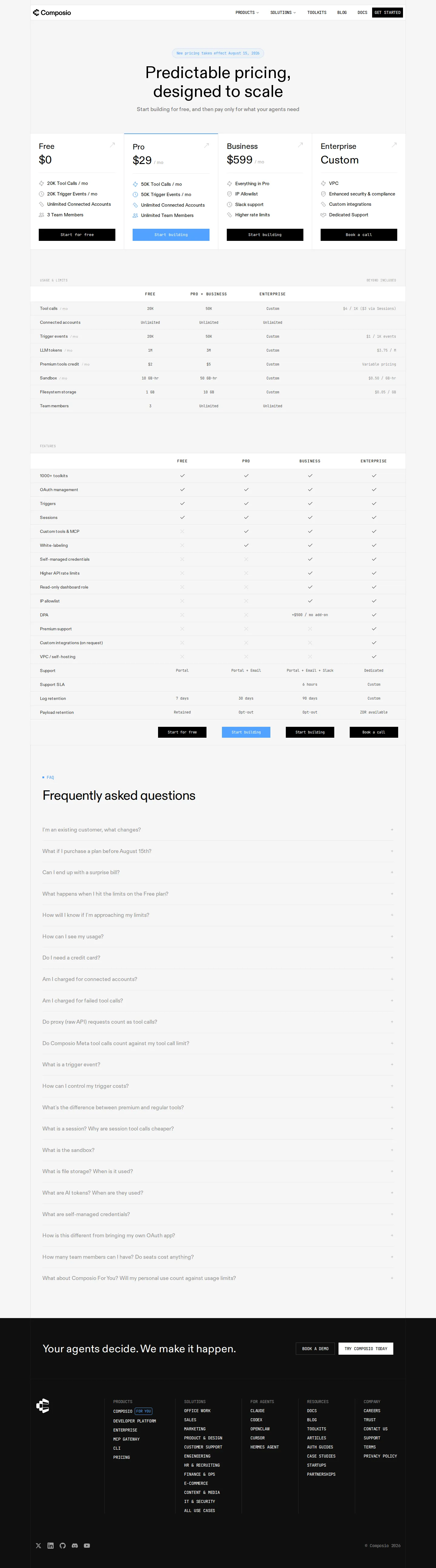
composio.dev/updated-pricing) retires the single tool-call meter for a six-dimension usage model (tool calls, trigger events, LLM tokens, premium-tools credit, sandbox GB-hr, filesystem storage) and re-tiers plans to Free ($0) · Pro ($29/mo) · Business ($599/mo) · Enterprise (Custom). The $229 “Serious Business” tier is retired, Pro’s included tool calls drop from 200K to 50K/mo, and tool-call overage rises to $4/1K ($3/1K via Sessions) from $0.299/1K. Existing customers keep their current plans and limits through December 31, 2026. The full announced table is under Pricing by product below.
Pricing by product
Composio platform (tool-call plans)
| Tier | Price | Included | Key mechanics |
|---|---|---|---|
| Totally Free | $0 / mo | 20K tool calls/mo + 1K premium; community support | Hard cap, no overage; free entry point for a first agent |
| Ridiculously Cheap | $29 / mo | 200K tool calls/mo + 5K premium; email support | +$0.299 / 1K additional standard calls; self-serve |
| Serious Business | $229 / mo | 2M tool calls/mo + 50K premium; Slack support (1K+/mo) | +$0.249 / 1K additional standard calls; lower unit rate |
| Enterprise | Custom | Custom user accounts; custom API volume | Dedicated SLA & SOC-2; VPC/on-prem; sales-led, quoted |
Standard vs premium overage rates
| Plan | Standard overage / 1K | Premium overage / 1K | Premium multiple |
|---|---|---|---|
| Ridiculously Cheap | $0.299 | $0.897 | 3.0x |
| Serious Business | $0.249 | $0.747 | 3.0x |
Announced pricing (effective August 15, 2026)
Composio has published a replacement pricing model at composio.dev/updated-pricing, dated to take effect August 15, 2026. It abandons the single tool-call meter and the “Ridiculously Cheap / Serious Business” labels for four conventional tiers (Free / Pro / Business / Enterprise) sitting on a six-dimension usage meter. Existing customers keep their current plans and limits through December 31, 2026; purchasing a current plan before August 15 counts as an existing customer.
| Tier | Price | Included | Key mechanics |
|---|---|---|---|
| Free | $0 / mo | 20K tool calls, 20K trigger events, 1M LLM tokens, $2 premium-tools credit, 10 GB-hr sandbox, 1 GB filesystem, 3 team members | Hard limits; usage pauses at cap until next month or upgrade |
| Pro | $29 / mo | 50K tool calls, 50K trigger events, 3M LLM tokens, $5 premium-tools credit, 50 GB-hr sandbox, 10 GB filesystem, unlimited team members | Custom tools & MCP, white-labeling; overage billed per dimension |
| Business | $599 / mo | Everything in Pro plus IP allowlist, Slack support, higher API rate limits, self-managed credentials, read-only dashboard role; 6-hour support SLA | DPA available as a +$500/mo add-on; same usage allowances as Pro |
| Enterprise | Custom | Custom volume across all dimensions; VPC / self-hosting, enhanced security & compliance, custom integrations, dedicated support, ZDR | Sales-led, “Book a call” |
Beyond-included (overage) rates under the announced model:
| Metered dimension | Free / Pro / Business included | Overage beyond included |
|---|---|---|
| Tool calls / mo | 20K / 50K / 50K | $4 / 1K ($3 / 1K via Sessions) |
| Trigger events / mo | 20K / 50K / 50K | $1 / 1K events |
| LLM tokens / mo | 1M / 3M / 3M | $3.75 / M |
| Premium-tools credit / mo | $2 / $5 / $5 | Variable pricing |
| Sandbox / mo | 10 / 50 / 50 GB-hr | $0.50 / GB-hr |
| Filesystem storage | 1 / 10 / 10 GB | $0.05 / GB |
| Connected accounts | Unlimited (all tiers) | Not metered |
Note the direction of the change for the entry paid plan: Pro stays $29/mo but its included tool calls fall from 200K to 50K/mo, tool-call overage rises from $0.299/1K to $4/1K, and the $229 “Serious Business” mid-tier is replaced by Business at $599/mo. Failed tool calls and Composio meta/session tool calls are not counted against limits.
Sales motions across products: PLG / self-serve for the Free, $29, and $229 plans (Free / Pro / Business under the announced model); sales-led for Enterprise (custom quote, “Book a call”).
Hidden costs : What Composio users actually pay
The headline plan fee is a floor, and the real bill is shaped by three things the pricing page underplays. First, premium tools: search APIs (Composio Search, Perplexity, Exa, SerpAPI), E2B code sandboxes, ML inference, and document processing bill at 3x a standard call from a much smaller allowance — an agent that leans on web search burns its 5K premium calls long before its 200K standard ones. Second, overage costs more than bundled usage: the $29 plan works out to roughly $0.145 per 1K bundled calls, but overage runs $0.299/1K — about double — so sustained overage makes the upgrade to $229 (effective ~$0.115/1K bundled) the rational move. Third, rate limits: premium tools are throttled to 1,000 calls/hour on free and 10,000/hour on paid plans, a soft ceiling on bursty agent workloads.
| Line item | Monthly cost (illustrative, $29 plan) |
|---|---|
| Base plan | $29 |
| 100K standard calls over allowance | ~$30 (at $0.299/1K) |
| 10K premium calls over allowance | ~$9 (at $0.897/1K) |
| Estimated total (agent in production) | ~$68 |
A team tracking toward that bill is already better off on Serious Business at $229 with 2M calls bundled — which is the point of the rate design.
Want to estimate your own Composio bill? Use the Composio pricing calculator to model your costs based on usage patterns.
Pricing evolution : Composio pricing history and changes
Cadence
| Period | Price changes | Product / SKU additions | Notes |
|---|---|---|---|
| 2024 H2 | Starter $39 | Individual / Starter / Growth | Meter: executions (10K free / 100K paid) |
| 2025 Q1 | Starter $39→$199→$29 | Hobby / Starter / Growth / Enterprise | Meter: API calls + user accounts; free cut 10K→2K |
| 2025 Q3 | Relaunch at $29/$229 | Totally Free / Ridiculously Cheap / Serious Business | Meter: tool calls; allowances 10x’d; overage published |
| 2026 H1 | 0 | 0 | Structure stable through 2026-06-10 live capture |
| 2026 Q3 | Repricing announced (effective Aug 15) | Free / Pro / Business / Enterprise | Six-dimension meter; $229 tier retired, $599 Business added; Pro tool calls 200K→50K; overage $0.299→$4/1K |
Tracked range: 2024–present, via Wayback Machine snapshots (2024-07, 2025-01, 2025-02, 2025-04, 2025-05, 2025-07) and live captures on 2026-06-10 and 2026-07-23.
Notable changes
- 2024-07 — Earliest archived pricing: Individual (Free Forever, 10K executions/mo), Starter $39/mo (100K executions), custom Growth. Limits expressed in executions, connected accounts, and log retention.
- 2025-01 — Restructure: Hobby (free, 2K API calls), Starter $199/mo (20K API calls), Enterprise. The meter becomes API calls plus authenticated user accounts; the free allowance drops 80%.
- 2025-02 — Starter cut from $199 to $29 and a $229 Growth tier appears — the $29/$229 price points that survive today arrived here, still denominated in API calls.
- 2025-07 — Tool-call relaunch alongside the July 22 $25M Series A: Totally Free (20K), Ridiculously Cheap $29 (200K), Serious Business $229 (2M). Allowances jump roughly 10x at the same price points, and per-1K overage rates ($0.299/$0.249) are published for the first time.
- 2026-06-10 — Live capture confirms the July 2025 structure is unchanged.
- 2026-07-23 — Major repricing announced via a banner on the live pricing page (“Pricing will be changing on August 15th”), detailed at
composio.dev/updated-pricing. Plans become Free ($0) / Pro ($29/mo, 50K tool calls) / Business ($599/mo) / Enterprise (Custom); the $229 “Serious Business” tier is retired, Pro’s included tool calls drop from 200K to 50K, and the single tool-call meter is replaced by six metered dimensions (tool calls, trigger events, LLM tokens, premium-tools credit, sandbox GB-hr, filesystem storage). Tool-call overage rises to $4/1K ($3/1K via Sessions). Existing customers keep their current plans and limits through December 31, 2026.
What’s unique : Composio’s distinctive pricing mechanics
1. One flat unit across 1,000+ apps — except a 3x premium class. Most integration platforms price by connector, by workflow, or by task complexity. Composio flattens everything to one tool-call price, then carves out a single premium class (search, sandboxes, inference) at exactly 3x. That keeps the mental model to two numbers while still protecting margin on calls where Composio pays real underlying costs.
2. Overage priced ~2x above the bundled rate. Bundled calls cost ~$0.145/1K on the $29 plan and ~$0.115/1K on the $229 plan, but overage runs $0.299 and $0.249. The gap makes sustained overage irrational and pushes growth into plan upgrades — the opposite of pay-as-you-go platforms that price marginal usage at or below the bundled rate.
3. A meter that keeps changing as the product expands. Composio billed on executions in 2024, API calls plus authenticated user accounts in early 2025, and tool calls from July 2025 — landing, for a year, on a unit the buyer (an agent developer) already counts. Each rename tracked the product’s center of gravity, from workflow automation toward a full agent runtime.
4. …but the two-number card is about to become a seven-row table. Effective August 15, 2026 (announced via a banner on the pricing page on 2026-07-23), the single tool-call meter and the clean 3x premium multiplier give way to a six-dimension usage model — tool calls, trigger events, LLM tokens, a premium-tools dollar credit, sandbox GB-hr, and filesystem storage, each metered and overaged separately. Tool-call overage jumps to $4/1K ($3/1K via Sessions), and premium tools shift from a legible 3x multiple to a variable-priced dollar credit. The very simplicity described above is what the new model trades away — legibility for margin accuracy on a widening set of cost drivers. Existing customers keep the simpler model through December 31, 2026.
Strengths & weaknesses
| Strengths | Weaknesses |
|---|---|
| Public, two-number price card (plan fee + per-1K overage) | Premium-tool mechanics live in docs, not on the pricing page |
| Free 20K calls/mo is a genuinely usable dev allowance | Free tier is hard-capped — agents stop working at the limit |
| Overage design cleanly funnels growth into upgrades | Overage at ~2x the bundled rate punishes spiky workloads |
| Tool call is a unit agent developers already count | Four meter identities in two years — a six-dimension model lands Aug 15, 2026 — churns early adopters |
| Enterprise adds VPC/on-prem and SOC-2 for regulated buyers | Aug 2026 model jumps $29 Pro straight to $599 Business with the same usage allowances — a wide self-serve gap |
Billing UX : tool-call allowances, overage rates, and support gating
- Two-number price card — each paid plan shows its monthly fee and its per-1K overage rate directly on the card ($29 + $0.299/1K; $229 + $0.249/1K), which is more transparent than most agent-infrastructure peers.
- Hard cap on free — the Totally Free plan carries no overage rate; usage stops at 20K calls, so a hobby agent fails closed rather than billing surprise dollars.
- Premium-tool sub-meter — premium calls draw from a separate allowance (1K/5K/50K) at 3x rates with their own hourly rate limits (1K/hr free, 10K/hr paid); this is documented in the docs rather than on the pricing page.
- Support-tier gating — support escalates by plan: community → email → Slack, with the $229 plan’s Slack channel explicitly gated at 1K+ calls/month.
- Enterprise “Book a call” quote flow — the Enterprise band routes to a custom quote covering custom user accounts, a dedicated SLA, SOC-2, custom API volume, and a VPC/on-prem option.
- Pre-announced pricing change with grandfathering — as of 2026-07-23 the pricing page banners an upcoming change (“Pricing will be changing on August 15th”) linking to a full
composio.dev/updated-pricingbreakdown, and its FAQ commits that existing customers (including anyone who purchases before August 15) keep their current plans and limits through December 31, 2026 — a rare, explicit grandfathering window rather than a silent migration.
Strategic wins : Why Composio’s pricing decisions worked
1. Repricing into the developer’s comfort zone
The January 2025 structure ($199 entry, 2K free calls) priced like middleware sold to companies. Cutting the entry plan 85% to $29 within weeks — and then 10x-ing allowances at the July relaunch — repriced Composio as a developer tool an individual can expense without approval. For a product whose funnel is 100,000+ developers wiring up agents, the cheap, self-serve entry is the growth engine. See how AI companies structure pricing.
2. Betting the meter on the tool call
Naming the unit “tool call” — the same word the OpenAI and Anthropic APIs use for agent actions — made the meter legible to exactly the buyer Composio wants. A developer estimating agent costs already thinks in tool calls per task; Composio’s price card plugs straight into that arithmetic. See choosing the right usage metric.
3. The 3x premium class instead of a price list
When some calls cost Composio real money (search APIs, sandboxes, inference), the temptation is a per-provider rate card. The flat 3x multiplier keeps pass-through economics without destroying the one-price simplicity — a clean answer to a problem that bloats most integration platforms’ pricing pages. Related: outcome-based pricing trends.
Areas to improve : Gaps in Composio’s pricing approach
1. Surface premium-tool pricing on the pricing page
The 3x multiplier, the separate premium allowances, and the premium overage rates ($0.897/$0.747 per 1K) live only in the docs. A search-heavy agent’s bill can run well above what the pricing page implies — the classic setup for bill shock. The fix is cheap: one more line per plan card.
2. Stabilize the meter
Executions → API calls → tool calls inside twelve months already forced anyone who modeled costs in 2024 to redo the exercise twice — and the six-dimension meter announced for August 15, 2026 is the fourth meter identity in two years. Grandfathering existing customers through December 31, 2026 softens the immediate blow, but any developer who priced against the tool-call meter now has to re-model against six metered dimensions with tool-call overage roughly 13x higher ($0.299 → $4/1K). Each remodel taxes exactly the developers who anchor the funnel; the current unit was the one that finally matched the product, and stability from here would be worth more than the next refinement.
3. Mind the new $29-to-$599 self-serve chasm
The announced August 2026 model retires the $229 mid-tier and inserts Business at $599/mo — but Pro and Business carry the same usage allowances (50K tool calls, 3M LLM tokens), so the 20x price step buys governance features (IP allowlist, Slack support, self-managed credentials, 6-hour SLA), not capacity. A team that outgrows Pro’s 50K tool calls but doesn’t need enterprise controls is left choosing between $4/1K overage on Pro or a $599 tier that adds no included volume — precisely the segment a mid-volume scale tier (or commitment-based pricing) would retain.
Monetization stack & signals : how Composio builds & buys its revenue engine
5 open roles
Off its $25M Series A, Composio is staffing its first dedicated revenue org — founding RevOps, a BDR leader, customer success and growth — rather than buying monetization tooling. No source names a billing, metering or CPQ vendor in internal use.
- Founding RevOps RevOps Jun 1, 2026
- Founding BDR Leader RevOps Jun 1, 2026
- Founding Customer Success Manager Customer success Jun 1, 2026
- Growth Engineer Growth May 21, 2026
- Growth Marketing Manager Growth May 21, 2026
Signals reviewed · derived from public job posts
Job postings fill and close over time — once a posting is filled we keep it as a dated citation (the quoted evidence remains); use View open roles for current listings.
Key takeaways
- Pick the unit your buyer already counts. Composio converged on the tool call — the same noun in every agent framework’s API — after two earlier meters (executions, API calls) failed to stick.
- Cheap entry beats high anchor for developer infrastructure. The $199 entry plan lasted weeks; the $29 plan that replaced it has held for over a year and survived a full relaunch.
- A flat multiplier can replace a rate card. Pricing premium tools at exactly 3x standard keeps pass-through economics in two numbers instead of a per-provider price list.
- Price overage above the bundled rate if you want upgrades. Composio’s ~2x overage premium makes the next tier the rational answer to growth — by design.
- Reprice loudly, and give incumbents a runway. The July 2025 tool-call relaunch shipped in the same news cycle as the $25M Series A — new meter, new names, 10x allowances as one coherent story. The August 2026 repricing goes further on communication: a pre-announcement banner roughly three weeks ahead, a published side-by-side model, and explicit grandfathering of existing customers through December 31, 2026 — the opposite of a silent migration.
UBP implications
- Agent infrastructure is converging on the action as the value metric. Tool calls sit above tokens (too granular, model-dependent) and below outcomes (too hard to attribute) — a middle layer that maps to what the agent actually did. See usage-based pricing strategy.
- Hybrid plans-plus-overage is doing the work of pure usage. Composio brands itself “usage based,” but the flat fee + allowance + punitive overage structure is really a subscription ladder with a usage escape valve — predictable revenue with usage-shaped expansion.
- A single-meter abstraction holds only while your cost drivers are few. A single tool-call unit with a premium-at-3x class kept Composio’s card to two numbers for a year — but as the product absorbed triggers, LLM sub-agents, sandboxes and filesystem storage, that abstraction leaked, and its August 2026 model breaks the meter into six priced dimensions. The UBP lesson: a flat class system buys legibility while cost drivers are few, but a platform that keeps absorbing new resource types gets pushed toward metering each one — trading simplicity for margin accuracy. See choosing the right usage metric.
Sources
- Composio pricing page (live capture) (accessed 2026-07-23)
- Composio announced pricing (effective August 15, 2026) (live capture) (accessed 2026-07-23)
- Composio premium / pro tools documentation (accessed 2026-07-23)
- SiliconANGLE — Composio raises $25M in funding to ease AI agent development (accessed 2026-06-10)
- PR Newswire — Composio raises $29M to solve AI’s learning problem (accessed 2026-06-10)
- Lightspeed — Investing in Composio (accessed 2026-06-10)
- Together Fund — Investing in Composio (accessed 2026-06-10)
- Wayback Machine snapshots: composio.dev/pricing (accessed 2026-06-10) — snapshots from 2024-07, 2025-01, 2025-02, 2025-04, 2025-05, 2025-07
Bottom line
Composio is tool-calling infrastructure for AI agents — managed auth and execution across 1,000+ apps — priced on a hybrid model: flat plans at $0, $29, and $229/month bundling 20K, 200K, and 2M tool calls, with per-1K overage ($0.299/$0.249) and a premium-tool class billed at exactly 3x. The structure landed in July 2025 alongside a $25M Lightspeed-led Series A, after a year in which the meter changed from executions to API calls to tool calls and the entry price whipsawed $39→$199→$29. It is one of the cleanest public price cards in agent infrastructure — provided you read the docs for the premium-tool fine print. That clean card is itself about to change: effective August 15, 2026 Composio replaces the single tool-call meter with a six-dimension usage model (Free / Pro $29 / Business $599 / Enterprise), retires the $229 tier, and raises tool-call overage to $4/1K, with existing customers grandfathered through December 31, 2026. Browse the pricing blueprint for more fully-researched company profiles.
Want to compare Composio against other AI agent infrastructure companies? Browse the pricing blueprint.
Pricing timeline : Major events on a vertical axis
Each milestone below corresponds to a public pricing change, product launch, or material adjustment. Major events use a filled marker; minor adjustments use a faded one.
Major repricing announced — Business $599 tier, $229 tier retired, 6-dimension usage meter (effective Aug 15, 2026)
A banner on the live pricing page announces a new pricing model effective August 15, 2026, detailed at composio.dev/updated-pricing. Plans become Free ($0), Pro ($29/mo, 50K tool calls — down from 200K), Business ($599/mo — replacing the $229 Serious Business tier), and Enterprise (Custom). The single tool-call meter is replaced by six metered dimensions (tool calls, trigger events, LLM tokens, premium-tools credit, sandbox GB-hr, filesystem GB), and tool-call overage jumps to $4/1K ($3 via Sessions) from $0.299/1K. Existing customers keep current plans and limits through December 31, 2026.
Usage-based tool-call pricing confirmed live
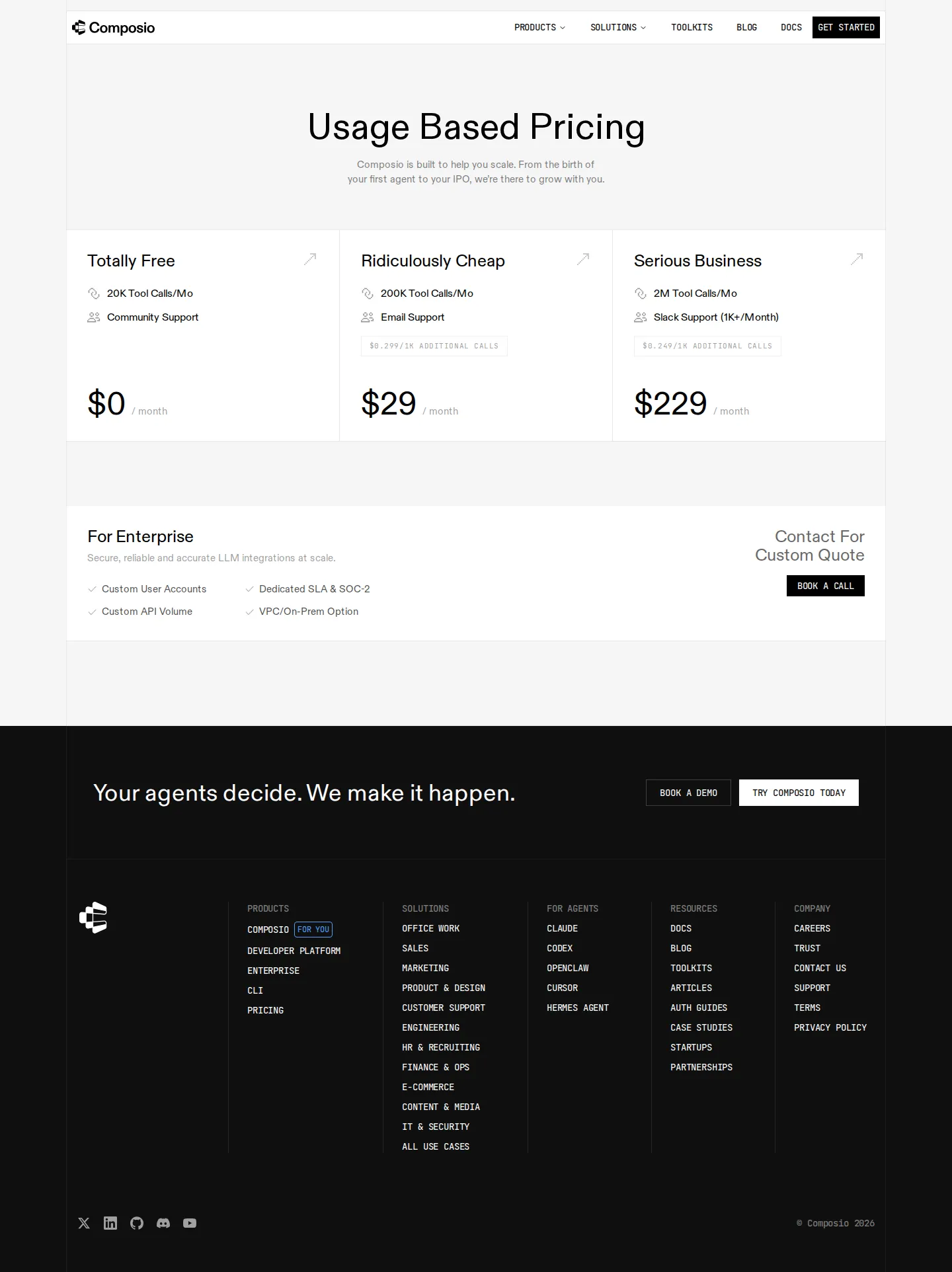
Live capture confirms the structure is unchanged: Free (20K tool calls/mo, $0), Ridiculously Cheap ($29, 200K/mo, +$0.299/1K), Serious Business ($229, 2M/mo, +$0.249/1K), and custom Enterprise with VPC/on-prem, dedicated SLA and SOC-2.
Tool-call relaunch — Totally Free / Ridiculously Cheap / Serious Business
By late July 2025 — alongside the $25M Lightspeed-led Series A announced July 22 — a rebuilt site introduced the current plans: Totally Free (20K tool calls, no overage), Ridiculously Cheap $29 (200K calls, +$0.299/1K), Serious Business $229 (2M calls, +$0.249/1K), plus custom Enterprise. The meter became the 'tool call' and per-1K overage rates were published for the first time.
Starter cut $199 to $29; $229 Growth tier added
By mid-February 2025 Starter had been repriced from $199 to $29/mo and a $229 Growth tier appeared (up to 600K API calls, 3,000 user accounts in the comparison view) — an 85% price cut on the entry paid plan within weeks.
API-call restructure — Starter jumps to $199
Restructured to Hobby (free, 2K API calls/mo, 50 user accounts), Starter at $199/mo (20K API calls, 500 user accounts), and Enterprise. The meter shifted from executions to API calls plus authenticated user accounts, and the free allowance fell from 10K to 2K.
Executions-metered Free / $39 Starter
Earliest archived pricing: Individual (Free Forever — 10K executions/mo, 100 connected accounts, Discord support), Starter at $39/mo (100K executions, 5,000 connected accounts, email support), and a custom Growth tier with RBAC, SSO, and on-prem. The meter was 'executions'.
- · Composio's paid tiers carry unusually candid marketing names on the live pricing page: 'Ridiculously Cheap' ($29) and 'Serious Business' ($229).
- · Its pricing meter changed identity three times in roughly twelve months: 'executions' (2024) → 'API calls' plus authenticated user accounts (January 2025) → 'tool calls' (July 2025).
- · The entry paid plan whipsawed from $39 to $199 to $29 between July 2024 and February 2025 — an 85% cut within weeks of the $199 peak.
Questions & answers
- How does Composio pricing work?
- Composio sells three flat monthly plans — $0, $29, and $229 — each bundling a monthly tool-call allowance (20K, 200K, and 2M respectively). Calls beyond the allowance bill per 1,000 additional calls on paid plans, and Enterprise is custom-quoted.
- What is a tool call in Composio?
- A tool call is a single action an AI agent takes through Composio against one of its 1,000+ app integrations (for example sending an email or creating a ticket). It is the unit Composio meters and bills on.
- How much does Composio cost?
- Composio offers a free plan with 20K tool calls/month, a $29/month plan with 200K tool calls, and a $229/month plan with 2M tool calls. Overage runs $0.299/1K and $0.249/1K respectively, and Enterprise pricing is a custom quote.
- What are Composio premium tools and how are they billed?
- Premium tools are high-cost integrations like search APIs, E2B code sandboxes, and ML inference. They bill at roughly 3x a standard tool call, with separate included allowances (1K free, 5K on the $29 plan, 50K on the $229 plan) and overage at $0.897/1K and $0.747/1K.
- Is Composio changing its pricing?
- Yes. Effective August 15, 2026, Composio replaces its single tool-call meter with a six-dimension usage model (tool calls, trigger events, LLM tokens, premium-tools credit, sandbox GB-hr, and filesystem storage) and re-tiers plans to Free, Pro ($29/mo), Business ($599/mo), and Enterprise. The $229 'Serious Business' tier is retired, Pro's included tool calls drop from 200K to 50K/month, and tool-call overage rises to $4/1K ($3/1K via Sessions). Existing customers keep their current plans and limits through December 31, 2026.
- Does Composio have a free tier?
- Yes. The Totally Free plan costs $0/month and includes 20K standard tool calls plus 1K premium tool calls per month with community support. No overage applies on the free plan — usage is capped.