AI Summary
About
Dropzone AI builds an autonomous AI SOC analyst — software that investigates every incoming security alert end-to-end, from triage through evidence-gathering to a written verdict, without pre-built playbooks. The product reasons through phishing, endpoint, identity, and cloud-security alerts the way a human Tier-1 analyst would, querying the customer’s SIEM, EDR, identity, and cloud tools during each investigation and showing its work. The company positions this as a way for short-staffed security teams to investigate 100% of alerts rather than triaging only the ones they have time for.
The buyer is a security operations team — anywhere from a three-person in-house SOC to a large Managed Security Service Provider (MSSP) running detection-and-response across a portfolio of clients. Dropzone AI reports 300+ deployments worldwide and 90+ integrations, and was named a Gartner Cool Vendor for the Modern SOC. Named customers span Zapier, Lemonade, UiPath, Pipe, Critical Insight, ECS, and CBTS, and the company says it works with the largest IT services provider to the U.S. Department of Defense. The Seattle-based company is venture-backed: it raised a $16.85M Series A led by Theory Ventures in April 2024, followed by a $37M Series B led by Theory Ventures in July 2025 (with Madrona, Decibel, Pioneer Square Labs, and In-Q-Tel) — about $54M total — to fund global expansion.
Commercially, Dropzone AI is a privately held, sales-led vendor. Notably, it used to publish a list price — a “Starting list price” of $24,000/year in mid-2024 that rose to $36,000/year by early 2025 — but during 2025 it removed all public dollar amounts from its pricing page, moving to a fully sales-quoted model. Its three packaged tiers — a base AI SOC Analyst plan, an Enterprise plan, and an MSSP plan — are now all custom-quoted, and the pricing page substitutes an interactive ROI calculator for any headline rate. It competes against traditional SOAR automation platforms (which it frames as playbook-bound) and against the alternative of simply hiring more analysts.
Pricing summary : An ROI-led, sales-quoted investigation-capacity subscription
Dropzone AI uses a sales-quoted annual subscription whose single value metric is investigation capacity, not seats, tokens, or alerts ingested. The current published pricing page shows no dollar amounts at all; instead it frames cost through an ROI calculator and three named feature tiers. This is a recent change: as recently as early 2025 the page carried a public “Starting list price” for the base plan, which the company has since removed (the exact figures and dates are traced in Pricing evolution below). The dimensions a buyer negotiates are:
- Investigation capacity (the meter): the base AI SOC Analyst plan covers up to 4,000 full investigations per year per AI analyst, with unlimited human users included. Approaching the cap triggers an email grace window, and additional capacity can be purchased — with volume discounts available for larger needs.
- Tier / tenancy: the base plan runs on shared infrastructure; Enterprise upgrades to a dedicated single-tenant environment with custom workflows; MSSP provides a dedicated multi-tenant environment so a provider can pool AI analysts across its client base. Both upper tiers add premium support and SLAs.
- Quote, not catalog: every tier — including the base plan — is obtained by contacting sales. There is no free tier and no self-serve checkout.
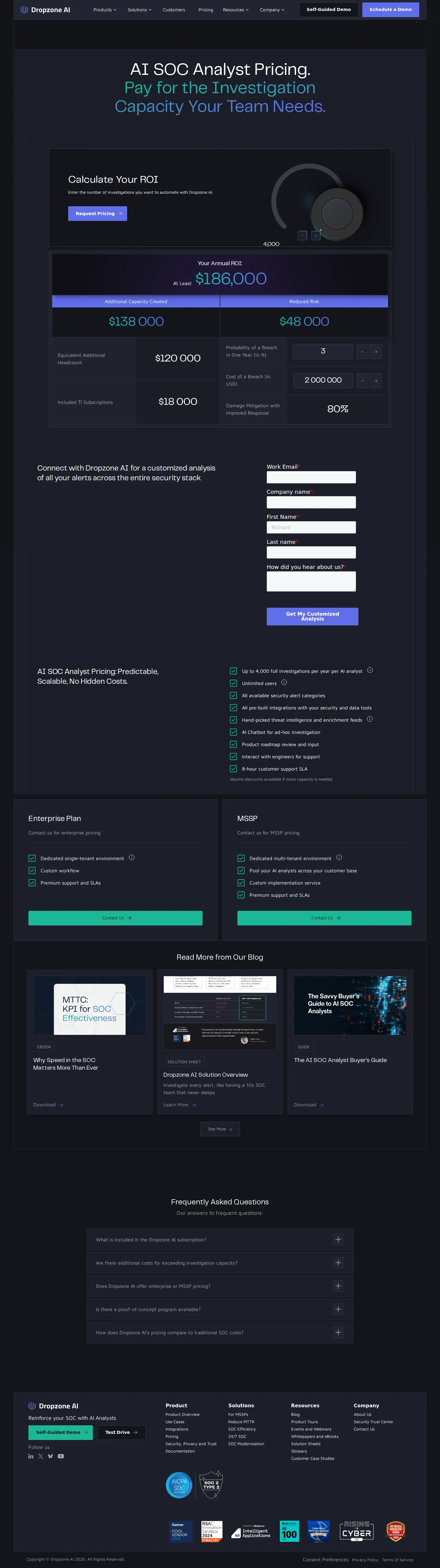
Instead of a price, the pricing page leads with a “Calculate Your ROI” widget: enter the number of investigations to automate (default 4,000) and it returns an estimated annual return (“At Least $186,000” at the default) decomposed into Additional Capacity Created, Equivalent Additional Headcount, Included TI Subscriptions, and Reduced Risk, with adjustable breach-probability, breach-cost, and damage-mitigation inputs.
A former list price still circulates in third-party buyer guides (now stale — see Pricing evolution); treat any number you find as an indicative floor, because the actual quoted price for any given deal is custom.
What makes this different: Dropzone AI meters on investigations — the unit of analyst work — and sells the outcome through an outcome / ROI-led sales motion rather than a price list, anchoring negotiation on avoided headcount rather than on a per-seat or per-token rate. For more on this metering choice, see our guide to usage-based pricing value metrics.
Pricing by product
Dropzone AI lists three tiers on a single pricing page, none with a published dollar amount. The “Included” columns below are transcribed verbatim from the pricing page; the “Price” column is the exact call-to-action shown for each tier.
AI SOC Analyst (base plan)
| Tier | Price | Included | Key mechanics |
|---|---|---|---|
| AI SOC Analyst | Contact sales (carried a public list price until 2025 — see Pricing evolution) | Up to 4,000 full investigations / year per AI analyst; unlimited users; all alert categories; all pre-built integrations; threat-intel & enrichment feeds; AI chatbot; roadmap input; engineer support; 8-hour support SLA | ”Predictable, Scalable, No Hidden Costs”; volume discounts for added capacity |
Upper tiers (sales-quoted)
| Tier | Price | Included | Key mechanics |
|---|---|---|---|
| Enterprise | Contact sales | Dedicated single-tenant environment; custom workflow; premium support and SLAs | For large security orgs needing isolation |
| MSSP | Contact sales | Dedicated multi-tenant environment; pool AI analysts across your customer base; custom implementation service; premium support and SLAs | For managed security service providers |
Sales motions across products: there is no self-serve tier — all three plans (base AI SOC Analyst, Enterprise, MSSP) are sales-led and custom-quoted.
The ROI calculator (in place of a price)
Rather than a rate card, the pricing page leads with a “Calculate Your ROI” widget. The buyer enters the number of investigations to automate (default 4,000) and the tool returns an estimated annual return, decomposed into four components. At the default input it shows:
| ROI component | Estimated annual value |
|---|---|
| Additional Capacity Created | $138 000 |
| Equivalent Additional Headcount | $120 000 |
| Included TI Subscriptions | $18 000 |
| Reduced Risk | $48 000 |
| Your Annual ROI (At Least) | $186,000 |
The Reduced Risk figure is itself driven by three adjustable inputs — Probability of a Breach in One Year (%), Cost of a Breach (USD), and Damage Mitigation with Improved Response (shown at 80%). These are modeled returns, not prices: Dropzone AI’s actual subscription cost is never displayed and must be requested.
Hidden costs : investigation overage, third-party tool metering, and tenancy step-ups
Because Dropzone AI no longer publishes a list price, a precise bill cannot be reconstructed from public data — there is no UsagePricing calculator for it yet. But the pricing page and its FAQ are unusually candid about where the additional costs come from, so the cost drivers a buyer should model in a quote are knowable:
- Investigation overage beyond the 4,000/year cap. The base plan covers up to 4,000 full investigations per year per AI analyst. Dropzone AI emails you with a grace window as you approach the limit and sells “extra capacity packages.” A high-alert-volume SOC can blow through 4,000 investigations well before year-end, so the effective annual cost is the base subscription plus however many capacity packages (or additional AI analysts) the team needs. Volume discounts apply, but the unit economics are negotiated, not published.
- Third-party tool metering (the genuinely external cost). Dropzone AI’s own FAQ states: “Some of the security tools that our AI Analyst taps may have extra metering. You will need to pay extra fees to your provider … if you go above your current limits.” Because each investigation queries the customer’s SIEM, EDR, identity, and threat-intel tools, heavier investigation volume can drive up those vendors’ bills — a cost that lands outside the Dropzone invoice and is easy to miss. (Note a public disagreement: one third-party guide claims Dropzone “charges per alert ingested”, while another stresses “no hidden data-ingest fees” — the page itself meters investigations, not ingested alerts, but downstream tool metering is real.)
- Tenancy step-up (shared → Enterprise → MSSP). The base plan runs on shared infrastructure; Enterprise moves to a dedicated single-tenant environment and MSSP to a dedicated multi-tenant one, each adding premium support, SLAs, and (for MSSP) custom implementation services. These are priced on request and represent the largest discrete jumps in a quote.
Because the price is now opaque, the most honest planning input is the former public anchor — roughly $36,000/year for 4,000 investigations (~$9/investigation) — used as a floor, with the drivers below moving the real number up. The table models direction, not fabricated totals, since Dropzone publishes no current rates:
| Cost driver | Effect on annual bill |
|---|---|
| Base subscription (≤4,000 investigations) | The floor — formerly ~$36,000/year list; now sales-quoted |
| Investigation overage (extra capacity packages) | Added when alert volume exceeds 4,000/year; volume discounts apply, rates unpublished |
| Third-party tool metering (SIEM/EDR/TI) | External — paid to those vendors as the AI’s queries push past your existing limits |
| Enterprise tenancy (dedicated single-tenant) | Step-up over base; adds isolation, custom workflow, premium SLAs — quoted |
| MSSP tenancy (dedicated multi-tenant) | Largest step-up; adds custom implementation services across a client base — quoted |
| Effective annual cost | ~$36,000 floor + overage + external metering + tenancy step-up (all custom-quoted) |
Want to estimate your own Dropzone AI bill? A dedicated Dropzone AI pricing calculator is not yet live — until Dropzone publishes rates again, model your annual cost from the ~$36,000/year (4,000-investigation) anchor above, then add overage capacity packages, any third-party tool metering, and the Enterprise/MSSP tenancy step-up.
Pricing evolution : from a $24K list price to a 50% hike to no price at all
Cadence
| Quarter | Price changes | Product / SKU additions | Notes |
|---|---|---|---|
| 2024 Q3 | 0 | 0 | Public “Starting list price: $24,000/year” for up to 4,000 investigations; Enterprise + MSSP already Contact-sales. |
| 2025 Q1 | 1 | 1 | List price raised ~50% to $36,000/year; interactive ROI calculator added; richer feature list (threat-intel feeds, 8-hour SLA). |
| 2025 Q2 | 0 | 0 | Pricing page redesigned under the “Pay for the Investigation Capacity Your Team Needs” headline; $36,000 list price retained. |
| 2026 Q2 | 1 | 0 | Public list price removed — all dollar amounts gone; page now leads with the ROI calculator only and routes every tier to “Request Pricing.” |
Tracked range: 2024-Q3 to 2026-Q2 (Wayback Machine + live capture). The exact quarter the $36,000 line was removed falls between the 2025-04 snapshot (price still shown) and the 2026-06 live capture; it is attributed to 2026-Q2 here for the capture date.
Notable changes
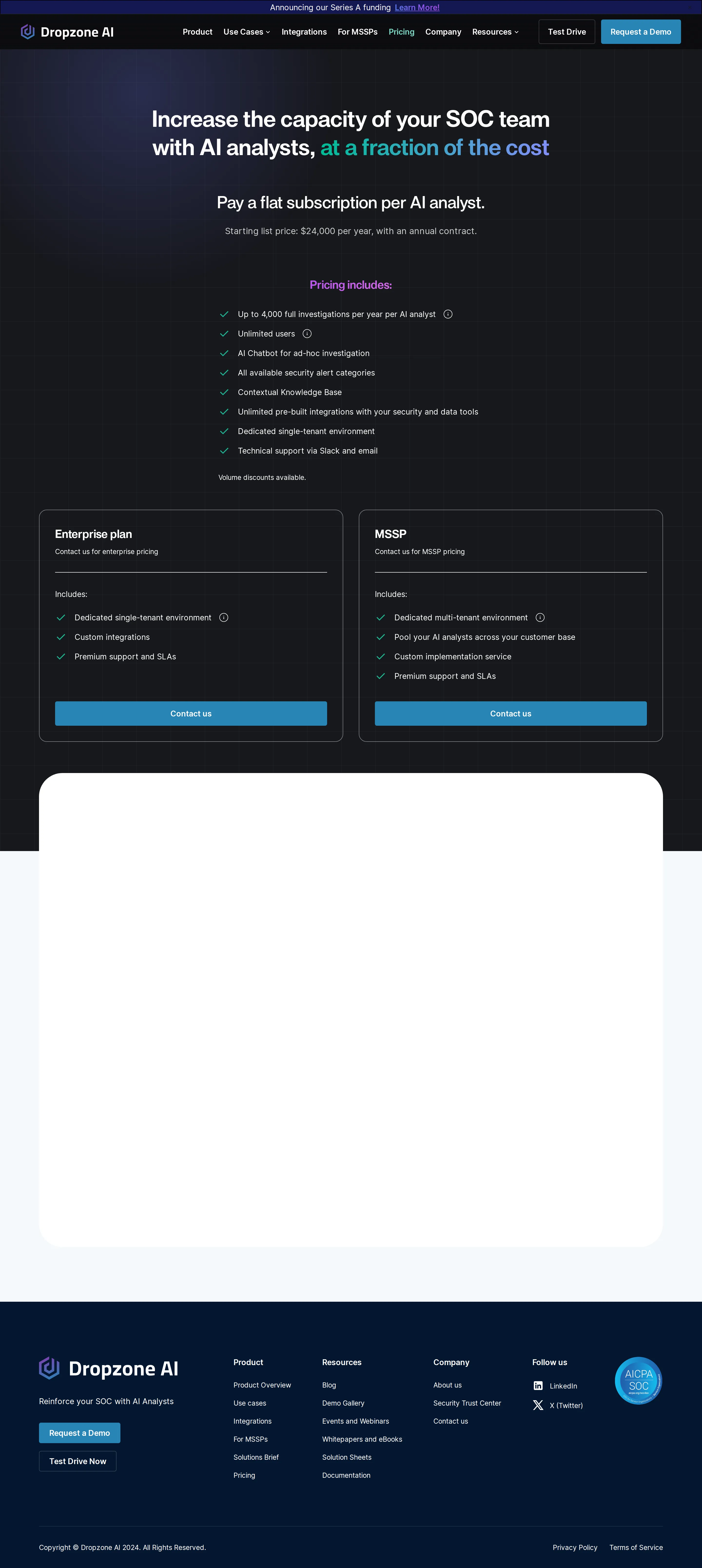
- 2024-07 — Pricing page shows a public “Starting list price: $24,000 per year, with an annual contract” for up to 4,000 investigations per AI analyst.
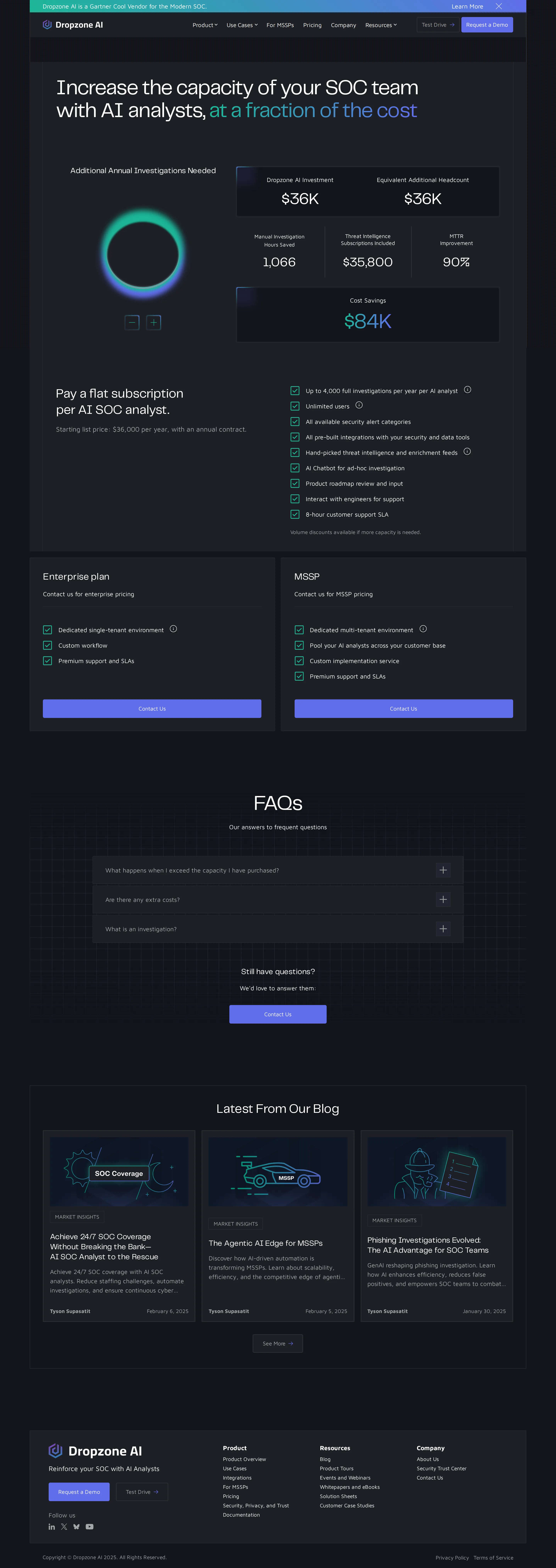
- By 2025-02 — Starting list price raised ~50% to $36,000/year; an interactive ROI calculator is added alongside the list price.
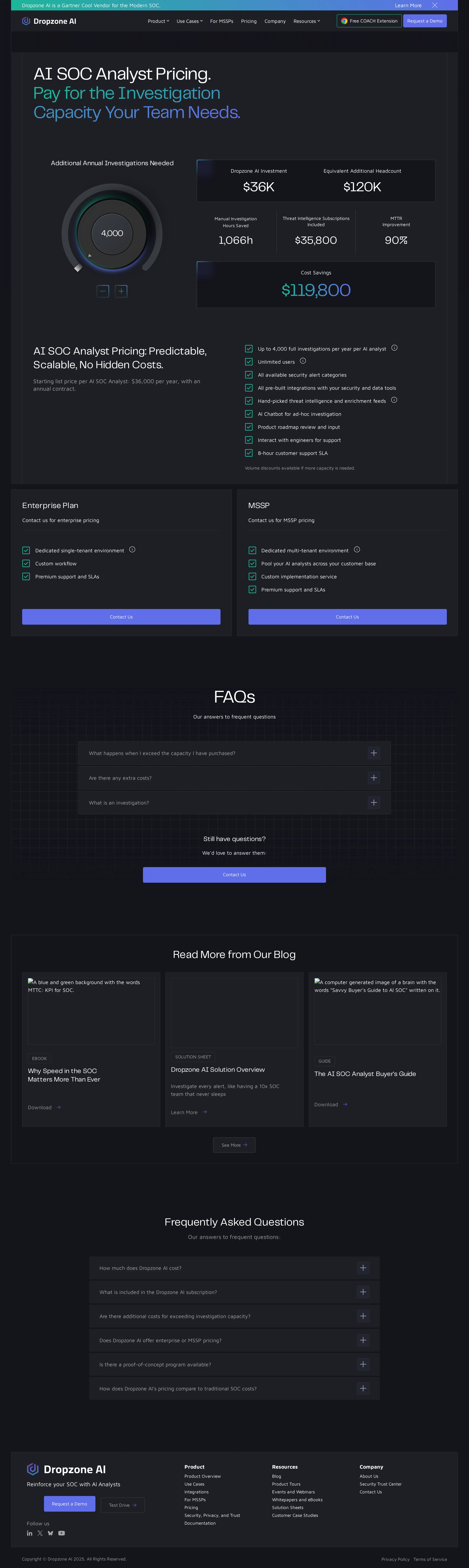
- 2025-04 — Page relaunched as “AI SOC Analyst Pricing — Pay for the Investigation Capacity Your Team Needs,” still displaying “$36,000 per year” and an FAQ that reads “Dropzone AI pricing starts at $36,000 per year.”
- 2025-07-28 — Dropzone AI announces a $37M Series B led by Theory Ventures (BusinessWire), bringing total funding to ~$54M and funding a move toward channel/partner distribution.
- By 2026-06-07 — All public dollar amounts removed from the pricing page; the “$36,000” line and the “How much does Dropzone AI cost?” FAQ entry are gone, leaving only the ROI calculator and “Request Pricing” CTAs.
The list-price removal in detail
Dropzone AI is a rare case of a vendor that published a transparent list price and then walked it back. From mid-2024 through at least April 2025, the pricing page carried an explicit “Starting list price” — $24,000/year, then $36,000/year — plus an FAQ that answered “How much does Dropzone AI cost?” in plain dollars. By the June 2026 capture, both were gone: no headline price, no cost FAQ, every tier routed to “Request Pricing.” The shift to opacity lines up with two events visible in the public record — the July 2025 $37M Series B (which named global expansion and scaling as the use of funds) and a reported move to channel-only distribution, where partner-led deals make a single public list price harder to maintain. The legacy figure now survives mainly in third-party buyer guides: independent AI-SOC roundups still cite ~$36,000/year for 4,000 investigations — roughly $9 per investigation — and call it “the most accessible enterprise AI SOC entry point by far” (UnderDefense, accessed 2026-06-08; Intezer, accessed 2026-06-08). Treat that as a stale list anchor, not a current quote.
What’s unique : metering on investigations, selling on ROI
Metering on investigations — the unit of analyst work. Dropzone AI bills on investigations, not seats, tokens, or alerts ingested. One investigation is “a comprehensive report with a summary, outcome, and AI analyst work log,” and related alerts from one incident collapse into a single investigation. This is a deliberately outcome-shaped meter: 4,000 investigations/year is framed as “the equivalent of the average output of a human tier-1 analyst,” so a unit of the bill maps to a unit of analyst labor. It is the first canonical use of investigations as a usage-based billing unit in this corpus, distinct from tickets, resolutions, or raw log events — part of the broader shift toward agentic, task-completion pricing.
Unlimited users bundled with the capacity cap. Where most security tools meter seats, Dropzone AI bundles unlimited human users into the investigation-capacity subscription. A growing SOC adds analysts at no incremental license cost; the only thing that scales the bill is automated throughput.
An ROI calculator in place of a price. The current page leads not with a number but with a “Calculate Your ROI” widget that returns “At Least $186,000” of modeled annual return, decomposed into Additional Capacity Created, Equivalent Additional Headcount, Included TI Subscriptions, and Reduced Risk. This is a textbook outcome-based / ROI-led pricing presentation: the buyer is asked to compare against the cost of analyst headcount, not against a competitor’s per-seat rate.
A tenancy ladder, not a feature ladder. The upsell path is shared infrastructure → dedicated single-tenant (Enterprise) → dedicated multi-tenant (MSSP), rather than feature-gating. For security buyers, isolation and tenancy are the premium, so the ladder maps cleanly to procurement requirements.
A list price that was published and then withdrawn. Unusually, Dropzone AI ran the full transparency experiment — a public “$24,000 → $36,000/year” starting price — and reversed it, replacing the number with a quote-only motion. That arc (documented in Pricing evolution) is itself the most distinctive thing about how this company prices.
Strengths & weaknesses
| Strengths | Weaknesses |
|---|---|
| Value metric (investigations) maps directly to analyst workload | Withdrew its public list price; buyers can no longer self-qualify on budget |
| Unlimited users removes seat-count friction for growing SOCs | No free or self-serve tier; every deal needs a sales motion |
| ROI calculator frames cost against avoided headcount | Annual investigation cap can require mid-term capacity top-ups |
| Clear tenancy ladder for Enterprise and MSSP isolation needs | Pricing opacity makes competitive comparison hard for buyers |
| Unusually candid FAQ about overage and third-party tool metering | Third-party tool metering can add costs outside the Dropzone invoice |
Billing UX : ROI calculator, capacity grace window, and quote requests
- “Calculate Your ROI” widget — the centerpiece of the pricing page; a buyer enters the number of investigations to automate and it returns an estimated annual ROI broken into Additional Capacity Created, Equivalent Additional Headcount, Included TI Subscriptions, and Reduced Risk.
- Breach-risk inputs — the Reduced Risk component is adjustable via Probability of a Breach in One Year (%), Cost of a Breach (USD), and Damage Mitigation with Improved Response (defaulting to 80%), so the buyer can tune the modeled return to their own environment.
- “Request Pricing” / “Get a Custom Quote” / “Contact Us” CTAs — every tier and the calculator route to a sales conversation rather than a checkout; the base plan, Enterprise, and MSSP all use a contact form.
- Investigation-capacity grace window — as a customer approaches the annual investigation limit, Dropzone AI sends an email notification with a grace window, and additional capacity can be purchased to avoid interruption.
- Proof-of-concept (POC) and self-guided demo — a structured POC program and a browser-based self-guided demo (no install, provisioned account, ~10–15 minutes) let teams evaluate the product before a quote is finalized.
Strategic wins : why investigation-metered, ROI-led packaging works
1. Metering on investigations aligns price with delivered work
By billing on investigation capacity rather than seats, Dropzone AI ties cost to the work the AI actually performs — and explicitly benchmarks 4,000 investigations/year against “the average output of a human tier-1 analyst.” That is exactly the kind of outcome-aligned value metric that resonates with buyers who already price the alternative (headcount) in the same terms. It also future-proofs the meter: as the AI gets more efficient, the unit the customer pays for (a finished investigation) stays stable even as the underlying token/compute cost falls — a structural advantage we explore in the AI token-cost deflation paradox.
2. Unlimited users removes a growth tax
Bundling unlimited human users with the investigation cap means a growing SOC is never penalized for adding people. The value story stays focused on automated throughput rather than seat count, which removes a common source of expansion friction and makes the bill predictable as the team scales — the opposite of the per-seat creep covered in our usage-based pricing fundamentals.
3. ROI calculator reframes the buying conversation
Leading with a modeled annual return (“At Least $186,000”) instead of a price anchors the deal on avoided headcount and reduced breach risk rather than on a line-item rate. For a category where the honest comparison is “AI analyst vs. hiring another human,” reframing the conversation around delivered value — the heart of outcome-based pricing — is a defensible sales motion, especially once the public list price was withdrawn and there was no number to negotiate down from.
Areas to improve : where pricing opacity costs deals
1. Withdrawing the list price reintroduced funnel friction
Dropzone AI had the rarest asset in enterprise security pricing — a credible, public “starting at $36,000/year” anchor — and removed it. Budget-conscious buyers can no longer pre-qualify before a sales call, which lengthens the funnel and pushes the (still-circulating) $36,000 number into third-party guides Dropzone doesn’t control. Concrete fix: restore a published “starting at” floor (even a banded range), exactly the transparency lever covered in our usage-based pricing fundamentals; it costs little and keeps the narrative in Dropzone’s hands while leaving Enterprise/MSSP custom.
2. The ROI calculator shows return but never the cost side
The calculator outputs “At Least $186,000” of modeled return but never the price it’s returning on, so the headline ratio is unfalsifiable to a skeptical buyer. Concrete fix: show a worked end-to-end example — “$36,000 subscription → $186,000 modeled return” — so the ROI claim is anchored to a real cost. Pairing modeled value with a real price is the credibility pattern behind durable outcome-based pricing.
3. Capacity-cap and overage mechanics are qualitative, not quantified
The grace window and “extra capacity packages” are described in words but never priced, so a buyer can’t model what happens when a noisy quarter pushes them past 4,000 investigations. Concrete fix: publish indicative overage pricing (per-investigation or per-1,000-investigation block) and the grace-window length, so capacity risk is quantifiable before signing — reducing the purchase anxiety that opacity creates.
Monetization stack & signals : how Dropzone AI builds & buys its revenue engine
Buys 3 Builds 0
A lean, buy-everything stack — Salesforce for CRM, Pylon for post-sale support, Metabase for reporting — consistent with a fully sales-led motion. No billing or metering vendor is visible; revenue flows through negotiated contracts, not self-serve checkout.
-
“Salesforce (SFDC) — CRM”
-
“pool tickets (Pylon was a huge unlock for managing Slack and Microsoft Teams support without losing things in the noise)”
-
“Metabase — visibility and reporting”
Signals reviewed · derived from engineering blogs
Key takeaways
- Pick a value metric that maps to the work, not the user. Dropzone AI meters investigations — explicitly benchmarked against a human tier-1 analyst’s annual output — and bundles unlimited users, so the bill tracks AI output rather than seat count. Teams pricing AI agents should look for the unit of delivered work before defaulting to seats.
- A withdrawn list price is hard to take back. Dropzone’s $36,000 figure still circulates in third-party buyer guides long after the company removed it. Once a number is public, the market keeps quoting it — so removing transparency doesn’t reclaim narrative control, it just cedes it to others.
- An ROI calculator can substitute for a price — but only if it shows the cost side. Leading with modeled return frames the conversation around value, yet a return figure with no price to return on reads as marketing rather than math. Pair the two.
- Tenancy is a clean upsell axis for security buyers. Shared → single-tenant → multi-tenant maps directly to isolation and compliance requirements, letting the upsell ladder follow procurement reality instead of arbitrary feature gates.
- Capacity caps need a graceful, quantified overage path. An email grace window and purchasable capacity packages reduce the risk of a hard stop, but leaving overage rates unpublished reintroduces the very budget uncertainty the flat subscription was meant to remove.
UBP implications
- Investigations are a credible new usage meter for security AI. Metering on the unit of analyst work — not on logs ingested or seats provisioned — gives buyers a value metric they can reason about and benchmark against headcount. Expect “investigations,” “resolutions,” and “tasks completed” to become the dominant meters for autonomous AI agents, displacing token- and seat-based pricing.
- Outcome framing can replace a rate card — when the buyer already prices the alternative. ROI-led packaging works in security because the comparison (“AI analyst vs. another human hire”) is already denominated in the same currency. That makes it portable to any category where the buyer’s status-quo cost is legible; it fails where the alternative is fuzzy.
- Pricing transparency is a one-way door for usage-based vendors. Dropzone shows that withholding a list price can protect deal-level margin and channel flexibility, but it forfeits self-serve qualification and lets third parties define your price. UBP vendors should treat the decision to publish — or un-publish — as strategic and hard to reverse.
Sources
- Dropzone AI pricing page (accessed 2026-06-07)
- Dropzone AI MSSP page (accessed 2026-06-07)
- Dropzone AI schedule-a-demo page (accessed 2026-06-07)
- Dropzone AI self-guided demo page (accessed 2026-06-07)
- Dropzone AI contact page (accessed 2026-06-07)
Bottom line
Dropzone AI prices its autonomous AI SOC analyst as a sales-quoted annual subscription metered by investigation capacity — up to 4,000 investigations a year per AI analyst, unlimited users — with Enterprise and MSSP tiers that add dedicated tenancy. It is a rare reverse-transparency case: it published a “$24,000 → $36,000/year” starting price through early 2025 and then removed all dollar amounts, replacing the number with an ROI calculator that frames cost against avoided analyst headcount and reduced breach risk. The legacy $36,000 figure now survives only in third-party guides.
Want to compare Dropzone AI against other security and AI-agent pricing? Browse the pricing blueprint.
Pricing timeline : Major events on a vertical axis
Each milestone below corresponds to a public pricing change, product launch, or material adjustment. Major events use a filled marker; minor adjustments use a faded one.
Public price removed — fully sales-quoted
Dropzone AI removed all dollar amounts from the pricing page; the '$36,000' starting-price line and the 'How much does Dropzone AI cost?' FAQ entry are gone. The ROI calculator (now 'At Least $186,000') is all that remains in place of a price, and all three tiers route to 'Request Pricing.' The removal happened after the 2025-04 snapshot, coinciding with the July 2025 $37M Series B and a shift to channel distribution. Source: live capture.
Redesigned 'investigation capacity' page, $36,000 list price retained
Page relaunched under the headline 'AI SOC Analyst Pricing — Pay for the Investigation Capacity Your Team Needs,' still showing 'Starting list price per AI SOC Analyst: $36,000 per year' and an FAQ stating 'Dropzone AI pricing starts at $36,000 per year.' Source: Wayback snapshot.
List price raised to $36,000/year; ROI calculator added
Starting list price rose ~50% from $24,000 to $36,000 per year (still public), and the page added an interactive ROI calculator plus a richer feature list (threat-intel feeds, 8-hour support SLA). Investigation cap held at 4,000/year per AI analyst. Source: Wayback snapshot.
Public list price: $24,000/year per AI analyst
Pricing page published a 'Starting list price: $24,000 per year, with an annual contract' for up to 4,000 full investigations per year per AI analyst, unlimited users, and a dedicated single-tenant environment. Enterprise and MSSP tiers were already Contact-sales. Source: Wayback snapshot.
- · Dropzone AI used to publish a list price: Wayback snapshots show a 'Starting list price' of $24,000/year in mid-2024 that rose to $36,000/year by early 2025, before the company removed all public dollar amounts from the page by 2026.
- · At the former $36,000/year list price for 4,000 investigations, Dropzone AI worked out to roughly $9 per investigation — a figure third-party guides still cite as 'the most accessible enterprise AI SOC entry point.'
- · Today the pricing page publishes no dollar prices at all — instead it leads with an interactive ROI calculator that estimates 'At Least $186,000' in annual return from automating 4,000 investigations.
Questions & answers
- How much does Dropzone AI cost, and did it used to publish a price?
- Dropzone AI no longer publishes public prices — all three tiers (AI SOC Analyst, Enterprise, MSSP) require a custom quote. It did publish one historically: Wayback snapshots show a 'Starting list price' of $24,000/year in mid-2024 that rose to $36,000/year by early 2025 (about $9 per investigation at 4,000 investigations), removed during 2025 around its $37M Series B and a shift toward channel distribution. Third-party guides still cite the $36,000 figure as a stale anchor.
- What is included in the Dropzone AI subscription?
- The base plan includes up to 4,000 full investigations per year per AI analyst, unlimited users, all security-alert categories, all pre-built integrations, hand-picked threat-intelligence feeds, an AI chatbot for ad-hoc investigation, engineering support, and an 8-hour customer-support SLA.
- What happens if I exceed my investigation capacity?
- Dropzone AI notifies you by email with a grace window as you approach the limit, and additional investigation capacity can be purchased. Volume discounts are available when more capacity is needed.
- Does Dropzone AI offer a free trial?
- There is no free tier, but Dropzone AI offers a browser-based self-guided demo and a structured proof-of-concept (POC) program so security teams can evaluate the AI SOC analyst before committing.
- How is Enterprise pricing different from the base plan?
- The Enterprise plan adds a dedicated single-tenant environment, custom workflows, and premium support and SLAs on top of the base AI SOC Analyst capabilities. Pricing is quoted by sales.
- Does Dropzone AI have MSSP pricing?
- Yes. The MSSP plan provides a dedicated multi-tenant environment, the ability to pool AI analysts across a client base, custom implementation services, and premium support and SLAs — all custom-quoted.