AI Summary
About
Eko Health makes FDA-cleared AI that detects cardiac and pulmonary disease during a routine physical exam. Founded in 2013 by three UC Berkeley students — Connor Landgraf (CEO), Jason Bellet (COO), and Tyler Crouch (CTO) — the San Francisco company set out to modernize the stethoscope, a tool that had barely changed in 200 years. Its first digital stethoscope cleared the FDA in 2015; today its software layers AI algorithms (developed and validated with partners including Mayo Clinic and Imperial College London) that flag structural heart murmurs, atrial fibrillation, and low ejection fraction in seconds. Eko’s product pages claim 750k+ devices sold worldwide, 9 FDA clearances across devices and AI, a 2x increase in heart-disease detection, and 70+ medical publications featuring the technology.
The business pairs hardware (digital stethoscopes you buy outright) with recurring software (the Eko+ subscription that unlocks the AI) and an enterprise platform (SENSORA) for health systems. Eko has raised over ~$165M, most recently a $41M Series D in June 2024 (ARTIS Ventures, Highland Capital Partners, Questa Capital, and Mayo Clinic among backers), to scale AI-driven heart and lung disease detection internationally.
For the most current information, visit Eko Health.
Pricing summary : How Eko Health’s pricing model works
Eko Health runs a hybrid hardware + SaaS model with a separate enterprise platform. First you buy a device once: the CORE Digital Attachment at $259 (it clips onto an analog stethoscope), the 3M Littmann CORE at $379, or the flagship CORE 500 at $449 — all three are near-permanently discounted on the store, listed at $224 / $329 / $379 at capture, with the CORE 500’s cut running as a “Summer Sale: $70 off all CORE 500 colors” promotion through 8/1. Then, to turn on the FDA-cleared AI, you subscribe to Eko+ at $12.99/month or $119.99/year (the annual works out to about $9.99/month billed upfront). A free Eko Standard tier gives amplification, audio filters, live waveform trace, and Bluetooth listening — but no AI, no recording, and no dashboard. Veterinary users get Eko Vet+ at $180/year. Every CORE 500 ships with 14 days of complimentary Eko+ access.
For hospitals and health systems, Eko sells the SENSORA platform and Eko Telehealth on a custom quote. SENSORA is where the model gets interesting: its Category III CPT code 0962T (effective July 1, 2025) and the finalized CMS OPPS payment of roughly $128.90 per use (APC 5734) mean a hospital can be reimbursed by insurers every time the algorithm screens a patient — turning AI screening into a billable, per-exam clinical service.
What makes this different: the hardware is a near-commodity entry point, and the AI — the actual product — is gated behind a low-cost subscription and an enterprise platform whose unit economics are tied to a reimbursement code, not a seat. The device gets the tool in a clinician’s hands; the recurring revenue comes from Eko+ and, at scale, from per-exam reimbursement.
Pricing by product
Devices (one-time hardware)
| Tier | Price | Included | Key mechanics |
|---|---|---|---|
| Eko CORE Digital Attachment | $259 (sale $224) | Clips onto your existing analog stethoscope; 40x amplification, 7 volume settings, noise cancellation, body-sound filters; 480-minute battery | No ECG; FDA-cleared AI alerts for murmur/tachycardia/bradycardia only “when using Eko+“ |
| 3M Littmann CORE Digital Stethoscope | $379 (sale $329) | Littmann cardiology-grade acoustics with Eko CORE digital tech; 40x amplification; 480-minute battery | Analog/digital toggle in one click; AI still gated on an Eko+ subscription |
| Eko CORE 500 Digital Stethoscope | $449 (Summer Sale $379 — “$70 off every CORE 500 color through 8/1”) | TrueSound digital listening, 3-lead ECG, full-color display, 40x amplification, 300-minute battery, “14 days of complimentary Eko+ access included” | Only device that detects AFib (via Eko+) and low ejection fraction (via SENSORA); listed at 16% off during the sale |
Software plans (from the Compare Plans table, “Price Per Year”)
| Tier | Price | Included | Key mechanics |
|---|---|---|---|
| Eko Standard | Free | Live scope trace, wireless/Bluetooth listening, audio filters, over-the-air updates | No record/save/share, no PDF reports, no web dashboard, no AI analysis; no onboarding or support tier |
| Eko+ | $119.99/yr (or $12.99/mo) | Everything in Standard plus record/save/share, PDF reports, web dashboard, AFib detection, sinus tachycardia & bradycardia, structural murmur detection | Intended use: individual providers; in-app onboarding, general support. Monthly is a separate self-serve SKU on the store |
| Eko Vet+ | $180/yr | Standard features plus record/save/share, PDF reports and structural murmur detection | Veterinary professionals; no web dashboard, no AFib, no tachy/brady detection; in-app onboarding, general support |
| Eko Telehealth | Contact Sales | Everything in Eko+ plus telehealth live streaming, user management, single sign-on, shared recordings library | Health systems; virtual onboarding, dedicated VIP support. No EHR integration or billing code |
| Eko SENSORA | Contact Sales | Everything in Telehealth plus murmur type (systolic/diastolic), low ejection fraction detection, EHR integration and a billing code | Health systems; on-site onboarding, dedicated VIP support. The billing-code row is the per-exam reimbursement hook (CPT 0962T) |
Sales motions across products: self-serve PLG for hardware and Eko+ (buy on the store, start the complimentary Eko+ access, subscribe), and sales-led for the SENSORA platform and Eko Telehealth, where deployment, EHR integration, training, and per-exam reimbursement are negotiated per health system.
Hidden costs : What Eko Health users actually pay
The sticker on the box is only the start. A clinician who buys a CORE 500 and wants the AFib/murmur AI is really committing to device + annual software — and the software renews indefinitely. Skip Eko+ and the expensive device degrades into a (very good) amplified stethoscope with no disease detection. That coupling is the real cost structure.
| Line item | Cost |
|---|---|
| CORE 500 device (one-time) | $449 (Summer Sale $379 through 8/1) |
| Eko+ software (year 1, after the 14 days of complimentary access) | $119.99 |
| First-year total (individual clinician) | ~$569 |
| Eko+ every year thereafter | $119.99 / yr ongoing |
| Eko Vet+ (if veterinary) | $180 / yr |
Other things to budget for: the AI is subscription-gated, so the recurring $119.99/yr is effectively mandatory to use the headline feature; AFib detection requires the $449 CORE 500 specifically (the cheaper devices can’t do it regardless of subscription); and at the health-system level the economics invert — SENSORA is a quoted contract, but each exam is reimbursable at ~$128.90 under CPT 0962T, so the “cost” can be offset (or net-positive) through billing rather than paid out of pocket.
Want to estimate your own Eko Health cost? Use the Eko Health pricing calculator to model device + subscription spend across your team.
Pricing evolution : Eko Health pricing history and changes
Cadence
| Period | Hardware | Software / platform | Notes |
|---|---|---|---|
| 2015 | CORE attachment (FDA cleared) | — | One-time device sale; no recurring AI |
| 2023 | CORE 500 launches at $449 | Eko+ AI subscription | High-end device + 3-lead ECG anchors the lineup |
| 2024 | Lineup held ($259/$379/$449) | Eko+ $119.99/yr | $41M Series D fuels SENSORA + global scale |
| 2025 | — | SENSORA gains CPT 0962T; CMS finalizes ~$128.90/use | AI screening becomes a reimbursable, per-exam service |
| 2026 | $259 / $379 / $449 (discounted at capture) | Eko+ $12.99/mo or $119.99/yr; Vet+ $180/yr | Hybrid hardware + SaaS + per-exam platform |
Tracked range: 2015–present, anchored on FDA-clearance milestones, the June 2023 CORE 500 launch, the June 2024 Series D, the July 2025 CPT code, the December 2025 CMS finalization, and the live store captures of 2026-06-10 and 2026-06-30 (prices held flat between the two).
Notable changes
- 2015 — First FDA clearance for the CORE attachment; the business is a one-time hardware sale with no AI subscription.
- 2023-06 — CORE 500 launches at $449 (MSRP $499) with a 3-lead ECG and full-color display, anchoring the premium tier and pairing with Eko+ for AI.
- 2024-06 — $41M Series D (total funding past ~$165M) to scale AI detection and the SENSORA platform internationally.
- 2025-07 — CPT code 0962T takes effect, making AI-assisted cardiac analysis on SENSORA a billable procedure.
- 2025-12 — CMS finalizes national OPPS payment for SENSORA at roughly $128.90 per use (APC 5734) — per-exam reimbursement goes national.
- 2026-06 — Live capture: CORE Attachment $259, Littmann CORE $379, CORE 500 $449 (all discounted), Eko+ $12.99/mo or $119.99/yr, Eko Vet+ $180/yr, SENSORA + Telehealth quoted.
What’s unique : Eko Health’s distinctive pricing mechanics
1. Hardware as the wedge, AI as the subscription. The stethoscope is a one-time, near-commodity purchase ($259–$449) that lands the device in a clinician’s hands; the recurring revenue comes from Eko+ ($119.99/yr) that unlocks the disease-detection AI. The expensive object is the cheap part of the relationship over time — a razor-and-blades structure built around an FDA-cleared algorithm.
2. A hardware gate on a software feature. AFib detection requires the CORE 500 specifically — the cheaper Littmann CORE and CORE Attachment can’t do it even with an Eko+ subscription. Eko uses the embedded 3-lead ECG to justify the premium device price while making the most clinically compelling AI feature exclusive to it.
3. Per-exam reimbursement as the enterprise meter. SENSORA’s pricing is anchored to CPT code 0962T and a CMS payment of ~$128.90 per use — so the health-system tier is effectively metered by billable exams, not seats or sites. Few software companies can say the government set a per-use price for their product; that reimbursement turns Eko’s AI from a cost line into a revenue line for the hospital.
Strengths & weaknesses
| Strengths | Weaknesses |
|---|---|
| Fully transparent consumer pricing — devices and Eko+ are on a public store | AFib AI is locked to the $449 CORE 500; cheaper devices can’t unlock it |
| Low-friction land: buy a device, get a 14-day trial, subscribe for $12.99/mo | The headline AI is subscription-gated — $119.99/yr is effectively mandatory |
| Free Eko Standard tier keeps non-AI users in the ecosystem | First-year all-in (~$569 for CORE 500 + Eko+) is steep for an individual |
| Per-exam reimbursement (CPT 0962T, ~$128.90) makes the enterprise tier self-funding | SENSORA and Telehealth pricing is quote-only — no public enterprise anchor |
| FDA clearances + clinical validation (Mayo, Imperial) defend the premium | Hardware margin is thin and exposed to commodity stethoscope competition |
Billing UX : Eko Health billing controls and transparency
- Device configurator with live price — The CORE 500 product page is a 5-step configurator (device color → engraving → protective case → chestpiece cover → extra ear tips), and the price block updates in place, showing the struck-through list price, the sale price, the percentage off, and a “$70 Savings Applied” line before you add to cart.
- Reimbursement Receipt — A checkout add-on (shown at $0) that generates a printable PDF with order details, reimbursement instructions for HSA/FSA, and justification language for CME. Eko also badges the store with “HSA/FSA/CME Eligible”, a “Lowest Price Guarantee”, and “Risk-Free Returns”.
- Compare Plans table — A public feature-by-feature grid (
/pages/memberships) that prices the software line on a single “Price Per Year” row — Free / $119.99 / Contact Sales / Contact Sales / $180 — and marks every entitlement with a check or an em-dash, including the Billing Code row that only SENSORA carries. - Subscription controls — Eko+ is a self-serve subscription billed annually ($119.99) or monthly ($12.99, a separate “Eko+ Monthly Membership” SKU on the store) with flexible month-to-month cancellation. The CORE 500 ships with “14 days of complimentary Eko+ access included”, and the free Eko Standard tier is always available if you don’t want the AI. Self-serve users manage plans through the Eko+ Membership Hub and the Eko Web Dashboard Login; there is also a Gift an Eko+ Membership flow.
- Enterprise motion — SENSORA and Eko Telehealth route through Book Consultation / Talk to Sales rather than checkout, are invoiced under negotiated contracts, and carry virtual or on-site onboarding with dedicated VIP support. Eko publishes a Reimbursement Guide in the footer for the per-exam billing workflow.
Strategic wins : Why Eko Health’s pricing decisions worked
1. Razor-and-blades around an FDA-cleared algorithm
Selling the stethoscope once and the AI forever turns a hardware company into a recurring-revenue software business. The device ($259–$449) is the acquisition cost; Eko+ ($119.99/yr) is the durable margin. Because the AI is FDA-cleared and clinically validated, the subscription is defensible in a way a generic SaaS add-on wouldn’t be. See how AI companies structure pricing.
2. Letting the government price the enterprise tier
By securing CPT code 0962T and a national CMS payment (~$128.90/use), Eko made SENSORA reimbursable. That reframes the enterprise sale from “buy our software” to “deploy a screening service you can bill for” — arguably the strongest possible answer to healthcare’s cost objection. Related: outcome-based pricing trends.
3. Gating the marquee AI to the premium device
Tying AFib detection to the $449 CORE 500 gives clinicians a concrete reason to buy up. It couples a hardware upgrade to a software capability, lifting average device revenue without changing the subscription price. See choosing the right usage metric.
Areas to improve : Gaps in Eko Health’s pricing approach
1. The subscription gate can feel like a bait-and-switch
A clinician who pays $449 for a CORE 500 then discovers the headline AI requires another $119.99/year may feel the device was sold incompletely. Surfacing the full device-plus-Eko+ cost of ownership up front — rather than at the trial’s end — would set expectations and reduce churn. See bill shock and cost unpredictability.
2. No published enterprise anchor
SENSORA and Eko Telehealth are entirely quote-driven. Health systems can’t self-qualify or budget without a sales call, and the absence of even an indicative per-site or per-exam list price slows mid-market adoption. A published reference price (even a range) would shorten the funnel.
3. Feature fragmentation across devices
Whether you get AFib detection depends on which device you bought, not just whether you subscribe. That device/feature matrix is hard for buyers to reason about and risks under-selling cheaper devices to clinicians who later discover the AI they wanted is gated to hardware they don’t own.
Monetization stack & signals : how Eko Health builds & buys its revenue engine
Buys 1 Builds 0 4 open roles
Eko's open roles are weighted to the enterprise side — a SENSORA sales director plus enterprise and paid-social marketing — pointing the investment at the reimbursable health-system platform rather than the self-serve hardware-plus-Eko+ core.
-
“Experience with CRM and marketing tools (Salesforce, Shopify, HubSpot, Google Suite)”
-
“Experience with CRM and marketing tools (Salesforce, Shopify, HubSpot, Google Suite)”
- Enterprise Marketing Manager Growth Jun 9, 2026
- Channel Marketing Manager, Paid Social Growth Jun 9, 2026
- Director of Sales, SENSORA Customer success seen Feb 7, 2026
- Customer Experience Associate Customer success seen Feb 7, 2026
Signals reviewed · derived from public job posts
Job postings fill and close over time — once a posting is filled we keep it as a dated citation (the quoted evidence remains); use View open roles for current listings.
Key takeaways
- Hardware lands, software earns. Eko sells a $259–$449 device once and monetizes the FDA-cleared AI through a $119.99/yr subscription — a razor-and-blades model with a regulatory moat.
- A reimbursement code is the ultimate price anchor. SENSORA’s CPT 0962T and ~$128.90 CMS payment let hospitals bill per exam, turning Eko’s enterprise tier into a self-funding clinical service.
- Gate features to hardware to lift device revenue. AFib detection is exclusive to the $449 CORE 500, giving clinicians a reason to buy the premium device.
- Free tiers keep the ecosystem warm. Eko Standard (no AI) and a 14-day Eko+ trial keep non-subscribers inside the platform and primed to upgrade.
- Healthtech monetization increasingly runs through reimbursement, not seats. Eko’s per-exam model shows how AI clinical tools can price against billable procedures rather than software licenses.
UBP implications
- Per-use reimbursement is a usage meter set by a third party. When a payer assigns a per-exam price (CPT 0962T at ~$128.90), the vendor’s enterprise tier becomes inherently usage-based — and the buyer’s cost is offset by billing. That’s a powerful template for any AI tool that produces a billable clinical artifact. See usage-based pricing strategy.
- Subscriptions can unlock value the hardware merely enables. Eko shows you can sell the instrument cheaply and meter the intelligence — the recurring charge attaches to the AI output, not the object. See choosing the right usage metric.
- Regulatory clearance is pricing power. FDA clearance and clinical validation make a software subscription defensible where a generic add-on would face discount pressure — the moat justifies the recurring fee.
Sources
- Eko Health memberships page (live capture, accessed 2026-06-30)
- Eko Health stethoscope store (live capture, accessed 2026-06-30)
- Eko CORE 500 product page (live capture, accessed 2026-06-30)
- Eko+ monthly membership page ($12.99/mo, $119.99/yr; accessed 2026-06-30)
- Eko Health raises $41M Series D (MassDevice) (accessed 2026-06-10)
- Eko Health launches CORE 500 (PR Newswire) (accessed 2026-06-10)
- CMS finalizes OPPS payment for SENSORA (PR Newswire) (accessed 2026-06-10)
- Eko Health granted Category III CPT code for SENSORA (accessed 2026-06-10)
- Eko Health Inc. — Wikipedia (accessed 2026-06-10)
Bottom line
Eko Health is a hybrid hardware + SaaS healthtech company: buy an FDA-cleared digital stethoscope once ($259 CORE Attachment, $379 3M Littmann CORE, or $449 CORE 500), then subscribe to Eko+ ($12.99/month or $119.99/year) to unlock the AI that detects murmurs, AFib, and low ejection fraction — with a free Eko Standard tier (no AI) and Eko Vet+ at $180/year. For health systems, the quoted SENSORA platform is the strategic engine: its CPT code 0962T and finalized CMS payment of ~$128.90 per exam make AI cardiac screening a billable, per-use clinical service. The device lands the customer; the subscription and per-exam reimbursement earn the revenue. Browse the pricing blueprint for more fully-researched company profiles.
Want to compare Eko Health against other healthtech and AI companies? Browse the pricing blueprint.
Pricing timeline : Major events on a vertical axis
Each milestone below corresponds to a public pricing change, product launch, or material adjustment. Major events use a filled marker; minor adjustments use a faded one.
Summer Sale — $70 off every CORE 500 color through 8/1
List prices hold at $259 / $379 / $449 and the software line is unchanged (Eko Standard free, Eko+ $119.99/yr or $12.99/mo, Eko Vet+ $180/yr, Telehealth and SENSORA quoted). What moved is the promotion: the June single-color '$75 off the Rose Gold CORE 500' banner is replaced by a site-wide 'Summer Sale: $70 off all CORE 500 colors through 8/1', so the flagship's street price drops from $399 to $379 (16% off). The Compare Plans grid also reordered its columns, moving Eko Vet+ from third to last; entitlements are identical row-for-row.
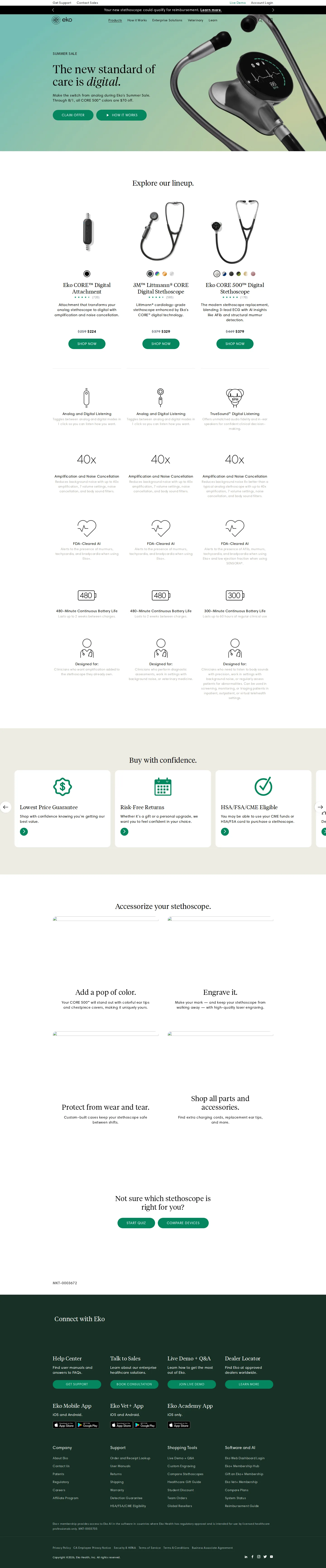
Live capture — hardware + Eko+ + SENSORA hybrid (unchanged)
Re-verified public pricing, all unchanged: CORE Attachment $259 (sale $224), 3M Littmann CORE $379 (sale $329), CORE 500 $449 (sale $399); Eko+ software $12.99/mo or $119.99/yr (Eko Standard free, Eko Vet+ $180/yr); Eko Telehealth and SENSORA quoted via sales, SENSORA reimbursed per-exam under CPT 0962T. The memberships comparison table now lists annual ('Price Per Year') only; the monthly $12.99 option still lives on the Eko+ subscription product page.
CMS finalizes national OPPS payment (~$128.90/use)
CMS finalizes national Outpatient Prospective Payment System payment for SENSORA, assigning CPT 0962T to APC 5734 at roughly $128.90 per use. Hospitals and outpatient settings can now be reimbursed per AI cardiac exam, cementing the per-use enterprise model.
SENSORA gets a billable CPT code (0962T)
Category III CPT code 0962T for AI-assisted cardiac dysfunction analysis takes effect July 1, 2025, covering SENSORA exams. This converts AI screening from a software cost into a reimbursable clinical service for health systems — a structural shift in how the enterprise tier monetizes.
$41M Series D — scaling the SaaS + platform motion
Eko raises a $41M Series D (bringing total funding past ~$165M, with ARTIS Ventures, Highland Capital, Questa Capital, and Mayo Clinic among backers) to scale AI-driven heart and lung disease detection and the SENSORA platform internationally.
CORE 500 launches at $449 with embedded AI + 3-lead ECG
Eko launches the CORE 500 (MSRP $499, listed $449) — full-color display, 40x amplification, active noise cancellation, and a 3-lead ECG enabling on-device AFib detection. This anchors the high end of the hardware lineup and pairs with the Eko+ software subscription for AI.
First FDA clearance — CORE attachment, no recurring AI
Eko's first digital stethoscope (the CORE attachment) clears the FDA. The early model is a hardware sale that digitizes and amplifies auscultation and streams audio to the Eko app — no AI disease-detection subscription yet. The business is essentially a one-time device sale.
- · Eko Health was founded in 2013 by three UC Berkeley students — Connor Landgraf (CEO), Jason Bellet (COO), and Tyler Crouch (CTO) — to reinvent a tool that had barely changed in 200 years; its first device cleared the FDA in 2015.
- · Eko's AI is reimbursable: SENSORA's Category III CPT code 0962T (effective July 1, 2025) carries a finalized CMS OPPS payment of about $128.90 per exam — so hospitals can bill insurers each time the algorithm screens a patient.
- · The flagship CORE 500 ($449) is the only Eko device with a built-in 3-lead ECG, and it is the only one that supports on-device AFib detection through Eko+ — a deliberate hardware gate on a software feature.
Questions & answers
- What is Eko Health's pricing model?
- It is a hybrid hardware-plus-software model. You buy a digital stethoscope once ($259 CORE Attachment, $379 3M Littmann CORE, or $449 CORE 500), then pay for Eko+ software to unlock the AI — $12.99/month or $119.99/year. A free Eko Standard tier gives amplification, recording, and visualization with no AI. Health systems instead license the SENSORA platform on a custom quote, reimbursed per exam under CPT code 0962T.
- Does Eko Health offer a free tier?
- Yes. Eko Standard is free and includes wireless/Bluetooth listening, audio filters, live scope trace, and over-the-air updates — but no recording, no PDF reports, no web dashboard and no AI analysis. The CORE 500 also ships with 14 days of complimentary Eko+ access that unlocks the AI detection features before the $119.99/year (or $12.99/month) subscription begins.
- How much does the Eko CORE 500 stethoscope cost?
- The CORE 500 — Eko's flagship with 3-lead ECG, full-color display, 40x amplification, and active noise cancellation — is listed at $449 on Eko's store and is currently $379 during a Summer Sale that takes $70 off every color through 8/1. It is the only device that supports on-device AFib detection. Cheaper options are the 3M Littmann CORE at $379 and the CORE Digital Attachment at $259.
- How does Eko Health make money from AI if the hardware is one-time?
- The hardware is a low-margin entry point; the recurring revenue is the Eko+ subscription that unlocks the FDA-cleared AI, plus the enterprise SENSORA platform. SENSORA is the strategic prize: its CPT code 0962T (effective July 2025) and finalized CMS OPPS payment of roughly $128.90 per exam mean hospitals can bill insurers for each AI screening, aligning Eko's revenue with usage at the health-system level.