AI Summary
About
ElevenLabs is a voice AI platform for text-to-speech, voice cloning, speech-to-text, music, dubbing, and conversational agents.
The pricing surface is split across a public subscription ladder, a separate model-pricing table, and billing docs that explain PAYG, credit rollover, and workspace controls.
That matters because ElevenLabs is not selling one simple meter; it is packaging a voice stack that can be bought as a subscription, consumed as usage, or upgraded into custom enterprise terms.
Pricing summary : Subscription tiers plus usage meters across voice products
ElevenLabs uses a hybrid pricing model with three billing dimensions:
- Subscription access: Free, Starter, Creator, Pro, Scale, Business, and Enterprise.
- Usage metering: credits on the creative ladder, minutes on the agents ladder, and characters / hours / minutes / generations on API surfaces.
- Billing controls: monthly billing is visible on the pricing page; billing docs say monthly and annual subscriptions exist; PAYG pre-funds usage instead of allowing surprise overages.
The pricing model also maps cleanly to credit-based billing, per-seat pricing, and the blueprint index.
Pricing by product
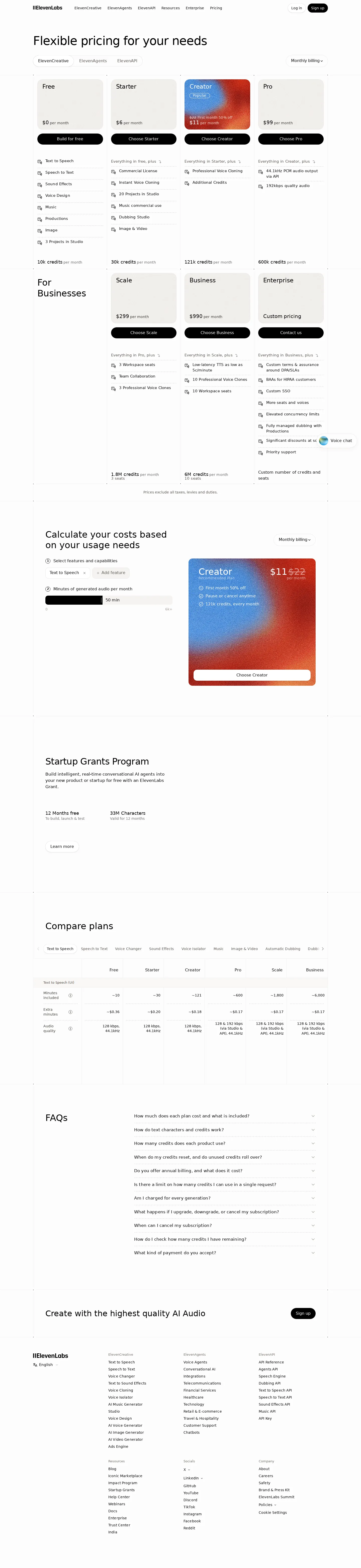
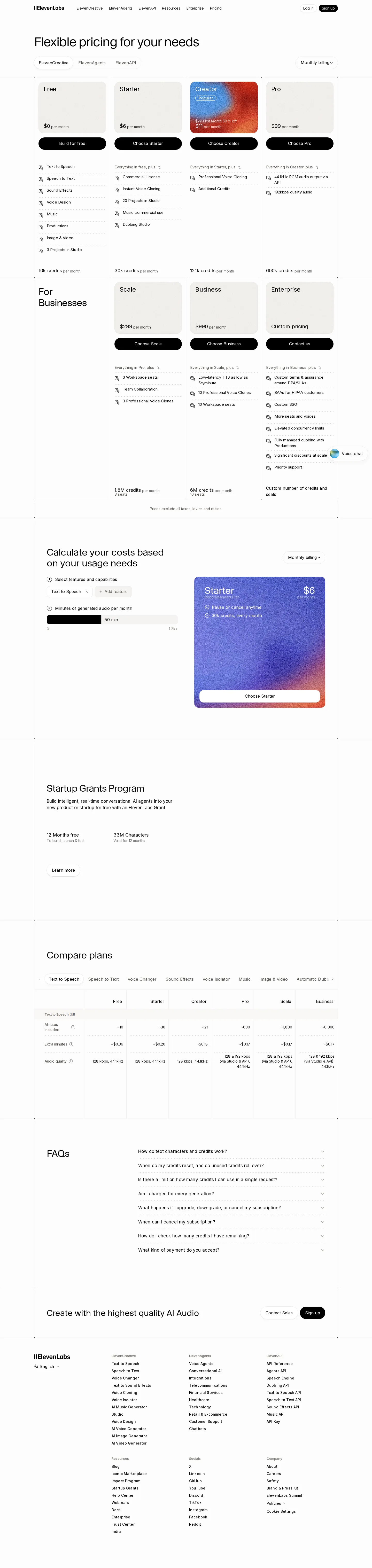
ElevenCreative (subscription ladder)
| Tier | Price | Included | Key mechanics |
|---|---|---|---|
| Free | Free | 10k credits; 3 Projects in Studio | Build for free |
| Starter | $6 / mo | 30k credits; Commercial License; Instant Voice Cloning | Entry tier |
| Creator | $22 / mo | 121k credits; Professional Voice Cloning | Popular tier; first-month promo visible |
| Pro | $99 / mo | 600k credits; 44.1kHz PCM audio output via API | Power-user tier |
| Scale | $299 / mo | 1.8M credits; 3 Workspace seats; Team Collaboration | Team tier |
| Business | $990 / mo | 6M credits; 10 Workspace seats; 10 Professional Voice Clones | Large-team tier |
| Enterprise | Custom | Custom credits and seats | Sales-led contract tier |
Sales motions across products: self-serve / PLG for Free, Starter, Creator, and Pro; sales-led for Scale, Business, and Enterprise.
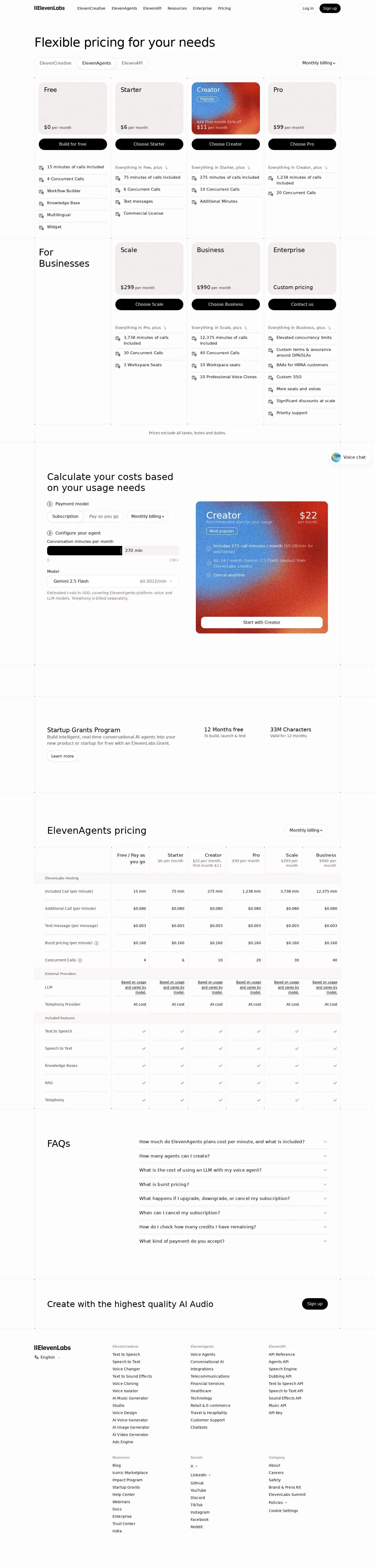
ElevenAgents (monthly billing)
| Tier | Price | Included | Key mechanics |
|---|---|---|---|
| Free | Free / Pay as you go | 15 minutes of calls; 4 concurrent calls; Workflow Builder; Knowledge Base | Free plan and PAYG path both visible |
| Starter | $6 / mo | 75 minutes of calls; 6 concurrent calls; text messages | Entry agent tier |
| Creator | $22 / mo | 275 minutes of calls; 10 concurrent calls; additional minutes | Popular tier |
| Pro | $99 / mo | 1,238 minutes of calls; 20 concurrent calls | Power-user tier |
| Scale | $299 / mo | 3,738 minutes of calls; 30 concurrent calls; 3 workspace seats | Team tier |
| Business | $990 / mo | 12,375 minutes of calls; 40 concurrent calls; 10 workspace seats | Large-team tier |
| Enterprise | Custom | Elevated concurrency, DPA / SLA, BAA, SSO, more seats and voices | Sales-led contract tier |
ElevenLabs Hosting meter
| Meter | Value |
|---|---|
| Included Call | $0.080 per minute |
| Additional Call | $0.003 per minute |
| Text message | $0.160 per message |
| Burst pricing | $0.160 per minute |
| Concurrent Calls | 4 / 6 / 10 / 20 / 30 / 40 |
Sales motions across products: self-serve / PLG for Free, Starter, Creator, and Pro; sales-led for Scale, Business, and Enterprise.
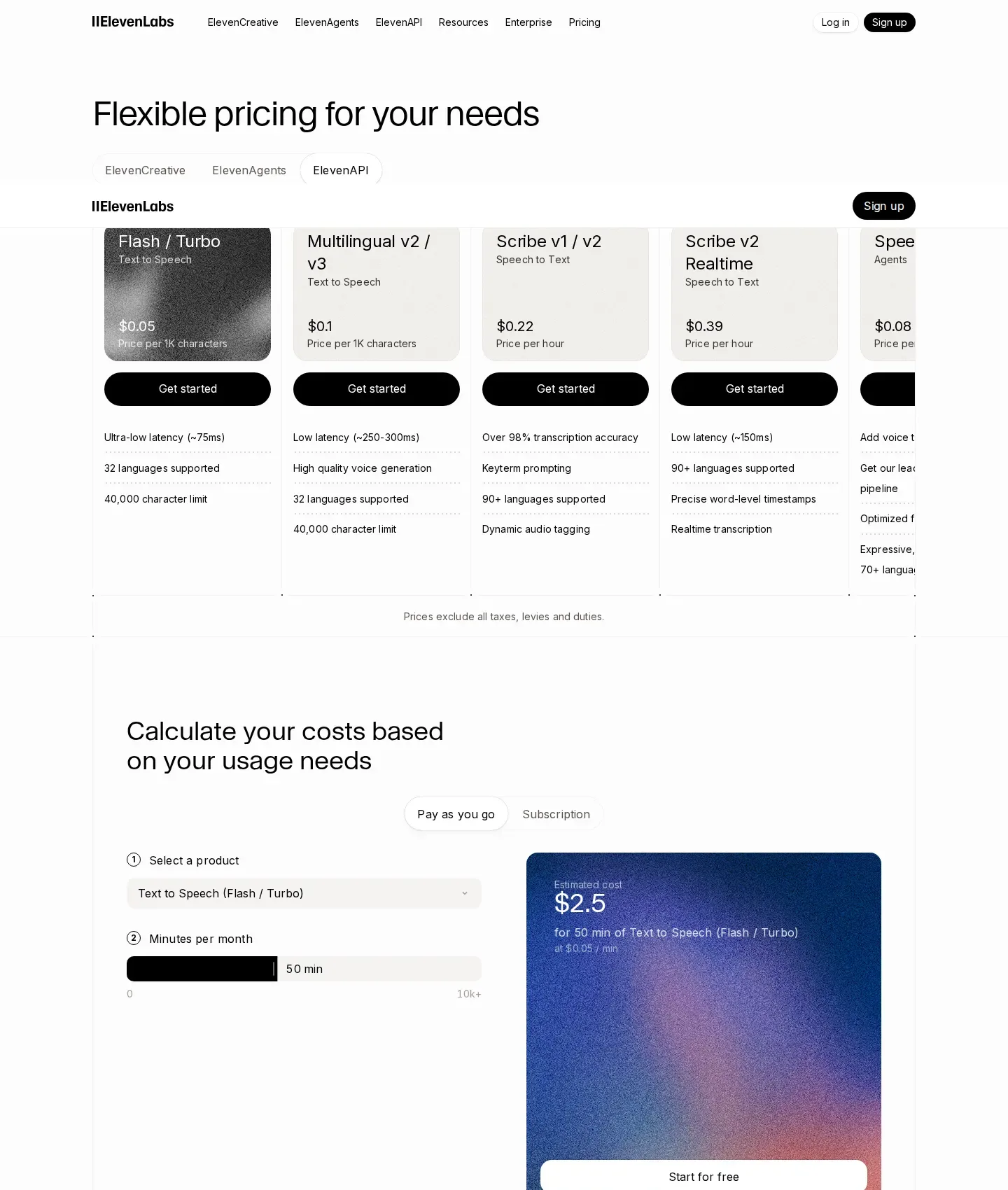
ElevenAPI (model pricing and PAYG)
| Surface | Price | Notes |
|---|---|---|
| Flash / Turbo TTS | $0.05 per 1K characters | Ultra-low-latency text to speech |
| Multilingual v2 / v3 TTS | $0.10 per 1K characters | High-quality voice generation |
| Scribe v2 STT | $0.22 per hour | Speech to text |
| Scribe v2 Realtime | $0.39 per hour | Realtime transcription |
| Speech Engine | $0.08 per minute | Agents / conversational AI |
| Music | $0.15 per minute | Music generation |
| Voice Isolator | $0.12 per minute | Audio processing |
| Voice Changer | $0.12 per minute | Audio processing |
| Sound Effects | $0.12 per generation | Audio generation |
| Dubbing v1 | $0.33 per minute | Dubbing |
The PAYG calculator lets you size usage per product; at the Flash / Turbo rate of $0.05 per 1K characters, 100k characters of Multilingual v2 / v3 maps to the Creator plan at $11 first-month.
Hidden costs : Top Ups, concurrency, and usage spikes
The headline price is not the whole bill. Top Ups, concurrency, and usage spikes are where ElevenLabs gets expensive.
Archetype: small team using PAYG
| Line item | Monthly cost |
|---|---|
| Starter plan | $6 |
| Minimum PAYG top up | $5 |
| Auto Top Up default recharge | $20 |
| Low balance threshold | $10 |
| Cash needed to keep usage flowing | Higher than the headline tier once usage starts |
Want to estimate your own ElevenLabs bill? Use the ElevenLabs pricing calculator to model plan tier, voice minutes, and API usage.
Pricing evolution : From PAYG launch to lower-minute voice pricing
Cadence
| Quarter | Price changes | Product / SKU additions | Notes |
|---|---|---|---|
| 2025 Q1 | major | Conversational AI cut | ElevenLabs cut Conversational AI to 10 cents per minute on Creator and Pro, with 8 cents per minute on annual Business plans. |
| 2025 Q2 | major | PAYG introduced | ElevenLabs cut API and agents pricing, then moved new self-serve users toward PAYG instead of legacy usage billing. |
| 2025 Q3 | minor | Conversational AI renamed to Agents | ElevenLabs renamed the surface to ElevenLabs Agents, which made the pricing language line up better with the product. |
| 2026 Q2 | major | Conversational AI cut | Conversational AI reset the floor to 10 cents per minute and made long-running sessions cheaper. |
Tracked range: 2025-02–2026-05.
Notable changes
- 2025-02-11 — Conversational AI price cut set the first visible lower floor for voice-agent workloads.
- 2025-05-07 — PAYG launch moved new subscriptions toward pre-funded usage and away from surprise overages.
- 2025-09-03 — Agents rename aligned the product naming with the conversational pricing surface.
- 2026-05-07 — Conversational AI price cut lowered the floor for agent-heavy workloads and made silence handling more economically important.
What’s unique : Multi-surface voice pricing instead of one meter
1. One company, three metering grammars. Creative plans burn credits, agents burn minutes, and API surfaces burn characters or hours. See the blueprint index.
2. The same buyer can see different economics depending on the surface. A creator may think in credits, but a support team will feel the minute meter and the silence discount immediately.
3. The ladder is broad enough to support both experimentation and production. That lowers entry friction, but it also means the invoice can shift quickly once a team crosses from trial into steady usage. A related view is AI outcome-based pricing.
The structure is a good example of usage-based pricing models and tracking and metering usage events.
Strengths & weaknesses
| Strengths | Weaknesses |
|---|---|
| Strong free-to-paid funnel | Multiple meters make forecasting harder |
| PAYG reduces surprise relative to pure usage billing | Legacy billing paths still add cognitive load |
| Broad fit across creators and teams | The pricing surface is split across several product pages |
| India-local funding and currency support | The buyer has to reconcile credits, minutes, and characters manually |
Billing UX : Monthly toggles, PAYG controls, and legacy billing settings
- Monthly billing view — the pricing page defaults to monthly and hides annual prices behind a toggle.
- Subscription details — the billing page links directly to subscription settings and workspace controls.
- PAYG — buyers can prepay usage without signing up for a monthly commitment.
- Top Up controls — minimum top-up is $5 / INR 500, default auto top-up is $20 / INR 2,000, the low-balance threshold is $10 / INR 1,000, and a maximum of 250 top-ups per month is enforced.
- Billing groups — admins can set credit quotas and professional voice clone caps for teams.
- Credit rollover — unused credits can roll over up to two months.
- PAYG plan-change conversion — PAYG balance is stored as a dollar value, not a fixed credit count; changing subscription plans converts the remaining dollar balance using the new plan’s credit-to-dollar rate, so a downgrade can lower the credit total even though the dollar value is unchanged.
Strategic wins : Why the pricing system is commercially useful
1. The free tier lowers friction without making the model look small
ElevenLabs gets users to the first prompt quickly, then keeps the paid ladder visible enough that the path to expansion is obvious. The Startup Grants Program also broadens the funnel for startups that can prove out usage before they buy.
2. PAYG turns usage into a pre-funded habit instead of a surprise invoice
PAYG is a stronger bridge than a pure sales-led motion because buyers can scale incrementally and top up as they go. That is especially useful in a voice product where usage bursts can be lumpy.
3. The broad ladder works because the product surface is already broad
Starter and Creator serve the creative workflow, while Scale, Business, and Enterprise cover heavier collaboration and production use. That split is structurally correct for a multi-surface voice platform.
Areas to improve : Where the pricing surface still feels fragmented
1. Normalize the meter across product surfaces
API buyers think in characters or hours, voice-agent buyers think in minutes, and creative users think in credits. A single normalization table would make the product easier to evaluate and would reduce the need for manual translation across tabs.
2. Make PAYG and legacy billing more distinct
The docs explain the difference, but the UI still leaves room for confusion. A clearer comparison panel would help buyers understand whether they are pre-funding usage or running on an older billing path.
3. Surface regional payment options more clearly
India-local INR support is useful but buried in help content. Bringing that detail into the main billing flow would make the payment experience feel more intentional.
Monetization stack & signals : how ElevenLabs builds & buys its revenue engine
Buys 4 Builds 0 12 open roles
Buys its entire monetization stack — even the meter behind its own usage pricing runs on Stripe Billing, with Stripe Connect handling marketplace payouts. A fast-growing RevOps and customer-success org on Salesforce signals a sales-led enterprise overlay on the self-serve creative core.
-
“A single engineer initially set up Stripe Billing, rapidly enabling subscriptions ... Stripe's flexibility allowed us to seamlessly introduce usage-based pricing and scale our platform quickly.”
-
“Creating this marketplace required managing licensing, rights, payments, and international compliance. Stripe Connect simplified this through one integration ... Stripe manages KYC, payouts, and fraud protection seamlessly.”
-
“Integrating AI systems with our core business stack - Salesforce, Slack, Ashby, and more”
-
“Implement and maintain dbt best practices, data standards, and quality controls”
- Account Manager - North America - Enterprise Customer success Jun 17, 2026
- Customer Success Lead - APAC Customer success Jun 17, 2026
- Deployment Strategist (multi-region) Customer success Jun 17, 2026
- Account Executive (multi-region) Monetization seen Jun 2, 2026
- Sales Development (multi-region) Monetization seen Jun 2, 2026
- Systems Architect (Revenue) RevOps seen May 28, 2026
- Lead Generation Strategy and Operations RevOps seen May 28, 2026
- GTM Chief of Staff RevOps seen May 28, 2026
- Data Engineer (Revenue) RevOps seen May 28, 2026
- Full-Stack Growth Engineer Growth seen May 22, 2026
- Mobile Growth Manager Growth seen May 22, 2026
- B2B Growth Marketing - Agents Growth seen May 22, 2026
Signals reviewed · derived from public job posts, engineering blogs
Job postings fill and close over time — once a posting is filled we keep it as a dated citation (the quoted evidence remains); use View open roles for current listings.
Key takeaways
- ElevenLabs is not one pricing model. It is a stack of subscription, usage, PAYG, and enterprise paths.
- The company keeps a free entry point. That matters for trial, creator adoption, and product-led expansion.
- Usage metering is product-specific. Minutes, characters, hours, and credits all show up, which makes cross-product forecasting harder.
- Legacy billing still matters. PAYG is the newer path for new self-serve customers, but the older usage model still shapes the story.
- Regional payment support is part of the story. INR top-ups and subscriptions show a willingness to localize the billing experience.
UBP implications
- One vendor can support multiple usage grammars at once. ElevenLabs shows that the same company can sell credits, minutes, and characters without collapsing them into one meter.
- PAYG can bridge the gap between free trial and enterprise contract. That matters when buyers need to scale gradually but still want budget control.
- The hardest part of AI pricing is not the rate, it is the unit. Unit selection determines how buyers understand risk, not just how much they pay.
Sources
- ElevenLabs Pricing (accessed 2026-05-28)
- ElevenLabs Pricing API (accessed 2026-05-28)
- ElevenLabs Pricing Agents (accessed 2026-05-28)
- Billing | ElevenLabs Documentation (accessed 2026-05-28)
- Pay As You Go | ElevenLabs Documentation (accessed 2026-05-28)
- Do you offer annual or quarterly plans? (accessed 2026-05-28)
- What is the price for usage based billing? (accessed 2026-05-28)
- What is usage based billing? (accessed 2026-05-28)
- How much does ElevenAgents cost? (accessed 2026-05-28)
- We’ve lowered API & Agents pricing and introduced PAYG (accessed 2026-05-28)
- We cut our pricing for Conversational AI (accessed 2026-05-28)
- ElevenLabs Pricing (accessed 2026-05-30)
- ElevenLabs Pricing API (accessed 2026-05-30)
- Pay As You Go | ElevenLabs Documentation (accessed 2026-05-30)
- ElevenLabs Pricing (accessed 2026-07-30)
- ElevenLabs Pricing Agents (accessed 2026-07-30)
- ElevenLabs Pricing API (accessed 2026-07-30)
- Billing | ElevenLabs Documentation (accessed 2026-07-30)
- Pay As You Go | ElevenLabs Documentation (accessed 2026-07-30)
Bottom line
ElevenLabs is a strong example of modern AI pricing done at commercial scale: generous entry, a visible subscription ladder, and product-specific usage meters that can expand into enterprise deals. The tradeoff is clarity. Once you cross from creative experimentation into real production, the invoice becomes a mix of credits, minutes, characters, and PAYG settings that buyers have to model separately.
Pricing timeline : Major events on a vertical axis
Each milestone below corresponds to a public pricing change, product launch, or material adjustment. Major events use a filled marker; minor adjustments use a faded one.
Conversational AI price cut
ElevenLabs said Conversational AI starts at 10 cents per minute, which reset the floor for long-running voice-agent workloads.
Conversational AI renamed to Agents
ElevenLabs renamed Conversational AI to ElevenLabs Agents, making the pricing surface easier to map to the platform's phone, web, and app workflows.
PAYG shift begins
ElevenLabs lowered API and agent pricing for self-serve users and introduced PAYG, shifting new subscriptions away from legacy usage-based billing.
Conversational AI price cut
ElevenLabs cut Conversational AI to 10 cents per minute for Creator and Pro, with 8 cents per minute on annual Business plans.
- · ElevenLabs is really three pricing systems in one: a credit ladder, a voice-agent minute meter, and an API meter.
- · The company renamed Conversational AI to ElevenLabs Agents in 2025, so the billing story is tied to product naming as well as pricing.
- · Annual billing exists across the subscription tiers, so the monthly pricing page is only the default view, not the whole offer.
Questions & answers
- Does ElevenLabs have a free plan?
- Yes. ElevenLabs says a free plan is available for new accounts, and some products also expose a pay-as-you-go path.
- Does ElevenLabs bill monthly or annually?
- Both. ElevenLabs says annual plans exist for all subscription tiers and that the pricing page lets you toggle between monthly and annual views.
- Is usage-based billing still available?
- Yes, but ElevenLabs describes it as a legacy feature on older subscriptions. PAYG is the newer replacement for new subscriptions.
- Can customers in India pay in local currency?
- Yes. ElevenLabs says customers located in India can pay in INR through the subscription flow.
- How are ElevenAgents calls billed?
- ElevenLabs bills voice calls by connection duration and documents a 95% discount for silence periods longer than 10 seconds.