AI Summary
About
Factory builds AI software-development agents it calls “Droids” — autonomous coding agents that generate, test, review, document, and merge code across a native desktop app (macOS and Windows), a CLI, and an SDK. The product targets engineering organizations that want agents embedded in their existing toolchain rather than a standalone chat assistant, and markets enterprise outcomes such as faster feature delivery, large migration-time reductions, and on-call time saved.
Commercially, Factory sells per-seat subscriptions. The three self-serve tiers — Pro ($20/mo), Plus ($100/mo), and Max ($200/mo) — are priced per individual seat, and the step-up between them buys usage headroom (Plus is marketed as ~5x Pro’s usage and Max ~10x) rather than per-token billing. Plus and Max also unlock “Droid Computers,” Factory-managed cloud machines for running background and remote Droids. Larger buyers move to custom-quoted Business (up to 150 seats) and Enterprise (unlimited seats) plans that layer on SSO, SAML/SCIM, Zero Data Retention, audit logging, dedicated compute, and on-premise options.
Founded by CEO Matan Grinberg (a former Berkeley physics PhD) and Eno Reyes, Factory raised a $150M Series C in April 2026 — led by Khosla Ventures (Keith Rabois) with Sequoia Capital, Blackstone, Insight Partners, NEA, and others — at a reported $1.5B valuation, having roughly doubled revenue month over month for six consecutive months. Droids are used by engineering teams at Nvidia, Adobe, EY, Palo Alto Networks, and Adyen. The company also acquired Lumetric (a YC W24 team building applied-AI workflows) to help shape its desktop app. Notably, Factory’s billing has swung from $80/user/mo token-metered tiers in early 2025 to today’s $20-entry rate-limit seats — a reversal detailed in Pricing evolution below.
Pricing summary : How Factory’s pricing model works
Factory prices on a single dimension: the seat. Every self-serve tier is a flat per-user monthly fee — Pro $20, Plus $100, Max $200 — and the only thing that scales as you move up is usage capacity, expressed as “rolling rate limits” rather than a metered token bill. Plus is marketed at roughly 5x Pro’s usage and Max at roughly 10x, so the primary way to buy more capacity is to choose a higher tier. Nothing bills above the seat fee automatically — but Factory’s docs do document an optional overage path, prepaid Extra Usage credits from a $10 minimum, that a user can switch on rather than wait out a rate limit. Business and Enterprise convert this into custom-quoted contracts with custom usage limits and seat counts (Business up to 150 seats, Enterprise unlimited).
- Billing unit: per seat, billed monthly. No mandatory per-token or per-request metering on self-serve tiers.
- Usage model: bundled Standard Usage, capped by rolling rate limits across three windows (5-hour, weekly, monthly), sized per tier (Plus ~5x Pro, Max ~10x Pro).
- Past the limit: two continuation paths, per Factory’s docs — Droid Core (designated open-weight models, free, on their own separate rate limits) and Extra Usage (opt-in prepaid credits, $10 minimum, never expire). Standard Usage is always consumed first.
- Free tier: no free plan. The entry point is Pro at $20/mo per seat.
- Custom tiers: Business (≤150 seats, custom limits, SSO/SAML/SCIM, ZDR, audit logging) and Enterprise (unlimited seats, dedicated compute, sub-organizations, on-prem, data residency) are contact-sales.
What makes this different: Most agentic-coding peers attach token or credit overage that bills automatically once a seat’s allowance runs out. Factory instead packages usage as a rate-limit tier and makes the overage path opt-in — you either downshift to free Droid Core models or deliberately switch on prepaid Extra Usage credits, so an untouched seat never bills above its subscription price. That makes it an unusually pure example of seat-based pricing in a code-generation category that mostly runs on metered credit-based billing.
Pricing by product
Factory sells one product — Droids (AI software-development agents) — across five plans. The three lowest are self-serve seats; the top two are custom-quoted.
Droids (Individual / self-serve plans)
| Plan | Price | Included usage | Key mechanics |
|---|---|---|---|
| Pro | $20 / seat / mo | Base rolling rate limits (Standard Usage) | Agent-native desktop / CLI / SDK; cloud & local background agents; billing & usage stats; agent-readiness dashboard |
| Plus | $100 / seat / mo | ~5x the usage of Pro | Everything in Pro + expanded rolling rate limits + Droid Computers (Factory-managed cloud machines for remote Droids) |
| Max | $200 / seat / mo | ~10x the usage of Pro | Everything in Plus + further expanded rate limits + early access to new features |
Included usage on every plan is metered as Factory Standard Credits against three independent rolling Rate Limit windows — 5-hour, 7-day, and 30-day — and you need headroom in all three to send a request. Unused Standard Usage does not roll over month to month. Rate Limits are per-organization and shared across members, with plans scaling by seat count.
Continuation options once Standard Usage is exhausted
| Option | Price | Included | Key mechanics |
|---|---|---|---|
| Droid Core | Free, no additional cost | Designated open-weight (“Core”) models on their own separate Rate Limits | Auto-fallback when Standard Usage runs out; current Core model list lives in Settings > Models and changes as new models ship. Droid Core usage still draws on Standard Usage while any remains |
| Extra Usage | Prepaid credits, $10 minimum purchase | USD-denominated credit balance drawn down by model usage | Opt-in toggle that stays on until switched off or exhausted; credits never expire and do roll over. Consumed only after Standard Usage (and, for Core-labeled models, after Droid Core limits). Required to be enabled in order to run a Factory Mission |
Business and Enterprise plans are explicitly “not affected by Rate Limit changes” and negotiate custom usage limits instead. All Individual plans also include an allowance of free BYOK (bring-your-own-key) usage, after which BYOK is charged according to the plan.
Droids (Business & Enterprise plans)
| Plan | Price | Seats | Key mechanics |
|---|---|---|---|
| Business | Custom (contact sales) | Up to 150 | Custom usage limits; dedicated onboarding and support; Single Sign-On (SSO) integration; SAML/SCIM provisioning; Zero Data Retention (ZDR); audit logging and activity trails; basic admin controls (model selection, autonomy level, model access controls, org-level deny lists, network policy) |
| Enterprise | Custom (contact sales) | Unlimited | ”Every feature prior, and:” dedicated compute with partitioned inference pool; Agent-readiness Improvement Program; enterprise-specific automation cookbook; on-premise deployment options; sub-organizations; full admin controls; customer-managed encryption keys; data residency; dedicated Account Manager and Customer Engineer; priority support with SLAs; custom onboarding program |
Sales motions across products: PLG / self-serve for Pro, Plus, and Max (sign up and pay online); sales-led for Business and Enterprise (custom quote, contact sales).
Hidden costs : What Factory users actually pay
Factory’s current self-serve model is unusually clean: nothing bills automatically above the seat fee, so the default bill is essentially tier price × seats. The real “hidden” costs are tier inflation (a heavy user who outgrows Pro’s rate limits must jump to Plus or Max, a 5x or 10x price step), the rate-limit ceiling itself, which throttles rather than charges, and the opt-in Extra Usage credit balance ($10 minimum) that a user can switch on to trade throttling for spend. Two archetypes show how that plays out.
Archetype A — a 4-person startup squad on Plus. A small team where everyone runs Droids heavily through the day picks Plus ($100/seat) to clear Pro’s rate limits, and nobody needs Max’s headroom.
| Line item | Monthly cost |
|---|---|
| Plus seats (4 × $100) | $400 |
| Extra Usage credits (toggle left off; falls back to free Droid Core) | $0 |
| Droid Computers (bundled in Plus) | $0 |
| Estimated total | $400 |
The lesson: because Plus bundles ~5x Pro’s usage and Droid Computers, the bill is fully predictable as long as Extra Usage stays off — but if one engineer routinely hits Plus’s rolling limit, the levers are a permanent per-seat jump to Max ($200), a downshift to the free Droid Core model pool, or switching on prepaid Extra Usage credits from a $10 minimum.
Archetype B — a 30-engineer org weighing Business vs. stacking Max seats. At scale, list-price Max seats (30 × $200 = $6,000/mo) buy maximum individual headroom, but lose SSO, SAML/SCIM, Zero Data Retention, and admin controls.
| Line item | Monthly cost |
|---|---|
| 30 × Max @ $200 (self-serve, no governance) | $6,000 |
| SSO / SAML/SCIM / ZDR / admin controls | Not available on self-serve |
| Self-serve total (no governance) | $6,000 |
| Business plan (≤150 seats, custom limits + SSO/SCIM/ZDR + audit logging) | Custom quote |
The lesson: above a handful of seats the real decision is governance, not price — security and provisioning features only appear on custom-quoted Business and Enterprise, so most 20+ seat buyers are pushed into a sales conversation regardless of headline seat math.
Want to estimate your own Factory bill? Use the Factory pricing calculator to model your monthly cost based on tier choice and seat count.
Pricing evolution : Factory pricing history and changes
Factory’s pricing has changed more in 18 months than most companies do in their lifetime — it ran a per-seat, token-metered model from early 2025 through early 2026, then reversed course at its Series C and removed the token meter entirely. The cadence below is reconstructed from Wayback Machine snapshots of factory.ai/pricing.
Cadence
| Quarter | Price changes | Product / SKU additions | Notes |
|---|---|---|---|
| 2025 Q1 | 0 | 0 | Single self-serve Team plan at $80/user/mo + Enterprise; token-metered (20M Standard + 1M Premium per user), “Engineering Intelligence” code-retrieval positioning. |
| 2025 Q2 | 1 | 0 | Team repriced to $40 first seat + $10/additional seat; 15–20M shared Standard Tokens with overage charged above the allocation. |
| 2025 Q4 | 1 | 3 | Droids relaunch (Oct): added BYOK Free $0, Pro $20 (20M tokens then usage-based overage, $5/seat); by Dec added Max $200 and Ultra $2,000 token tiers. |
| 2026 Q1 | 0 | 0 | Grid trimmed: Free and Ultra dropped; Pro $20 (≤2 seats) and Max $200 (5 seats) tightened, still token-metered. |
| 2026 Q2 | 1 | 1 | Series C (Apr 16); per-token metering replaced by rolling rate limits — Pro $20 / Plus $100 (new, ~5x Pro, Droid Computers) / Max $200 (~10x Pro) / Teams (≤150 seats) / Enterprise. |
| 2026 Q3 | 0 | 0 | Seat prices held at $20 / $100 / $200; the custom mid tier was renamed Teams → Business and picked up audit logging and activity trails plus network policy from Enterprise. Packaging-only — the fence between the two custom bands moved, the price list did not. |
Tracked range: 2025-01 – 2026-07 (Wayback snapshots of factory.ai/pricing). Quarters not listed had no distinct snapshot showing a change.
Notable changes
- 2025-01 — Earliest archived pricing: one Team plan at $80/user/mo plus Enterprise, metered in Standard + Premium Tokens.
- 2025-05 — Team dropped to $40 first seat + $10/additional seat; usage above the shared 20M-token allocation billed as overage.
- 2025-10 — Major Droids relaunch: a BYOK Free $0 tier (bring-your-own keys/models, terminal UI) and a Pro $20 tier with usage-based token pricing after 20M tokens.
- 2025-12 — Token ladder peaked with Max $200 (100M + 100M bonus tokens) and an Ultra $2,000 tier (1B + 1B bonus tokens).
- 2026-02 — Free and Ultra removed from the main grid; Pro capped at 2 seats, Max at 5.
- 2026-04 — At its $150M Series C (Khosla-led, $1.5B valuation), Factory dropped token metering for rolling rate-limit tiers and introduced Plus $100 with Droid Computers (factory.ai/news/series-c).
- 2026-07 — Mid tier renamed Teams → Business; audit logging and activity trails and network policy moved down from Enterprise into Business, while Enterprise began itemizing sub-organizations, customer-managed encryption keys, and data residency. Seat prices unchanged — this is a fence move, not a price move: the compliance requirement that used to force an Enterprise contract now clears at the Business quote.
The Business repackaging in detail
The 2026-07-22 change is the first Factory pricing edit in 18 months that touches no number, and that is what makes it readable. Two things happened at once. The mid tier stopped being called Teams — a size label that reads as “Max, but for several people” — and became Business, a segment label that matches the mid-market account executives and ADRs Factory has been hiring since April 2026. And the entitlement that most often forced a mid-market buyer past that tier, audit logging and activity trails, moved down into it, along with network policy.
Giving away audit logging costs Enterprise a differentiator, so Enterprise was re-argued rather than left thin: sub-organizations, customer-managed encryption keys, and data residency were promoted from inside a single “full admin controls” parenthetical (their form in the 2026-06-08 capture) into discrete named bullets. The fence between the two custom-quoted bands therefore moved from observability to data sovereignty — a more defensible line, because logging is cheap to ship to everyone while key custody, residency and tenant partitioning are infrastructure commitments that genuinely cost Factory money per account.
For buyers, the practical effect is a lower compliance floor: a 30–150-seat org that needs an activity record for SOC 2 or internal audit can now clear it inside a Business quote instead of negotiating an Enterprise contract sized for a much larger deal. For Factory, it trades a small amount of Enterprise upsell pressure for a better-qualified Business band. Billing complexity is unchanged in both directions — the bill is still tier price × seats on self-serve and a custom quote above it, with no new meter, unit, or overage introduced.
The token-to-rate-limit reversal in detail
For its first year of public pricing Factory billed like most agentic-coding tools: a seat fee plus a monthly token allocation, with usage-based overage once you exhausted it (and, briefly, a $2,000/mo Ultra tier bundling a billion tokens). Around the April 2026 Series C it deleted the entire token meter. The current Pro/Plus/Max ladder charges a flat seat fee and gates usage with rolling rate limits — Plus is marketed at ~5x Pro and Max at ~10x — so there is no overage line at all on self-serve plans. The trade is deliberate: Factory swapped a metered bill that could spike for a predictable seat bill that throttles instead of charging, betting that buyers of autonomous coding agents value a fixed monthly number over pay-as-you-go granularity.
What’s unique : Factory’s distinctive pricing mechanics
1. Rate limits as the meter, not tokens. Factory’s defining choice is that usage scales by rolling rate limits, not a token or credit meter. Plus is “~5x the usage of Pro” and Max “~10x” — but neither has an overage line. You buy a usage ceiling by picking a tier, and when you hit it you wait or upgrade rather than getting a surprise bill. In a category where almost every peer bills metered tokens or credits, this is the cleanest example of pure seat pricing in the corpus.
2. Droid Computers bundled into the seat, not metered. Plus and Max include Droid Computers — Factory-managed cloud machines that run background and remote Droids. Most platforms would meter that compute by the hour (see compute pricing patterns); Factory folds it into the flat seat fee, so the cost of running agents in the cloud is invisible to the buyer’s bill.
3. A deliberate reversal away from usage metering. Almost uniquely, Factory tried token-based usage pricing for a full year — including a $2,000/mo, billion-token Ultra tier — and then walked it back to flat rate-limit tiers at its Series C. Most AI companies are migrating toward usage and outcome metering; Factory ran the experiment and chose predictability instead, a counter-trend worth watching for how AI companies are rethinking per-user licenses.
4. Governance gated behind sales, not price. SSO, SAML/SCIM, Zero Data Retention, audit logging, on-premise deployment, and admin controls (model selection, autonomy level, deny lists) appear only on custom-quoted Business and Enterprise. The self-serve ladder tops out at Max; any organization that needs provisioning or compliance is routed into a sales motion regardless of seat count. The 2026-07-22 repackaging moved that fence within the sales-led band rather than lowering it: audit logging and activity trails dropped from Enterprise into Business, so the two custom tiers now split on data sovereignty (sub-organizations, customer-managed encryption keys, data residency) rather than on who can see what their agents did.
Strengths & weaknesses
| Strengths | Weaknesses |
|---|---|
| Fully predictable bill: seat price × seats, no per-token overage to forecast or fear | No free tier — the cheapest entry is Pro at $20/mo, unlike BYOK Free that existed in late 2025 |
| Clean 3-step self-serve ladder ($20 / $100 / $200) that’s easy to reason about | Rate limits are described relatively (~5x, ~10x Pro) — actual request/usage caps aren’t published |
| Droid Computers (cloud compute) bundled into Plus/Max rather than metered separately | Outgrowing a tier means a 5x or 10x per-seat jump, with no metered top-up in between |
| Enterprise-grade controls available (SSO, SCIM, ZDR, on-prem, dedicated inference), and the compliance floor is falling — audit logging moved down to Business in July 2026 | All governance (SSO/SCIM/ZDR/admin) is still locked behind custom-quoted Business/Enterprise, so no seat count buys it self-serve |
| Stable, transparent public pricing after a year of churn — two consecutive quarters with seat prices held at $20 / $100 / $200 | Heavy pricing instability through 2025 (token tiers, Ultra $2,000, overage) may give procurement pause, and the unannounced Teams → Business rename shows tier identity is still moving |
| Per-seat model is simple for finance to budget and for sales to quote | No published usage transparency means buyers can’t self-verify whether a tier fits before committing |
Billing UX : Factory billing controls and transparency
- Billing & usage statistics — every paid tier (from Pro up) includes an in-product view to “track billing and usage statistics.”
- Agent-readiness dashboard — surfaced as a Pro-tier feature for monitoring Droid/agent readiness.
- Rolling rate limits — usage is governed by three independent rolling windows (5-hour, 7-day, 30-day) sized by tier (Plus ~5x Pro, Max ~10x Pro); hitting any one refuses further requests rather than silently billing.
/limitscommand and Settings > Usage — Factory exposes remaining headroom in-product; running/limitsmid-session lets you toggle Droid Core or Extra Usage and retry immediately without reopening the session.- Extra Usage toggle — an opt-in prepaid credit balance ($10 minimum, never expires) that continues work past the included limits. The toggle is sticky: enable once and it stays on until switched off or exhausted, which makes it a deliberate spend decision rather than an automatic overage.
- Droid Core fallback — sessions that hit a rate limit can automatically fall back to the free Droid Core model pool when the overage preference is set that way, so throttling need not stop work.
- Per-user credit limits (org admins) — Factory’s organization API exposes a global per-user credits limit plus individual per-user overrides, letting admins cap what any one member can consume.
- Basic admin controls (Business) — model selection, autonomy level, model access controls, org-level deny lists, and network policy; plus SSO integration and SAML/SCIM provisioning for user management.
- Audit logging and activity trails — now listed on the Business plan (previously an Enterprise-only entitlement), giving custom-quoted mid-market buyers an activity record without an Enterprise contract.
- Full admin controls (Enterprise) — adds sub-organizations, customer-managed encryption keys, and data residency as separately named controls.
- Self-serve checkout vs. contact sales — Pro/Plus/Max sign up online; Business and Enterprise route through Contact Sales for custom quotes.
Strategic wins : Why Factory’s pricing decisions worked
1. Killing the token meter to win on predictability
Factory ran a year-long experiment with token allocations and overage, then deleted it. The current flat rate-limit seats turn an unpredictable, spikey bill into a fixed monthly number — exactly the property CFOs and procurement teams prize when buying autonomous agents whose consumption is hard to forecast. It’s a sharp bet that for this buyer, predictability beats granularity — the opposite of the metered direction described in the introduction to usage-based pricing.
2. Anchoring entry at $20 to match the category
By landing Pro at $20/mo — the same psychological price point as Cursor and GitHub Copilot individual plans — Factory removes price as a reason not to try Droids, then differentiates on the agent itself. Dropping from an $80/user starting point in early 2025 to a $20 entry widened the top of the funnel dramatically. This mirrors the broader move away from per-user licenses toward lower-friction entry.
3. Bundling compute to hide a scary line item
Running autonomous agents in the cloud is expensive, and a metered “Droid Computer hours” line would invite bill-shock anxiety. By folding Droid Computers into Plus and Max, Factory keeps the buyer’s mental model simple — one seat fee — and absorbs the compute risk itself, a deliberate packaging choice covered in choosing the right usage metric.
4. Gating governance to drive enterprise into sales
Reserving SSO, SCIM, ZDR, audit logging, and on-prem for Business and Enterprise is a classic value-fence: the features large orgs cannot live without are precisely the ones that require a sales conversation. With Droids already in use at Nvidia, Adobe, and Adyen, this converts self-serve adopters into qualified enterprise pipeline without discounting the self-serve tiers.
The 2026-07-22 repackaging shows the fence being tuned rather than abandoned. Renaming Teams to Business aligns the tier with a buyer segment instead of a headcount, and pushing audit logging and activity trails down into it removes the most common reason a mid-market deal had to be written as an Enterprise contract. That is a deliberate trade: Factory gives up some Enterprise upsell in exchange for closing 30–150-seat compliance deals faster in the band its newly hired mid-market AEs actually own. Enterprise keeps its own justification by naming sub-organizations, customer-managed encryption keys, and data residency outright — a fence built on capabilities that are expensive to deliver, which ages better than one built on a log view.
Areas to improve : Gaps in Factory’s pricing approach
1. Publish the actual rate limits
“~5x Pro” and “~10x Pro” are relative, not absolute. A prospective buyer cannot tell whether Pro’s ceiling fits their workflow before paying, which undercuts the predictability story. Fix: publish concrete rate-limit numbers (requests/hour, concurrent Droids, or token-equivalent caps) per tier, even as ranges, so buyers can self-qualify — the transparency lesson from choosing the right usage metric.
2. Add a metered top-up between tiers
The jump from Pro ($20) to Plus ($100) is 5x; Plus to Max is 2x. A user who occasionally exceeds Pro’s limit has no graceful path short of a permanent upgrade. Fix: offer an optional pay-as-you-go burst (a small per-extra-usage charge or a one-off day pass) so heavy days don’t force a 5x permanent step — a hybrid seat-plus-usage safety valve without abandoning the flat-tier default.
3. Reintroduce a free or trial on-ramp
The late-2025 BYOK Free tier let developers run Droids with their own keys at $0 — a powerful adoption wedge that’s now gone. Fix: restore a no-cost BYOK or time-boxed trial so individual developers can validate Droids before the $20 commitment, reducing the funnel friction that a hard paywall creates for a still-young brand.
4. Stabilize and document pricing history
Five distinct pricing models in 18 months is hard for procurement to trust, and the 2026-07-22 change makes the point in a smaller way: the tier a customer signed as Teams is now called Business, with a different entitlement list, and nothing on the pricing page marks that it changed. Renames are cheap for the vendor and expensive for the buyer — every MSA, security questionnaire, and internal wiki that names the tier goes stale silently. Fix: publish a short pricing-changelog (dated entries for renames and entitlement moves, not just price moves) and a grandfathering policy so existing customers know their plan won’t be repriced, renamed, or deprecated without notice — the kind of predictability that reduces churn risk.
Monetization stack & signals : how Factory builds & buys its revenue engine
Buys 3 Builds 0 6 open roles
Factory buys its revenue stack — Salesforce as system of record, HubSpot for field marketing — with no sign of in-house billing despite owning its rate-limit metering. A RevOps hire plus mid-market and enterprise sales roles mark a sales-led overlay onto the self-serve core.
-
“Hands-on experience with CRM platforms (Salesforce strongly preferred) and familiarity with GTM/BI tools (e.g., Metabase, Looker)”
-
“Comfort with the modern event and marketing tech stack (Salesforce, HubSpot, Luma)”
-
“operational familiarity using tools like dbt, Airflow, or Dagster”
- Mid-Market Account Development Representative Retention May 12, 2026
- Mid-Market Account Executive Retention seen Apr 10, 2026
- Revenue Operations RevOps seen Feb 15, 2026
- Customer Success Manager Customer success seen Dec 18, 2025
- Technical Support Engineer - Remote APAC Customer success seen Oct 31, 2025
- Enterprise Account Executive Retention seen Sep 19, 2025
Signals reviewed · derived from public job posts
Job postings fill and close over time — once a posting is filled we keep it as a dated citation (the quoted evidence remains); use View open roles for current listings.
Key takeaways
- Usage metering is reversible — and sometimes worth reversing. Factory tried token allocations with overage for a year, then removed them entirely. If your meter is creating bill anxiety more than it’s capturing value, flat tiers gated by rate limits can be a legitimate retreat.
- Rate limits can do the work of a meter without a meter’s downside. Gating usage by tier-specific rolling limits gives you the segmentation of metered pricing (light vs. heavy users self-sort into tiers) while keeping the bill flat and predictable.
- Anchor your entry price to the category, then differentiate elsewhere. Factory moved from $80/user to a $20 Pro to match the established coding-tool price point, taking price off the table as an objection and competing on the agent instead.
- Bundle the scary line item. Folding cloud compute (Droid Computers) into the seat fee removes a variable cost the buyer would otherwise fear, and lets you manage that cost as a vendor rather than passing volatility downstream.
- Fence governance, then move the fence down as features commoditize. Putting SSO, SCIM, ZDR, and on-prem behind custom quotes converts self-serve adoption into enterprise pipeline without discounting the paid tiers — but the line has to keep moving. Factory dropped audit logging from Enterprise into Business in July 2026 and re-argued Enterprise on data sovereignty (key custody, residency, tenant isolation), which is what a fence should sit on: things that are genuinely expensive to deliver, not table-stakes visibility a mid-market buyer will refuse to pay a contract premium for.
UBP implications
- Not every AI workload wants to be metered. Factory is a live counterexample to the “everything moves to usage/outcome pricing” thesis: for autonomous coding agents, the buyer’s preference for a fixed bill outweighed the vendor’s ability to capture variable value through tokens.
- Rate-limit tiering is an underused middle path. Between pure seats and pure usage sits “flat fee with a usage ceiling,” which segments customers by consumption without exposing them to overage. UBP teams worried about bill shock should treat it as a first-class option, not a fallback.
- Compute-cost absorption is a pricing strategy, not just an ops decision. Choosing to bundle agent compute rather than meter it shifts margin risk onto the vendor in exchange for a simpler buyer story — a trade every agentic-product team must consciously make as inference costs become the dominant variable cost.
Sources
- Factory pricing page (accessed 2026-07-22)
- Factory enterprise page (accessed 2026-07-22)
- Factory docs — Plans & Pricing (accessed 2026-07-22) — second source for the seat prices, and the only surface documenting Rate Limit windows, Droid Core, and Extra Usage prepaid credits
- Factory docs — release notes (accessed 2026-07-22)
- Factory news / Series C announcement (accessed 2026-06-08)
- Factory news / Lumetric acquisition (accessed 2026-06-08)
- Factory documentation (accessed 2026-06-08)
- Historical pricing reconstructed from Wayback Machine snapshots of factory.ai/pricing, 2025-01 through 2026-03 (accessed 2026-06-08)
Bottom line
Factory is the rare AI-coding company that tried metered token pricing, learned its buyers wanted predictability instead, and reversed course at its $1.5B Series C — landing on a clean per-seat ladder (Pro $20, Plus $100, Max $200) where rolling rate limits, not a token meter, do the segmentation. The bet is that for autonomous software-development agents, a fixed monthly number beats pay-as-you-go granularity. The open questions are whether undocumented rate limits and a hard $20 paywall slow adoption, and whether procurement will trust a vendor that has changed its pricing five times in 18 months.
Want to compare Factory against other AI coding and developer-tools companies? Browse the pricing blueprint.
Pricing timeline : Major events on a vertical axis
Each milestone below corresponds to a public pricing change, product launch, or material adjustment. Major events use a filled marker; minor adjustments use a faded one.
Teams renamed Business; audit logging moves down a tier
Seat prices held at Pro $20 / Plus $100 / Max $200 per month, but the custom-quoted mid tier was renamed from Teams to Business and gained entitlements previously reserved for Enterprise: audit logging and activity trails, plus network policy inside its basic admin controls. Enterprise now itemizes sub-organizations, customer-managed encryption keys, and data residency as named features. Packaging-only: no billing unit, meter or list price changed, but the fence between the two custom-quoted bands moved from observability to data sovereignty.
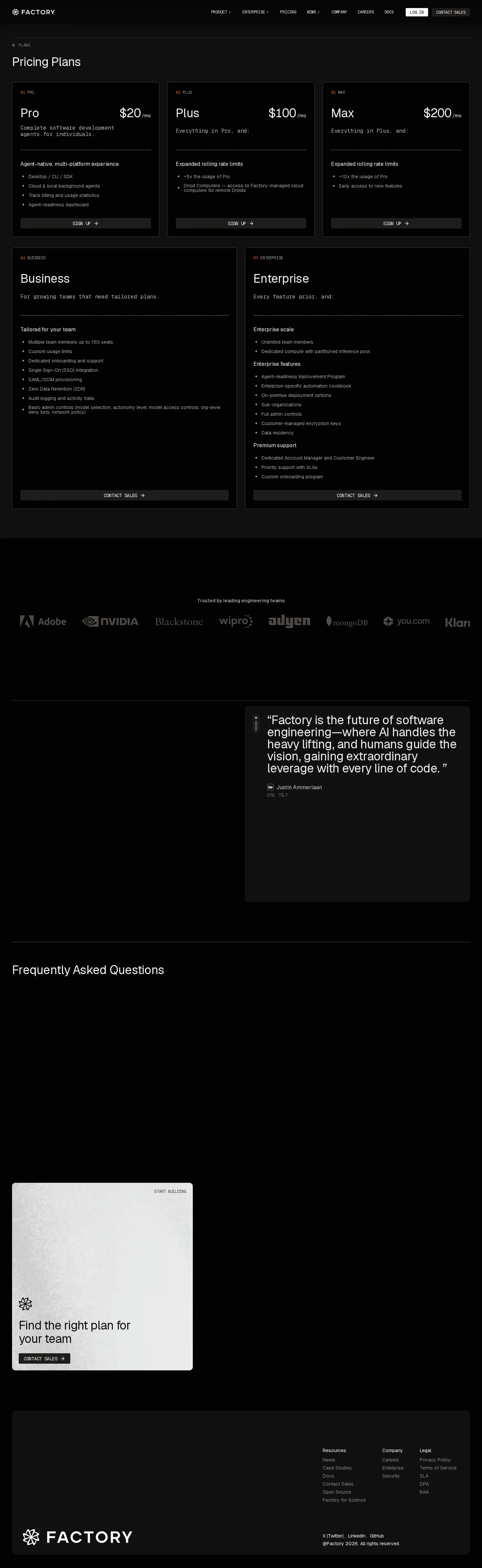
Current rate-limit seat tiers confirmed
Live pricing page shows Pro $20, Plus $100, Max $200/mo per seat — included usage gated by per-tier rolling rate limits (Plus ~5x Pro, Max ~10x), with no automatic overage — plus custom Teams (≤150 seats) and Enterprise (unlimited). Factory's docs additionally document the beyond-the-limit paths the marketing page omits: free Droid Core models and opt-in Extra Usage prepaid credits.
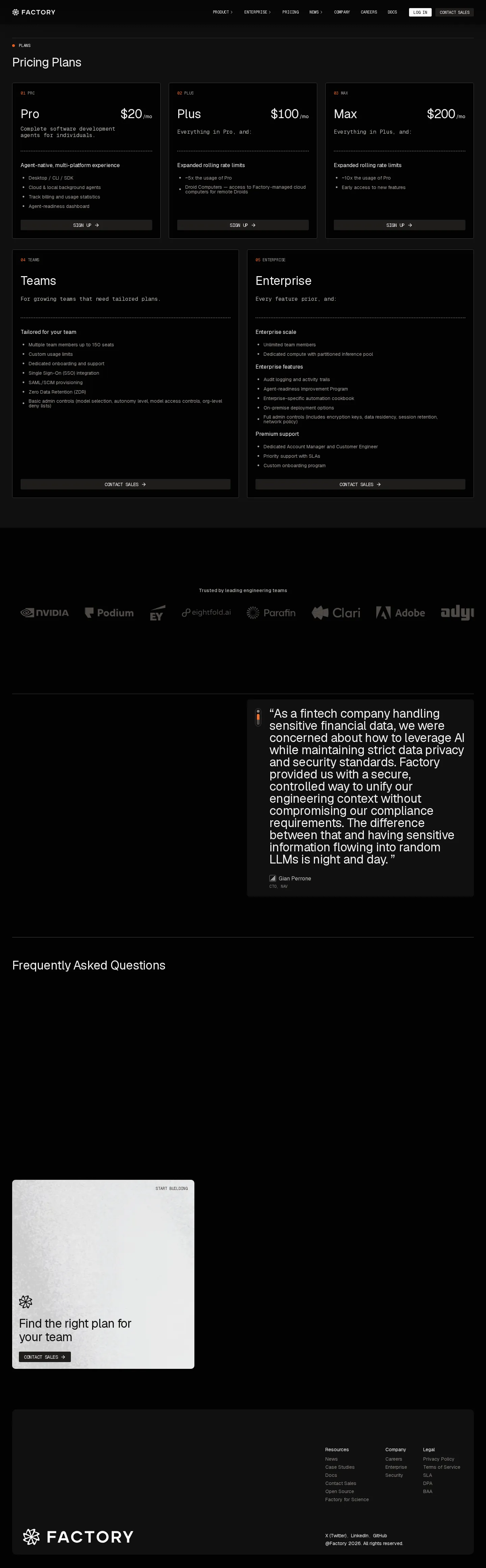
Series C; switch to rate-limit tiers (Pro/Plus/Max)
Alongside a $150M Series C at a $1.5B valuation (led by Khosla Ventures, announced 2026-04-16), Factory replaced per-token metering with rolling rate limits: Pro $20 / Plus $100 (~5x Pro, adds Droid Computers) / Max $200 (~10x Pro) / Teams (up to 150 seats) / Enterprise. Source: Wayback web.archive.org/web/20260302055101/https://www.factory.ai/pricing and factory.ai/news/series-c.
Ladder trimmed; seat caps tightened on Pro/Max
Free and Ultra removed from the main grid, leaving Pro $20 (up to 2 seats, 10M+10M tokens), Max $200 (5 seats, 100M+100M), and Enterprise. Still token-metered. Source: Wayback web.archive.org/web/20260201045903/https://www.factory.ai/pricing.
Four-tier token ladder adds Max $200 and Ultra $2,000
Self-serve ladder expanded to Free $0 / Pro $20 (10M + 10M bonus tokens) / Max $200 (100M + 100M bonus) / Ultra $2,000 (1B + 1B bonus) plus Enterprise. Pricing was still token-metered with bonus-token allocations. Source: Wayback web.archive.org/web/20251204233655/https://www.factory.ai/pricing.
Droids relaunch — BYOK Free $0 + Pro $20
Major repackaging to a Droids-first agent. New BYOK 'Free forever' tier ($0, bring-your-own keys/models, terminal UI), a Pro tier at $20/mo (20M Standard Tokens then usage-based token pricing, $5/additional seat), and custom Enterprise. Source: Wayback web.archive.org/web/20251002190323/https://www.factory.ai/pricing.
Team repriced to $40 first seat + $10/additional seat
Team plan dropped to $40/mo for the first seat, then $10 per additional seat, with 15-20M shared Standard Tokens and overage charged above the allocation. Source: Wayback web.archive.org/web/20250520055001/https://www.factory.ai/pricing.
Token-metered Team plan ($80/user)
Earliest captured pricing: a single self-serve Team plan at $80 per month per user plus custom Enterprise. Usage was metered as Standard + Premium Tokens (e.g. 20M Standard, 1M Premium per user), under the 'Engineering Intelligence' code-retrieval positioning. Source: Wayback web.archive.org/web/20250118021550/https://www.factory.ai/pricing.
- · Factory reversed its own pricing model: through 2025 it metered Factory Standard Tokens with overage, but around its April 2026 Series C it dropped per-token billing entirely for flat rate-limit seat tiers.
- · For a brief stretch in late 2025, Factory listed an Ultra tier at $2,000/mo bundling 1 billion Standard Tokens (plus 1 billion bonus tokens) — it has since vanished from the pricing page.
- · Factory's entry price has fallen from $80/user/mo (early 2025) to $20/mo (Pro today), even as it added a Plus tier and richer Droid Computers compute.
Questions & answers
- What is Factory's pricing model?
- Factory uses per-seat monthly subscriptions whose included Standard Usage is capped by rolling rate limits: Pro is $20/mo, Plus $100/mo, and Max $200/mo. When those limits run out you can keep working free on Droid Core models or enable Extra Usage, an opt-in prepaid credit balance with a $10 minimum purchase. Business and Enterprise are custom-quoted, and since July 2026 they split on data control rather than visibility: Business covers up to 150 seats with SSO, SAML/SCIM, Zero Data Retention and audit logging, while Enterprise adds unlimited seats, dedicated compute, sub-organizations, customer-managed encryption keys and data residency.
- Does Factory offer a free tier?
- No free plan. As of the July 2026 pricing page the lowest plan is Pro at $20/mo per seat, and there is no $0 tier listed. Factory's docs do describe Droid Core — a set of designated open-weight models you can keep using at no additional cost on their own rate limits once your plan's Standard Usage is exhausted — but that is free usage inside a paid plan, not a free tier.
- How much does Factory cost per month?
- Self-serve plans are Pro $20/mo, Plus $100/mo, and Max $200/mo per seat. Plus delivers roughly 5x the usage of Pro and Max roughly 10x. Business and Enterprise pricing is custom.
- Is Factory pricing usage-based or subscription?
- Primarily a per-seat subscription: each paid tier raises the rolling rate limit ceiling (Plus ~5x Pro, Max ~10x Pro) rather than selling a token bundle. There is an optional usage component, though — Extra Usage prepaid credits ($10 minimum, never expire) can be toggled on to continue past the included limits, so the seat fee is the default spend ceiling rather than a hard one.
- Did Factory used to charge for tokens?
- Yes. Through 2024 and 2025 Factory metered Factory Standard Tokens with overage above each plan's allocation, and even ran a $2,000/mo Ultra tier with 1B tokens. Around its April 2026 Series C it dropped per-token metering for the current rate-limit tiers.
- How does Factory pricing compare to Cursor or GitHub Copilot?
- Factory's $20 Pro entry matches Cursor and GitHub Copilot's individual price points, but Factory gates included usage with rolling rate limits per tier rather than a monthly credit pool. Extra Usage credits exist as an opt-in continuation path ($10 minimum), so unlike peers whose overage bills automatically, a Factory seat only exceeds its subscription price if the user deliberately turns Extra Usage on.