AI Summary
About
FLORA (operating as Flora Fauna AI) is a unified creative AI platform that integrates 60+ generative AI models into a single canvas-based environment for professional creative teams. The platform includes FAUNA, a built-in AI assistant that helps orchestrate multi-step creative workflows, and supports real-time team collaboration alongside powerful generation tools.
Founded circa 2024 and headquartered in San Francisco, FLORA has raised 42 million USD and counts clients including Pentagram (the world’s largest independent design consultancy) and Lionsgate. The company’s branding connects professional creative workflows with AI infrastructure — “Your team’s new all-in-one creative solution.”
FLORA competes with Adobe Firefly, Canva, Midjourney, and Runway for professional creative team workflows.
Pricing summary : How FLORA’s pricing model works
FLORA uses a seat-based subscription with a pooled team usage budget. The pricing model has two components:
- Seat cost: A fixed per-seat monthly subscription ($18/Starter, $50/Pro, $200/Max) that funds platform access, collaboration features, and API/MCP access.
- Usage pool: Each seat contributes included usage to the team’s shared generative AI budget, which grows with headcount and is spent at published model API rates — not abstract credits. FLORA does not publish a fixed base dollar amount per seat; instead a Special launch offer (through Aug 1) currently grants extra usage of $12/seat (Starter), $50/seat (Pro), $100/seat (Max) per month on top of the base pool.
What makes this different: FLORA prices model usage in actual dollars at published API rates, not arbitrary “credits.” Users see the dollar cost of every generation, by project and by team member. This enables creative agencies to bill clients directly from FLORA’s usage history — a rare feature in AI creative tools and a direct answer to the “black box credit” problem common in competing platforms.
The free tier is particularly transparent: users get “up to 17 generations free” based on Nano Banana 2’s published $0.151/image price, capped at $2.50 total usage — a far more honest accounting than “10 free credits.”
Pricing by product
| Plan | Seat price/mo | Usage per seat | Max seats | Key features |
|---|---|---|---|---|
| Free | $0 | $2.50 total cap (~17 images) | 1 | Canvas, text/image models, FAUNA, 3 projects |
| Starter | $18 | +$12 launch offer* | 8 | All models, API+MCP, real-time collab, unlimited projects |
| Pro | $50 | +$50 launch offer* | 8 | Shared assets/elements, per-member caps, usage analytics |
| Max | $200 | +$100 launch offer* | 8 | Custom voices (3/org via ElevenLabs) |
| Enterprise | Custom | Custom | Unlimited | SSO/SAML, custom contracts, dedicated support |
*The $12/$50/$100 figures are the Special launch offer’s extra usage per seat/mo, advertised as applying through Aug 1; the page does not disclose a fixed base pool amount, and all usage is metered at published model rates.
Sales motions across products: self-serve PLG for Free/Starter/Pro/Max (up to 8 seats); sales-led for Enterprise. 20% annual discount available on all paid plans.
Hidden costs : What FLORA users actually pay
FLORA’s pricing is unusually transparent due to its dollar-denominated usage pool. The main potential “hidden cost” is usage beyond the included pool — when the team’s shared budget is exhausted, additional generation is billed at published model rates (i.e., pay-as-you-go overage at API rates).
For high-generation workflows (e.g., generating hundreds of Veo 3.1 videos daily), the included pool may be insufficient. A Pro team’s included usage pool equals seats × $50/month — exhausted quickly on video-heavy projects at Veo 3.1 pricing.
| Line item | Monthly cost (example: 4-seat Pro team) |
|---|---|
| Platform seats (4 × $50) | $200 |
| Included usage pool (4 × $50) | $200 included |
| Overage if pool exhausted | Variable at published API rates |
| Estimated platform commitment | $200/mo (usage additional) |
Interested in estimating FLORA costs for your creative team? Use the FLORA pricing calculator to model seat costs and usage pool requirements.
Pricing evolution : FLORA pricing history and changes
Cadence
| Quarter | Price changes | Notes |
|---|---|---|
| 2025 Q1 | Launch | Seed/Series A; “biggest pricing update ever” referenced at launch |
| 2026 Q2 | 0 | Free, Starter $18, Pro $50, Max $200/seat confirmed; launch promo running (then dated through Jul 1) |
| 2026 Q3 | 0 | Base seat prices unchanged; launch offer reframed as extra $12/$50/$100 usage per seat and extended through Aug 1 |
Tracked range: 2025–2026. FLORA is a relatively new platform; pricing confirmed from flora.ai capture 2026-07-23.
Notable changes
- 2025 — FLORA launches with seat-based + usage-pool pricing from day one; raises 42M USD; clients include Pentagram and Lionsgate.
- 2026-06-11 — Research confirms Free/Starter/Pro/Max/Enterprise structure; “biggest pricing update ever” launch promotion running on Starter/Pro/Max, then dated through July 1.
- 2026-07-23 — Recapture: base seat prices unchanged; the launch offer is now expressed as extra usage of $12 (Starter) / $50 (Pro) / $100 (Max) per seat/mo and its deadline extended from Jul 1 to Aug 1.
What’s unique : FLORA’s distinctive pricing mechanics
1. Dollar-denominated usage at published API rates — not abstract credits. This is FLORA’s most distinctive pricing mechanic. Every generation shows its exact dollar cost from published model pricing. Creative agencies can bill clients directly from FLORA’s usage history, treating it as a cost-pass-through platform rather than a black-box subscription.
2. Pooled team usage budget that scales with headcount. The usage pool is not per-person — it’s pooled across the team. Light users don’t waste capacity that heavy users could use. Adding a seat directly increases the team’s generative budget, creating a clear scaling incentive.
3. Free tier metered in dollars, not opaque credits. Rather than “10 free credits,” FLORA grants “$2.50 of total usage” — specifically calculated as ~17 Nano Banana 2 images at $0.151 each. This transparency signals FLORA’s commitment to cost accountability throughout the product.
4. API and MCP access from the Starter plan. Unlike most creative AI tools that lock API access to Enterprise tiers, FLORA includes API and MCP (Model Context Protocol) access from $18/seat/mo. This positions FLORA as infrastructure for AI-native creative workflows, not just a consumer app.
Strengths & weaknesses
| Strengths | Weaknesses |
|---|---|
| Dollar-denominated usage enables client billing by agencies | Current 8-seat max on self-serve plans limits growth for larger teams |
| API+MCP access from Starter positions as creative infrastructure | Pro plan ($50/seat) is expensive vs. consumer AI tools like Canva |
| Pooled team budget scales cleanly with headcount additions | Usage overage (beyond included pool) may surprise teams with spiky generation needs |
| Nano Banana 2 as proprietary model creates platform lock-in | Brand (FLORA/FAUNA) and domain changes (florafauna.ai → flora.ai) may cause SEO confusion |
| 42M raised + Pentagram/Lionsgate clientele signals product-market fit in professional creative | SSOSML only on Enterprise — blocks larger org adoption until then |
Billing UX : FLORA billing controls and transparency
- Billing controls — Per-member usage caps available on Pro and Max plans; workspace-level usage visibility on Starter and above.
- Usage visibility — In-app usage analytics show dollar cost per project and per member; generation history available (30 days on Starter, full on Pro+).
- Payment options — Monthly and annual billing; 20% annual discount.
- Enterprise — SSO/SAML, custom usage contracts, dedicated support.
Strategic wins : Why FLORA’s pricing decisions worked
1. Dollar transparency as a trust signal for professional buyers
By pricing model usage in dollars at published API rates, FLORA removes the “black box” objection that prevents many creative studios from adopting AI tools at scale. Pentagram-caliber clients need to account for every dollar on client projects — FLORA’s usage history doubles as billing documentation.
2. Pooled usage as a team-growth incentive
Because the usage pool grows with headcount, adding a new team member directly increases the team’s generative capacity. This creates a positive feedback loop: as teams grow and generate more work, the economic case for more seats strengthens simultaneously.
3. API+MCP access from entry-level tier positions as infrastructure
Including API and MCP access from Starter ($18/seat) signals that FLORA is designed for AI-native creative workflows — where teams might integrate FLORA into custom automation pipelines, not just use the consumer-facing canvas. This is a significant differentiator vs. tools that lock programmatic access behind Enterprise tiers.
Areas to improve : Gaps in FLORA’s pricing approach
1. Eight-seat cap creates growth ceiling for mid-sized studios
Creative studios with 10-20 employees hit the 8-seat cap before qualifying for Enterprise pricing. A “Studio” tier in the 10-50 seat range with volume pricing would capture growing agencies that don’t need full Enterprise contracts. See choosing the right usage metric for how seat caps can be designed as growth levers rather than friction points. See also AI outcome-based pricing trends for how creative tools are structuring team tiers.
2. No mid-tier between Pro ($50) and Max ($200) per seat
The 4x price jump from Pro to Max for individual contributors creating videos vs. images is steep. A video-generation-focused tier at $80-120/seat could capture the segment of users who generate video regularly but don’t need custom voices. See AI companies shifting from per-user licenses for how modular add-ons can bridge pricing gaps.
3. Domain migration (florafauna.ai → flora.ai) creates discovery confusion
FLORA has migrated its domain but the old domain still redirects. SEO consolidation will be important as the brand establishes itself. See usage-based pricing strategy for how brand and pricing clarity work together to drive acquisition. Also see AI cost unpredictability for how dollar-transparent pricing can become a competitive advantage in communication.
Monetization stack & signals : how FLORA builds & buys its revenue engine
Buys 1 Builds 1 4 open roles
FLORA buys product analytics (PostHog, live) but runs its dollar-denominated usage-metering layer in-house — the core of its pricing pitch. A founding data engineer plus enterprise-marketing and forward-deployed hires signal an early sales-led push onto the self-serve creative core.
-
“Every generation is billed at the published model API rate (dollar-denominated, not abstract credits); users see the exact dollar cost of every generation, by project and by team member.”
-
“Our PostHog telemetry is live. ... Deep PostHog experience (cohorts, funnels, feature flags, warehouse sync)”
- Founding Data Engineer Data platform seen Mar 10, 2026
- Enterprise Marketing Lead GrowthRevOps seen Mar 10, 2026
- Growth Marketing Lead Growth seen Mar 9, 2026
- Forward Deployed Creative Customer success seen Nov 4, 2025
Signals reviewed · derived from public job posts, product docs
Job postings fill and close over time — once a posting is filled we keep it as a dated citation (the quoted evidence remains); use View open roles for current listings.
Key takeaways
- Dollar-denominated usage at published API rates is a breakthrough pricing design for professional creative teams who need cost accountability for client billing.
- Pooled team budgets that scale with seat count create a clean growth incentive — every new hire directly increases creative capacity without renegotiating plans.
- API+MCP access from the entry tier signals infrastructure intent, not just a consumer creative app; FLORA is positioning itself as the operating system for AI-native creative workflows.
- 42M funding and Pentagram/Lionsgate clients validate the professional creative market as FLORA’s beachhead — not consumer users experimenting with AI art.
- The “biggest pricing update ever” launch promotion (extra $12/$50/$100 usage per seat, extended through Aug 1) is a loss-leader to demonstrate platform value and drive adoption before normalizing to the metered model.
UBP implications
- Dollar-denominated usage is a UBP evolution beyond abstract credits — it eliminates the opacity that makes credit-based billing feel arbitrary and enables direct cost pass-through for professional service firms.
- Pooled team budgets that scale with headcount are a natural extension of seat-based pricing into usage-based territory — the seat price is a platform access fee; the usage pool is the actual metered consumption layer.
- Per-member usage caps (Pro/Max) allow teams to prevent runaway individual consumption without limiting total team output — a sophisticated UBP governance feature rarely seen in creative AI tools.
Sources
- FLORA pricing page (accessed 2026-07-23) — confirmed all plan tiers, seat prices, usage pool amounts; launch offer extended to Aug 1
- FLORA homepage (accessed 2026-06-11) — company description, model list (60+ models including Veo 3.1, Kling 3.0, FLUX, Gemini), client references (Pentagram, Lionsgate), funding (42M USD raised)
- FLORA pricing page — florafauna.ai redirect (accessed 2026-06-11) — confirmed 301 redirect to flora.ai; original domain still active as redirect for legacy links
Bottom line
FLORA is a seat-based creative AI platform with a pooled dollar-denominated usage budget — one of the most pricing-innovative models in the creative AI space. Rather than abstract credits, FLORA charges real dollars at published model API rates, enabling agencies to bill clients directly from usage history. With Free, Starter ($18/seat), Pro ($50/seat), Max ($200/seat), and Enterprise tiers, plus API/MCP access from the entry tier, FLORA is positioned as creative infrastructure for professional teams rather than a consumer AI tool. Backed by 42M USD and trusted by Pentagram and Lionsgate, it is building toward being the operating system for AI-native creative workflows.
Want to compare creative AI platforms? Browse the pricing blueprint.
Pricing timeline : Major events on a vertical axis
Each milestone below corresponds to a public pricing change, product launch, or material adjustment. Major events use a filled marker; minor adjustments use a faded one.
Pricing stable; launch offer extended to Aug 1
Recaptured flora.ai/pricing: base seat prices unchanged (Free $0, Starter $18, Pro $50, Max $200 per seat/mo, up to 8 seats each). The 'Special launch offer' now grants extra usage of $12 (Starter), $50 (Pro), $100 (Max) per seat/mo and its deadline moved from Jul 1 to Aug 1. Free tier unchanged (1 seat, 3 projects, up to 17 generations free).
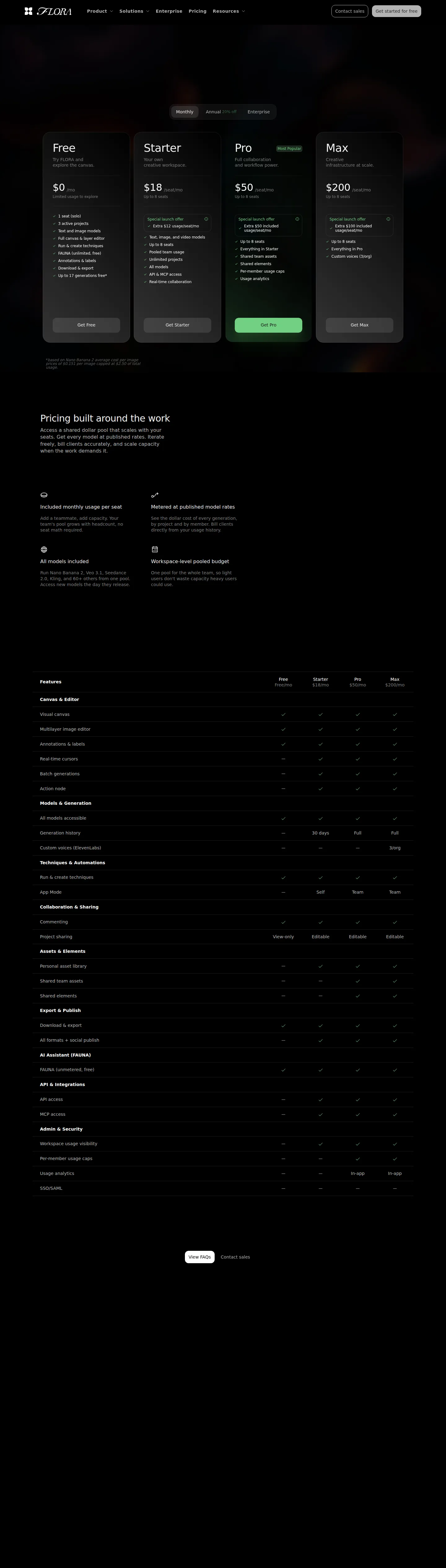
Current pricing confirmed: Free, Starter $18, Pro $50, Max $200 per seat/mo
Pricing confirmed via official flora.ai/pricing. Usage pool: Starter $12/seat, Pro $50/seat, Max $100/seat. Annual discount 20%. Special launch offer for Starter/Pro/Max through Jul 1: unmetered Nano Banana 2 and Pro usage.
FLORA platform launch
FLORA launches as a creative AI canvas platform targeting professional creative teams. Seat-based pricing with pooled usage budgets introduced from day one.
- · FLORA's free tier is metered by dollar value, not credit count: users get up to $2.50 of total usage (roughly 17 Nano Banana 2 images at $0.151 each), making the limit unusually transparent compared to most AI platforms that hide per-generation costs.
- · FLORA's flagship model 'Nano Banana 2' is their own proprietary image model — the unusual name reflects the startup's playful brand, while the model itself is positioned as the high-value workhorse for professional creative workflows.
- · FLORA raised 42M USD and counts Pentagram (the world's largest independent design consultancy) and Lionsgate among its users — an early enterprise signal that positions it in the professional creative market rather than consumer AI tools.
Questions & answers
- What is FLORA's pricing model?
- FLORA uses seat-based subscriptions with a pooled team usage budget that grows with headcount. All models are priced at published API rates — so users see the exact dollar cost of every generation, not abstract credits. A Special launch offer (through Aug 1) currently adds extra usage worth $12/seat (Starter), $50/seat (Pro), and $100/seat (Max) per month.
- Does FLORA offer a free tier?
- Yes. The free plan provides 1 seat (solo), 3 active projects, and up to 17 free generations (based on Nano Banana 2's $0.151/image cost, capped at $2.50 total usage). Free users get access to text and image models, the canvas editor, and FAUNA (the AI assistant).
- How much does FLORA cost per month?
- FLORA pricing: Free ($0), Starter ($18/seat/mo, up to 8 seats), Pro ($50/seat/mo, up to 8 seats), Max ($200/seat/mo, up to 8 seats). Enterprise pricing is custom. Annual plans offer 20% discount. A Special launch offer (through Aug 1) adds extra usage worth $12, $50, or $100 per seat/mo on Starter/Pro/Max respectively.
- Is FLORA pricing usage-based or subscription?
- Both. FLORA charges a seat-based subscription that includes a monthly usage budget. The usage budget is spent at published model API rates (dollar-denominated, not abstract credits). Additional usage beyond the included budget can be purchased separately. This creates a hybrid: predictable seat cost + transparent, metered model usage.