AI Summary
About
Gladia is a Paris-based speech-to-text and audio intelligence API, founded in 2022 by Jean-Louis Quéguiner (CEO, formerly head of AI at OVHcloud) and Jonathan Soto (CTO). It began as a hosted, production-hardened version of OpenAI’s Whisper — branded Whisper-Zero — that cut hallucinations and added enterprise features, and has since shipped its own Solaria-1 model claiming to remove up to 99% of Whisper’s hallucinations while supporting 100+ languages with automatic language detection and code-switching. The platform offers both asynchronous (batch) transcription and a multilingual real-time streaming engine with under-300ms latency.
Gladia raised a $4M seed in June 2023 (led by New Wave, with Sequoia participating via its Arc program, plus Cocoa) and a $16M Series A in October 2024 led by XAnge, with Illuminate Financial, XTX Ventures, and others — roughly $20M raised to date. The company positions itself against AssemblyAI, Deepgram, Speechmatics, and the hyperscalers’ STT APIs, and its pricing page claims it is trusted by 300,000+ developers and 5,000+ organizations worldwide.
For the most current information, visit Gladia.
Pricing summary : How Gladia’s pricing model works
Gladia prices on a single, intuitive value metric: the hour of audio processed. There are no seats and no fixed monthly platform fee — you pay for what you transcribe, with a clean split between async (batch) and real-time (streaming) rates because live transcription is more expensive to serve. Self-serve spend runs through a prepaid credit wallet: you top up manually or set an auto-top-up threshold, and hours are drawn down against the balance rather than invoiced in arrears.
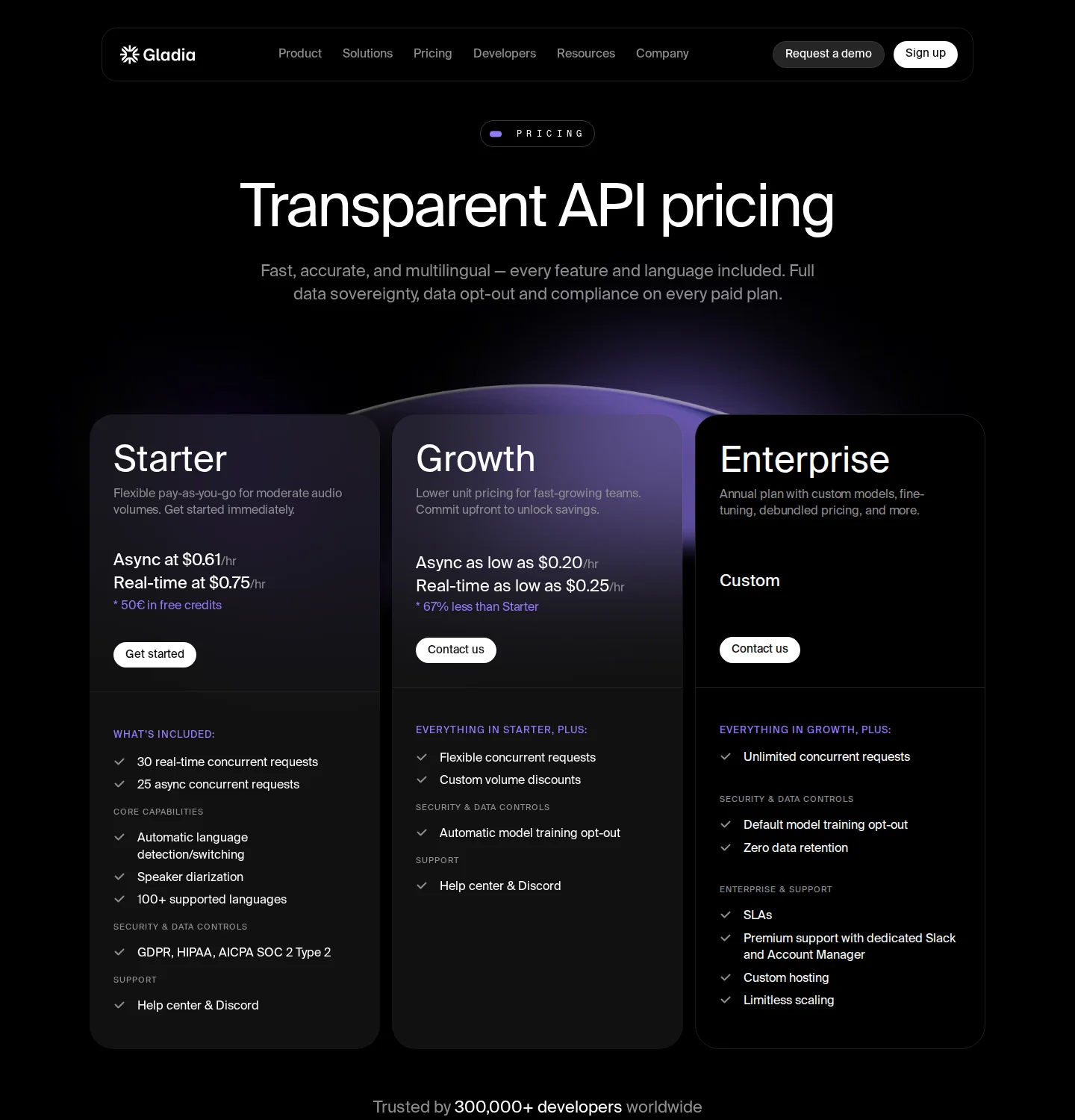
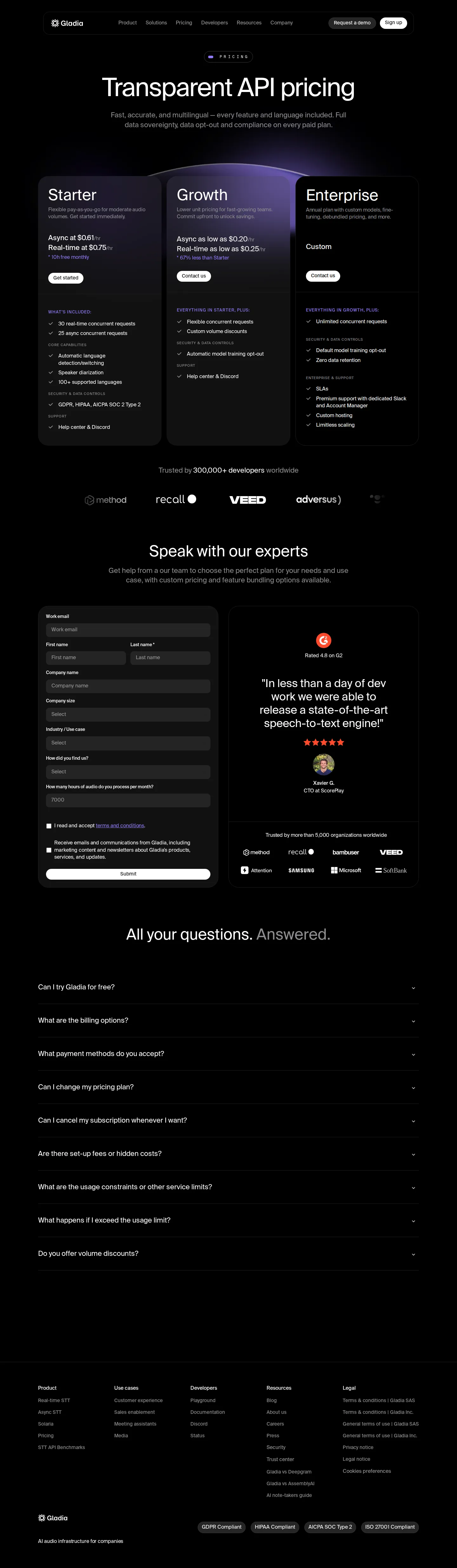
Three tiers map to commitment level. Starter is pure pay-as-you-go: async at $0.61/hour and real-time at $0.75/hour, opened with 50 EUR in free credits (a one-time grant with no monthly reset — the page puts it at roughly 80+ hours of pre-recorded or 60+ hours of real-time transcription at current rates), 30 real-time / 25 async concurrent requests, and every language and core feature included. Growth trades an upfront usage commitment for sharply lower unit prices — async as low as $0.20/hour and real-time as low as $0.25/hour, 67% less than Starter — plus flexible concurrency, custom volume discounts, and automatic model-training opt-out. Enterprise is a custom-quoted annual plan adding unlimited concurrent requests, zero data retention, default model-training opt-out, custom hosting, fine-tuning, debundled per-feature pricing, SLAs, limitless scaling, and premium support with a dedicated Slack channel and account manager.
Billing dimensions in play: hours of audio (the meter), async vs real-time rate class, prepaid credits (the purchased currency and top-up unit), concurrent requests (throughput cap per tier), and commitment level (what unlocks the Growth discount). This is pure usage-based pricing with a credit-based billing wallet on top.
What makes this different: Gladia keeps every feature and language bundled into the base hourly rate at every paid tier — there’s no per-language or per-feature upsell on Starter/Growth (debundling only appears at Enterprise). The meter is the same unit a buyer already thinks in (hours of audio), and the async-vs-real-time split honestly reflects the cost-to-serve difference rather than hiding it in a flat rate.
Pricing by product
Speech-to-Text API (self-serve and commit plans)
| Tier | Price | Included | Key mechanics |
|---|---|---|---|
| Starter | Async at $0.61/hr, real-time at $0.75/hr | 50 EUR in free credits*; 30 real-time / 25 async concurrent requests; automatic language detection & switching, speaker diarization, 100+ languages; GDPR, HIPAA, AICPA SOC 2 Type 2; help center & Discord | ”Flexible pay-as-you-go for moderate audio volumes. Get started immediately.” Self-serve “Get started” button; spend drawn from a prepaid credit wallet |
| Growth | Async as low as $0.20/hr, real-time as low as $0.25/hr | Everything in Starter, plus flexible concurrent requests, custom volume discounts and automatic model-training opt-out | ”Lower unit pricing for fast-growing teams. Commit upfront to unlock savings.” Page footnotes the rate as *67% less than Starter; “Contact us” — no self-serve path to the discount |
| Enterprise | Custom | Everything in Growth, plus unlimited concurrent requests, default model-training opt-out, zero data retention, SLAs, premium support with dedicated Slack and account manager, custom hosting, limitless scaling | ”Annual plan with custom models, fine-tuning, debundled pricing, and more.” Contact us; volume discounts are offered on the Enterprise plan |
*The 50 EUR free-credit grant is described on the pricing FAQ as “a one-time grant with no monthly reset… roughly 80+ hours of pre-recorded transcription or 60+ hours of real-time transcription at current rates. Once used, top up or upgrade to continue.” It is not a recurring monthly free allowance.
Wallet mechanics (applies to the self-serve plans)
| Dimension | How it works |
|---|---|
| Funding | Prepaid credit wallet — top up manually or set auto top-up |
| Auto top-up | Adds credits when the balance drops below a threshold you set; charges the existing payment method; threshold, amount, and on/off are editable in the Developer Console |
| Notifications | Alerts on low balance, top-ups, and failed payments |
| Rate limits | Rate limitations on calls per hour and total hours of transcribed audio, depending on the tier; exceeding the limit means contacting sales to raise it |
Sales motions across products: self-serve PLG for Starter (sign up, spend the 50 EUR free credits, top up by card via Stripe); sales-led for Growth (the commitment and the “as low as” rate are quoted, not published); and sales-led annual contracts for Enterprise (bank transfer / invoicing available for enterprise-level plans).
Hidden costs : What Gladia users actually pay
Gladia is unusually clean on hidden costs — the page explicitly states no setup fees or hidden costs — but the real bill is shaped by how many hours you process and whether they’re async or real-time. Real-time is ~23% more expensive per hour than async on Starter ($0.75 vs $0.61), so a workload heavy on live streaming costs meaningfully more than the headline async rate implies.
| Line item | Monthly cost (illustrative) |
|---|---|
| Signup credit (50 EUR, one-time — no monthly reset) | Free until exhausted |
| 200 hours async @ $0.61/hr (Starter) | ~$122 |
| 200 hours real-time @ $0.75/hr (Starter) | ~$150 |
| Same 200 hours async @ $0.20/hr (Growth commit) | ~$40 |
| Estimated total — 200h mixed async, Starter | ~$110–$150 |
Other things to budget for: concurrency limits on Starter (25 async / 30 real-time) cap throughput — bursting past them requires Growth or Enterprise; the 67% Growth discount is gated behind an upfront commitment, so the cheap rate isn’t available pay-as-you-go; and data-residency / zero-retention controls and custom hosting are Enterprise-only, so compliance-sensitive buyers effectively pay the quoted annual rate.
Want to estimate your own Gladia bill? Use the Gladia pricing calculator to model your costs based on hours of audio and async-vs-real-time mix.
Pricing evolution : Gladia pricing history and changes
Cadence
| Period | Price changes | Product / SKU additions | Notes |
|---|---|---|---|
| 2023 | Launch | Free (10h) + Enterprise | Usage calculator; pay-as-you-go via Stripe |
| 2024 H1 | Pro $0.612/hr async | Pro self-serve tier added | +$0.144/hr for live transcription |
| 2024 H2 | — | Real-time engine GA; $16M Series A | Pro structure carried forward |
| 2025 | — | Solaria/Whisper-Zero positioning | Free / Pro / Enterprise unchanged |
| 2026 H1 | Real-time → $0.75/hr standalone | Starter / Growth / Enterprise repackage | Growth commit tier; async $0.61, real-time $0.75 |
| 2026 H2 | None — every rate held | Prepaid credit wallet; auto top-up | 2026-07-22: recurring 10 free hours/month withdrawn for a one-time 50 EUR signup credit |
Tracked range: 2023–present. Periods not listed above were verified stable (0 price changes, 0 SKU additions).
Notable changes
- 2023-06 — Launches the hosted STT API with a Free plan (10 hours/month included) and a contact-sales Enterprise plan, plus an interactive hours-of-audio calculator. Pay-as-you-go billing via Stripe, no setup fees, alongside a $4M seed round.
- 2024-04 — Adds a self-serve Pro tier at $0.612/hour async plus $0.144/hour for live (real-time) transcription — the first explicit per-hour self-serve price.
- 2024-10 — $16M Series A (XAnge) and GA of the multilingual real-time engine (under 300ms latency); Pro pricing carried into 2025.
- 2026-06-09 — Repackages into Starter / Growth / Enterprise. Real-time becomes its own full per-hour rate ($0.75/hr vs $0.61 async) instead of a $0.144 add-on; new Growth tier offers ~67% volume discounts ($0.20/$0.25 per hour) behind an upfront commitment. The 10-free-hours-a-month allowance survives the repackage.
- 2026-07-22 — Changes how the account is funded rather than what it costs. Self-serve moves onto a prepaid credit wallet with manual or automatic top-ups, a user-set low-balance threshold, and alerts on low balance, top-ups, and failed payments; the recurring 10 free hours per month is withdrawn for a one-time 50 EUR signup credit with no monthly reset (~80+ hours pre-recorded, ~60+ hours real-time). Every per-hour rate and both concurrency caps are unchanged.
The free-hours-to-wallet swap in detail
Read the two halves of the 2026-07-22 change together and they point the same way: Gladia wants money in the account before the audio is processed. Moving self-serve onto a prepaid wallet converts a monthly arrears invoice into cash collected up front, and auto top-up keeps a growing workload from stalling at a zero balance — the reason the notification set covers low balance, top-ups, and failed payments rather than overage. The buyer-visible upside is real: with a wallet you cannot receive a bill larger than what you funded, which is the “no end-of-month surprises” framing Gladia uses, and the top-up threshold, amount, and switch all sit in the Developer Console instead of behind support.
The cost falls almost entirely on one cohort. A team transcribing a handful of hours a month previously sat inside a perpetual 10-hours-free allowance and never reached a payment step; after 2026-07-22 the same team gets a larger but finite runway (50 EUR is worth roughly eight months of the old allowance in one grant) and then has to fund a wallet. For anyone already paying, nothing about the bill changes — the rates, the async/real-time split, and the 30/25 concurrency caps all held. That makes this a change to the entry motion and cash timing, not a price increase, and it does not disturb the core thesis on the rest of this page: the meter is still the audio hour, and the discount is still bought with commitment rather than feature-gating.
What’s unique : Gladia’s distinctive pricing mechanics
1. One honest value metric: the audio hour. No seats, no platform fee, no per-language or per-feature upsell on the self-serve tiers — you pay per hour transcribed, full stop. That makes Gladia’s bill trivial to forecast from a single input (hours of audio) compared with token- or character-based STT pricing elsewhere.
2. Async and real-time priced separately and transparently. Rather than blending a flat rate, Gladia charges $0.61/hr for batch and $0.75/hr for live, surfacing the genuine cost-to-serve gap. The 2026 move from a $0.144 “live add-on” to a standalone real-time rate made that split explicit.
3. Commitment buys the discount, not the features. The Growth tier’s ~67% price cut is unlocked by an upfront usage commitment — features and languages are identical to Starter. Discounting on volume commitment rather than feature-gating keeps the cheap tier from feeling crippled, while still rewarding predictable demand.
4. The wallet is the spend cap. Since 2026-07-22 self-serve spend is drawn from a prepaid credit balance rather than invoiced in arrears, so the maximum a Starter account can be billed in a month is whatever it funded. Most usage-based vendors ask buyers to police overage with alerts and budgets bolted onto an arrears invoice; Gladia inverts it — the ceiling is structural, and the escape hatch (auto top-up above a threshold you set) is opt-in and reversible from the Developer Console. The same move retires the recurring free allowance: free usage is now a fixed 50 EUR grant, not a monthly entitlement.
Strengths & weaknesses
| Strengths | Weaknesses |
|---|---|
| Single intuitive meter (audio hours) — easy to forecast | Growth’s 67% discount locked behind an upfront commitment |
| Large one-time 50 EUR signup credit (~80+ async hours), no setup fees | No recurring free allowance since 2026-07-22 — the free runway is finite |
| Prepaid wallet caps the bill at what you funded; auto top-up and alerts are self-service | Prepayment means paying before value is delivered, and unused credit sits with the vendor |
| Every language & feature bundled on self-serve tiers | Concurrency capped on Starter (25 async / 30 real-time) |
| Honest async-vs-real-time price split | Growth & Enterprise unit prices are “as low as” / quoted — not fully public |
| Compliance (GDPR, HIPAA, SOC 2) on every paid plan | Data residency, zero-retention & custom hosting are Enterprise-only |
Billing UX : Gladia billing controls and transparency
- Prepaid credit wallet — Self-serve billing runs on a prepaid wallet rather than an arrears invoice: “You top up manually or set auto top-up to refill automatically when your balance drops below a threshold you choose.” Gladia frames the benefit as “full visibility, no end-of-month surprises.”
- Auto top-up with a user-set threshold — Automatically adds credits when the balance falls below the threshold you set, charging the existing payment method. The threshold, the top-up amount, and the feature itself can be adjusted or turned off “entirely from the Developer Console at any time.”
- Balance and payment notifications — Account-level alerts fire on low balance, on top-ups, and on failed payments.
- Plan changes — Upgrade or downgrade “anytime directly from your account settings or by contacting our sales team”; cancellation is allowed “in accordance with your contract terms.”
- Rate limits, not silent overage — Limits apply to calls per hour and total hours of transcribed audio, varying by tier. Exceeding a limit means contacting sales to raise the cap rather than auto-billed overage.
- Payment options — Stripe for the main credit cards (Visa and Mastercard) on self-serve plans; alternative options such as bank transfer or invoicing for enterprise-level plans. No setup fees or hidden costs at any tier.
Strategic wins : Why Gladia’s pricing decisions worked
1. Pricing on the unit the buyer already counts
Charging per hour of audio — not per token, character, or API call — matches how transcription buyers (CCaaS, sales-enablement, meeting assistants, media) think about their workload. That made cost modeling trivial and lowered the barrier to a self-serve “just try it” start. See how AI companies structure pricing.
2. Splitting real-time into its own rate
Moving from a blended “$0.612 + $0.144 live” structure to a clean $0.61 async / $0.75 real-time split in 2026 made the more expensive product visibly more expensive — protecting margin on streaming workloads while keeping the cheap batch rate as the headline. Related: choosing the right usage metric.
3. Discounting on commitment, not on capability
The Growth tier rewards predictable volume with a ~67% cut while leaving every feature intact. That avoids the trust-eroding “crippled cheap tier” pattern and converts growing customers into committed ones. Related: outcome-based pricing trends.
Areas to improve : Gaps in Gladia’s pricing approach
1. “As low as” hides the real Growth curve
Growth is advertised as “as low as $0.20/hr,” but the actual rate depends on the size of the commitment, which isn’t published. Buyers can’t self-serve their way to the discount or model it without a sales conversation. See bill shock and cost unpredictability.
2. Real-time premium can surprise live-heavy workloads
Teams that anchor on the $0.61 async headline can be caught out by the 23% higher $0.75 real-time rate once they ship streaming. Making the blended cost more prominent for mixed workloads would reduce surprise.
3. Compliance & data controls gated to Enterprise
Zero data retention, custom hosting, and data residency only arrive at the quoted Enterprise tier — a hurdle for mid-market buyers in regulated verticals who otherwise fit Growth. A self-serve data-residency add-on would widen the funnel.
4. The free-tier swap was made silently, and the wallet has no forecast attached
The 2026-07-22 move from 10 free hours a month to a one-time 50 EUR credit is defensible on its merits, but the pricing page presents it as a footnote (* 50€ in free credits) with the “no monthly reset” caveat buried in the FAQ — a low-volume user who onboarded under the old allowance learns the difference when the credit runs out, not before. The fix is cheap: state the grant’s non-recurring nature on the plan card itself, and pair the wallet with a burn-rate estimate (“at your last 30 days of usage this balance lasts ~N days”) so auto top-up is a considered setting rather than the only thing standing between a live workload and a hard stop. Prepaid balances make the ceiling explicit but do nothing for cost predictability unless the buyer can see how fast the balance is draining.
Monetization stack & signals : how Gladia builds & buys its revenue engine
Buys 2 Builds 0
Gladia buys its monetization spine: Stripe takes the card, Hyperline runs the per-hour-of-audio meter, self-serve onboarding, and Enterprise subscriptions. It deliberately ruled out Stripe Billing as too costly for engineering to customize.
-
“We wanted to have a unique billing tool to onboard our future customers autonomously on our free and pay-as-you-go plans and manage Enterprise subscriptions—all in one place.”
-
“We use Stripe for payments and accept the main credit cards (Visa and Mastercard).”
Signals reviewed · derived from press & filings, product docs
Key takeaways
- A single value metric beats clever ones. Pricing per hour of audio makes Gladia’s bill forecastable from one number, lowering the barrier to adoption versus token- or character-based STT.
- Price the expensive product as expensive. Splitting real-time ($0.75) from async ($0.61) protects streaming margin and signals the cost-to-serve difference honestly.
- Commitment, not feature-gating, should earn the discount. Growth’s 67% cut is unlocked by upfront volume while keeping features identical — a cleaner incentive than a crippled cheap tier.
- Bundle features, gate sovereignty. Every language and capability is included on self-serve tiers; only data residency, retention, and hosting controls sit behind Enterprise.
- A free trial is a budget; a monthly allowance is a subsidy. Gladia’s 2026-07-22 swap of 10 recurring free hours for a one-time 50 EUR credit turns an open-ended cost of carry into a fixed, forecastable acquisition line while still funding a serious evaluation (80+ async hours). The catch to plan for is that perpetual-free users become a conversion decision on a date you chose, so the entry motion has to be worth converting into.
UBP implications
- Choose the meter your buyer already uses. Hours of audio is intuitive for transcription buyers; aligning the meter with the customer’s mental model reduces friction and disputes. See usage-based pricing strategy.
- Differentiate rates by cost-to-serve, not just packaging. Async vs real-time pricing reflects real infrastructure cost and keeps the model defensible as volume scales.
- Collect before you meter — prepayment and commitments de-risk usage revenue at both ends of the funnel. Gladia’s 2026-07-22 prepaid wallet takes cash from small self-serve accounts before the audio is processed, removing arrears collection risk and giving buyers a structural spend cap, while the Growth commitment does the same job for large accounts by trading a ~67% discount for forecastable volume. Usage-based vendors that pair the two get predictable revenue without feature-gating the cheap tier — but the wallet only works if top-up thresholds and burn rate are self-service, or the “cap” becomes an outage. See choosing the right usage metric.
Sources
- Gladia pricing page (accessed 2026-07-22) — live capture
- Gladia pricing FAQ — free credits, billing options, auto top-up (accessed 2026-07-22)
- Gladia changelog (accessed 2026-07-22) — “Moving to credit-based billing” (2026-07-03): “There is no change in pricing: the per-hour rates remain the same”; free plan moves from 10 hours/month to “a one-time grant of 50 EUR in credits”
- Gladia docs — concurrency limits (accessed 2026-07-23) — paid-plan caps of 25 concurrent async and 30 concurrent live requests, Enterprise “on demand”
- Gladia blog — Rev.ai vs Gladia comparison (accessed 2026-07-23) — restates the rate card: “$0.61/hr async or $0.75/hr real-time on the Starter plan”, Growth “as low as $0.20/hr” async and “$0.25/hr” real-time
- Wayback Machine snapshots: gladia.io/pricing (accessed 2026-06-09) — 2023-06, 2024-04, 2025-02
Bottom line
Gladia is a Paris-based (2022, ~$20M raised through a 2024 $16M Series A) speech-to-text and audio intelligence API that prices on the one unit its buyers already count: the hour of audio. Self-serve Starter is pay-as-you-go at $0.61/hour async and $0.75/hour real-time, funded since 2026-07-22 from a prepaid credit wallet that opens with a one-time 50 EUR grant (~80+ pre-recorded hours) rather than the recurring 10 free hours it replaced; the commitment-based Growth plan drops rates to as low as $0.20/$0.25 per hour (~67% off); and Enterprise is a quoted annual contract adding unlimited concurrency, zero data retention, custom hosting, and SLAs. Every language and feature is bundled on the self-serve tiers — only sovereignty controls sit behind Enterprise. The wallet caps your bill at what you funded, so the thing to watch is burn rate rather than an invoice. Browse the pricing blueprint for more fully-researched company profiles.
Want to compare Gladia against other speech and audio AI companies like Deepgram, AssemblyAI, or Speechmatics? Browse the pricing blueprint.
Pricing timeline : Major events on a vertical axis
Each milestone below corresponds to a public pricing change, product launch, or material adjustment. Major events use a filled marker; minor adjustments use a faded one.
Prepaid credit wallet replaces the monthly free-hours allowance
Self-serve billing moved from pay-as-you-go in arrears to a prepaid credit wallet with manual or automatic top-ups, a user-set low-balance threshold, and notifications on low balance, top-ups, and failed payments — all editable in the Developer Console. The recurring 10-free-hours-per-month allowance was withdrawn in favour of a one-time 50 EUR signup credit with no monthly reset (roughly 80+ hours pre-recorded or 60+ hours real-time). No rate moved: Starter stays $0.61/hr async and $0.75/hr real-time, Growth as low as $0.20/$0.25 per hour, Enterprise custom; concurrency stays 30 real-time / 25 async.
Starter / Growth / Enterprise restructure
Repackaged into three tiers: Starter pay-as-you-go ($0.61/hr async, $0.75/hr real-time, 10h free, 25 async / 30 real-time concurrent requests); Growth commitment-based (as low as $0.20/hr async, $0.25/hr real-time — 67% off Starter, flexible concurrency, model-training opt-out); and Enterprise (custom annual, unlimited concurrency, zero data retention, custom hosting, SLAs). Real-time became its own full per-hour rate rather than a live add-on.
Series A + real-time engine GA
Gladia raises a $16M Series A led by XAnge and launches its multilingual real-time transcription engine (under 300ms latency). Pro pricing structure ($0.612/hr async + $0.144/hr live) carried through into 2025.
Pro plan added — $0.612/hr async + $0.144/hr live
Introduced a self-serve 'Pro' tier at $0.612/hour for async transcription, plus an additional $0.144/hour for live (real-time) transcription. Free (10h/month) and Enterprise tiers retained. First explicit per-hour self-serve pricing.
Launch — Free tier + Enterprise, usage calculator
Gladia launches its hosted Whisper-based STT API with a Free plan (10 hours/month included) and a contact-sales Enterprise plan. Pricing page features an interactive hours-of-audio calculator; pay-as-you-go billing via Stripe, no setup fees. Coincides with a $4M seed round (New Wave, Sequoia via Arc, Cocoa).
- · Gladia was founded in 2022 in Paris by Jean-Louis Quéguiner (CEO, ex-head of AI at OVHcloud) and Jonathan Soto (CTO).
- · It raised a $4M seed in June 2023 (New Wave, Sequoia via the Arc program, Cocoa) and a $16M Series A in October 2024 led by XAnge — about $20M total raised.
- · Gladia started as a fine-tuned, hallucination-reduced version of OpenAI's Whisper (branded Whisper-Zero) and now ships its own Solaria-1 model claiming to remove up to 99% of Whisper's hallucinations.
Questions & answers
- What is Gladia's pricing model?
- Gladia bills per hour of audio processed, with separate rates for async (batch) and real-time (streaming) transcription, drawn down from a prepaid credit wallet. The Starter plan is pure pay-as-you-go ($0.61/hr async, $0.75/hr real-time) and starts with 50 EUR in free credits; the Growth plan offers volume discounts down to $0.20/hr async and $0.25/hr real-time in exchange for an upfront commitment; and Enterprise is a custom-quoted annual contract.
- Does Gladia offer a free tier?
- Gladia gives every new account 50 EUR in free credits — a one-time grant with no monthly reset, which the pricing page says is roughly 80+ hours of pre-recorded transcription or 60+ hours of real-time transcription at current rates. Once the credits are used, you top up the wallet or upgrade to continue. There are no setup fees or hidden costs.
- How much does Gladia cost per hour?
- On the Starter (pay-as-you-go) plan, async transcription is $0.61/hour and real-time streaming is $0.75/hour. On the commitment-based Growth plan, prices fall to as low as $0.20/hour async and $0.25/hour real-time — about 67% less than Starter. Enterprise pricing is custom and can include debundled per-feature rates.
- Is Gladia pricing usage-based or subscription?
- It is primarily usage-based: you pay per hour of audio transcribed rather than a fixed monthly fee. Starter is pure pay-as-you-go funded by a prepaid credit wallet with manual or automatic top-ups, Growth layers volume discounts on top of an upfront commitment, and Enterprise is an annual contract. Payments run through Stripe (Visa/Mastercard), with bank transfer and invoicing for enterprise-level plans.
- What's the difference between async and real-time pricing on Gladia?
- Async (batch) transcription processes pre-recorded files and is cheaper — $0.61/hour on Starter. Real-time streaming transcribes live audio with under-300ms latency and costs more — $0.75/hour on Starter. Earlier (2024–2025) Gladia charged a single $0.612/hour async rate plus a $0.144/hour add-on for live; in 2026 it split real-time into its own full per-hour rate.