AI Summary
About
Gumloop is a no-code platform for building AI workflows and autonomous agents. Users assemble automations from a visual node canvas — pulling data from integrations like Google Sheets, Slack, Gmail, Airtable, and Salesforce, then layering AI nodes, web scraping, and custom code — and run them on triggers, on schedules, or interactively through agents. It targets operators, marketers, and ops teams who want to automate research, enrichment, lead generation, content, and support tasks without writing glue code.
The company raised a $50M Series B led by Benchmark, and its pricing page features logos from Gusto, Instacart, Shopify, and Ramp as customers. Gumloop positions against both classic automation tools (Zapier, n8n) and newer AI-agent platforms (Dust, Glean, ChatGPT’s agent mode), competing on a no-code builder paired with agent-native primitives like hosted MCP servers, agent skills, and reflections.
Rather than charging per user — the default for SaaS automation tools — Gumloop meters everything on a single credit currency. Seats are unlimited and free on every paid plan, so the entire bill is a function of how many workflow runs and agent interactions a customer drives in a month.
Pricing summary : How Gumloop’s flat-rate-plus-orchestration-fee model works
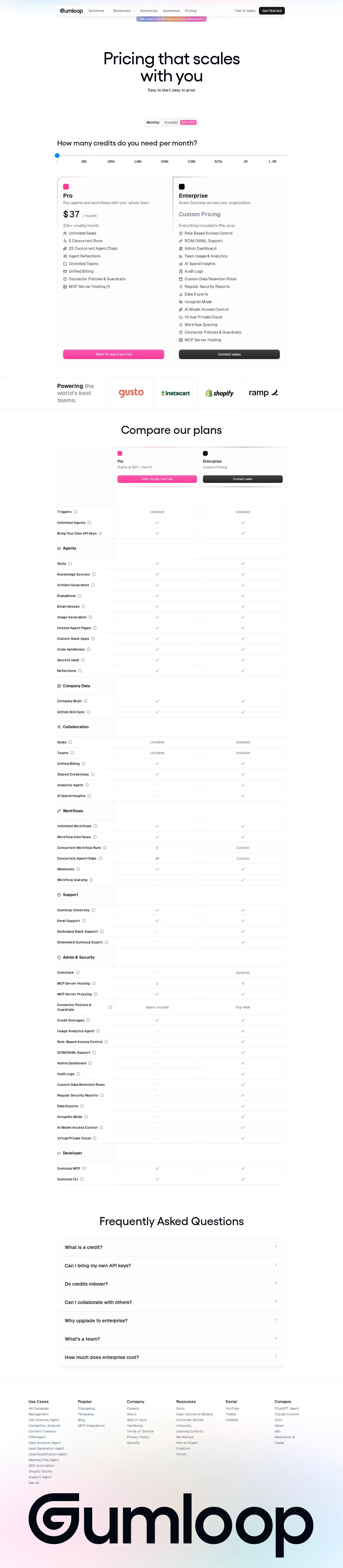
Gumloop uses a flat-rate subscription built on credit-based billing, with a 14-day free trial gating entry. As of the live 2026-08-26 capture, Gumloop dropped the interactive credit-volume slider it ran from June 2026 through at least July 2026, replacing it with a single fixed price plus a new percentage fee:
- Base subscription (now flat): Pro costs a flat $37/mo for 20,000 credits/month — there is no slider and no self-serve way to buy a bigger monthly allocation. 1 credit = $0.005; the 20,000 included credits work out to 7,400 credits at that list price plus 12,600 bonus credits, by Gumloop’s own accounting. The Monthly/Annual toggle is also gone — no self-serve annual discount is currently offered.
- Orchestration Fee (new): Every agent chat’s total is the sum of five components — Chat & Reasoning (the model’s cost), Tool Calls (1 credit per call plus the tool’s own charge), Compute (5 credits per session-minute), Workflows (billed at their own node cost), and a new Orchestration Fee of 8% of the first three, charged for running the agent loop itself. Bringing your own API key (BYOK) zeroes out the Chat & Reasoning credits but raises the Orchestration Fee to 16% (calculated on what the run would otherwise have cost) — in Gumloop’s own worked example, a 459-credit standard chat drops to 93 credits with BYOK.
- Overage (now opt-in and capped): Overage must be manually enabled on the Subscription page — it no longer applies automatically. Once enabled it bills at $0.005/credit and is capped at 1,000,000 overage credits per billing period ($5,000) for Pro by default (a lower cap can be set); agents stop once the cap is reached. This reverses the “default to unlimited overage” policy Gumloop shipped in March 2026. Enterprise plans set their own cap, or can run uncapped, and unused credits roll over (Pro credits still do not).
What’s different from the prior slider era: Gumloop still charges nothing for seats — unlimited users remain included on every paid plan — so the bill is still a hybrid function of a base fee plus metered consumption, not headcount. But the shape of that hybrid changed: a continuous $37-and-up price-to-volume slider became one fixed $37 price, and a new 8%/16% orchestration fee was layered on top of agent credit costs. The 14-day free trial (introduced 2026-07-30) is confirmed to require a card and to auto-convert into a paid Pro subscription at the end of the trial unless canceled.
Pricing by product
Gumloop platform (subscription plans)
| Tier | Price | Included | Key mechanics |
|---|---|---|---|
| Pro | Flat $37/mo, 14-day free trial (card required) | 20,000 credits/mo; unlimited seats & teams, 5 concurrent workflow runs, 25 concurrent agent chats, unified billing, MCP hosting (1) | Fixed price — the credit-volume slider is gone; overage opt-in at $0.005/credit, capped at 1M credits/mo ($5,000) by default; 8% orchestration fee on agent runs (16% with BYOK) |
| Enterprise | Custom | Everything in Pro, plus RBAC, SCIM/SAML, admin dashboard, audit logs, VPC, AI model access control, workflow queuing, credit rollover, configurable overage cap | Sales-led, quoted; only plan where credits roll over and the overage cap can be configured or removed |
As of the 2026-08-26 capture, Gumloop replaced its interactive credit-volume slider (previously $37/mo up to roughly 50x that across 14 steps, with a Monthly/Annual toggle saving 20%) with this single flat Pro price — the slider and self-serve annual billing are both gone. See Pricing evolution for the slider era’s mechanics.
Agent credit components (Pro & Enterprise)
| Component | What it covers | Rate |
|---|---|---|
| Chat & Reasoning | The model reading, thinking, and writing a response | The model’s cost, at $0.005/credit (0 credits with BYOK) |
| Tool Calls | Each tool the agent uses | 1 credit per successful call, plus that tool’s own charge |
| Compute | Time the agent spends actively working | 5 credits per session-minute |
| Orchestration Fee | Running the agent loop itself | 8% of the three rows above (16% with BYOK) |
| Workflows | Any workflow the agent runs | The workflow’s own node costs, added to the chat; no orchestration fee |
Sales motions across products: PLG / self-serve for Pro (start a 14-day trial, card required); sales-led for Enterprise (custom credit allocation, rollover, and configurable overage cap).
Hidden costs : What real Gumloop credit bills actually total
The $37 Pro headline only covers 20k credits. Because agents consume variable, token-based credits — a single research task with 3+ tool calls can run 30–100 credits, and complex expert-model analysis 50–200+ — heavy agent users blow through the entry allocation fast. Two representative bills:
A marketing team scaling agent research and enrichment
| Line item | Monthly cost |
|---|---|
| Pro plan at 250k credits/mo | $460 |
| Slide up to 330k credits/mo to cover steady-state growth | $603 |
| Total (one slider step up) | $603 |
Once you regularly exceed your slider step, the cheaper, more predictable move is to slide up to the next credit tier rather than ride overage — because, since the March 2026 repackaging, Pro plans default to unlimited overage rather than hard-stopping at a cap, so an unmanaged spike can run well past the allocation. This is exactly the bill-shock dynamic that makes agent-heavy automation spend hard to forecast.
A solo operator on the entry tier
| Line item | Monthly cost |
|---|---|
| Pro plan at 20k credits/mo | $37 |
| Slide up to 55k credits/mo once 20k isn’t enough | $97 |
| Total (one slider step up) | $97 |
A solo user who outgrows 20k credits is better off stepping the slider to 55k ($97) and setting the 75%/90% usage-threshold email alerts than relying on unlimited overage — strong pressure to right-size the slider or bring your own API key (which halves agent AI-model credits).
Want to estimate your own Gumloop bill? Use the Gumloop pricing calculator to model your monthly cost based on credit volume, agent usage, and overage.
Pricing evolution : From fixed $97/$297 tiers to a seat-free credit slider
Gumloop’s packaging has moved through three distinct phases in two years. The company began as AgentHub (YC W24), which launched on Hacker News on 2024-02-08 to a 162-point Launch HN thread, then rebranded the product to Gumloop while keeping the legal entity AgentHub Inc. The earliest archived /pricing page (2024-06) priced four fixed tiers on flow-run and AI-call quotas; by 2024-07 those quotas had been replaced by a credit currency, with the slider sizing the allocation but leaving the $97/$297 sticker prices untouched. That four-tier model held all the way through the $17M Series A (Jan 2025) and the Enterprise launch (mid-2025). The changelog pins the repackaging to March 2026, days around the $50M Series B led by Benchmark: on 2026-03-09 Gumloop merged its Solo and Team plans into a single Pro with no seat limits (“more credits, same price”), and on 2026-03-19 it flipped overage from a hard cap to unlimited-by-default (with a configurable cap reserved for Enterprise). The net result is today’s model — Starter dropped, Pro a single slider where the price itself scales with credits from $37 to $1,840 (self-serve to 1M credits, then “Contact sales”), the free tier grown from 1k to 5k credits, and seats unlimited and free on every paid plan.
Cadence
| Quarter | Price changes | Product / SKU additions | Notes |
|---|---|---|---|
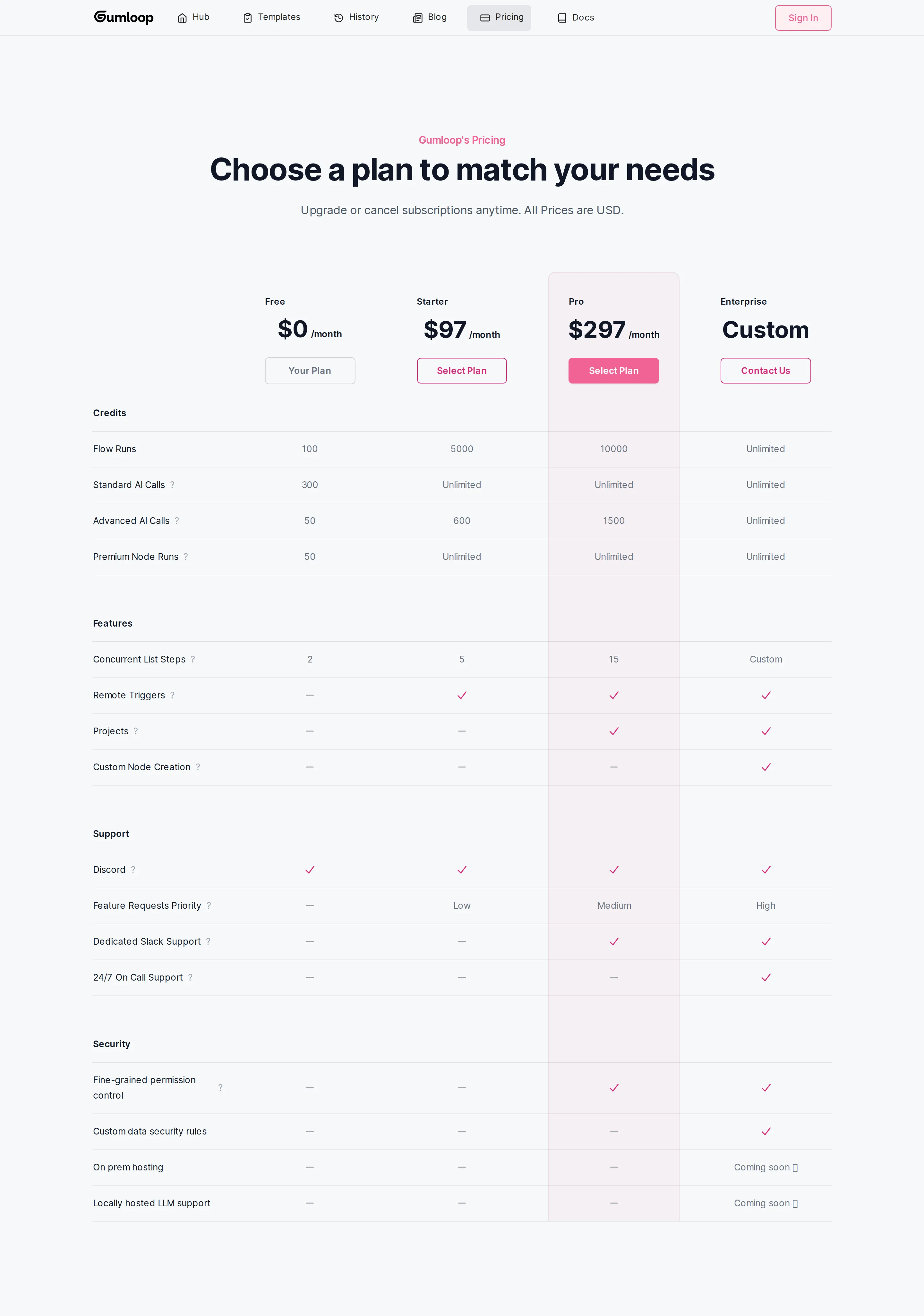
| 2024 Q2 | — | Flow-run/AI-call quota model | Earliest archived snapshot (2024-06-12): Free / Starter $97 / Pro $297 / Enterprise, metered on Flow Runs + AI Calls + Premium Node Runs. |
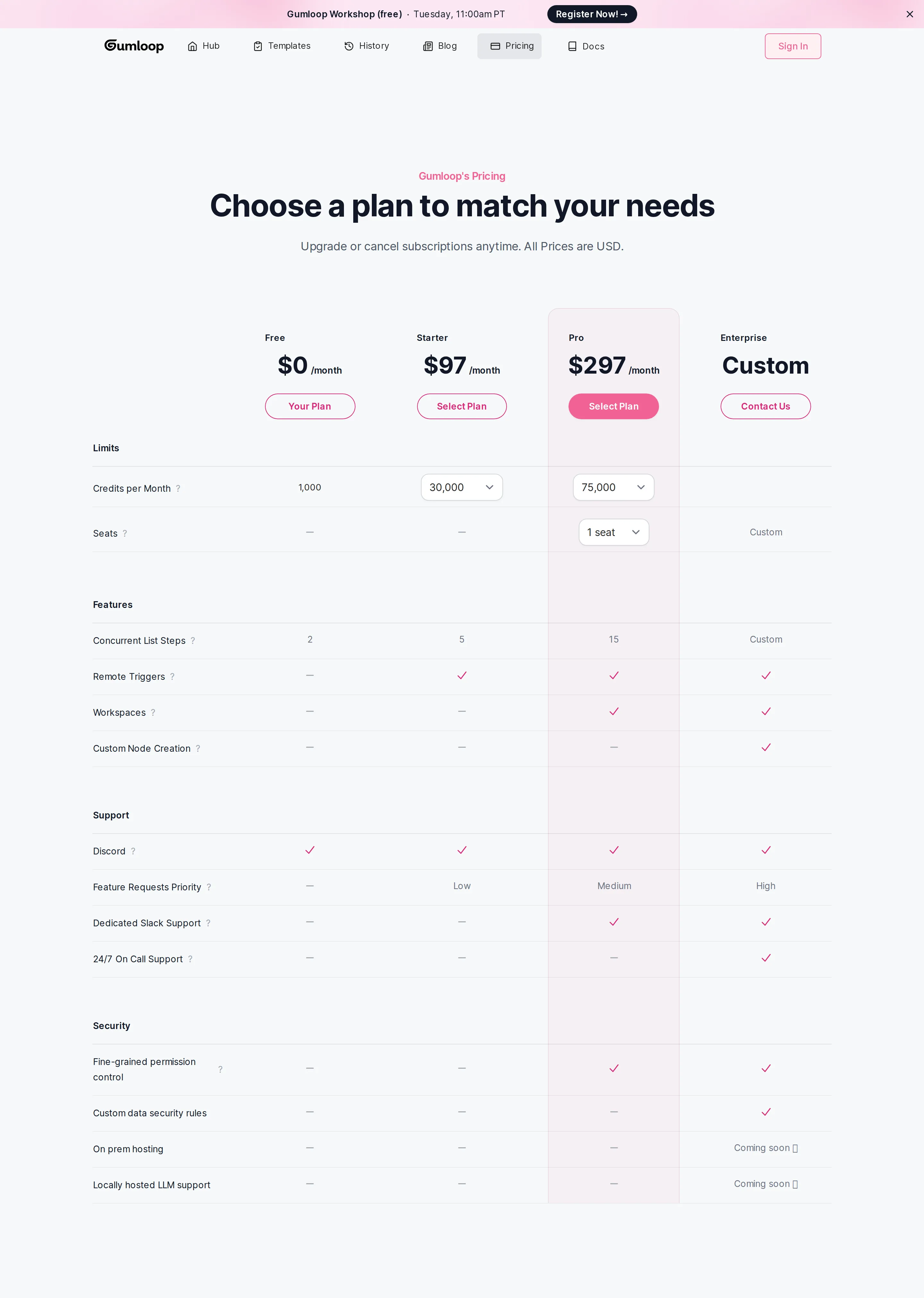
| 2024 Q3 | 0 | Credit currency + allocation slider | By 2024-07-16, “Credits per Month” replaces flow-run quotas; prices unchanged at $97 / $297; slider sizes allocation only. |
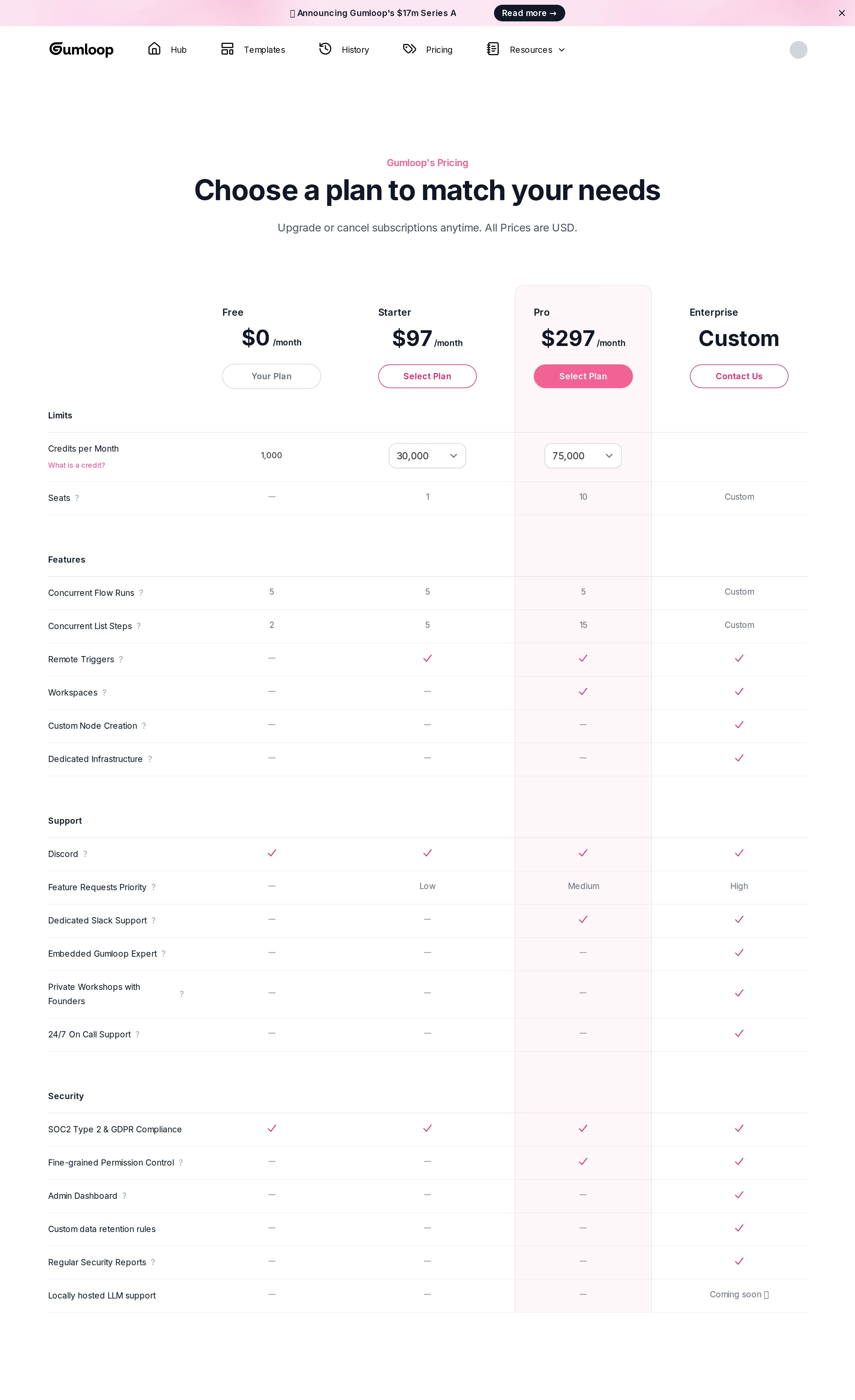
| 2025 Q1 | 0 | — | $17M Series A (Nexus VP, First Round, YC) announced 2025-01-10; four-tier credit model unchanged, free tier 1,000 credits, Pro 10 seats. |
| 2025 Q3 | 0 | Enterprise governance rows | 2025-08 snapshot adds RBAC, SCIM/SAML, AI Model Access Control, Audit Logging, Incognito Mode; still Free / Starter $97 / Pro $297 / custom. |
| 2026 Q1 | Repackage | Solo+Team merged into Pro; overage→unlimited-default | Changelog: 2026-03-09 “Revamped Pricing” merges Solo and Team into one seat-free Pro (“more credits, same price”); 2026-03-19 “Unlimited Overages & Configurable Cap” flips overage from a hard cap to unlimited-by-default (Enterprise sets a custom cap). Brackets the 2026-03-12 $50M Series B (Benchmark). |
| 2026 Q2 | 0 | Pro self-serve to 1M credits | 2026-04-29 “Higher Pro Credit Limits”: Pro buys up to 1M credits self-serve. Live captures (2026-06-02, 2026-06-30) confirm the $37→$1,840 slider, 5k free credits, unlimited free seats; slider axis now shows a 1.5M marker but $1,840/1M stays the top self-serve sticker. |
Tracked range: 2024-Q2 – 2026-Q2 (Wayback /pricing snapshots 2024-06 through 2025-08, plus the dated changelog and live 2026-06 captures). The changelog pins the repackaging mechanics to March 2026 (plan merge 2026-03-09, overage flip 2026-03-19), resolving the 2025-08 → 2026-06 window left open by the gap in renderable /pricing snapshots.
Notable changes
- 2024-02-08 — AgentHub (YC W24) launches on Hacker News; the Launch HN thread reaches 162 points and 85 comments, the strongest single community signal in the company’s history (HN 39302870). The product is later rebranded to Gumloop.
- 2024-06 → 2024-07 — The pricing model shifts from flow-run/AI-call quotas to a credit currency, while the headline prices stay fixed at Free / Starter $97 / Pro $297 / Enterprise. The credit slider sizes allocation, not price (Wayback 2024-06-12 vs 2024-07-16).
- 2025-01-10 — Gumloop announces a $17M Series A led by Nexus Venture Partners (with First Round and Y Combinator); ~$20M raised to date. Pricing is unchanged (gumloop.com/blog/gumloops-17m-series-a/).
- 2025-08 — An “Announcing Gumloop for Enterprise” banner and a deep enterprise governance feature set (RBAC, SCIM/SAML, audit logs) appear; the $97/$297 fixed tiers remain in force (Wayback 2025-08-07).
- 2026-03-09 — “Revamped Pricing”: Gumloop merges its Solo and Team plans into a single Pro with shared credits and no seat limits — “More credits, same price.” This is the seat-free repackaging the live page reflects (gumloop.com/changelog).
- 2026-03-12 — $50M Series B led by Benchmark (Everett Randle’s first lead since joining), covered by TechCrunch; named customers include Shopify, Ramp, Gusto, Instacart, Samsara, and Opendoor (TechCrunch). The live model captured 2026-06-02 and re-verified 2026-06-30 — Starter dropped, Pro a $37→$1,840 price slider, unlimited free seats — sits on the far side of this raise.
- 2026-03-19 — “Unlimited Overages & Configurable Cap”: overage flips from a hard cap to “Plans now default to unlimited overages. Enterprise customers can configure a custom overage cap” — superseding the earlier $0.007/credit-capped-at-2x mechanic (gumloop.com/changelog).
- 2026-04-29 — “Higher Pro Credit Limits”: Pro members can self-serve purchase up to 1M credits, confirming the $1,840/1M ceiling on the slider before “Contact sales” (gumloop.com/changelog).
What’s unique : Seat-free pricing on a credit slider
1. The price is a slider, not a plan. Pro has no single sticker price — customers drag a credit slider and the monthly price moves with it across 14 steps from $37 to $1,840. This collapses the usual “Starter / Growth / Scale” tier ladder into one continuous dimension keyed to credit volume.
2. Seats are free; credits are everything. Every paid plan includes unlimited seats and teams, inverting the per-seat SaaS norm. The entire bill is consumption, so adding teammates never raises cost — only running more automations does — a clean illustration of the value-metric problem in AI pricing.
3. Two cost models under one currency. Workflows are deterministic (1 base credit + node costs, most nodes free), while agents are variable (token-based AI-model credits + tool + workflow credits). The same credit pool absorbs both, with a transparent docs page mapping real dollar costs to credit charges — part of the industry-wide shift from entitlements to credits in LLM billing. See our guide on prepaid credit models for how this packaging works.
Strengths & weaknesses
| Strengths | Weaknesses |
|---|---|
| Unlimited free seats removes the per-user tax on collaboration | No fixed Pro price makes budgeting harder until you pick a slider step |
| Continuous credit slider lets cost track usage precisely | Variable agent credit costs make agent-heavy bills hard to predict |
| Transparent docs map dollar costs to credit charges | Credits don’t roll over on Pro — unused allocation is forfeited |
| BYOK halves agent AI-model credits; most nodes are free | Overage now defaults to unlimited on Pro (no cap unless Enterprise) — an unmanaged spike has no built-in ceiling |
Billing UX : Opt-in overage caps, an orchestration-fee breakdown, and threshold alerts
- Subscription-page overage toggle — overage is off by default as of the 2026-08-26 capture; enabling it lets Pro keep running past 20,000 monthly credits at $0.005/credit, capped at 1,000,000 overage credits per billing period ($5,000) by default (a lower cap can be set). Agents stop once the cap is reached. Enterprise sets its own cap or can run uncapped.
- Chat’s details drawer (opened from the running credit count in the chat header, renamed from the earlier “Chat Details panel” as of the 2026-08-28 docs capture) — a per-chat cost breakdown listing every credit type actually charged (Chat & Reasoning, Tool Calls, Workflows, Compute, Orchestration Fee, Evaluation & Self-Improvement, Subagents, Other); BYOK-waived charges appear struck through and labeled “Free” so you can see what the run would have cost.
- Insights dashboard (Settings › Organization › Insights, Enterprise feature) — total credit spend for a selected period, a spend-and-volume chart, and leaderboards of top agents, models, and workflows, with Models and Credit Explorer tabs.
- Usage & Limits (Settings › Profile › Usage & Limits) — a transaction-level credit logs table filterable by Agent Chats or Workflow Runs, with a View link into the source conversation or run; org admins see the same log with a User column at Settings › Organization › Usage & Limits.
- Analytics agent — answers plain-language usage questions (“how many credits did we spend in the last 30 days, broken down by user?”) with tables, charts, or CSV exports, available on the Organization Analytics page and in Slack.
- Per-Chat Credit Warnings — Admins and Security role holders can set a per-chat spend threshold (e.g. 5,000 or 10,000 credits) via Custom Roles; crossing it pauses the agent and creates an Action Request for approval.
- Threshold notifications — an Out of Credits Notification (on by default) plus Credit Usage Notifications at customizable thresholds (75% and 90% by default), managed on the Subscription page.
- Export Credit Logs — CSV export of credit log data (Settings › Organization › Data Export) for external analysis or compliance.
Strategic wins : Why seat-free credit pricing works for Gumloop
1. Removing the seat tax accelerates team adoption
Gumloop didn’t start seat-free — through 2025 the Pro tier capped seats (1 in 2024-07, 10 by 2024-12) on top of its $297 price. The 2026 repackaging made seats unlimited and free on every paid plan, eliminating the friction of justifying per-user spend so anyone on a team can build automations without procurement gatekeeping. This is the same land-and-expand logic behind usage-based pricing: grow accounts on consumption, not headcount negotiations.
2. The slider turns price discovery into self-service
Instead of a sales call to size a plan, customers drag a slider and instantly see the price for their credit volume. This product-led mechanic lets buyers self-qualify into the right spend level, reserving sales effort for the genuinely large (1M+ credit) accounts.
3. One credit currency simplifies a two-model product
Workflows and agents have fundamentally different cost structures, but a single credit pool hides that complexity from the buyer while still charging fairly. Pairing it with a transparent docs page that maps dollar costs to credits builds trust without per-feature line items — a clean example of credit-based billing done legibly.
Areas to improve : Predictability gaps in agent credit costs
1. Agent credit variability invites bill shock
A single agent task can range from 1 credit (simple Q&A) to 200+ (expert-model analysis), so agent-heavy users can’t forecast spend from the slider alone. Fix: surface a rolling burn-rate projection in the dashboard that estimates end-of-cycle credit consumption and recommends the next slider step before overage triggers.
2. No rollover on Pro penalizes spiky usage
Because credits expire monthly on Pro, customers with bursty workloads must over-provision the slider to cover peaks, then forfeit unused credits in quiet months. Fix: offer limited credit rollover (e.g. 1 month of carryover) on Pro, narrowing the gap with Enterprise and reducing the incentive to under-buy and ride overage.
3. Annual savings are under-communicated at the point of choice
The 20% annual discount shows as a toggle, but the slider table makes the monthly figure the anchor. Fix: show the annual-equivalent savings inline on each slider step so the value of committing is visible exactly where the buyer is choosing volume.
Monetization stack & signals : how Gumloop builds & buys its revenue engine
Buys 1 Builds 0 3 open roles
Layering its first enterprise sales motion onto a self-serve credit core: founding GTM, RevOps, and customer-success hires signal a deliberate build-out of the revenue org behind the PLG slider.
-
“The Salesforce instance, the measurement ontology, the territory and routing infrastructure, and the forecasting cadence that leadership trusts”
- Founding Customer Success Manager Customer successRetention seen Jun 10, 2026
- GTM Operations Lead RevOps seen May 6, 2026
- Founding GTM Growth seen May 4, 2026
Signals reviewed · derived from public job posts
Job postings fill and close over time — once a posting is filled we keep it as a dated citation (the quoted evidence remains); use View open roles for current listings.
Key takeaways
- Decouple seats from value when usage is the real cost driver. Gumloop charges nothing for users and everything for credits, so collaboration is free and revenue scales with automation volume — the metric that actually maps to its compute and AI costs.
- A slider can replace a tier ladder — and Gumloop proved it on itself. It ran fixed Starter $97 / Pro $297 tiers from 2024 through mid-2025, then collapsed them into one continuous Pro slider where price tracks credit volume. Continuous pricing gives buyers precise cost-to-usage fit without Starter/Growth/Scale buckets and turns plan sizing into a self-serve act.
- Make the unit economics legible. Publishing a docs table that maps real dollar costs to credit charges pre-empts “why did this cost so much?” support tickets and builds pricing trust.
- Watch how an overage default sets expectations. Gumloop moved from a hard overage cap to unlimited overage by default (with a configurable cap reserved for Enterprise) — a bet that uninterrupted automation beats a hard stop, but one that shifts runaway-bill protection from the default plan onto in-app threshold alerts and per-chat warnings.
- Offer levers to reduce spend. BYOK at 50% off agent credits and free native nodes give cost-conscious customers a path to optimize — turning price objections into engineering choices.
UBP implications
- Seat-free, usage-only pricing is viable for collaborative AI tools. Gumloop shows that removing per-seat fees entirely — and recovering all revenue through a consumption currency — can be a feature, not a giveaway, when the value metric is automation volume rather than logins.
- Credits unify heterogeneous cost models. When a product mixes deterministic (workflow) and variable (agent/token) costs, a single credit currency lets one bill absorb both while still charging proportionally to resource use.
- Sliders are an underused UBP packaging primitive. Exposing the price-to-usage curve directly as an interactive control turns pricing into self-service price discovery, compressing the sales motion for everything below the enterprise threshold.
Sources
- Gumloop pricing page (accessed 2026-06-30)
- Gumloop credits documentation (accessed 2026-06-30)
- Gumloop changelog (accessed 2026-06-30)
- Gumloop contact / enterprise sales (accessed 2026-06-30)
Bottom line
Gumloop bets that the cleanest way to price an AI automation platform is to charge for nothing but the work it does: seats are free, plans collapse into a single credit slider from $37 to $1,840 a month, and a transparent credit ledger maps every dollar of underlying cost to a charge. The trade-off is predictability — agent costs swing widely and credits expire monthly — but for teams that want collaboration to be free and spend to track usage, it’s an unusually honest model.
Want to compare Gumloop against other AI automation and agent pricing? Browse the pricing blueprint.
Pricing timeline : Major events on a vertical axis
Each milestone below corresponds to a public pricing change, product launch, or material adjustment. Major events use a filled marker; minor adjustments use a faded one.
Permanent Free plan discontinued; Pro gains a 14-day trial
Live capture shows the permanent Free plan ($0/mo, 5,000 credits) is no longer listed on the pricing page. Pro now leads with a 14-day free trial instead, shown only on monthly billing (the Annually toggle shows no trial CTA and goes straight to a paid 'Select Plan' button). The Pro slider curve itself ($37/20k -> $1,840/1M monthly, x0.8 annual) is unchanged.
Slider curve and seat-free Pro re-verified; overage policy confirmed unlimited-default
Live re-capture confirms the Pro slider curve is unchanged ($37/20k → $1,840/1M monthly, ×0.8 annual, then Contact sales above 1M; axis now shows a 1.5M marker but the $1,840/1M step remains the highest self-serve sticker). The default overage is unlimited (Enterprise-configurable cap), and credits still don't roll over except on Enterprise. Source: gumloop.com/pricing + gumloop.com/changelog (live 2026-06-30)
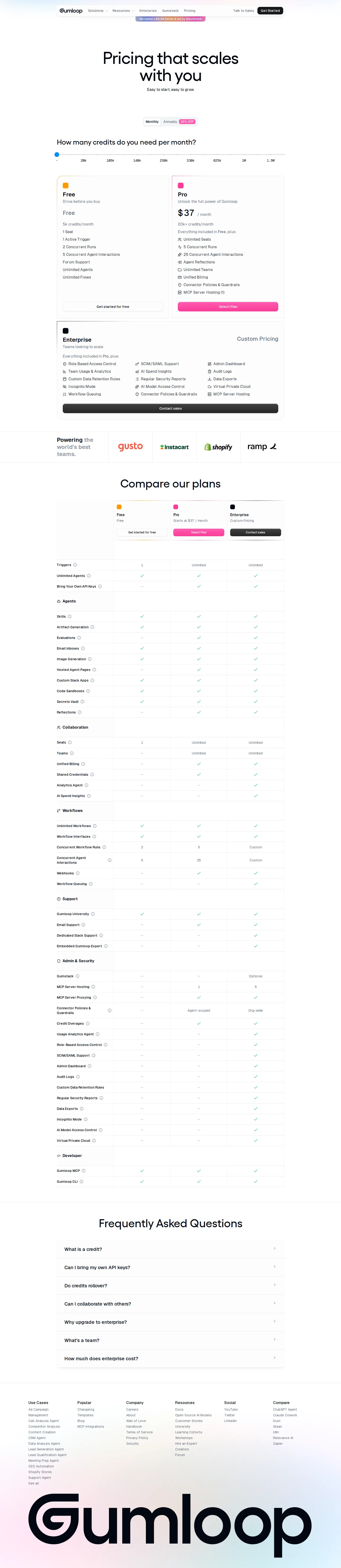
Repackaged: Starter dropped, Pro becomes a $37 credit slider, seats free
Live capture shows a fully repackaged model: the Starter tier is gone, and Pro is a single slider where the PRICE (not just the credit allocation) scales — from $37/mo (20k credits) to $1,840/mo (1M credits), then 'Contact sales'. Free tier grew from 1k to 5k credits; every paid plan now includes unlimited seats (vs Pro's old 10). Annual billing 20% off. This repackaging brackets the 2026-03-12 $50M Series B led by Benchmark. Source: gumloop.com/pricing (live 2026-06-02)
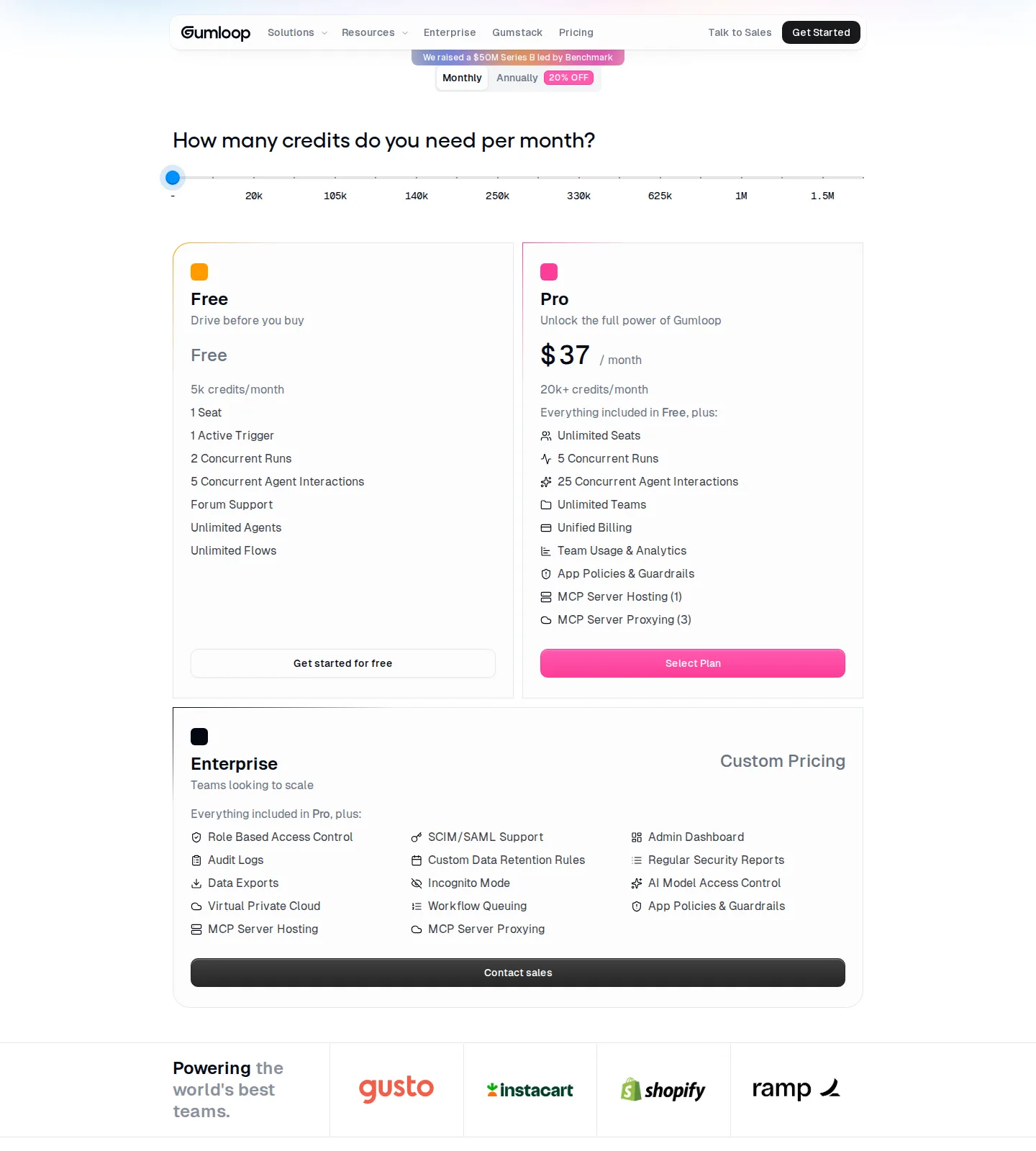
Overage flips to unlimited-by-default; Solo+Team merged into seat-free Pro
The changelog dates the repackaging mechanics precisely: 2026-03-09 'Revamped Pricing' merged the Solo and Team plans into a single Pro with shared credits and no seat limits ('more credits, same price'); 2026-03-19 'Unlimited Overages & Configurable Cap' changed overage from a hard cap to 'Plans now default to unlimited overages. Enterprise customers can configure a custom overage cap.' (This supersedes the earlier $0.007/credit-capped-at-2x mechanic recorded in prior snapshots — that cap is no longer the default.) 2026-04-29 'Higher Pro Credit Limits' confirmed Pro self-serves up to 1M credits. Source: gumloop.com/changelog
Enterprise launch; $97 / $297 tiers still in force
By 2025-08-07 the page carried an 'Announcing Gumloop for Enterprise' banner and added enterprise governance rows (RBAC, SCIM/SAML, AI Model Access Control, Audit Logging, Incognito Mode, Data Exports). Headline prices were still Free / Starter $97 / Pro $297 / custom — the four-tier fixed-price-plus-credit-slider model that held from 2024-07 through 2025-08. Source: web.archive.org/web/20250807102608/https://www.gumloop.com/pricing
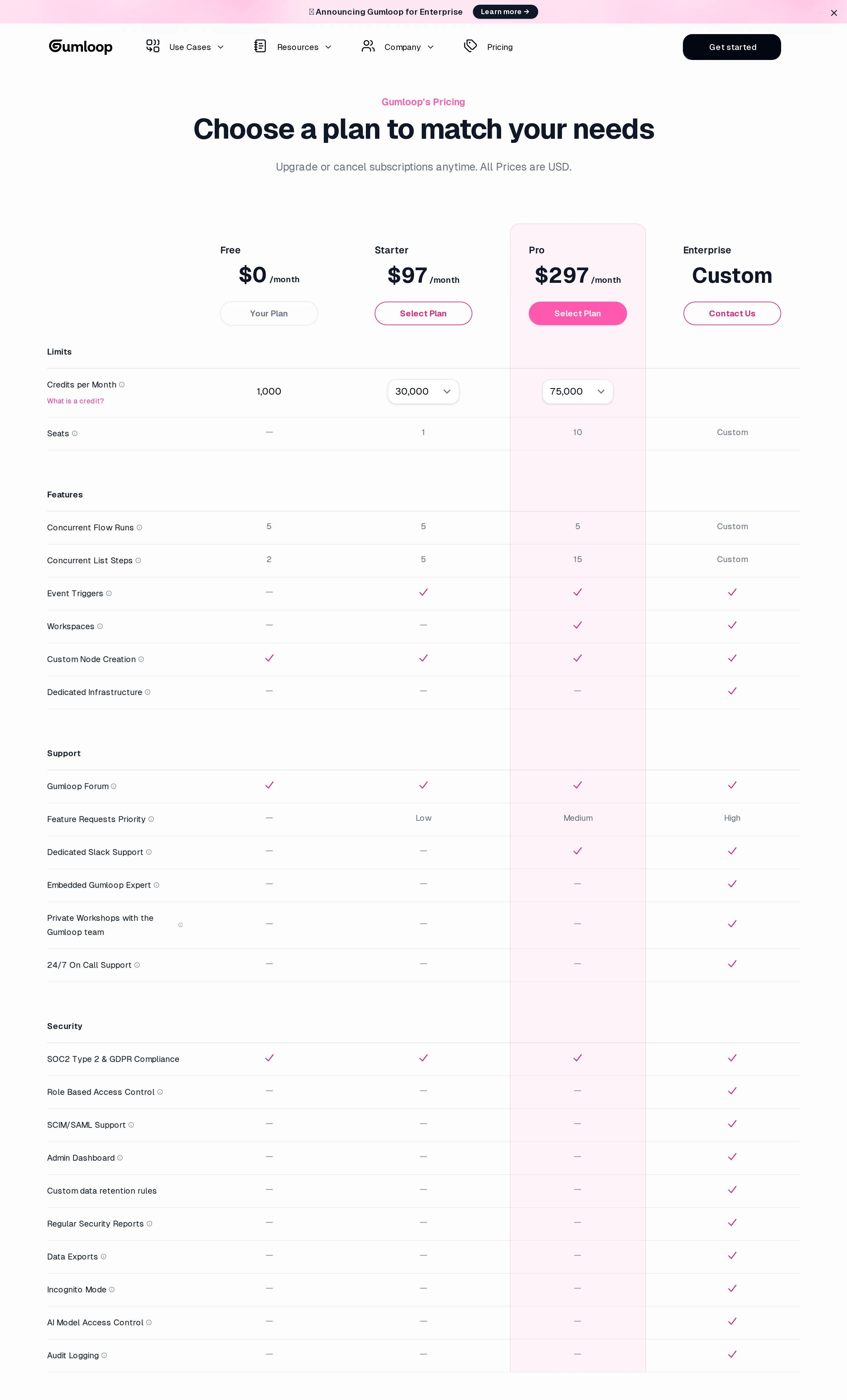
$17M Series A; four-tier credit model stable
Snapshot run after the 2025-01-10 '$17M Series A' announcement (led by Nexus Venture Partners, with First Round and Y Combinator; ~$20M total raised). Pricing unchanged: Free / Starter $97 / Pro $297 / Enterprise; free tier 1,000 credits, Pro 10 seats. Source: web.archive.org/web/20250114202537/https://www.gumloop.com/pricing + gumloop.com/blog/gumloops-17m-series-a/
Credit currency introduced; prices held at $97 / $297
By the 2024-07-16 snapshot, flow-run quotas were replaced by a 'Credits per Month' dropdown (Pro defaulting to 75,000 credits, 1 seat). Prices stayed fixed: Free $0 / Starter $97 / Pro $297 / Enterprise custom. The credit slider sized allocation only — it did not change the sticker price. Source: web.archive.org/web/20240716233104/https://www.gumloop.com/pricing
Four fixed tiers metered on flow runs (AgentHub era)
Earliest archived /pricing snapshot (2024-06-12). Free $0 / Starter $97 / Pro $297 / Enterprise custom, metered on Flow Runs + Standard/Advanced AI Calls + Premium Node Runs — no credit currency yet. Free included 100 flow runs; Pro 10,000. Legal entity AgentHub Inc. (YC W24); product launched on HN as 'AgentHub' on 2024-02-08 (162-point Launch HN). Source: web.archive.org/web/20240612175101/https://www.gumloop.com/pricing
- · Gumloop's Pro plan has no fixed price — a credit slider sets it anywhere from $37/mo (20k credits) to $1,840/mo (1M credits), then hands off to 'Contact sales' above 1M.
- · Seats are free on every paid Gumloop plan: Pro includes unlimited seats, so the only thing you pay for is credits — a near-total inversion of the per-seat SaaS norm.
- · Bringing your own API key cuts agent AI-model credit costs by 50%, and most native workflow nodes (logic, loops, Google Sheets, Slack) cost 0 credits.
Questions & answers
- How much does Gumloop cost?
- Gumloop's Pro plan starts at $37/month for 20,000 credits and scales on a slider up to $1,840/month for 1,000,000 credits, with a 14-day free trial on monthly billing. Above 1M credits, pricing is custom (Enterprise). Gumloop previously offered a permanent free tier (5,000 credits/month) but removed it as of the 2026-07-30 pricing-page capture.
- What is a Gumloop credit?
- Credits are Gumloop's usage currency. A workflow costs 1 base credit plus per-node costs (most native nodes are free), and an agent interaction costs variable AI-model credits based on token usage, plus any tool and workflow credits it triggers.
- Does Gumloop charge per seat?
- No. Every paid plan includes unlimited seats. You pay only for credits, which makes Gumloop's pricing usage-based rather than seat-based.
- What happens if I run out of credits?
- Since the March 2026 repackaging, Pro plans default to unlimited credit overage, so your automations keep running past the allocation; Enterprise plans can configure a custom overage cap. You can also buy more credits or slide up to a higher tier, and per-chat warnings can pause a single runaway conversation. Credits do not roll over month-to-month except on Enterprise plans.
- How much do I save with annual billing?
- Annual billing is 20% off. The entry Pro tier drops from $37/month to roughly $30/month billed annually, with proportional savings across every slider step.
- Can I reduce Gumloop credit costs?
- Yes. Bringing your own API key cuts agent AI-model credits by 50%, building workflows with free native nodes avoids node costs, and choosing budget AI models over expert models lowers per-interaction spend.