AI Summary
About
Keap is an all-in-one CRM, sales, and marketing-automation platform built specifically for small businesses and solo entrepreneurs. A single subscription bundles contact management, marketing and sales automation, email and text campaigns, a sales pipeline, landing pages and forms, appointment scheduling, quotes and invoices, and native payment processing (Keap Pay). Its pitch is consolidation: replace a stack of point tools with one system that also automates the follow-up small businesses rarely have time to do manually.
The company launched in 2001 as Infusionsoft, long known for powerful-but-complex automation aimed at the small-business market. It rebranded to Keap in 2019 and, on 2024-10-31, was acquired by Thryv for $80M in cash (Keap carried roughly $85M in trailing-twelve-month revenue at the time). Today Keap’s pricing page footers a Thryv acquisition link and shares Thryv’s legal terms, while the Keap product continues to operate under its own brand out of Grapevine, Texas.
Keap’s pricing history matters to how you read its current page. For most of the early 2020s it sold a feature-tiered ladder — Keap Grow/Pro at launch, later Pro vs Max — where capabilities like text marketing and lead scoring were gated behind the higher tier. Around 2024 it abandoned that ladder entirely for a single “entire platform” plan that meters on capacity (contacts and users) instead of features. That convergence — an SMB incumbent trading a good/better/best ladder for a capacity-plus-usage meter, with AI folded into the base rather than sold as a premium add-on — is the through-line of this analysis.
Keap competes with SMB CRM and marketing-automation platforms such as HubSpot, ActiveCampaign, GoHighLevel, and Ontraport. Its distinguishing positioning is opinionated simplicity plus mandatory hand-holding — “serious automation for serious businesses” sold as one platform with a required implementation package, rather than a self-serve feature-tier ladder. For a contrasting outcome-priced approach in an adjacent category, see the Intercom pricing blueprint.
Pricing summary : how Keap’s contact-tiered CRM and marketing-automation pricing works
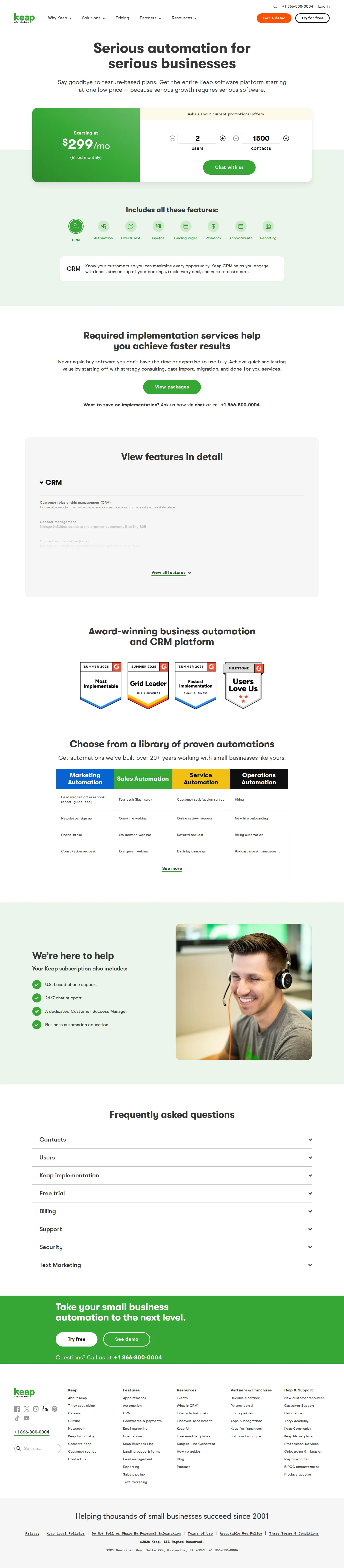
Keap uses a contact-tiered platform fee — a single all-in-one plan whose monthly price is driven by two capacity dimensions plus optional usage add-ons. There is no feature-tier ladder; everyone gets the entire platform.
- Base platform fee: Starts at $299/mo (billed monthly) and includes 2 users and 1,500 contacts, plus the full CRM, automation, email/text, pipeline, landing-page, payments, and appointment feature set — including the AI Content Assistant and AI Automation Assistant.
- Contacts (sliding tier): The price rises as you raise the contact count on the on-page slider, and the cost per contact falls at higher volumes (per Keap’s own FAQ: “the cost per contact going down as you add larger quantities of contacts”). Very large lists stop showing a self-serve price and route to “Chat with us.”
- Users (per-seat): Beyond the 2 included, additional users are $39/month per user.
- Text marketing (usage add-on): Tier 1 (500 messages, 100 voice minutes) is included; upgrade tiers run $24–$279/mo, with overages at $0.015 per message and $0.01 per voice minute (U.S.-only).
- Implementation (required): Every subscription requires a separately quoted implementation package (data migration, done-for-you automations, strategy calls).
What makes this different: Keap collapsed the classic good/better/best feature ladder into one platform and moved all the pricing leverage onto capacity (contacts + users) and usage (texts) — closer to a hybrid seat-plus-usage model than the flat SaaS tiers most SMB CRMs still sell.
Pricing by product
Keap platform (single all-in-one plan)
| Tier | Price | Included | Key mechanics |
|---|---|---|---|
| Free trial | $0 | Most features; email sends capped at 25, no payments, no texting; no credit card required | Demo sandbox, not a usable free tier |
| Keap platform | $299 / mo | Entire platform (CRM, automation, email & text, pipeline, landing pages, payments, appointments, reporting); 2 users + 1,500 contacts; AI Content & Automation Assistants | Starting price, billed monthly; one plan for everyone |
| Scaled (contacts) | $299+ / mo | Same platform, larger contact list (raise the on-page contacts stepper past 1,500) | Sliding per-contact tier; per-contact cost drops as volume rises |
| Additional users | +$39 / user / mo | One extra login-capable user beyond the 2 included | Managed via admin account |
Text marketing (usage add-on, U.S.-only)
| Tier | Price | Included (messages / voice minutes) | Key mechanics |
|---|---|---|---|
| Tier 1 | Included | 500 messages / 100 minutes | Bundled with every Keap subscription; toll-free number included |
| Tier 2 | $24 / mo | 1,000 / 300 | Upgrade any time |
| Tier 3 | $39 / mo | 2,500 / 500 | — |
| Tier 4 | $79 / mo | 5,000 / 800 | — |
| Tier 5 | $139 / mo | 10,000 / 1,000 | — |
| Tier 6 | $279 / mo | 25,000 / 2,000 | Highest published tier |
Overages bill at $0.015 per message and $0.01 per voice minute. Optional add-ons: 500 texts @ $6/month and a local number @ $10/month. Text marketing (automated texts and broadcasts) is U.S.-only; 1:1 texts and the dedicated business line are U.S. and Canada only.
Implementation package (required, quoted)
Every new Keap subscription requires a paid implementation package on top of the software fee. It includes a business-mapping session with an automation expert, done-for-you automations, proven automation templates, data import, migration services, third-party integration, and recurring strategy calls. The price is quoted by sales, not published — factor it into any first-year budget.
Sales motions across products: self-serve free-trial signup and published platform/text pricing for the core plan; sales-led for adding contacts, adding users at scale, and the required implementation package.
Hidden costs : what a growing Keap list actually pays past the $299 headline
The $299/mo starting price understates the real bill for any business that grows its list, adds a team, or texts customers. Two representative examples:
Small team, mid-size list, active texting
| Line item | Monthly cost |
|---|---|
| Keap platform base (2 users, 1,500 contacts) | $299 |
| Contacts scaled to a mid-size list (illustrative) | + slider delta |
| 2 additional users ($39 each) | +$78 |
| Text marketing Tier 4 (5,000 msgs / 800 min) | +$79 |
| Total (software only) | $456 + contact delta |
The advertised entry price climbs quickly once a real small business grows its contact list, adds a couple of seats, and turns on texting — before the required implementation package and payment-processing fees. (The contact-scaling delta is set by the on-page slider and rises with list size; see the calculator below to model it.)
First-year reality check
| Line item | Monthly-equivalent cost |
|---|---|
| Software (per example above) | $456 + contact-slider delta |
| Implementation package (quoted, amortized) | Quoted — often a four-figure one-time fee |
| Payment processing (Keap Pay / third-party) | Standard processor rate per transaction |
| Annual-contract early-termination exposure | $299 fee if canceled early |
Because implementation is mandatory and quoted separately, and payment processing rides on top, the first-year cost of Keap is materially higher than the recurring software line alone.
Want to estimate your own Keap bill? Use the Keap pricing calculator to model your monthly cost based on contacts, users, and text-marketing volume.
Pricing evolution : from Infusionsoft feature tiers to one contact-priced platform
Keap’s pricing arc is a textbook SMB-CRM consolidation. It began as Infusionsoft (2001) with complex, quote-heavy packaging; ran a feature-tiered ladder through the early 2020s (Keap Grow/Pro, then Pro/Max); and — by 2024 — collapsed the ladder into a single “entire platform” plan that meters only on capacity (contacts + users) and usage (texts). The value metric migrated from which features you unlock to how big your business is. First-party Wayback snapshots of the older pricing pages were not capturable at analysis time (the archive was unreachable), so the pre-2026 tier prices below are sourced from dated third-party pricing records rather than archived screenshots.
Cadence
| Quarter | Price changes | Product / SKU additions | Notes |
|---|---|---|---|
| 2019 Q1 | 1 | 1 | 2019-01-29 Infusionsoft rebrands to Keap; ships packaged SMB tiers (Keap Grow ~$79/mo, Keap Pro ~$149/mo). |
| 2022 Q4 | — | — | Feature-tier era in force: Keap Pro ~$129–159/mo (1,500 contacts) vs Keap Max ~$199–229/mo (2,500 contacts); +$29/user; one-time onboarding ~$499–999. |
| 2024 Q4 | 1 | 0 | Feature tiers collapse into one capacity-metered platform (all features included, price scales on contacts + users). 2024-10-31 Thryv closes its $80M acquisition of Keap. |
| 2026 Q3 | 0 | 0 | Live page confirmed: one plan from $299/mo (2 users, 1,500 contacts), sliding per-contact rate, six text-marketing tiers, AI assistants bundled. |
Tracked range: 2019–2026. Pre-2026 tier prices are from dated third-party pricing records (archive unreachable at capture time); the 2026 state is first-party verified. Quarters not listed were not independently price-verified.
Notable changes
- 2019-01-29 — Infusionsoft rebrands to Keap and ships packaged small-business tiers (Keap Grow/Pro), moving off heavily quoted Infusionsoft packaging.
- ~2022 — Feature-tiered ladder documented as Keap Pro vs Keap Max, with texting, lead scoring and upsells gated behind Max — the inverse of today’s “everyone gets everything” model.
- 2024 — Keap eliminates its feature tiers in favour of a single “entire platform” plan priced on contacts + users; the AI Content and Automation Assistants are bundled into the base plan, not sold as a premium AI SKU.
- 2024-10-31 — Thryv closes its acquisition of Keap for $80M cash (announced 2024-10-29; Keap ~$85M TTM revenue). The pricing page now footers a Thryv acquisition link and shares Thryv legal terms.
- 2026-07-06 — Live pricing verified: single “entire platform” plan from $299/mo (2 users, 1,500 contacts), sliding per-contact tier, six published text-marketing tiers with per-message/per-minute overages.
The feature-tier-to-capacity-meter convergence in detail
The most interesting thing about Keap’s history is how it consolidated. Under the Pro/Max ladder, a small business that wanted text marketing, lead scoring, or upsells had to buy up to Max — the classic good/better/best gate. The 2024 restructure inverted that: every subscriber now gets the whole platform, and the only pricing levers are contacts (a sliding per-contact tier where marginal cost falls as lists grow) and users ($39/mo each). Text marketing became a genuine metered usage add-on (bundled Tier 1, then $24–$279/mo tiers with overages) rather than a feature flag.
This mirrors a broader pattern the corpus tracks: incumbents abandoning feature tiers for capacity- and usage-based metering. Notably, Keap did not carve its AI features into a premium tier — the AI Content Assistant and AI Automation Assistant ship inside the $299 base — a deliberate contrast to the 2024–2026 wave of vendors monetizing AI as a separate SKU.
What’s unique : capacity-metered platform pricing with mandatory onboarding
1. No feature tiers — one platform, priced on capacity. Keap deliberately killed the good/better/best ladder (“say goodbye to feature-based plans”). Everyone gets the entire product; the only levers are contacts and users. That removes upsell friction over features and turns growth itself into the expansion motion — the kind of value-metric choice that decides whether a pricing model scales with the customer.
2. Sliding per-contact pricing. Contact cost is tiered so the marginal price per contact falls as the list grows. This rewards list growth (the thing that also deepens lock-in) instead of punishing it with linear per-contact fees — a subtle but deliberate expansion-friendly design.
3. Mandatory, separately-quoted implementation. Unlike self-serve SMB rivals, Keap requires a paid implementation package and defends it explicitly on the pricing page (“you’ll thank us later”). It converts onboarding from a cost center into a revenue line and a retention lever, at the expense of a higher, opaquer entry price.
4. Usage add-ons bolted onto a capacity base. Text marketing is a genuine metered usage layer — bundled Tier 1, six upgrade tiers, and per-message/per-minute overages — sitting on top of the capacity-based platform fee, making the overall model a hybrid seat-plus-usage structure rather than pure subscription.
Strengths & weaknesses
| Strengths | Weaknesses |
|---|---|
| One plan = no feature-gating anxiety; buyers get everything | $299/mo entry price is high for a solo/very-small business |
| Sliding per-contact pricing rewards list growth | Contact-scaled pricing is only visible via an on-page slider, not a table |
| Mandatory implementation drives real onboarding success | Required, unpublished implementation fee makes true cost opaque |
| AI Content + Automation Assistants included at no extra charge | Text marketing is U.S.-only; several features gated by geography |
| Transparent base + published text-marketing usage tiers | Annual contract carries a $299 early-termination fee |
Billing UX : the interactive contact/user slider and quote-driven controls
- Contacts / Users steppers — the pricing page shows live ”+ / −” steppers for users (increment by 1) and contacts (increment by 100) that recalculate the “Starting at $X/mo” figure in real time as capacity changes.
- “Chat with us” escalation — very large contact counts stop showing a self-serve price and route to a chat/sales conversation instead of a published number.
- Text-marketing tier table — a published six-tier table (Tier 1 included through Tier 6 at $279/mo) with explicit overage rates ($0.015/message, $0.01/voice minute) and optional 500-text ($6) and local-number ($10) add-ons.
- “Ask us about current promotional offers” — the base price block invites a promo conversation rather than listing discounts, keeping headline discounting sales-mediated.
- Required implementation “View packages” / chat CTA — implementation is surfaced as a mandatory package with a “View packages” link and a chat/phone prompt to negotiate, never a self-checkout price.
- Cancellation via phone + 10-day notice — cancellation must be initiated by phone at least 10 days before the next invoice date, with a $299 early-termination fee on annual contracts.
Strategic wins : pricing decisions that reinforce SMB retention
1. Killing feature tiers removed the biggest SMB pricing objection
By giving every customer the whole platform, Keap eliminated the “which tier has the feature I need?” paralysis that stalls small-business buyers. The only decision left is capacity, which maps cleanly to business size. This is a textbook example of choosing a value metric that grows with the customer rather than gating features.
2. Sliding per-contact pricing makes expansion feel like a discount
Because the marginal cost per contact drops as lists grow, customers experience scaling up as increasingly efficient — a psychological win that encourages them to consolidate more of their audience into Keap. It aligns the vendor’s expansion revenue with the customer’s growth, a core principle of usage-based pricing and a common thread in SaaS moves from flat to usage-based models.
3. Monetizing onboarding as a required package
Mandatory implementation turns the single biggest driver of SMB churn — failed setup — into both a revenue line and a success mechanism. Businesses that complete guided implementation are far likelier to stick, so the fee doubles as a retention investment.
4. Bundling AI into the base instead of an upsell SKU
Keap folded its AI Content Assistant and AI Automation Assistant into the single $299 platform rather than gating them behind a premium tier — a deliberate contrast to the 2024–2026 wave of vendors monetizing AI as a separate add-on. For a small business already paying a high entry price, “AI included” reads as value rather than another line item, and it keeps the one-plan simplicity intact. It also sidesteps the thorny question of how to meter and price AI features that trips up feature-tier vendors — when everything is bundled, there is no AI-usage bill to explain.
Areas to improve : transparency gaps that raise buyer friction
1. Publish the contact-price tiers as a table
Contact pricing is only discoverable by dragging an on-page slider, and very large lists hide the price entirely. A published per-tier contact table (like the text-marketing table already on the page) would let buyers self-qualify and reduce sales friction. Fix: add a static “contacts → monthly price” reference table alongside the slider.
2. Give the implementation fee a starting price
Requiring implementation while hiding its price makes the true entry cost unknowable until a sales call — a real barrier for budget-conscious SMBs. Fix: publish a “starting at $X” implementation figure, even if the final package is quoted, so buyers can budget the first-year total. See how transparent usage-based billing lowers buyer anxiety, and how usage-based pricing changes the finance conversation for the buyer’s CFO.
3. Reconsider the $299 entry point for solopreneurs
At $299/mo before implementation, Keap prices out the smallest solo operators it historically served. Fix: offer a genuinely usable low-contact starter tier (not just a 25-email trial) to capture early-stage businesses before they commit to a competitor.
Monetization stack & signals : how Keap builds & buys its revenue engine
Buys 3 Builds 0
Buys its entire monetization spine rather than building it: payments and sales-tax compliance run on Stripe (incl. Stripe Tax, live in under eight weeks), and the metered text-marketing tiers on the pricing page run on Twilio underneath. The signal worth watching is whether the Thryv acquisition eventually consolidates Keap's stack — no revenue/lifecycle hiring is discoverable (careers page lists zero roles) to read that inflection from yet.
-
“Stripe powers payments across all Keap platforms... customers can easily accept payments in over 135 currencies, and gain access to Stripe Radar, a set of machine learning-powered fraud tools.”
-
“Other solutions the company evaluated would have taken six months to a year to deploy, but Keap was able to launch Tax in less than eight weeks. (Sales-tax compliance automated via Stripe Tax.)”
-
“The system uses more than a half-dozen Twilio APIs, including Voice, Messaging, Authy, and Verify. — Twilio customer case study on Keap Business Line and text marketing”
Signals reviewed · derived from press & filings
Key takeaways
- Capacity beats features as a value metric. Keap proves an SMB CRM can drop feature tiers entirely and price on contacts + users — simpler to buy and naturally expansion-aligned.
- Declining marginal rates turn growth into loyalty. Making per-contact cost fall at scale rewards customers for consolidating their audience, deepening lock-in without feeling punitive.
- Onboarding can be a priced product, not a giveaway. A required, revenue-generating implementation package both funds success and reduces churn — but only works if the resulting outcomes justify the fee.
- Usage add-ons extend a subscription without repackaging it. Layering metered text marketing on a capacity base adds a second revenue vector while keeping the core plan simple.
- Opacity has a cost. Hiding contact tiers behind a slider and implementation behind a quote raises friction for exactly the self-serve buyers who prefer to qualify themselves.
UBP implications
- Capacity metering is a bridge to usage-based pricing. Contact- and user-based scaling gives SMB vendors a low-risk on-ramp to consumption pricing without exposing customers to volatile per-action bills.
- Declining-tier pricing is an expansion design pattern. Falling marginal rates at higher volumes are a reusable lever for encouraging the very growth that drives net revenue retention.
- Bundled-then-metered usage is the pragmatic SMB shape. Including a usage allowance (Tier 1 texts) before charging overages mirrors the credit-pool pattern seen across usage-priced platforms and softens the shift from flat to metered billing.
Sources
- Keap pricing page (accessed 2026-07-06)
- Keap help center — what’s new (accessed 2026-07-06)
- Keap blog (accessed 2026-07-06)
Bottom line
Keap bet that small businesses want one platform, not a feature ladder — so it prices the entire product on capacity (contacts + users) from $299/mo, layers metered text marketing on top, and requires a quoted implementation package that turns onboarding into both revenue and retention. It is a clean example of capacity-plus-usage pricing, undercut only by the opacity of its contact tiers and mandatory-but-hidden implementation fee.
Want to compare Keap against other CRM and marketing-automation pricing? Browse the pricing blueprint.
Pricing timeline : Major events on a vertical axis
Each milestone below corresponds to a public pricing change, product launch, or material adjustment. Major events use a filled marker; minor adjustments use a faded one.
Single platform plan from $299/mo, priced by contacts and users
Keap sells one all-in-one plan from $299/mo (2 users, 1,500 contacts), scaling on additional users ($39/mo each) and a sliding per-contact tier, with text-marketing usage add-ons ($24–$279/mo) layered on top. AI Content + AI Automation Assistants are bundled into the base platform, not sold as a premium SKU.
Thryv closes acquisition of Keap ($80M cash)
Thryv Holdings announced a definitive agreement to acquire Keap (Infusion Software, Inc.) on 2024-10-29 and announced closing on 2024-10-31 for $80M cash — Keap had ~$85M trailing-twelve-month revenue through June 2024. Keap continues under its own brand; the pricing page now footers a Thryv acquisition link and shares Thryv legal terms.
Feature-tier era: Pro vs Max (+ legacy Max Classic)
Third-party pricing records (Tech.co, updated 2022-12-07) document a good/better ladder: Keap Pro ~$129–159/mo (1,500 contacts, 2 users) and Keap Max ~$199–229/mo (2,500 contacts, 3 users), additional users ~$29/mo, plus a one-time onboarding/coaching fee (~$499–999). Max added lead scoring, text marketing, discount codes and upsells over Pro. Value was gated by FEATURE tier, not just capacity — the inverse of today's model. No first-party Wayback snapshot was capturable (archive unreachable at capture time).
Infusionsoft rebrands to Keap; launches packaged small-business plans
The 2001-founded Infusionsoft renames itself Keap and ships packaged small-business tiers (Keap Grow ~$79/mo and Keap Pro ~$149/mo, each starting at 500 contacts), moving away from its historically complex, quote-heavy Infusionsoft packaging. Announced via GlobeNewswire (2019-01-29).
Feature tiers collapse into one capacity-metered platform
Keap eliminated its feature-gated ladder (Pro/Max) in favour of a single 'entire platform' plan where every subscriber gets all features and price scales on contacts + users rather than feature access (multiple third-party trackers date the shift to 2024). This is the SMB-CRM version of the industry-wide move from feature tiers to capacity/usage metering. No first-party Wayback snapshot was capturable (archive unreachable at capture time).
- · Keap started life as Infusionsoft in 2001 and rebranded to Keap in 2019; Thryv closed its $80M acquisition of Keap on 2024-10-31, so its pricing page now footers a Thryv acquisition link.
- · Keap used to sell a good/better feature ladder (Keap Grow/Pro, later Pro/Max) where texting, lead scoring and upsells were locked behind the higher tier; the current page now bundles every feature and prices only on contacts + users.
- · Keap folds its AI Content Assistant and AI Automation Assistant into the single base platform at no extra charge — it never spun AI out as a premium SKU the way many 2024–2026 SaaS vendors did.
Questions & answers
- How much does Keap cost?
- Keap sells one all-in-one plan starting at $299/mo (billed monthly) for 2 users and 1,500 contacts, with the AI Content and Automation Assistants included in the base at no extra charge. The price scales up as you add users ($39/month each) or contacts (a sliding per-contact rate that falls at higher volumes).
- Does Keap have a free plan?
- No. Keap offers a free trial (no credit card required) but it caps email sends at 25 and disables payments and text messaging, so it functions as a demo rather than a usable free tier.
- How does Keap charge for contacts?
- Contact pricing is tiered, and the cost per contact goes down as you add larger quantities. The base $299/mo plan includes 1,500 contacts; entering a higher contact count on the pricing page recalculates the monthly price, and very large lists route to a 'Chat with us' sales conversation rather than a self-serve price.
- How much does text marketing cost with Keap?
- Tier 1 (500 messages and 100 voice minutes) is included. Upgrade tiers run $24/mo (Tier 2) to $279/mo (Tier 6), overages are $0.015 per message and $0.01 per voice minute, and optional add-ons include 500 texts @ $6/month and a local number @ $10/month. Text marketing is U.S.-only.
- Is a Keap implementation package required?
- Yes. Keap requires a paid implementation package (business-mapping session, data import, migration, done-for-you automations, and strategy calls) on top of the software subscription. The implementation price is quoted by sales, not published.
- Did Keap used to have Pro, Max, or Grow plans?
- Yes. As Infusionsoft (2001) then Keap (rebranded 2019), the company sold feature-tiered plans — Keap Grow/Pro at first, later Keap Pro (~$129–159/mo) and Keap Max (~$199–229/mo), where features like text marketing and lead scoring were gated behind Max. Around 2024 Keap dropped the tiers for a single 'entire platform' plan priced only on contacts and users. There is also a $299 early-termination fee on annual contracts. Legacy Pro/Max/Max Classic accounts still exist but new customers cannot buy them.