AI Summary
About
Intercom is a customer service platform founded in 2011, serving over 25,000 businesses worldwide. Its flagship product is a next-generation helpdesk combined with Fin AI Agent, marketed as the #1 AI agent for customer service. Fin claims to resolve roughly 59% of customer queries autonomously across live chat, email, phone, and social channels.
The strategic positioning is sharper than the typical helpdesk replatform pitch: Intercom is the rare AI vendor whose financial model only makes money when the AI works. That structural choice — outcome-based per-resolution billing on top of a thin seat fee — is what makes Intercom worth studying as a pricing case, not just as a product.
The company has roughly $250M+ ARR, took a Kleiner Perkins-led growth round in the early 2020s, and remains private with no announced IPO timeline.
Pricing summary : How Intercom’s hybrid seat-plus-outcome pricing model works
Intercom uses a hybrid seat + outcome model with three pricing dimensions:
- Platform access (seat-based): $29 / $85 / $132 per seat/month on annual billing across Essential, Advanced, and Expert; $39 / $99 / $139 per seat/month on monthly billing for Essential / Advanced / Expert. As of the 2026-08-27 capture, the entry-tier discount has split across surfaces for the first time:
intercom.com/pricing’s own annual toggle shows Essential at the clean $29/seat/mo list rate — no “Save 35%” banner, no strike-through — while that same domain’s pricing calculator, on its own annual toggle, still shows Essential discounted to $19/seat/mo (“Billed annually at $348.00 → $228.00”).fin.ai/pricing’s “Fin with the Intercom helpdesk” seat anchor agrees with the calculator, not the pricing page, still showing $19/seat/mo. Monthly billing is unaffected on either intercom.com surface: both the pricing page and the calculator show Essential struck from $39 to $29/seat/mo under a “Save 25%” banner. This is the sixth move on this entry-tier offer since it first appeared 2026-06-24 (on, off, on, off, on, and now split) and the first time the pricing page and its own calculator have disagreed on the same billing cadence. Advanced and Expert are unaffected on every surface. - AI outcomes (outcome-based): $0.99 per Fin outcome. Same rate across all three tiers and for standalone Fin. An outcome is counted when the customer confirms the issue is resolved, when they don’t ask for more help after Fin responds, or when Fin completes a configured Procedure — including one that ends in a handoff. You’re charged once per conversation even if Fin answers several questions in it.
- Channel passthroughs (usage-based): every plan includes free unlimited live chat, inbound support email, in-app chats, banners, and tooltips. Email campaigns (per bulk email sent), SMS (per message, varies by region), WhatsApp (per conversation, varies by volume and direction), and phone are pay-as-you-go on top of the seat + outcome lines.
- Add-ons (flat monthly with included capacity): Pro at $99/mo (analysis of 1,000 conversations/mo), Proactive Support Plus at $99/mo (500 messages sent/mo, additional messages charged per unit), and Copilot at $29 per agent/mo annual or $35 per agent/mo monthly for unlimited usage.
What makes this different: the headline meter is the outcome, not the input. Most “AI” products today charge per token, per query, or per API call regardless of whether the user got what they came for — Intercom only collects when Fin actually resolves the conversation. That alone justifies looking at this page if you’re designing AI pricing of your own.
Pricing by product
Platform tiers (seat-based)
| Tier | Price (annual / monthly) | Included | Key mechanics |
|---|---|---|---|
| Essential | $29 / seat / mo annual (pricing page; calculator + fin.ai show $19) · $29 / seat / mo monthly (list $39) | Fin Customer Agent for service, sales and ecommerce; Messenger; shared inbox and ticketing; pre-built reports; public help center | Surfaces disagree as of 2026-08-27 — the pricing page’s annual toggle shows the clean $29 list rate, but the calculator’s annual toggle and fin.ai still show $19 (Save 35%); monthly discount ($39→$29, Save 25%) matches on both intercom.com surfaces — sixth toggle/split since June 2026 (see Pricing evolution); 1 Full seat minimum; Early Stage Program cuts 93% in year one |
| Advanced | $85 / seat / mo · $99 monthly | Every Essential feature, plus multiple team Inboxes, Workflows automation builder, round-robin assignment, private and multilingual Help Center | Self-serve; includes 20 free Lite seats; not part of the new-customer offer |
| Expert | $132 / seat / mo · $139 monthly | Every Advanced feature, plus SSO & identity management, HIPAA support, SLAs, multibrand Messenger / Help Center | Sales-led; includes 50 free Lite seats; not part of the new-customer offer |
Annual is the pricing page’s default toggle; the monthly figures come from the “Billed monthly” state of the same page and calculator. The $0.99 Fin outcome rate is identical on either cadence. Full seats are paid and required for any teammate who interacts with customers; Lite seats are free on Advanced and Expert but limited to internal collaboration — only Full seats can send messages or use outbound content. As of 2026-08-27 the new-customer Essential discount has split across intercom.com’s own surfaces: the pricing page’s annual toggle shows the clean $29 list rate (no banner, no strike-through), while the calculator’s annual toggle still reads $348.00 struck to $228.00 (12 × $29 list → 12 × $19 discounted) and fin.ai/pricing’s Intercom-helpdesk anchor still shows $19/seat/mo. Monthly billing is unaffected — both the pricing page and calculator show $39 struck to $29 (Save 25%). The offer is intermittent (an A/B experiment, team-self-serve-essential-price-reduction) and has now flipped on, off, or split six times since June 2026, so a given visitor’s price is not guaranteed to match this snapshot on any single surface.
Fin AI (outcome-based, every tier)
| Surface | Price | Notes |
|---|---|---|
| Fin in any Intercom tier | From $0.99 / outcome | No per-tier discount or markup; same meter on Essential, Advanced, and Expert |
| Fin with your current helpdesk | $0.99 / outcome | 50 outcomes per month minimum; works with Salesforce, HubSpot, and more; no seat costs, no setup, integration, or platform fees; contact-sales entry |
| Fin with the Intercom helpdesk | From $0.99 / outcome + $19 per helpdesk seat / mo | The seat anchor fin.ai/pricing advertises alongside the outcome meter; the 2026-08-27 capture still shows $19/seat/mo on this surface — but intercom.com/pricing’s own annual toggle reverted to the clean $29 list rate the same day, so fin.ai now agrees with the pricing calculator (which still shows $19) rather than the main pricing page. This is the first time intercom.com’s own pricing page and calculator have disagreed with each other on the same billing cadence |
What counts as an outcome: the customer confirms their issue is resolved, they don’t ask for more help after Fin responds, or Fin completes a Procedure you configured — including one that ends in a handoff to a human or a workflow. Billed once per conversation regardless of how many questions Fin answers in it.
Add-ons + channel passthroughs
| Item | Price | What it covers |
|---|---|---|
| Copilot (agent AI) | $29 / agent / mo billed annually; $35 / agent / mo billed monthly | Unlimited usage. Free without the add-on: 10 Copilot + 10 AI auto-translation conversations per agent/mo |
| Pro (AI analytics) | $99 / mo, includes analysis of 1,000 conversations/mo | CX Score, AI Topics, Trends, AI Recommendations, Monitors, Custom AI Scorecards |
| Proactive Support Plus | $99 / mo, includes 500 messages sent/mo | Posts, Checklists, Product Tours, Surveys, Series campaign builder; additional messages are charged per unit |
| Per conversation, varies by volume + direction | Pay-as-you-go channel; not included in the plan | |
| SMS | Per message, varies by region | Pay-as-you-go channel; not included in the plan |
| Email campaigns | Per bulk email sent | Inbound support email is included; only outbound campaigns are metered |
| Phone | Usage-based (varies) | Pay-as-you-go channel |
Every plan includes free, unlimited live chat, support email, in-app chats, banners, and tooltips. The free trial runs 14 days, needs no credit card, and includes all features, Fin, and add-ons — you only pay once you choose a plan and add payment details. No contract is required for self-serve Essential and Advanced; contracts apply to enterprise needs, Premier Support / onboarding, and custom terms.
Sales motions across products: self-serve PLG for Essential and Advanced; sales-led for Expert and any custom volume deal. Fin on your current helpdesk is a contact-sales entry; Fin with the Intercom helpdesk starts self-serve on a free trial.
Hidden costs : What a real Intercom bill actually looks like
The advertised “$85/seat” tells you almost nothing about what an Intercom-with-Fin bill actually looks like. The per-resolution and channel lines routinely dwarf the seat line at moderate volume.
Archetype: 10-person Advanced team handling 5,000 Fin resolutions / month
| Line item | Monthly cost |
|---|---|
| 10 seats × $85 | $850 |
| 5,000 Fin resolutions × $0.99 | $4,950 |
| Copilot (5 agents × $29) | $145 |
| Proactive Support Plus | $99 |
| Total | $6,044 |
The seat line is 14% of the total. The headline $85/seat is barely a meaningful number for this archetype — the resolution meter is the real bill driver. The lesson the table teaches: when evaluating outcome-priced AI, model the meter first and the platform fee second.
Want to estimate your own Intercom bill? Use the Intercom pricing calculator to model your monthly cost based on team size, plan tier, and expected Fin resolution volume.
The unpredictability of usage-based bills is a real problem at this archetype — a 2x traffic spike doubles the Fin line without warning, and Intercom does not surface spend alerts as hero functionality.
Pricing evolution : From per-user SaaS to outcome-based AI billing
Cadence
| Quarter | Price changes | Product / SKU additions | Notes |
|---|---|---|---|
| 2011 Q3 | new pricing | initial SKU | Launch on sliding active-user scale. |
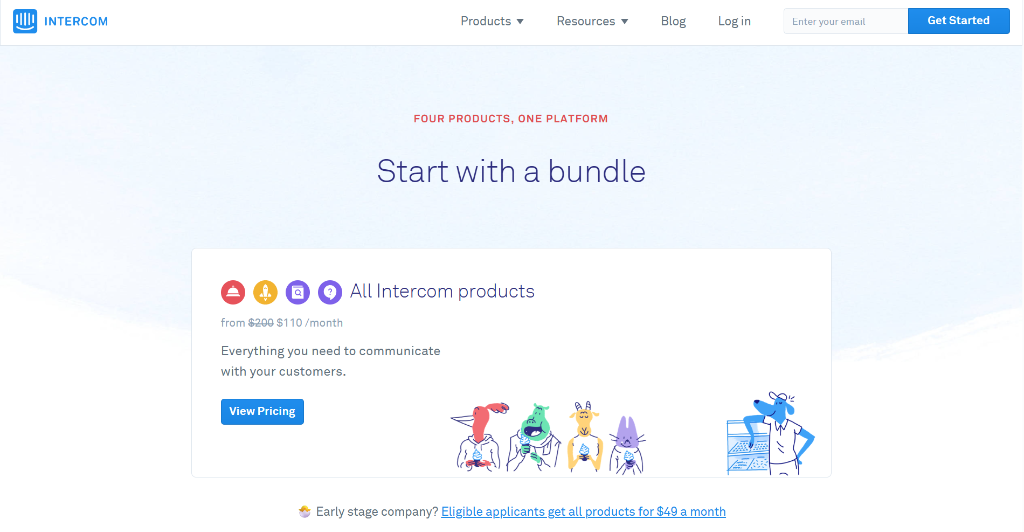
| 2017 Q1 | minor | bundling pivot | ”Start with a bundle” methodology cemented. |
| 2018 Q2 | minor | — | Switch to strict ‘Active People’ meter, killing the lead/user distinction. |
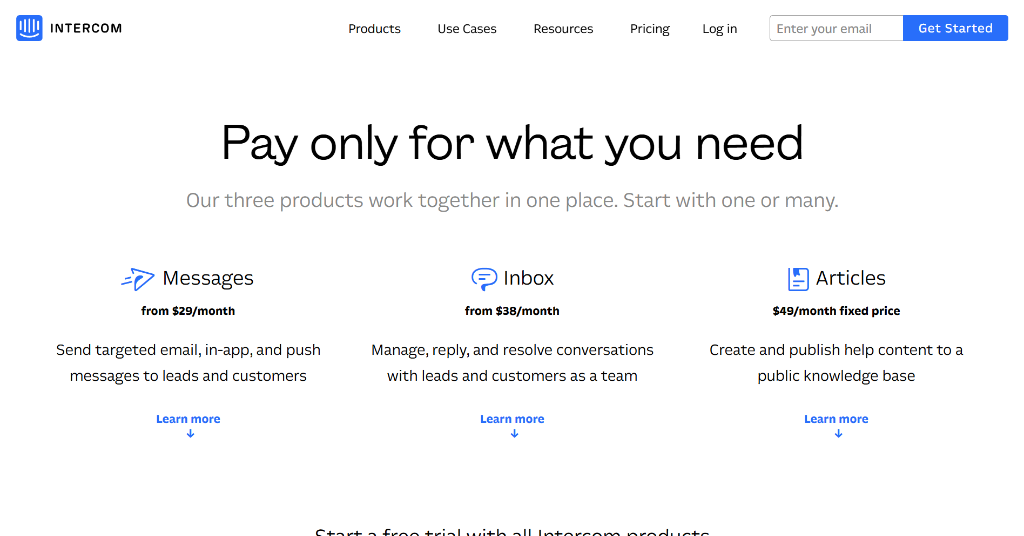
| 2019 Q3 | restructure | unbundle SKUs | Modular “à la carte” Messages / Inbox / Articles. |
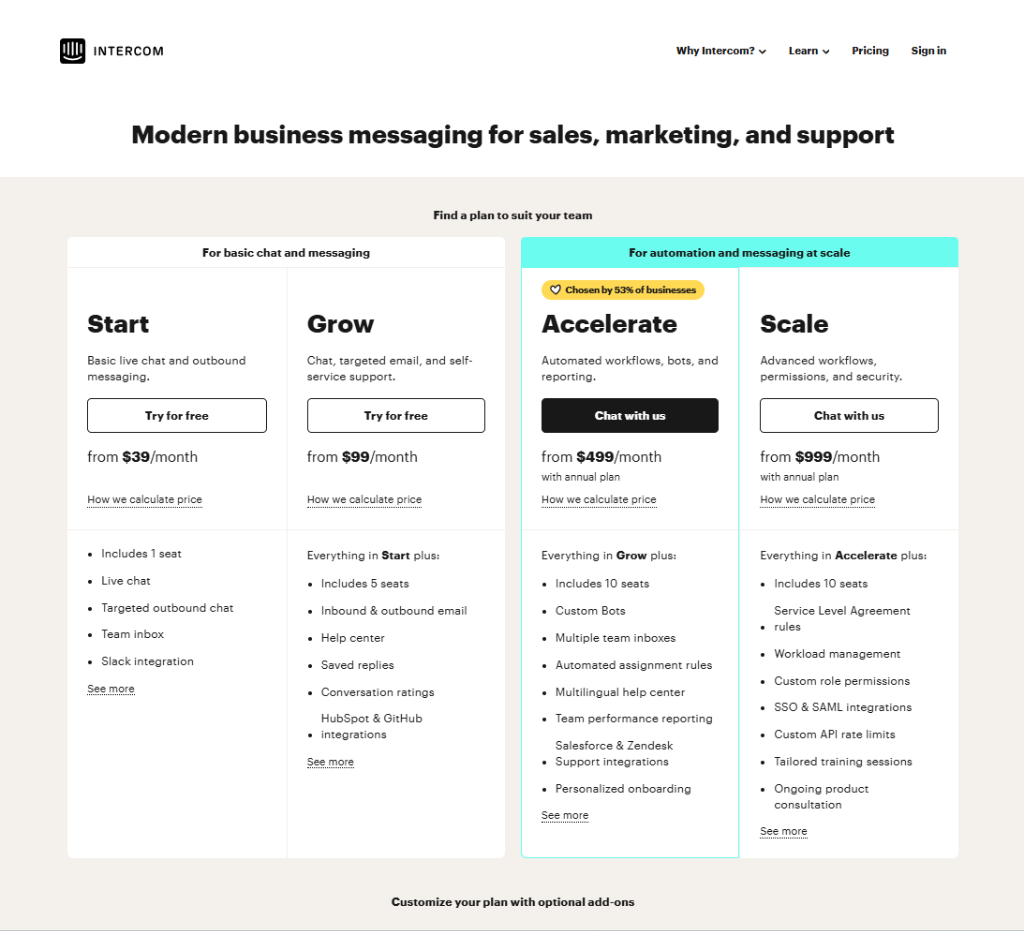
| 2020 Q4 | restructure | conversation meter | Move from per-user to per-conversation pricing for support. Foreshadows the eventual per-resolution Fin model. |
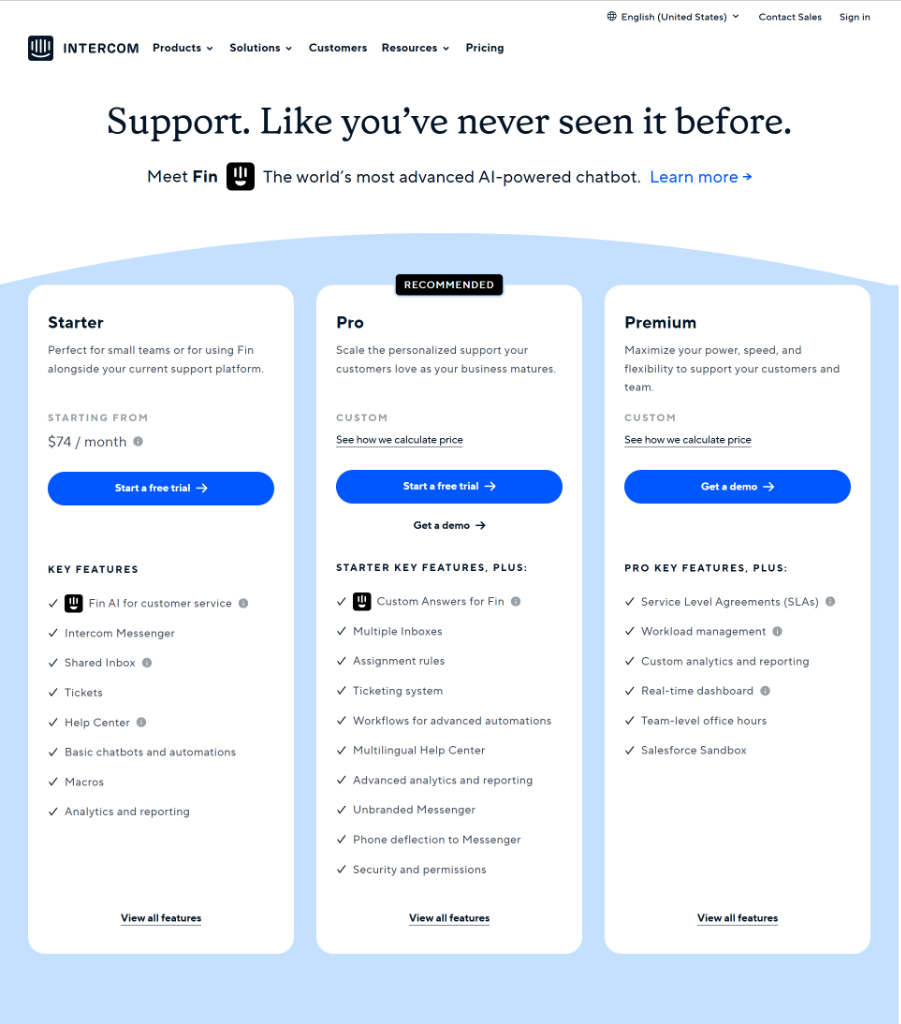
| 2021 Q1 | restructure | lifecycle tiers | ”Start / Grow / Accelerate / Scale” methodology — staged feature sets. |
| 2023 Q1 | new pricing | Fin AI launch | $0.99 / resolution introduced — one of the earliest outcome-based AI pricing models in customer service. |
| 2024 Q1 | formalization | standalone Fin | Usage-based AI model formalised; Fin offered standalone for Zendesk / Salesforce at same $0.99 rate with 50-resolution minimum. |
| 2026 Q2 | acquisition | — | Salesforce signs a definitive agreement to acquire Fin (renamed from Intercom in May 2026) for ~$3.6B (announced 2026-06-15, closes ~Q4 FY2027). Pricing unchanged at announcement; Fin’s Apex model + AI Agent to complement Salesforce Agentforce. |
| 2026 Q2 | promo (minor) | — | New-customer offer: Essential 35% off ($29 → $19/seat). List price and the $0.99 Fin meter unchanged — an acquisition lever, not a repricing. Offer ended by 2026-06-30; Essential reverted to flat $29/seat. |
| 2026 Q3 | promo (minor) ×4 | — | 2026-07-21: the Essential new-customer discount returns as a named A/B experiment, now on both cadences — annual $29 → $19/seat (“Save 35%”), monthly $39 → $29/seat (“Save 25%”); fin.ai/pricing serves its Intercom-seat anchor as the same $19-or-$29 variant. 2026-08-14: the discount disappears again — Essential is back to the clean $29/$39 list on both the pricing page and calculator, no banner or strikethrough; fin.ai’s seat anchor still shows $19, unaffected. 2026-08-26: the discount returns a third time — annual $29 → $19/seat (“Save 35%”), monthly $39 → $29/seat (“Save 25%”) — and for the first time fin.ai’s seat anchor is in sync, also showing $19. 2026-08-27: the pricing page’s annual toggle reverts to the clean $29 list rate one day later, but the calculator’s own annual toggle and fin.ai still show $19 — the first split between the pricing page and its own calculator; monthly ($39→$29) is unaffected on both surfaces. Advanced, Expert, and the $0.99 outcome meter unchanged throughout. Six entry-seat moves in about nine weeks, zero moves on the meter. |
Tracked range: 2011–2026. Dated milestones are drawn from Intercom’s public blog and external pricing trackers, and should be read as best-public-record.
Notable changes
- 2026-08-27 — The Essential discount splits between intercom.com’s own two surfaces for the first time. One day after the 08-26 cross-surface sync,
intercom.com/pricing’s annual toggle reverts to the clean $29/seat/mo list rate — no “Save 35%” banner, no strike-through price. But that same domain’s pricing calculator, on its own annual toggle, still shows Essential discounted to $19/seat/mo (the calculator’s annualised line still reads “$348.00 → $228.00”), andfin.ai/pricing’s “Fin with the Intercom helpdesk” seat anchor still shows $19/seat/mo too — agreeing with the calculator, not the pricing page. Monthly billing is untouched on every surface: both the pricing page and calculator still show Essential struck from $39 to $29/seat/mo under a “Save 25%” banner. Every prior split in this saga has been between intercom.com and the external fin.ai domain; this is the first time the pricing page has disagreed with its own calculator. Advanced ($85/$99), Expert ($132/$139), and the $0.99-per-Fin-outcome meter are unchanged. Six entry-seat moves in nine weeks now (on, off, on, off, on, split) — the pattern reads less like a converging A/B test and more like an unmanaged promo banner that isn’t wired consistently to every surface that reads the same discount flag. - 2026-08-26 — The Essential discount flips back on for the third time. Both
intercom.com/pricingand its calculator again show the “New customer offer: Save 35% on Essential plan” banner on annual billing ($29 struck to $19/seat/mo; calculator annual total “$348.00 → $228.00”) and “Save 25%” on monthly billing ($39 struck to $29/seat/mo; calculator monthly total a plain $29.00/mo). This reverses the 2026-08-14 off-flip after roughly two weeks off. The notable new development:fin.ai/pricing’s “Fin with the Intercom helpdesk” seat anchor — which has run its own uncorrelated variant every time this offer has toggled since June — shows $19/seat/mo on the same day, matching the main site’s discounted annual rate for the first time in this cycle. Advanced ($85/$99), Expert ($132/$139), and the $0.99-per-Fin-outcome meter are unchanged. Five moves in nine weeks (on, off, on, off, on) confirm this is a recurring toggle Intercom re-runs roughly every two to four weeks, on the one line of the bill that barely moves total spend — but the sudden cross-surface sync is worth watching on the next capture to see if it holds or was coincidental. - 2026-08-14 — The Essential discount flips off for the second time, confirming a toggle pattern rather than a one-off test. Both
intercom.com/pricingand its calculator now show Essential cleanly at $29/seat/mo annual ($39 monthly) on both billing toggles — no “Save 35%”/“Save 25%” banner, no struck-through price; the calculator’s annualised line reads the standard “$468.00 → $348.00” (the 12-month annual-vs-monthly discount only, not a promo). This is the second time the offer has switched off since it first appeared 2026-06-24: live roughly a week, off by 2026-06-30, back 2026-07-21 (and reconfirmed present on the 2026-08-11, 2026-08-12, and 2026-08-13 captures), off again roughly three weeks later.fin.ai/pricing’s independent “Fin with the Intercom helpdesk” seat anchor still shows $19/seat/mo the same day, reconfirming that surface remains an uncorrelated variant rather than tracking the main site’s promo state. Advanced ($85/$99), Expert ($132/$139), and the $0.99-per-Fin-outcome meter are unchanged. Read across four moves now, the pattern is not an A/B test converging toward a winner — it’s a recurring toggle Intercom re-runs roughly monthly, on the one line of the bill that barely moves total spend. - 2026-07-21 — The new-customer Essential discount is back, wider, and visibly instrumented. The pricing page now serves a “New customer offer: Save 35% on Essential plan” banner on annual billing ($29 struck to $19/seat/mo; calculator annual total $348.00 struck to $228.00) and a “Save 25%” banner on monthly billing ($39 struck to $29/seat/mo) — the June run only touched annual. The banner ships inside a container tagged
data-experiment="team-self-serve-essential-price-reduction", so it is an allocated A/B test rather than a blanket price move: repeat loads land on either the treatment ($19) or the control ($29 list).fin.ai/pricingturns out to run the same experiment on its own “Fin with the Intercom helpdesk” card: the 2026-07-21 screenshot capture shows $0.99 per outcome + $19 per helpdesk seat per month, but two independent fetches of that page on the same day returned $29 per helpdesk seat per month with no struck-through price and no discount banner. The capture history of that single card ($29 on 2026-05-28, $19 on 2026-06-24 and 2026-06-30, $29 on 2026-07-06, both on 2026-07-21) confirms the anchor is variant-served rather than date-driven, so there is no standing “$29 → $19” move on the Fin surface to report. Advanced ($85 annual / $99 monthly), Expert ($132 annual / $139 monthly), the add-on rack (Pro $99/mo, Proactive Support Plus $99/mo, Copilot $29 annual / $35 monthly per agent) and the $0.99 outcome meter are all unchanged. Read together, the two surfaces say the same thing from opposite ends: Intercom is measuring how much entry-seat elasticity it can buy, and it is doing the measuring on the line that contributes least to a real bill. For a 10-seat team the treatment is worth $120/mo against a $6,000-ish invoice — a rounding error next to the resolution meter, which has now sat at $0.99 through three entry-seat moves in five weeks. The cost that lands on buyers is not dollars but verifiability: from 2026-07-21 the entry price shown to two prospects on the same day can legitimately differ, so a screenshot, a quote, or a competitor’s comparison table is no longer reproducible on either surface —fin.aiis not a stable fallback reference for the entry seat, because it varies too. - 2026-06-30 — The new-customer Essential offer has ended. The 2026-06-30 capture of both the pricing page and the calculator shows Essential back at its flat $29/seat list rate ($348/yr) with no “Save 35%” banner or struck-through $19 — the promo seen on 2026-06-24 ran roughly a week before reverting. List pricing across all three tiers ($29 / $85 / $132) and the $0.99/Fin-outcome meter are unchanged; only the temporary entry-tier discount went away. The ~one-week life of the cut confirms the read at launch: this was a short-window acquisition lever on the entry seat, not a list reprice. The buyer takeaway is unchanged either way — the entry seat is a rounding error against the $0.99 resolution meter, so a $10/seat swing on Essential moves a real Intercom bill by single-digit dollars and leaves the outcome economics that actually drive cost untouched.
- 2026-06-24 — A live new-customer offer cuts the Essential entry tier 35% ($29 list → $19/seat/mo; $348 → $228/yr). This is acquisition-lever discounting on the entry tier, not a structural repricing: $29 stays the list/calculator base, Advanced ($85) and Expert ($132) are untouched, and the $0.99/Fin-outcome meter — the real bill driver at volume — is unchanged. The cut narrows the entry seat fee toward the $19/helpdesk-seat figure
fin.aiwas showing on that date (that anchor is itself variant-served — see 2026-07-21), lowering the platform-access barrier while leaving the outcome economics intact. (Offer ended by 2026-06-30 — see above.) - 2026-06-15 — Salesforce signs a definitive agreement to acquire Fin (formerly Intercom) for ~$3.6 billion, expected to close around Q4 FY2027 (early 2027), subject to regulatory approval. The company had renamed itself from Intercom to Fin in May 2026. Customer-facing pricing is unchanged at announcement — $0.99 per Fin resolution and the $29–$132/seat platform tiers hold — with any repricing or packaging into the Salesforce stack expected only after close. Fin brings a proprietary post-trained support model (Apex), an AI Agent that resolves ~76% of support volume, and 30,000+ customers to complement Salesforce Agentforce; co-founder Eoghan McCabe stays on as CEO. Source: Salesforce investor relations, 2026-06-15.
- 2023-03-01 — Fin AI Agent launches with $0.99-per-resolution outcome pricing, one of the first true outcome meters in B2B AI.
- 2024-03-01 — Standalone Fin is formalised at the same $0.99 rate with a 50-resolution/month minimum, decoupling Fin revenue from helpdesk migration.
- 2020-10-15 — Support-side pricing moves from per-user to per-conversation, the structural step that made outcome-priced Fin possible three years later.
- 2017-01-29 — “Start with a bundle” methodology is committed to as a core pricing lever, the pattern that resurfaces a decade later with Fin bundled into every tier.
What’s unique : The three mechanics worth copying
1. Same Fin price across every surface. Essential, Advanced, Expert, and Standalone Fin all charge $0.99 per resolution. No per-tier discount, no enterprise rate, no volume tier. The structural simplicity is itself a marketing asset — there is exactly one number to remember, and it doesn’t move when you change plans or grow.
2. Standalone Fin on competitors’ helpdesks. Intercom sells Fin to teams who refuse to leave Zendesk or Salesforce, at the same $0.99 rate with a 50-resolution minimum. This is the rare pricing move where a vendor monetises a customer it can’t otherwise win. It also creates a credible upgrade path: “you’re already paying us $0.99/resolution — switching the helpdesk costs you nothing on the AI line.”
3. Outcome pricing absorbs vendor quality risk. When Fin fails to resolve, the customer doesn’t pay. That contract shape is structurally rare in B2B SaaS (most AI products bill on inputs regardless of outcome) and creates real trust — it’s also one of the strongest arguments in the outcome-based pricing playbook.
Strengths & weaknesses
| Strengths | Weaknesses |
|---|---|
| Outcome-based Fin meter — vendor only earns when AI delivers value | Calculator is buried at the bottom of the pricing page rather than acting as hero content |
| Standalone Fin removes switching cost for Zendesk / Salesforce customers | No customer archetypes with all-in totals on the pricing page — prospects can’t estimate cost without sales contact |
| Same $0.99 resolution rate across every tier — structurally simple | ”Resolution” definition has soft-resolution ambiguity — silent customer exits can count toward the meter |
| Early Stage Program: 93% first-year off for sub-15-headcount startups with under $10M raised | Mixed pricing dimensions (seat + resolution + channel + add-on) create cognitive load when comparing tiers |
| Variable-cost channels passed through honestly rather than buried in opaque “Enterprise” pricing | Lite seat mechanic (20 free in Advanced, 50 in Expert) mentioned but never defined in the tier comparison table |
| Discounting is confined to the entry seat, so the $0.99 meter every buyer models against has held since 2023 | The entry seat price has flipped or split six times since 2026-06-24 (on, off, on, off, on, and — as of 2026-08-27 — a split where the pricing page shows $29 but its own calculator and fin.ai show $19) with no stated terms or end date — no single number on any surface is a reliable reference for what the next visitor will see |
Billing UX : Specific named controls inside the account
- Billed annually / Billed monthly toggle — A two-button switch above the plan grid on both the pricing page and the calculator. It re-prices Advanced and Expert consistently ($85 → $99, $132 → $139) on both surfaces. Essential is where the two surfaces currently disagree: as of 2026-08-27 the pricing page’s annual toggle shows a clean $29/seat with no banner while its monthly toggle shows $39 struck to $29 (“Save 25%”); the calculator’s annual toggle still shows $29 struck to $19 (“Save 35%”) on the same click. The $0.99 outcome meter does not move with the toggle on any surface.
- Pricing calculator — The pricing calculator has named line items for Full seats, Fin AI Agent outcomes, Copilot seats, Email campaigns, Emails sent per month, Phone, SMS, and Bulk WhatsApp, each showing its own
$0.00/morunning subtotal, plus toggleable Pro and Proactive Support Plus add-on cards (“Add from $99/mo”). It closes with a Total and an annualised line — as of 2026-08-27 this still reads “Billed annually at $348.00 $228.00” on the calculator’s annual toggle (the new-customer Essential discount is applied: 12 × $29 list struck to 12 × $19 discounted), even though the pricing page itself has reverted its own annual toggle to the clean $29 rate the same day; the monthly calculator shows a plain $29.00/mo total with no strikethrough. It’s the right tool, but it’s positioned below the fold on the pricing page rather than treated as the headline — and now it doesn’t even agree with the page it sits on. - Fin ROI calculator — A separate Fin savings estimator with Conversations per month, No of customer support employees, Annual cost per employee, and a Resolution rate slider (1% – 100%, marked “Avg.”), outputting a 3-year savings figure, an ROI percentage, and a Before-Fin / Year 1 / Year 2 / Year 3 / Total cost table.
- Configurable alerts, limits, and real-time reporting —
fin.ai/pricingnames this as the “Control built in” pillar for managing outcome spend, though the controls themselves are only visible inside the workspace, not on the pricing surface. - Tier comparison “View all features” — Each plan card links to a deep feature comparison; the default is collapsed, which is the right call given the column volume.
- Early Stage Program eligibility — A separate signup path advertised on the pricing page as “Startups get 93% off” (up to 93% off Intercom plus a year of Fin free); you have to click through and apply, which protects the headline price but understates the actual price for the startup segment.
Strategic wins : Why specific pricing decisions worked
1. Outcome pricing absorbs the AI quality risk
By charging per resolution rather than per query or per token, Intercom shoulders the model-quality risk. If Fin fails to resolve a conversation, the customer doesn’t pay. This is rare in usage-based B2B SaaS and creates trust that’s hard to manufacture any other way — it’s also one of the cleanest examples of a value-aligned pricing metric in any AI product on the market today.
2. Sub-dollar price anchors the buy decision
The $0.99 figure feels like a bargain. Compare it to the cost of a human agent answering one support ticket (commonly estimated at $5–15 in fully-loaded labour cost). The mental math runs itself — and once a prospect has done that math, it becomes very hard to justify not using Fin on the long tail of low-complexity conversations.
3. Minimum commitment creates a revenue floor without breaking the model
The 50-resolution/month minimum on standalone Fin guarantees Intercom at least $49.50 per active standalone account while still preserving the usage-aligned upside above the floor. It’s the right kind of pricing floor — large enough to make the customer relationship economically meaningful, small enough not to disqualify SMB adoption.
4. Bundling Fin into every platform tier creates retention gravity
Fin is included at the same $0.99 rate in Essential, Advanced, and Expert. Once a customer’s support workflow runs through Fin, the cost of switching helpdesks is no longer just the helpdesk migration — it’s the entire AI integration too. The bundle isn’t a price tactic, it’s a retention moat.
5. Experimenting on the line that doesn’t drive the bill
The entry seat has now moved six times in about nine weeks — cut on 2026-06-24, reverted on 2026-06-30, cut again on 2026-07-21 as an allocated A/B test (team-self-serve-essential-price-reduction) spanning both billing cadences, reverted a second time on 2026-08-14, cut a third time on 2026-08-26, and — on 2026-08-27 — split, with the pricing page’s annual toggle reverting to list while its own calculator and fin.ai stayed discounted. The $0.99 outcome meter has not moved once across any of it. That split is deliberate and worth copying: in a hybrid model the fixed line is the cheapest place to run acquisition experiments, because it is the number that decides whether a prospect starts a trial and the number that barely shows up on the invoice afterwards. Testing the meter instead would have re-opened every existing customer’s usage-based cost model and put the trust contract at risk for a few points of signup conversion.
Areas to improve : Specific gaps with proposed fixes
1. Lead with outcome economics, not feature lists
The pricing page is heavy on features (inbox, tickets, workflows). The strongest CFO-facing argument — “5 more support agents = $300K/yr; Intercom + Fin for the same volume = $85K/yr” — is left implicit. Putting that comparison above the fold would change the conversation from “is this a fair seat price?” to “how fast can we deploy it?“
2. Make the calculator hero content, not a footer CTA
The calculator is the single most important element on a usage-priced page. Today it lives below the fold. Above the fold, pre-filled with category-benchmark resolution volumes, with a live total that updates as inputs change, is the right shape. This is the lesson from every successful usage-based pricing implementation — show the meter, show the bill, show the math.
3. Publish 3-4 customer-archetype cost case studies
Existing testimonials cite outcome metrics (70% resolution rate, 97% CSAT) but never the dollars. Showing “Company X, 200 agents, 80K resolutions/month, $X total monthly cost, $Y saved vs. headcount” would do more to convert finance buyers than another logo wall. The trust this builds for an outcome meter is disproportionate.
4. Address bill variance head-on with spend alerts and caps
Usage-based bills are unpredictable by construction. Intercom should publish guidance on how seasonal volume affects the bill, surface spend-alert configuration in the BillingUX panel as a hero feature, and offer commitment-discount tiers for buyers who would trade a 10% premium for predictability. This is the threshold-and-alerts playbook the rest of the category is moving toward.
The same predictability standard now applies one line up. Since 2026-06-24 the Essential seat price has flipped or split six times — on, off, on, off, on, and now a same-day split between the pricing page ($29) and its own calculator ($19) as of 2026-08-27 — with no stated terms, duration, or renewal rate published anywhere on the page; each run has lasted between one and three weeks before reverting without notice. A one-line qualifier under the banner while it’s live (“$19 for new customers on annual billing through <date>; renews at $29”) would keep the conversion benefit while letting a buyer reproduce and defend the price internally, instead of leaving prospects and competitors’ comparison tables to discover the reversion — or, now, the intra-site inconsistency — after the fact.
5. Define “Lite seat” inside the tier comparison
Advanced includes 20 free Lite seats, Expert includes 50 — but the tier comparison table never says what a Lite seat actually is. This is one of those small frontmatter-level gaps that creates outsized confusion in the buy cycle.
Monetization stack & signals : how Intercom builds & buys its revenue engine
Buys 4 Builds 1 1 open role
Intercom — which itself prices Fin at $0.99 per resolution — runs a bought revenue stack (Salesforce for CRM, Salesforce CPQ for quoting, NetSuite as the ERP its billing reconciles into, and Stripe Billing) but builds the orchestration layer in-house: a "mission-critical" billing platform owning subscription management, metering, and invoicing. Hiring skews overwhelmingly to retention and customer success (70+ open roles) — the post-sale motion that protects outcome-based revenue.
- In-house billing platform (subscription management, metering, invoicing) Billing Job post 1 Job post 2 Jun 2026
“Lead and scale a team building and enhancing Fin's billing, subscription, invoicing, and metering capabilities ... shape and execute the technical strategy across subscription management, metering, invoicing, and integrations.”
-
“Partner with Senior and Staff Engineers to shape and execute the technical strategy across subscription management, metering, invoicing, and integrations (e.g., Stripe Billing).”
-
“You have built robust, scalable integrations between billing and an ERP system, preferably Netsuite.”
-
“Familiarity with these systems and tools: (SFDC, Outreach, Cognism, Zoominfo, LinkedIn Sales Navigator).”
-
“Experience with pricing or billing platforms (Stripe Billing, Salesforce CPQ, or similar) ... integrations that wire pricing intent into billing reality across Stripe, Salesforce CPQ, and internal APIs.”
- Engineering Manager, Billing Platform Billing engineering seen Jun 1, 2026
- +90 more matched roles
Signals reviewed · derived from public job posts
Job postings fill and close over time — once a posting is filled we keep it as a dated citation (the quoted evidence remains); use View open roles for current listings.
Key takeaways
- Outcome meters change the trust contract. When Intercom only earns when Fin resolves, the customer’s risk is structurally lower than every per-token AI product on the market. That alone is worth designing your AI meter around.
- Hybrid models reduce buyer risk and seller risk at once. A predictable seat floor + a variable outcome line gives finance buyers a planning anchor and gives Intercom revenue stability — neither party is fully exposed to the other’s volatility. It also gives the vendor a low-stakes place to experiment: Intercom moved or split the Essential seat six times between 2026-06-24 and 2026-08-27 (on, off, on, off, on, split) without touching the $0.99 meter once, because the seat decides signups while the meter decides invoices.
- Transparent calculators are the single biggest trust signal on a usage-priced page. Burying the calculator (Intercom does) leaves money on the table; making it hero content (which Intercom should) compresses the buy cycle.
- Bundling AI into every tier is a retention strategy, not a price strategy. Fin at $0.99 in every plan means the cost of leaving Intercom includes re-integrating the AI — a moat that grows with usage.
- Show real customer economics. Case studies with actual dollars beat 100 feature lists. The vendors who publish “this customer, this volume, this bill, this saving” win the finance conversation by default.
UBP implications
- Outcome meters are the natural ceiling of usage-based pricing for AI. When the model output is verifiable (a closed support ticket, a successful payment, a passing test), outcome pricing structurally beats input pricing on alignment, trust, and bill predictability. Intercom is the proof point.
- The right floor + the right meter, together, beat either alone. A 50-resolution minimum on standalone Fin makes the relationship economically meaningful without disqualifying small accounts; a $29/seat platform fee on the helpdesk side anchors the predictable line of the bill. Hybrids are not a compromise — they’re the design. The 2026 promo sequence shows the second-order benefit: because the fixed line carries only ~14% of a real bill, Intercom can discount it 35%, revert it, A/B-test it again, revert it a second time, and even let two of its own surfaces (pricing page vs calculator) show different figures on the same day — six moves between 2026-06-24 and 2026-08-27 — without renegotiating the economics with a single existing customer. Keep your acquisition levers on the fixed line and your value story on the meter.
- Pass-through channels (WhatsApp, SMS, Twilio-shaped lines) are worth honest exposure rather than absorption. Intercom doesn’t bury those costs inside enterprise quotes; the prospect sees them. That clarity is itself a competitive moat against vendors who absorb-and-hide.
Sources
- Intercom Pricing (accessed 2026-08-28)
- Intercom Pricing Calculator (accessed 2026-07-21)
- Intercom Help Center: Pricing plans and billing (accessed 2026-08-28)
- Fin AI Standalone Pricing (accessed 2026-08-28)
- Fin ROI Calculator (accessed 2026-07-21)
- Salesforce Signs Definitive Agreement to Acquire Fin (Salesforce investor relations, 2026-06-15; accessed 2026-06-24)
- Intercom: How conversations are marked resolved (accessed 2026-01-30)
- Intercom Early Stage Program (accessed 2026-08-28)
- Intercom blog (accessed 2026-01-30)
Bottom line
Intercom’s per-resolution Fin pricing is one of the cleanest outcome-based meters in B2B AI today — vendor and customer incentives line up structurally, the headline rate ($0.99) is sticky and memorable, and the standalone Fin SKU is a quietly brilliant land-and-expand play on competitors’ helpdesk surfaces. The next move is editorial: lead with the CFO economics, treat the calculator as hero content, and ship the customer-archetype case studies the rest of the page is missing.
Want to compare Intercom against other outcome-based and hybrid pricing models? Browse the pricing blueprint.
Pricing timeline : Major events on a vertical axis
Each milestone below corresponds to a public pricing change, product launch, or material adjustment. Major events use a filled marker; minor adjustments use a faded one.
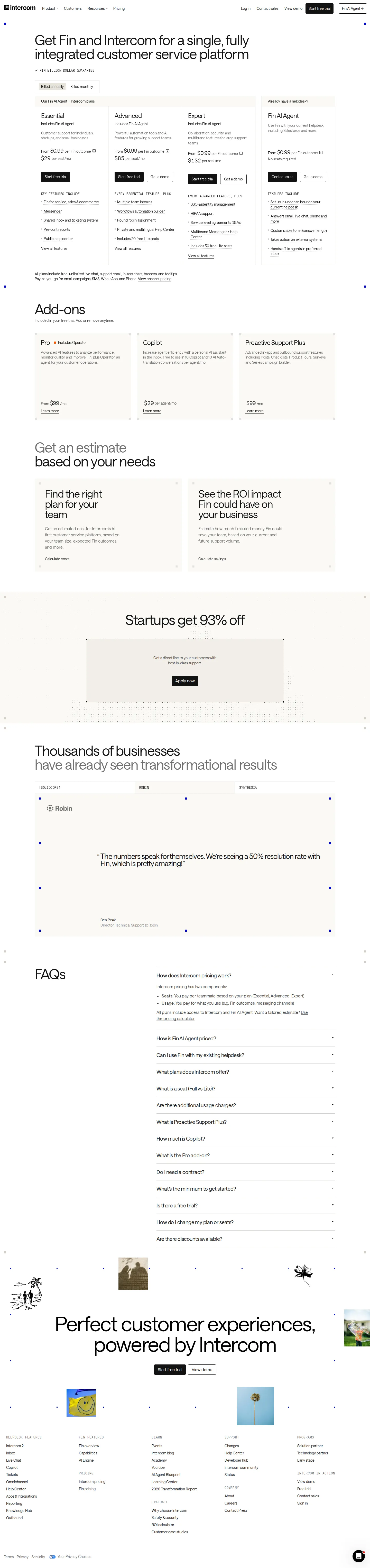
Essential Discount Splits: Pricing-Page Annual Reverts, Calculator + fin.ai Still Show $19
One day after the 2026-08-26 cross-surface sync, intercom.com/pricing's ANNUAL toggle reverts Essential to its clean $29/seat/mo list rate with no banner or strikethrough — but that same domain's pricing calculator (also on its annual toggle) and fin.ai/pricing's Intercom-helpdesk seat anchor still show the discounted $19/seat/mo (calculator: 'Billed annually at $348.00 → $228.00'). Monthly billing is unaffected on every surface: the pricing page and calculator both still show $39 struck to $29/seat/mo ('Save 25%'). This is the first time intercom.com's own pricing page and its own calculator have disagreed with each other on the same billing cadence — previously the split (when it happened) was between intercom.com and fin.ai, not within intercom.com itself. Advanced ($85/$99), Expert ($132/$139), and the $0.99-per-Fin-outcome meter are unchanged.
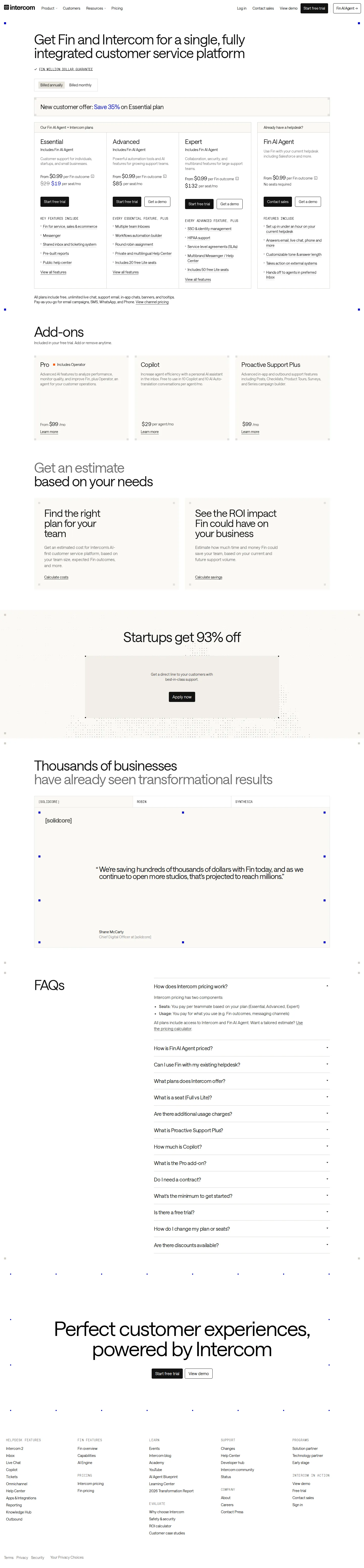
Essential Discount Returns a Third Time — Now In Sync With fin.ai
The Essential new-customer offer that went dark 2026-08-14 is back: intercom.com/pricing and its calculator show $29 struck to $19/seat/mo annual ('Save 35%') and $39 struck to $29/seat/mo monthly ('Save 25%'). For the first time this cycle, fin.ai/pricing's independent Intercom-helpdesk seat anchor also shows $19/seat/mo on the same day — previously that surface ran an uncorrelated variant. This is the third time the offer has resurfaced since 2026-06-24 (on, off, on, off, on — five moves in about nine weeks). Advanced ($85/$99), Expert ($132/$139), and the $0.99-per-Fin-outcome meter are unchanged.
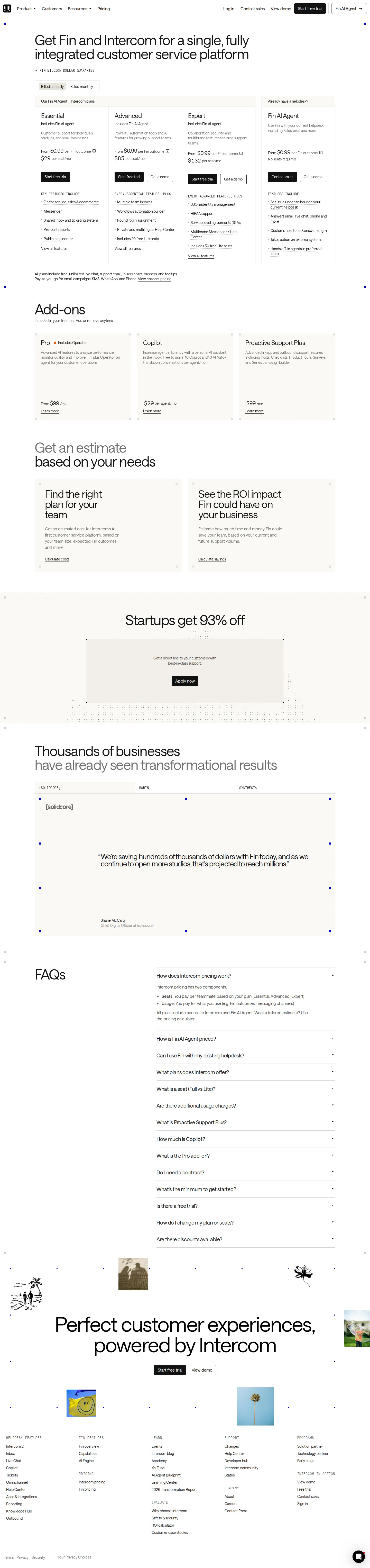
Essential Discount Disappears Again — Second Off-Flip Since June
The new-customer Essential discount that returned 2026-07-21 (and was reconfirmed on the 2026-08-11/12/13 captures) is off again: intercom.com/pricing and its calculator show Essential at the clean $29/seat/mo annual ($39 monthly) list price on both billing toggles, with no 'Save 35%'/'Save 25%' banner or struck-through price. This is the second time this specific offer has switched off since it first appeared 2026-06-24 (live ~1 week, off by 2026-06-30, back 2026-07-21, off again roughly three weeks later). fin.ai/pricing's independent Intercom-helpdesk seat anchor still shows $19/seat/mo the same day. Advanced ($85/$99), Expert ($132/$139), and the $0.99-per-Fin-outcome meter are unchanged.
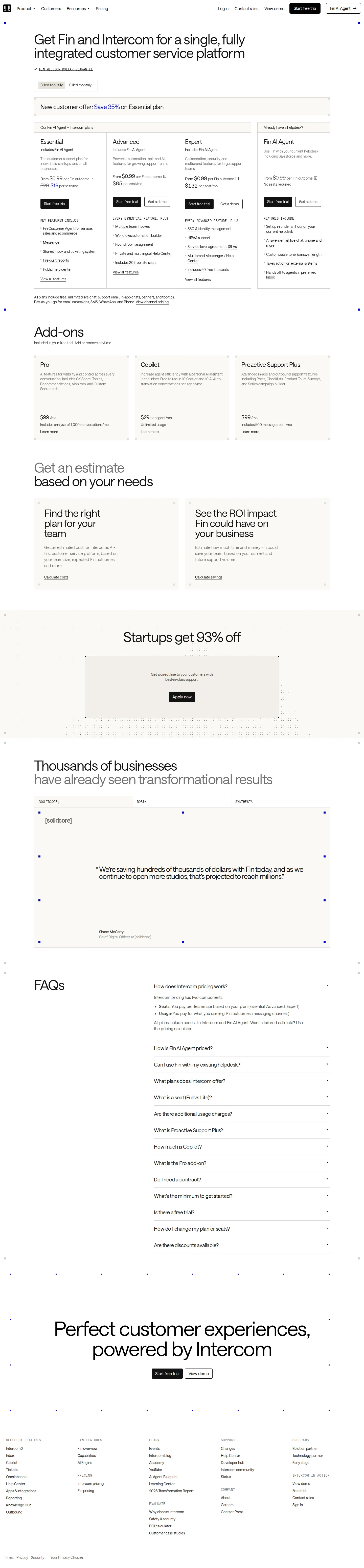
Essential Entry Seat Cut Again — 35% Off Annual, 25% Off Monthly
The new-customer Essential discount is live again, this time on both billing cadences and as a named A/B experiment (team-self-serve-essential-price-reduction). Annual Essential shows $29 struck to $19/seat/mo ($348/yr struck to $228/yr) under a Save 35% banner; monthly Essential shows $39 struck to $29/seat/mo under a Save 25% banner. fin.ai/pricing serves the same variance on its Intercom-helpdesk seat anchor — the 2026-07-21 capture shows $19/seat/mo, while two independent same-day fetches returned $29/seat/mo with no discount banner. Advanced ($85 annual / $99 monthly), Expert ($132 annual / $139 monthly) and the $0.99-per-Fin-outcome meter are unchanged.
35%-Off Essential Offer Ends
The June-2026 new-customer offer that cut Essential 35% ($29 → $19/seat, $348 → $228/yr) has ended. The 2026-06-30 pricing page and calculator both show Essential back at its flat $29/seat list rate ($348/yr); Advanced ($85), Expert ($132), and the $0.99/Fin-outcome meter are unchanged.

New-Customer 35% Off Essential
Intercom launches a standing new-customer offer cutting the Essential entry tier 35% — $29 list struck to $19/seat/mo (annual $348 → $228). Advanced ($85), Expert ($132), and the $0.99/Fin-outcome meter are unchanged; the discount is scoped to the Essential tier for new customers only.

Salesforce to Acquire Fin (formerly Intercom)
Salesforce signs a definitive agreement to acquire Fin — the company renamed from Intercom in May 2026 — for approximately $3.6 billion, expected to close around Q4 FY2027 (early 2027), subject to regulatory approval. Customer-facing pricing is unchanged at announcement ($0.99 per Fin resolution; Essential $29 / Advanced $85 / Expert $132 per seat). Fin's proprietary Apex support model and AI Agent are positioned to complement Salesforce Agentforce.
Usage-Based AI Formalization
Intercom formalises the usage-based pricing model for its AI products, cementing the $0.99/resolution fee for Fin across all platform tiers and the standalone product.
Fin AI Pricing Launch
Intercom introduces $0.99-per-resolution pricing for Fin AI Agent — one of the earliest examples of true outcome-based AI pricing in the customer-service category.
Contextual / Lifecycle Tiers
Intercom introduces the 'Start, Grow, Accelerate, Scale' methodology, varying feature sets by company stage — predecessor to today's Essential / Advanced / Expert tiering.
Conversation-Based Pricing
Intercom shifts from per-user pricing to conversation-based pricing for its support tools, foreshadowing the eventual per-resolution model that lands with Fin three years later.
Modular Unbundling
Intercom shifts to unbundled 'à la carte' pricing for Messages, Inbox, and Articles — first attempt at letting customers buy only the components they use.
Active People Pricing
Intercom moves strictly to 'Active People' pricing, removing the confusing lead/user distinction that had been in place since the early seat-based era.
The Bundle Era
Intercom commits to bundling as a core pricing lever ('Start with a bundle'), originally for product suites — a pattern that returns a decade later with Fin bundled into all platform tiers.
Early Seat-Based Launch
Intercom launches with a simple sliding scale based on active users, the standard early-2010s SaaS approach that the next 15 years of pricing evolution would steadily move away from.
- · Intercom sells Fin AI Agent as a standalone product that runs INSIDE its competitors' helpdesks — Zendesk, Salesforce, etc. — at the same $0.99/resolution with a 50-resolution monthly minimum and no seat fee. It's a rare 'compete on your rival's surface' pricing move that removes switching costs entirely while still collecting outcome revenue.
- · Intercom's Early Stage Program offers a 93% first-year discount for startups with fewer than 15 employees and under $10M funding — the program page advertises the Intercom helpdesk from $33/month in year one for a bundle of 2 Advanced seats, 2 Copilot seats and 20 Lite seats, plus 300 free Fin outcomes per month. It's one of the most aggressive startup discounts in B2B SaaS and a quiet pricing-tier-by-stealth that's invisible to anyone who doesn't qualify.
- · Fin's $0.99/resolution is one of the cleanest outcome-based meters in AI today — most 'AI product' pricing meters input (tokens, API calls, queries) regardless of whether the user got what they came for. Intercom only bills when Fin closes a conversation without human escalation, which structurally aligns vendor incentives with customer outcomes.
Questions & answers
- What is a resolution in Intercom's Fin AI pricing?
- A resolution is counted when Fin AI successfully closes a customer conversation without human escalation. Intercom charges $0.99 per resolved conversation. There is some ambiguity around 'soft resolutions' — conversations where a customer stops responding may still count as resolved, which can inflate the bill compared to a strict 'customer confirmed solved' definition.
- How much does Intercom cost per month?
- Costs depend on team size and AI usage. A 5-person Essential plan team ($29/seat) with 2,000 monthly Fin resolutions pays roughly $2,125/month. A 10-person Advanced plan team ($85/seat) with 5,000 resolutions pays roughly $6,044/month including Copilot and channel add-ons. Intercom has intermittently discounted new-customer Essential to $19 per seat per month on annual billing, which would take the 5-person example to about $2,075/month — as of 2026-08-27 that discount shows on the pricing calculator and on fin.ai, but the main pricing page's own annual toggle has reverted to the $29 list price, so which number you'll actually be billed depends on which surface (and A/B variant) you land on. Either way, the Fin resolution meter, not the seat line, is what actually moves the bill.
- Is Intercom's $19 Essential price available to everyone?
- No, and as of 2026-08-27 it depends on which page you're looking at. The $19 per seat per month rate is a new-customer offer on the Essential tier that Intercom has switched on, off, or split across surfaces six times since 2026-06-24. As of this capture, intercom.com/pricing's own annual toggle shows the clean $29 list rate with no discount banner, while that same site's pricing calculator (also on annual) and fin.ai/pricing both still show $19 — the first time the pricing page and its own calculator have disagreed with each other. The equivalent monthly-billing offer ($39 struck to $29 per seat) is showing on every surface right now. Advanced and Expert have never been part of the offer, and Intercom has never published an end date or a renewal rate for it.
- Can you use Fin AI without switching to Intercom?
- Yes. Intercom offers Fin as a standalone product that integrates with Zendesk, Salesforce, and other helpdesks at $0.99/resolution with a 50-resolution monthly minimum. No seat-based platform fees apply for standalone Fin.
- Does Intercom offer startup discounts?
- Yes. The Early Stage Program offers a 93% first-year discount for startups with fewer than 15 employees and under $10M in funding. Intercom advertises the year-one helpdesk from $33 per month — a bundle of 2 Advanced seats, 2 Copilot seats and 20 Lite seats — with 300 free Fin outcomes per month included in year one.
- How does Intercom's per-resolution pricing compare to token-based AI pricing?
- Unlike token-based AI APIs that charge per input/output token regardless of outcome, Intercom only charges $0.99 when Fin fully resolves a customer conversation. This outcome-based model means you pay for results, not attempts — making cost estimation much more straightforward.