AI Summary
About
LiveKit is the open-source, end-to-end WebRTC stack that has become the default real-time transport layer for voice and video AI. Launched in July 2021 as a free, Apache-2.0 server you can self-host, it grew into a three-part product: the open-source media server, LiveKit Cloud (the managed, globally-distributed network), and the Agents framework for building voice/video AI agents. LiveKit provides the real-time transport behind OpenAI’s ChatGPT voice mode, and the Agents framework — modeled on that work — is downloaded more than a million times a month. Other customers include xAI, Salesforce (Agentforce), Tesla, and even 911 emergency services; the network handles billions of calls a year.
The company raised a $45M Series B at a $345M valuation in April 2025 (led by Altimeter), then a $100M Series C at a $1B valuation in January 2026 (led by Index Ventures, with Salesforce Ventures, Hanabi, Altimeter and Redpoint). At its Series B it reported 500+ paying customers and 100,000+ developers.
For the most current information, visit LiveKit.
Pricing summary : How LiveKit’s pricing model works
LiveKit has two pricing paths. The open-source server is free to self-host under Apache 2.0 — no LiveKit fees, you pay only for your own infrastructure. LiveKit Cloud is the managed alternative with four tiers: Build (free), Ship ($50/mo), Scale ($500/mo), and Enterprise (custom).
Cloud is multi-dimension metered. Each tier bundles monthly allotments of several units, then charges usage-based overage above them:
- Agent-session minutes — time an AI agent runs on Cloud. Build includes 1,000, Ship 5,000, Scale 50,000; overage is $0.01 per min.
- WebRTC media minutes — end-user connection time to the realtime network. Build 5,000, Ship 150,000, Scale 1.5M; overage is $0.0005 per min (Ship) / $0.0004 per min (Scale).
- Inference credits — for LiveKit Inference (LLM/STT/TTS via one API key). Build includes $2.50 in credits (~50 minutes), Ship $5 (~100 minutes), Scale $50 (~1,000 minutes, then billed at discounted model prices).
- Agent observability — session recordings (1,000 / 5,000 / 50,000 min included, then $0.005 per min) and observability events (100,000 / 500,000 / 5,000,000 entries, then $0.00003 per entry).
- Telephony — 1 free US local number, then $1.00/month per number and $0.01 per inbound min; toll-free is $2.00/month per number and $0.02 per minute; third-party SIP minutes run $0.004 per min (Ship) / $0.003 per min (Scale).
- Data transfer — 50 GB / 250 GB / 3 TB included, then $0.12 per GB (Ship) / $0.10 per GB (Scale).
Two smaller meters ride alongside: voice isolation minutes (100 / 1,000 / 10,000 included, then $0.0012/min) and hard concurrency ceilings — concurrent agent sessions (5 / 20 / up to 600, starting at 50 with more on request), inference concurrency (5 / 20 / 50) and concurrent connections (100 / 1,000 / 5,000).
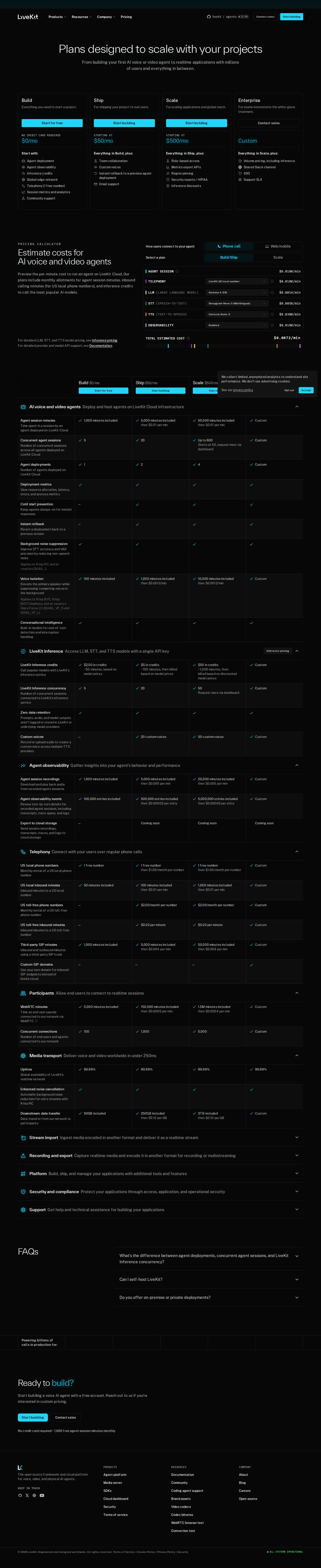
What makes this different: LiveKit prices the AI-agent workload, not just raw video conferencing — a textbook hybrid pricing model with a small subscription floor and a wide metered surface. The headline meter — agent-session minutes at a flat $0.01 per min — is independent of which LLM/STT/TTS models you call (those bill separately through inference credits or your own provider keys). A built-in calculator estimates blended per-minute agent cost — its default Gemma 4 31B + Deepgram Nova-3 (Multilingual) + Cartesia Sonic 3 voice stack with observability enabled lands at $0.0672/min — so buyers can model a voice agent end-to-end before committing.
Pricing by product
LiveKit Cloud (plan tiers)
| Tier | Price | Included (monthly) | Key mechanics |
|---|---|---|---|
| Self-host (OSS) | Free | No caps | Apache 2.0; you run the infrastructure, no LiveKit fees |
| Build | $0/mo | 1,000 agent-session min · 5,000 WebRTC min · 50 GB transfer · $2.50 in credits · 1 free US number · 1 agent deployment | ”No credit card required”; community support; 5 concurrent agent sessions |
| Ship | $50/mo (“starting at”) | 5,000 agent-session min · 150,000 WebRTC min · 250 GB transfer · $5 in credits · 2 agent deployments | Then usage overage; team collaboration, custom voices (20), instant rollback, email support |
| Scale | $500/mo (“starting at”) | 50,000 agent-session min · 1.5M WebRTC min · 3 TB transfer · $50 in credits · 4 agent deployments | Discounted overage and discounted model prices; RBAC, metrics export APIs, region pinning, security reports / HIPAA |
| Enterprise | Custom | Custom allotments on every meter | Volume pricing including inference, SSO, shared Slack channel, support SLA |
LiveKit Cloud (metered units and overage)
| Metered unit | Build (included) | Ship (included, then) | Scale (included, then) |
|---|---|---|---|
| Agent-session minutes | 1,000 | 5,000, then $0.01 per min | 50,000, then $0.01 per min |
| Concurrent agent sessions | 5 | 20 | Up to 600 (starts at 50, request more via dashboard) |
| Agent deployments | 1 | 2 | 4 |
| Voice isolation minutes | 100 | 1,000, then $0.0012/min | 10,000, then $0.0012/min |
| Inference credits | $2.50 (~50 min) | $5 (~100 min) | $50 (~1,000 min, then discounted model prices) |
| Inference concurrency | 5 | 20 | 50 (request more via dashboard) |
| Custom voices | — | 20 custom voices | 50 custom voices |
| Agent session recordings | 1,000 min | 5,000 min, then $0.005 per min | 50,000 min, then $0.005 per min |
| Agent observability events | 100,000 entries | 500,000 entries, then $0.00003 per entry | 5,000,000 entries, then $0.00003 per entry |
| US local phone numbers | 1 free number | 1 free, then $1.00/month per number | 1 free, then $1.00/month per number |
| US local inbound minutes | 50 | 100, then $0.01 per min | 1,000, then $0.01 per min |
| US toll-free numbers / minutes | — | $2.00/month per number · $0.02 per minute | $2.00/month per number · $0.02 per minute |
| Third-party SIP minutes | 1,000 | 5,000, then $0.004 per min | 50,000, then $0.003 per min |
| WebRTC minutes | 5,000 | 150,000, then $0.0005 per min | 1.5M, then $0.0004 per min |
| Concurrent connections | 100 | 1,000 | 5,000 |
| Downstream data transfer | 50 GB | 250 GB, then $0.12 per GB | 3 TB, then $0.10 per GB |
| Network uptime | 99.99% | 99.99% | 99.99% |
Enterprise is “Custom” on every row above. Export of recordings, transcripts, traces and logs to cloud storage is listed as Coming soon on Ship, Scale and Enterprise (and unavailable on Build), and custom SIP domains are not offered on any published tier.
LiveKit Inference (model prices, per minute)
Inference draws down the plan’s credits, then bills per minute of model time. Scale (and Enterprise) get discounted STT/TTS rates; LLM rates are published as a single per-minute list.
| Model | Build / Ship | Scale |
|---|---|---|
| Gemma 4 31B (LLM) | $0.0014/min | $0.0014/min |
| Moonshot AI Kimi K2.6 (LLM) | $0.0035/min | $0.0035/min |
| xAI Grok 4.3 / Grok 4.5 (LLM) | $0.0042/min · $0.0070/min | $0.0042/min · $0.0070/min |
| OpenAI GPT-5.6 Luna / Terra / Sol (LLM) | $0.0040/min · $0.0101/min · $0.0203/min | same |
| OpenAI GPT Realtime (LLM) | $0.0676/min | $0.0676/min |
| Deepgram Nova-3, Multilingual (STT) | $0.0058/min | $0.0050/min |
| Cartesia Sonic 3 (TTS) | $0.0300/min | $0.0225/min |
| ElevenLabs Eleven v3 (TTS) | $0.1800/min | $0.0720/min |
Sales motions across products: self-serve PLG for Build/Ship/Scale (instant signup, no card on Build), open-source self-host, and sales-led for Enterprise (volume + inference discounts, on-prem/private deployment).
Hidden costs : What LiveKit users actually pay
The flat $50/$500 is only the floor. A production voice-AI app stacks five separate meters: agent-session minutes, WebRTC media minutes, inference credits (or your own model bills), telephony, and data transfer. The single biggest line is usually inference — the LLM/STT/TTS model minutes that the LiveKit calculator surfaces — which can dwarf the $0.01/min agent-session fee. For example, the calculator’s default voice stack (Gemma 4 31B + Deepgram Nova-3 Multilingual + Cartesia Sonic 3 + observability) lands at $0.0672/min all-in, of which the LiveKit agent-session + observability portion is only $0.02/min — swap the LLM for OpenAI GPT Realtime and the same session costs roughly twice as much.
| Line item | Typical cost |
|---|---|
| Ship base plan | $50/mo |
| Agent-session minutes (over 5,000) | $0.01/min |
| Model inference (LLM+STT+TTS, blended) | ~$0.04–$0.07/min |
| WebRTC media minutes (over 150,000) | $0.0005/min |
| Data transfer (over 250 GB) | $0.12/GB |
| Example: 10K min/mo voice agent (Ship) | ~$50 base + a few hundred $ inference |
Other things to budget for: HIPAA, RBAC, region pinning and metrics-export APIs are gated to Scale ($500) and above; cold-start prevention (always-on agents), custom voices and inference discounts also start at Ship/Scale; and toll-free numbers ($2/number, $0.02/inbound min) and third-party SIP minutes bill on top.
Want to estimate your own LiveKit bill? Use the LiveKit pricing calculator to model your costs based on usage patterns.
Pricing evolution : LiveKit pricing history and changes
Cadence
| Period | Price changes | Product / SKU additions | Notes |
|---|---|---|---|
| 2021 | Free (OSS) | Open-source WebRTC server | Apache 2.0, self-host |
| 2023 | Cloud tiers | LiveKit Cloud + Agents framework | Powers ChatGPT voice mode |
| 2025 | Repositioning | Agent-session minutes + inference credits foregrounded | Series B; voice-AI agents focus |
| 2026 H1 | Build free / Ship $50 / Scale $500 | Multi-dimension metering; LiveKit Inference | Series C, $1B valuation |
| 2026 Q3 | 0 | 6 new inference LLM SKUs | 2026-07-21: GPT-5.6 Luna/Terra/Sol, Grok 4.3/4.5 and Kimi K2.6 join LiveKit Inference; every plan price, allotment and overage rate holds; the calculator’s default LLM moves to Gemma 4 31B |
Tracked range: 2021–2026 Q3. Periods not listed above carried no plan-price changes and no SKU additions.
Notable changes
- 2021-07 — Launches as a free, open-source, end-to-end WebRTC stack (Apache 2.0). Self-hosting carries no LiveKit fees.
- 2023-09 — LiveKit powers OpenAI’s ChatGPT voice mode and releases the open-source Agents framework; LiveKit Cloud (Build/Ship/Scale) matures, metered on participant/connection minutes and bandwidth.
- 2025-04 — $45M Series B at $345M (FinSMEs). Cloud repositions around voice/video AI agents, making agent-session minutes and inference credits the primary metered units.
- 2026-01 — $100M Series C at a $1B valuation led by Index Ventures (LiveKit blog; TechCrunch).
- 2026-06 — Current structure: Build (free), Ship $50, Scale $500, Enterprise. Seven metered dimensions with per-unit overage — agent sessions, WebRTC minutes, inference credits, observability (recordings and events), voice isolation, telephony and data transfer — with LiveKit Inference exposing LLM/STT/TTS model minutes through one API key.
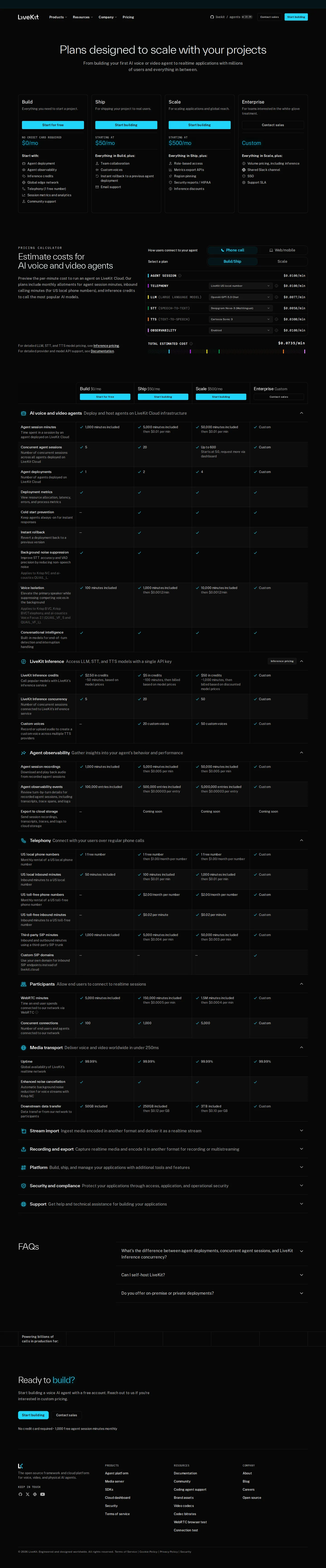
- 2026-07-21 — Six new LLM SKUs land in LiveKit Inference (GPT-5.6 Luna $0.0040/min, Terra $0.0101/min, Sol $0.0203/min; Grok 4.3 $0.0042/min, Grok 4.5 $0.0070/min; Kimi K2.6 $0.0035/min) with no change to any plan price, allotment or overage rate. The visible move is on the pricing-page calculator, whose default LLM switched from GPT-5.3 Chat ($0.0077/min) to Gemma 4 31B ($0.0014/min), cutting the advertised blended voice-agent estimate from $0.0735/min to $0.0672/min — a 9% drop in the headline number that LiveKit achieved by changing a default rather than a price.
What’s unique : LiveKit’s distinctive pricing mechanics
1. Agent-session minutes as the headline meter. Rather than billing on raw video minutes or seats, LiveKit prices the agent runtime at a flat $0.01/min — decoupled from which models you run. It’s a value metric that maps directly to “how long my voice agent was live,” which is intuitive for AI builders.
2. Genuinely free via open source. The full WebRTC server is Apache 2.0 and self-hostable with no LiveKit fees. Cloud sells the managed global network, agent deployment/observability, and inference convenience — not the core capability — which caps pricing power but maximizes adoption.
3. Model-cost passthrough with optional discounts. LiveKit Inference lets you call LLM/STT/TTS models through one key, billed via credits; Scale and Enterprise get discounted model rates. You can also bring your own provider keys. This turns model spend into a metered, optionally-marked-up dimension layered on the subscription — and the catalog is restocked continuously rather than repriced: the 2026-07-21 refresh added six LLM SKUs (GPT-5.6 Luna/Terra/Sol, Grok 4.3/4.5, Kimi K2.6) while leaving every LiveKit-owned rate untouched. The published LLM list now spans roughly $0.0002/min to $0.0676/min, so which model you pick moves the bill by two orders of magnitude while LiveKit’s own take stays a flat $0.01/min.
4. The calculator default is itself a pricing lever. LiveKit advertises a blended per-minute number rather than a plan price, and that number is a function of the models pre-selected in the on-page estimator. On 2026-07-21 the default LLM moved from GPT-5.3 Chat to Gemma 4 31B and the advertised total fell from $0.0735/min to $0.0672/min without a single rate changing. It is an honest number — the stack is named on screen — but it means the headline moves with merchandising decisions, and two quotes taken months apart are not comparable unless you fix the model stack first.
Strengths & weaknesses
| Strengths | Weaknesses |
|---|---|
| Free, genuinely open-source self-host path (no LiveKit fees) | Seven separate meters make total cost hard to predict |
| Value metric (agent-session minutes) maps to AI-agent runtime | Inference (model) cost usually dwarfs the $0.01/min agent fee |
| Transparent, model-by-model inference calculator on the pricing page | Advertised blended rate tracks the calculator’s default stack, not a fixed price (fell to $0.0672/min on 2026-07-21 purely via a default swap) |
| Model catalog refreshed within weeks of a frontier release (GPT-5.6, Grok 4.5 and Kimi K2.6 all live by 2026-07-21) | Compliance (HIPAA), RBAC, region pinning gated to $500 Scale |
| Powers OpenAI ChatGPT voice mode — strong reference & reliability | Bandwidth overage ($0.10–$0.12/GB) can surprise video-heavy apps |
| Generous free Build tier (1,000 agent min, no card) | Heavy reliance on third-party model providers’ pricing |
Billing UX : LiveKit billing controls and transparency
- Self-serve signup, “No credit card required” — Build starts free with 1,000 free agent-session minutes monthly and no card; upgrades to Ship ($50/mo) and Scale ($500/mo) are self-serve from the same flow.
- Pricing calculator (“Estimate costs for AI voice and video agents”) — an interactive per-minute estimator on the pricing page with a How users connect toggle (Phone call / Web-mobile) and a Select a plan toggle (Build/Ship vs Scale), breaking the bill into Agent session, Telephony, WebRTC connection, LLM, STT, TTS and Observability lines and summing a Total estimated cost ($0.0672/min on the default stack).
- “View pricing in plain text (Markdown)” — a machine-readable dump of the whole pricing page, linked from the top of the pricing page for agents and scripts.
- Concurrency ceilings with a dashboard raise path — concurrent agent sessions, LiveKit Inference concurrency and concurrent connections are each hard-capped per tier, with “request more via dashboard” as the documented lift for Scale.
- Agent observability + deployment metrics — agent session recordings, turn-by-turn observability events (transcripts, trace spans, logs), deployment metrics (resource allocation, latency, errors) and session metrics/analytics in-product; metrics export APIs unlock at Scale, and export to cloud storage is marked Coming soon.
- Zero data retention — available on every published tier: prompts, audio and model outputs aren’t logged or stored by LiveKit or the underlying model providers.
- Payment options — card-based self-serve for Build/Ship/Scale; Enterprise is quoted by sales (“Contact sales”) with volume pricing including inference, SSO, a shared Slack channel and a support SLA.
Strategic wins : Why LiveKit’s pricing decisions worked
1. Open source as the top-of-funnel
Launching a free Apache-2.0 WebRTC stack made LiveKit the default real-time layer for an entire generation of voice/video apps — including OpenAI’s ChatGPT voice mode. The free self-host path removes adoption friction; Cloud monetizes the teams that don’t want to operate a global media network. See how AI companies structure pricing.
2. Repricing around the agent, not the call
By moving the headline meter to agent-session minutes, LiveKit aligned its pricing with the unit AI builders actually reason about, riding the voice-AI wave from a $345M (April 2025) to a $1B (January 2026) valuation. Related: outcome-based pricing trends.
3. Inference as a layered, discountable meter
Folding LLM/STT/TTS access into metered inference credits (with Scale/Enterprise discounts) lets LiveKit capture model spend as an expansion lever without forcing a single model choice. Because the meter is the minute, not the model, LiveKit can restock the catalog as fast as the labs ship — the 2026-07-21 update dropped in GPT-5.6, Grok 4.3/4.5 and Kimi K2.6 with zero repricing work and zero migration for existing customers. That turns “we support the newest model” into routine catalog maintenance instead of a pricing event. See choosing the right usage metric.
Areas to improve : Gaps in LiveKit’s pricing approach
1. Too many meters to forecast confidently
Seven simultaneous metered dimensions (agent minutes, WebRTC minutes, inference, observability recordings, observability events, voice isolation, telephony and bandwidth) make it genuinely hard to predict a monthly bill without running the calculator for each scenario — and observability quietly doubles LiveKit’s own per-minute take, since the calculator’s $0.01/min observability line matches the agent-session line. A blended “all-in per-minute” headline, or a saved-scenario feature in the calculator, would reduce planning friction. See bill shock and cost unpredictability.
2. Compliance gated high
HIPAA, RBAC, region pinning and metrics-export APIs only appear at the $500 Scale tier, which can push regulated startups straight to a steep step-up well before their volume justifies it.
3. Model-cost dependence — and a moving headline number
Because inference is usually the dominant line and rides third-party model pricing, LiveKit’s effective cost-to-serve for a customer can swing with provider price changes — a transparency and predictability gap LiveKit only partly controls. The 2026-07-21 refresh showed the buyer-facing edge of that: the advertised blended estimate dropped from $0.0735/min to $0.0672/min because the calculator’s default LLM changed, not because anything got cheaper for an existing customer still on GPT-5.3 Chat. A durable fix is cheap — stamp the calculator with the model stack and date it assumes, and let buyers save or share a fixed configuration — so a quote made in June is still comparable to one made in September.
Monetization stack & signals : how LiveKit builds & buys its revenue engine
Buys 4 Builds 0 5 open roles
LiveKit buys its monetization stack rather than building it, on the evidence of a single still-live Controller posting (re-confirmed 2026-06-16) that describes the operating reality as "NetSuite/QuickBooks ↔ Metronome/Stripe reconciliation" — naming Metronome for usage metering, Stripe for payments and a NetSuite migration (off legacy QuickBooks) for rev-rec under ASC 606. All four names rest on that one posting; no independent second source (Metronome case study, press, or eng blog) corroborates them, so each is single-source. It is actively investing in the billing layer — a June 2026 Billing Systems Engineer req spans billing-eng, deal-desk and RevOps to rebuild CPQ↔billing↔ERP integrations for its consumption model (credit expiration, minimum commits), though that req lists "Metronome, Orb, Chargebee, or similar" as a skills set rather than a stack disclosure. Alongside it, a Staff PM, Enterprise monetization role and SDR growth hires. No public engineering-blog disclosure of an in-house monetization build was found.
-
“Billing system integrity: NetSuite/QuickBooks ↔ Metronome/Stripe reconciliation; ensuring recognized revenue ties to invoiced and collected amounts.”
-
“Billing system integrity: NetSuite/QuickBooks ↔ Metronome/Stripe reconciliation; ensuring recognized revenue ties to invoiced and collected amounts.”
-
“NetSuite experience — we are on or moving to NetSuite; prior implementation or heavy operating experience required.”
-
“Billing system integrity: NetSuite/QuickBooks ↔ Metronome/Stripe reconciliation; ensuring recognized revenue ties to invoiced and collected amounts.”
- Billing Systems Engineer Billing engineeringDeal deskRevOps Jun 8, 2026
- Controller Billing engineering Jun 8, 2026
- Staff Product Manager, Enterprise MonetizationGrowth Jun 2, 2026
- Sales Development Representative Growth Jun 2, 2026
- IT Support Engineer Retention Jun 2, 2026
- +1 more matched role
Signals reviewed · derived from public job posts
Job postings fill and close over time — once a posting is filled we keep it as a dated citation (the quoted evidence remains); use View open roles for current listings.
Key takeaways
- Open source built the funnel. A free Apache-2.0 WebRTC stack made LiveKit the default real-time layer for voice AI — including ChatGPT voice mode — before Cloud monetized the managed network.
- Price the agent, not the call. Switching the headline meter to agent-session minutes ($0.01/min) aligned pricing with the AI-builder’s mental model and tracked a 3x valuation jump in nine months.
- A flat floor plus many meters trades simplicity for fairness. Build/Ship/Scale anchor the bill, but seven overage dimensions make forecasting hard.
- Inference is the real cost driver, and defaults are prices. The $0.01/min agent fee is small next to blended model minutes (~$0.04–$0.07/min) on a published LLM list running $0.0002–$0.0676/min. LiveKit cut its advertised blended estimate 9% on 2026-07-21 by changing the calculator’s default LLM rather than any rate — whatever a buyer sees pre-selected is effectively your list price.
- Self-host stays the escape valve. Because the core server is free under Apache 2.0, Cloud has to win on convenience and scale, not lock-in.
UBP implications
- Choose a value metric your buyer already counts. “Agent-session minutes” maps cleanly to how voice-AI teams think about runtime — a more intuitive meter than raw video minutes or seats.
- Meter the minute, not the model — then the catalog is free to churn. Passing through (and discounting at scale) third-party model spend lets a platform expand revenue without dictating a model choice, and because the unit is time rather than a named SKU, adding GPT-5.6, Grok 4.5 and Kimi K2.6 on 2026-07-21 required no repricing, no plan change and no customer migration. Any UBP vendor reselling a fast-moving upstream should design the meter so new supply is a catalog update rather than a pricing event.
- Open core changes pricing power. When the engine is free to self-host, the paid tiers must sell the managed network, observability, and compliance — not the capability. See usage-based pricing strategy.
Sources
- LiveKit pricing page (accessed 2026-07-21)
- LiveKit GitHub (open-source WebRTC server, Apache 2.0) (accessed 2026-06-09)
- LiveKit Series C: towards the voice-driven era of computing (accessed 2026-06-09)
- LiveKit Inference pricing (per-model LLM, STT and TTS rates) (accessed 2026-07-21)
- LiveKit documentation — quotas and limits (accessed 2026-07-21)
Bottom line
LiveKit is the open-source (Apache 2.0) WebRTC stack that became the default real-time layer for voice and video AI — it powers OpenAI’s ChatGPT voice mode and its Agents framework is downloaded over a million times a month. The server is free to self-host; LiveKit Cloud is a hybrid — free Build, $50 Ship, $500 Scale and custom Enterprise — metered across seven dimensions including agent-session minutes ($0.01/min), WebRTC media minutes ($0.0004–$0.0005/min), inference credits, observability, telephony and data transfer. Plan rates have held steady through 2026; the movement is in the LiveKit Inference catalog, which added GPT-5.6, Grok 4.3/4.5 and Kimi K2.6 on 2026-07-21 and now anchors an advertised blended voice-agent estimate of $0.0672/min. After a $45M Series B at $345M (April 2025), LiveKit raised a $100M Series C at a $1B valuation in January 2026. Browse the pricing blueprint for more fully-researched company profiles.
Want to compare LiveKit against other voice and real-time AI companies? Browse the pricing blueprint.
Pricing timeline : Major events on a vertical axis
Each milestone below corresponds to a public pricing change, product launch, or material adjustment. Major events use a filled marker; minor adjustments use a faded one.
LiveKit Inference adds GPT-5.6, Grok 4.3/4.5 and Kimi K2.6
Plan structure and every plan rate hold (Build free / Ship $50 / Scale $500 / Enterprise custom). The metered LiveKit Inference catalog gains six new per-minute LLM SKUs — OpenAI GPT-5.6 Luna $0.0040/min, Sol $0.0203/min, Terra $0.0101/min, xAI Grok 4.3 $0.0042/min, Grok 4.5 $0.0070/min and Moonshot Kimi K2.6 $0.0035/min — and the pricing-page calculator now defaults to a cheaper Gemma 4 31B stack at $0.0672/min.
Build free / Ship $50 / Scale $500 + multi-dimension metering
Current structure: Build (free), Ship $50/mo, Scale $500/mo, Enterprise custom. Each bundles agent-session minutes, WebRTC media minutes, inference credits, telephony minutes and data transfer, then usage-based overage (agent sessions $0.01/min; WebRTC $0.0004–$0.0005/min; transfer $0.10–$0.12/GB).
Series B + voice-AI agent repositioning
Raised $45M Series B at a $345M valuation (Altimeter). Cloud repositions around voice/video AI agents, foregrounding agent-session minutes and inference credits as primary metered units.
LiveKit Cloud + ChatGPT voice mode
LiveKit Cloud (managed) matures with Build/Ship/Scale tiers metered on participant/connection minutes and bandwidth. LiveKit powers OpenAI's ChatGPT voice mode and releases the open-source Agents framework.
Open-source WebRTC stack launches
LiveKit launches as a free, open-source, end-to-end WebRTC stack (Apache 2.0) for real-time audio/video — self-hostable with no LiveKit fees.
- · LiveKit provides the real-time transport behind OpenAI's ChatGPT voice mode, and its open-source Agents framework — modeled on that work — is downloaded more than a million times a month.
- · LiveKit launched in July 2021 as a free, open-source, end-to-end WebRTC stack (Apache 2.0) — you can still self-host the full server with no LiveKit fees.
- · It raised a $100M Series C at a $1B valuation in January 2026 (led by Index Ventures), roughly 3x the $345M valuation from its $45M Series B in April 2025.
Questions & answers
- What is LiveKit's pricing model?
- LiveKit has two paths. The open-source WebRTC server is free to self-host under Apache 2.0. LiveKit Cloud is a managed platform with four tiers — Build (free), Ship ($50/mo), Scale ($500/mo) and custom Enterprise — each including monthly allotments of agent-session minutes, WebRTC media minutes, inference credits, telephony minutes and data transfer, then usage-based overage.
- Does LiveKit offer a free tier?
- Yes, two ways. LiveKit Cloud's Build tier is free with no credit card (1,000 agent-session minutes, 5,000 WebRTC minutes, 50 GB transfer and inference credits monthly). Separately, the open-source LiveKit server is free to self-host with no per-minute fees — you pay only for your own infrastructure.
- How much does LiveKit Cloud cost per month?
- LiveKit Cloud Ship starts at $50/month and Scale starts at $500/month; Build is free and Enterprise is custom-quoted. The flat fee buys larger included allotments and features — on top, you pay usage-based overage, e.g. $0.01 per agent-session minute and $0.0004–$0.0005 per WebRTC media minute beyond the included amounts.
- How much does LiveKit Inference cost per model?
- LiveKit Inference bills per minute of model time and draws down each plan's credit allotment first. As of July 2026 the published LLM list runs from about $0.0002/min (OpenAI GPT-5 nano) to $0.0676/min (OpenAI GPT Realtime), with newer entries including GPT-5.6 Luna at $0.0040/min, xAI Grok 4.5 at $0.0070/min and Moonshot Kimi K2.6 at $0.0035/min; Scale and Enterprise get discounted speech-to-text and text-to-speech rates.
- Is LiveKit pricing usage-based or subscription?
- It is a hybrid. LiveKit Cloud has a flat monthly subscription floor (Ship $50, Scale $500) plus usage-based overage metered on multiple dimensions — agent-session minutes, WebRTC media minutes, inference credits, telephony and data transfer. Self-hosting the open-source stack is free of any LiveKit fees.
- Does LiveKit power OpenAI's ChatGPT voice mode?
- Yes. LiveKit provides the real-time transport behind OpenAI's ChatGPT voice mode, and its open-source Agents framework was modeled on that work. The Agents framework is downloaded over a million times a month, and LiveKit also serves customers like xAI, Salesforce and Tesla.