AI Summary
About
Mem (mem.ai), built by Mem Technologies, is an AI-powered personal memory and notes workspace that brands itself as a “self-organizing workspace” — you dump everything on your mind into it and AI surfaces, links, and retrieves it without manual tagging or folders. The product was relaunched as Mem 2.0 in early 2026, a significant rewrite over the original Mem 1.0 / Mem X generation.
The company was founded by Kevin Moody (a former Google product manager) and Dennis Xu (ex-Yelp), both Stanford grads, and is based in Los Altos Hills, California. It has raised roughly $28.6M: a $5.6M seed led by Andreessen Horowitz (a16z) in April 2021, followed by a ~$23.5M Series A led by the OpenAI Startup Fund in November 2022. It is privately held; ARR and headcount are not disclosed.
For the most current information on Mem’s pricing, visit get.mem.ai/pricing.
Pricing summary : How Mem’s pricing model works
Mem replaced its flat-rate lineup with a single scaling ladder: seven tiers from Free through Mem Pro 20× at $199/month, each bundling a fixed set of monthly quotas rather than the unlimited paid plan Mem sold as recently as mid-2026. Every tier meters the same six dimensions — Messages to Mem, New Notes, Task & Project Tracking capacity, Open Tasks & Projects, Custom Routines, Connections, and Voice Mode hours — and the quotas scale together as you move up the ladder:
- Free — $0/month. 25 Messages to Mem, 25 New Notes, Task & Project Tracking across those 25 notes, 15 Open Tasks & Projects, and 3 hours of Voice Mode per month. No Custom Routines or Connections.
- Mem Plus — $9/month. Doubles the Free quotas (50 messages, 50 notes, 25 open tasks/projects, 10 hours Voice Mode). Still no Custom Routines or Connections.
- Mem Pro — $29/month, marked Recommended on the pricing page. 100 messages, 100 notes, 50 open tasks/projects, 25 hours of Voice Mode, and the first Custom Routine and Connection.
- Mem Pro 2× / 5× / 10× / 20× — $49 to $199/month. Each step multiplies every quota in lockstep — messages, notes, open tasks, Custom Routines, Connections, and Voice Mode hours all scale together, up to 2,000 messages/notes and 500 hours of Voice Mode on Mem Pro 20×.
- Extra Usage — $50/month per block, Mem Pro 20× subscribers only. Adds another 500 messages, 500 notes, 250 open tasks/projects, 5 Custom Routines, 250 routine executions, 5 Connections, and 125 Voice Mode hours without changing plans — Mem’s only genuinely metered add-on.
The key thing to understand: every paid tier now caps AI usage, including the cheapest $9 Plus plan — a reversal from the flat, unmetered Pro plan Mem sold before this relaunch (see Pricing evolution for the prior pricing). “Mem Agent” behavior (the proactive task/project tracking) is now bundled starting at the Free tier rather than gated behind a separate top-tier plan, but its capacity — how many notes it reviews, how many open tasks it tracks — scales with what you pay.
What makes this different: instead of one flat price for unlimited AI use, Mem now runs a linear capacity ladder (1×, 2×, 5×, 10×, 20× the Pro allotment) plus a true pay-as-you-go overage — $50 per 500-message/500-note block — but only for customers already on the $199/month top tier, keeping self-serve simplicity everywhere else.
Pricing by product
Mem (Individual plans)
| Tier | Price | Included | Key mechanics |
|---|---|---|---|
| Free | $0 | 25 Messages to Mem/mo, 25 New Notes/mo, Task & Project Tracking across those 25 notes, 15 Open Tasks & Projects, 3 hours of Voice Mode/mo | Entry tier; no Custom Routines or Connections |
| Mem Plus | $9/mo | 50 messages, 50 new notes, tracking across up to 50 notes, 25 open tasks/projects, 10 hours Voice Mode | Doubles Free’s quotas; still no Custom Routines/Connections |
| Mem Pro | $29/mo | 100 messages, 100 new notes, tracking across up to 100 notes, 50 open tasks/projects, 1 Custom Routine, 1 Connection, 25 hours Voice Mode | Recommended tier; first plan with Custom Routines & Connections |
| Mem Pro 2× | $49/mo | 200 messages, 200 new notes, tracking across up to 200 notes, 100 open tasks/projects, 2 Custom Routines, 2 Connections, 50 hours Voice Mode | Twice the Mem Pro capacity |
| Mem Pro 5× | $99/mo | 500 messages, 500 new notes, tracking across up to 500 notes, 250 open tasks/projects, 5 Custom Routines, 5 Connections, 125 hours Voice Mode | ”More working memory for a full personal and professional workload” |
| Mem Pro 10× | $149/mo | 1,000 messages, 1,000 new notes, tracking across up to 1,000 notes, 500 open tasks/projects, 10 Custom Routines, 10 Connections, 250 hours Voice Mode | ”High-capacity support for many projects, sources, and automations” |
| Mem Pro 20× | $199/mo | 2,000 messages, 2,000 new notes, tracking across up to 2,000 notes, 1,000 open tasks/projects, 20 Custom Routines, 20 Connections, 500 hours Voice Mode | Largest packaged plan; only tier eligible for the Extra Usage add-on |
Extra Usage add-on (Mem Pro 20× only)
| Tier | Price | Included | Key mechanics |
|---|---|---|---|
| Extra Usage block | $50/mo per block | +500 Messages to Mem, +500 New Notes, tracking across +500 active notes, +250 Open Tasks & Projects, +5 active Custom Routines, +250 routine executions, +5 active Connections, +125 Voice Mode hours | Self-serve, stackable add-on restricted to Mem Pro 20× subscribers; buy multiple $50 blocks without changing plans |
Sales motions across products: self-serve and product-led across all seven tiers and the Extra Usage add-on — every plan and add-on signs up or upgrades in-app, with no sales contact anywhere in the lineup.
Hidden costs : What Mem users actually pay
Mem is still simple to budget for — every price is public and self-serve — but the relaunch replaced the old flat, unmetered Pro plan with quotas on every tier, so the realistic “hidden” cost is now an unplanned upgrade rather than a surprise bill. The realistic costs are:
| Line item | Monthly cost |
|---|---|
| Mem Pro base plan (100 messages/notes, 25 open tasks/projects) | $29 |
| Extra Usage add-on | $0 (not available below Mem Pro 20×) |
| Add-ons | $0 (none offered below the top tier) |
| Estimated total (Mem Pro user, within quota) | $29 |
The “hidden” cost is the inverse: the Free tier’s 25-message/25-note/3-hour monthly caps are low enough that any genuine daily user hits them quickly and is pushed onto a paid tier, and a Mem Pro subscriber who outgrows the $29 plan’s 100-message/100-note quota has to step up the ladder — to Mem Pro 2× ($49/mo), 5× ($99/mo), 10× ($149/mo), or 20× ($199/mo) — since there is no metered overage below the top tier. Only Mem Pro 20× subscribers can avoid a full plan upgrade by instead buying $50/month Extra Usage blocks.
Want to estimate your own Mem bill? Use the Mem pricing calculator to model your costs based on usage patterns.
Pricing evolution : Mem pricing history and changes
Cadence
| Period | Price changes | Product / SKU additions | Notes |
|---|---|---|---|
| 2021–2022 | — | Mem X premium tier launched | Original “self-organizing workspace” premium, ~8.33/mo annual (~10/mo monthly) |
| Early 2026 | Consolidation | Mem 2.0 relaunch; “Mem X” retired, “Mem Pro” introduced | Premium tier renamed and re-priced to a flat $12/mo |
| 2026 Q2 | 0 | 0 | Verified Free / $12 Pro / custom Teams on 2026-06-15 |
| 2026 Q3 | 0 | +1 (Mem Proactive / Mem Agent) | 2026-07-14 Mem Proactive launched at $99/mo (7-day trial); custom Mem Teams no longer listed on the pricing page. 2026-07-29 “AI model selection” removed from Mem Pro’s listed features; prices unchanged |
Tracked range: 2021–present.
Notable changes
- 2021–2022 — Mem launched its premium “Mem X” tier, the original self-organizing-workspace upsell, reportedly priced around 8.33 USD/user/month billed annually (roughly 10 USD/month on monthly billing).
- Early 2026 — Mem 2.0 relaunch. The “Mem X” branding was retired and the consumer premium tier became Mem Pro at a flat $12/month, with the Free tier’s hard 25/25/25 monthly caps formalized.
- 2026-06-15 — Pricing verified: Free ($0), Mem Pro ($12/mo), Mem Teams (custom).
- 2026-07-14 — Mem launched Mem Proactive at $99/month (7-day free trial), bundling the new autonomous Mem Agent on top of Pro. The earlier custom-quoted Mem Teams tier was removed from the pricing page; Free ($0) and Mem Pro ($12/mo) are unchanged.
- 2026-07-29 — Mem Pro’s listed features dropped “AI model selection” (previously shown as “Meeting Briefings and AI model selection”, now just “Meeting Briefings”); no price changes on any tier.
Note: some third-party review sites still cite an older “$15/month” figure; the official pricing page shows $12/month as of June 2026.
What’s unique : Mem’s distinctive pricing mechanics
1. Flat AI pricing with no meter. Despite being LLM-heavy on every note and chat, Mem Pro charges one flat $12/month — no tokens, no credits, no overages. Mem takes the inference-margin risk so the buyer gets a predictable bill.
2. Hard, countable free-tier caps. Instead of a vague “fair use” free tier, Mem publishes exact monthly limits — 25 notes, 25 chat messages, 25 PDF pages understood. The precision makes the upgrade trigger obvious and honest.
3. No sales-gated tier left. The July 2026 relaunch retired the custom-quoted Mem Teams tier entirely — Free, Mem Pro, and Mem Proactive are now Mem’s only tiers, and all three carry a public, self-serve price. The tradeoff: Mem no longer offers a purpose-built team/collaboration SKU (group billing, seats, SLA) at any price.
Strengths & weaknesses
| Strengths | Weaknesses |
|---|---|
| Dead-simple, predictable $12 flat price — no token/credit anxiety | Free tier is very tight (25/25/25 a month) — closer to a trial than a usable free plan |
| Genuinely free entry tier to evaluate the product | No dedicated team/multi-seat plan — Mem Proactive is individually priced, so collaboration buyers have no purpose-built option since Mem Teams was retired |
| Every Pro feature ships in one flat price — no per-feature paywalls or add-ons | No annual-discount tier publicly surfaced (was a feature of legacy Mem X) |
| No surprise overages — bill is the same every month | Flat pricing means heavy users effectively subsidized by light ones; sustainability depends on Mem’s inference margins |
Billing UX : Mem billing controls and transparency
- Proactive limit warnings — Per Mem’s own FAQ, “Mem will show you when you’re approaching a limit so you can choose a larger plan before work is interrupted,” rather than silently blocking usage mid-task.
- Featured vs. full plan toggle — A “See all plans” / “Show featured plans” control switches the pricing page between the default 4-card view (Free, Plus, Pro, Pro 2×) and the full 7-tier ladder up to Mem Pro 20×.
- Full comparison panel — A “Compare every plan and limit” expandable (“FULL COMPARISON — See every plan and allowance”) lays out every quota side by side; the page notes “Monthly activity resets each billing period. Open work, routines, and connections measure what is active at the same time.”
- Per-quota tooltips — Every line item on every plan card carries a ”?” tooltip with a precise definition (e.g., exactly what counts as a “Message to Mem” or how “Task and Project Tracking” reviews notes), so quota definitions are explicit rather than left to interpretation.
- Self-serve Extra Usage add-on — Mem Pro 20× subscribers can add $50/month Extra Usage blocks in-app “without changing plans,” each adding another fixed bundle of messages, notes, tasks, routines, connections, and Voice Mode hours.
- Billing controls — Self-serve sign-up and upgrade from inside the app (Google, Apple, or email); every one of the seven tiers checks out with a “Sign up” button and no sales contact.
Strategic wins : Why Mem’s pricing decisions worked
1. Predictability as the wedge
By refusing to meter AI, Mem turns “no bill shock” into a selling point against credit-based competitors. For a personal-productivity tool people use daily, a fixed $12 removes the anxiety that kills habitual use. See bill shock and cost unpredictability.
2. A free tier tuned to convert
The 25/25/25 caps are low enough that any real user hits them within days, making the upgrade decision fast and obvious rather than letting power users live indefinitely on free. Related: how AI companies structure pricing.
3. Simplifying at relaunch
Retiring the “Mem X” name and folding it into a single $12 “Mem Pro” at the 2.0 relaunch cut decision friction to one yes/no upgrade — a deliberate simplification. See choosing the right usage metric.
Areas to improve : Gaps in Mem’s pricing approach
1. The free tier may be too tight
At 25 notes a month, many evaluators churn before the “self-organizing” magic compounds — the value of Mem grows with the size of your corpus, which the free caps actively prevent. A higher one-time or first-month allowance could improve conversion.
2. No dedicated team plan anymore
Retiring Mem Teams in July 2026 fixed the opacity problem — every tier is now publicly priced — but it also removed the only SKU built for group billing, seats, and SLAs. Buyers who need genuine multi-seat collaboration have no purpose-built plan today, public or custom. See outcome-based pricing trends for how transparency affects adoption.
3. Flat-rate margin exposure
A flat $12 with unmetered LLM usage is generous, but it concentrates margin risk on heavy users. If inference costs rise or power users grow, Mem may eventually need a usage ceiling or a higher “power” tier — a tension worth watching.
Monetization stack & signals : how Mem builds & buys its revenue engine
Mem bills subscriptions and its metered Extra Usage add-on entirely self-serve, card-on-file. Nothing on its public pricing or legal pages names a payments, billing or metering vendor, so the stack behind that meter is unattested.
Signals reviewed · derived from public sources
Key takeaways
- Mem prices for predictability, not metering. Mem Pro is a flat $12/month with no token or credit meter, even though every note and chat is LLM-backed.
- The free tier is a conversion tool, not a destination. Exact 25/25/25 monthly caps make the upgrade trigger fast and honest.
- Relaunch simplified the lineup. Mem 2.0 retired “Mem X” and consolidated to one consumer paid plan (Mem Pro).
- The custom-quote tier is gone — and so is the team SKU. July 2026 retired Mem Teams, so every tier (Free, Pro, Proactive) now has a public price, but there’s no dedicated multi-seat/collaboration plan to take its place.
- Flat AI pricing is a margin bet. It works only if median Pro usage stays below the implied inference budget — a category-wide tension for consumer AI tools.
UBP implications
- Flat pricing can beat metering for habitual consumer AI. When daily use is the goal, removing the meter removes friction — usage-based billing isn’t always the answer for personal tools.
- Free-tier caps are a legitimate usage metric. Even a “flat” company uses counted limits (notes/chats/pages) on its free tier to drive conversion — the meter moves to acquisition rather than billing.
- Unmetered AI shifts risk to the vendor. Companies offering flat AI plans are implicitly forecasting per-user inference; if that forecast slips, expect a later move toward usage-based pricing strategy or tiered ceilings.
Sources
- Mem pricing page (accessed 2026-08-26) — independently re-verified: Free $0, Mem Plus $9/mo, Mem Pro $29/mo, Mem Pro 2×/5×/10×/20× $49-$199/mo, Extra Usage +$50/mo (Mem Pro 20× only)
- Mem official website (accessed 2026-06-15)
- fahimai.com — Mem AI review (2026) (accessed 2026-06-15) — corroborates $12 Pro and a16z/OpenAI funding
- TechCrunch — Mem raises $5.6M from a16z (2021) (accessed 2026-06-15)
- PitchBook / Tracxn — Mem Technologies funding profile (accessed 2026-06-15)
Bottom line
Mem (mem.ai) keeps AI-notes pricing refreshingly simple: a tight but genuinely free tier (25 notes / 25 chats / 25 PDF pages a month), a flat $12/month Mem Pro that unlocks everything with no usage meter, and a $99/month Mem Proactive tier that layers an autonomous Mem Agent on top of Pro. Backed by a16z and the OpenAI Startup Fund and relaunched as Mem 2.0, it’s a bet that predictable flat pricing beats credit-metering for a tool you’re meant to use every day.
Want to compare Mem against other productivity and AI-platform companies? Browse the pricing blueprint.
Pricing timeline : Major events on a vertical axis
Each milestone below corresponds to a public pricing change, product launch, or material adjustment. Major events use a filled marker; minor adjustments use a faded one.
Mem Pro drops 'AI model selection' from listed features
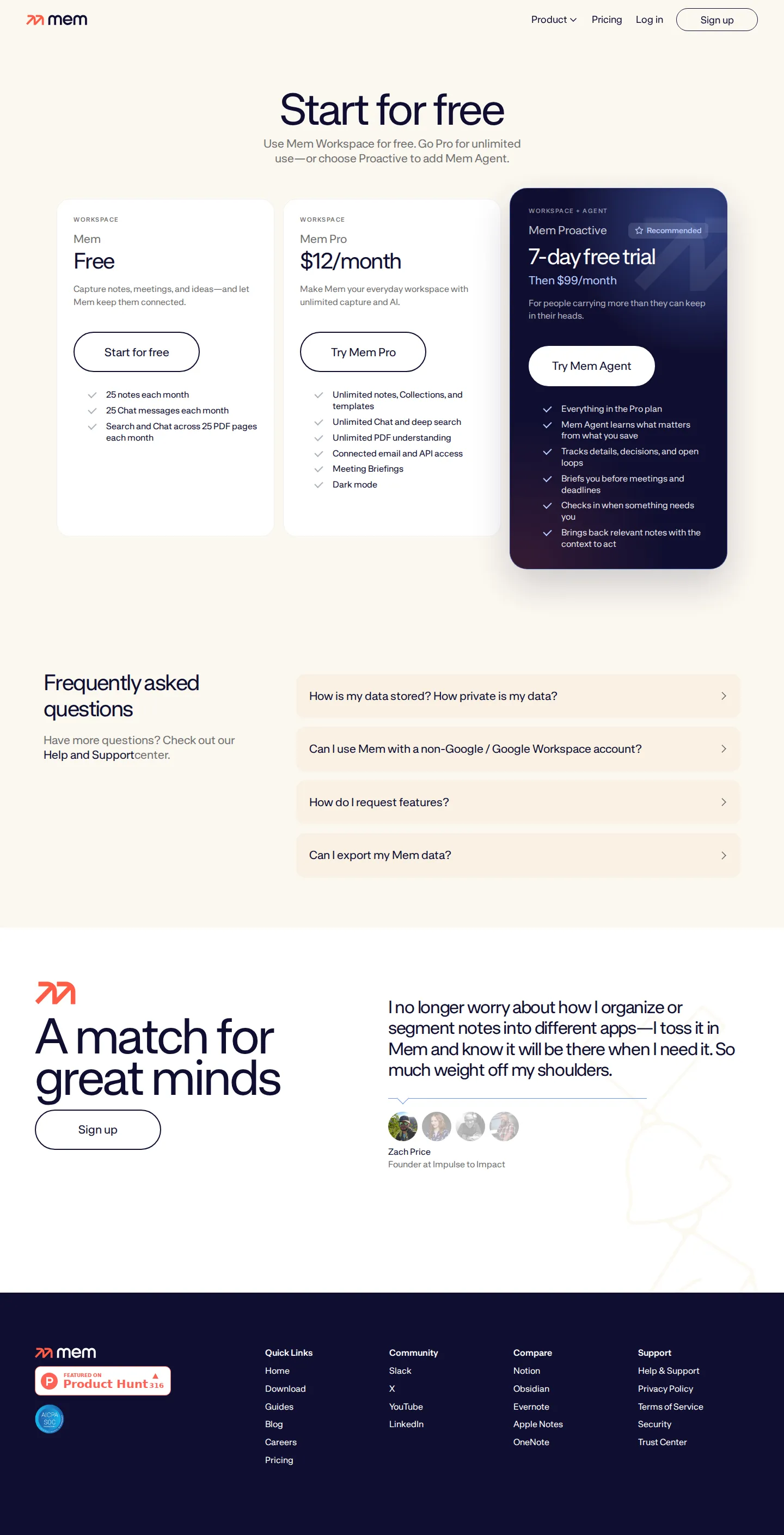
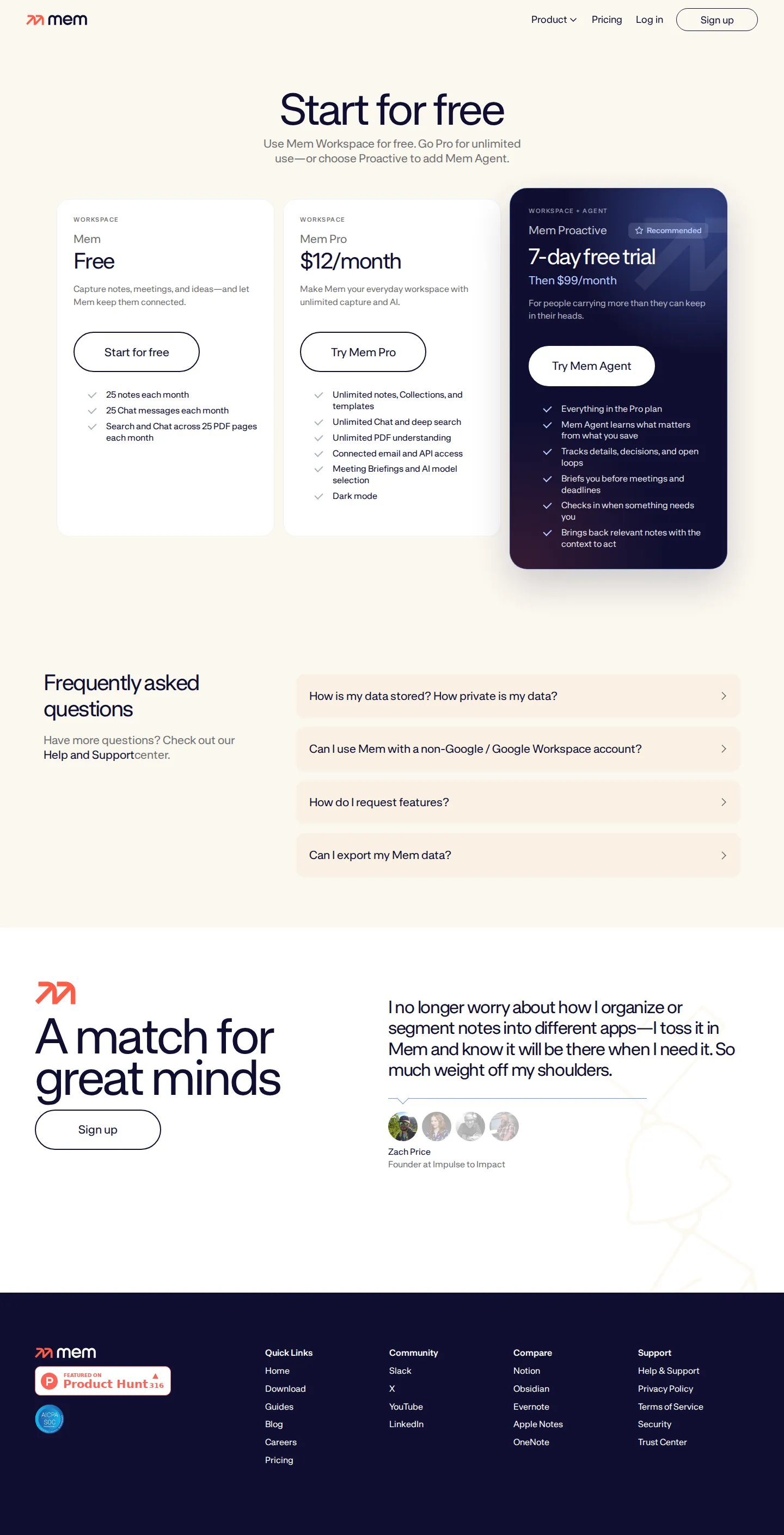
Mem's pricing page no longer lists AI model selection as an included Mem Pro feature — the plan now shows Meeting Briefings and Dark mode without it. Free ($0), Mem Pro ($12/mo), and Mem Proactive ($99/mo) prices are unchanged.
Mem Proactive ($99/mo) launches with the Mem Agent; Teams retired
Mem added a third tier — Mem Proactive at $99/month (7-day free trial) — bundling the new autonomous Mem Agent on top of everything in Pro. The earlier custom-quoted Mem Teams tier no longer appears on the pricing page. Free ($0) and Mem Pro ($12/mo) are unchanged.
Mem 2.0 pricing documented: Free / $12 Pro / custom Teams
Researched current Mem 2.0 pricing. Free tier capped at 25 notes/chats/PDF-pages per month; Mem Pro flat at $12/mo for unlimited use; Mem Teams custom-quoted. The legacy Mem X consumer tier (~$8-10/mo) was folded into Mem Pro at the 2.0 relaunch.
Blueprint stub created
Initial stub generated for batch blueprint expansion.
- · Mem's Series A was led by the OpenAI Startup Fund (~$23.5M, Nov 2022) — one of the fund's earliest bets on a consumer notes app, on top of a $5.6M a16z seed.
- · The Free plan's limits are unusually literal: exactly 25 notes, 25 chat messages, and 25 PDF pages understood per month — a hard, countable cap rather than a vague 'fair use' policy.
- · Mem Pro is a flat $12/month with no AI-usage meter, even though every note and chat runs through LLMs — Mem eats the inference cost rather than passing it through as tokens or credits.
Questions & answers
- What is Mem's pricing model?
- Mem uses a 7-tier metered subscription ladder: a $0 Free plan, then Mem Plus ($9/mo), Mem Pro ($29/mo), and Mem Pro 2×/5×/10×/20× scaling up to $199/month. Every tier caps monthly Messages to Mem, New Notes, Task and Project Tracking, Open Tasks and Projects, and Voice Mode hours, with higher tiers unlocking Custom Routines and Connections.
- Does Mem offer a free tier?
- Yes. Mem's Free plan is $0/month and includes 25 Messages to Mem, 25 New Notes, Task and Project Tracking across those 25 notes, 15 Open Tasks and Projects, and 3 hours of Voice Mode per month.
- How much does Mem cost per month?
- Mem runs from $0 (Free) to $199/month (Mem Pro 20×), with steps at $9 (Plus), $29 (Pro, marked Recommended), $49 (Pro 2×), $99 (Pro 5×), and $149 (Pro 10×). Mem Pro 20× subscribers can also add $50/month Extra Usage blocks.
- Is Mem pricing usage-based or subscription?
- It's a tiered subscription with usage caps on every plan — messages, notes, tracked tasks, and Voice Mode hours are all capped per tier rather than billed per unit. The one exception is Extra Usage, a genuinely metered $50/month add-on available only to Mem Pro 20× subscribers.