AI Summary
About
Milvus is the world’s most widely deployed open-source vector database, created by the engineers at Zilliz. The software is free under the Apache-2.0 license and is a graduated, top-level project of the Linux Foundation’s LF AI & Data Foundation — so the technology has no list price at all; self-hosters pay only for the compute, storage, and operational effort to run it.
Zilliz monetizes through Zilliz Cloud, the fully managed version of Milvus. This open-core split is the whole pricing story: the database is a commodity good given away to win developer mindshare, and the company captures revenue by removing the operational burden (cluster sizing, indexing, scaling, backups, compliance) of running vector search in production.
Zilliz raised a $60M Series B extension in August 2022 (on top of an earlier $43M), bringing total funding to roughly $113M, and relocated its headquarters to the San Francisco Bay Area to expand its engineering and go-to-market teams around the managed cloud.
As of July 2026 the managed offering is packaged as four project plans — Free, Standard, Enterprise and Business Critical — crossed with four deployment options: Serverless, Dedicated, the newly launched On-demand Compute (public preview, for lake-scale jobs on zero-copy external data), and BYOC.
For the most current information, visit Zilliz Cloud pricing and the Milvus project site.
Pricing summary : How Milvus’s pricing model works
There are two distinct cost worlds. Milvus OSS is free — your only costs are the cloud/server infrastructure and the engineering time to operate it. Zilliz Cloud (managed Milvus) is consumption-based and sold along two axes at once: a project plan (Free · Standard · Enterprise · Business Critical) that sets your support, SLA and security envelope, and a deployment option (Serverless · Dedicated · On-demand Compute · BYOC) that sets how compute is metered. Unit rates vary by plan, cloud region and cluster type.
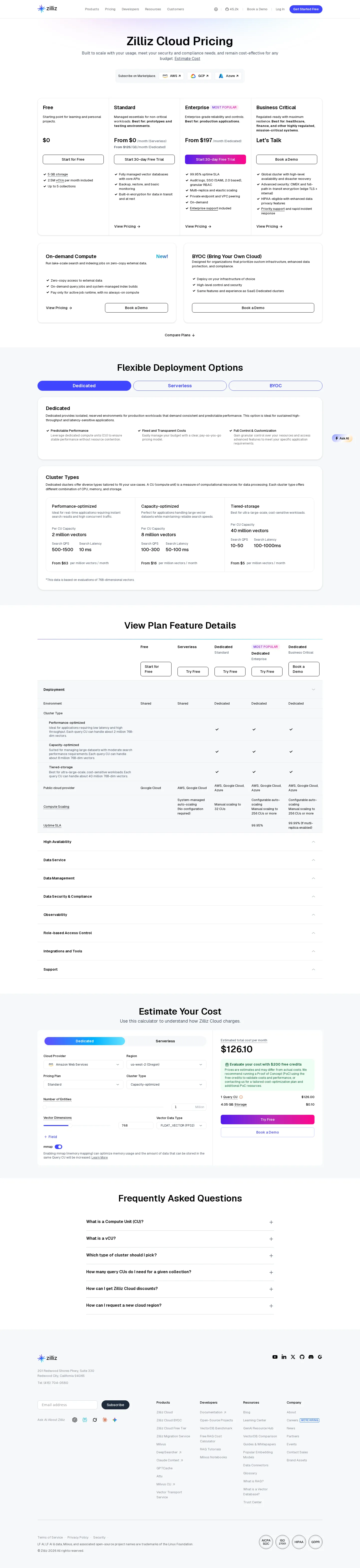
- Free — $0: 5 GB storage, 2.5M vCUs per month included, up to 5 collections, on a shared Google Cloud environment.
- Standard — From $0/month (Serverless) and From $126/GB/month (Dedicated) as shown on the pricing page. Fully managed vector databases with core APIs, backup/restore and basic monitoring, encryption in transit and at rest; manual scaling to 32 CUs. 30-day free trial.
- Enterprise (marked Most Popular) — From $197/month (Dedicated): 99.95% uptime SLA, audit logs, SSO (SAML 2.0), granular RBAC, multi-replica and elastic scaling, private endpoint and VPC peering, 24/7/365 support. 30-day free trial.
- Business Critical — “Let’s Talk” (sales-quoted): global cluster with DR, 99.99% uptime SLA with multi-replica, CMEK and full-path in-transit encryption, HIPAA-eligible, 30-minute emergency response.
- BYOC (Bring Your Own Cloud) — deploy in your own cloud account with the same features as SaaS Dedicated clusters; Book a Demo (no public price).
Metering by deployment option:
- Serverless — pay-per-operation, billed in virtual compute units (vCUs) at $4 per million vCUs for reads and writes, plus storage. Inserts cost 0.25 vCU per KB, deletes 1 vCU per entity, and each read costs a minimum of 6 vCUs, scaling with data scanned and returned. Idle compute is free; storage still bills.
- Dedicated — Query CU Unit Price × Total Query CUs × Cluster Runtime, billed hourly. The docs’ worked example prices an Enterprise-plan, performance-optimized cluster in AWS us-east-1 at $0.248/hour per CU. Suspended clusters stop CU charges but keep billing storage. Headline cluster-type rates on the pricing page: performance-optimized from $63, capacity-optimized from $16, tiered-storage from $5 — all per million vectors / month.
- On-demand Compute (public preview, badged New!) — usage-based Query CU plus Indexing CU, billed per minute of active job runtime with no always-on compute; the docs example uses $0.41 / CU / hour for both in AWS us-west-2 on the Enterprise plan.
- Storage — Storage Unit Price × Data Size × Duration, billed hourly (backups daily), rate set by region and cluster type; docs examples use $0.025/GB per month for a performance-optimized dedicated cluster and $0.04/GB per month for managed volume storage.
- Add-on lines — storage requests, data transfer and audit logs are separately metered.
What makes this different: Milvus separates the metering for writes (data volume inserted/deleted) from reads (query work + data scanned/returned), lets Serverless drop idle compute to zero, and now adds a per-minute On-demand Compute mode for lake-scale jobs over zero-copy external data — three different meters for three different workload shapes under one plan ladder.
Pricing by product
Milvus (open source)
| Product | Price | Included | Key mechanics |
|---|---|---|---|
| Milvus OSS | Free (Apache-2.0) | Full vector database | Self-hosted; you pay your own compute, storage and ops |
| Milvus tooling (Attu, Milvus CLI, DeepSearcher, GPTCache) | Free | Open-source companions | No list price; community-supported |
Zilliz Cloud (project plans)
| Plan | Price | Included | Key mechanics |
|---|---|---|---|
| Free | $0 | 5 GB storage, 2.5M vCUs per month included, up to 5 collections | Shared environment on Google Cloud; 1 organization / 1 project; community + support-bot only |
| Standard | From $0/month (Serverless); From $126/GB/month (Dedicated) | Fully managed vector DB with core APIs, backup/restore, basic monitoring, encryption in transit and at rest | Manual scaling to 32 CUs; business-hours support (4-hour urgent SLA); 30-day free trial |
| Enterprise (Most Popular) | From $197/month (Dedicated) | 99.95% uptime SLA, audit logs, SSO (SAML 2.0), granular RBAC, multi-replica, private endpoint and VPC peering | Configurable auto-scaling, manual scaling to 256 CUs or more; 24/7/365 support (1-hour urgent SLA); 30-day free trial |
| Business Critical | ”Let’s Talk” (sales-quoted) | Global cluster with DR, CMEK, full-path in-transit encryption, HIPAA-eligible, cross-region backup, PITR and data masking (demo-gated) | 99.99% uptime SLA with multi-replica; 30-minute emergency on-call response; assigned support engineers |
| BYOC (Bring Your Own Cloud) | “Book a Demo” | Deployment in your own cloud account | Same features and experience as SaaS Dedicated clusters |
Zilliz Cloud (metered usage)
| Meter | Price | Included | Key mechanics |
|---|---|---|---|
| Serverless vCUs | $4 per million vCUs | Reads and writes on shared infrastructure | Insert 0.25 vCU per KB; delete 1 vCU per entity; each read costs a minimum of 6 vCUs, growing with data scanned and returned; import/bulk insert is free |
| Dedicated Query CUs | Query CU unit price × total CUs × runtime (docs example: $0.248/hour per CU) | Reserved, isolated cluster capacity | Billed while Running/Modifying/Migrating; Suspended stops CU charges but not storage; replicas multiply CU count |
| Dedicated cluster types | Performance-optimized from $63; capacity-optimized from $16; tiered-storage from $5 (all per million vectors / month) | 2M / 8M / 40M vectors per CU respectively | QPS 500-1500 @ 10 ms · 100-300 @ 50-100 ms · 10-50 @ 100-1000ms, on 768-dim vectors |
| On-demand Compute (public preview) | Query CU + Indexing CU, docs example $0.41 / CU / hour | Lake-scale search and index builds on zero-copy external data | Billed per minute of active runtime; auto-suspends on inactivity; queue time and failed jobs not billed |
| Storage | Docs examples: $0.025/GB per month (dedicated cluster) and $0.04/GB per month (managed volume) | Cluster data, backups, volumes | Billed hourly (1-hour minimum); backups billed daily (1-day minimum); charged even while suspended |
| Storage requests · Data transfer · Audit logs | Separately metered add-on lines | — | Storage requests cover on-demand search, index builds and volume reads/writes; audit logs deploy an extra logging service |
Sales motions across products: PLG/self-serve for Milvus OSS, the Free plan, Serverless and Standard (30-day free trials, $200 free credits in the cost estimator, AWS/GCP/Azure Marketplace subscription); sales-led for Enterprise at scale, Business Critical and BYOC.
Hidden costs : What Milvus users actually pay
The real cost of Milvus depends almost entirely on whether you self-host or use the managed cloud:
- Self-hosted (OSS): the “free” software still costs you GPU/CPU instances, memory (HNSW indexes are memory-hungry), object storage, and — most underrated — engineering time. Community reports note teams running self-hosted Milvus for months before realizing ops cost more than a managed plan would have at their scale.
- Zilliz Cloud Serverless: the trap is read amplification — each read is a minimum of 6 vCUs and grows with data scanned and rows returned, so high query-per-second RAG workloads can run up vCU bills even with cheap storage.
- Storage and transfer: storage is now cheap — the docs’ worked examples price dedicated-cluster and backup storage at $0.025/GB per month (AWS us-east-1, performance-optimized) and managed volume storage at $0.04/GB per month — but data transfer and audit logs are separately billed line items, and Dedicated CU-hours accrue whether or not the cluster is queried.
| Line item | Typical driver |
|---|---|
| Compute (Serverless) | vCUs: reads (min 6 vCU each) + writes (0.25 vCU/KB insert) at $4/M vCUs |
| Compute (Dedicated) | CU-hours × per-CU rate (~$0.25/hr), 24×7 while running |
| Storage | $0.04/GB/month (post-Oct-2025) |
| Data transfer + audit logs | Billed separately when enabled |
| Self-host alternative | Cloud instances + EBS + engineering ops time |
Want to estimate your own Milvus / Zilliz Cloud bill? Use the Milvus pricing calculator to model costs from your read/write and storage patterns.
Pricing evolution : Milvus pricing history and changes
Cadence
| Period | Price changes | Product / SKU additions | Notes |
|---|---|---|---|
| 2023 | Tiered launch | Zilliz Cloud GA, Serverless | Free/Dedicated (~$99)/Serverless; ~$0.30/GB storage |
| 2024 | Model refinement | vCU metering matures | $4/M vCU pay-per-operation settles |
| 2025 Q4 | Major cut | Tiered storage, Business Critical | Storage −87% ($0.30→$0.04), compute −25% |
| 2026 Q1 | Standardization | — | $0.04/GB/mo unified across AWS/Azure/GCP |
| 2026 Q3 | Entry prices published | On-demand Compute (public preview) | Four-plan ladder gets list prices (Standard from $0/mo Serverless or $126/GB/mo Dedicated; Enterprise from $197/mo); Dedicated cluster-type headline rates published ($63 / $16 / $5 per million vectors/mo); third compute meter added |
Tracked range: 2023–present, reconstructed from Zilliz Cloud release notes, pricing-update posts and the live pricing page. Periods not listed above were verified stable (0 price changes, 0 SKU additions).
Notable changes
- 2023-06-11 — Zilliz Cloud reaches general availability with a tiered model (Free, Dedicated from ~$99/mo, Serverless) and consumption-based billing.
- 2024 — Serverless consolidates on a pay-per-operation model billed in vCUs ($4 per million), charging only for read/write operations plus storage.
- 2025-10 — Tiered storage rebuild cuts storage 87% ($0.30 → $0.04/GB/month), reduces compute pricing ~25%, and adds cross-region backups + a Business Critical plan for regulated industries.
- 2026-01-01 — Storage pricing standardized at $0.04/GB/month across AWS, Azure and Google Cloud.
- 2026-07-21 — The pricing page publishes entry prices for the paid plans for the first time in our tracking: Standard from $0/month (Serverless) or $126/GB/month (Dedicated), Enterprise from $197/month (Dedicated) with a Most Popular badge, and Business Critical as “Let’s Talk”. Dedicated cluster-type headline rates appear alongside them — performance-optimized from $63, capacity-optimized from $16, tiered-storage from $5, all per million 768-dim vectors per month. Nothing already published moved: Serverless stays at $4 per million vCUs (6-vCU read minimum), Dedicated at the docs’ $0.248/hour per CU, storage at $0.025–$0.04/GB/month, and the Free plan at 5 GB + 2.5M vCUs + 5 collections. This is packaging becoming legible, not a repricing.
- 2026-07-21 — On-demand Compute launches in public preview (badged New! on the pricing page): a third compute meter that bills Query CUs and Indexing CUs per minute of active job runtime for lake-scale search and system-managed index builds over zero-copy external data. Queue time and failed jobs are not billed, the minimum billing unit is one minute, and clusters auto-suspend on inactivity. The docs’ worked example prices both CU types at $0.41/CU/hour (AWS us-west-2, Enterprise plan) — roughly 65% above the $0.248/hour per-CU rate the Dedicated docs quote for an always-on cluster (different region, so not a like-for-like comparison, but the direction is clear). That gap is the price Zilliz puts on never provisioning capacity you don’t use.
What’s unique : Milvus’s distinctive pricing mechanics
1. Open-core, two-priced. The product literally has two prices: $0 for the OSS engine, and consumption-based for the managed cloud. The free software is the funnel; the managed cloud is the business.
2. Read/write split metering. Serverless meters writes by data volume (0.25 vCU/KB inserted, 1 vCU/delete) and reads by query work (minimum 6 vCUs, scaling with scan + rows returned) — a finer-grained value metric than the per-pod or per-vector models rivals use.
3. Zero-cost idle. Serverless charges nothing for idle compute — only storage — so a large but rarely-queried index is cheap to keep online. The October 2025 object-storage-backed tiered architecture (S3 with >90% local cache hit rates) is what makes the $0.04/GB storage line economically credible, and the July 2026 cluster-type rates put a number on the same trade — performance-optimized from $63, capacity-optimized from $16, tiered-storage from $5 per million vectors/month, a 12× spread bought entirely with latency. Compare how peers meter the same dimension on the vector storage pricing theme page.
4. Plan and deployment are priced on separate axes. Since July 2026 the page sells a support/SLA/security ladder (Free · Standard · Enterprise · Business Critical) and a metering mode (Serverless · Dedicated · On-demand Compute · BYOC), and the two multiply rather than nest. The same Dedicated cluster costs more on Enterprise than on Standard because the plan sets the CU unit price — so buyers are choosing a compliance envelope and a consumption curve in the same transaction, and an SSO or 99.95%-SLA requirement quietly reprices every CU-hour they will ever run.
5. A per-minute meter for job-shaped work. On-demand Compute (public preview) bills Query CUs and Indexing CUs by the minute of active runtime over zero-copy external data, with queue time and failed jobs excluded. It is a deliberate answer to the batch/analytical end of vector search — the workload that neither Serverless (per-operation, tuned for interactive reads) nor Dedicated (always-on, tuned for steady QPS) prices well — and it gives Zilliz three meters that map to three genuinely different workload shapes instead of one meter stretched across all of them.
Strengths & weaknesses
| Strengths | Weaknesses |
|---|---|
| Free OSS core removes vendor lock-in fear and seeds adoption | Self-hosting “free” software hides large ops/engineering costs |
| Genuinely usage-based: idle Serverless compute is free | vCU read metering (min 6 vCU/read) can surprise high-QPS RAG apps |
| Aggressive, transparent cuts (storage −87%, compute −25%) | Seven separately metered cost categories (on-demand CU-minutes, dedicated CU-hours, serverless vCUs, storage, storage requests, data transfer, audit logs) make forecasting hard |
| Generous free tier (5 GB, 2.5M vCUs) vs rivals (Pinecone 2 GB) | Dedicated CU-hours bill 24×7 whether queried or not |
| Every paid plan now carries a published entry price (July 2026) — Standard, Enterprise and the Dedicated cluster-type rates are all self-serviceable without a sales call | The two published Dedicated entry prices use different denominators ($126/GB/month for Standard vs $197/month for Enterprise), so the ladder can’t be compared at a glance |
| On-demand Compute prices batch/index jobs by the minute, with queue time and failed jobs excluded | On-demand rates are public preview and appear only as a docs worked example ($0.41/CU/hour), not on the pricing page itself |
Billing UX : Milvus billing controls and transparency
- Cost estimator on the pricing page — an “Estimate Your Cost” calculator with Dedicated / Serverless tabs, cloud provider, region, pricing plan, cluster type, number of entities, vector dimensions, data type and an mmap toggle; it returns an estimated monthly total broken into Query CU and storage lines (the captured default returns $126.10 = $126.00 Query CU + $0.10 storage for 1 CU and 4.05 GB).
- $200 free credits — the estimator offers “Evaluate your cost with $200 free credits” for running a proof of concept before committing.
- 30-day free trials — Standard and Enterprise both start from a “Start 30-day Free Trial” button; the Free plan requires no credit card (“Start for Free”).
- Marketplace subscriptions — “Subscribe on Marketplace” toggles for AWS, GCP and Azure; per the billing docs, credits and Advance Pay can combine with either a credit card or a Marketplace subscription, but not both payment channels at once.
- Billing & usage console pages — documented Payment and Billing Overview, Set Up / Update Payment Method, Billing Profile, Understand Invoices, Manage Invoices, Separate Billing on Marketplace, Failed Payments and Organization Recovery, plus Monitor Billing Alerts.
- Cost analysis tooling — the docs expose Analyze Cost and Cost Optimization guides, with cost broken out by category (on-demand compute, dedicated cluster, serverless cluster, storage, storage requests, data transfer, audit logs); indexing CU costs roll up by database rather than by job.
- Suspend to stop compute — suspending a Dedicated cluster halts vector-database (CU) charges while storage keeps billing until you delete the cluster; on-demand clusters auto-suspend on inactivity.
- Annual commitment discount — per the pricing FAQ, “when you commit to an annual plan, you can get additional credits based on your usage.”
Strategic wins : Why Milvus’s pricing decisions worked
1. Give away the engine, sell the operations
By open-sourcing Milvus under Apache-2.0 and donating it to the LF AI & Data Foundation, Zilliz turned the database into a default choice for AI builders, then monetized the part developers actually dislike — running it. This is the classic open-core play applied to vector search. See usage-based pricing strategy for the underlying frameworks.
2. Lead the price-down race in vector storage
The October 2025 87% storage cut and ~25% compute reduction were a deliberate move to stay ahead as vector-DB pricing compresses. Re-architecting onto object storage with a hot cache let Zilliz cut the price while improving margins — a structural win, not just a discount. Related: how AI companies structure pricing and outcome-based pricing trends.
3. Pick value metrics that match the workload
Splitting metering into write-volume (vCU/KB) and read-work (vCU/query) ties the bill to the actual value-producing operations rather than to provisioned capacity. See choosing the right usage metric.
4. Put an entry price on every paid plan, then badge the one you want bought
The July 2026 page turned an opaque rate card into a shoppable ladder: Standard from $0/month, Enterprise from $197/month with a Most Popular badge, Business Critical as “Let’s Talk”. For a consumption product this is harder than it looks — there is no natural “price” when everything is metered — and Zilliz solved it by quoting the cheapest real configuration rather than hiding behind “contact us”. The badge does the rest of the work: it anchors the buyer on the SLA/SSO tier before they have modelled a single CU-hour, which is exactly where a pure-usage pricing vendor wants the conversation to start.
5. Add a meter when a workload doesn’t fit, instead of bending an existing one
Lake-scale index builds and batch search are bursty, long-running and indifferent to latency — priced on Serverless they would detonate the 6-vCU read minimum; priced on Dedicated they would pay for 24×7 capacity to run for 30 minutes. Rather than discount around the mismatch, Zilliz shipped On-demand Compute with its own per-minute Query/Indexing CU meter and excluded queue time and failed jobs from the bill. Charging a premium per CU-hour for that elasticity is the honest trade, and it keeps the existing meters clean. See choosing the right usage metric and why AI companies are moving off per-user licenses.
Areas to improve : Gaps in Milvus’s pricing approach
1. vCU forecasting is hard
The minimum-6-vCU-per-read rule plus scan/return scaling makes Serverless bills tough to predict for query-heavy RAG. A clearer per-query cost estimator up front would reduce bill-shock risk. See bill shock and cost unpredictability.
2. Too many metered dimensions — and July 2026 added a seventh
The docs’ own cost breakdown now runs to seven categories: on-demand compute, dedicated cluster, serverless cluster, storage, storage requests, data transfer and audit logs. Adding On-demand Compute solved a real workload mismatch, but it also means a single project can now accrue per-minute CUs, per-hour CUs, per-operation vCUs and per-GB storage simultaneously, and indexing CU costs roll up by database rather than by job — so you cannot attribute a spike to the job that caused it. A per-job indexing breakdown in the Usage view, plus a bundled “all-in” line for smaller customers, would cut the cognitive cost of adoption.
3. The “free” trap for self-hosters
Marketing leans on “free and open-source,” but the total cost of self-hosting (memory-hungry indexes + ops) catches teams off guard. More honest TCO guidance vs. the managed cloud would build trust.
4. The published entry prices aren’t comparable to each other
Publishing list prices was the right call, but the two Dedicated entry points are quoted in different units — Standard “from $126/GB/month”, Enterprise “from $197/month” — so a buyer cannot tell from the page whether moving up the ladder doubles their bill or barely moves it. The page’s own estimator returns $126.00 for a single Query CU on a Standard capacity-optimized cluster, which suggests the $126 figure tracks a compute unit rather than a gigabyte. Quoting both plans on the same denominator (per CU per month, at a stated cluster type and region) would remove the ambiguity, and publishing the On-demand Query/Indexing CU rates on the pricing page — rather than leaving $0.41/CU/hour to a docs worked example — would let buyers price the preview meter before adopting it.
Monetization stack & signals : how Milvus builds & buys its revenue engine
Buys 1 Builds 0 5 open roles
Zilliz's only revenue-org hiring on its public Lever board is five Enterprise Account Executive reqs spread across the US (NY, Texas, SF Bay Area), the UK and South Korea — a geographic field-sales build-out for the enterprise tier of Zilliz Cloud, not a billing/RevOps platform team. No billing, metering, CPQ or customer-success engineering roles are open. The monetization stack is largely opaque: first-party docs confirm consumption metering (CU/vCU) and cloud-marketplace billing (AWS/GCP/Azure) as a payment channel, but name no underlying billing or metering vendor and disclose no in-house build, so the metering layer is recorded as unknown/inferred rather than asserted.
-
“Credits and Advance Pay can be used together with either a credit card or a Marketplace subscription. However, you cannot use a credit card and a Marketplace subscription at the same time. (Marketplace subscriptions are offered via AWS, Google Cloud and Microsoft.)”
-
“Serverless clusters in Zilliz Cloud use a pay-per-operation model, where you are mainly charged for the resources consumed by your read and write operations [billed in vCUs at $4 per million]; Dedicated clusters bill compute units (CUs) per hour — implying a usage-metering layer, though no vendor or in-house build is disclosed.”
- Enterprise Account Executive - EU (UK) Customer success Jun 16, 2026
- Enterprise Account Executive - New York Customer success Jun 16, 2026
- Enterprise Account Executive - Texas Customer success Jun 16, 2026
- Enterprise Account Executive - South Korea Customer success Jun 16, 2026
- Enterprise Account Executive - SF Bay Area Customer success Jun 16, 2026
Signals reviewed · derived from public job posts, product docs
Job postings fill and close over time — once a posting is filled we keep it as a dated citation (the quoted evidence remains); use View open roles for current listings.
Key takeaways
- Milvus is free; Zilliz Cloud is the product. Never conflate the OSS engine’s $0 license with the cost of running vector search in production.
- Usage-based done well rewards idle. Serverless charging nothing for idle compute is a genuine UBP feature, not a gimmick, and July 2026’s On-demand Compute extends the same promise to batch work by auto-suspending on inactivity and excluding queue time and failed jobs from the bill.
- Storage is racing to zero. The 87% storage cut shows vector-DB economics shifting from RAM-resident indexes to object-storage-backed tiers.
- One meter per workload shape beats one meter stretched thin. Zilliz now runs three compute meters — per-operation vCUs, per-hour CUs and per-minute on-demand CUs — because interactive, steady-state and batch vector workloads genuinely price differently; the cost is that a single project can hit all three at once, so invest in per-job attribution before you add the third meter, not after.
- Open-core seeds the funnel. Free OSS + a generous managed free tier is how Zilliz competes with closed rivals like Pinecone on adoption.
UBP implications
- Charge for value-producing operations, not provisioned capacity. Milvus’s vCU/CU-hour split is a clean example of metering reads and writes separately.
- Make idle free to win spiky workloads — and charge a premium for the elasticity. Zero-cost idle Serverless compute is a strong UBP differentiator for unpredictable AI traffic, and On-demand Compute takes it further by billing per minute of active job runtime with queue time and failures excluded. The docs’ $0.41/CU/hour on-demand example against $0.248/hour for an always-on Dedicated CU shows the honest version of that trade: buyers pay a higher unit rate precisely because they buy far fewer units.
- Re-architect to cut price and protect margin. The object-storage tiered redesign let Zilliz drop storage 87% without bleeding margin — pricing power follows architecture.
Sources
- Zilliz Cloud pricing (accessed 2026-07-21)
- Understand Cost — Zilliz Cloud docs (accessed 2026-07-21)
- Serverless Cluster Cost — Zilliz Cloud docs (accessed 2026-07-21)
- Dedicated Cluster Cost — Zilliz Cloud docs (accessed 2026-07-21)
- On-Demand Compute Cost — Zilliz Cloud docs (accessed 2026-07-21)
- Storage Cost — Zilliz Cloud docs (accessed 2026-07-21)
- Free Trials — Zilliz Cloud docs (accessed 2026-07-21)
- New in Zilliz Cloud: Tiered Storage, BC Plan, Pricing Changes (Oct 2025) (accessed 2026-06-09)
- Zilliz Cloud free tier (accessed 2026-06-09)
Bottom line
Milvus is the rare AI-infra entry whose core product is genuinely free: the open-source vector database carries no license cost, and Zilliz makes money by managing it. Zilliz Cloud’s pricing is real usage-based — vCUs for spiky Serverless workloads, CU-hours for steady Dedicated clusters, and since July 2026 per-minute Query and Indexing CUs for lake-scale batch jobs — with a generous free tier and an October 2025 re-architecture that cut storage 87% and compute ~25%. That same July 2026 update finally put entry prices on the ladder (Standard from $0/month Serverless or $126/GB/month Dedicated, Enterprise from $197/month, Business Critical quoted), which makes the offer shoppable without making it simple: seven metered cost categories, a per-read vCU minimum and two entry prices quoted in different units still make bills hard to forecast, and the “free” OSS path quietly bills you in engineering time. Browse the pricing blueprint for more fully-researched company profiles.
Want to compare Milvus against other vector databases like Pinecone, Weaviate, and Qdrant? Browse the pricing blueprint.
Pricing timeline : Major events on a vertical axis
Each milestone below corresponds to a public pricing change, product launch, or material adjustment. Major events use a filled marker; minor adjustments use a faded one.
Four-plan ladder published + On-demand Compute launches in public preview
The pricing page now publishes a Free / Standard / Enterprise / Business Critical plan ladder with entry prices (Standard from $0/month Serverless or $126/GB/month Dedicated; Enterprise from $197/month Dedicated), and adds On-demand Compute — a per-minute Query CU + Indexing CU meter for lake-scale search over zero-copy external data.
Storage pricing standardized across clouds
Storage standardized at $0.04/GB/month across AWS, Azure and Google Cloud.
Tiered storage, 87% storage price cut, Business Critical plan
New object-storage-backed tiered storage drops storage from $0.30 to $0.04/GB/month, compute pricing cut ~25%, plus cross-region backups and a Business Critical plan for regulated industries.
Serverless pay-per-operation model matures
Serverless clusters settle on a pay-per-operation model billed in vCUs ($4 per million vCUs), charging only for read/write operations plus storage; idle compute is free.
Zilliz Cloud GA + Serverless preview
Managed Milvus reaches general availability with tiered plans (Free, Dedicated from ~$99/mo, Serverless) and a consumption-based model; storage priced around $0.30/GB/month.
- · Milvus is a graduated, top-level project of the Linux Foundation's LF AI & Data Foundation — the software is free under Apache-2.0; you pay only the company (Zilliz) if you use the managed cloud.
- · Zilliz's October 2025 tiered-storage rebuild cut managed storage 87% — from $0.30 to $0.04 per GB/month — by keeping full datasets in object storage (S3) with local SSD/RAM as a >90%-hit cache.
- · Zilliz raised a $60M Series B extension in August 2022 (on top of an earlier $43M), bringing total funding to ~$113M, and relocated its HQ to the San Francisco Bay Area.
Questions & answers
- Is Milvus free?
- Yes. Milvus is open-source under Apache-2.0 and free to self-host — you only pay for the compute, storage, and ops to run it. The managed service, Zilliz Cloud, is the paid product and also has a free tier.
- How does Zilliz Cloud (managed Milvus) pricing work?
- You pick a project plan — Free ($0), Standard (from $0/month on Serverless, from $126/GB/month on Dedicated), Enterprise (from $197/month on Dedicated) or Business Critical (sales-quoted) — and a deployment option. Serverless bills per operation in virtual compute units (vCUs) at $4 per million; Dedicated bills Query CUs per hour; On-demand Compute bills Query and Indexing CUs per minute.
- What is Zilliz Cloud On-demand Compute and how is it billed?
- On-demand Compute is a Zilliz Cloud deployment option, launched in public preview in July 2026, that runs lake-scale search and index-building jobs over zero-copy external data. It bills Query CUs and Indexing CUs per minute of active job runtime — queue time and failed jobs are not billed, the minimum billing unit is one minute, and clusters auto-suspend on inactivity. The Zilliz docs' worked example prices both CU types at $0.41 per CU per hour on the Enterprise plan in AWS us-west-2.
- How much does Zilliz Cloud storage cost?
- Storage is priced by cloud region and cluster type and billed hourly. The Zilliz docs' worked examples use $0.025 per GB per month for a performance-optimized dedicated cluster in AWS us-east-1 and $0.04 per GB per month for managed volume storage. Storage keeps billing while a cluster is suspended.
- Is self-hosted Milvus cheaper than a managed vector database?
- It depends on scale and ops capacity. Practitioners report self-hosted Milvus undercutting managed services well above ~10M vectors, but the operational overhead is real — one user found they spent more on ops than a managed plan would have cost at low scale.