AI Summary
About
Modal is a New York-based serverless compute platform founded in September 2021 by Erik Bernhardsson (creator of Luigi and Annoy, ex-Spotify ML lead) and Akshat Bubna. The product is an opinionated Python-native serverless cloud: customers wrap functions with @app.function() decorators specifying GPU type, container image, memory, and concurrency, and Modal handles container build, image registry, scheduling, autoscaling, and per-second billing without exposing Kubernetes or infrastructure abstractions. The platform supports both interactive workloads (Jupyter, web endpoints) and batch jobs (training, batch inference, ETL).
By 2026 Modal serves Suno, Substack, Ramp, Notion, Anthropic (for select internal workloads), and roughly 1,000 paying customers spanning AI-native startups, academic research labs, and mid-market product engineering teams running Python data pipelines. The company raised a $16M Series A in February 2023 led by Redpoint with Lux Capital participation, followed by a Series B (reportedly $31M+) in mid-2024. The startup credit program grants up to $10,000 to qualifying companies — one of the most generous in the serverless GPU category.
Modal competes with RunPod, Replicate, Baseten (for AI inference), Lambda Labs, and serverless platforms like AWS Lambda + GPU options. Its differentiation is per-second billing granularity (finest in the category), Python-native developer ergonomics (@app.function() decorators rather than Docker + Kubernetes manifests), and a founder whose creation of widely-deployed open-source data tooling (Luigi, Annoy) gives the developer-experience pitch unusual credibility.
Pricing summary : How Modal’s per-second compute + plan-tier stack works
Modal runs a hybrid pricing model: pure-usage per-second compute (GPU, CPU, memory) plus flat monthly subscription fees that unlock concurrency limits, seat counts, and included credit grants. Starter is free with $30/month in compute credits, 3 workspace seats, 100 container concurrency, and 10 GPU concurrency — enough for evaluation and small production. Team is $250/month + compute with $100/month in credits, unlimited seats, 5,000 container concurrency, and 50 GPU concurrency. Enterprise is quote-based with volume discounts, dedicated capacity, VPC deployment, and AWS/GCP Marketplace billing.
The compute rate card is denominated per second across every SKU: T4 at $0.000164/sec, L4 at $0.000222, A10 at $0.000306, L40S at $0.000542, A100 40GB at $0.000583, A100 80GB at $0.000694, RTX PRO 6000 at $0.000842, H100 at $0.001097, H200 at $0.001261, B200 at $0.001736, and the newest B300 at $0.001972. CPU is $0.0000131/physical-core/sec (minimum 0.125 cores); memory is $0.00000222/GiB/sec; persistent volume storage is $0.09/GiB-month with 1 TiB/month free. This per-second granularity is two orders of magnitude finer than the per-minute industry standard.
Two per-second modifiers ride on top of the base rate card: region selection costs 1.5–1.75× base prices, and non-preemptible (guaranteed, non-interruptible) execution costs 3× base prices — both apply across Starter, Team, and Enterprise. Modal’s Sandbox + Notebooks product is metered separately at a higher rate: CPU at $0.00003942/physical-core/sec and memory at $0.00000667/GiB/sec (GPU follows the standard rate card), reflecting the burst-oriented, over-allocation-free profile of interactive sandbox and notebook workloads.
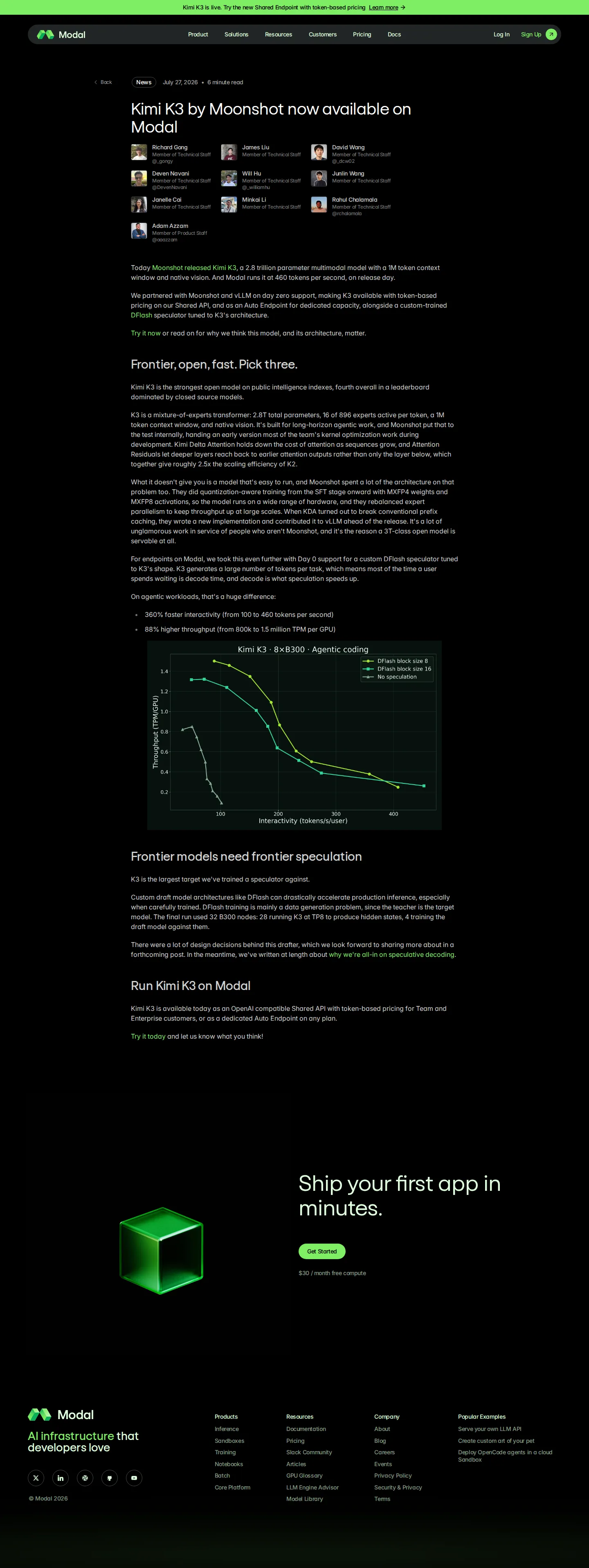
As of 2026-07-29, Modal added a fourth billing dimension: a Shared API, an OpenAI-compatible inference endpoint billed by token rather than by GPU-second, launched alongside hosting Moonshot’s Kimi K3 model. This runs in parallel with the per-second GPU rate card — customers can either run a model on dedicated GPU compute (per-second billing) or call it through the Shared API (token billing). As of 2026-08-14, Modal’s own announcement post narrowed the stated access: the Shared API (token-based pricing) is now advertised as available to Team and Enterprise customers only, while the same models remain reachable on any plan — including Starter — via a dedicated Auto Endpoint (per-second GPU billing). The post previously said Starter’s $30/month credit covered ongoing Shared API usage on the free tier; that language has since been removed. Modal has not yet published a per-token rate card on its public pricing page; exact per-million-token input/output prices are unknown pending a follow-up capture.
What makes this different: Modal is the only Python-native serverless platform where @app.function() decorators are the primary interface — there is no Docker file or Kubernetes manifest in the canonical workflow. For data scientists and ML engineers who write Python but not YAML, this developer-experience choice is materially better than alternatives — and the founder’s open-source pedigree (Luigi, Annoy) makes the experience pitch credible.
Pricing by product
Compute per second (the canonical SKU)
| Resource | Per-second rate |
|---|---|
| Nvidia T4 (16GB) | $0.000164 |
| Nvidia L4 (24GB) | $0.000222 |
| Nvidia A10 (24GB) | $0.000306 |
| Nvidia L40S (48GB) | $0.000542 |
| Nvidia A100 (40GB) | $0.000583 |
| Nvidia A100 (80GB) | $0.000694 |
| Nvidia RTX PRO 6000 | $0.000842 |
| Nvidia H100 (80GB) | $0.001097 |
| Nvidia H200 (141GB) | $0.001261 |
| Nvidia B200 | $0.001736 |
| Nvidia B300 | $0.001972 |
| CPU (physical core) | $0.0000131 (min 0.125 cores) |
| Memory | $0.00000222/GiB |
Per-second rate modifiers (apply on all plans): region selection is billed at 1.5–1.75× base prices; non-preemptible (guaranteed, non-interruptible) execution is billed at 3× base prices.
Sandbox + Notebooks (separately metered compute)
| Resource | Per-second rate |
|---|---|
| CPU (physical core) | $0.00003942 (min 0.125 cores) |
| Memory | $0.00000667/GiB |
| GPU | Standard per-second rate card (above) |
Shared API (token-based inference, new 2026-07-29)
| Resource | Rate |
|---|---|
| Per-token pricing (input/output) | Unknown — not yet published on modal.com/pricing |
| First model available | Kimi K3 (Moonshot), OpenAI-compatible endpoint |
| Plan access | Team and Enterprise only (as of 2026-08-14) |
| Auto Endpoint (dedicated per-second capacity, same models) | Available on any plan, including Starter |
This is a new, separately-billed surface (token-based, not per-second GPU) discovered via the pricing-page announcement banner on 2026-07-29. Modal’s own pricing page and billing docs do not yet itemize a rate card for it — see Modal blog. As of 2026-08-14, that same post narrowed the stated access from “covered by Modal’s standard $30/month free-compute offer” (implying all plans) to “Shared API with token-based pricing for Team and Enterprise customers” — Starter access to the Shared API specifically is no longer advertised; Starter retains access to the per-second Auto Endpoint.
Storage (persistent volumes)
| Resource | Rate |
|---|---|
| First 1 TiB/month | Free |
| Above 1 TiB | $0.09/GiB-month |
Plan tiers
| Tier | Monthly fee | Included credits | Seats | Container concurrency | GPU concurrency | Deployed apps | Log retention |
|---|---|---|---|---|---|---|---|
| Starter | $0 | $30/month | Up to 3 | 100 | 10 | 200 | 1 day |
| Team | $250 + compute | $100/month | Unlimited | 5,000 | 50 | 1,000 | 30 days |
| Enterprise | Custom | Custom | Unlimited | Custom | Custom | 1,000 | Custom |
Sales motions across products: PLG / self-serve for Starter and Team; sales-led for Enterprise commits, private-Slack support, and AWS/GCP marketplace billing.
Hidden costs : What Modal customers actually pay beyond the per-second rates
Archetype A: Solo developer on Starter running batch inference on H100
A solo developer running occasional H100 batch jobs (~30 minutes/day, scale-to-zero in between):
| Line item | Monthly cost |
|---|---|
| H100 compute (30 min/day × 30 × 60 × $0.001097) | $59 |
| CPU + memory overhead (1 core, 16 GiB, ~5% overhead) | $4 |
| Volume storage for model weights (50 GiB, under 1 TiB free) | $0 |
| Egress (small response payloads, negligible) | <$1 |
| Subtotal compute | $63 |
| Starter credit ($30/mo) | -$30 |
| Estimated total | ~$33/month |
The Starter $30 credit covers roughly half the bill for typical small batch workloads. Pure scale-to-zero on per-second granularity means a 5-minute idle period costs nothing — a meaningful advantage over per-minute or per-hour platforms.
Archetype B: Mid-market team on Team plan running mixed inference + training
A 20-person AI engineering team on Team plan running production inference (A100 80GB during business hours) plus weekly training (H100 cluster):
| Line item | Monthly cost |
|---|---|
| Team plan fee | $250 |
| A100 80GB inference (8h/day × 30 × 60 × 60 × $0.000694) | $360 |
| H100 training (4h/week × 4 × 60 × 60 × $0.001097) | $63 |
| CPU + memory for orchestration (~$20) | $20 |
| Storage (200 GiB models, under 1 TiB free) | $0 |
| Subtotal | $693 |
| Team credit ($100/mo) | -$100 |
| Estimated total | ~$593/month |
For sustained mid-market workloads, Team plan economics are reasonable — $250 plan fee covers seats and higher concurrency limits, $100 credit offsets ~13% of compute, and per-second billing keeps idle costs near zero. The fixed $250 plan fee is the main differentiator from pure pay-as-you-go competitors.
Want to estimate your own Modal bill? Use the Modal pricing calculator to model GPU seconds, CPU core-seconds, memory, and storage by workload profile.
Pricing evolution : Modal’s pricing history from Python serverless to multi-tier platform
Cadence
| Quarter | Price changes | Product / SKU additions | Notes |
|---|---|---|---|
| 2021 Q3 | 0 | 1 | Modal founded; closed beta |
| 2023 Q1 | 0 | 1 | Public beta + Series A ($16M) + per-second pricing |
| 2024 Q1 | 0 | 1 | Team plan launched at $250/mo + compute |
| 2024 Q2 | 1 | 0 | Series B + H100 per-second pricing published |
| 2025 Q1 | 0 | 1 | Persistent volumes + 1 TiB/mo free storage |
| 2025 Q3 | 0 | 1 | B200 + H200 + L40S per-second pricing added |
| 2025 Q4 | 0 | 0 | Startup credit program expanded to $10k |
| 2026 Q1 | 0 | 1 | AWS + GCP Marketplace billing for Enterprise |
| 2026 Q3 | 0 | 3 | B300 GPU + separately-metered Sandbox/Notebooks tier; region & non-preemptible modifiers itemized; Shared API (token-based inference) launched with Kimi K3, per-token rates not yet published; Team container concurrency raised 5x to 5,000 with feature itemization (2026-08-11); Shared API access narrowed to Team/Enterprise only, with Starter routed to the per-second Auto Endpoint instead (2026-08-14) |
Tracked range: 2021 Q3–2026 Q3. Quarters not listed above were verified stable (0 price changes, 0 SKU additions).
Notable changes
- 2023-02-15 — Public beta launch + Series A; established per-second CPU/GPU/memory billing as the canonical pricing model.
- 2024-01-22 — Team plan launched at $250/month + compute with $100/month in credits and higher concurrency limits.
- 2024-06-10 — Series B + H100 per-second pricing at $0.001097/sec ($3.95/hour) published as competitive differentiator.
- 2025-03-19 — Persistent volumes launched at $0.09/GiB-month with 1 TiB/month free; vertically integrated storage with compute.
- 2025-09-04 — B200, H200, L40S added at per-second rates; maintained per-second granularity across new generations.
- 2025-12-11 — Startup credit program expanded to $10,000 grants; most generous in the category.
- 2026-02-25 — AWS + GCP Marketplace billing added for Enterprise contracts.
- 2026-07-14 — B300 (Blackwell Ultra) added at $0.001972/sec as the new top-end SKU above B200, extending the per-second rate card to the latest Blackwell generation without breaking granularity. Two structural additions accompanied it: a separately-metered Sandbox + Notebooks compute tier (CPU $0.00003942/core/sec, memory $0.00000667/GiB/sec — roughly 3× the standard function rates, pricing the burst-oriented interactive profile explicitly), and the first on-page itemization of two per-second modifiers — region selection at 1.5–1.75× and non-preemptible (guaranteed) execution at 3× base prices. All existing GPU/CPU/memory/storage rates and plan fees ($0 / $250 / Custom) were unchanged, so the headline economics held while the rate card gained resolution.
- 2026-07-29 — Modal launched Shared API, an OpenAI-compatible inference endpoint billed by token rather than by GPU-second, going live first with Moonshot’s Kimi K3 model. This is the company’s first departure from pure per-second GPU/CPU/memory billing since founding — it runs alongside, not instead of, the existing rate card, and Starter’s $30/month free-credit grant applies to Shared API usage too. Per-token input/output rates were not yet published on modal.com/pricing as of this capture.
- 2026-08-11 — Team plan container concurrency raised 5x, from 1,000 to 5,000, with no change to the $250/month + compute plan fee. The pricing page also itemized previously-generic Team-tier features (custom domains, static IP proxy, deployment rollbacks, Environment-level budgets, RBAC) and clarified that private Slack support is Enterprise-only, with Team and Starter both on Community Slack.
- 2026-08-14 — Modal edited its Kimi K3 / Shared API announcement post to restrict the token-based Shared API to Team and Enterprise customers only, removing language that had implied Starter’s $30/month credit covered ongoing Shared API usage on any plan. Starter and other plans retain access to the same hosted models via a dedicated per-second Auto Endpoint; no per-second rates or plan fees changed.
What’s unique : Modal’s distinctive pricing mechanics
1. Per-second billing across every SKU (not just GPU). Modal bills GPU, CPU, and memory all per second — the finest billing granularity in any major cloud compute product. For bursty serverless workloads where containers spin up for 2–10 seconds and shut down, this granularity makes scale-to-zero economics genuinely cheap, in a way that per-minute or per-hour billing cannot match.
2. Python-decorator-as-deployment-API is the canonical interface. Most serverless platforms accept Docker images and Kubernetes manifests; Modal’s primary interface is @app.function(gpu="H100") in a Python file. For data scientists and ML engineers who write Python but not infrastructure-as-code, this is a meaningful developer-experience cost advantage — and the founder’s open-source pedigree (Luigi, Annoy) makes the experience pitch credible.
3. Subscription-plus-compute hybrid (Team $250/mo + compute). Most serverless GPU competitors offer pure pay-as-you-go. Modal’s Team plan adds a $250/month flat fee for seats, higher concurrency, Slack support, and $100 in compute credits. This subscription-plus-usage hybrid is unusual in the category and signals Modal’s bet that mid-market teams will pay for predictable plan economics even when usage is variable.
4. Generous startup credit program (up to $10k). Modal grants up to $10,000 in credits to qualifying startups and academic researchers — substantially more generous than competitors’ typical $30–$500 trial offers. This credit-led PLG strategy prioritizes long-term developer adoption over short-term revenue from evaluation traffic.
5. Vertical storage integration with free 1 TiB/month tier. Persistent volumes at $0.09/GiB-month with 1 TiB free per month absorb model-weight and dataset storage without forcing customers to S3. For ML workloads where checkpoints and datasets compose most storage, this bundling reduces vendor sprawl and simplifies developer workflow — at the cost of multi-cloud flexibility.
6. A second billing unit added alongside, not instead of, the first (2026-07-29) — then tiered by plan (2026-08-14). Modal’s new Shared API — an OpenAI-compatible endpoint billed by token, launched with Moonshot’s Kimi K3 — runs in parallel with the per-second GPU rate card rather than replacing it. Customers can choose dedicated per-second GPU capacity or shared per-token inference for supported models, which lets Modal compete for LLM-inference workloads that buyers evaluate against per-token vendors (OpenAI, Anthropic, Together) without giving up the per-second granularity that differentiates its dedicated-compute business. As of 2026-08-14, that choice is itself tiered: Modal narrowed Shared API access to Team and Enterprise customers, routing Starter and other plans to the same hosted models through the per-second Auto Endpoint instead — so the “pick your billing unit” pitch now fully applies only once a customer is paying for Team or above. The token rate card itself is still not public, so the structural move remains one whose buyer-facing economics can’t be judged until Modal publishes per-token prices.
Strengths & weaknesses
| Strengths | Weaknesses |
|---|---|
| Finest billing granularity in cloud compute (per second, every SKU) | Network egress and function invocation charges not itemized on pricing page |
| Python-decorator-as-deployment-API is the most opinionated DX in serverless GPU | Python-only orientation limits TAM for teams using Go, Rust, or polyglot stacks |
| Founder credibility from Luigi + Annoy open-source pedigree | Team plan $250/mo + compute is higher than pure pay-as-you-go competitors |
| Startup credit program (up to $10k) among most generous in category | Storage tier ($0.09/GiB-month) above free 1 TiB is roughly 4× S3 Standard pricing |
| Subscription-plus-usage hybrid (Team) captures predictable mid-market spend | Cold-start latency on infrequently-used containers (~3–8 seconds) |
| Free 1 TiB/month storage absorbs ML model weights without S3 | Concurrency limits gate scale-up — Team’s cap was raised 5x to 5,000 (2026-08-11), narrowing the gap for paying customers, but Starter is still capped at 100 and exceeding it requires a plan upgrade or commit |
| Region and non-preemptible rate multipliers now published on the pricing page (2026-07-14) | Headline per-second rates assume preemptible, in-default-region scheduling — guaranteed (non-preemptible) execution costs 3× base and region selection 1.5–1.75× |
| Shared API (2026-07-29) extends the platform to token-metered inference, matching how LLM-inference buyers benchmark cost elsewhere | Shared API per-token input/output rates were still unpublished as of 2026-08-14, and that same date narrowed access to Team and Enterprise only — Starter buyers can no longer evaluate or use the token-metered surface directly |
Billing UX : Modal’s account controls and payment experience
- Self-serve signup — Sign up at
modal.com/signupwith email or GitHub; Starter tier $30 credits applied automatically. No credit card required to deploy first function. - Real-time per-second cost meter — Console shows per-function per-container cost in real time; each task has a live cost projection.
- Workspace and project organization — Workspace-level usage aggregation; per-environment (dev / staging / prod) separation supported.
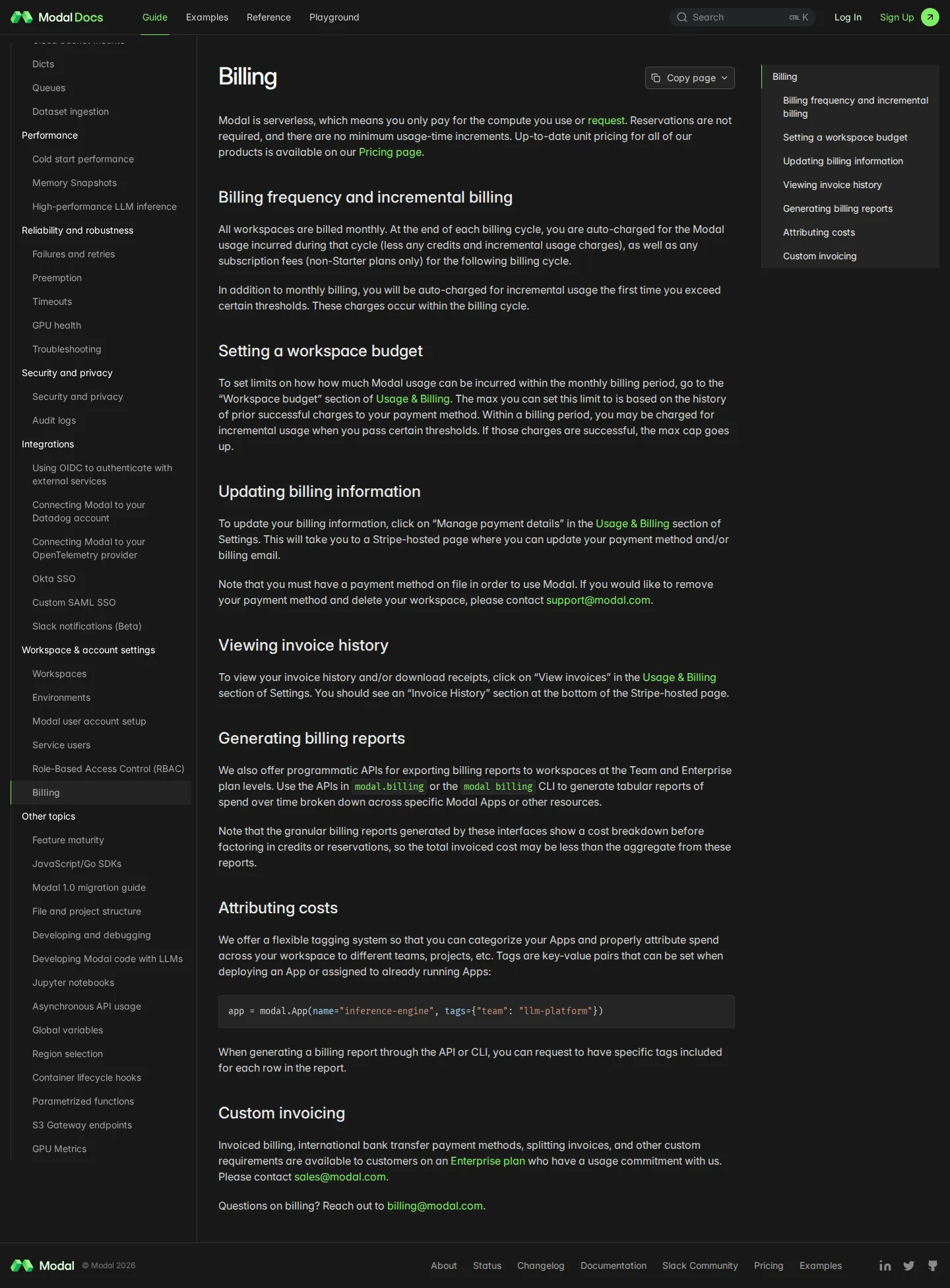
- Workspace- and Environment-level budgets — Spend budgets configurable at both the Workspace and per-Environment (dev / staging / prod) level; incremental usage is auto-charged the first time certain thresholds are exceeded within a cycle.
- Programmatic billing reports (Team & Enterprise) —
modal.billingAPIs and themodal billingCLI export tabular spend-over-time reports broken down by App or resource (pre-credit / pre-reservation figures). - Cost-attribution tags — Key-value tags on Apps (
tags={"team": "llm-platform"}) let spend be allocated across teams and projects in billing reports. - Payment methods — Stripe-hosted payment management (card / ACH) on Starter and Team; invoiced billing, international bank transfer, and split invoices available to Enterprise customers with a usage commitment; AWS/GCP Marketplace committed-spend billing on Enterprise.
- Credit grants — Startup and academic credit grants up to $10k applied to workspace balance; offset against compute, storage, and Team plan fees.
- Annual commit pricing — Enterprise customers receive volume discounts in exchange for annual usage commitments and dedicated capacity reservations.
- Audit logging + RBAC — Workspace-level RBAC on Team+; SOC 2 audit-log exports on Enterprise.
- Multi-region availability — US standard; EU and APAC regions on Enterprise with VPC deployment.
Strategic wins : Why Modal’s pricing decisions worked
1. Per-second billing granularity as the structural cost moat
By billing GPU, CPU, and memory per second rather than per minute or hour, Modal made scale-to-zero economics genuinely cheap — and forced competitors to either match the granularity or accept the comparison gap. For bursty serverless workloads, the unit-economics advantage is real and reproducible. Most legacy cloud platforms cannot match per-second billing without re-architecting their metering infrastructure.
2. Python-decorator-as-deployment-API removed the YAML / Docker friction barrier
Most serverless platforms require Dockerfile + Kubernetes manifests; Modal’s @app.function() decorator hides the infrastructure entirely. For data scientists and ML engineers — Modal’s primary target persona — this is a meaningful productivity gain. The fact that Erik Bernhardsson created Luigi and Annoy makes the developer-experience promise credible in a way that pure-marketing positioning cannot replicate.
3. Generous startup credit program as the developer-led GTM engine
The up-to-$10k startup credit grants signal Modal’s bet on long-term developer adoption over short-term revenue from evaluation traffic. AI-native startups that build their initial product on Modal-funded compute tend to stay on Modal at scale — a classic PLG flywheel that competitors with smaller trial credits cannot match.
4. Team plan ($250/mo + compute) captures predictable mid-market revenue
Most serverless GPU competitors are pure pay-as-you-go, leaving predictable revenue uncaptured. The Team plan flat fee covers seats, concurrency, and Slack support — capturing customers who value predictability even at variable usage. This hybrid pricing is also a leading indicator of mature mid-market product-market fit.
5. Shared API optionality hedges against per-second billing being a mismatch for token-native workloads
Launched 2026-07-29, the token-metered Shared API runs alongside — not instead of — the per-second GPU rate card. Most LLM-inference buyers benchmark cost against per-token vendors (OpenAI, Anthropic, Together), not per-second GPU rate cards; by adding a token-metered surface rather than forcing buyers to convert units, Modal removes a comparison-shopping barrier for supported hosted models while preserving per-second granularity for customers who want dedicated capacity control. Pairing rather than replacing the existing meter is the safer sequencing choice for a company whose core differentiator is per-second billing. Narrowing Shared API access to Team and Enterprise on 2026-08-14 reinforces the same tiering logic: rather than diluting free-tier trial economics with an unmetered new surface, Modal reserved the token-based option as a genuine Team-tier differentiator — consistent with the Team plan’s role as the platform’s predictable-revenue mid-tier (see win #4).
Areas to improve : Gaps in Modal’s pricing approach
1. Egress and function-invocation charges are still not itemized
The pricing page lists compute, memory, and storage rates but not network egress or per-function-invocation charges. Modal moved in the right direction on 2026-07-14 by itemizing the region (1.5–1.75×) and non-preemptible (3×) rate modifiers that had previously been implicit — a genuine transparency step that turned two hidden multipliers into published line items. But egress and per-invocation costs remain the largest un-itemized items on the page, so for high-volume customers the residual opacity still creates bill-shock risk and erodes the per-second transparency advantage. Publishing egress rates (even at a “first X GB/month free, then $Y/GB” structure) would close the remaining transparency gap versus AWS, GCP, and Azure rate cards.
2. Python-only orientation limits TAM
The @app.function() decorator pattern is Python-only. Teams using Go, Rust, or polyglot stacks cannot use Modal as their primary serverless platform. Adding a generic container interface (with Docker images as input, similar to RunPod and Replicate) would broaden TAM without abandoning the Python-native DX as the canonical path.
3. Storage above 1 TiB is expensive relative to S3
At $0.09/GiB-month, Modal’s storage tier is roughly 4× S3 Standard. For ML workloads with multi-TiB dataset storage, customers will need to either offload to S3 (introducing the vendor sprawl Modal’s free 1 TiB was designed to prevent) or accept significantly higher storage spend. A tiered storage rate (cheaper for archival, premium for hot) would close the cost gap.
4. Concurrency limits create scale-up friction
Starter caps at 100 container concurrency / 10 GPU concurrency; Team at 1,000 / 50. Customers hitting these limits during burst events face either degraded service or a plan-upgrade scramble. Soft caps with overage billing (rather than hard caps with service throttling) would smooth the scale-up experience and reduce churn at the boundary.
5. Shared API rate card is unpublished, and its access terms changed without a visible notice
Modal announced token-based pricing for the Shared API on 2026-07-29 without publishing per-token input/output rates on its pricing page or billing docs — that gap was still open as of 2026-08-14. Compounding it, the same announcement post was edited on 2026-08-14 to restrict access to Team and Enterprise, removing language that had implied Starter’s $30/month credit covered ongoing Shared API usage — with no dated “Updated” marker or changelog entry on the post itself. Until per-token rates appear, buyers evaluating Kimi K3 (or future Shared API models) against per-token competitors have no way to run the comparison; and until access-term edits are visibly dated, a buyer who read the original post has no way to know the terms changed under them. Publishing the rate card promptly and adding a visible revision marker (or a dedicated changelog entry) to pricing-adjacent blog posts whenever their terms change would close both gaps before they erode trust in Modal’s pricing-transparency reputation.
Monetization stack & signals : how Modal builds & buys its revenue engine
Buys 2 Builds 1 1 signal role
Modal buys its analytics warehouse (Snowflake + dbt, confirmed on its own eng blog) while the GPU-cost instrumentation behind its per-second pricing stays in-house — fitting for a serverless GPU vendor whose gross margin IS its own fleet utilization. The signal worth watching is the Business Operations hire below: a self-serve/PLG company spinning up its first deal desk plus a dedicated pricing-and-packaging analytics function is the canonical sales-led-onto-self-serve-core inflection.
-
“At Modal, we have our own GPU utilization challenges to solve and we help our users solve theirs — an educational guide; an internal cost/metering system is implied by the fleet-margin model, not disclosed as a named build.”
-
“one of our most important data loading use cases is copying our production read replica Postgres instance to Snowflake, our data warehouse.”
-
“After our data has been loaded into Snowflake, we still need to transform it to make it analysis ready. dbt is the de facto standard for this — Modal's own transformation layer over Snowflake.”
-
“Hands-on experience with QuickBooks, NetSuite, Ramp, and other systems — Controller JD (named in a candidate-skills basket alongside QuickBooks; not confirmed as Modal's operated GL).”
- Metering Metering inferred
-
Modal's pure-PLG self-serve core is acquiring a sales-led spine: one BizOps generalist owns BOTH the pricing-and-packaging analytics and standing up the first deal desk — the textbook inflection where a usage-billed product layers negotiated enterprise contracts onto its self-serve meter.
“Drive in-depth quantitative analyses to inform our pricing and packaging strategy. Help spin up our deal desk and streamline enterprise deals.”
3 more matched roles — supporting evidence
- Member of Technical Staff - Product (Growth) Growth seen May 18, 2026
- VP, Finance RevOps seen Feb 24, 2026
- Controller RevOps seen Sep 19, 2025
Signals reviewed · derived from public job posts, engineering blogs
Job postings fill and close over time — once a posting is filled we keep it as a dated citation (the quoted evidence remains); use View open roles for current listings.
Key takeaways
-
Per-second billing granularity is a structural cost moat that legacy clouds cannot match. Modal’s decision to bill GPU, CPU, and memory per second forced a category-wide expectation shift — competitors now have to either match or justify per-minute / per-hour billing. For usage-based platforms where scale-to-zero is a marketing claim, billing granularity must match the claim.
-
Founder open-source pedigree is the most credible developer-experience trust anchor. Erik Bernhardsson’s authorship of Luigi and Annoy gives the Python-native DX promise weight that pure-engineering teams cannot replicate. Infrastructure commercializations targeting developer audiences should consider founder open-source visibility as a structural advantage.
-
Subscription-plus-usage hybrids capture predictable mid-market revenue. The Team plan ($250/mo + compute) is unusual among serverless GPU competitors and likely reflects mature mid-market product-market fit. Other usage-based platforms considering subscription components should look at Modal’s Team economics as a reference.
-
Generous startup credit programs are PLG levers, not lost revenue. Modal’s up-to-$10k credit grants signal long-term thinking: AI-native startups that build on Modal-funded compute tend to stay at scale. Trial credit generosity is a strategic GTM choice, not just a marketing line item.
-
Vertical bundling (storage with compute) simplifies developer experience at the cost of multi-cloud flexibility. Modal’s free 1 TiB/month storage absorbs ML model weights and reduces S3 dependence — a developer-experience win that comes at the cost of locking customers into Modal’s storage economics. For value-metric design, the bundling trade-off is structural.
UBP implications
-
Per-second billing is becoming the new transparency floor for serverless compute. Per-minute or per-hour billing is increasingly perceived as legacy-cloud opacity. New usage-based platforms entering serverless GPU should default to per-second granularity as a baseline expectation.
-
Subscription-plus-usage hybrids capture revenue that pure pay-as-you-go leaves on the table. Mid-market customers value predictable plan economics even when usage is variable; the Modal Team plan demonstrates the segment exists. Other usage-based platforms should consider hybrid SKUs for the predictable-spend mid-market.
-
Hybrid billing-unit strategies let infrastructure vendors meet buyers on their preferred meter without abandoning a structural differentiator — and can double as a packaging lever. Modal’s 2026-07-29 Shared API (token-metered, running alongside per-second GPU billing) adds a second billing unit rather than replacing the first: buyers who benchmark against per-token LLM APIs get a comparable meter for supported models, while dedicated-capacity buyers keep the per-second granularity that differentiates Modal’s core product. When the new unit is then gated by plan tier — as Modal did on 2026-08-14, restricting Shared API’s token-based pricing to Team and Enterprise — the pluralized-metric move stops being purely a buyer-preference accommodation and becomes a paid-tier differentiator too. Usage-based platforms serving heterogeneous buyer segments should treat the value metric as pluralizable, not singular, and decide deliberately whether each unit is universal or a monetization lever.
Sources
- Modal pricing page (accessed 2026-05-30)
- Modal docs — billing (accessed 2026-05-30)
- Modal blog — Series B announcement (accessed 2026-05-29)
- Modal blog — Kimi K3 / Shared API announcement (accessed 2026-08-14)
- Modal startup credit program (accessed 2026-05-29)
- Erik Bernhardsson — Luigi and Annoy author (accessed 2026-05-29)
- Related infra blueprint — Baseten
- Related infra blueprint — Replicate
- Blueprint corpus index
Bottom line
Modal priced its serverless compute platform around three structural ideas: per-second billing granularity (finest in the category, GPU + CPU + memory) that makes scale-to-zero economics genuinely cheap, Python-decorator-as-deployment-API (@app.function(gpu="H100")) as the canonical interface for data scientists and ML engineers who write Python but not YAML, and founder credibility from Erik Bernhardsson’s open-source pedigree (Luigi, Annoy) that makes the developer-experience promise believable. The subscription-plus-usage hybrid (Team plan at $250/mo + compute) captures predictable mid-market revenue, and the up-to-$10k startup credit grant program drives long-term developer adoption.
For AI-native engineering teams that prioritize Python developer experience and per-second cost transparency over multi-cloud flexibility, Modal is the most ergonomic serverless GPU platform on the market. The remaining gaps (egress not itemized, Python-only orientation, storage above 1 TiB expensive, concurrency hard-caps) are TAM-expansion and transparency-polish problems rather than structural pricing flaws. The 2026-07-29 Shared API launch adds a first hedge against being locked into a single billing unit, pairing token-metered inference with the per-second core rather than replacing it — though with per-token rates still unpublished, that hedge is directional today, not yet something a buyer can price. As of 2026-08-14, the hedge is also tiered: Team and Enterprise get the token-metered option, while Starter and other plans reach the same models only through the per-second Auto Endpoint — making Shared API as much a Team-tier upsell lever as a cross-metric hedge, on top of the already-real 2026-08-11 win of a 5x Team concurrency increase at no added cost.
Compare with peers via the blueprint corpus, or model your own spend with the Modal pricing calculator.
Pricing timeline : Major events on a vertical axis
Each milestone below corresponds to a public pricing change, product launch, or material adjustment. Major events use a filled marker; minor adjustments use a faded one.
Shared API Access Narrowed to Team and Enterprise
Modal edited its Kimi K3 / Shared API announcement post to restrict the token-based Shared API to Team and Enterprise customers only, removing earlier language that had implied Starter's $30/month credit covered ongoing Shared API usage on any plan. Starter and other plans keep access to the same hosted models via a dedicated per-second Auto Endpoint instead; no per-second rates or plan fees changed.
Team Plan Container Concurrency Raised 5x to 5,000
Modal raised Team plan container concurrency from 1,000 to 5,000 — a 5x increase — with no change to the $250/month + compute plan fee. The pricing page also itemized previously-generic Team-tier features (custom domains, static IP proxy, deployment rollbacks, Environment- level budgets, RBAC) and clarified that private Slack support is Enterprise-only; Team and Starter both get Community Slack access.

Shared API Launched — Token-Based Pricing Alongside Per-Second GPU
Modal launched an OpenAI-compatible Shared API metered by token rather than by GPU-second, going live first with Moonshot's Kimi K3 model. The Shared API runs in parallel with — not instead of — the existing per-second GPU/CPU/memory rate card, and Starter's $30/month free credit grant applies to Shared API usage too. This is Modal's first departure from pure per-second compute billing since founding; per-token input/output rates were not yet published on modal.com/pricing as of this capture.

B300 GPU + Sandbox/Notebooks Pricing + Rate Modifiers
Modal added the NVIDIA B300 (Blackwell Ultra) at $0.001972/sec — its new top-end GPU SKU above the B200 ($0.001736/sec). A separately-metered Sandbox + Notebooks compute tier appeared at $0.00003942/core/sec CPU and $0.00000667/GiB/sec memory (roughly 3× the standard function rates, reflecting burst-oriented interactive workloads). The pricing page also now itemizes two per-second modifiers: region selection at 1.5–1.75× base prices and non-preemptible (guaranteed) execution at 3× base prices. All existing GPU, CPU, memory, storage rates and plan fees ($0 / $250 / Custom) were unchanged.

AWS + GCP Marketplace Billing for Enterprise
Modal added support for AWS Marketplace and GCP Marketplace billing on Enterprise contracts, letting customers consume Modal spend through existing cloud-provider committed-spend agreements. Reduces procurement friction for Fortune-500 buyers with EDP or CUD agreements.
Startup Credit Program Expanded to $10k
Modal expanded its startup credit grant program to up to $10,000 in credits for qualifying companies and academic researchers. Established Modal as the most generous credit-grant program among serverless GPU competitors, reflecting developer-led GTM emphasis.
B200 + H200 + L40S Added at Per-Second Rates
Modal added NVIDIA B200 (180GB) at $0.001736/sec, H200 (141GB) at $0.001261/sec, and L40S (48GB) at $0.000542/sec. The Blackwell-class addition came alongside continued per-second billing rather than per-hour, preserving granularity advantage at the high end.
Persistent Volumes + 1 TiB/mo Free Storage
Modal launched persistent volumes at $0.09/GiB-month with 1 TiB/month free. The free tier absorbed model-weight storage for most production workloads, vertically integrating storage with compute. Eliminated S3-dependence for many use cases.
Series B + H100 Per-Second Pricing
Modal raised a $31M+ Series B (reportedly led by Lux Capital with Redpoint and others) and published H100 per-second pricing at $0.001097/sec — roughly $3.95/hour, undercutting major competitors' on-demand H100 rates. Per-second granularity emphasized as a competitive differentiator.
Team Plan Launched at $250/mo + Compute
Modal introduced its Team plan at $250/month plus compute, with $100/month in included credits. The plan added unlimited workspace seats, 1,000 container concurrency, and 50 GPU concurrency — bridging the gap between free Starter and quote-based Enterprise tiers.
Public Beta + Series A ($16M)
Modal went into public beta and raised a $16M Series A led by Redpoint Ventures. Pricing model established: per-second CPU, GPU, and memory billing with a free tier of $30/month credits. Positioned as the developer-experience leader in serverless compute.
Modal Founded
Erik Bernhardsson (creator of Luigi and Annoy, ex-Spotify ML) and Akshat Bubna founded Modal Labs to build serverless infrastructure for Python data and ML workloads. Initial closed beta launched with the @app.function() decorator pattern as the canonical interface.
- · Modal's per-second billing granularity ($0.001097/sec on H100) means a 5-second cold start costs $0.0055 — among the finest billing granularity in any cloud compute product, two orders of magnitude finer than the per-minute industry standard.
- · Modal was founded in 2021 by Erik Bernhardsson (ex-Spotify ML, creator of Luigi and Annoy) — making it one of the few infrastructure platforms where the founder is the primary author of widely-deployed open-source data tooling, lending unusual credibility to the developer-experience pitch.
- · Modal grants up to $10,000 in credits to qualifying startups and academic researchers — one of the most generous credit programs in cloud compute, reflecting the founder's bet on developer-led GTM rather than enterprise sales-led growth.
Questions & answers
- How much does Modal cost per month?
- Modal's Starter tier is free with $30/month in compute credits, plus pay-as-you-go above that. Team plan is $250/month + compute (with $100/month in credits). A typical mid-volume workload running an A100 80GB ($0.000694/sec) for 4 hours/day would cost about $300/month in compute on top of the plan fee.
- What compute rates does Modal publish?
- Modal publishes per-second rates for GPU, CPU, and memory: T4 $0.000164, L4 $0.000222, A10 $0.000306, L40S $0.000542, A100 40GB $0.000583, A100 80GB $0.000694, RTX PRO 6000 $0.000842, H100 $0.001097, H200 $0.001261, B200 $0.001736, B300 $0.001972 per second; CPU is $0.0000131 per physical core per second (minimum 0.125 cores); memory is $0.00000222 per GiB per second. All bill per second of active use — idle containers cost only memory and storage. Region selection adds 1.5–1.75× and non-preemptible execution 3× on top of base rates.
- What does Modal include in the free Starter tier?
- Starter is free with $30/month in compute credits, 3 workspace seats, 100 container concurrency, and 10 GPU concurrency. Credits cover roughly 27 hours of T4 or 7.5 hours of H100. Sufficient for evaluation and small-scale production; no credit card required.
- Does Modal offer startup credits?
- Yes — qualifying startups and academic researchers can receive up to $10,000 in Modal credits. Application is via Modal's startup program; eligibility typically requires early-stage status, ML/AI focus, or academic affiliation. Among the most generous credit grants in serverless GPU.
- How does Modal Team plan differ from Enterprise?
- Team ($250/mo + compute, $100/mo credits) offers unlimited seats, 5,000 container concurrency, 50 GPU concurrency, and standard compliance (SOC 2). Enterprise is quote-based and adds custom volume discounts, dedicated capacity reservations, advanced security (audit logs, RBAC), VPC deployment, and marketplace billing via AWS/GCP.
- Does Modal offer token-based pricing?
- Yes — Modal's Shared API is an OpenAI-compatible endpoint billed by token rather than by GPU-second, launched July 29, 2026 alongside hosting Moonshot's Kimi K3 model. It runs alongside (not instead of) Modal's per-second GPU/CPU/memory rate card. As of August 2026, Shared API access is advertised for Team and Enterprise customers only; Starter and other plans can still reach the same models via a dedicated Auto Endpoint on per-second GPU billing. Modal has not yet published per-token input/output rates.