AI Summary
About
Mosaic AI is not a standalone company — it is the generative-AI and machine-learning layer of Databricks, the data-and-AI platform company. The technology traces back to MosaicML, the startup behind the MPT open-weight models and a high-efficiency training stack, which Databricks acquired in July 2023 for roughly $1.3B. Databricks folded that team and product into its Lakehouse / Data Intelligence Platform and now markets the combined GenAI tooling as Mosaic AI.
In practice, Mosaic AI is an umbrella over a set of surfaces — Foundation Model APIs (pay-per-token access to open models), Model Serving (real-time and provisioned-throughput endpoints), Vector Search (AI Search), Agent Bricks / Agent Evaluation, AI Functions, and Model Training / fine-tuning — all sitting on top of the same governed lakehouse and, crucially, all billed the same way as everything else on Databricks: in DBUs (Databricks Units).
Databricks itself is one of the largest private data-and-AI companies in the world, with multi-billion-dollar revenue and a valuation reported above 60B (USD). Because Mosaic AI is sold as a consumption line within that platform rather than a separate product with its own plans, its pricing is fully public on Databricks’ rate card. For current pricing, see Databricks’ pricing page.
Pricing summary : How Mosaic AI’s pricing model works
Mosaic AI is pure consumption-based: there are no per-seat plans and no monthly subscription. You pay for the DBUs each surface consumes, metered per second, with no up-front cost. The DBU is Databricks’ normalized unit of processing; the Artificial Intelligence (Mosaic AI) line lists at $0.07/DBU (US East serving reference), the lowest of Databricks’ per-DBU workloads. A critical wrinkle: the DBU is the software charge only — you also pay your own cloud provider (AWS, Azure, or GCP) for the underlying compute, so a real bill is always DBUs plus cloud infrastructure.
The model splits across the Mosaic AI surfaces:
- Foundation Model APIs — pay-per-token access to open models, priced in DBU per 1M tokens (or reserve provisioned throughput).
- Model Serving — real-time CPU/GPU endpoints billed per DBU-hour by instance size.
- Vector Search (AI Search) — endpoints billed per DBU-hour (Standard or Storage Optimized), which unpacks into an explicit $/hour compute charge plus a separate $/GB-per-month storage charge (first 30GB free on Standard).
- Model Training / fine-tuning — per fine-tuning run, referenced at $0.65/DBU.
What makes this different: Mosaic AI has no pricing page of its own — it inherits Databricks’ DBU meter, so a token of inference, an hour of GPU serving, and a fine-tuning run all roll up into the same consumption bill and the same committed-use discount. That unifies AI spend with the data-platform spend it sits next to, but it also means buyers must reason in DBUs (and remember the separate cloud-compute line) rather than a clean dollar-per-token sticker.
Pricing by product
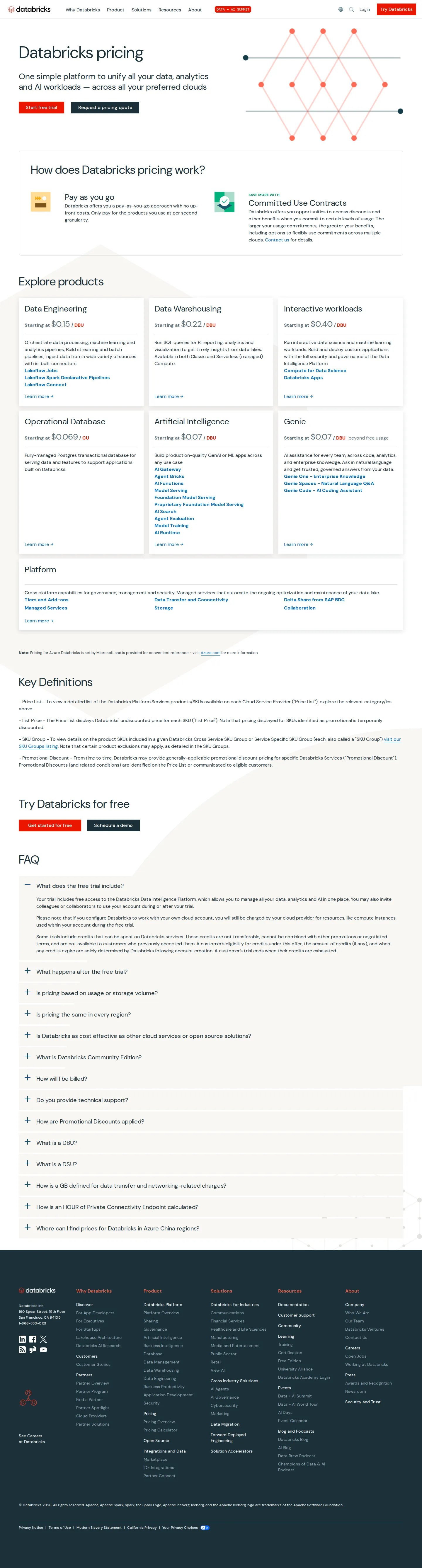
Databricks’ published list rates, by workload, per DBU (US East reference; underlying cloud compute billed separately):
| Workload (DBU rate card) | List price | What it covers |
|---|---|---|
| Artificial Intelligence (Mosaic AI) | $0.07 / DBU | Model Serving, Foundation Model APIs, AI Search, Agent Bricks, AI Functions |
| Model Training (fine-tuning) | $0.65 / DBU | Fine-tuning / training runs |
| Data Engineering | $0.15 / DBU | Pipelines that often feed AI |
| Data Warehousing | $0.22 / DBU | SQL / analytics |
| Interactive workloads | $0.40 / DBU | Notebooks, data science, apps |
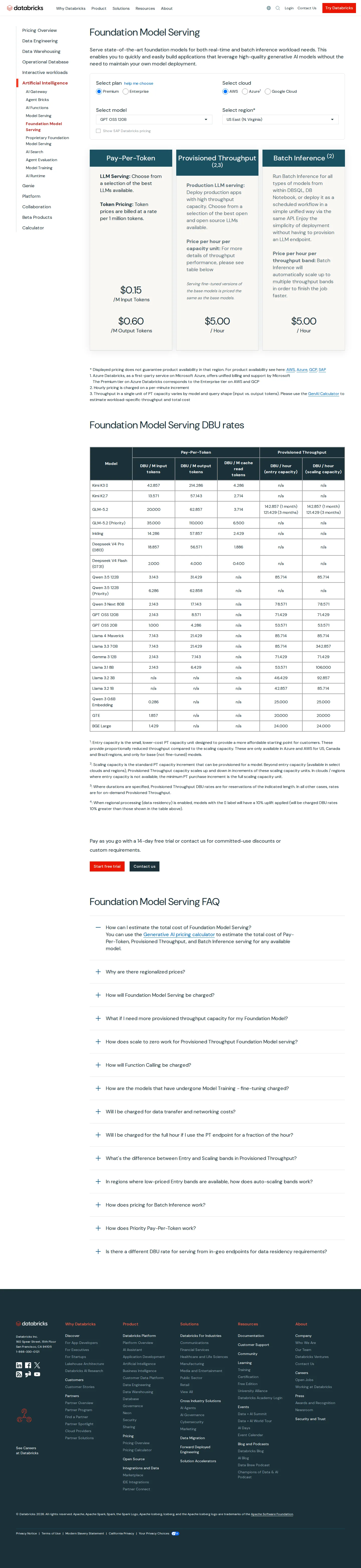
Foundation Model APIs — pay-per-token, in DBU per 1M tokens (multiply by $0.07 for the dollar cost). The catalog expanded materially as of August 2026 to add several new frontier models alongside the existing lineup:
| Model | Input (DBU/1M) | Output (DBU/1M) | Approx dollars in / out per 1M |
|---|---|---|---|
| Kimi K3 | 42.857 | 214.286 | $3.00 / $15.00 |
| GLM-5.2 | 20.000 | 62.857 | $1.40 / $4.40 |
| DeepSeek V4 Pro (0813) | 18.857 | 56.571 | $1.32 / $3.96 |
| Qwen 3.5 122B | 3.143 | 31.429 | $0.22 / $2.20 |
| Llama 4 Maverick | 7.143 | 21.429 | $0.50 / $1.50 |
| Llama 3.3 70B | 7.143 | 21.429 | $0.50 / $1.50 |
| GPT OSS 120B | 2.143 | 8.571 | $0.15 / $0.60 |
| Llama 3.1 8B | 2.143 | 6.429 | $0.15 / $0.45 |
| GPT OSS 20B | 1.000 | 4.286 | $0.07 / $0.30 |
| BGE Large (embeddings) | 1.429 | n/a | $0.10 |
Also available (Aug 2026 catalog): Kimi K2.7, GLM-5.2 (Priority), Inkling, DeepSeek V4 Flash (0731), Qwen 3.5 122B (Priority), Qwen 3 Next 80B, Gemma 3 12B, Llama 3.2 3B/1B (provisioned-throughput only), Qwen 3 0.6B Embedding, and GTE embeddings. Provisioned Throughput starts at $5.00/hour per capacity unit (varies by model — priced in DBU/hour, e.g. Llama 4 Maverick 85.714 DBU/hr); Batch Inference also starts at $5.00/hour per throughput band.
Model Serving — provisioned endpoints, per DBU-hour (approx dollars at $0.07/DBU). CPU and GPU Serving both list at $0.070/DBU (includes cloud instance cost); the GPU rate card now spans T4 through H100:
| GPU configuration | DBU/hr | Approx $/hr |
|---|---|---|
| T4 (or equiv) | 10.48 | $0.73 |
| A10G x1 | 20.00 | $1.40 |
| A10G x4 | 112.00 | $7.84 |
| A10G x8 | 290.80 | $20.36 |
| L40S x1 | 44.86 | $3.14 |
| A100 40GB x8 | 538.40 | $37.69 |
| A100 80GB x8 | 628.00 | $43.96 |
| H100 x1 | 100.00 | $7.00 |
| H100 x8 | 800.00 | $56.00 |
Vector Search (AI Search): Standard endpoint 4.00 DBU/hr ($0.28/hr compute, $0.230/GB/mo storage — first 30GB free), Storage Optimized 18.29 DBU/hr ($1.28/hr compute, $0.046/GB/mo storage). Databricks’ own example: a Standard endpoint serving 5M vectors (3 units, 720 hours) at $0.07/DBU is about $605/month.
Model Training / fine-tuning — referenced at $0.65/DBU (includes cloud instance cost); Databricks publishes worked examples by model and training-data size:
| Model | Training word count | Approx DBUs | Approx cost/run ($0.65/DBU) |
|---|---|---|---|
| Llama 3.3 70B | 10M / 500M | 225 / 11,000 | $146.25 / $7,150.00 |
| Llama 3.1 70B | 10M / 500M | 225 / 11,000 | $146.25 / $7,150.00 |
| Llama 3.1 8B | 10M / 500M | 100 / 4,400 | $65.00 / $2,860.00 |
| Llama 3.2 3B | 10M / 500M | 75 / 2,750 | $48.75 / $1,787.50 |
| Llama 3.2 1B | 10M / 500M | 25 / 1,100 | $16.25 / $715.00 |
Sales motions across products: Mosaic AI is fully self-serve (PLG) on pay-as-you-go DBUs with a free trial; committed-use contracts for volume discounts and multi-cloud flexibility are sales-led (“contact us”).
Hidden costs : What Mosaic AI users actually pay
The headline $0.07/DBU rate is clean, but a real Mosaic AI bill has several layers beyond the DBU meter:
| Line item | Cost |
|---|---|
| Mosaic AI DBUs (serving / inference) | $0.07/DBU, metered per second |
| Underlying cloud compute (AWS/Azure/GCP) | Billed by your cloud provider, NOT by Databricks |
| Model Serving idle endpoints | DBU-hours accrue while an endpoint is provisioned, even if traffic is low |
| Vector Search endpoints | 4.00–18.29 DBU/hr per endpoint, billed while live |
| Model Training runs | Referenced at $0.65/DBU — far above the $0.07 serving rate |
| Data Engineering / Warehousing DBUs | Pipelines and SQL feeding the AI workload bill at their own higher rates |
The single biggest surprise for buyers is that the DBU is only half the bill — the cloud compute that runs underneath is billed separately by AWS, Azure, or GCP, so cost models that only count DBUs understate the true total. The second is always-on endpoints: a provisioned GPU Model Serving endpoint or a Vector Search endpoint keeps consuming DBU-hours whether or not requests flow, so under-utilized endpoints quietly accrue cost. Third, Model Training references $0.65/DBU — nearly 10x the serving rate — so fine-tuning is materially pricier per DBU than inference.
Want to estimate your own Databricks Mosaic AI bill? Use the Databricks Mosaic AI pricing calculator to model your costs based on DBU usage and token volume.
Pricing evolution : Databricks Mosaic AI pricing history and changes
Cadence
| Period | Price changes | Product / SKU additions | Notes |
|---|---|---|---|
| 2023 H2 | — | MosaicML acquired (~1.3B USD) | Folded into the Lakehouse AI platform |
| 2024 | — | Mosaic AI branding consolidates surfaces | Model Serving, FM APIs, Vector Search, Training under one umbrella |
| 2026 Q2 | Published DBU rate card | — | AI at $0.07/DBU; Training $0.65/DBU; FM APIs in DBU/1M tokens |
| 2026 Q3 | — (core rates unchanged) | FM API catalog +6 models (GLM-5.2, DeepSeek V4 Pro/Flash, Kimi K3/K2.7, Qwen 3.5 122B); GPU Model Serving tiers extended to H100 x1/x8; Vector Search storage split surfaced | Catalog and hardware expansion, not a repricing — ceiling rises from 628 to 800 DBU/hr |
Tracked range: 2023–present. Because Mosaic AI is sold as a consumption line on Databricks’ platform, its pricing rides the platform’s DBU rate card rather than standalone plan changes.
Notable changes
- July 2023 — Databricks completes its ~1.3B-dollar acquisition of MosaicML, the team behind the MPT open models, and begins integrating it tightly with the Lakehouse AI platform.
- 2024 — Databricks consolidates its GenAI tooling under the Mosaic AI brand — Model Serving, Foundation Model APIs, Vector Search, Agent/Model Training, and evaluation — all metered in DBUs at the Artificial Intelligence rate rather than as separate products.
- June 2026 — Current published rate card: Artificial Intelligence (Mosaic AI) at $0.07/DBU, Model Training referencing $0.65/DBU, Foundation Model APIs priced in DBU per 1M tokens, GPU Model Serving 10.48–628 DBU/hr, Vector Search 4.00 / 18.29 DBU/hr.
- August 2026 — Databricks widens the Foundation Model APIs catalog with GLM-5.2, DeepSeek V4 Pro/Flash, Kimi K3/K2.7, and Qwen 3.5 122B, extends Model Serving’s GPU rate card to H100 x1/x8 (the ceiling rises from 628 to 800 DBU/hr), and gives Vector Search an explicit $/hour compute plus $/GB-month storage breakdown. None of the existing model or GPU prices moved — the $0.07/DBU AI rate and $0.65/DBU training rate are unchanged.
The direction of travel remains consolidation, not repricing — and the August 2026 catalog expansion is the clearest evidence yet: rather than launch new AI SKUs with bespoke prices, Databricks keeps widening what the single DBU meter buys (twice as many frontier models, five more GPU tiers) so committed-use discounts and governance keep applying uniformly across data and AI spend even as the catalog grows.
What’s unique : Mosaic AI’s distinctive pricing mechanics
1. One meter for everything — even as the catalog grows. Inference tokens, GPU serving hours, vector endpoints, and fine-tuning runs all bill in DBUs at the Artificial Intelligence rate — so AI spend rolls into the same consumption bill and the same committed-use discount as the data platform it sits on. When Databricks added six new frontier models (GLM-5.2, DeepSeek V4 Pro/Flash, Kimi K3/K2.7, Qwen 3.5 122B) and new H100 GPU tiers in August 2026, it didn’t spin up new pricing — it just plugged them into the existing $0.07/DBU meter.
2. The DBU is only the software charge. Unlike a managed inference API where one number covers everything, Mosaic AI’s DBU rate sits on top of the cloud compute you pay your own provider, making the platform consumption-pure but the total cost two-sided.
3. Token prices quoted in DBUs, not dollars. Foundation Model API rates are published as DBU per 1M tokens (Llama 4 Maverick at 7.143 in / 21.429 out), which buyers must convert at their DBU rate — a layer of indirection most token-API competitors don’t have.
Strengths & weaknesses
| Strengths | Weaknesses |
|---|---|
| Pure consumption, metered per second, no up-front cost | DBU is only half the bill — cloud compute billed separately |
| Public DBU rate card (no sales call to see prices) | Token prices in DBUs require conversion to reason about |
| AI line is the cheapest DBU rate ($0.07) | Model Training at $0.65/DBU is ~10x the serving rate |
| One discount/governance model across data + AI | Always-on serving / vector endpoints accrue idle cost |
| Free Edition + 14-day trial with credits | Real total cost is hard to forecast for newcomers |
| Catalog keeps pace with frontier releases (GLM-5.2, DeepSeek V4, Kimi K3, Qwen 3.5 added Aug 2026) without new pricing tiers | More SKUs to compare — a dozen-plus DBU/1M-token rates now sit side by side with no dollar-normalized view |
Billing UX : Databricks Mosaic AI billing controls and transparency
- Billing controls — Pay-as-you-go DBUs metered per second; budgets, tags, and system tables let teams attribute Mosaic AI spend by workspace, job, and SKU. Committed-use contracts lock volume discounts.
- Usage visibility — Databricks exposes DBU consumption through system tables and account dashboards; the recurring buyer challenge is reconciling Databricks DBUs against the separate cloud-provider compute bill.
- Payment options — Self-serve checkout and credit-funded trial for pay-as-you-go; sales-led contracts and invoicing for committed-use and enterprise, with multi-cloud commitment flexibility.
Strategic wins : Why Mosaic AI’s pricing decisions worked
1. Folding GenAI into the existing DBU meter
By billing Mosaic AI in DBUs rather than inventing standalone AI plans, Databricks let every customer adopt GenAI with no new contract, no new pricing model, and the same governance — AI spend simply appears on the bill they already understand. See how AI companies structure pricing.
2. Publishing the rate card in a sales-gated category
Most enterprise AI platforms hide inference and serving prices behind a quote. Databricks publishes per-DBU and per-token (in DBU) rates openly, turning transparency into a buyer-friendly wedge against opaque competitors. Related: outcome-based pricing trends.
3. Layering committed-use discounts over pure consumption
The committed-use contract converts spiky pay-as-you-go DBU demand into predictable, discounted commitments that flex across clouds — smoothing both the customer’s budget and Databricks’ revenue. See choosing the right usage metric.
4. Absorbing new frontier models without touching the price
In August 2026, Databricks added GLM-5.2, DeepSeek V4 Pro/Flash, Kimi K3/K2.7, and Qwen 3.5 122B to Foundation Model APIs and extended Model Serving to H100 GPU tiers — roughly doubling the catalog — while leaving the $0.07/DBU AI rate and $0.65/DBU training rate untouched. Customers get same-week access to new open-weight releases without a contract amendment or a new pricing conversation, keeping the catalog competitive purely on breadth rather than on price.
Areas to improve : Gaps in Mosaic AI’s pricing approach
1. The two-part bill is hard to forecast
Because the DBU rate excludes the underlying cloud compute, newcomers routinely understate true cost. A blended “all-in” estimate per workload would reduce bill shock. See bill shock and cost unpredictability.
2. Token prices in DBUs add friction — and it compounds as the catalog grows
Quoting Foundation Model API rates in DBU per 1M tokens forces buyers to do conversion math just to compare against a dollar-per-token competitor. The August 2026 catalog expansion (adding GLM-5.2, DeepSeek V4 Pro/Flash, Kimi K3/K2.7, and Qwen 3.5 122B on top of the existing lineup) roughly doubled the number of DBU/1M-token rates buyers must convert and compare, so the conversion tax now scales with catalog breadth. A visible dollar equivalent at the standard rate, shown alongside each model, would help.
3. Idle-endpoint cost traps
Provisioned Model Serving and Vector Search endpoints bill per hour while live, regardless of traffic. Clearer auto-scale-to-zero defaults and idle warnings would curb silent spend.
Monetization stack & signals : how Databricks (Mosaic AI) builds & buys its revenue engine
Buys 3 Builds 2 8 signal roles
Databricks builds the meter behind its own DBU rate — an in-house Money Team owns usage ingestion, metering, pricing and credits — plus its cloud-cost tooling, but buys the CRM. The tell below: a mid-flight NetSuite-to-SAP finance-ERP swap.
- Databricks Money Team (in-house billing & usage-metering platform) Metering Job post 1 Job post 2 Aug 2026
“As a Sr. Software engineer on the Money team, you will be closely involved in the entire billing process, including usage ingestion, metering, pricing, credits, promotions, payments, usage reporting, and cost center and budgeting.”
- Multi Cloud Efficiency (in-house cloud-cost / FinOps platform) Cost & FinOps Job post 1 Job post 2 Sep 2026
“Your work will directly impact our infrastructure margins by building the next generation of cost attribution, automated resource management, and efficiency tooling.”
-
“Run a disciplined operating cadence — pipeline reviews, forecast, and KPI inspection anchored to Salesforce as the system of record; report impact, not activity”
-
“Play a key role in our NetSuite-to-SAP transition, helping design statutory and technical accounting processes that will scale on the new platform.”
-
“Play a key role in our NetSuite-to-SAP transition, helping design statutory and technical accounting processes that will scale on the new platform.”
-
A dedicated Multi Cloud Efficiency team builds cost attribution, waste cleanup and resource-governance tooling in-house across AWS, Azure and GCP, framed explicitly around 'infrastructure margins' — the cost side that sets the real margin under the published AI DBU rate.
“Your work will directly impact our infrastructure margins by building the next generation of cost attribution, automated resource management, and efficiency tooling.”
-
A dedicated Multi Cloud Efficiency team builds cost attribution, waste cleanup and resource-governance tooling in-house across AWS, Azure and GCP, framed explicitly around 'infrastructure margins' — the cost side that sets the real margin under the published AI DBU rate.
“Your work will directly impact our infrastructure margins by building the next generation of cost attribution, automated resource management, and efficiency tooling.”
-
Databricks is mid-migration of its finance backbone from NetSuite to SAP S/4HANA, with an internal team building clean-core SAP BTP extensions wired into its own Data Intelligence Platform — the order-to-cash and rev-rec layer under consumption billing being rebuilt in flight.
“Play a key role in our NetSuite-to-SAP transition, helping design statutory and technical accounting processes that will scale on the new platform.”
-
Databricks is mid-migration of its finance backbone from NetSuite to SAP S/4HANA, with an internal team building clean-core SAP BTP extensions wired into its own Data Intelligence Platform — the order-to-cash and rev-rec layer under consumption billing being rebuilt in flight.
“Play a key role in our NetSuite-to-SAP transition, helping design statutory and technical accounting processes that will scale on the new platform.”
-
Databricks is mid-migration of its finance backbone from NetSuite to SAP S/4HANA, with an internal team building clean-core SAP BTP extensions wired into its own Data Intelligence Platform — the order-to-cash and rev-rec layer under consumption billing being rebuilt in flight.
“Play a key role in our NetSuite-to-SAP transition, helping design statutory and technical accounting processes that will scale on the new platform.”
-
The meter behind the DBU rate is staffed as product engineering: one in-house team owns usage ingestion, metering, pricing, credits and payments end-to-end, and is asked to build pricing-strategy primitives (PAYG, credits, trials, promotions) rather than run a bought billing platform.
“Develop innovative primitives that enable and support various pricing strategies such as Pay-As-You-Go, commissions, credits, trials, and promotions.”
-
The meter behind the DBU rate is staffed as product engineering: one in-house team owns usage ingestion, metering, pricing, credits and payments end-to-end, and is asked to build pricing-strategy primitives (PAYG, credits, trials, promotions) rather than run a bought billing platform.
“Develop innovative primitives that enable and support various pricing strategies such as Pay-As-You-Go, commissions, credits, trials, and promotions.”
-
The meter behind the DBU rate is staffed as product engineering: one in-house team owns usage ingestion, metering, pricing, credits and payments end-to-end, and is asked to build pricing-strategy primitives (PAYG, credits, trials, promotions) rather than run a bought billing platform.
“Develop innovative primitives that enable and support various pricing strategies such as Pay-As-You-Go, commissions, credits, trials, and promotions.”
Signals reviewed · derived from public job posts
Job postings fill and close over time — once a posting is filled we keep it as a dated citation (the quoted evidence remains); use View open roles for current listings.
Key takeaways
- Mosaic AI is pure consumption pricing in DBUs — metered per second at $0.07/DBU for the AI line, with no seats and no subscription. For the underlying model, see the introduction to usage-based pricing.
- It has no separate pricing model — it rides Databricks’ DBU rate card, so AI spend shares the same meter, discounts, and governance as the data platform.
- The DBU is only the software charge — the underlying cloud compute is billed separately by AWS/Azure/GCP, making the true total two-sided.
- Foundation Model APIs are pay-per-token in DBUs across a fast-growing catalog (Llama 4 Maverick 7.143/21.429 per 1M, plus GLM-5.2, DeepSeek V4, Kimi K3, and Qwen 3.5 122B added in August 2026), while Model Training references a much higher $0.65/DBU.
- Transparency is the edge: in a category that usually gates AI prices behind sales, Databricks publishes the full per-DBU and per-token rate card.
UBP implications
- A single meter can unify data and AI spend — and absorb new capacity without renegotiation. Mosaic AI shows that pricing GenAI in the same consumption unit as the surrounding platform lets customers adopt new capabilities with zero contract friction; when Databricks added six new frontier models and new GPU tiers in August 2026, they simply plugged into the existing DBU rate rather than triggering a repricing event.
- Beware the hidden second axis. When a usage rate excludes a major cost (here, cloud compute), buyers under-forecast — vendors win trust by surfacing the all-in number.
- Consumption plus committed-use is a durable combo. Pure pay-as-you-go for adoption, committed-use discounts for predictability — a reusable pattern for any usage-based business with capacity to plan.
Sources
- Databricks pricing overview (accessed 2026-08-26)
- Databricks pricing — main rate card (accessed 2026-08-26)
- Foundation Model APIs / Serving pricing (accessed 2026-08-26)
- Model Serving pricing (accessed 2026-08-26)
- Vector Search / AI Search pricing (accessed 2026-08-26)
- Model Training pricing (accessed 2026-08-26)
- Databricks completes acquisition of MosaicML (accessed 2026-06-15)
Bottom line
Mosaic AI is Databricks’ GenAI platform, not a standalone company — the product line that grew out of the ~1.3B-dollar MosaicML acquisition. Its pricing is the cleanest possible expression of consumption billing: everything (Foundation Model API tokens, Model Serving GPU-hours, Vector Search endpoints, fine-tuning runs) is metered in DBUs at the $0.07/DBU AI rate, layered on the cloud compute you pay your provider separately, with committed-use discounts on top. The August 2026 catalog expansion — six new frontier models and five new GPU tiers, all absorbed into the same unchanged rate card — confirms the pattern: Databricks competes on catalog breadth, not on price. The transparency is a genuine edge in an otherwise sales-gated category; the watch-outs are the two-part bill, DBU-denominated token prices across a growing catalog, and idle-endpoint cost. Browse the pricing blueprint for more fully-researched company profiles, or compare Mosaic AI against other Infrastructure, Compute & MLOps companies.
Pricing timeline : Major events on a vertical axis
Each milestone below corresponds to a public pricing change, product launch, or material adjustment. Major events use a filled marker; minor adjustments use a faded one.
Foundation Model APIs catalog and Model Serving GPU tiers expand
Databricks added GLM-5.2, DeepSeek V4 Pro/Flash, Kimi K3/K2.7, and Qwen 3.5 122B to Foundation Model APIs, extended Model Serving's GPU rate card with L40S, A10G x4, A100 40GB x8, and H100 x1/x8 (ceiling rises from 628 to 800 DBU/hr), and gave Vector Search an explicit $/hour compute plus $/GB-month storage split. The core $0.07/DBU AI rate and $0.65/DBU training rate are unchanged — catalog and hardware expansion, not repricing.
Published DBU rate card: AI at $0.07/DBU, training $0.65/DBU
Current list pricing: Artificial Intelligence (Mosaic AI) starts at $0.07/DBU; Model Training references $0.65/DBU. Foundation Model APIs priced in DBU/1M tokens (Llama 4 Maverick 7.143/21.429); GPU Model Serving 10.48–628 DBU/hr; Vector Search 4.00 / 18.29 DBU/hr.
Mosaic AI branding consolidates GenAI surfaces
Databricks rebranded its GenAI tooling under the Mosaic AI umbrella — Model Serving, Foundation Model APIs (pay-per-token), Vector Search, Agent/Model Training, and evaluation — all metered in DBUs at the Artificial Intelligence rate rather than separate SKUs.
Databricks completes ~$1.3B MosaicML acquisition
Databricks acquired MosaicML, folding its generative-AI training and serving stack into the Lakehouse/Data Intelligence Platform. The technology became the foundation of what Databricks now markets as Mosaic AI, billed under the existing DBU consumption model rather than as a standalone product.
- · Mosaic AI is not a standalone company — it is Databricks' GenAI platform, born from the ~$1.3B acquisition of MosaicML (the team behind the MPT open models) completed in July 2023.
- · Everything in Mosaic AI bills in DBUs (Databricks Units) metered per SECOND — the AI line lists at just $0.07/DBU, the cheapest of Databricks' per-DBU workloads (Data Engineering is $0.15, Interactive $0.40).
- · The DBU is only the software charge: customers also pay their own cloud provider (AWS/Azure/GCP) for the underlying compute, so the real Mosaic AI bill is always DBUs + cloud infra.
Questions & answers
- How does Databricks Mosaic AI pricing work?
- Mosaic AI is billed the same consumption way as the rest of Databricks: in DBUs (Databricks Units) metered per second, with no up-front cost. The AI product line lists at $0.07/DBU (US East). You pay for the DBUs each Mosaic AI surface consumes — Foundation Model APIs (per token), Model Serving (per GPU/CPU-hour), Vector Search (per endpoint-hour), and Model Training (per fine-tuning run) — on top of the underlying cloud compute you pay AWS, Azure, or GCP separately.
- What is a DBU and how much does it cost for Mosaic AI?
- A DBU (Databricks Unit) is Databricks' normalized unit of processing capability consumed per second. List prices vary by workload: Data Engineering $0.15/DBU, Data Warehousing $0.22/DBU, Interactive $0.40/DBU, and Artificial Intelligence (Mosaic AI) $0.07/DBU. Model Training references $0.65/DBU. The DBU rate is the Databricks software charge; cloud infrastructure is billed by your cloud provider.
- How much do Databricks Foundation Model APIs cost per token?
- Foundation Model APIs are priced in DBUs per 1M tokens, billed at the $0.07/DBU AI rate. For example Llama 4 Maverick is 7.143 DBU input / 21.429 DBU output per 1M tokens (about $0.50 / $1.50 per 1M), Llama 3.1 8B is 2.143 / 6.429, GPT OSS 20B is 1.000 / 4.286, and BGE Large embeddings are 1.429 DBU per 1M. As of August 2026 the catalog also includes GLM-5.2 (20.000/62.857), DeepSeek V4 Pro (18.857/56.571), Kimi K3 (42.857/214.286), and Qwen 3.5 122B (3.143/31.429) DBU per 1M tokens. You can also reserve provisioned throughput instead of paying per token.
- Does Databricks Mosaic AI have a free tier?
- Yes. Databricks offers a free Databricks Free Edition and a 14-day free trial of the Data Intelligence Platform, sometimes with credits that fund Databricks services until exhausted. Note that if you connect your own cloud account, your cloud provider still bills you for the compute used during the trial. Committed-use contracts for discounts are sales-quoted.