AI Summary
About
Netlify is a web development and deployment platform (a frontend cloud / PaaS) that lets developers deploy sites and apps from Git, an AI agent, or an API, with a global CDN, serverless functions, edge rendering, a managed database, and blob storage. In 2026 Netlify has leaned into agentic development, adding Agent Runners (running AI agent tasks in the background) and an AI Gateway for adding AI-model functionality to projects.
Founded in 2014 by Mathias Biilmann and Christian Bach, Netlify popularized the “Jamstack” architecture and grew into a frontend cloud used by a community that surpassed 8 million developers by 2026. It raised roughly $212M across its Series A–D rounds, reaching a $2 billion valuation in its 2021 Series D led by Bessemer Venture Partners, and acquired Gatsby (2023), OneGraph (2021), and FeaturePeek (2021) along the way. Its primary competitor is Vercel; both compete with self-host alternatives like Coolify and Dokploy and with hyperscaler edge products.
Netlify serves everyone from individual developers building side projects to enterprise engineering organizations. Its 2026 pricing is deliberately seat-free: paid plans are a flat monthly fee (Personal $9, Pro $20 with unlimited members) plus a credit-based usage pool, with an Enterprise tier for teams that need SLAs, SSO/SCIM, and dedicated support. That structure is a sharp break from the per-seat model Netlify ran for most of its history, and it was re-architected explicitly for AI-paced development where a single developer can trigger hundreds of deploys and large inference bills.
Pricing summary : credit-based usage pool across four flat-fee plans
Netlify uses a freemium + credit-based usage model with two dimensions:
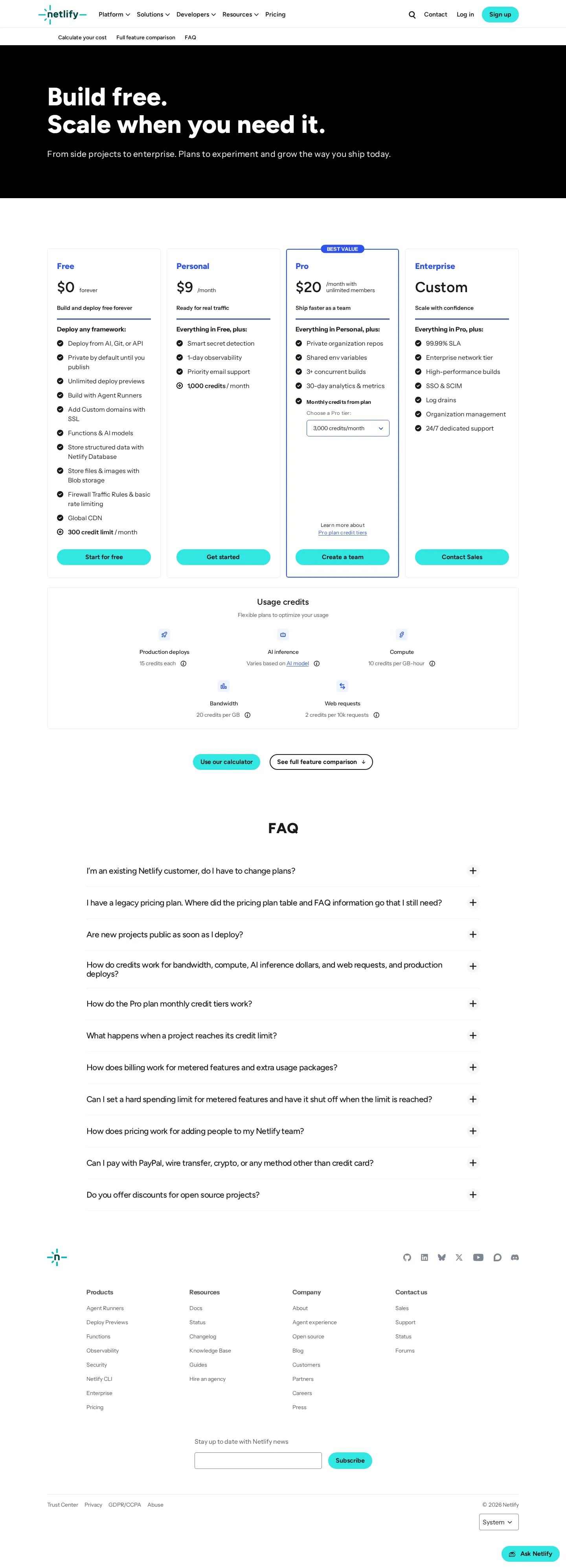
- Flat plan fee: Free ($0 forever), Personal ($9/month), Pro ($20/month with unlimited members), and Enterprise (custom — contact sales, no starting price disclosed on the pricing page as of this capture). There is no per-seat charge.
- Monthly credit pool + usage: Each plan includes a credit allotment — 300 credits (Free), 1,000 credits (Personal), 3,000 credits (Pro base) — consumed by usage. Pro additionally offers selectable monthly credit tiers (3,000 / 5,000 / 10,000 / 15,000 / 20,000 credits/month; higher tiers at higher monthly prices, not shown on the pricing card). Metered usage rates: production deploys 15 credits each, AI inference varies by AI model, compute 10 credits per GB-hour, bandwidth 20 credits per GB, and web requests 2 credits per 10,000 requests.
What makes this different: Netlify folds heterogeneous usage — deploys, compute, bandwidth, web requests, and AI inference — into a single credit-based billing currency, and its Pro plan removes per-seat pricing entirely (unlimited members for $20/month). The result is a freemium plan fee layered over a pure-usage credit pool — the same entitlement-to-credits shift reshaping AI-era billing across the corpus.
Pricing by product
Netlify platform (plans)
| Tier | Price | Included | Key mechanics |
|---|---|---|---|
| Free | $0 forever | Deploy from AI/Git/API, unlimited deploy previews, build with Agent Runners, custom domains with SSL, functions & AI models, Netlify Database, Blob storage, global CDN; 300 credit limit / month. | Build and deploy free forever |
| Personal | $9 / mo | Everything in Free, plus smart secret detection, 1-day observability, priority email support; 1,000 credits / month. | Ready for real traffic |
| Pro | $20 / mo (unlimited members) | Everything in Personal, plus private organization repos, shared env variables, 3+ concurrent builds, 30-day analytics & metrics; 3,000 credits / month base, with selectable credit tiers up to 20,000 credits/month. | Best value — ship faster as a team, no per-seat fee; “Choose a Pro tier” credit selector |
| Enterprise | Custom (contact sales) | Everything in Pro, plus 99.99% SLA, enterprise network tier, high-performance builds, SSO & SCIM, log drains, organization management, 24/7 dedicated support. | Sales-led, quoted; no price floor disclosed on the pricing page as of this capture (see Pricing evolution for the prior disclosed figure) |
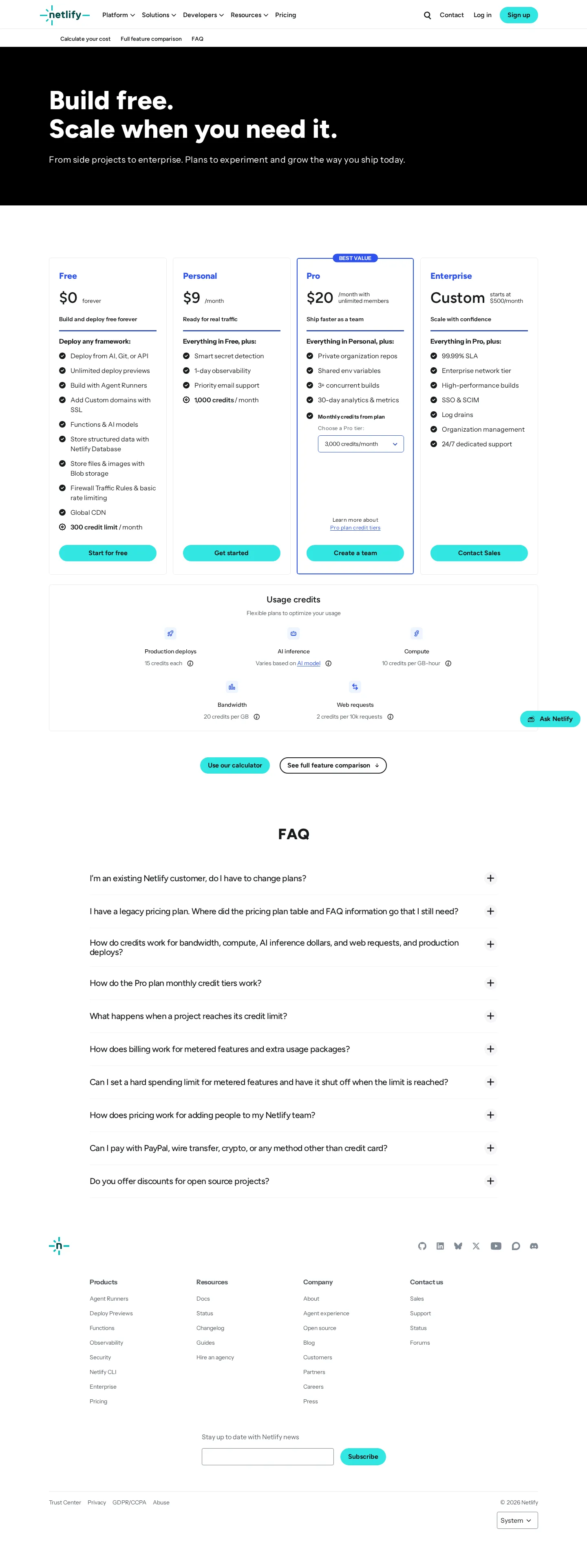
As of July 2026 the Pro card carries a “Choose a Pro tier” credit selector: the $20/month base includes 3,000 credits, and teams can step up to 5,000, 10,000, 15,000, or 20,000 credits/month. The pricing card does not print the higher-tier prices, but Netlify’s billing docs publish them: 5,000 credits for $33/mo, 10,000 for $63/mo, 15,000 for $95/mo, and 20,000 for $126/mo (Pro tiers of 5,000+ credits include rollover credits; the base 3,000-credit tier does not roll over). This lets a team pre-buy a larger included credit pool instead of relying only on add-on credits.
Per Netlify’s credit-based pricing plans docs, add-on/auto-recharge credit packs are priced per plan: Personal — 500 credits for $5; Pro — 1,500 credits for $10; the Free plan has a hard credit limit with no recharge option. Concurrent-build add-ons are also disclosed: Personal can add 1 extra concurrent build for $40/month (capped at 3 total); Pro includes 3 concurrent builds with $40/month per additional build and no cap. Pro also lists “$15 a month per each new additional Live Preview Server” beyond the 1 included.
Usage credits (metered — draws down the monthly pool)
| Meter | Rate | Notes |
|---|---|---|
| Production deploys | 15 credits each | Per production deploy |
| AI inference | Varies based on AI model | Covers Agent Runners and AI Gateway (see below) |
| Compute | 10 credits per GB-hour | Serverless/function compute |
| Bandwidth | 20 credits per GB | CDN egress |
| Web requests | 2 credits per 10,000 requests | Edge/web request volume |
Sales motions across products: PLG / self-serve for Free, Personal, and Pro (sign up and pay online); sales-led for Enterprise (custom quote, no disclosed price floor).
AI inference pricing (Agent Runners & AI Gateway)
AI inference is a usage meter that covers both Agent Runners (running AI agent tasks in the background) and AI Gateway (adding AI-model functionality to a project). Netlify measures AI inference by the cost set by AI-model providers, converting model-usage tokens to USD, and then converting every $1 USD of AI-model spend to 180 Netlify credits. There are no special AI-Gateway credits — it draws from the same plan credit pool (or add-on credits).
Netlify publishes per-model USD token rates (per 1 million tokens) before the credit conversion. Providers supported: Anthropic, Gemini, and OpenAI. A sample of published rates (per 1M tokens):
| Provider | Model | Input | Output | Cache read | Cache write |
|---|---|---|---|---|---|
| Anthropic | claude-opus-4-8 | $5.00 | $25.00 | $6.25 | $0.50 |
| Anthropic | claude-sonnet-5 | $2.00 | $10.00 | $2.50 | $0.20 |
| Anthropic | claude-haiku-4-5 | $1.00 | $5.00 | $1.25 | $0.10 |
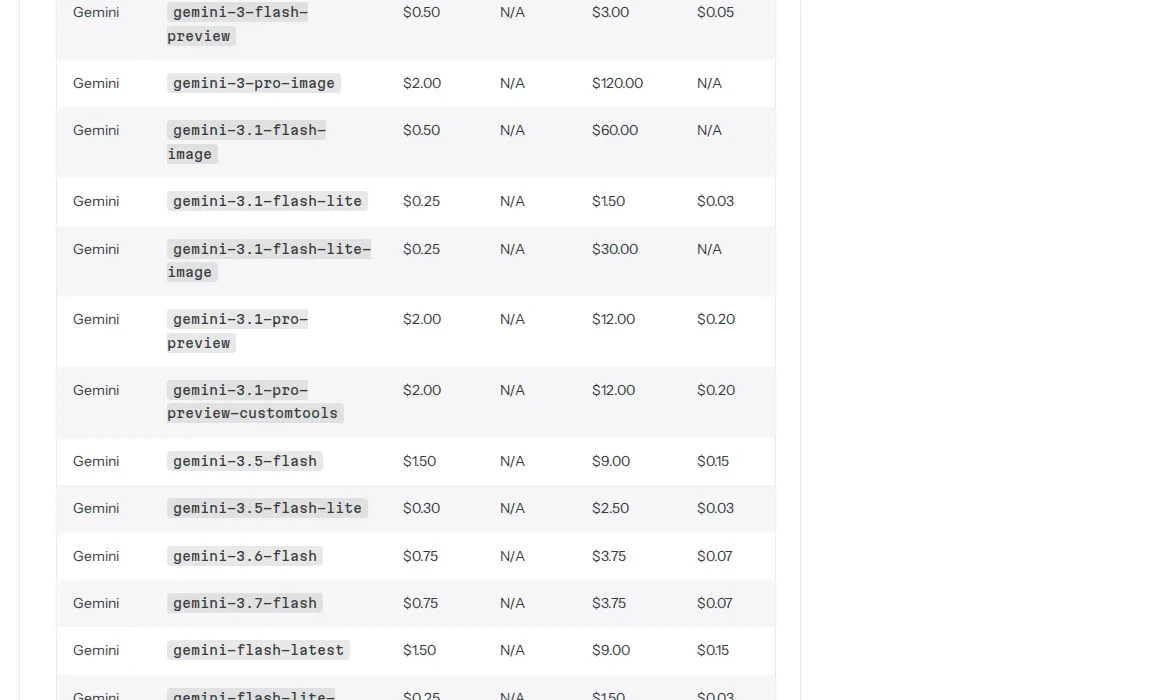
| Gemini | gemini-3.1-pro-preview | $2.00 | $12.00 | N/A | $0.20 |
| Gemini | gemini-2.5-flash | $0.30 | $2.50 | N/A | $0.03 |
| OpenAI | gpt-5.5 | $5.00 | $30.00 | N/A | $0.50 |
| OpenAI | gpt-5.4 | $2.50 | $15.00 | N/A | $0.25 |
| OpenAI | gpt-4o-mini | $0.15 | $0.60 | N/A | $0.07 |
Per Netlify AI features pricing docs (page caption reads “Last updated: Jul 15, 2026,” though the underlying rate table has changed more recently than that caption — see below). These provider rates are subject to change with the market and are the pre-conversion USD basis; actual billing converts $1 to 180 credits.
As of the 2026-08-14 capture, Gemini 3.6 Flash is priced at $0.75 input / N/A cache read / $3.75 output / $0.07 cache write per 1M tokens — roughly half the rate shown in the prior day’s capture (see Pricing evolution) — and a new Gemini 3.7 Flash model appeared at the identical rate ($0.75 / N/A / $3.75 / $0.07). No other sampled provider rate (Anthropic, OpenAI, or the remaining Gemini models) moved between the 2026-08-13 and 2026-08-14 captures, and Netlify’s own plan prices and the 180-credits-per-$1 conversion were unchanged.
Hidden costs : how the credit pool and AI inference convert to real bills
The $9 / $20 plan fees understate what heavy AI-inference or high-bandwidth users pay once the included credit pool (300 / 1,000 / 3,000 credits) is exhausted and add-on credits are consumed. The dangerous dimension is AI inference: the meter is 180 credits per $1 of underlying model spend, so a Pro plan’s entire 3,000-credit pool corresponds to only about $16.67 of raw model spend before the pool is gone. The historical worst case is bandwidth — the $104K DDoS bill (see Pricing evolution) — which today would draw down 20 credits per GB.
Archetype A: an AI-agent side project on Pro
A solo developer on Pro ($20) uses Agent Runners to iterate on an app, spending roughly $30 of Claude Sonnet inference in a month, plus modest compute and bandwidth.
| Line item | Monthly cost |
|---|---|
| Pro plan base (3,000 credits, unlimited members) | $20 |
| ~$30 AI-model spend × 180 credits = 5,400 AI credits | draws 3,000 included, +2,400 over |
| Compute + bandwidth (light) | a few hundred more credits |
| Add-on credits to cover the ~2,700-credit overage | ≈ $18–$20 (add-on credit pricing) |
| Total | ≈ $38–$40 |
Lesson: even light agentic use doubles the headline $20 fee, because the included pool is sized for human-paced iteration, not for an agent making dozens of model calls per task.
Archetype B: a small team hit by a traffic spike
A 5-person team on Pro serves a viral asset and pushes 4TB of bandwidth in a month.
| Line item | Monthly cost |
|---|---|
| Pro plan base (unlimited members) | $20 |
| 4TB bandwidth × 20 credits/GB = 80,000 credits | 3,000 included, 77,000 over |
| Add-on credits for the 77,000-credit overage | material (hundreds of $) |
| Total | $20 + large usage bill |
Lesson: a single heavy dimension — bandwidth or AI inference on a large model — can exhaust the included credits and drive add-on-credit purchases far beyond the $20 base. Setting an AI inference spending limit and monitoring the credit balance is essential; see thresholding and alerting on usage and our take on AI cost unpredictability and bill shock.
Want to estimate your own Netlify bill? Use the Netlify pricing calculator to model your monthly cost based on deploys, compute, bandwidth, web requests, and AI inference. (Netlify also offers a cost calculator on its own pricing page.)
Pricing evolution : from seat-based hosting to a credit-based usage pool
Netlify’s pricing arc runs from a per-seat, multi-metric legacy model to a seat-free credit pool re-architected for AI-paced development. The Wayback CDX API was unreachable at capture time, so no historical pricing-page screenshots are attached; the dates and figures below are sourced from Netlify’s own blog/changelog and corroborating community threads rather than archived captures.
Cadence
| Quarter | Price changes | Product / SKU additions | Notes |
|---|---|---|---|
| 2022 Q2 | 2 | 0 | Seat-based plan changes (higher limits; 7+ members forced to Enterprise) drew backlash; 2022-06-13 partial walk-back added the Git Contributor role and paused the build-trigger change. |
| 2024 Q1 | 1 | 0 | 2024-02-27 $104K bill-shock incident; CEO waived the charge. No pricing change, but exposed the absence of spending caps. |
| 2024 Q4 | 0 | 1 | 2024-12-11 new always-free Free plan with usage notifications at 50/75/90/100% of limits. |
| 2025 Q3 | 1 | 1 | 2025-09-04 credit-based pricing launches for new accounts; AI-inference metering (180 credits / $1) added; older accounts become Legacy plans. |
| 2026 Q2 | 1 | 0 | 2026-04-14 seat-based pricing removed from credit Pro plan — flat $20/mo, unlimited members, 3,000 credits. |
| 2026 Q3 | 2 | 2 | 2026-07-14 Pro plan gains a “Choose a Pro tier” credit selector — selectable 5,000 / 10,000 / 15,000 / 20,000-credit monthly tiers above the unchanged $20 / 3,000 base; 2026-08-04 Enterprise drops its disclosed “starts at $500/month” floor, now showing only “Custom” with no price; 2026-08-14 Gemini 3.6 Flash AI Gateway rate halved (input $1.50→$0.75, output $7.50→$3.75 per 1M tokens) and a new Gemini 3.7 Flash model added at the same discounted rate. Headline Free/Personal/Pro prices unchanged throughout. |
Tracked range: 2022-06 to 2026-08. Quarters not listed were verified stable against the sources cited (0 price changes, 0 SKU additions found).
Notable changes
- 2022-06-02 — Seat-based plan changes (raised limits, forced 7+ member teams to Enterprise, billed Git contributors) triggered a contentious Hacker News reaction (“Tell HN: Netlify changing Starter plan”).
- 2022-06-13 — Partial walk-back: Netlify paused the build-trigger change and introduced the paid Git Contributor role (netlify.com/blog/changes-to-our-recent-pricing-update/).
- 2024-02-27 — The $104K bill-shock incident: a free-tier static site absorbed ~190TB of traffic; the CEO waived the bill after the Reddit post reached 1,783 upvotes (corroborated by cybernews.com).
- 2024-12-11 — New always-free Free plan with hard usage notifications at 50/75/90/100% of monthly limits (netlify.com/blog/introducing-netlify-free-plan/).
- 2025-09-04 — Credit-based pricing launches for new accounts, collapsing 15+ metrics into one credit balance and adding AI-inference metering (netlify.com/changelog/netlify-pricing-update-introducing-credit-based-plans/).
- 2026-04-14 — Seat-based pricing removed from the credit Pro plan; $20 per seat becomes a flat $20/mo for unlimited members (netlify.com/changelog/2026-04-14-pricing-updates-april-2026/).
- 2026-07-14 — Pro plan gains a “Choose a Pro tier” credit selector: the $20 base keeps 3,000 credits, with selectable 5,000 / 10,000 / 15,000 / 20,000-credit monthly tiers above it (higher-tier prices shown behind a link, not on the card) and a new “How do the Pro plan monthly credit tiers work?” FAQ. Headline prices unchanged (netlify.com/pricing).
- 2026-08-04 — Netlify removed the disclosed “starts at $500/month” caption from the Enterprise card; the tier now shows only “Custom,” with no price shown anywhere on the page (screenshot diff, 2026-07-29 vs 2026-08-04 captures of netlify.com/pricing).
- 2026-08-14 — The AI features pricing docs’ published Gemini 3.6 Flash rate dropped roughly in half (input $1.50→$0.75, output $7.50→$3.75, cache write $0.15→$0.07 per 1M tokens) and a new Gemini 3.7 Flash model appeared at the same discounted rate; no other sampled provider rate or Netlify plan price moved (screenshot diff, 2026-08-13 vs 2026-08-14 captures of docs.netlify.com AI features pricing).
The $104K bill in detail
In February 2024, a developer discovered a ~$104,000 Netlify bill on what had been a free-tier static site with ~200 daily visitors. Investigation traced it to a single 3.44MB MP3 file downloaded roughly 55 million times over several days — about 190TB of egress. Netlify first offered a discount to a ~$5,000 liability; once the Reddit r/webdev post trended (1,783 upvotes, 798 comments), the CEO waived the charge entirely. The episode is a canonical usage-based bill-shock case because, at the time, Netlify offered no spending-limit capability — the meter simply ran. Netlify’s later moves map directly onto this: the December 2024 Free plan added staged usage notifications and instant-upgrade prompts, and the credit-based plans expose an AI inference credit usage limit that halts new agent runs and pauses AI Gateway when hit. The lesson for any usage-priced platform — hard caps and default alerts are a trust feature, not an edge case — echoes our analysis of AI cost unpredictability and bill shock.
What’s unique : credit-based usage and seat-free Pro pricing
One credit currency across everything. Netlify collapsed what it describes as 15+ separate metrics, add-on packages, and usage tiers into a single credit balance. Deploys (15 credits each), compute (10 credits/GB-hour), bandwidth (20 credits/GB), web requests (2 credits/10k), and AI inference all draw from the same monthly pool. That is a rarer commitment than most “credit” systems, which typically reserve credits for one dimension (e.g., AI features) and bill the rest separately. It maps onto the hybrid credit-pool model seen at peers like Vercel and Cursor.
AI inference priced as a pass-through, not a markup. Netlify meters AI at 180 credits per $1 of underlying model spend, and publishes the raw provider USD token rates (Anthropic, Gemini, OpenAI) that feed the conversion. There is no separate “AI credit” — the AI meter tracks provider pricing almost transparently, which is unusual: many platforms bundle inference into opaque per-request or per-token markups. It is closer to a metered pass-through than a resold token model.
Seat-free by design, for AI-paced work. Removing per-seat pricing (April 2026) was not a generic simplification — Netlify framed it around AI development that “doubled our community in one year” past 8 million developers. When a single developer with an agent can generate hundreds of deploys, charging per human seat stops correlating with value; usage does. This is a deliberate value-metric change, not just packaging.
Bill-shock scars baked into the product. The December 2024 Free plan’s staged usage notifications and the credit plans’ AI inference credit usage limit are direct product responses to the 2024 $104K incident — an example of a pricing model that visibly encodes a past trust failure into its controls.
Strengths & weaknesses
| Strengths | Weaknesses |
|---|---|
| Seat-free Pro ($20, unlimited members) removes the classic team-scaling penalty. | Credit pools are small relative to AI workloads — 3,000 Pro credits ≈ only ~$16.67 of raw model spend. |
| One credit currency across deploys, compute, bandwidth, requests, and AI simplifies tracking. | Converting heterogeneous usage into abstract credits makes it harder to reason about cost per dimension. |
| AI inference priced as a near pass-through (180 credits / $1) with published provider rates. | 180 credits/$1 is still a markup layer over provider pricing that users must back-calculate to compare. |
| Self-serve tiers (Free, Personal, Pro) stay fully priced and card-visible with no signup gate. | Enterprise price signal was disclosed for over a year, then quietly removed on 2026-08-04 — buyers lost the one anchor they had before a sales call, and pre-2025-09-04 Legacy accounts still sit on a different, un-migrated model. |
| Post-incident controls (usage notifications, AI spending limit) are real, named guardrails. | Reputation overhang from the 2024 $104K bill and the 2022 pricing backlash lingers in developer sentiment. |
| Strong brand and 8M+ developer community give distribution few frontend-cloud rivals match. | Direct competition from Vercel plus a large field of self-host alternatives (Coolify, Dokploy) caps pricing power. |
Billing UX : credit pool controls, spending limits, and add-on credits
- Monthly credit pool — each plan includes a fixed credit allotment (300 / 1,000 / 3,000 credits on Free / Personal / Pro base) shown on the pricing page and consumed by usage.
- Pro plan credit tiers — a “Choose a Pro tier” selector on the Pro card lets a team pick a larger included pool (3,000 / 5,000 / 10,000 / 15,000 / 20,000 credits/month, priced in Netlify’s billing docs at $20 / $33 / $63 / $95 / $126 per month) instead of relying only on add-on credits.
- AI inference credit usage limit — teams can set a cap on AI inference; once reached, no new agent runs can start, active agent runs stop, and AI Gateway usage is paused (per Netlify AI features docs).
- Add-on credits and auto recharge — teams can buy add-on credit packs and configure auto recharge when the pool runs low: Personal is 500 credits for $5, Pro is 1,500 credits for $10 (Free has a hard limit, no recharge) (per Netlify billing docs).
- Concurrent-build and Live Preview Server add-ons — Personal can add 1 extra concurrent build for $40/month (max 3); Pro includes 3 concurrent builds with no cap at $40/month per additional build; Pro also allows “$15 a month per each new additional Live Preview Server” beyond the 1 included (per Netlify billing docs).
- Usage and billing insights — Account usage insights shows AI inference and other usage meters over time.
- Cost calculator — a Calculate your cost / Use our calculator tool on the pricing page models monthly cost from usage.
Strategic wins : what Netlify got right in the model shift
1. Re-based the value metric from seats to usage before rivals
By removing per-seat pricing, Netlify aligned billing with the thing that actually scales in AI-era development — usage, not headcount. When one developer plus an agent can do the work of a team, per-seat pricing both under-monetizes and annoys. Choosing usage as the value metric is the harder, more durable call, and it mirrors the broader SaaS-to-usage migration reshaping developer tools.
2. Made AI cost legible with a published pass-through
Rather than burying inference in an opaque markup, Netlify publishes provider USD token rates and a single 180-credits-per-$1 conversion. Legibility is a trust move: developers can sanity-check the AI meter against Anthropic/OpenAI list prices. It positions Netlify as a neutral conduit for AI spend rather than a reseller skimming margin invisibly. The pass-through cuts both ways, too: when Google halved its Gemini 3.6 Flash token rate on 2026-08-14 (and shipped a new Gemini 3.7 Flash at the identical lower price), Netlify’s published rate table moved in lockstep within a day — concrete evidence the meter tracks the market down, not just up.
3. Turned a bill-shock disaster into product guardrails
The 2024 $104K incident could have been a permanent reputation wound. Instead Netlify shipped staged usage notifications (Dec 2024) and an AI inference spending limit on credit plans — converting a trust failure into named controls. Encoding hard caps and default alerts is exactly the guardrail discipline we argue for in FinOps for AI cost management.
Areas to improve : where the credit model still leaks trust
1. Right-size the included AI credit pool
3,000 Pro credits mapping to only ~$16.67 of raw model spend means any real agentic workflow blows through the pool almost immediately, making the “$20 Pro” headline feel like a teaser. Model-level repricing can shift this at the margins — the 2026-08-14 halving of the Gemini 3.6 Flash rate (plus the new, identically-priced Gemini 3.7 Flash) roughly doubles how many Flash-model tokens that same $16.67 buys — but it’s a provider-side discount Netlify doesn’t control, not a structural fix, and it does nothing for teams standardized on premium models like Opus or GPT-5.5. The July 2026 “Choose a Pro tier” selector (5,000 / 10,000 / 15,000 / 20,000 credits/month) is a step in this direction — teams can pre-buy a bigger included pool rather than lean on add-on credits — but it addresses the symptom sideways: the $20 base allotment is unchanged, the tiers are still denominated in an abstract credit unit rather than dollars of model spend, and the higher-tier prices sit behind a link instead of on the card, so a buyer cannot see what right-sizing actually costs without clicking through. Fix: publish an explicit “AI credits included” figure in dollars-of-model-spend terms and surface each Pro tier’s price on the pricing card, so the pre-buy option is legible rather than a hidden step-up.
2. Show cost per dimension, not just a credit balance
Collapsing everything into one credit currency simplifies the meter but obscures where money goes — a user cannot easily see “I spent $X on bandwidth vs $Y on AI.” Fix: in usage insights, break the credit burn back down into dollar-denominated dimension buckets so finance teams can attribute spend, in line with tracking and metering usage events.
3. Unify the plan lineage and make Legacy migration painless
Prospects now face Free/Personal/Pro/Enterprise credit plans plus a parallel Legacy plan universe for pre-September-2025 accounts. Fix: give legacy accounts a clear, incentivized migration path and a side-by-side “what your bill becomes on credits” estimator so the fragmentation resolves over time.
4. Default the spending caps ON
The AI inference credit usage limit and add-on-credit auto-recharge exist, but bill-shock happens when protections are opt-in. Fix: default a conservative spending cap and staged alerts for new accounts (as the Free plan already does), so the next $104K scenario is impossible by default rather than avoidable by expertise.
5. Explain — or reverse — the silent removal of the Enterprise price signal
On 2026-08-04 Netlify dropped the “starts at $500/month” caption from the Enterprise card, leaving a bare “Custom” like most contact-sales tiers. That undoes one of the few genuine transparency wins on this page: buyers now get zero anchor before a sales call, and there is no public explanation for why the figure disappeared (a higher real floor, tighter sales-led control, or something else). Fix: if $500/month no longer reflects reality, publish an updated floor or range instead of removing disclosure outright; a silent retraction reads as a step backward against the price-transparency standard Netlify’s own self-serve tiers otherwise meet.
Key takeaways
- Pick a value metric that survives your customers’ next efficiency gain. Netlify’s per-seat model quietly broke when AI let one developer do a team’s work; usage tracks value better in an agentic world. If your metric can be gamed away by a productivity tool, it is already obsolete.
- Bill-shock is a trust problem, not a billing edge case. A single missing spending cap produced a $104K bill and a 1,783-upvote reputation event. Default alerts and hard caps are cheaper than the goodwill you lose without them.
- Legibility beats margin games on AI cost. Publishing provider token rates and a single 180-credits-per-$1 conversion buys trust that an opaque markup destroys. Buyers increasingly back-calculate; assume they can see through resold-token pricing.
- A disclosed price anchor is only a feature while it survives. Netlify’s “starts at $500/month” Enterprise caption pre-qualified buyers and set expectations for over a year, then vanished from the pricing page on 2026-08-04 with no public explanation. A floor that can quietly disappear teaches buyers to discount it as much as a floor that was never shown.
- Simplifying metrics has a hidden cost — attribution. Folding many meters into one credit currency is easier to track but harder to reason about. Give customers a way to see cost per dimension or you trade transparency for tidiness.
UBP implications
- Credit pools are becoming the default packaging for heterogeneous AI usage. Netlify’s single-currency pool over deploys, compute, bandwidth, and inference shows how prepaid-credit models let a platform meter wildly different resources under one balance — the packaging pattern to watch as AI workloads mix compute and tokens.
- AI inference is pushing platforms toward pass-through metering. When the underlying cost is a volatile third-party token price, resellers increasingly expose the provider rate plus a fixed conversion rather than a fat opaque markup — a structural shift in how usage-based pricing models handle bought-in cost.
- Spending controls are graduating from feature to table stakes. Post-Netlify, a usage-priced platform without default caps and staged alerts carries reputational tail risk; guardrails are now part of the pricing model itself, not an afterthought.
Sources
- Netlify pricing page (accessed 2026-08-14)
- Netlify AI features pricing docs (accessed 2026-08-14)
- Netlify credit-based pricing plans (docs) (accessed 2026-08-14)
- Netlify changelog — introducing credit-based plans (accessed 2026-07-06)
- Netlify changelog — pricing updates (April 14, 2026) (accessed 2026-07-06)
- Netlify blog — changes to our recent pricing update (2022 walk-back) (accessed 2026-07-06)
- Netlify AI Gateway providers API (raw pricing data source) (accessed 2026-08-14)
Bottom line
Netlify in 2026 prices a frontend cloud on a credit-based usage pool with seat-free flat plans — Free, Personal ($9), Pro ($20 with unlimited members), and Enterprise (custom, contact sales) — folding deploys, compute, bandwidth, web requests, and AI inference into one credit currency, with AI metered at 180 credits per $1 of underlying model spend.
Want to compare Netlify against other frontend-cloud pricing? Browse the pricing blueprint.
Pricing timeline : Major events on a vertical axis
Each milestone below corresponds to a public pricing change, product launch, or material adjustment. Major events use a filled marker; minor adjustments use a faded one.
Gemini 3.6 Flash AI Gateway rate halved; Gemini 3.7 Flash added
Netlify's AI features pricing docs cut the published Gemini 3.6 Flash token rate roughly in half — input $1.50 to $0.75, output $7.50 to $3.75, cache write $0.15 to $0.07 per 1M tokens — and added a new Gemini 3.7 Flash model at the same discounted rate. All other sampled provider rates (Anthropic, OpenAI, other Gemini models) and Netlify's own plan prices (Free/Personal/Pro/Enterprise) and the 180-credits-per-$1 conversion were unchanged. Source: docs.netlify.com AI features pricing page (screenshot diff, 2026-08-13 vs 2026-08-14 captures).
Enterprise price floor removed from disclosure
Netlify dropped the 'starts at $500/month' caption that had appeared beneath the Enterprise tier's Custom label since at least July 2026, leaving the card as a bare 'Custom' with no price shown. Free ($0), Personal ($9), Pro ($20, unlimited members), the credit tiers, usage-credit rates, and AI-model token rates were all confirmed unchanged. Source: netlify.com/pricing (screenshot diff, 2026-07-29 vs 2026-08-04 captures).
Pro plan gains selectable monthly credit tiers
The Pro plan pricing card added a 'Choose a Pro tier' selector: the $20/month base still includes 3,000 credits, but teams can now pick higher monthly credit tiers of 5,000, 10,000, 15,000, or 20,000 credits/month (higher tiers at higher monthly prices, not shown on the card). A new 'How do the Pro plan monthly credit tiers work?' FAQ entry appeared alongside it. All headline prices ($0 / $9 / $20 / from $500) were unchanged. Source: netlify.com/pricing.
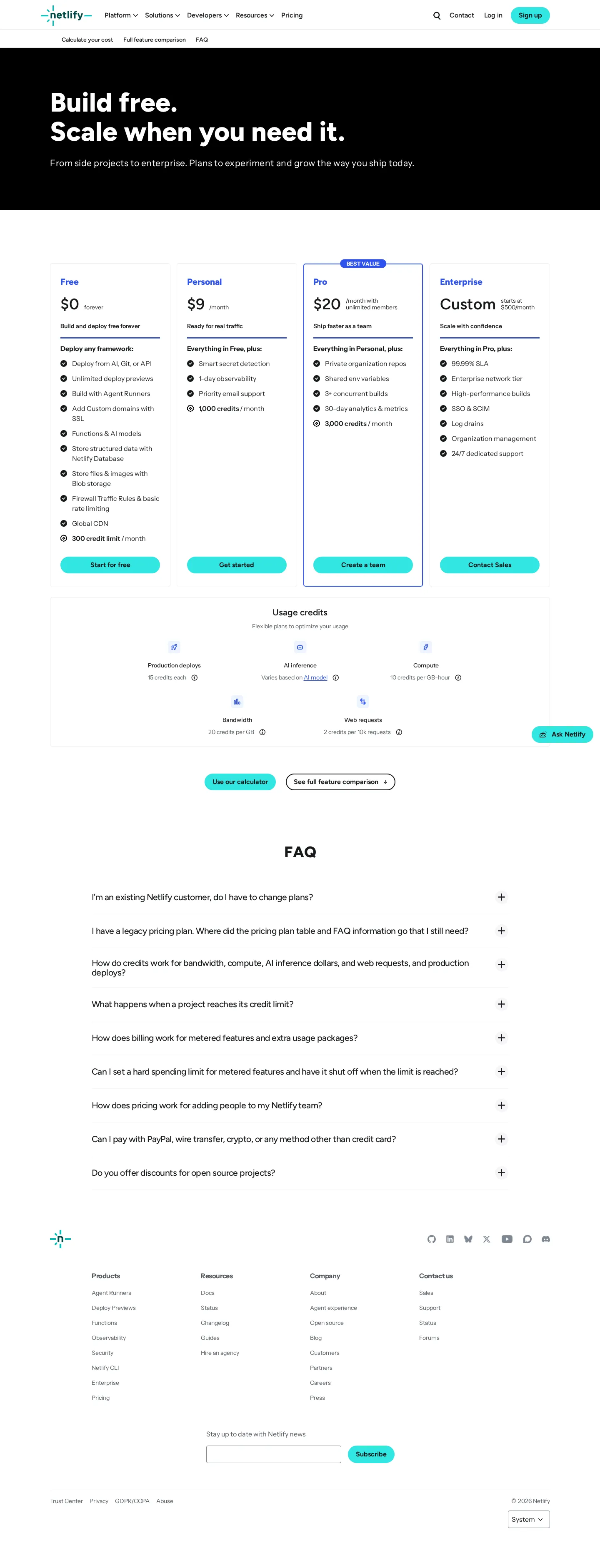
Credit-based plans with Agent Runners and AI inference metering
Netlify pricing is structured as Free ($0) / Personal ($9) / Pro ($20, unlimited members) / Enterprise (custom from $500/mo), each with a monthly credit pool (300 / 1,000 / 3,000 credits on Free/Personal/Pro). AI inference (Agent Runners + AI Gateway) is metered at 180 credits per $1 of underlying AI-model spend.
Seat-based pricing removed from credit Pro plan
Netlify removed per-seat charges from the credit Pro plan: previously $20 per seat (including active Git contributors), now a flat $20/month for 3,000 credits with unlimited team-member seats. Framed by CEO Mathias Biilmann around AI development that 'doubled our community in one year' past 8M developers. Source: netlify.com/changelog/2026-04-14-pricing-updates-april-2026/.
Credit-based pricing launches for new accounts
All new Netlify accounts moved to credit-based plans, collapsing 15+ separate metrics into a single credit balance and adding AI-inference metering (180 credits per $1 of model spend) for AI Gateway / Agent Runners. Pro at launch was still seat-based ($20/member/month, 5,000 credits/seat). Accounts created before 2025-09-04 became 'Legacy' plans with no forced migration. Source: netlify.com/changelog/netlify-pricing-update-introducing-credit-based-plans/ and netlify.com/blog/new-pricing-credits/.
New Free plan with hard usage notifications
Netlify introduced an always-free Free plan (100GB bandwidth, 300 build minutes, 125,000 function + 1M edge-function invocations, 10GB storage) with usage notifications at 50/75/90/100% of monthly limits and no credit card required — a direct answer to bill-shock concerns. Source: netlify.com/blog/introducing-netlify-free-plan/ (HN item, 28 pts, 2024-12-11).
The $104K bill-shock incident (no spending caps)
A developer's free-tier static site absorbed ~190TB of traffic — later found to be ~55 million downloads of a single 3.44MB MP3 — and Netlify issued a ~$104,000 bill. The Reddit r/webdev post reached 1,783 upvotes / 798 comments; after it trended, the CEO waived the entire charge. Netlify had no spending-limit capability at the time. Corroborated by cybernews.com and the Netlify support forum follow-up (answers.netlify.com/t/113472).
Partial walk-back: Git Contributor role, build-trigger change paused
After the backlash Netlify published 'Improved workflow and new role for pricing changes': it paused the build-trigger change, introduced a paid Git Contributor role (auto-approved, removed after 30 days inactive, off by default), and kept the 7+ member Enterprise requirement with carve-outs for open source, early-stage startups, and agencies. Source: netlify.com/blog/changes-to-our-recent-pricing-update/.
Seat-based plan changes trigger community backlash
Netlify raised limits and required teams of 7+ members to move to Enterprise on its legacy seat-based plans (Starter/Pro/Business, roughly $19/member/month). The change — especially charging for Git contributors who only triggered builds — drew a contentious Hacker News reaction ('Tell HN: Netlify changing Starter plan'). Prices on the pre-change plans are unknown here (Wayback CDX was unreachable at capture time; no historical screenshot). Source: news.ycombinator.com/item?id=31937401.
- · Netlify 2026 credit-based plans charge no per-seat fee — Pro is $20/month with unlimited members, and usage bills from a shared monthly credit pool (300 / 1,000 / 3,000 credits on Free / Personal / Pro).
- · AI inference on Netlify is metered by converting AI-model provider costs to USD, then charging 180 Netlify credits per $1 of underlying model spend — so the AI meter tracks raw provider token pricing.
- · Netlify disclosed a rare Enterprise price floor — 'Custom, starts at $500/month' — for over a year before quietly removing the figure from netlify.com/pricing on August 4, 2026, leaving Enterprise as an undisclosed 'Custom' quote like most contact-sales tiers.
Questions & answers
- How much does Netlify cost in 2026?
- Netlify has four plans: Free ($0 forever), Personal ($9/month), Pro ($20/month with unlimited members), and Enterprise (custom — contact sales, with no starting price shown on the pricing page as of August 2026). Each includes a monthly credit pool consumed by deploys, compute, bandwidth, web requests, and AI inference.
- How does Netlify credit-based billing work?
- Every plan includes a monthly credit allotment (300 / 1,000 / 3,000 credits on Free / Personal / Pro base). Usage draws down credits: production deploys cost 15 credits each, compute 10 credits per GB-hour, bandwidth 20 credits per GB, and web requests 2 credits per 10,000 requests. As of July 2026 the Pro plan also carries a 'Choose a Pro tier' selector to pre-buy a larger included pool — 5,000, 10,000, 15,000, or 20,000 credits/month at higher monthly prices — instead of relying only on add-on credits.
- How is AI inference priced on Netlify?
- Netlify converts each $1 of underlying AI-model provider cost into 180 Netlify credits. This applies to both Agent Runners and AI Gateway, and per-model USD token rates are published in Netlify AI features pricing docs.
- Does Netlify charge per seat?
- Not anymore. Netlify billed per team member for years (roughly $19–$20 per seat) and removed seats from the credit Pro plan on April 14, 2026 — Pro is now a flat $20/month with unlimited members, billing usage from a shared credit pool instead.
- Did Netlify really send a developer a $104,000 bill?
- Yes. In February 2024 a free-tier static site absorbed ~190TB of traffic (about 55 million downloads of one 3.44MB MP3) and Netlify issued a ~$104K bill. After the Reddit post reached 1,783 upvotes, the CEO waived the charge entirely. Netlify had no spending caps at the time and later added a Free plan with usage notifications and (on credit plans) AI spending limits.
- What is a Netlify Legacy plan?
- Accounts created on a Free, Starter, or Pro plan before September 4, 2025 are 'Legacy' plans, billed on the old per-seat / multi-metric model. New accounts use the credit-based plans; Netlify does not force legacy accounts to migrate.