AI Summary
About
New Relic is a full-stack observability platform covering application performance monitoring (APM), infrastructure and Kubernetes monitoring, log management, browser/mobile monitoring, and — increasingly — AI-driven “Intelligent Observability” capabilities such as New Relic AI, Agentic AI, and Security RX, all delivered as one unified platform rather than a bundle of separately-branded products. The company built its early reputation on APM before broadening to 50+ monitoring capabilities and 780+ integrations under a single price list, and was taken private by Francisco Partners and TPG in 2023 after roughly a decade as a public company.
New Relic sells to engineering, DevOps, SRE, and security teams, with plans that span a perpetually free solo-developer tier through FedRAMP Moderate and HIPAA-eligible Enterprise contracts. Its most direct competitors are Datadog, Dynatrace, and Splunk Observability Cloud — comparisons the company links to directly from its own pricing page.
New Relic’s differentiation is explicitly billing-model-driven: where Datadog charges à la carte per host across 40+ SKUs, New Relic markets “one platform, one price” and, as of 2026, is actively pushing customers away from its historical per-user (Basic/Core/Full Platform) model toward consumption-based Core Compute and Advanced Compute add-ons that remove per-seat licensing friction entirely.
Pricing summary : How New Relic’s GB-ingest + per-user observability pricing works
New Relic uses a hybrid pricing model that pairs data + user tiers with a consumption layer, across four dimensions:
- Data ingest: 100 GB of data ingest/month is free on every edition. Beyond that, data is billed at $0.40/GB (Original Data — at least 8-day retention, 20B-datapoint/min query limit) or $0.60/GB (Data Plus — up to 90-day retention, 60B-datapoint/min query limit), available on Standard and Pro; Enterprise data rates are Contact Sales (Data Plus on Enterprise adds FedRAMP Moderate + HIPAA eligibility).
- User tiers: Three billable user types, priced per edition. Basic users are always free (querying, dashboards, basic alerting, no curated UI access). Core users are $49/user/month on every paid edition (adds CodeStream, Errors Inbox, log management UI). Full Platform users (APM/infra/mobile/synthetics UI) are $10 for the first user + $99/additional user (max 5) on Standard, $349/user/month on Pro (annual commitment) or $418.80/user/month (monthly pay-as-you-go), and uncapped/Contact Sales on Enterprise.
- Advanced Compute: A consumption add-on metered in Advanced Compute Capacity Units (aCCUs) that unlocks “Intelligent Observability” features (New Relic AI, Security RX, Transaction 360, Agentic AI, Autopilot, Cloud Cost Intelligence, Live Archives) on top of either the User model or Core Compute; rates are Contact Sales.
- Core Compute (Public Preview): An emerging alternative to per-user billing — unlimited full-stack observability access for an entire engineering org, metered in Core Compute Capacity Units (Core CCUs) instead of seats; currently reachable only through a New Relic account executive.
What makes this different: New Relic prices the same underlying platform against three co-existing billing dimensions (GB ingested, per-user seats, and consumption-based CCUs) at once, and is deliberately walking its historical seat-based Full Platform pricing toward a no-per-license Core/Advanced Compute model rather than replacing it outright.
Pricing by product
New Relic Observability Platform (Free / Standard plans)
| Tier | Price | Included | Key mechanics |
|---|---|---|---|
| Free | $0 | 100 GB data ingest/mo, 1 free Full Platform user, unlimited free Basic users, default logs obfuscation, ≥8-day retention, 500 synthetic (ping) monitor checks, access to 50+ capabilities | ”Perpetual free tier, no credit card required” |
| Standard | $10/user (first) + $99/additional (max 5) | Up to 5 Full Platform users, Core users $49/user/mo, $0.40/GB data beyond 100 GB free (Data Plus $0.60/GB), SAML single sign-on | Ticketed support, 2-business-day critical initial response SLA |
New Relic Observability Platform (Pro / Enterprise plans)
| Tier | Price | Included | Key mechanics |
|---|---|---|---|
| Pro | $349/user/mo (annual commitment) or $418.80/user/mo (monthly pay-as-you-go) | “Everything in Standard plus: unlimited Full Platform users, Core users $49/user/mo, Data Plus eligibility, optional Core Compute (no user licenses)“ | Commitment options, 2-hour critical initial support response SLA |
| Enterprise | Custom — Contact Sales / Request Pricing form | ”Everything in Pro plus: no maximum on Full Platform users, FedRAMP Moderate + HIPAA eligibility (with Data Plus), designated contact in Global Technical Support” | Priority ticket routing, 1-hour critical initial support response SLA; sales-led, business-email-gated request form |
Compute add-ons and consumption billing
| Add-on | Price | Mechanics |
|---|---|---|
| Advanced Compute | Consumption-based; rates are Contact Sales | Metered in Advanced Compute Capacity Units (aCCUs); unlocks Intelligent Observability features (New Relic AI, Security RX, Transaction 360, Agentic AI, Autopilot, Memories, Cloud Cost Intelligence, Live Archives, Unlimited Cardinality, Pipeline Control); purchasable on top of either User or Core Compute billing; admins toggle features on/off via Feature Control Manager |
| Core Compute (Public Preview) | Consumption-based; reachable via account executive | Alternative to per-user billing for full-stack observability capabilities; unlimited users, billed on Core Compute Capacity Units (Core CCUs) for successful queries, alerts, API calls, and page loads; unlocks Synthetics ping/API/browser test runs not available under the User model |
| EU Data Center | Add-on surcharge — Contact Sales | Applies to Original Data or Data Plus when the EU is selected as the data region |
| Extended Retention | Add-on surcharge — Contact Sales | Extends data retention beyond the edition default, for Original Data or Data Plus, across all data (not just logs) |
| Live Archives | Add-on (requires Advanced Compute) | Extends log storage duration up to 7 years |
| New Relic Synthetic Checks | Add-on — Contact Sales | Applies once synthetic monitor checks exceed the free tier’s default of 500 |
Sales motions across products: PLG / self-serve for Free; hybrid self-serve-to-quote for Standard and Pro (headline seat/data rates are published, but the “Get Standard/Pro Pricing” CTAs route to a Request Pricing form); sales-led (quote-only, business-email-gated) for Enterprise and every compute add-on rate (Advanced Compute, Core Compute, EU Data Center, Extended Retention, Synthetic Checks).
Hidden costs : What GB-ingest, per-user, and Advanced Compute overages actually cost
The “100 GB free + $99/user” headline understates what production teams actually pay once data volume, Core users, and Advanced Compute enter the picture. Two real-world examples:
Growing SRE team on Pro (15 Full Platform users, 800 GB/month)
| Line item | Monthly cost |
|---|---|
| 15 Full Platform users × $349/user (annual commit) | $5,235 |
| 5 Core users × $49/user | $245 |
| Data ingest: 700 GB over the 100 GB free limit × $0.40/GB | $280 |
| Total | $5,760 |
The “$349/user” headline is only the seat line — data overage and Core users routinely add another 5-10% on top before any Advanced Compute add-on is even switched on.
Startup outgrowing the free tier (Standard, 5 Full Platform users, 250 GB/month)
| Line item | Monthly cost |
|---|---|
| First Full Platform user | $10 |
| 4 additional Full Platform users × $99/user | $396 |
| 3 Core users × $49/user | $147 |
| Data ingest: 150 GB over free limit × $0.40/GB | $60 |
| Total | $613 |
A 5-person team can cross $600/month well before touching Pro, purely from adding Core users and a modest data volume beyond the free 100 GB.
The opaque third dimension. Advanced Compute and Core Compute rates behave like credit-based billing with no published per-CCU price — an abstraction layer that hides the underlying cost driver from the buyer. A 2025 third-party teardown (SigNoz) reported an engineering director paying “$1,000 a month and only ingesting 10% of their traces” specifically to manage unpredictable compute-driven costs, and described teams tracking New Relic bills in spreadsheets — a pattern our own post on AI cost unpredictability and bill shock covers as a broader industry problem, not one unique to New Relic.
Want to estimate your own New Relic bill? Use the New Relic pricing calculator to model your monthly cost across data ingest, user tiers, and compute add-ons.
Pricing evolution : From host-based, to flat per-user, to a three-dimensional usage model
Cadence
| Quarter | Price changes | Product / SKU additions | Notes |
|---|---|---|---|
| 2020 Q3 | 1 | 2 | 2020-08: “New Relic One” relaunch drops host-based pricing entirely for GB-ingest + per-user + a short-lived per-transaction “Applied Intelligence” tier. |
| 2022 Q4 | 1 | 1 | 2022-10: Data ingest rises $0.25→$0.30/GB (+20%); Applied Intelligence per-transaction pricing quietly disappears; Core users formalized at $49/user. |
| 2023 Q2 | 2 | 2 | 2023-04: Pro ($349/user) and Enterprise ($549/user) list prices published for the first time; Data Plus tier launches at $0.50/GB. |
| 2023 Q4 | 1 | 1 | 2023-10: Free tier split out from Standard (Standard’s first user goes from $0 to $10/mo). 2023-11-08: Francisco Partners/TPG close the $6.5B take-private acquisition. |
| 2024 Q3 | 2 | 1 | 2024-07: Core Compute launches in Public Preview; data ingest rises to $0.35/GB (Data Plus $0.55/GB); Enterprise’s published $549/user rate is replaced with “Contact Sales.” |
| 2026 Q3 | 2 | 0 | 2026-09: Data ingest at $0.40/GB, Data Plus at $0.60/GB; Advanced Compute is now the sole path to every AI/Intelligent Observability feature; Core Compute still in Public Preview. |
Tracked range: 2020-08–2026-09. 2021 Q1 and 2025 Q3 were captured and verified stable (0 material changes) against the surrounding quarters.
Notable changes
- 2020-08-01 — New Relic abandons host-based pricing for GB-ingest + per-user consumption pricing under the “New Relic One” brand (newrelic.com blog; theregister.com/2020/07/30/new_relic_payment).
- 2022-10 — Data ingest overage rises from $0.25/GB to $0.30/GB; the 2020-era “Applied Intelligence” per-transaction/per-incident pricing line is dropped from the public pricing page.
- 2023-04-06 — Pro and Enterprise per-user list prices go public for the first time ($349 and $549/user); Data Plus premium ingest tier launches at $0.50/GB.
- 2023-07-31 / 2023-11-08 — Francisco Partners and TPG announce, then close, a $6.5B take-private acquisition at $87/share (newrelic.com/press-release/20230731).
- 2024-07-06 — Core Compute (per-user-fee-free consumption billing) launches in Public Preview; data ingest rises to $0.35/GB; Enterprise’s per-user rate is removed from public view in favor of “Contact Sales.”
- 2026-09 — Data ingest at $0.40/GB and Data Plus at $0.60/GB; every AI capability (New Relic AI, Agentic AI, Autopilot, Security RX, Transaction 360) is now gated behind the Advanced Compute add-on rather than any per-user tier.
The 2023 take-private acquisition in detail
Francisco Partners and TPG’s $6.5 billion take-private deal (announced 2023-07-31, shareholder vote 2023-11-01, close 2023-11-08) followed a stock decline from roughly $98 to $60 earlier in 2023 and closed at $87/share — about a 26% premium to New Relic’s trailing 30-day average. A VC case study by TacticalVC (tacticalvc.ai/cases/new-relic-consumption-pricing-ndr-compression-take-private) argues the deal was a downstream consequence of New Relic’s 2020 usage-based pricing pivot: net revenue retention reportedly fell from ~115% (FY2022) to ~99% (FY2023) as the consumption model let customers cut spend by reducing data retention or removing unused monitoring, removing the automatic-expansion floor that a seat-only or host-only model provides. Datadog, by contrast, reportedly held NRR above 130% over the same window while running its own hybrid usage-plus-seat model with committed-spend contracts. New Relic’s own docs (docs.newrelic.com/…/new-relic-one-pricing-billing/) confirm committed-contract mechanics exist today, suggesting the post-acquisition pricing structure has moved toward the spend-floor discipline the pre-2023 consumption-only model lacked.
What’s unique : Three co-existing pricing dimensions, AI gated behind a separate meter
1. Three billing dimensions running simultaneously, by design. Most observability vendors pick one primary meter — Datadog bills per-host across dozens of SKUs, Dynatrace bills on a unified Davis Data Unit. New Relic instead prices the same underlying platform on GB ingested, per-user seats (Basic/Core/Full Platform), and consumption-based Compute Capacity Units all at once, letting a customer land on whichever combination looks cheapest for their shape of usage — and giving New Relic three separate levers to raise revenue independently.
2. Every AI feature is metered separately from the base platform. New Relic AI, Agentic AI, Autopilot, Security RX, and Transaction 360 are not included in the Standard, Pro, or Enterprise per-user price at any tier — New Relic’s own pricing-model documentation shows them with a literal ❌ under the plain “Data + User” model, available only through the Advanced Compute consumption add-on. This is a materially different AI-monetization pattern from vendors that fold AI copilots into existing subscription tiers.
3. A live, self-cannibalizing bet against its own per-user revenue. Core Compute (Public Preview since July 2024) offers unlimited users and full-stack observability with zero per-seat licensing, billed purely on consumption — directly competing with New Relic’s own dominant Full Platform per-user line. Few vendors this far into a seat-based pricing model actively pilot an alternative that would eliminate the seat fee entirely.
Strengths & weaknesses
| Strengths | Weaknesses |
|---|---|
| Genuinely perpetual free tier (100 GB + 1 user, no credit card) rather than a time-boxed trial | Enterprise per-user rate went from a published $549/user (Oct 2023) to “Contact Sales” within a year of the take-private close |
| Standard and Pro publish real per-GB and per-user rates most competitors keep sales-gated | Advanced Compute / Core Compute CCU rates are entirely opaque, with documented third-party complaints about unpredictable bills |
| Feature Control Manager gives admins granular on/off control over discretionary AI/Compute spend | Data ingest overage has risen ~60% cumulatively since 2020 ($0.25→$0.40/GB) while the free-tier headline stayed flat |
| Direct in-page cost comparisons vs. Datadog, Dynatrace, and Splunk turn transparency into a sales tool | Core Compute has been stuck in “Public Preview” for 2+ years with no public GA date, limiting its usefulness as a real alternative |
Billing UX : Feature Control Manager, usage budgets, and value calculator
- Feature Control Manager — lets admins toggle individual Advanced Compute capabilities on or off, so the org only pays for the consumption-based features it actually invests in — a manual version of the AI cost monitoring and governance practices finance teams increasingly expect from any consumption-priced vendor.
- Usage Summary page / usage monitoring UI — tracks GB Ingested and billable-user counts in real time by product, user, and account, with usage breakdowns specific to Compute and Advanced Compute.
- Compute and Data Ingest Budgets — configurable threshold alerts that notify admins when consumption is nearing the limit of a shared monthly usage pool, similar in spirit to New Relic’s own committed-use pricing discounts for customers willing to commit to a spend floor.
- NRQL usage queries — customers can run New Relic Query Language queries directly against usage-tracking data (e.g., the
NrConsumptionevent) for a more granular self-serve audit than the UI alone provides — the kind of raw-event access our guide on tracking and metering usage events recommends for any usage-priced product. - Business Value Calculator — an ROI estimator at newrelic.com/platform/value-calculator that models potential annual value (business uptime, digital experience, engineering excellence) from inputs like annual revenue, developer/SRE headcount, outage frequency, and MTTR, echoing the broader push toward FinOps-style AI cost management that ties observability spend to measurable business value.
Strategic wins : Why specific pricing decisions worked
1. Being the first public SaaS company to fully abandon subscription pricing for usage-based pricing
The July 2020 “New Relic One” relaunch remains the textbook case study for a mature, public company completely re-platforming its pricing model in full view of Wall Street rather than quietly A/B testing it — the kind of bet our own introduction to usage-based pricing points to as the highest-risk, highest-visibility version of a UBP transition.
2. Turning pricing transparency into a sales weapon
New Relic links directly to New Relic-vs-Datadog and New Relic-vs-Dynatrace cost comparisons from its own pricing page — a rare instance of a vendor treating published, comparison-ready per-GB and per-user rates as a competitive differentiator rather than something to hide behind a “Contact Sales” wall.
3. Piloting a genuine seat-elimination alternative instead of just defending the seat model
Core Compute directly threatens New Relic’s own dominant Full Platform per-user revenue line by offering unlimited users on pure consumption billing — a rare example of a vendor testing outcome/consumption-based pricing against its own entrenched seat economics rather than only ever adding new seat-priced SKUs.
Areas to improve : Where the “simple, transparent” pricing story breaks down
1. Publish indicative Advanced Compute / CCU rates
Every AI feature — New Relic AI, Agentic AI, Autopilot, Security RX, Transaction 360 — depends on a consumption meter with zero published price, forcing every AI-curious buyer into a sales call. Publishing even an indicative aCCU rate range, the way Standard and Pro already publish GB and per-user rates, would directly address the “unpredictable costs” complaints documented by third parties like SigNoz.
2. Bring Core Compute out of Public Preview
Core Compute has sat in “Public Preview” since July 2024 with no announced GA date, reachable only through an account executive. A published preview-exit timeline (or GA announcement) would make it credible as a genuine per-user-fee alternative rather than a permanently-gated pilot.
3. Restore Enterprise per-user transparency
Enterprise pricing was publicly listed at $549/user as recently as October 2023; it has since become Contact-Sales-only. Republishing an indicative Enterprise rate (even with a “starting at” caveat) would better match the “simple, transparent pricing” positioning New Relic still uses on its own pricing page headline.
Monetization stack & signals : how New Relic builds & buys its revenue engine
Buys 2 Builds 1 4 signal roles
New Relic buys its quote-to-cash spine and staffs its own engineers to build on top of it. The one monetization piece it built — an internal cloud-cost correlation engine — it then productized and sold as a metered add-on.
-
“So we built those capabilities into our platform as Cloud Cost Intelligence (CCI). It automates the work we had to do manually, pulling cost data from cloud providers and correlating it with telemetry from applications, infrastructure, and Kubernetes clusters.”
-
“Lead the architectural design, development, and deployment of resilient, scalable solutions in our Salesforce Platform for both Sales & CPQ.”
-
“Lead the architectural design, development, and deployment of resilient, scalable solutions in our Salesforce Platform for both Sales & CPQ.”
-
“Bonus Points: Industry Experience: Previous experience navigating SaaS or consumption-based revenue models. Technical Toolkit: Familiarity with NetSuite, Zuora, or Salesforce CPQ.”
-
The post-sales motion is built around burning down committed consumption, not seat renewal — New Relic staffs a role whose named duties are driving accounts to their committed usage levels and then maintaining consumption to mitigate churn.
“Guide Customers to Committed Consumption: Work alongside customers during the onboarding process, understanding their needs and guiding them through best practices to ensure prompt achievement of committed usage levels.”
-
Quote-to-cash is a bought platform with a heavily built-out engineering layer on top: the role writes APEX and Lightning Web Components in-house against Salesforce Sales & CPQ, and stays 70-80% hands-on in code — the classic sales-led buy-then-build pattern.
“Lead the architectural design, development, and deployment of resilient, scalable solutions in our Salesforce Platform for both Sales & CPQ.”
-
Pricing and packaging for New Relic's newest capability sit with the product manager who ships it, not a central pricing team — consistent with each AI feature arriving already metered behind the separate Advanced Compute add-on rather than bundled into the base price.
“Ship to GA, then keep iterating: pricing, packaging, and the next wave of features GA customers ask for once they're live.”
-
A dedicated co-sell role routes deals through AWS and Azure private offers against customers' committed cloud spend — a monetization channel that lets New Relic's usage-priced bill draw down a hyperscaler commitment the buyer has already made.
“Deal Governance: Navigate and optimize cloud marketplace listing mechanisms, private offers (CPPO/MPO), and cloud consumption commitments (EDPs/MACC).”
1 more matched role — supporting evidence
- Lead Revenue Recognition Accountant Deal desk seen Jan 14, 2026
Signals reviewed · derived from public job posts, engineering blogs, product docs
Job postings fill and close over time — once a posting is filled we keep it as a dated citation (the quoted evidence remains); use View open roles for current listings.
Key takeaways
- New Relic prices on three axes at once. Buyers must budget for GB ingested, per-user seats (Basic/Core/Full Platform), and — increasingly — a separate consumption-based compute add-on for AI features, not a single flat number.
- The free tier is real, but the ceiling is close. 100 GB/month and one free user is genuinely usable for a solo developer, but data and additional users convert to real spend fast for any production workload.
- GB pricing quietly compounds. New Relic has raised its per-GB data ingest rate in nearly every capture window since 2020 ($0.25→$0.30→$0.35→$0.40); budget for ~10-20% ingest cost inflation at renewal, not flat pricing.
- AI features cost extra, always. Unlike vendors that bundle AI copilots into the base subscription, every New Relic AI capability rides on the separately-metered, sales-gated Advanced Compute add-on.
- Ownership changes can quietly reduce price transparency. Enterprise per-seat pricing disappeared from New Relic’s public page within a year of the 2023 take-private acquisition — a reminder to re-verify published rates after any pricing-relevant ownership change.
UBP implications
- Usage-based pricing without a spend floor is a growth risk, not just a customer-friendliness feature. New Relic’s own net-revenue-retention compression (per the TacticalVC case study) after removing host-based minimums in 2020 is a cautionary data point for any SaaS company modeling a shift to pure consumption pricing without committed-spend guardrails.
- Gating new capabilities behind a separate consumption meter preserves list-price integrity. By routing every AI feature through Advanced Compute rather than repricing the base Full Platform tier, New Relic avoids sticker-shocking existing per-user customers while still monetizing AI adoption — a pattern other seat-based incumbents bolting on AI could reuse.
- A preview that never ships stalls a pricing-model transition. Core Compute’s two-plus years in Public Preview shows that even a well-reasoned no-user-fee alternative struggles to displace an entrenched per-seat model without a hard GA push — inertia protects legacy pricing more than technical readiness does.
Sources
- New Relic pricing page (accessed 2026-09-01)
- New Relic Compute & Advanced Compute page (accessed 2026-09-01)
- New Relic Free Tier page (accessed 2026-09-01)
- How New Relic pricing works (billing docs) (accessed 2026-09-01)
- New Relic press release: acquisition by Francisco Partners and TPG (accessed 2026-09-01)
- New Relic blog (accessed 2026-09-01)
Bottom line
New Relic is the closest thing usage-based pricing has to a public-company case study — the 2020 “New Relic One” relaunch remains the reference example of a mature SaaS vendor fully abandoning subscription pricing in the open, and its subsequent net-revenue-retention squeeze and 2023 take-private are just as instructive as the launch itself. Today’s three-dimensional model (GB ingest, per-user tiers, and a separately-metered Advanced Compute add-on gating every AI feature) is genuinely more transparent than most observability competitors at the Standard and Pro tiers — but Enterprise pricing and the entire compute-consumption axis have quietly gone dark since the take-private close, and the story is worth re-verifying at every renewal, not just reading once.
Want to compare New Relic against other observability pricing? Browse the pricing blueprint.
Pricing timeline : Major events on a vertical axis
Each milestone below corresponds to a public pricing change, product launch, or material adjustment. Major events use a filled marker; minor adjustments use a faded one.
Advanced Compute add-on gates all AI features; Core Compute still in preview
As of September 2026, Original data ingest is $0.40/GB and Data Plus is $0.60/GB (both up again from the July 2024 rates, which had held flat through at least July 2025). Advanced Compute — a consumption add-on billed in aCCUs — is now the sole path to New Relic AI, Agentic AI, Autopilot, Security RX, and Transaction 360; per New Relic's own pricing-model docs, none of these AI/Intelligent Observability features are available under the plain Data + User model. Core Compute remains in Public Preview more than two years after its 2024 launch, reachable only through an account executive.

Core Compute launches in Public Preview; data prices rise again; Enterprise pricing goes dark
New Relic introduced 'Core Compute' in Public Preview — a no-user-fee, pure consumption alternative billed in Core Compute Capacity Units. In the same window, Original data ingest rose to $0.35/GB and Data Plus to $0.55/GB, while Enterprise's previously-published $549/user rate was replaced with 'Contact sales' — the first time Enterprise per-seat pricing went opaque since it was published in April 2023. New Relic AI also appeared as a named capability in the product list for the first time.

Francisco Partners and TPG close $6.5B take-private acquisition
Francisco Partners and TPG completed their all-cash acquisition of New Relic at $87/share (deal announced 2023-07-31, shareholder vote 2023-11-01, close 2023-11-08), ending New Relic's decade as a public company (NYSE: NEWR). A VC case study (tacticalvc.ai) links the deal to net revenue retention compression from ~115% to ~99% following the 2020 usage-based pricing shift, versus Datadog holding above 130% NRR over the same period — see newrelic.com/press-release/20230731 and cnbc.com/2023/07/31 for primary deal terms.
Four-edition split: Free separated from Standard
One month before the take-private deal closed, New Relic restructured from a 3-edition (Standard/Pro/Enterprise) to a 4-edition grid by carving Free out as its own tier; Standard's previously-free first Full Platform user became $10/month, with $99/additional user unchanged. Pro ($349/user) and Enterprise ($549/user) list prices were unchanged from April 2023.

Pro and Enterprise per-user rates published; Data Plus tier launched
New Relic published explicit per-user list prices for Pro ($349/user/month) and Enterprise ($549/user/month) for the first time, alongside a new premium 'Data Plus' ingest tier at $0.50/GB (vs. $0.30/GB Original) offering extended retention and a separate $0.10/GB Vulnerability Management add-on.

Data ingest price raised to $0.30/GB; Applied Intelligence pricing dropped
Original data ingest overage rose from $0.25/GB to $0.30/GB (a 20% increase), and the standalone per-transaction/per-incident 'Applied Intelligence' pricing line from the 2020 launch had disappeared from the pricing page. Core users appeared as a distinct $49/user/month tier; Pro and Enterprise still routed to 'Request a Demo' with no published per-user rate.

New Relic One usage-based relaunch
New Relic abandoned host-based pricing entirely for 'New Relic One': a perpetual free tier (100 GB/mo + unlimited Basic users), $99/additional Full Platform user (down from a $149 list price), $0.25/GB data ingest beyond the free limit, and a short-lived 'Applied Intelligence' consumption tier ($0.25/million app transactions, $0.50/incident event). Confirmed via the company's own July 2020 blog post and coverage in The Register (theregister.com/2020/07/30/new_relic_payment).
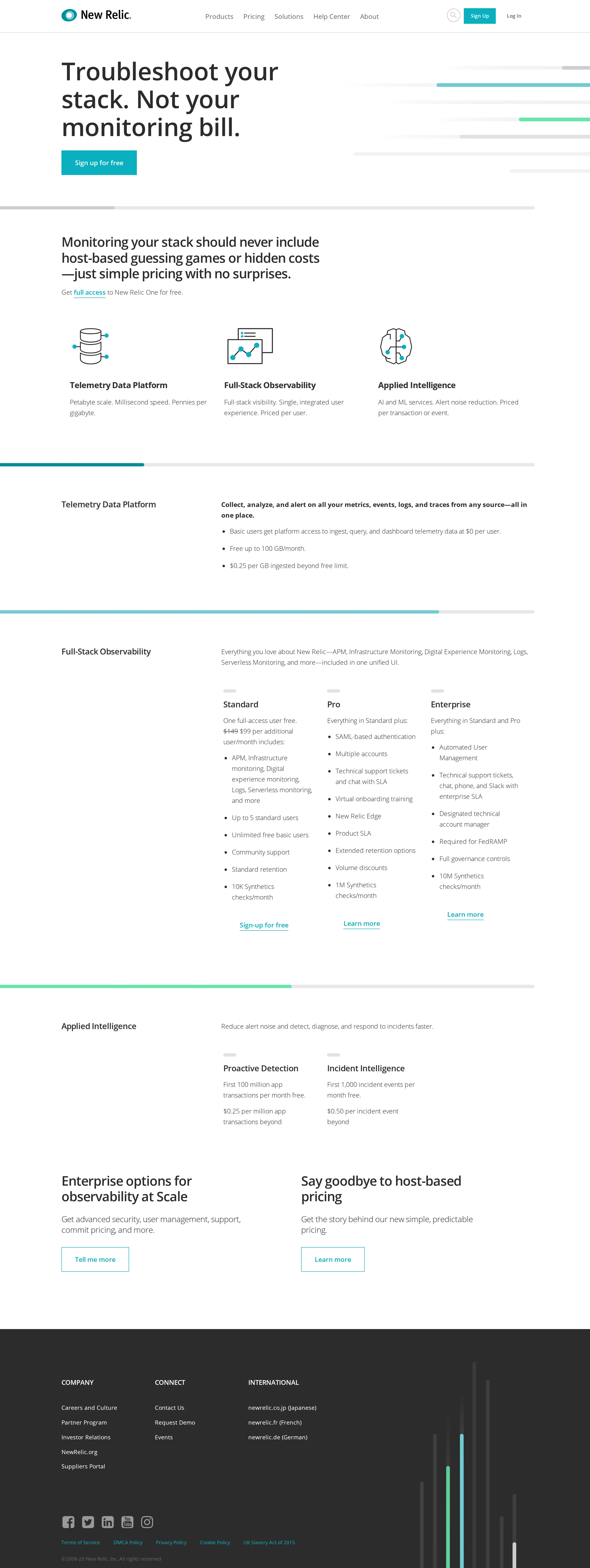
- · New Relic's July 2020 'New Relic One' relaunch is widely cited as the first time a public SaaS company completely abandoned subscription pricing for usage-based pricing in full public view — CEO Lew Cirne argued host-based pricing 'has not aged well' against Kubernetes and serverless.
- · A VC case study (TacticalVC) argues the 2020 usage-based pivot compressed New Relic's net revenue retention from roughly 115% to 99% within about a year, versus Datadog holding above 130% NRR over the same stretch — a widely-cited cautionary tale about consumption pricing removing the automatic expansion floor.
- · Francisco Partners and TPG took New Relic private for $6.5B in November 2023 (announced July 31, 2023, closed November 8, 2023) at $87/share — roughly a 26% premium to its 30-day average price, following a stock decline from ~$98 to ~$60 earlier that year.
Questions & answers
- Is New Relic free to use?
- Yes — the Free edition includes 100 GB of data ingest per month, one free Full Platform user, and unlimited free Basic users forever, with no credit card required. Beyond that, data costs $0.40/GB and additional Full Platform users require a paid edition.
- How much does New Relic actually cost for a mid-size engineering team?
- A team of 10 Full Platform users on Pro with moderate data volume (say 500 GB/month) would pay roughly $3,490/month in user fees (10 × $349, annual commitment) plus about $160/month in data overage (400 GB × $0.40), before any Advanced Compute add-on — commonly $3,500-$4,500/month all-in, excluding AI features.
- What's the difference between Basic, Core, and Full Platform users?
- Basic users are always free and can query data, use dashboards, and get basic alerting, but can't access curated UIs like APM. Core users ($49/user/month) add CodeStream, Errors Inbox, and the log management UI. Full Platform users get the full curated observability UI (APM, infrastructure, mobile, synthetics) and are the most expensive tier.
- Are New Relic AI and other AI features included in the price?
- No. New Relic AI, Agentic AI, Autopilot, Security RX, and Transaction 360 are only available through the Advanced Compute add-on, a separate consumption-based charge metered in Advanced Compute Capacity Units (aCCUs) with rates available only via Contact Sales — they are not bundled into the base per-user or per-GB price.
- Why did New Relic get taken private in 2023?
- Francisco Partners and TPG acquired New Relic for $6.5 billion in November 2023. The deal followed New Relic's 2020 shift to usage-based pricing, which a VC case study links to net revenue retention falling from roughly 115% to 99% within about a year — weaker growth predictability than usage-pricing peers like Datadog maintained over the same period.
- What is Core Compute and how is it different from per-user pricing?
- Core Compute, in Public Preview since July 2024, replaces per-user licensing entirely: an unlimited number of users get full-stack observability access, and the bill is based purely on Core Compute Capacity Units (CCUs) consumed by successful queries, alerts, API calls, and page loads. It's currently reachable only by talking to a New Relic account executive.