AI Summary
About
Observe.AI is an enterprise Agentic CX platform for contact centers, headquartered in Redwood City, CA (275 Shoreline Drive, Suite #450). It sells AI agents across three surfaces — for customers (autonomous voice/chat agents that resolve inquiries end-to-end), for frontline teams (real-time guidance and task automation), and for operations (auto QA, coaching, and insights that evaluate every interaction). As of mid-2026 the site markets the platform as five named modules: Agent Platform, Agent Harness, CoBuilder, Interaction Intelligence, and Interaction Fabric, organised around a build → orchestrate → govern → evaluate → optimize lifecycle (“Turn your SOPs into production-ready agents in a governed workspace. Draft with CoBuilder, wire up actions, and ship safely with versioned rollout”). Supporting capabilities include conversation intelligence, screen recording, omnichannel support, and 200+ out-of-the-box integrations.
Observe.AI raised a $125M Series C in April 2022 led by SoftBank Vision Fund 2 (with Zoom joining as an investor, plus Menlo Ventures, Nexus, Scale, NGP Capital and Next47), bringing total funding to roughly $214M. Third-party trackers report revenue of about $44.2M in 2024 (up from ~$30.1M in 2023). The company launched VoiceAI Agents in March 2025 to automate routine calls, and reported layoffs in 2025 (including impact to its channel/partner organization).
For the most current information, visit Observe.AI. Note: there is no public pricing page — the /pricing URL returns a 404.
Pricing summary : How Observe.AI’s pricing model works
On its own site Observe.AI is fully sales-led: no published price list, no self-serve signup, and the public /pricing URL still returns 404. Direct deals are quoted per deal — the reported structure is a per-agent (per-seat) annual license plus a platform fee, sold modularly across the Agent Platform, Agent Harness, CoBuilder, Interaction Intelligence and Interaction Fabric surfaces, so contract value scales with both seat count and module mix. That makes it a committed-use enterprise contract rather than a rate card.
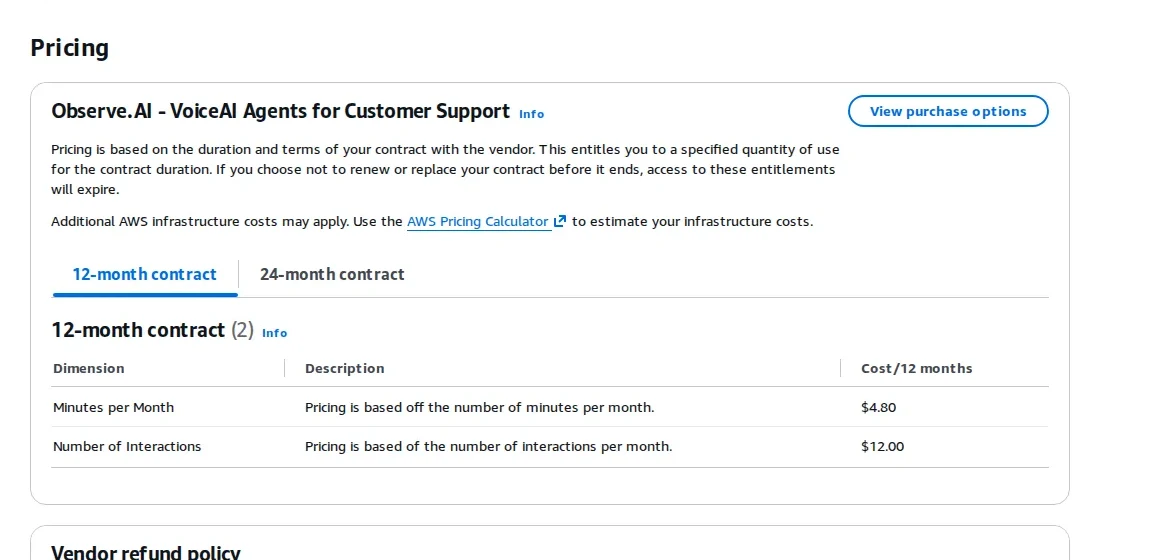
The one place Observe.AI does publish unit prices is AWS Marketplace, and those prices are not per-seat. The VoiceAI Agents for Customer Support listing is a prepaid SaaS contract priced on two usage dimensions:
- Minutes per Month — $4.80 per unit for a 12-month contract, $9.60 for a 24-month contract (“Pricing is based off the number of minutes per month”).
- Number of Interactions — $12.00 per unit for a 12-month contract, $24.00 for a 24-month contract (“Pricing is based of the number of interactions per month”).
- The 24-month rates are exactly double the 12-month ones — a longer commitment buys no posted discount.
- The contract “entitles you to a specified quantity of use for the contract duration”; if you don’t renew or replace it, access to those entitlements expires, and no refunds are given during an active subscription.
Third-party guides still report a ~100-seat minimum and annual-only commitment for direct deals, with full-platform 100-seat deployments in the six figures per year — those remain third-party-reported, not confirmed by Observe.AI.
What makes this different: the direct motion sells the agent seat, a unit contact-center buyers already budget by headcount, while the marketplace SKU meters media minutes and interactions — the automation-era units. The same vendor therefore prices the human-assist story and the deflection story on two different meters, and only the second one is public.
Pricing by product
VoiceAI Agents for Customer Support (AWS Marketplace contract)
| Tier | Price | Included | Key mechanics |
|---|---|---|---|
| 12-month contract — Minutes per Month | $4.80 per unit / 12 months | ”Pricing is based off the number of minutes per month” | Prepaid entitlement to a specified quantity of use |
| 12-month contract — Number of Interactions | $12.00 per unit / 12 months | ”Pricing is based of the number of interactions per month” | Second, independent dimension on the same contract |
| 24-month contract — Minutes per Month | $9.60 per unit / 24 months | Same minutes dimension over a two-year term | Exactly 2x the 12-month rate; no posted long-term discount |
| 24-month contract — Number of Interactions | $24.00 per unit / 24 months | Same interactions dimension over a two-year term | No refunds during an active subscription |
Direct / full platform (sales-led)
| Tier | Price | Included | Key mechanics |
|---|---|---|---|
| Full platform | Custom quote | Agent Platform, Agent Harness, CoBuilder, Interaction Intelligence, Interaction Fabric | Demo → scoping → quote; no list price (/pricing 404s) |
| AWS private offer | Custom quote | Negotiated terms layered on the marketplace listing | ”Request a private offer to receive a custom quote” |
| Other marketplace SKUs | Not shown on the VoiceAI listing | Post-Interaction AI, Real-Time AI, Screen Recording (separate AWS listings) | Modular — each product is subscribed to separately |
Sales motions across products: sales-led for the full platform, private offers and every module bought direct; marketplace self-serve subscription only for the VoiceAI Agents contract. No free tier and no monthly option — the shortest published term is 12 months, and unused entitlements expire at term end rather than rolling over.
Hidden costs : What Observe.AI users actually pay
Because pricing is quoted and modular, the real cost is shaped by how many modules you attach and the ~100-seat floor, not a published rate card. The biggest “hidden” factors buyers cite: each product (VoiceAI Agents, Auto QA, Copilot, etc.) prices separately, so bundling several quickly multiplies contract value; a platform fee sits on top of per-seat license; and professional-services implementation (commonly 4–12 weeks) is typically a separate line.
| Line item | Annual cost (third-party-reported, illustrative) |
|---|---|
| Per-agent license — direct deal | quoted (no published per-seat rate) |
| VoiceAI Agents via AWS Marketplace | prepaid contract on minutes-per-month and interactions dimensions |
| Platform fee + additional modules | varies (quoted) |
| Professional services / implementation | separate line (quoted) |
| Reported full-platform 100-seat range | wide range, quote-dependent |
Outside the Facts table, third-party guides (CloudTalk) put full-platform 100-seat deployments in the low-to-high six-figure range per year (buyer reports span roughly the high-five-figure to low-to-mid-six-figure band), depending on module mix and contract length — treat these as buyer-reported and indicative, not official. Other things to budget for: the annual commitment removes the option to pilot month-to-month; early termination likely carries penalties; and module pricing is opaque until you receive a quote, making apples-to-apples comparison hard pre-sales.
Want to estimate your own Observe.AI bill? Use the Observe.AI pricing calculator to model your costs based on seat count and module mix.
Pricing evolution : Observe.AI pricing history and changes
Cadence
| Period | Price changes | Product / SKU additions | Notes |
|---|---|---|---|
| 2022 | — | Series C ($125M, SoftBank-led) | Scaled conversation-intelligence + QA platform |
| 2025 H1 | — | VoiceAI Agents launch (Mar 2025) | Shift toward autonomous voice automation |
| 2025 | — | Channel/partner layoffs reported | Sales-org restructuring |
| 2026 | No public list price | Agentic CX repositioning | /pricing URL 404s; fully sales-led |
Tracked range: 2022–present. Observe.AI has never published a public price list, so no Wayback price snapshots exist to chart — the evolution here is product and go-to-market, not posted rate cards.
Notable changes
- 2022-04 — Raises $125M Series C led by SoftBank Vision Fund 2 (Zoom joins as investor); ~$214M total funding.
- 2025-03 — Launches VoiceAI Agents to automate routine contact-center calls — the company’s pivot to autonomous “agentic” voice.
- 2025 — Reports layoffs, including impact to the channel/partner organization.
- 2026-06 — Public
/pricingURL 404s; pricing remains a quoted, sales-led per-agent + platform-fee model with a reported ~100-seat minimum.
What’s unique : Observe.AI’s distinctive pricing mechanics
1. Seat-anchored, not token-anchored. In a corpus full of token- and request-metered AI tools, Observe.AI prices on the agent seat — a unit contact-center buyers already budget by headcount. That keeps the meter intuitive for CX leaders but ties revenue to human seats even as the product automates them.
2. Fully gated, modular contract. Nothing is published; everything is quoted. Each module (VoiceAI/ChatAI agents, Copilot, Auto QA) prices separately on top of a platform fee, so two buyers with identical seat counts can pay very different totals. This maximizes negotiating leverage for the vendor and opacity for the buyer.
3. ~100-seat floor + annual-only commit. A reported ~100-seat minimum and mandatory annual contract deliberately filter out small buyers and lock in revenue — a classic enterprise-CCaaS posture, the opposite of the self-serve PLG tools elsewhere in this corpus.
Strengths & weaknesses
| Strengths | Weaknesses |
|---|---|
| Seat-based metric maps to how CX teams already budget | No public pricing at all — /pricing URL 404s |
| Modular packaging lets buyers attach only the products they need | Module-by-module pricing is opaque until you get a quote |
| Enterprise posture (annual commit) gives revenue predictability | ~100-seat minimum and annual-only commit shut out small/pilot buyers |
| VoiceAI Agents add automation value beyond per-seat assist | Seat-anchored model is awkward as AI deflects the very seats sold |
| Strong funding base ($214M, SoftBank-backed) | 2025 layoffs and channel impact raise execution/continuity questions |
Billing UX : Observe.AI billing controls and transparency
- Contract-term selector (AWS Marketplace) — the listing’s Pricing card carries “12-month contract” / “24-month contract” tabs; switching tabs swaps the whole dimension table (
$4.80→$9.60on Minutes per Month,$12.00→$24.00on Number of Interactions). There is no monthly option. - “View purchase options” and “Request private offer” — the two buy paths on the marketplace listing: self-serve subscription to the published contract, or a negotiated custom quote. Both sit alongside a “Request demo” button.
- Entitlement-expiry rule — stated verbatim on the listing: “If you choose not to renew or replace your contract before it ends, access to these entitlements will expire.” The vendor refund policy adds that “during the term of an active subscription, no refunds will be provided.”
- AWS Pricing Calculator link — the listing warns that “additional AWS infrastructure costs may apply” and links the AWS Pricing Calculator to estimate them; Observe.AI itself publishes no cost calculator or rate card.
- PNC Vendor Finance line of credit — AWS Marketplace surfaces financing for the purchase (US customers, excluding NV, NC, ND, TN and VT).
- Support and change management — a named Customer Success Manager and Technical Success Manager plus ticketing through the Observe.AI Help Center; direct contract changes (seats, modules) go through the account team, not an in-app toggle.
Strategic wins : Why Observe.AI’s pricing decisions worked
1. Pricing on a metric buyers already trust
Anchoring on the agent seat lets Observe.AI sell into contact-center budgets that are already organized by headcount, sidestepping the “what’s a token?” education problem that pure-usage AI tools face. See how AI companies structure pricing.
2. Modular packaging to expand accounts
Selling VoiceAI, ChatAI, Copilot, and Auto QA as separate modules creates a natural land-and-expand path — start with QA, add agents later — growing contract value without renegotiating the core seat license. Related: outcome-based pricing trends.
3. Enterprise commitment for predictable revenue
The ~100-seat floor and annual-only commit trade addressable market for revenue predictability and qualification, concentrating effort on large regulated contact centers where switching costs are high. See choosing the right usage metric.
Areas to improve : Gaps in Observe.AI’s pricing approach
1. Zero pricing transparency
A 404 on /pricing and no published rate card force every buyer into a sales motion just to learn rough cost. Even a posted “starting at” or a public methodology would reduce friction and shorten cycles. See bill shock and cost unpredictability.
2. Seat metric vs. automation thesis
If VoiceAI Agents succeed at deflecting calls, the customer needs fewer human seats — directly eroding a per-seat revenue base. Observe.AI will need an outcome/automation-based meter (resolved conversations, automated minutes) to keep value and price aligned.
3. High floor blocks experimentation
A reported ~100-seat minimum and annual-only commitment prevent the small pilots that build category trust. A capped pilot SKU or short-term trial would widen the funnel without undermining the enterprise motion.
Monetization stack & signals : how Observe.AI builds & buys its revenue engine
Buys 1 Builds 0 1 signal role
Runs the textbook sales-led CRM spine — Salesforce, named as the sales team's own tool across AE and SDR postings — exactly as the gated, quoted, per-agent contract implies; no billing/metering/CPQ vendor surfaces because the meter is the negotiated contract, not software. The signal worth watching is the value hire below: a Business Value Consultant building ROI business cases ties price to QA/AHT/churn outcomes — the value-engineering muscle a seat-anchored vendor needs as VoiceAI Agents automate the seats it sells.
-
“Operate With Modern Sales Tools + GenAI — Leverage a modern sales tech stack (Salesforce, Gong, Outreach, ZoomInfo, 6sense, Clari)”
- Billing Billing inferred
-
The value-engineering tell: a hybrid pre-sales/post-sales role whose whole job is quantifying ROI against contact-center KPIs (QA score uplift, AHT reduction, churn risk). For a vendor with no published price and a per-agent meter under pressure from its own automation, the price-to-value bridge is consulting headcount, not a packaging or metering build.
“Partner with AEs and Solutions Engineers on enterprise deals: run discovery, map pain points to product, and translate findings into business cases, dashboards, and ROI narratives that resonate with economic buyers”
3 more matched roles — supporting evidence
- Senior Customer Success Manager Customer success Jun 22, 2026
- Engagement Manager - AI Agents Customer success Jun 22, 2026
- Sr. Manager, Integrated Campaigns and ABX RevOps Jun 22, 2026
Signals reviewed · derived from public job posts
Job postings fill and close over time — once a posting is filled we keep it as a dated citation (the quoted evidence remains); use View open roles for current listings.
Key takeaways
- Observe.AI publishes nothing — pricing is fully sales-led. The
/pricingURL 404s; expect a quoted per-agent license plus a platform fee, with modules priced separately. - The direct value metric is the agent seat — but the public one isn’t. Direct deals are quoted per agent with third-party-reported ~100-seat minimums and six-figure annual totals, while the only listed prices (AWS Marketplace) meter minutes per month and number of interactions instead.
- Annual-only, no free tier. A mandatory annual commit and no monthly option signal an enterprise CCaaS posture, not a self-serve tool.
- Modular packaging drives expansion — and opacity. Identical seat counts can cost very differently depending on attached modules.
- Automation strains the seat model. As VoiceAI Agents deflect calls, a per-seat base sits in tension with the product’s own value proposition.
UBP implications
- Seat-based is durable where buyers budget by headcount, but it ages poorly when the product’s job is to remove those seats — a tension every contact-center AI vendor now faces. See usage-based pricing strategy.
- Full opacity is a deliberate enterprise choice, trading shorter sales cycles for negotiating leverage; it works at high ACV but blocks the bottom-up adoption that powers PLG competitors.
- The automation era pushes toward outcome metrics (resolved/deflected conversations, automated minutes); vendors anchored on human seats will need a credible path to repricing on outcomes.
Sources
- Observe.AI official website (accessed 2026-07-22)
- Observe.AI Agent Platform (accessed 2026-07-22)
- Observe.AI /pricing URL — returns 404 on live capture (accessed 2026-07-22)
- AWS Marketplace — Observe.AI VoiceAI Agents for Customer Support (accessed 2026-07-22)
- Observe.AI raises $125M Series C (SoftBank Vision Fund 2) (accessed 2026-06-09)
- TechCrunch — Observe.ai raises $125M, adding Zoom as investor (accessed 2026-06-09)
- Observe.AI launches VoiceAI Agents (press release, Mar 2025) (accessed 2026-06-09)
- Getlatka — Observe.AI revenue ($44.2M, 2024) (accessed 2026-06-09)
Bottom line
Observe.AI is a SoftBank-backed (~$214M raised) enterprise Agentic CX platform for contact centers — AI agents for customers, frontline copilots, and operations Auto QA. Its pricing is fully sales-led with no public list (the /pricing URL 404s): a quoted per-agent license plus platform fee, sold modularly, with a reported ~100-seat minimum and annual-only commitment. The only published prices sit on AWS Marketplace, where VoiceAI Agents is sold as a prepaid 12- or 24-month contract metered on minutes per month and number of interactions; third parties still cite six-figure annual cost for 100-seat deployments, indicative and not official. The open question is whether a seat-anchored model survives as VoiceAI Agents automate the very seats it prices. Browse the pricing blueprint for more fully-researched company profiles.
Want to compare Observe.AI against other contact-center and AI-agent companies? Browse the pricing blueprint.
Pricing timeline : Major events on a vertical axis
Each milestone below corresponds to a public pricing change, product launch, or material adjustment. Major events use a filled marker; minor adjustments use a faded one.
AWS Marketplace VoiceAI listing meters minutes and interactions
Observe.AI's AWS Marketplace listing for VoiceAI Agents for Customer Support prices two usage dimensions on a prepaid contract — Minutes per Month at $4.80 and Number of Interactions at $12.00 per unit for 12 months, and $9.60 / $24.00 for 24 months (the same effective rate, no long-term discount). No per-agent seat dimension appears on the listing. Observe.ai's own /pricing URL still 404s.
Sales-led, quoted per-agent + platform-fee model (no public price)
Observe.AI's public /pricing URL 404s; pricing is fully sales-led. Reported model: annual contract with a per-agent (per-seat) license plus platform fee, sold modularly (VoiceAI/ChatAI agents, Agent Copilot, Auto QA). Third parties cite a ~100-seat minimum and six-figure annual cost for 100-seat deployments.
- · Observe.AI's public /pricing URL returns a 404 ('Lost In Space') — there is no published price list; everything is quoted by sales.
- · Third-party guides report a ~100-seat minimum and a mandatory annual commitment, with no monthly billing and no free trial.
- · The only published Observe.AI prices sit on AWS Marketplace, and they are not per-seat: the VoiceAI Agents listing meters Minutes per Month and Number of Interactions on a prepaid 12- or 24-month contract.
Questions & answers
- What is Observe.AI's pricing model?
- Observe.AI is sales-led and does not publish list prices. The reported structure is a quoted annual contract combining a per-agent (per-seat) license with a platform fee, priced modularly across products like VoiceAI/ChatAI agents, Agent Copilot and Auto QA. A roughly 100-seat minimum and annual commitment are commonly reported by third parties.
- Does Observe.AI offer a free tier?
- No. There is no free tier and no public self-serve plan. Buyers go through a demo and a custom quote; third-party guides report no monthly billing option and no free trial — only annual commitments.
- How much does Observe.AI cost per agent?
- Observe.AI does not publish a per-agent price. The only listed prices are on AWS Marketplace, where VoiceAI Agents for Customer Support is sold as a contract priced on two usage dimensions — $4.80 per Minutes-per-Month unit and $12.00 per Number-of-Interactions unit for a 12-month term. Full-platform, direct deals are quoted; third-party guides put 100-seat deployments in the six figures per year.
- Is Observe.AI pricing usage-based or subscription?
- Both. Direct deals are reported as a per-agent license plus platform fee on an annual contract, while the AWS Marketplace VoiceAI Agents listing is a prepaid usage contract metered on minutes per month and number of interactions. Neither surface publishes a full-platform rate card.
- Can you buy Observe.AI through AWS Marketplace?
- Yes. Observe.AI lists VoiceAI Agents for Customer Support on AWS Marketplace with 12-month and 24-month contract options, plus a 'Request private offer' path for a custom quote. Separate listings exist for Post-Interaction AI, Real-Time AI and Screen Recording.