AI Summary
About
OpenRouter is a multi-model LLM API marketplace: one API key, one balance, and unified access to 400+ models from 70+ providers (OpenAI, Anthropic, Google, Meta, Mistral, DeepSeek, and dozens more), with automatic routing, fallbacks, and provider-level price/latency comparison. It was founded in early 2023 by Alex Atallah, co-founder and former CTO of OpenSea, and grew into the default aggregation layer for developers who want to switch models without re-integrating.
The growth curve is steep: annualized inference spend through the platform went from $10M in October 2024 to over $100M by May 2025, and by May 2026 OpenRouter reported 8 million users and ~100 trillion tokens processed per month. It raised a $12.5M seed (a16z, February 2025) and a $28M Series A (Menlo Ventures, April 2025) — announced together as a $40M round at a ~$500M valuation in June 2025 — then a $113M Series B led by Alphabet’s CapitalG at ~$1.3B post-money in May 2026.
For the most current information, visit OpenRouter.
Pricing summary : How OpenRouter’s pricing model works
OpenRouter has no subscription plans and no markup on models. Every model’s per-token input/output price is passed through at the same rate the underlying provider charges directly. You fund usage with prepaid credits, and OpenRouter monetizes the transaction: a 5.5% platform fee on each non-crypto credit purchase, with a minimum fee of $0.80 (crypto payments pay a flat 5.0% with no minimum). There is no minimum spend and no lock-in.
Two other modes round out the structure. A free tier offers 25+ free model variants from 4 providers, capped at 20 requests/minute and 50 requests/day — rising to 1,000/day once you’ve bought at least $10 of credits. And BYOK (bring your own key) lets you attach your own provider API keys while keeping OpenRouter’s routing and analytics: the first $25,000 of list-price inference per month runs with no fees, then OpenRouter charges 5% of what the same model and provider would normally cost. Enterprise is quoted, with volume commitments, bulk fee discounts, invoicing, a larger $200,000/month of list-price inference free on BYOK, SSO/SAML, and contractual SLAs.
What makes this different: OpenRouter is a true marketplace take-rate model — rare in AI infrastructure. It doesn’t sell compute, seats, or subscriptions; it sells liquidity and optionality across providers, and skims a fee off the money flowing through. The price you compare on its models page is the provider’s own price.
Pricing by product
| Tier | Price | Included | Key mechanics |
|---|---|---|---|
| Free | $0 | 25+ free models, 4 free providers | 20 req/min; 50 req/day (1,000/day with $10+ lifetime credits) |
| Pay-as-you-go | 5.5% fee per credit purchase (min $0.80) | 400+ models, 70+ providers, per-token pass-through pricing | Prepaid credits; crypto fee 5.0% flat; no minimum spend, no lock-in |
| BYOK | 5% of normal model cost (after free allotment) | $25,000/month of list-price inference free | Use your own provider keys; keeps routing, fallbacks, analytics |
| Enterprise | Custom | $200,000/month of list-price inference free on BYOK, bulk fee discounts | Volume commitments, invoicing, SSO/SAML, contractual SLAs, dedicated limits |
Sales motions across products: self-serve PLG for Free and Pay-as-you-go (sign up, buy credits, go), and sales-led for Enterprise (contact sales, custom contracts). Payment options include credit/debit cards, crypto, and bank transfers.
Hidden costs : What OpenRouter users actually pay
The headline “no markup” is real — but the all-in cost is model spend plus the credit-purchase fee, and the fee’s shape penalizes small top-ups: on a $5 purchase the $0.80 minimum is an effective 16%, while on a $100 purchase the 5.5% fee is $5.50. Heavy users who top up in large increments pay close to the nominal rate; drip-feeders pay materially more.
| Line item | Monthly cost (illustrative, $500 model spend) |
|---|---|
| Model usage (pass-through, same as going direct) | $500.00 |
| Credit-purchase fee (5.5% on one $500 top-up) | $27.50 |
| Same spend topped up $25 at a time (20 × $1.38) | $27.60 — but $5 top-ups would cost $0.80 each (16%) |
| BYOK usage beyond $25,000/mo of list-price inference | 5% of normal model cost |
| Estimated total | ~$527.50 |
Other things to budget for: credits are prepaid, so OpenRouter holds your float and you carry balance-management overhead; BYOK’s 5% kicks in silently once you cross $25,000 of list-price inference in a month; and free-model daily caps (50 requests) make the free tier a sandbox, not a workload home, until you’ve bought $10 of credits.
Want to estimate your own OpenRouter bill? Use the OpenRouter pricing calculator to model your costs based on usage patterns.
Pricing evolution : OpenRouter pricing history and changes
Cadence
| Period | Price changes | Product / SKU additions | Notes |
|---|---|---|---|
| 2023 | Launch | Multi-model marketplace, prepaid credits | Pass-through token prices from day one |
| 2024 | — | Model catalog scales | Inference run-rate hits $10M (Oct) |
| 2025 H1 | Fee simplification (Jun 9) | — | Old %-plus-$0.35 formula → flat 5.5% (min $0.80); crypto 5.0% |
| 2025 H2 | — | Dedicated /pricing page (by Oct 31) | Free / PAYG / Enterprise formalized; BYOK allotments published |
| 2026 H1 | — | Enterprise tier marketed harder | Series B $113M at ~$1.3B (May); 100T tokens/month |
| 2026 H2 | — | BYOK free allotment re-based to $ value (Jul 14) | 1M/5M free reqs → $25K/$200K of list-price inference; 5% fee unchanged; providers 60+→70+ |
Tracked range: 2023–present, via Wayback Machine snapshots (2023-05, 2025-01, 2025-09, 2025-10, 2026-01/03/06) and a live 2026-06-10 capture.
Notable changes
- 2023 (spring) — Launches as a marketplace aggregating LLMs behind one API; per-token provider prices pass through, funded by prepaid credits with a purchase fee.
- 2025-06-09 — Fee simplification: the old credit-purchase fee (a percentage plus a fixed $0.35 Stripe charge) becomes a flat 5.5% with a $0.80 minimum; crypto moves to 5.0% flat. A $25 order’s fee drops $1.67 → $1.38; a $5 order rises to $0.80. OpenRouter also signals the 5% BYOK usage fee will eventually be replaced by a fixed monthly subscription.
- 2025-09→10 —
/pricingstops redirecting to the models list and becomes a real Free / Pay-as-you-go / Enterprise comparison page, publishing the 5.5% platform fee, BYOK allotments (1M free reqs/month then 5%; 5M on Enterprise), and free-tier limits. - 2026-05-26 — $113M Series B led by CapitalG at ~$1.3B post-money; OpenRouter reports 8M users and ~100T tokens/month, with weekly token volume up 5x in six months.
- 2026-07-14 — BYOK free tier re-based from requests to dollars: the free bring-your-own-key allotment stops counting requests (1M/month on Pay-as-you-go, 5M on Enterprise) and instead measures $25,000/month of list-price inference (Pay-as-you-go) and $200,000/month (Enterprise), with the 5% fee unchanged after. Denominating the free ceiling in inference value rather than request volume aligns it with OpenRouter’s take-rate economics — an expensive call and a cheap one no longer count the same — and the pricing page’s advertised provider count ticked from 60+ to 70+.
What’s unique : OpenRouter’s distinctive pricing mechanics
1. A take rate, not a price. OpenRouter is the only company in this corpus whose core monetization is a marketplace fee on money flowing through the platform rather than a price on its own product. The 5.5% credit fee works like a payment-plus-aggregation toll: model prices stay identical to going direct, so the comparison-shopping objection (“am I paying a markup?”) is structurally answered on the pricing page itself.
2. BYOK as a metered escape valve. Most aggregators lose the customer once they sign a direct provider contract. OpenRouter instead prices retention: bring your own keys, keep the routing and analytics, and pay 5% of what the model would have cost — free below $25,000 of list-price inference/month, $200,000 on Enterprise. As of July 2026 that free ceiling is denominated in dollars of list-price inference, not request count (it was 1M/5M requests through mid-2026), so the giveaway scales with the value flowing through rather than raw call volume — the same unit its take rate rides on. It converts churn into a discounted SKU.
3. The free tier is a loyalty switch, not just a trial. Free-model limits jump from 50 to 1,000 requests/day once you’ve bought just $10 of lifetime credits — a tiny commitment that flips users from anonymous samplers into funded accounts, while the 25+ free models cost OpenRouter little (they’re providers’ own free variants).
Strengths & weaknesses
| Strengths | Weaknesses |
|---|---|
| Zero markup on 400+ models — price-comparison objection removed | Take-rate revenue is thin: ~5% of flow means modest revenue on huge volume |
| One balance, one API across 70+ providers; no minimums or lock-in | $0.80 minimum fee punishes small top-ups (16% on a $5 purchase) |
| BYOK pricing retains customers who sign direct provider deals | Prepaid-credits-only: no postpaid billing below Enterprise |
| Fee structure is public, simple, and was simplified in users’ favor | Routing layer adds a dependency between you and every provider |
| Free tier with 25+ models is a genuine on-ramp | Pass-through pricing means OpenRouter can’t shield users from provider price hikes |
Billing UX : OpenRouter billing controls and transparency
- Billing controls — Prepaid credits with self-serve top-ups (card, crypto, bank transfer); no minimum spend or lock-in on pay-as-you-go. Budgets and spend controls, per-environment API keys, and a management API are built into the platform; Enterprise adds admin controls and invoicing.
- Usage visibility — Every model’s per-token input/output price is published on the models page, and activity logs with export cover per-request spend. The pricing page itself states the platform fee, BYOK allotments, and rate limits in one comparison table — unusually transparent for AI infrastructure.
- Payment options — Credit/debit cards, crypto (5.0% flat fee), and bank transfers self-serve; Enterprise gets invoicing options and volume commitments with bulk discounts on the platform fee.
Strategic wins : Why OpenRouter’s pricing decisions worked
1. No-markup pass-through built the marketplace
By guaranteeing you pay exactly the provider’s rate, OpenRouter removed the core reason not to use an aggregator. That neutrality attracted both sides of the market — 8M users and 70+ providers by 2026 — and made the models page itself the industry’s de facto price sheet. The fee sits on the transaction, where it’s least resented. See usage-based pricing strategy.
2. Monetizing the off-ramp with BYOK
The 5% BYOK fee (after $25,000/month of list-price inference free) turned the classic aggregator failure mode — customers graduating to direct contracts — into a revenue line. Teams keep OpenRouter’s routing, fallbacks, and analytics at a fraction of full pass-through economics. Related: how AI companies structure pricing.
3. Simplifying the fee in public
The June 2025 move from an opaque %-plus-$0.35 formula to a flat 5.5% (min $0.80) was announced with worked examples showing most users paying less. For a business whose entire pitch is price transparency, making the take rate trivially calculable was on-brand and cheap goodwill — a contrast with the outcome-based pricing wave, which moves fees further from the meter. See choosing the right usage metric.
Areas to improve : Gaps in OpenRouter’s pricing approach
1. Small top-ups pay an outsized toll
The $0.80 minimum makes a $5 purchase cost 16% in fees — exactly the hobbyist segment the free tier courts. A lower minimum, or fee-free auto-top-up above a threshold, would smooth the on-ramp. See bill shock and cost unpredictability.
2. Prepaid-only below Enterprise
There is no postpaid or net-terms option for mid-size teams: finance departments must manage a credit float and reconcile top-ups rather than receive a monthly invoice. A usage-billed tier between PAYG and Enterprise would fit teams spending thousands per month.
3. Thin-margin exposure to provider economics
A ~5% take on pass-through flow means OpenRouter’s revenue scales only with gross spend, and provider price cuts (which are constant in AI) directly shrink the fee base. The announced shift of BYOK from a 5% usage fee to a fixed monthly subscription hints the company knows it needs flatter, margin-bearing SKUs.
Monetization stack & signals : how OpenRouter builds & buys its revenue engine
Buys 1 Builds 1 2 signal roles
OpenRouter buys its payments rail (Stripe) but builds the metering, billing and spend-management surface in-house — fitting for a marketplace whose whole product IS the meter. The signal to watch is the first enterprise GTM build-out: a CSM role that explicitly owns "the revenue lifecycle" on a self-serve, take-rate core.
- Billing & spend-management surface In-house build Job post Apr 2026
“build the surfaces our customers depend on — dashboards, admin tooling, billing and spend management, analytics, onboarding”
-
“One command creates the account, generates an API key, wires up billing through Stripe, and drops the credentials into your .env”
- CRM CRM inferred
-
OpenRouter's value metric is token/inference volume, not seats: the CSM owns "the revenue lifecycle" and expands usage across product lines — a sales-led, consumption-expansion motion layered onto the self-serve take-rate core.
“own the revenue lifecycle, own and drive massive inference outcomes ... turn abstract AI goals into concrete ROI metrics”
- Software Engineer, Product Billing engineering seen Apr 23, 2026
The billing/metering UI is an in-house product surface, not a bought billing platform — consistent with a marketplace that operates its own credit ledger, 5.5% fee and per-token pass-through accounting.
“dashboards, admin tooling, billing and spend management, analytics, onboarding”
4 more matched roles — supporting evidence
- Enterprise Account Executive Customer success Jun 18, 2026
- Forward Deployed Engineer Customer success Jun 18, 2026
- Scaled Customer Success Manager, Startups Customer success Jun 18, 2026
- Scaled Support Specialist Customer success Jun 18, 2026
Signals reviewed · derived from public job posts, engineering blogs
Job postings fill and close over time — once a posting is filled we keep it as a dated citation (the quoted evidence remains); use View open roles for current listings.
Key takeaways
- A take rate can be the whole pricing model. OpenRouter charges nothing for its product and ~5% on the money moving through it — and reached a $1.3B valuation on that toll.
- Neutrality is a pricing feature. “No markup, same price as direct” removed the comparison objection and made OpenRouter’s catalog the market’s reference price sheet.
- Price the off-ramp. BYOK at 5% of normal cost converts would-be churn into a discounted retained customer.
- Fee minimums shape behavior. The $0.80 floor quietly taxes small top-ups at up to 16% — minimums are a real pricing dimension, not rounding.
- Tiny paid commitments unlock loyalty. Gating 20x higher free-model limits behind a one-time $10 credit purchase converts samplers into funded accounts.
UBP implications
- Marketplace take-rates are a fourth UBP archetype. Beyond per-unit, credits, and subscriptions, charging a percentage of flow works when you aggregate supply and guarantee price parity — but it caps revenue at a sliver of GMV.
- Pass-through plus fee maximizes trust in the meter. When the metered price is the provider’s own public price, billing disputes nearly vanish; the vendor’s cut is isolated in one visible line. See usage-based pricing strategy.
- Prepaid credits fund the float but block the mid-market. Credit-only billing works for developers and self-serve, yet enterprises need invoices and commits — OpenRouter’s Enterprise tier exists precisely to bridge that gap.
Sources
- OpenRouter pricing page — live capture; BYOK $25,000/$200,000-per-month dollar caps re-verified live (accessed 2026-07-14)
- OpenRouter models marketplace — live capture (accessed 2026-06-10)
- OpenRouter FAQ — fees, BYOK, no-markup statement — docs FAQ still cites the retired 1M-request BYOK allotment, while /pricing shows the current $25,000/mo dollar cap (accessed 2026-07-14)
- OpenRouter announcement: Simplifying Our Platform Fee — June 9, 2025 (accessed 2026-06-10)
- OpenRouter raises $40 million — GlobeNewswire — June 25, 2025 (accessed 2026-06-10)
- Menlo Ventures: Investing in OpenRouter (accessed 2026-06-10)
- TechCrunch: OpenRouter more than doubles valuation to $1.3B — May 26, 2026 (accessed 2026-06-10)
- OpenRouter rate limits documentation (accessed 2026-06-10)
- Wayback Machine snapshots: openrouter.ai and /pricing — 2023-05, 2025-01, 2025-09, 2025-10, 2026-01/03/06 (accessed 2026-06-10)
Bottom line
OpenRouter, founded in 2023 by OpenSea co-founder Alex Atallah, is the marketplace layer of the LLM economy: one API and one prepaid balance across 400+ models from 70+ providers, with every per-token price passed through at exactly the provider’s rate. Its revenue is a take rate, not a price — 5.5% on credit purchases (minimum $0.80; 5.0% crypto), 5% on BYOK usage past $25,000/month of list-price inference, and quoted Enterprise deals with volume commitments. Routing ~100 trillion tokens a month for 8 million users, it raised a $113M Series B at ~$1.3B in May 2026 — proof a thin toll on enormous flow can be a venture-scale pricing model. Browse the pricing blueprint for more fully-researched company profiles.
Want to compare OpenRouter against other AI infrastructure companies like Helicone, DeepInfra, or Novita AI? Browse the pricing blueprint.
Pricing timeline : Major events on a vertical axis
Each milestone below corresponds to a public pricing change, product launch, or material adjustment. Major events use a filled marker; minor adjustments use a faded one.
BYOK free allotment moves to a dollar cap ($25K / $200K of list-price inference)
OpenRouter restructures the bring-your-own-key free tier from a request count (1M free reqs/month on Pay-as-you-go, 5M on Enterprise) to a dollar value of list-price inference: $25,000/month free on Pay-as-you-go and $200,000/month on Enterprise, both charging the same 5% fee after. The pricing page's provider count also ticks from 60+ to 70+.
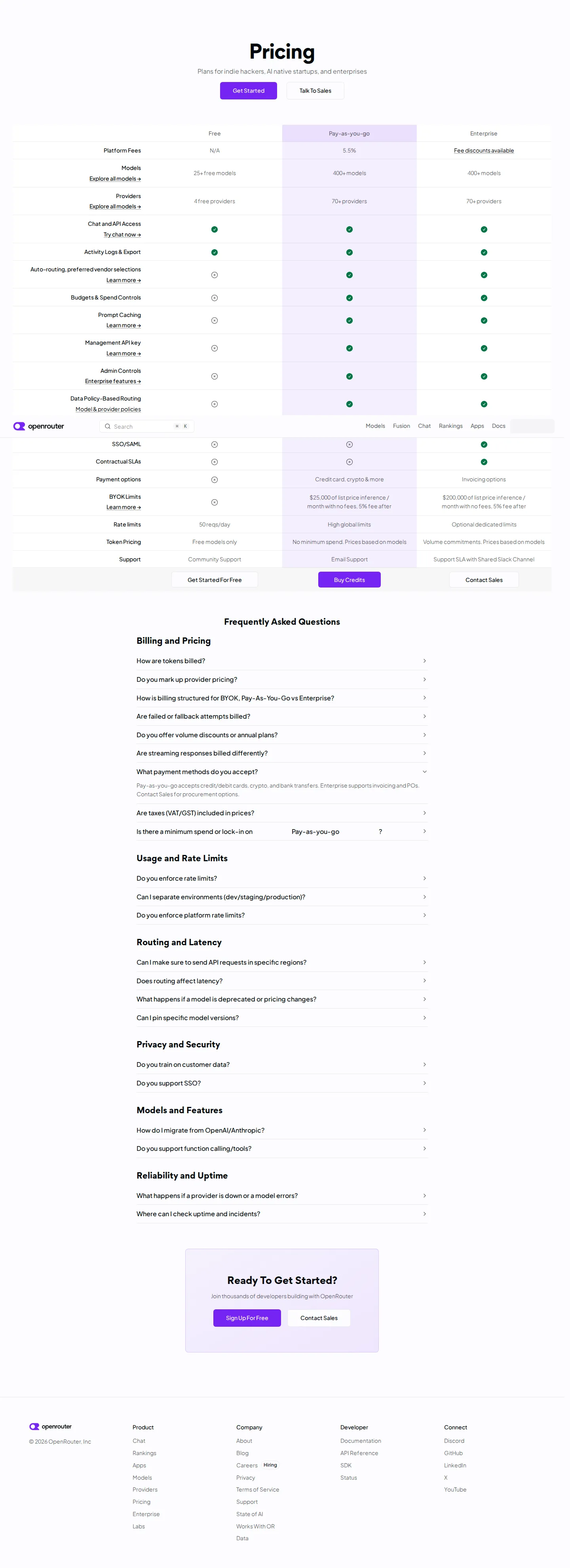
Pass-through tokens + 5.5% credit fee + request-based BYOK tiers
Live structure: Free tier (25+ free models, 4 providers, 50 reqs/day), Pay-as-you-go (400+ models, 60+ providers, 5.5% platform fee on credit purchases, BYOK 1M free reqs/month then 5%, no minimum spend), and Enterprise (volume commitments, bulk fee discounts, 5M free BYOK reqs/month, SSO/SAML, contractual SLAs).
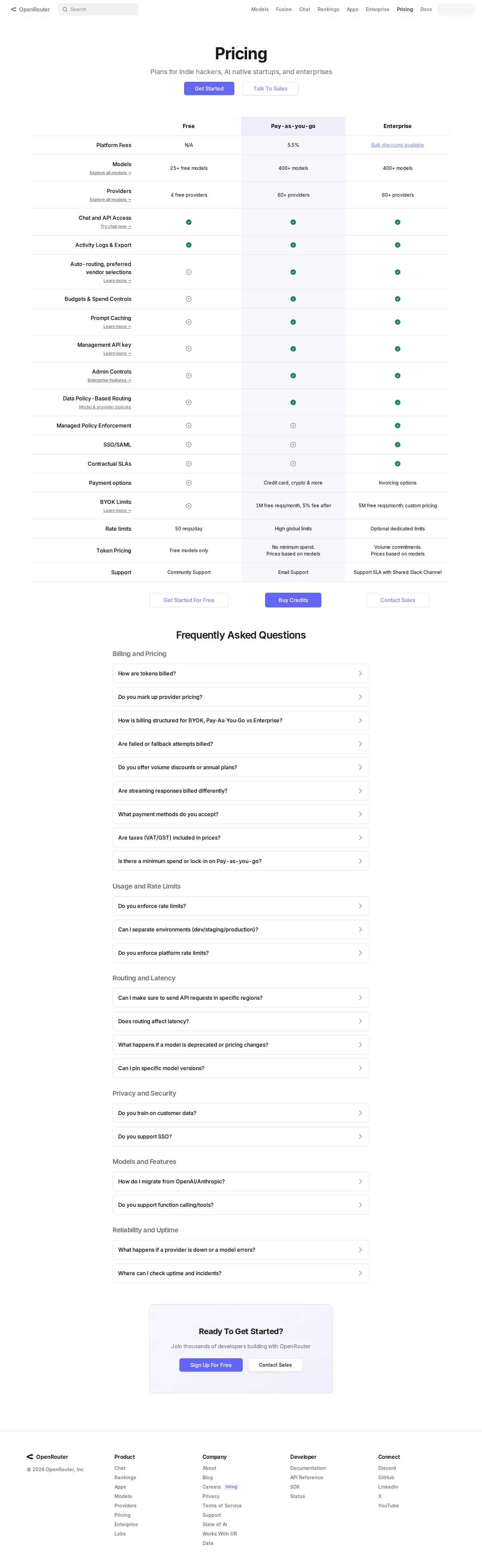
Dedicated /pricing page — Free / Pay-as-you-go / Enterprise
Between September and October 2025, openrouter.ai/pricing stops redirecting to the models list and becomes a real comparison page formalizing three tiers: Free (25+ free models, 50 reqs/day), Pay-as-you-go (5.5% platform fee, 1M free BYOK reqs/month then 5%), and Enterprise (bulk discounts, 5M free BYOK reqs, volume commitments).
Fee simplification — 5.5% (min $0.80) replaces formula
OpenRouter replaces its old credit-purchase fee (a percentage plus a fixed $0.35 Stripe charge) with a flat 5.5% of the order, minimum $0.80; crypto payments move to a flat 5.0% with no minimum. A $25 top-up's fee drops from $1.67 to $1.38, while a $5 top-up rises to $0.80 due to the minimum.
Launch — multi-model marketplace with pass-through pricing
OpenRouter launches in spring 2023 (founded by OpenSea co-founder Alex Atallah) as a marketplace aggregating LLMs behind one API. Model prices are passed through per token and paid via prepaid credits; the platform takes a fee on credit purchases.
- · OpenRouter was founded in early 2023 by Alex Atallah, co-founder and former CTO of NFT marketplace OpenSea — his second marketplace, this time for AI models.
- · OpenRouter charges no markup on model prices at all; its entire self-serve revenue is the 5.5% fee on credit purchases — a marketplace take rate, not a price.
- · Annualized inference spend flowing through OpenRouter grew from $10M in October 2024 to over $100M by May 2025 — at a ~5% take, that implied only single-digit-millions of revenue at a $500M valuation.
Questions & answers
- What is OpenRouter's pricing model?
- OpenRouter passes through the per-token price of each underlying model provider with no markup — you pay the same rate as going direct. The company monetizes through a 5.5% fee (minimum $0.80) when you buy prepaid credits, a flat 5.0% fee on crypto payments, and a 5% fee on bring-your-own-key usage beyond $25,000 of list-price inference per month.
- Does OpenRouter offer a free tier?
- Yes. OpenRouter offers 25+ free model variants from 4 free providers, limited to 20 requests per minute and 50 requests per day. If you have purchased at least $10 of credits lifetime, the daily cap on free models rises to 1,000 requests.
- How much does OpenRouter cost per month?
- There is no subscription — you prepay credits and spend them at each model's per-token rate. The cost is your model usage plus the 5.5% credit-purchase fee (minimum $0.80 per purchase). A $100 top-up costs $105.50; the underlying token prices match what providers charge directly.
- Is OpenRouter pricing usage-based or subscription?
- Purely usage-based. You buy prepaid credits and burn them per token at each model's listed rate, with no monthly subscription, no minimum spend, and no lock-in. Enterprise is the exception: it adds volume commitments, bulk discounts, and invoicing under custom contracts.
- What is OpenRouter's BYOK fee?
- If you bring your own provider API keys, the first $25,000 of list-price inference per month is free; after that OpenRouter charges 5% of what the same model and provider would normally cost through OpenRouter. Enterprise plans raise that free allotment to $200,000 of list-price inference per month.