AI Summary
About
Orb (withorb.com) is a usage-based billing platform that brands itself as “the revenue design platform.” It was founded in 2021 by Alvaro Morales (CEO) and Kshitij Grover (CTO), two engineers who spent five years at Asana and grew frustrated building billing in-house. Orb sits between a company’s product usage data and its invoices, ingesting raw events, computing billable metrics, generating invoices, and feeding revenue recognition — built for companies where billing is mission-critical. Orb leans heavily into the AI and agentic-AI market, supporting prepaid credit models, token-based and per-action pricing, and threshold billing to cap runaway costs from fraud.
Orb has raised roughly $44M total: a $5.1M seed, a $14M Series A announced in March 2023, and a $25M Series B led by Mayfield in September 2024 (with Greylock, Menlo Ventures, basecase, South Park Commons, Scribble Ventures, and Uncorrelated Ventures participating). At the Series B, Orb reported its customer base had tripled and revenue had grown nearly 5x year-over-year. The product targets three buyer personas — finance, product, and engineering — across AI, cloud-infrastructure, and SaaS segments. Public customers and case studies include Vercel, Perplexity, Pinecone, Replit, Stytch (75% reduction in time spent processing bills), Supabase, Materialize, and Dune. Orb stresses scale and trust: ingestion is stress-tested to volumes such as 250,000+ events/second, it is SOC-1 and SOC-2 certified, and offers 99.99% SLAs for mission-critical billing.
Orb competes directly with Metronome, Stripe Billing, and Chargebee in the usage-based billing infrastructure category — even publishing a “Metronome vs. Orb” comparison. Like its peers, Orb runs a fully sales-led go-to-market: there are no self-serve sign-up prices anywhere on its pricing page.
Acquired by Adyen (2026). On 2026-06-11, Dutch payments giant Adyen announced a definitive agreement to acquire Orb for $335M all-cash (a reverse triangular merger), a deal that closed in early July 2026 alongside Adyen’s Talon.One acquisition. The rationale is to fuse usage-based billing with payment processing as AI pushes software toward complex, high-volume usage models. Critically for pricing, this is a continuity event, not a wind-down: Adyen is running an “incubator” model that preserves Orb’s operations, brand, and multi-PSP support in the first phase, so the pricing page and the billings + events + platform-fee model below are unchanged as captured. Longer-term, buyers should expect Orb’s metering to integrate into Adyen’s payments and Dynamic Identification stack.
Pricing summary : billings + events usage plus a platform fee
Orb runs a fully gated, sales-led pricing model: three tiers (Core, Advanced, Enterprise) are all displayed as “Custom pricing” with a “Contact Sales” CTA and no public dollar amounts. Per Orb’s own pricing FAQ, the quoted price is built from two usage metrics plus a fixed platform component — a hybrid pricing model in the same shape Orb tells its customers to use.
The model dimensions, verbatim from the pricing page:
- Billings — the total value of all invoices (fixed fees, usage-based fees, taxes, and every other monetary amount) you issue to your end customers through Orb. This is the primary value-aligned metric.
- Events — raw usage records ingested into Orb (a unique identifier, a timestamp, and optional metadata). Orb ingests at volumes such as 250K+ events/second.
- Platform fee — an additional fixed fee added on the Advanced and Enterprise tiers “to cover additional functionality and support.” (Core does not carry one in the FAQ description.) Exact amount:
unknown(gated).
What makes this different: Orb meters on billings — a percentage of the revenue it helps you collect — not just on raw event volume. That ties Orb’s own pricing to the value it creates (revenue invoiced) rather than purely to its infrastructure cost (events processed), the same value-metric alignment it preaches to customers.
Pricing by product
Orb billing platform (all tiers)
| Tier | Price | Included | Key mechanics |
|---|---|---|---|
| Core | Custom pricing | Real-time event ingestion + alerting, hybrid and usage-based billing, automated price changes, Orb Invoicing, finance and tax integrations | ”For fast setup of usage-based billing”; sales-led, quoted; billings + events metrics |
| Advanced | Custom pricing | Everything in Core, plus data warehouse sync, Salesforce integration, NetSuite integration, customer hierarchy, premium support | ”Most popular”; “for high-velocity sales & finance workflows”; adds a platform fee |
| Enterprise | Custom pricing | Everything in Advanced, plus enterprise-grade SLAs and dedicated support | ”For maximum scale and support”; SLAs documented “in MSA”; adds a platform fee |
All prices are gated — every tier routes to “Contact Sales.” No dollar amounts, seat prices, per-event rates, or platform-fee figures are published; those are unknown until quoted.
Pricing metrics (what the quote is built from)
| Metric | Definition (verbatim from Orb’s FAQ) | Applies to |
|---|---|---|
| Billings | Total value of all invoices (fixed fees, usage-based fees, taxes, all monetary amounts) issued to your customers via Orb | All tiers |
| Events | Raw data records ingested into Orb (unique id + timestamp + optional metadata) | All tiers |
| Platform fee | Fixed fee “to cover additional functionality and support” | Advanced, Enterprise |
Support tiers (by plan)
| Tier | Support level | SLA |
|---|---|---|
| Core | Basic | — |
| Advanced | Premium | — |
| Enterprise | Dedicated (priority support + Quarterly Business Reviews) | Enterprise-grade SLAs, documented “in MSA”; 99.99% SLAs available |
Sales motions across products: sales-led / Contact Sales for all tiers (Core, Advanced, Enterprise). There is no self-serve or PLG purchase path — prospects explore a demo, then contact Sales for a plan recommendation.
Hidden costs : where a gated billings + events quote adds up
Because Orb publishes no rates, an exact bill cannot be modeled from public data — every figure below is unknown until a sales quote. What the screenshots do establish is the cost structure: a billings component (scaling with your invoice volume), an events component (scaling with raw usage ingested), and — on Advanced and Enterprise — a platform fee on top. The hidden-cost risk is that the billings metric grows with your own revenue, so the bill compounds as you succeed.
A high-velocity AI company on the Advanced tier would assemble its monthly bill like this:
| Line item | Monthly cost |
|---|---|
| Platform fee (Advanced) | unknown — quoted |
| Billings component (% of total invoiced value through Orb) | unknown — scales with your revenue |
| Events component (ingested usage records, e.g. 250K+ events/sec capacity) | unknown — scales with usage volume |
| Salesforce / NetSuite / data-warehouse-sync access | included in Advanced (no separate add-on price shown) |
| Estimated total | unknown — Contact Sales |
An Enterprise archetype adds dedicated support, enterprise-grade SLAs (terms “in MSA”), and 99.99% availability on top of the same billings + events + platform-fee structure — again with no public figures. The takeaway: Orb’s cost grows on two axes at once (revenue invoiced and events ingested), so finance teams should model both before signing.
Want to estimate your own Orb bill? Use the Orb pricing calculator to model your costs across billings volume and event ingestion once you have a quoted rate.
Pricing evolution : Orb pricing history and changes
Orb’s pricing page is unusually well-archived, and the snapshots tell a clear story: Orb went from a pure events-based meter to a billings + events + platform-fee model, briefly published a concrete Core price, then erased every number and went fully gated — all inside about eight months.
Cadence
| Quarter | Price changes | Product / SKU additions | Notes |
|---|---|---|---|
| 2024 Q3 | 0 | 0 | ”Most flexible billing engine” page; pure events-only meter (“we bill based on event volumes per month”); CTAs “Talk to us”; no platform fee |
| 2024 Q4 | 1 | 1 | 2024-11 redesign to “For every stage of growth”: model switched to billings + events + platform fee; Core published a “$1,750/mo, billed annually” starting price with a “Start a free trial” CTA |
| 2025 Q1 | 1 | 1 | 2025-03 all dollar amounts removed → fully gated “Custom pricing”; CTAs switched to “Contact Sales”; Advanced gained a “Most Popular” badge; Customer hierarchy surfaced as an Enterprise feature |
| 2025 Q2 | 0 | 0 | Stable: three “Custom pricing” tiers, “Contact Sales” throughout |
| 2026 Q2 | 0 | 1 | Live page adds the self-annotated 19 “Anatomy of a Pricing Page” teaching layer; tiers unchanged |
Tracked range: 2024 Q3–2026 Q2 (earliest archived pricing snapshot is 2024-04; pre-2024 the page was not captured under this URL). Quarters not listed were verified stable. Because pricing is now fully gated, exact dollar deltas after 2025 Q1 cannot be tracked from the public page — only packaging and model wording are observable.
Notable changes
- 2024-08 and earlier — Pure events-only billing. The FAQ read “we bill based on event volumes per month, with significant volume discounts at the Advanced and Enterprise tiers,” and the page explicitly stated invoicing was included “without charging a percentage of billings.” No platform fee, no published prices, CTAs “Talk to us.”
- 2024-09-17 — Orb announced a $25M Series B led by Mayfield (total raised $44M), reporting a tripled customer base and ~5x YoY revenue growth, and signaling plans for an AI-powered pricing-recommendation engine.
- 2024-11 — Page redesign (“For every stage of growth”). The model was rewritten to billings + events + a platform fee on Advanced/Enterprise, and Core published a public “$1,750/month, billed annually” starting price alongside a “Start a free trial” CTA — the most transparent the page ever was.
- 2025-03 — Orb removed the $1,750 Core anchor and the free-trial CTA, moving all three tiers to “Custom pricing” with “Contact Sales,” and added a “Most Popular” badge to Advanced. The page has remained fully gated since.
The pricing-transparency reversal in detail
Orb’s own pricing page is a live case study in tightening, not loosening, transparency. Through mid-2024 it metered purely on monthly event volume and advertised that it did not take a percentage of billings. Then within roughly two quarters it (1) added billings — a cut of invoice value — as a primary metric, doing the very thing it had advertised it avoided; (2) briefly published a concrete $1,750/mo Core price with a self-serve free trial; and (3) reversed course, deleting every number and the trial to become fully sales-led “Custom pricing.” For a company that sells pricing tooling and lectures customers on when to show prices, the arc is striking: it moved toward the high-flexibility, low-transparency SLG posture its own pricing-page annotations now recommend for enterprise motions.
What’s unique : billing on billings, and a self-documenting pricing page
1. Orb prices on “billings” — a cut of the revenue it helps you collect. Most billing-infrastructure vendors meter on raw throughput (events, API calls). Orb’s primary metric is the total monetary value of invoices issued through it, which aligns its revenue with customer success but also means the bill compounds as your own revenue grows. This is the hybrid pricing model — usage on two axes plus a fixed platform fee — that Orb explicitly recommends to its own customers.
2. The pricing page is a teaching artifact. Orb annotates its own pricing page with 19 numbered “Anatomy of a Pricing Page” best practices — why three tiers, why a “Most Popular” badge anchors the middle, $99-vs-$100 charm pricing, when to show prices vs. “Contact Sales.” Selling pricing tooling, Orb turns its pricing page into a marketing asset, signaling expertise to the exact PM and finance buyers it targets. See how AI companies structure pricing.
3. Total opacity as a deliberate, recently-tightened SLG signal. Every tier is now “Custom pricing” with zero dollar amounts — unusual even among gated vendors, which often show a starting price. Orb itself briefly published a “$1,750/mo” Core anchor with a free trial in late 2024, then removed it by early 2025 (see Pricing evolution). Orb’s own annotation argues SLG companies should use “Contact Sales” and customized pricing, so the opacity is a deliberate choice, not an omission: it filters for serious, complex-billing buyers and keeps every deal in the redline.
4. Two metering axes that can diverge. A customer can have high event volume but low billings (a free-heavy product), or low events but high billings (few high-value invoices). Charging on both protects Orb’s margin in either shape — but makes the customer’s cost harder to forecast, a real bill-shock and cost-unpredictability risk for finance teams.
Strengths & weaknesses
| Strengths | Weaknesses |
|---|---|
| Value-aligned billings metric ties Orb’s revenue to customer success | Pricing fully gated — zero public figures make budgeting and vendor comparison hard |
| Hybrid model (billings + events + platform fee) flexes to any customer shape | Two metering axes make a customer’s own cost hard to forecast |
| Built for scale: 250K+ events/sec ingestion, SOC-1/SOC-2, 99.99% SLAs | No self-serve / PLG path — every buyer must engage sales, slowing SMB adoption |
| Deep finance integrations (NetSuite, Salesforce, ASC 606 rev-rec, tax) | Platform fee gated behind Advanced/Enterprise; entry cost unknown |
| Pricing page doubles as a credibility-building teaching asset | ”Custom pricing” everywhere can read as evasive to transparency-first SMBs |
Billing UX : spend controls, audit trails, and rev-rec governance
These are the named controls Orb advertises across its pricing and enterprise pages (controls Orb gives its customers to run their own billing):
- Real-time alerts / spend controls — developer-friendly webhook alerts that fire when customers hit specific usage and cost thresholds.
- Threshold billing — triggers an invoice when a customer reaches a set dollar threshold, used to prevent fraud and nonpayment (Orb pitches this specifically for AI runaway-cost protection).
- Role-based access control (RBAC) — restricts plan modifications, pricing changes, and invoice adjustments by role.
- Complete billing audit trail — an immutable log of all billing changes with timestamps and attribution.
- Revenue recognition governance — prevents edits to closed accounting periods to maintain internal compliance (aligned to ASC 606).
- Backdated billing adjustments — corrects historical errors with automatic recalculations and full audit tracking.
- Experience Kit — build customer-facing billing dashboards and checkout flows.
- Simulations — model and A/B test price changes before committing them.
- Orb Invoicing — native invoice generation, dunning, and delivery, included on every tier; optionally integrates with QuickBooks, NetSuite, Bill.com, or Stripe.
Strategic wins : why billing on billings and going fully sales-led worked
1. Charging on “billings” aligns Orb’s revenue with customer value
By metering on the total invoice value flowing through its system, Orb grows precisely when its customers grow — the textbook value-metric alignment that reduces churn and expands accounts automatically. It is also defensible: a customer that has wired Orb into its revenue stack will not rip it out lightly. See choosing the right usage metric and Orb’s own framing in usage-based pricing strategy.
2. A fully sales-led motion fits a high-complexity, high-ACV product
Billing infrastructure is a deeply technical, contract-heavy purchase. Orb’s all-custom, “Contact Sales” page filters for serious buyers and keeps pricing flexible per deal — the right call for a sales-led motion where the real terms live in the MSA. Related: how AI companies structure pricing.
3. The self-documenting pricing page builds expert credibility
Annotating its own page with 19 pricing best practices turns a conversion surface into a thought-leadership asset, reinforcing Orb’s authority with the PMs and finance leaders who decide on billing tooling. It is a clever applied demonstration of the outcome- and value-based pricing thinking Orb sells.
Areas to improve : opacity, forecastability, and the missing entry path
1. Publish at least a starting price or a worked example
Total “Custom pricing” across all tiers leaves prospects with no anchor and forces every evaluation through sales. Orb actually had this in late 2024 — a published “$1,750/mo” Core starting price — and removed it (see Pricing evolution). Restoring a directional starting price, a published billings-percentage band, or a worked sample invoice would cut friction for the many self-qualifying buyers without sacrificing enterprise flexibility — and would blunt the bill-shock and cost-unpredictability concern that gated pricing breeds.
2. Give finance teams a forecasting tool for the two-axis model
Because cost scales on both billings and events, customers cannot easily project spend. A public estimator (even rate-free, modeling the shape of the bill) or a clear “you pay X% of billings + $Y per million events” formula would build the trust Orb’s own annotations say transparency creates. See choosing the right usage metric.
3. Offer a low-friction entry tier for SMB and early-stage AI startups
With no self-serve path, smaller AI companies — exactly the agentic-AI segment Orb courts — must clear a sales conversation before they can start. A self-serve Core entry or a usage-capped free trial would capture early-stage logos before they standardize on a competitor, complementing the shift toward usage- and outcome-based models.
Monetization stack & signals : how Orb builds & buys its revenue engine
Buys 1 Builds 0 7 open roles
Orb's own revenue org is staffing the post-sale and field-technical layer, not a build-vs-buy billing-platform team — the open roles cluster in customer-success/solutions (a Pricing-Lifecycle engineer, two Solutions Architects, an enterprise Technical Account Manager) and enterprise sales (two Enterprise AEs, two Sales Directors). The only own-stack tool the postings name verbatim as in use is Salesforce, which Orb's Sales Directors are expected to run for pipeline analysis — i.e. Salesforce is Orb's internal CRM. Notably, the NetSuite and Salesforce references in the Technical Account Manager req describe the *customer's* surrounding ERP/CRM ecosystem that Orb integrates against ("ERP systems like NetSuite, CRMs like Salesforce"), not Orb's own rev-rec stack, so they are not asserted here. Orb discloses no in-house monetization build in public job posts or its engineering blog; as a billing/metering vendor it presumably meters its own revenue on its own product, but no source states this, so it is left unasserted.
-
“You know how to use Salesforce to deepen your analysis and can report your findings to guide your team’s future strategy”
- Senior Software Engineer, Pricing Lifecycle Customer success May 21, 2026
- Software Engineer, Core Product (Early Career) Customer success May 21, 2026
- Solutions Architect (San Francisco HQ) Customer success May 21, 2026
- Solutions Architect (Remote, USA) Customer success May 21, 2026
- Technical Account Manager, Enterprise Customer successBilling engineeringRetention May 21, 2026
- Enterprise Account Executive (Remote, USA) RevOps Feb 13, 2026
- Enterprise Account Executive (San Francisco HQ) RevOps Feb 13, 2026
Signals reviewed · derived from public job posts
Job postings fill and close over time — once a posting is filled we keep it as a dated citation (the quoted evidence remains); use View open roles for current listings.
Key takeaways
- Meter on the metric closest to customer value. Orb charges on billings — the revenue it helps collect — not just on raw events. Tie your value metric to your customer’s success and your account expansion becomes automatic.
- Gated pricing is a deliberate filter, not laziness. For complex, high-ACV products, an all-”Contact Sales” page qualifies serious buyers and keeps every deal in the redline. Match the disclosure to the motion.
- Your pricing page can be a marketing asset. Orb’s 19 self-annotations turn a conversion surface into proof of expertise for the exact buyers it sells to. Consider what your pricing page signals beyond the numbers.
- Two-axis usage pricing protects margin but costs forecastability. Billing on both billings and events covers every customer shape, but the trade-off is a bill the customer cannot easily predict — budget for that friction.
- Charge a platform fee to anchor the relationship. Layering a fixed platform fee on higher tiers gives Orb predictable base revenue on top of variable usage, smoothing the volatility inherent in pure consumption pricing.
UBP implications
- Billings-based pricing is a “tax on revenue” model worth studying. When a vendor’s metric is a percentage of the customer’s invoiced revenue, UBP becomes a revenue share. It maximizes alignment but invites scrutiny as the customer scales — watch for the renegotiation point where customers seek caps.
- Hybrid (usage + platform fee) is becoming the default for infrastructure UBP. Orb’s own recommended shape — variable usage plus a fixed platform component — mirrors a broad market move away from pure metering toward predictable-floor hybrids. The platform fee de-risks the vendor’s revenue and the customer’s surprise bills.
- Tooling vendors validate UBP by dogfooding it. Orb sells usage-based billing and prices itself on usage; that congruence is itself a market signal that consumption models are now the credible default for new software, not the exception.
Sources
- Orb pricing page (accessed 2026-06-02)
- Orb enterprise solution page (accessed 2026-06-02)
- Orb contact sales page (accessed 2026-06-02)
- Orb documentation (accessed 2026-06-02)
- Browse fully-researched peer profiles in the pricing blueprint.
Bottom line
Orb is a usage-based billing platform that prices itself the way it tells customers to price: on billings and events, with a platform fee on its Advanced and Enterprise tiers. All three tiers are fully gated “Custom pricing” with a “Contact Sales” CTA — no public dollar amounts exist — making Orb a clean example of a high-complexity, value-aligned, sales-led GTM. The strength is alignment (Orb wins when customers win); the cost is forecastability and the lack of any self-serve entry point.
Want to compare Orb against other usage-based billing infrastructure companies? Browse the pricing blueprint.
Pricing timeline : Major events on a vertical axis
Each milestone below corresponds to a public pricing change, product launch, or material adjustment. Major events use a filled marker; minor adjustments use a faded one.
Three custom-priced tiers (Core / Advanced / Enterprise)
Orb's public pricing page shows three sales-led tiers — Core, Advanced (most popular), and Enterprise — all marked "Custom pricing" with no dollar amounts. Pricing is based on billings and events, with a platform fee on Advanced and Enterprise. The page now annotates itself with 19 "Anatomy of a Pricing Page" best practices.
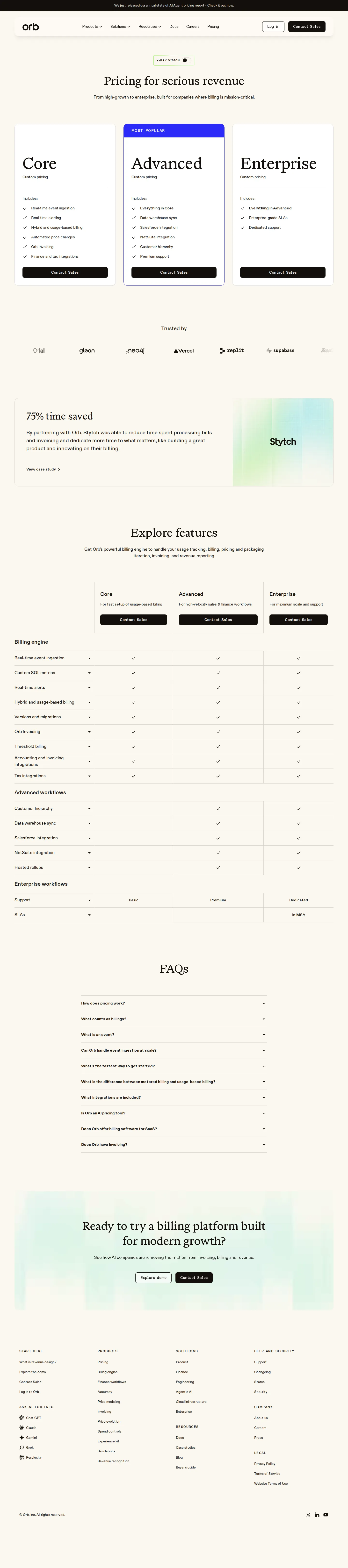
All prices removed — fully gated "Custom pricing" + "Most Popular" badge
The $1,750 Core anchor and the free-trial CTA were both removed. All three tiers became "Custom pricing" with "Contact Sales" CTAs, and Advanced gained a "Most Popular" badge. The billings + events + platform-fee model stayed in the FAQ, but no dollar amounts remained anywhere on the page.

Billings + events + platform-fee model; $1,750/mo Core starting price published
Page redesigned to "For every stage of growth." The FAQ rewrote the model to two metrics — billings (total invoice value issued through Orb) and events — plus a platform fee on Advanced and Enterprise. Core briefly showed a public anchor: "STARTING AT $1,750 per month, billed annually" with a "Start a free trial" CTA; Advanced and Enterprise were "Custom pricing." This was the most transparent the page ever got.

Events-only billing, no published prices
Under the "most flexible billing engine" page, Orb billed purely on monthly event volume — the FAQ read "we bill based on event volumes per month, with significant volume discounts at the Advanced and Enterprise tiers" — and explicitly noted invoicing was included "without charging a percentage of billings." Three tiers (Core / Advanced / Enterprise), all "Talk to us," no dollar amounts, no platform fee.

- · Orb briefly published a "$1,750/month, billed annually" Core starting price in late 2024 — then deleted every dollar amount and went fully "Custom pricing" by early 2025, a near-textbook reversal of pricing transparency for a company that sells pricing tooling.
- · Orb changed its own value metric mid-stream: through mid-2024 it billed purely on monthly event volume and explicitly said invoicing was included "without charging a percentage of billings" — then it added billings (a cut of invoice value) as a primary metric, doing the exact thing it had advertised it didn't do.
- · Orb's pricing page doubles as a teaching artifact: it annotates itself with 19 "Anatomy of a Pricing Page" best practices (why three tiers, why a 'Most Popular' badge, $99-vs-$100 charm pricing) used to design the page.
Questions & answers
- How does Orb's pricing work?
- Per Orb's pricing FAQ, pricing is based on two metrics: billings (the total value of invoices issued to your customers through Orb) and events (raw usage records ingested). The Advanced and Enterprise tiers also add a platform fee. All exact amounts are custom and quoted by sales.
- Does Orb publish prices?
- No. All three tiers — Core, Advanced, and Enterprise — are marked "Custom pricing" and route to "Contact Sales." There are no public dollar amounts on Orb's pricing page.
- What's the difference between Orb's Core, Advanced, and Enterprise tiers?
- Core covers real-time event ingestion, hybrid/usage-based billing, automated price changes, Orb Invoicing, and finance/tax integrations. Advanced adds data warehouse sync, Salesforce, NetSuite, customer hierarchy, and premium support. Enterprise adds enterprise-grade SLAs and dedicated support.
- Is Orb a billing tool for AI companies?
- Yes. Orb markets directly to AI and agentic-AI companies, supporting prepaid credit models, token-based or per-action pricing, and threshold billing to prevent runaway costs from fraud. Its customers include Vercel, Perplexity, Pinecone, and Replit.
- Has Orb's pricing always been custom and gated?
- No. Through mid-2024 Orb billed purely on monthly event volume with no platform fee. In late 2024 it switched to a billings + events + platform-fee model and briefly published a $1,750/month Core starting price with a free trial, then removed all prices by early 2025 to become fully "Custom pricing."
- How much funding has Orb raised?
- Orb has raised roughly $44M total: a $5.1M seed, a $14M Series A announced in March 2023, and a $25M Series B led by Mayfield in September 2024. It was founded in 2021 by ex-Asana engineers Alvaro Morales and Kshitij Grover.