AI Summary
About
Poolside is a frontier AI lab that builds its own foundation models for software development. Founded in 2023 by Jason Warner (former CTO of GitHub) and Eiso Kant, it is headquartered in Paris and explicitly positions itself as a model company, not a Copilot-style wrapper over someone else’s API. Through mid-2026 it sold exclusively through sales-quoted enterprise and government contracts; as of July 2026 it also ships open-weight models with public, per-token pricing on third-party marketplaces.
The product line has shifted from the earlier Malibu/Point pair to the Laguna family: Laguna S 2.1 (118B total parameters, 8B active, 1M context, released Jul 21, 2026) is the frontier-class reasoning model, and Laguna XS 2.1 (33B-A3B, 262K context, released Jul 2, 2026, FP8-quantized) is the lightweight, on-device-capable model. Both are open-weight (OpenMDW-1.1 license), downloadable from Hugging Face, and reachable through a new terminal coding agent called pool, a macOS desktop app, and editor extensions for VS Code, Visual Studio, Zed, and JetBrains.
What makes the business — and therefore the pricing — distinctive is that it now runs two parallel motions. The original enterprise/government motion still targets organizations with 5,000+ developers (banks, defense contractors, public-sector agencies) with a dedicated model deployed on-prem, in a private VPC, or via AWS Bedrock, plus forward-deployed research engineers embedded in the customer’s team — sales-led, contract-based, no public price. Alongside it, Poolside now runs a self-serve motion: Laguna models are served through OpenRouter and Vercel AI Gateway at published per-token rates, with a free-in-preview tier via the pool CLI and Poolside’s own OpenAI-compatible API (platform.poolside.ai, signup required).
On funding: Poolside raised a $500M Series B in October 2024 (led by Bain Capital Ventures, with NVIDIA, eBay Ventures, DST Global, Citi Ventures and others) at a roughly $3B valuation, taking total raised to about $626M. By late 2025, multiple outlets reported it raising up to $2B at a ~$12B valuation, with NVIDIA preparing to commit $500M–$1B, alongside Project Horizon — a 2-gigawatt AI campus in West Texas with CoreWeave and 40,000+ NVIDIA GB300 GPUs.
For the latest, visit Poolside.
Pricing summary : How Poolside’s pricing model works
Poolside’s own site still publishes no rate card: as of 2026-07-30, /pricing on poolside.ai still 404s, and /enterprise now redirects to the homepage. But as of July 2026, Poolside also serves its open-weight Laguna models through third-party marketplaces at real, published per-token rates — so price_transparency moves from sales-only to gated (the number exists and is public, but you have to follow a link off poolside.ai to see it; the flagship enterprise/government business remains fully sales-quoted).
Two pricing shapes now co-exist. (1) Enterprise/Government contracts combine a per-developer-seat subscription core, a dedicated model deployment in the customer’s environment (on-prem, private VPC, or managed AWS Bedrock), and the compute that runs it, plus embedded professional services — a hybrid seat-plus-usage structure with a heavy commitment component. (2) Laguna API access is pure per-token usage pricing with no seat or minimum: Laguna S 2.1 is $0.09 / $0.18 per 1M input/output tokens (shown as a “10% off” rate) and Laguna XS 2.1 is $0.06 / $0.12 per 1M (shown as a “40% off” launch rate) on OpenRouter, also available via Vercel AI Gateway, plus a free-in-preview tier through Poolside’s own pool CLI (Poolside’s disclosure: free-tier inputs/outputs may be used to train its models).
What makes this different: Poolside is now running a two-motion pricing strategy inside one company. The enterprise motion still deploys a dedicated model trained on a customer’s proprietary codebase inside their infrastructure, billed per seat plus compute — closer to a platform contract than a developer-tools subscription. The new developer motion instead open-sources the weights and lets marketplaces (OpenRouter, Vercel AI Gateway) set a transparent per-token rate card, competing directly with shared-API coding assistants on cost per token rather than seat price. Because Poolside trains the models itself, the cost base is GPU capex (10,000 GPUs after the Series B; 40,000+ GB300s planned) — which now shows up two ways: enterprise-scale, multi-year commitments on one side, and a sub-$0.18/1M-token public rate card on the other.
Pricing by product
Laguna models (self-serve API / developer plans)
| Model | Price | Included | Key mechanics |
|---|---|---|---|
| Laguna XS 2.1 (API, via OpenRouter) | $0.06 / $0.12 per 1M input/output tokens (listed as “40% off”) | 262K context, up to 32K output tokens, 33B total / 3B active params, FP8-quantized | Pure per-token usage pricing, no seat, no minimum; also served via Vercel AI Gateway; open-weight (OpenMDW-1.1), downloadable on Hugging Face |
| Laguna S 2.1 (API, via OpenRouter) | $0.09 / $0.18 per 1M input/output tokens (listed as “10% off”) | 1M context, 118B total / 8B active params | Pure per-token usage pricing, no seat, no minimum; also served via Vercel AI Gateway; open-weight (OpenMDW-1.1), downloadable on Hugging Face |
Laguna (Preview, pool CLI) | Free (Poolside’s own copy: “free to use for a limited time”) | Terminal coding agent, Agent Client Protocol-compatible, editor integrations (VS Code, Visual Studio, Zed, JetBrains), macOS desktop app | Free-in-preview access; Poolside states free-tier inputs/outputs may be used to train its models |
Laguna via own API (platform.poolside.ai) | Not disclosed (signup required for API key) | OpenAI-compatible chat API | Requires account creation; no public price sheet independent of OpenRouter/Vercel AI Gateway |
Enterprise & Government (sales-quoted deployment)
| Offering | Price | Included | Key mechanics |
|---|---|---|---|
| Enterprise | Contact sales (no public price) | Per-developer seats, dedicated Laguna deployment, IDE + CLI + agents, RBAC and audit trails | Seat-based core plus deployment and compute; forward-deployed engineers bundled |
| Government / defense | Contact sales (no public price) | Air-gapped or defense-grade deployment, data residency in your environment, custom training on your codebase | Three named deployment modes as of Aug 2026: Full Stack (Poolside’s complete integrated system — models, inference, infrastructure, security); Modular / bring-your-own-hardware (installs on the customer’s existing NVIDIA H100/H200 HGX infrastructure or RTX 6000 Blackwell workstations — the standard path for classified/sovereign environments where no third party may touch the hardware); Available on AWS (Poolside is a first-party AWS offering, contracted directly through AWS, deployed inside the customer’s AWS EC2 environment incl. GovCloud, C2E, VPC, and Bedrock). Same hybrid seat-plus-deployment contract, hardened for classified / regulated environments |
Sales motions across products: self-serve / PLG for Laguna’s API and CLI access (OpenRouter, Vercel AI Gateway, free preview); sales-led for Enterprise and Government deployments. Prices for Laguna XS 2.1 and Laguna S 2.1 verified on OpenRouter’s model pages; Poolside’s own site (poolside.ai) still does not publish a rate card for any tier.
Hidden costs : What Poolside users actually pay
For the Laguna API line, the published $0.06–$0.20-per-1M-token rates are only the list price — actual bills depend on a few mechanics OpenRouter discloses directly on the model pages:
| Line item | What drives it |
|---|---|
| Prompt-cache discount | OpenRouter shows a “weighted average” price below list ($0.013 measured input / $0.198 measured output for Laguna S 2.1 over the trailing 7 days) driven by a 95–97% cache-hit rate on repeated context — actual spend can run well under the $0.10/$0.20 list rate for agentic workloads that resend context |
| Launch discount is temporary | Laguna XS 2.1’s $0.06/$0.12 is explicitly flagged “40% off” on OpenRouter — expect this to reprice toward list once the launch promo ends |
| Free-tier data use | Poolside’s own disclosure: “If you are using Laguna S 2.1 [or XS 2.1] for free, we may use your inputs and outputs to train and improve our models” — the free/preview path is not private by default |
| ”Free to use for a limited time” | Poolside’s pool CLI access is explicitly time-boxed (“Get started with Laguna. Free to use for a limited time”), not a permanent free tier — budget for it converting to paid |
| Self-hosting compute | The weights are open (Hugging Face, OpenMDW-1.1/Apache 2.0), so running Laguna yourself trades the per-token rate for your own GPU cost |
For the Enterprise/Government line, the real “hidden costs” remain structural rather than line-item overages:
| Line item | What drives it |
|---|---|
| Per-developer seats | The seat core, scaled to your active engineer count (Poolside targets 5,000+ developer orgs) |
| Dedicated compute | The GPUs running your private model — on-prem hardware or VPC/Bedrock compute you provision |
| Deployment & integration | Forward-deployed research engineers embedding with your team; setup of connectors and eval frameworks |
| Custom model training | Dedicated training environment on your proprietary codebase, distinct from a shared API |
| Multi-year commitment | Enterprise contracts skew to longer terms; expect commitment/minimum structures, not month-to-month |
No public dollar figures exist for the Enterprise/Government line, so the only way to size that bill is a sales conversation scoped to your developer count and deployment environment. For how compute-coupled costs behave in usage-based contracts, see our introduction to usage-based pricing.
Want to estimate your own Poolside bill? Use the Poolside pricing calculator to model seat and deployment scenarios — but treat all outputs as estimates, since Poolside publishes no rates.
Pricing evolution : Poolside pricing history and changes
Cadence
| Period | Price changes | Product / SKU additions | Notes |
|---|---|---|---|
| 2024 Q4 | 0 public | Series B; 10,000-GPU training buildout | Sales-only from the start; no rate card |
| 2025 Q4 | 0 public | Reported ~$2B raise at ~$12B; Project Horizon (CoreWeave, GB300s) | Still no public pricing |
| 2026 Q2 | 0 public | Enterprise + Government surfaces live | /pricing 404s — verified sales-only |
| 2026 Q3 | First public prices: Laguna XS 2.1 $0.06/$0.12 per 1M tokens (Jul 2); Laguna S 2.1 launched at $0.10/$0.20 per 1M tokens (Jul 21), then discounted 10% to $0.09/$0.18 (Aug 4) | Open-weight Laguna model line, pool CLI, OpenRouter + Vercel AI Gateway listings, poolside.ai/enterprise retired (redirects to homepage) | Pricing model becomes hybrid: sales-only enterprise/government contracts alongside a new self-serve, per-token API line that already reprices post-launch |
Tracked range: 2024–present. Through mid-2026 Poolside never published a public price, so “pricing evolution” tracked only the funding and capacity milestones shaping its enterprise contract economics. As of Q3 2026, the open-weight Laguna launch adds real rate-card moves to track alongside those milestones.
Notable changes
- 2024-10-02 — $500M Series B at a ~$3B valuation (Bain Capital Ventures lead; NVIDIA, eBay Ventures, DST Global, Citi Ventures among investors), per TechCrunch. Pricing stayed sales-only.
- 2025-10-31 — Reported raise of up to $2B at a ~$12B valuation, NVIDIA committing $500M–$1B; Project Horizon 2GW campus announced, per Sacra. No rate card introduced.
- 2026-06-16 — Verified: still no public pricing. poolside.ai shows Models / Products / Enterprise / Government;
/pricingreturns 404. - 2026-07-02 — Laguna XS 2.1 released; listed on OpenRouter at $0.06/$0.12 per 1M input/output tokens (marked “40% off”).
- 2026-07-21 — Laguna S 2.1 released; listed on OpenRouter at $0.10/$0.20 per 1M input/output tokens. Homepage now leads with “Build with our open-weight agentic coding models” and CTAs for OpenRouter and Vercel AI Gateway;
/enterprisenow redirects to the homepage (nav no longer lists it separately, though the Government sales page remains live). - 2026-08-04 — Laguna S 2.1 discounted 10% to $0.09/$0.18 per 1M input/output tokens on OpenRouter (from its $0.10/$0.20 Jul 21 launch rate) — its first repricing since launch, shown with a “10% off” badge; Laguna XS 2.1 holds unchanged at $0.06/$0.12 (“40% off”).
What’s unique : Poolside’s distinctive pricing mechanics
1. You pay for a dedicated model, not shared API calls. Unlike Copilot or Cursor, Poolside deploys a model trained on your codebase inside your infrastructure. The price therefore bundles compute and a private training environment — a platform contract, not a per-seat SaaS line.
2. Compute footprint is a first-class pricing dimension. Because Poolside runs frontier models on customer-controlled hardware (on-prem, VPC, or Bedrock), the GPU footprint of your deployment is part of the bill. That makes pricing scale with deployment size, not just headcount.
3. Professional services are bundled, not bolted on. Forward-deployed research engineers embed with the customer and “take joint responsibility for outcomes.” The implementation cost that other vendors charge separately (or skip) is folded into the Poolside contract value.
4. Open-weighting the model is the pricing lever, not a side effect. Since July 2026, Poolside hasn’t added a self-serve tier to poolside.ai — it released the Laguna weights themselves and let OpenRouter and Vercel AI Gateway set the per-token rate card. That means Poolside’s public price is entirely intermediated: it never has to publish or defend a number on its own site, yet still gets a transparent, checkable rate ($0.06–$0.18 per 1M tokens, already repriced once — Laguna S 2.1 dropped 10% on Aug 4 — without Poolside itself issuing an announcement) that a shared-API-only competitor would have to price directly.
Strengths & weaknesses
| Strengths | Weaknesses |
|---|---|
| Owns its frontier code models (the Laguna family, successor to Malibu and Point) — no dependence on a third-party API or its price moves | Enterprise/Government pricing remains fully opaque — that line is still impossible to budget without a sales cycle |
| Deployment fits regulated/air-gapped environments banks and governments require | The two motions aren’t reconciled: self-serve API buyers get no visible path to a dedicated deployment, and enterprise prospects get no benefit from the public token-rate anchor |
| License-safe training (excludes GPL/AGPL) de-risks enterprise/legal adoption | Compute-heavy enterprise deployments mean high TCO vs a shared-API assistant |
| Embedded engineers reduce integration risk for large rollouts | Contracts likely multi-year with commitments — limited flexibility to scale down |
| Since July 2026, open-weighting Laguna via OpenRouter/Vercel AI Gateway gives a real no-sales-call on-ramp, priced competitively ($0.06–$0.18/1M) against shared-API coding assistants | Repricing risk is no longer theoretical — Laguna S 2.1 already moved 10% just two weeks after its Jul 21 launch, and XS 2.1’s “40% off” launch rate remains flagged as temporary, so self-serve buyers have no notice mechanism for the next move |
| Deep capital + NVIDIA backing signals durability and frontier-scale R&D | Laguna’s own hosted API (platform.poolside.ai) still discloses no price of its own — the only public rate lives on someone else’s marketplace |
Billing UX : Poolside billing controls and transparency
pool login— the CLI’s own authentication command opensplatform.poolside.aiin the browser so you can create or copy an API key, then paste it into the terminal — Poolside’s self-serve account/API-key flow.- OpenRouter usage dashboards — because Laguna S 2.1 and XS 2.1 are served through OpenRouter, developers get OpenRouter’s standard per-model usage, effective-price (post prompt-cache), throughput, latency, and uptime dashboards rather than a Poolside-native billing UI.
- Cache-read pricing — OpenRouter’s provider table prices cached input tokens separately and below the fresh-input rate: Laguna S 2.1 cache reads are $0.009 per 1M tokens (list $0.01, discounted with the same “10% off” badge as the input/output rate) and Laguna XS 2.1 cache reads are $0.03 per 1M tokens (list $0.05, “40% off”) — so re-sent context in agentic workflows costs less than a fresh input token on both models. OpenRouter’s dashboard also plots a rolling weighted-average “effective price” net of cache hits directly on the model page, though as of the Aug 2026 page redesign that chart is rendered as an in-page graphic rather than page text.
- Enterprise billing controls — Still not publicly documented for the sales-quoted line; handled through enterprise contracts and account teams rather than a self-serve billing dashboard. RBAC and audit trails give admins visibility into usage and access, but there is no public consumption/spend meter for that line.
- Payment options — Enterprise/Government: custom procurement (invoicing, POs, multi-year terms), no credit card; the Government line also now advertises three named deployment/procurement paths (Full Stack, Modular/bring-your-own-hardware, or a first-party AWS offering contracted directly through AWS, including GovCloud/C2E), still with no public price on any of them. Laguna API: standard OpenRouter/Vercel AI Gateway account billing (credit-based / pay-as-you-go), or free access with no payment method during the CLI preview.
Strategic wins : Why Poolside’s pricing decisions worked
1. Selling the model, not the seat, justifies enterprise-scale contracts
By deploying a dedicated, custom-trained model rather than a shared API, Poolside reframes the purchase from “developer tool” to “AI platform,” which supports far larger contract values per customer. See how AI companies are shifting away from per-user licenses.
2. Keeping the enterprise motion sales-only, even after publishing a price elsewhere
For Global 2000 and government buyers, procurement, security review, and on-prem deployment dominate — a public rate card adds little and can anchor negotiations low. Quoting per engagement lets Poolside price to the value of a dedicated model in a regulated environment, and it held that line even after Laguna gave the company its first public number to point to. Related: outcome-based and value pricing trends.
3. License-safe, air-gapped deployment unlocks the highest-paying segment
Excluding GPL/AGPL code from training and supporting air-gapped deployment directly addresses the compliance blockers that keep banks and defense agencies off shared-API assistants — the segment most able to fund frontier compute. See choosing the right usage metric for how value-aligned dimensions support premium pricing.
4. Open-weighting Laguna turns idle model-lab credibility into demand generation
Rather than gating Laguna behind a sales cycle, Poolside listed it on OpenRouter and Vercel AI Gateway at $0.06–$0.20 per 1M tokens — a rate that undercuts most shared-API coding assistants and puts a concrete, checkable number next to Poolside’s benchmark claims (70.2% Terminal-Bench 2.1 for Laguna S 2.1). That converts research output into inbound developer proof and a funnel for the enterprise pitch, without repricing or otherwise touching the sales-quoted dedicated-deployment business. See how usage-based pricing lowers the barrier to trial.
Areas to improve : Gaps in Poolside’s pricing approach
1. Enterprise/Government pricing is still totally opaque
With no public anchor for the dedicated-deployment line, even qualified buyers cannot estimate budget before committing to a sales cycle — Laguna’s public per-token rate doesn’t transfer, since the enterprise product (dedicated model, on-prem compute, embedded engineers) is priced on entirely different dimensions. A published “starting at” floor or sample TCO model would lower the barrier without giving up custom quoting. See bill shock and cost unpredictability.
2. Compute-coupled pricing is hard to forecast
Because the bill scales with the dedicated compute footprint, customers face the same unpredictability as raw GPU spend. Clear capacity tiers or usage caps would make TCO more forecastable for finance teams.
3. No upgrade path from Laguna’s self-serve line into the enterprise motion
The July 2026 launch closed Poolside’s old “no on-ramp” gap — Laguna now gives individual developers and small teams a free-in-preview CLI and a $0.06–$0.18 per 1M token API (Laguna S 2.1 down 10% as of Aug 4) with no seat or minimum. But nothing on poolside.ai, OpenRouter, or Vercel AI Gateway shows a self-serve team how to graduate into a dedicated deployment once they outgrow shared inference; a “talk to sales about a dedicated Laguna deployment” prompt inside the pool CLI or the OpenRouter/Vercel dashboards would connect the two motions into one funnel. See land-and-expand pricing strategies.
Monetization stack & signals : how Poolside builds & buys its revenue engine
No buy-vs-build monetization stack is sourceable yet. Poolside hires only into frontier-model research and engineering, with no revenue, billing or RevOps role open — fitting its sales-only motion, where the revenue engine lives inside bespoke enterprise and government contracts rather than any public meter.
Signals reviewed · derived from public sources
Key takeaways
- Sales-only doesn’t have to be permanent — or company-wide. Poolside ran two years with zero public pricing anywhere, then published a full per-token rate card for one product line (Laguna) in July 2026 while keeping its enterprise/government motion sales-quoted; transparency can be a per-product decision, not a single blanket policy.
- For enterprise deals, the unit is a dedicated model deployment, not a seat. Pricing there bundles per-developer seats, dedicated compute, and embedded engineers into one contract.
- Compute is a pricing dimension. Running a private frontier model on-prem/VPC means the GPU footprint drives cost as much as headcount.
- Built for regulated buyers. License-safe training and air-gapped deployment target banks, defense, and government — the segment that can fund frontier compute.
- Capital and NVIDIA backing underwrite the model. A ~$3B (2024) then reported ~$12B (2025) valuation and NVIDIA investment fund the GPU base that the enterprise contracts ultimately pay for.
UBP implications
- When the cost base is compute, couple price to deployment, not just seats. Poolside shows how a model lab aligns price with the GPU footprint it provisions per customer rather than a flat per-user fee.
- Sales-only pricing is a legitimate strategy for high-value, regulated buyers — but it doesn’t have to apply company-wide. Poolside keeps its enterprise/government motion fully opaque while running a fully public, per-token marketplace listing for Laguna, showing that price transparency can be scoped per product line rather than treated as one company-wide policy.
- Bundling professional services into contract value is a UBP-adjacent lever: it raises ACV and de-risks adoption, but obscures the unit economics buyers want to compare.
Sources
- Poolside official website — homepage still leads with the open-weight Laguna launch; still no dedicated pricing page (accessed 2026-08-26)
- Poolside
/pricing— still returns a 404, confirming the enterprise/government line remains fully sales-quoted (accessed 2026-07-30) - Poolside Models — Laguna S 2.1 and Laguna XS 2.1 specs and benchmarks, unchanged (accessed 2026-08-26)
- Poolside Get Started —
poolCLI, desktop app, and editor integrations, unchanged (accessed 2026-08-26) - Poolside Government — air-gapped/defense-grade deployment, sales-led; customer-logo wall expanded (adds Northrop Grumman, AWS, Dell Technologies, Atos, IQT); page now details three named deployment modes (Full Stack, Modular/bring-your-own-hardware on NVIDIA H100/H200 HGX or RTX 6000 Blackwell, and a first-party AWS offering with GovCloud/C2E/VPC/Bedrock) plus a “How teams put Poolside to work” use-case list — still no pricing added (accessed 2026-08-26)
- Poolside platform — signup-gated OpenAI-compatible API console, still shows no public price (accessed 2026-08-26)
- OpenRouter: Poolside Laguna S 2.1 — published per-token pricing and effective-price data; still $0.09/$0.18 per 1M (“10% off”) (accessed 2026-08-26)
- OpenRouter: Poolside Laguna XS 2.1 — published per-token pricing and “40% off” launch-rate label; still $0.06/$0.12 per 1M (accessed 2026-08-26)
- Vercel AI Gateway: Poolside Laguna S 2.1 — independent second source confirming Laguna S 2.1’s undiscounted $0.10/$0.20 per 1M list rate and confirming Laguna XS 2.1 is not listed on this marketplace (accessed 2026-08-04)
- Poolside blog: Introducing Laguna S 2.1 — confirms OpenRouter’s Jul 21 launch list price of $0.10/$0.20 (plus $0.01 cache-read) per 1M tokens ahead of the Aug 4 “10% off” repricing (accessed 2026-08-04)
- Poolside blog: Introducing Laguna XS 2.1 — confirms API pricing “matched to XS.2 at $0.10 / $0.20 / $0.05 per 1M input / output / cache-read tokens,” consistent with the “40% off” $0.06/$0.12 launch rate shown on OpenRouter (accessed 2026-08-04)
Bottom line
Poolside spent its first two years as a pure enterprise/government model lab, selling dedicated, custom-trained deployments with no public pricing anywhere. That changed in July 2026: the open-weight Laguna models gave Poolside its first published prices ($0.06–$0.20 per 1M tokens, via OpenRouter and Vercel AI Gateway) — but that number belongs to a separate self-serve line, not the enterprise business, which is still sales-quoted around per-developer seats, dedicated compute, and embedded engineering with multi-year commitments. If you run a 5,000+ developer org in a regulated environment and want a model trained on your codebase inside your infrastructure, Poolside’s enterprise motion is still built for you — but if you just want to try a frontier-trained coding model without a sales call, Laguna is now the on-ramp. Compare it against fully-priced coding assistants in the pricing blueprint.
Want to compare Poolside against other AI coding companies? Browse the pricing blueprint.
Pricing timeline : Major events on a vertical axis
Each milestone below corresponds to a public pricing change, product launch, or material adjustment. Major events use a filled marker; minor adjustments use a faded one.
Laguna S 2.1 discounted 10% to $0.09/$0.18 per 1M tokens
Two weeks after its Jul 21 launch, Laguna S 2.1's OpenRouter listing dropped 10% from $0.10/$0.20 to $0.09/$0.18 per 1M input/output tokens (shown with a "10% off" badge) — the self-serve Laguna line's first repricing event. Laguna XS 2.1 held at its existing $0.06/$0.12 ("40% off") rate; Poolside's own site still carries no rate card for either model.
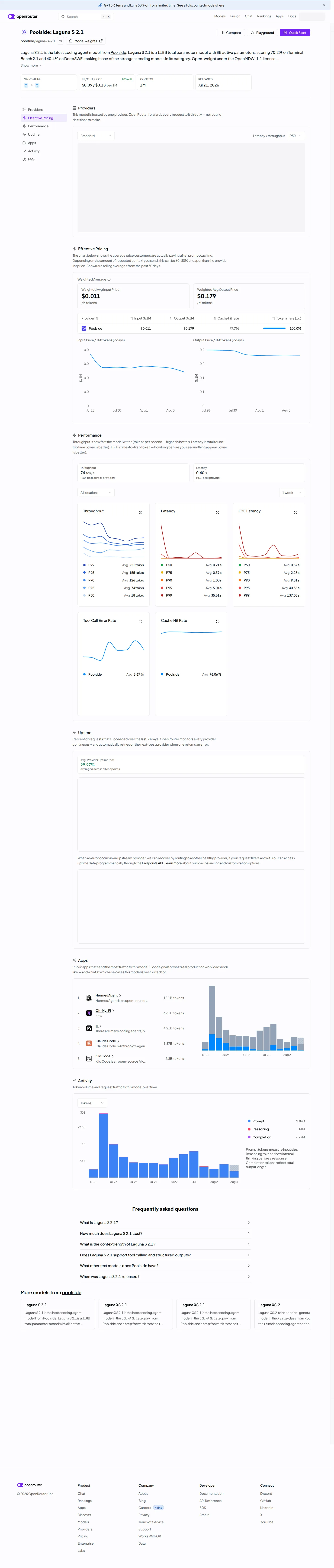
Launches open-weight Laguna models with public per-token API pricing
Poolside shipped open-weight coding-agent models — Laguna XS 2.1 (Jul 2) and Laguna S 2.1 (Jul 21) — publishing real per-token rates for the first time via OpenRouter and Vercel AI Gateway: Laguna S 2.1 at $0.10/$0.20 per 1M input/output tokens, Laguna XS 2.1 at $0.06/$0.12 per 1M (a launch-priced '40% off' rate). Weights are downloadable (Hugging Face, OpenMDW-1.1/Apache-2.0 licenses), and a new 'pool' CLI agent gives free-in-preview access. The poolside.ai/enterprise page now redirects to the homepage and /pricing still 404s — the sales-quoted enterprise/government contract business is unchanged, but Poolside now runs a parallel self-serve, usage-priced product line alongside it.
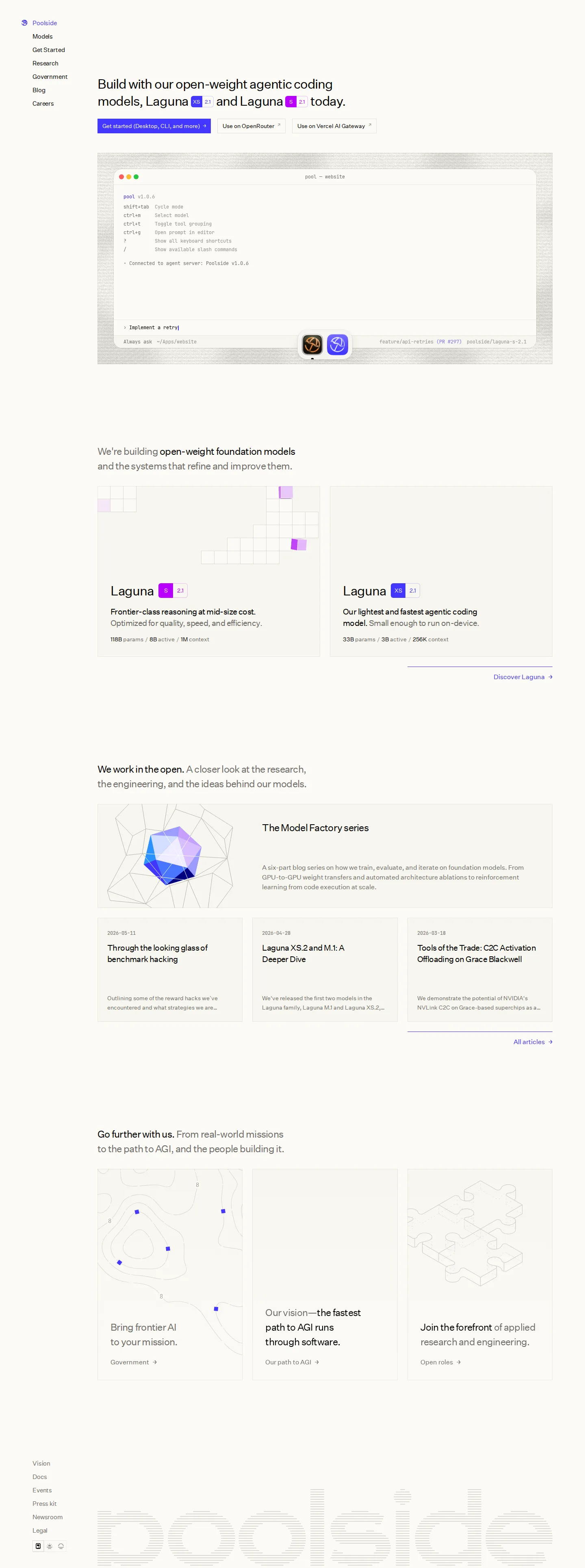
Still no public pricing; enterprise/government sales-only
Verified 2026-06-16: poolside.ai exposes Models, Products, Enterprise, and Government but no pricing page (/pricing 404s). Pricing remains fully sales-quoted per engagement.
Reportedly raising up to $2B at ~$12B valuation
Multiple outlets reported Poolside raising up to a $2B round at a ~$12B valuation, with NVIDIA preparing to invest $500M–$1B, alongside Project Horizon (a 2GW West Texas AI campus with CoreWeave and 40,000+ GB300 GPUs). No public rate card introduced.
$500M Series B at ~$3B valuation
Raised a $500M Series B led by Bain Capital Ventures (NVIDIA, eBay Ventures, DST Global, Citi Ventures and others participating) at a roughly $3B valuation — funding 10,000 NVIDIA GPUs for training. Pricing remained sales-only enterprise contracts throughout.
- · Poolside trains its OWN frontier code models (Malibu for heavy multi-file work, Point for sub-200ms IDE completion) rather than reselling someone else's API — pricing reflects a model lab, not a wrapper.
- · It was co-founded in 2023 by Jason Warner, the former CTO of GitHub — so the company most directly challenging GitHub Copilot is led by GitHub's old CTO.
- · NVIDIA is both an investor and the supplier: Poolside's Project Horizon campus in West Texas (with CoreWeave) is slated for 40,000+ NVIDIA GB300 GPUs, and NVIDIA reportedly committed up to $1B in the 2025 round.
Questions & answers
- What is Poolside's pricing model?
- Poolside runs two pricing motions. Enterprise and government contracts are still sales-quoted, combining per-developer seats with deployment and dedicated-compute costs (on-prem, private VPC, or AWS Bedrock) plus embedded professional services. Since July 2026, Poolside's open-weight Laguna models also carry a published rate card on OpenRouter — $0.06/$0.12 per 1M input/output tokens for Laguna XS 2.1 ("40% off") and $0.09/$0.18 per 1M for Laguna S 2.1 ("10% off"; list price $0.10/$0.20). Laguna S 2.1 is also listed on Vercel AI Gateway, but at its undiscounted $0.10/$0.20 rate; Laguna XS 2.1 is OpenRouter-only.
- Does Poolside offer a free tier?
- Yes, for Laguna. Since July 2026, Poolside's `pool` CLI, desktop app, and editor integrations give free-in-preview access to Laguna XS 2.1 and Laguna S 2.1 (Poolside discloses that free-tier inputs/outputs may be used to train its models). The original enterprise and government contracts still have no free tier, trial, or self-serve sign-up — evaluation there happens through a guided, sales-led pilot.
- How much does Poolside cost per month?
- Neither pricing line is billed as a flat monthly fee. Enterprise/government contracts bundle seats, a dedicated model deployment, and compute into a contract sized to your organization — Poolside targets enterprises with 5,000+ developers — and are quoted per engagement. The Laguna API line is metered per token instead: $0.06–$0.18 per 1 million input/output tokens depending on model, with no seat or minimum fee.
- Is Poolside pricing usage-based or subscription?
- Both, depending on the line. Enterprise/government deals are hybrid — a seat-based subscription core (per active developer) plus deployment and compute costs that scale with the dedicated environment running your model. Laguna's API line, by contrast, is pure usage-based: a per-token rate ($0.06–$0.18 per 1M tokens) with no seat and no minimum, published on OpenRouter and Vercel AI Gateway.