AI Summary
About
Qdrant (pronounced “quadrant”) is an open-source vector database and search engine for AI retrieval — the storage and similarity-search layer behind RAG pipelines, recommendation systems, and semantic search. The engine is built entirely in Rust with SIMD acceleration and a custom storage layer called Gridstore, and it is released under the Apache-2.0 license. It supports native hybrid search (dense + sparse vectors), JSON metadata filtering, multivectors, and real-time indexing.
Founded in Berlin in 2021 by Andre Zayarni and Andrey Vasnetsov, Qdrant has raised roughly $78M+ across a $28M Series A (Spark Capital, January 2024) and a $50M Series B (AVP, Bosch Ventures, Unusual Ventures, March 2026). The open-source project carries 30k+ GitHub stars and a 60k+ member community, and the managed service counts TripAdvisor, OpenTable, Deutsche Telekom, HubSpot, Canva, and Sprinklr among its referenced customers. Qdrant maintains SOC 2 and HIPAA compliance.
For the most current rates and to size a cluster, see Qdrant’s pricing page.
Pricing summary : How Qdrant’s pricing model works
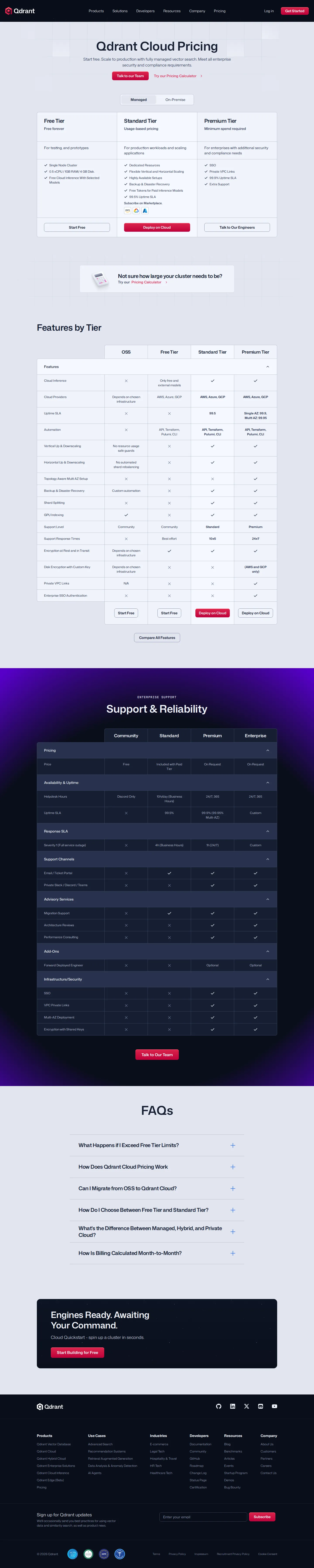
Qdrant runs a classic open-core split. The engine is free — Apache-2.0, self-hostable, with no paywalled features — so anyone can run it on their own hardware and pay only their own compute bill. The money is in Qdrant Cloud, the managed service, which is resource-metered: you are billed for the vCPU, GB of RAM, GB of disk storage and backup storage your clusters consume, plus any paid-inference tokens. Usage is measured hourly and your payment method is charged at the start of each month for the prior month’s usage.
The free Cloud tier is a permanent 1GB-RAM, 0.5-vCPU, 4GB-disk single-node cluster — no credit card, no time limit. Above that, the Standard tier is pure pay-for-what-you-run with HA, backups and a 99.5% uptime SLA. Premium layers on SSO, VPC private links, storage encryption with customer keys and a 99.9% SLA (99.95% multi-AZ) behind a minimum spend. Hybrid Cloud and Private Cloud move the data plane into the customer’s own environment for custom/quoted pricing.
What makes this different: Qdrant charges nothing per query and nothing per vector — you pay for the cluster, not the searches. That inverts the per-read/per-write metering common to serverless vector databases and makes Qdrant Cloud predictable for steady, high-QPS production workloads.
Pricing by product
| Product / tier | Price | Included | Key mechanics |
|---|---|---|---|
| Open source (self-host) | Free (Apache-2.0) | Full engine, all features | You operate it; cost = your own infra/compute |
| Cloud — Free | Free forever | 1GB RAM, 0.5 vCPU, 4GB disk, single node | No credit card, no expiry; free inference on select models |
| Cloud — Standard | Usage-based, metered hourly | Dedicated clusters, HA, backups & DR, 99.5% SLA | Billed on vCPU + GB RAM + GB storage consumed; queries free |
| Cloud — Premium | Minimum spend (quoted) | Everything in Standard + SSO, VPC links, encryption, 99.9% SLA | Sales-assisted; multi-AZ option for 99.95% SLA |
| Hybrid Cloud | Custom (quoted) | Managed control plane, data stays in your VPC/k8s | Sales-led; you supply the infrastructure |
| Private Cloud | Custom (quoted) | Fully isolated / air-gapped-capable, custom SLAs | Sales-led; for regulated & enterprise deployments |
Sales motions across products: self-serve and PLG drive the free and Standard Cloud tiers (sign up, size a cluster, pay by card); Premium, Hybrid and Private are sales-led with minimum-spend or custom contracts. Self-hosting the OSS engine is unmanaged and free.
Hidden costs : What Qdrant users actually pay
Qdrant Cloud has fewer “gotchas” than per-query vector databases — there are no read/write unit charges to model — but the real bill is driven by how much RAM your index needs, which is easy to underestimate. Vectors are held largely in memory; high dimensionality and large vector counts push you into bigger (pricier) clusters, and quantization vs. full-precision storage changes the footprint materially. High availability (multiple replicas) multiplies cluster cost, and backup storage is billed on top of the live cluster.
A rough production archetype (third-party estimates; size your own in the Qdrant pricing calculator):
| Line item (≈10M vectors, 1536-dim, prod) | Monthly cost |
|---|---|
| Dedicated cluster (vCPU + RAM + storage) | ~$120-180 |
| High-availability replicas (optional) | adds ~1-2x base |
| Backup storage | small, per-GB add-on |
| Per-query / per-vector fees | $0 |
| Typical single-cluster total | ~$120-180/mo |
The two costs people miss: (1) sizing for peak rather than steady RAM (a too-small cluster degrades recall/latency, so teams over-provision), and (2) paid-inference tokens if you use Qdrant’s hosted embedding/inference models beyond the free allowance.
Pricing evolution : Qdrant pricing history and changes
Cadence
| Quarter | Price changes | Product / SKU additions | Notes |
|---|---|---|---|
| 2023 Q1 | 0 | Qdrant Cloud (managed) launches | Usage-metered hosted clusters layered on the free OSS engine |
| 2024 Q1 | 0 | — | $28M Series A funds commercialization; free tier retained |
| 2024 Q2 | 0 | Hybrid Cloud launches | BYO-infrastructure managed deployment, custom pricing |
| 2026 Q1 | 0 | — | $50M Series B; resource-metered model unchanged |
Tracked range: 2023–present. Dates are anchored to public funding and launch announcements; Wayback CDX access was blocked during this pass, so per-snapshot rate diffs were not captured.
Notable changes
- 2023-02 — Qdrant Cloud (managed) goes live, introducing the usage-based hosted-cluster model and the permanent free tier.
- 2024-01 — $28M Series A (Spark Capital) accelerates the managed business; pricing stays resource-metered.
- 2024-04 — Qdrant Hybrid Cloud launches as the first managed vector DB deployable in any environment, sold with custom pricing.
- 2026-03 — $50M Series B (AVP-led) to scale “composable vector search”; the metered Cloud model and free tier are unchanged.
What’s unique : Qdrant’s distinctive pricing mechanics
1. You pay for the cluster, not the query. Qdrant Cloud meters vCPU, RAM and storage — searches and vector counts carry no per-unit fee. For steady, high-QPS production traffic this is the cheapest shape on the market and makes bills predictable.
2. A free tier that doesn’t expire. The 1GB-RAM Cloud cluster is permanent and needs no credit card — positioned explicitly against time-boxed “free trials” that throttle you toward an upgrade. Combined with the fully-free OSS engine, the on-ramp cost is genuinely zero.
3. Marketplace billing at a clean $0.01/unit. Through AWS/GCP/Azure Marketplace, spend converts at exactly one cent per Resource Usage Unit ($85 → 8,500 units), so cloud-committed customers can draw down their marketplace spend with no rate ambiguity.
Strengths & weaknesses
| Strengths | Weaknesses |
|---|---|
| No per-query/per-vector fees → predictable, often cheaper at scale | Headline per-unit rates aren’t on the pricing page; you must size in the calculator |
| Genuinely free, permanent OSS engine and Cloud free tier | Fixed cluster minimum makes tiny/bursty workloads relatively expensive vs. serverless |
| Resource-metered hourly billing maps cleanly to actual infra usage | RAM-driven cost is easy to under-estimate; over-provisioning is common |
| Open-core with no feature gating builds trust and avoids lock-in | Premium/Hybrid/Private hide behind minimum spend and sales contact |
Billing UX : Qdrant billing controls and transparency
- Billing controls — Cluster sizing happens in the cloud console with an in-app pricing calculator; you scale vCPU/RAM/storage up or down per cluster. Usage is metered hourly and invoiced monthly in arrears.
- Usage visibility — Billing is itemized by resource (compute, memory, disk, backup storage, paid-inference tokens). The free tier requires no card, so there’s no accidental-charge risk while prototyping.
- Payment options — Credit card via Stripe, or billing through AWS, GCP and Azure Marketplace (converting at $0.01 per Resource Usage Unit). The payment method is charged at the start of each month for the previous month’s usage.
- Support & advisory tiers — Support is packaged in four bands on the pricing page: Community (free, Discord-only), Standard (included with any paid tier, 10h/day business-hours), Premium (on request, 24/7/365) and Enterprise (on request, 24/7/365 with custom SLAs). Premium and Enterprise add advisory services (migration support, architecture reviews, performance consulting) and an optional Forward Deployed Engineer add-on.
Strategic wins : Why Qdrant’s pricing decisions worked
1. Open-core with no feature gating earns developer trust
By keeping the full engine free under Apache-2.0 and selling operations (managed hosting, HA, compliance) rather than features, Qdrant avoids the “the good stuff is paywalled” resentment that hurts some open-core vendors. The OSS adoption funnel (30k+ stars) feeds the paid Cloud. See how AI companies structure pricing and the broader open-core monetization pattern.
2. Charging for capacity, not queries, is a credible anti-Pinecone wedge
Qdrant’s zero-per-query model directly answers the most common complaint about serverless vector DBs — unpredictable per-read/write bills. For production workloads with steady traffic, paying for the cluster you run is both cheaper and easier to forecast, which is exactly the buyer Qdrant targets. Related: choosing the right usage metric.
3. A permanent free tier as a growth engine
The no-card, no-expiry 1GB cluster lowers the activation barrier to nearly zero and lets prototypes mature into paying clusters without a forced conversion event — a textbook PLG flywheel for infrastructure. See usage-based pricing strategy.
Areas to improve : Gaps in Qdrant’s pricing approach
1. Publish the per-unit rates
The pricing page describes the model (“billed on vCPU, RAM, storage”) but never states a dollar-per-vCPU-hour or dollar-per-GB number — you only see real figures after sizing a cluster in the in-app calculator. That opacity forces prospects to third-party blogs to comparison-shop. See bill shock and cost unpredictability.
2. The fixed-cluster floor hurts small workloads
Because the smallest paid cluster carries a fixed footprint, very small or bursty workloads can pay more on Qdrant Cloud than on a pay-per-query competitor. A truly serverless / scale-to-zero paid option would close the one gap where Pinecone Serverless wins on cost.
3. RAM-driven cost is hard to predict up front
Index RAM depends on vector count, dimensionality and quantization choices that buyers don’t fully know in advance, so first invoices can surprise. Clearer in-product guidance (or default quantization) on the memory-vs-cost tradeoff would reduce over-provisioning. Related: outcome-based pricing trends.
Monetization stack & signals : how Qdrant builds & buys its revenue engine
Buys 2 Builds 1
Buys the rails, owns the meter: card payments ride Stripe and cloud-committed spend draws down via AWS/GCP/Azure Marketplace, but the resource-to-Resource-Usage-Unit conversion behind both — the meter on its own usage pricing — is Qdrant's own at a clean $0.01/unit. No third-party billing meter is disclosed.
-
“Qdrant database clusters in Qdrant Cloud are priced based on CPU, memory, and disk storage usage. Your payment method is charged at the beginning of each month for the previous month's usage.”
-
“Credit card payments are processed through Stripe.”
-
“the Qdrant Cloud usage costs are added as $0.01 Resource Usage Units to your existing billing for your cloud provider services. E.g. if you create a Qdrant Cluster that costs $85 in a month, 8,500 Resource Usage Units for Qdrant Cloud will be added to your cloud provider bill.”
Signals reviewed · derived from product docs
Key takeaways
- Open-core done cleanly. The full Qdrant engine is free Apache-2.0 with no feature gating; Qdrant sells managed operations, not unlocked features.
- Capacity pricing, not query pricing. Qdrant Cloud meters vCPU/RAM/storage hourly and charges $0 per query or vector — predictable and often cheaper at steady scale.
- A real free tier. A permanent, no-card 1GB Cloud cluster plus free self-hosting drives a near-zero-cost on-ramp and PLG growth.
- Transparency stops at the calculator. The model is public but the per-unit rates aren’t — you must size a cluster to see real numbers.
- Shape decides the winner. Qdrant wins on steady/large workloads; serverless per-query rivals can still win on tiny, bursty ones.
UBP implications
- Meter the resource, not the event, when usage is steady. For infrastructure with predictable load, charging for provisioned capacity (vCPU/RAM) beats per-request metering on both predictability and, often, total cost — a deliberate counter-position to serverless rivals.
- A permanent free tier can replace a trial. Removing the expiry and credit-card requirement converts the free plan from a lead-capture trick into a genuine adoption funnel, especially when paired with free OSS.
- Model transparency ≠ price transparency. Explaining how you bill (resources, hourly) without publishing the rates trades comparison-shopping friction for flexibility — a tradeoff every usage-based vendor should make consciously.
Sources
- Qdrant pricing page (accessed 2026-06-09)
- Qdrant Cloud billing & payments docs (accessed 2026-06-09)
- Qdrant Cloud Premium tier docs (accessed 2026-06-09)
- Qdrant homepage / product (accessed 2026-06-09)
- Qdrant raises $50M Series B — BusinessWire (accessed 2026-06-09)
- Open-source vector database Qdrant raises $28M — TechCrunch (accessed 2026-06-09)
Bottom line
Qdrant monetizes a genuinely free, Apache-2.0 vector engine by selling managed operations on Qdrant Cloud — metering vCPU, RAM and storage by the hour while charging nothing per query. That capacity-not-query model, plus a permanent no-card free tier, makes it predictable and often cheaper than serverless rivals for steady production workloads, with the main friction being that real per-unit rates live in the in-app calculator rather than on the pricing page.
Want to compare Qdrant against other infrastructure and data-platform companies? Browse the pricing blueprint.
Pricing timeline : Major events on a vertical axis
Each milestone below corresponds to a public pricing change, product launch, or material adjustment. Major events use a filled marker; minor adjustments use a faded one.
$50M Series B
AVP-led round (Bosch Ventures, Unusual, Spark, 42CAP) to scale 'composable vector search' as core production-AI infrastructure; resource-metered cloud model unchanged.
Qdrant Hybrid Cloud launches
Adds a bring-your-own-infrastructure deployment — managed control plane, data stays in the customer's environment — sold with custom pricing.
$28M Series A
Spark Capital-led round (with Unusual Ventures, 42CAP) funds the managed-cloud commercialization; pricing stays usage-metered with a free tier.
Qdrant Cloud (managed) launches
Qdrant releases its commercial managed cloud, layering usage-based hosted clusters on top of the free open-source engine.
- · Qdrant's engine is written entirely in Rust with SIMD and a custom storage layer (Gridstore) — the performance story doubles as the cost story, since a tighter index needs less billable RAM.
- · Qdrant Cloud charges $0 for queries. You pay for the cluster you run, not the searches you make — the opposite of Pinecone Serverless's per-read/write model.
- · Marketplace billing converts at exactly $0.01 per Resource Usage Unit: an $85 Qdrant Cloud month shows up as 8,500 units on your AWS/GCP/Azure bill.
Questions & answers
- Is Qdrant free?
- The Qdrant engine is open-source under Apache-2.0 and free to self-host with no feature gating. Qdrant Cloud also offers a permanent free tier — a 1GB-RAM, 0.5-vCPU, 4GB-disk single-node cluster — that needs no credit card and never expires. You only pay once you scale beyond the free cluster on Qdrant Cloud.
- How does Qdrant Cloud pricing work?
- Qdrant Cloud is resource-metered, not per-query. You're billed for the vCPU, GB of RAM, GB of disk storage and backup storage your clusters actually consume, plus any paid-inference tokens. Usage is measured hourly and your payment method is charged at the start of each month for the previous month's usage. Queries themselves are free.
- How much does a Qdrant Cloud cluster cost per month?
- Qdrant doesn't publish flat per-unit rates on the pricing page — you size a cluster in the in-app calculator. Third-party estimates put a 1M-vector (1536-dim) production cluster at roughly $25-45/month and a 10M-vector cluster at roughly $120-180/month, since cost tracks the RAM and CPU your index needs rather than query volume.
- Is Qdrant cheaper than Pinecone?
- It depends on shape. Because Qdrant Cloud charges for the cluster rather than per query, it tends to undercut Pinecone Serverless at steady, high-query-volume or larger-index workloads (e.g. ~$120-180/mo vs ~$170-370/mo at 10M vectors per third-party tests). For tiny, bursty workloads a pay-per-query model like Pinecone Serverless can be cheaper, since a Qdrant cluster has a fixed minimum footprint.
- What's the difference between Qdrant Cloud, Hybrid Cloud and Private Cloud?
- Qdrant Cloud is the fully managed SaaS (free, Standard usage-based, and Premium tiers). Hybrid Cloud runs the managed data plane inside your own Kubernetes/VPC so data never leaves your network while Qdrant operates it. Private Cloud is a fully isolated, air-gapped-capable deployment with custom SLAs. Hybrid and Private are sales-led with custom/minimum-spend pricing.