AI Summary
About
Resemble AI is a generative voice AI and AI-security company founded in 2019 in Toronto by Zohaib Ahmed (CEO, formerly a lead software engineer at Magic Leap) and Saqib Muhammad. It began with synthetic-voice use cases for gaming, then broadened into text-to-speech, voice cloning, speech-to-speech conversion, real-time voice agents, and multilingual localization. More recently it has pivoted hard toward AI security — audio/video/image deepfake detection (its DETECT-3B-Omni multimodal model), watermarking, and audio intelligence — positioning itself as a “generative AI security” platform rather than only a voice-generation tool.
The company raised an $8M Series A in July 2023 and a $13M round in December 2025 (backed by Google’s AI Future Fund, Okta Ventures, Taiwania Capital, KDDI, and others), bringing total funding to roughly $25M. Its detection technology is marketed to entertainment companies, Fortune 500 telcos, and government agencies.
For the most current information, visit Resemble AI.
Pricing summary : How Resemble AI’s pricing model works
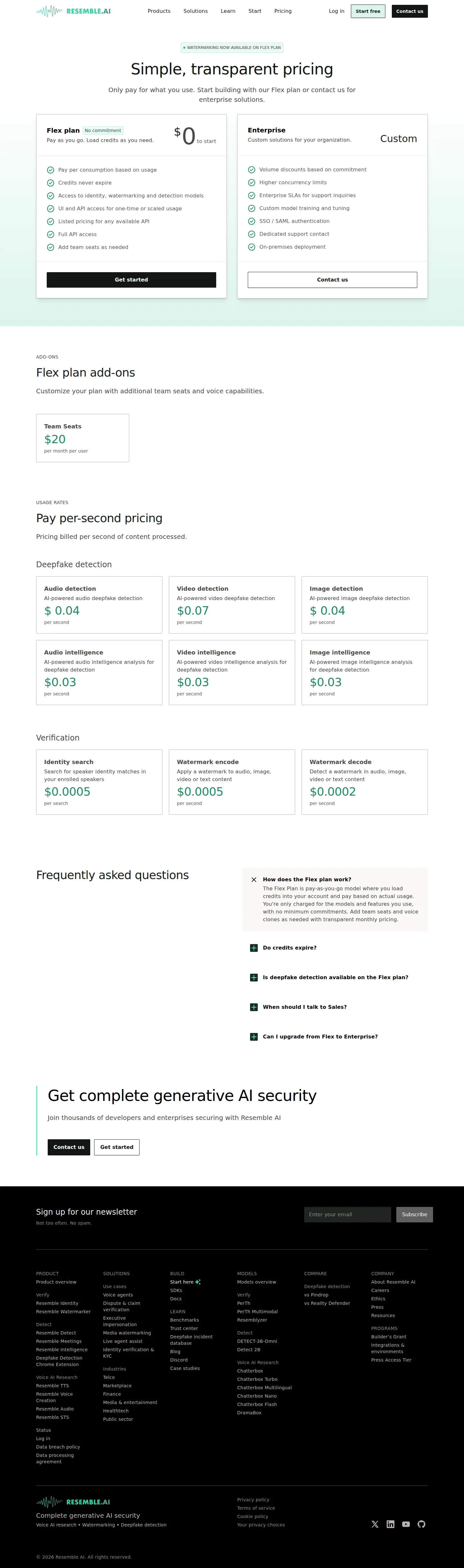
Resemble AI now sells everything through one self-serve plan — Flex — plus a quoted Enterprise tier. Flex is pure pay-as-you-go: you load credits into your account (Resemble emphasizes that credits never expire) and are billed per second of content processed, with the rate depending on the operation. As of mid-2026 the pricing page publishes rates only for its AI-security and verification surfaces: deepfake detection at $0.04/sec for audio and image, $0.07/sec for video, and $0.03/sec for the audio/video/image “intelligence” analysis variants; identity search at $0.0005/search; and multimodal watermark encode/decode at $0.0005 / $0.0002 per second. Voice-generation operations (text-to-speech, voice agents, speech-to-text, audio enhancement/editing) — which previously carried published per-second rates — are no longer listed on the pricing page and now sit under a “Voice AI Research” grouping.
On top of usage, the only remaining monthly add-on is $20/user for team seats (the earlier rapid, pro voice-clone and voice-design add-ons were removed). Enterprise is contact-sales and unlocks volume discounts based on commitment, higher concurrency, enterprise SLAs, custom model training and tuning, SSO/SAML, dedicated support, and on-premises deployment. Resemble now nudges anyone spending over $2,000/month on Flex toward a sales conversation for volume pricing (a threshold it raised from its earlier level in mid-2026).
What makes this different: Resemble replaced a five-tier monthly subscription ladder (which it ran as recently as mid-2025) with a single credit wallet, and has since stripped its commercial voice-generation rates off the page to lead with deepfake detection and watermarking — betting that a usage-only meter with non-expiring credits, focused on AI security, is the cleaner mental model for its target buyers while reserving discounting power for the Enterprise quote. See the pure usage pricing model it now anchors on, billed via a credit-based wallet.
Pricing by product
The pricing page now publishes rates only for the AI-security and verification surfaces below. Voice-generation operations remain available as products (under “Voice AI Research”) but their per-second rates are no longer listed on the pricing page.
Deepfake detection (Flex — per second of content)
| Surface | Price | Billing unit | Notes |
|---|---|---|---|
| Audio detection | $0.04/sec | per second | AI-powered audio deepfake detection |
| Video detection | $0.07/sec | per second | Highest per-second rate; long clips add up fast |
| Image detection | $0.04/sec | per second | AI-powered image deepfake detection |
| Audio intelligence | $0.03/sec | per second | Deeper analysis variant |
| Video intelligence | $0.03/sec | per second | Deeper analysis variant |
| Image intelligence | $0.03/sec | per second | Deeper analysis variant |
Verification & watermarking (Flex)
| Surface | Price | Billing unit | Notes |
|---|---|---|---|
| Identity search | $0.0005/search | per search | Enrolled-speaker match |
| Watermark encode | $0.0005/sec | per second | Multimodal (audio/image/video/text) |
| Watermark decode | $0.0002/sec | per second | PerTh watermark detection |
Plans & add-ons
| Surface | Price | Billing unit | Notes |
|---|---|---|---|
| Flex plan | $0 to start | pay-as-you-go credits | Load non-expiring credits; pay per second of usage |
| Team seat (add-on) | $20/mo per user | per seat/month | Only remaining Flex add-on |
| Enterprise | Custom | quoted | Volume discounts based on commitment; SSO, SLAs, on-prem |
Sales motions across products: self-serve PLG for the Flex plan (sign up, load credits, no minimum), and sales-led for Enterprise (volume pricing, SSO, SLAs, on-prem). Resemble routes Flex spenders over ~$2,000/month to sales for volume rates.
Hidden costs : What Resemble AI users actually pay
Because Flex is metered per second, the real bill is driven by how much content you process and which operations you run — and the per-second rates span a wide band, from fractions of a cent for watermarking and identity search to $0.07/sec for video deepfake detection. The $20/user team-seat add-on is easy to overlook because it is billed monthly rather than against credits.
A small AI-security team running audio deepfake detection at moderate volume:
| Line item | Monthly cost (illustrative) |
|---|---|
| Audio deepfake detection — ~10 hours/mo ($0.04/sec × 36,000 sec) | ~$1,440 |
| Watermark encode — ~5 hours/mo ($0.0005/sec × 18,000 sec) | ~$9 |
| 2 team seats ($20/user) | $40 |
| Estimated total (small security team) | ~$1,489 |
A video-verification-heavy workload looks very different: deepfake video detection at $0.07/sec runs ~$2,520 for the same 10 hours/month of content, so long-form video review is by far the most expensive surface on the meter. Other things to budget for: higher API concurrency is gated to Enterprise (so high-throughput batch jobs may force a sales motion), and enterprise SLAs, SSO and on-prem are Enterprise-only. There is no perpetual free tier, so prototyping consumes loaded credits from the first second — and Resemble now steers Flex spend above $2,000/month toward a sales conversation for volume pricing.
Want to estimate your own Resemble AI bill? Use the Resemble AI pricing calculator to model your costs based on usage patterns.
Pricing evolution : Resemble AI pricing history and changes
Cadence
| Period | Price changes | Product / SKU additions | Notes |
|---|---|---|---|
| 2023 | PAYG $0.006/sec | Basic + contact-sales Pro | Two-option, around $8M Series A |
| 2024 H1 | Creator $29 → Business $499 | Five-tier subscription ladder | Included seconds + overage; voice-clone counts by tier |
| 2025 H1 | Starter $5 → Business $699 | Restructured tiers | Cheaper entry; lower overage at scale; 150+ languages |
| 2026 H1 | Flat per-second usage | Single Flex plan; deepfake detection added | Subscription ladder removed; credits never expire |
| 2026 H2 | Voice-gen rates removed; $500 → $2,000 sales nudge | Multimodal watermarking; voice-clone add-ons removed | Page repackaged around AI security; only $20 seat add-on remains |
Tracked range: 2022–present, via Wayback Machine snapshots of resemble.ai/pricing (2023-07, 2024-06, 2025-05) and live captures (2026-06-09, 2026-07-14).
Notable changes
- 2023-07 — Around its $8M Series A, ran a two-option model: pay-as-you-go Basic at $0.006/sec and a contact-sales Pro (unlimited voices, 60+ languages).
- 2024-06 — Moved to a five-tier subscription ladder: Creator $29, Professional $99, Growth $299, Business $499 (each with included seconds + per-second overage), plus a Personal PAYG option and Enterprise.
- 2025-05 — Restructured the ladder: Starter $5, Creator $19, Professional $99, Scale $299, Business $699, with cheaper entry, lower overage rates at higher tiers, HD 48kHz output, and 150+ language translation.
- 2026-06 — Collapsed everything into the single pay-as-you-go Flex plan (per-second usage against non-expiring credits) plus Enterprise, and folded deepfake detection into Flex — reflecting the broader pivot toward AI security after the December 2025 raise.
- 2026-07 — Removed voice-generation rates from the pricing page and repackaged around AI security: the page now lists only deepfake detection ($0.03–$0.07/sec), identity search ($0.0005/search) and multimodal watermarking ($0.0002–$0.0005/sec). Voice-clone add-ons ($2 rapid, $5 pro, $2 voice design) were dropped, leaving only the $20/user Team Seats add-on; Enterprise’s “up to 80%” discount claim became “based on commitment,” and the sales-conversation nudge rose from $500 to $2,000/month.
What’s unique : Resemble AI’s distinctive pricing mechanics
1. Per-second metering for detection and verification. Every published surface — deepfake detection, audio/video/image intelligence, identity search, and multimodal watermarking — is priced per second of content processed (identity search, per search). Using time-on-media as the value metric for security work is unusual: most detection tools meter per file or per API call. Resemble kept the same per-second meter it built for voice generation and pointed it at verification, so the billing mental model survived the July 2026 repackaging even though the voice-generation rates left the page.
2. Non-expiring credit wallet, no subscription floor. Flex has no fixed monthly fee and credits that never expire. That removes both the “use-it-or-lose-it” pressure of monthly second allowances and the commitment of a subscription — a buyer-friendly stance Resemble leans on heavily in its FAQ.
3. A wide price band inside a single security meter. Even after voice-generation rates came off the page (July 2026), the published surfaces still span two orders of magnitude on one wallet: watermark decode and identity search sit at fractions of a cent ($0.0002/sec, $0.0005/search) while video deepfake detection runs $0.07/sec — roughly 350x higher. Metering a cheap watermark and an expensive video review through the same credit balance lets Resemble monetize the full AI-security workflow without a second price book.
Strengths & weaknesses
| Strengths | Weaknesses |
|---|---|
| Pure usage — no subscription floor, pay only for what you run | No perpetual free tier; prototyping burns loaded credits immediately |
| Credits never expire (rare, buyer-friendly) | Per-second video detection ($0.07/sec) gets expensive fast on long media |
| Transparent published per-second rates for every security/verification surface | Voice-generation rates left the page (July 2026) — those buyers must now contact sales to price |
| Single Flex plan is simpler than the old five-tier ladder | Higher API concurrency gated behind Enterprise |
| One wallet still spans voice generation and AI-security detection | Volume rates quote-only, and the old “up to 80%” anchor became “based on commitment” (July 2026) — no published breakpoint at all |
| Sales-nudge threshold raised to ~$2,000/mo, so heavy self-serve spend is tolerated longer | Frequent pricing-model changes (4 models in ~3 years) hurt planning |
Billing UX : Resemble AI billing controls and transparency
- Billing controls — Self-serve credit top-ups with no minimum commitment; credits never expire, so there is no forced monthly spend. The only recurring add-on is $20/user Team Seats, added or removed monthly. Upgrading to Enterprise is a sales conversation that preserves existing voices and data.
- Usage visibility — The pricing page publishes explicit per-second rates for its security-and-verification operations (detection, intelligence, watermarking, identity search), which is strong forward transparency. Resemble proactively signals the ~$2,000/month threshold where volume pricing becomes worthwhile, nudging heavy users to sales rather than letting bills creep.
- Payment options — Card-based self-serve checkout funds the credit wallet on Flex; Enterprise is invoiced under a custom agreement with commitment-based volume discounts, enterprise SLAs, and SOC 2.
Strategic wins : Why Resemble AI’s pricing decisions worked
1. Killing the tier ladder for one usage meter
Collapsing five monthly tiers into a single pay-as-you-go Flex plan removed the buyer’s hardest decision (which tier?) and aligned price directly with consumption. For an API-first product where workloads are bursty and unpredictable, a credit wallet is a cleaner sell than picking a seconds allowance up front. See how AI companies structure pricing.
2. Pricing the deepfake-detection pivot into the same wallet
Rather than spinning up a separate product and price book, Resemble folded detection into Flex at a higher per-second band ($0.03–$0.07/sec). That lets the December-2025 AI-security raise translate into revenue on the existing billing rails while keeping a single account for customers who do both generation and verification. By July 2026 it took the same move further — pulling the voice-generation rates off the page entirely and letting deepfake detection, identity search and watermarking be the only prices a buyer sees — so the pricing surface now reads as a security product even though voice generation still bills against the same wallet. Related: outcome-based pricing trends.
3. Non-expiring credits as a trust signal
In a category full of “use-it-or-lose-it” monthly allowances, promising that credits never expire lowers the perceived risk of pre-loading a wallet — a small mechanic that makes the usage model easier to commit to. See choosing the right usage metric.
Areas to improve : Gaps in Resemble AI’s pricing approach
1. No free tier to seed the funnel
Removing the old Free/Personal tier means developers can’t kick the tires without loading credits. For a PLG, API-first product, a small perpetual free allowance (or trial credits) is usually the cheapest top-of-funnel — its absence raises the bar to first integration. See bill shock and cost unpredictability.
2. Volume rates hidden behind a quote — and now with no anchor
Above ~$2,000/month (a threshold raised from ~$500 in July 2026) the only path is “talk to sales.” That same July change actually reduced transparency: the headline “volume discounts up to 80%” claim was softened to “based on commitment,” removing the one number a high-volume buyer could anchor to. Buyers still can’t model cost at scale without a sales cycle — and now can’t even bound the ceiling — which slows precisely the customers Resemble most wants.
3. Pricing-model whiplash
Four distinct models in roughly three years — PAYG, a five-tier ladder, a restructured ladder, and now Flex — make long-horizon budgeting and procurement approvals harder. Frequent re-architecting of the price book erodes confidence that today’s rates will hold.
Key takeaways
- Usage-only can replace a tier ladder. Resemble swapped five monthly subscriptions for a single pay-as-you-go Flex wallet, betting simplicity beats segmentation for an API product.
- One value metric, one repackaged story. Per-second billing lets Resemble lead its pricing page entirely with AI security (detection, verification, watermarking) after July 2026 while voice generation still bills quietly against the same wallet — monetizing a strategic pivot without fragmenting the product or the meter.
- Non-expiring credits lower commitment risk. A no-expiry promise is a low-cost trust mechanic that makes a prepaid usage model easier to adopt.
- Dropping the free tier has a cost. Pure pay-as-you-go with no free allowance raises friction for the developers who form the funnel.
- Frequent pricing changes are a tax on buyers. Four models in three years signals product-market searching but undermines budgeting and procurement.
UBP implications
- Time-on-media is a viable universal meter. Per-second billing works across generation, detection, and watermarking, giving one intuitive unit for a multi-product platform — useful when surfaces differ wildly in cost.
- Prepaid, non-expiring credits soften usage anxiety. Removing expiry and minimums makes a consumption model more palatable to bursty buyers — a pattern worth copying for spiky workloads.
- Reserve discounting for the quote, but don’t remove the anchor. Resemble keeps volume pricing behind Enterprise, and in July 2026 it went a step further by dropping its published “up to 80%” figure for a vaguer “based on commitment.” Softening a discount claim to nothing leaves high-volume buyers with no way to self-qualify — publishing at least tiered breakpoints (or keeping a stated ceiling) would help. See usage-based pricing strategy.
Sources
- Resemble AI pricing page (live capture, accessed 2026-06-09)
- Resemble AI secures $13M to combat AI-generated threats (accessed 2026-06-09)
- TechCrunch — Voice cloning platform Resemble AI lands $8M (accessed 2026-06-09)
- Speechify — Resemble AI plans and pricing (June 2023) (accessed 2026-06-09)
- SecurityWeek — Resemble AI raises $13M for AI threat prevention (accessed 2026-06-09)
- Wayback Machine snapshots: resemble.ai/pricing — 2023-07, 2024-06, 2025-05 (accessed 2026-06-09)
Bottom line
Resemble AI is a 2019-founded Toronto voice-AI company that has pivoted toward AI security (deepfake detection, watermarking) on top of its voice generation and cloning APIs. After cycling through pay-as-you-go, a five-tier subscription ladder, and a restructured ladder, it now sells everything through a single pay-as-you-go Flex plan — load non-expiring credits and pay per second of content (deepfake detection $0.03–$0.07/sec, watermarking $0.0002–$0.0005/sec, identity search $0.0005/search), with a $20/user team-seat add-on and a quoted Enterprise tier offering commitment-based volume discounts. As of mid-2026 the pricing page no longer publishes voice-generation rates or voice-clone add-ons. Browse the pricing blueprint for more fully-researched company profiles.
Want to compare Resemble AI against other generative-media and voice-AI companies? Browse the pricing blueprint.
Pricing timeline : Major events on a vertical axis
Each milestone below corresponds to a public pricing change, product launch, or material adjustment. Major events use a filled marker; minor adjustments use a faded one.
Voice-generation rates removed; page repackaged around AI security
Resemble pulled all voice-generation per-second rates (TTS, voice agents, STS, STT, audio enhancement, audio editing) and the voice-clone add-ons ($2 rapid, $5 pro, $2 voice design) off the pricing page, regrouping voice under 'Voice AI Research'. The page now publishes only deepfake detection ($0.03–$0.07/sec), identity search ($0.0005/search) and multimodal watermarking (encode $0.0005/sec, decode $0.0002/sec). The only add-on left is $20/user Team Seats. Enterprise 'volume discounts up to 80%' softened to 'based on commitment', and the sales-conversation nudge rose from $500 to $2,000/month.
Collapsed to pay-as-you-go Flex + Enterprise
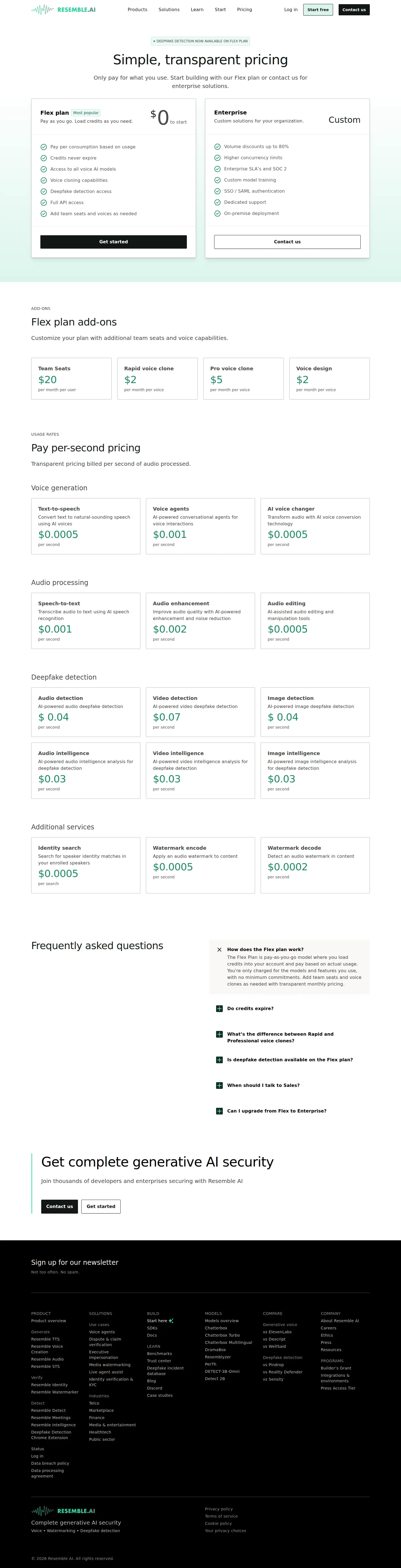
Replaced the entire subscription ladder with a single pay-as-you-go 'Flex' plan: load non-expiring credits, pay per second (TTS $0.0005/sec, voice agents/STT $0.001/sec, audio enhancement $0.002/sec). Deepfake detection ($0.03–$0.07/sec) added to Flex. Add-ons: $20/seat, $2–$5/voice. Enterprise offers volume discounts up to 80%.
Restructured tiers + cheaper entry
Reworked the ladder: Starter $5/mo (4K sec), Creator $19/mo (15K sec), Professional $99/mo (45K sec, $0.002/sec after), Scale $299/mo (120K sec, $0.0018/sec), Business $699/mo (360K sec, $0.0015/sec), and Enterprise. Added 150+ language translation and HD 48kHz output; volume overage rates fell at higher tiers.
Five-tier monthly subscription ladder
Shifted to a tiered subscription model with included seconds: Creator $29/mo (10K sec, then $0.006/sec), Professional $99/mo (80K sec, then $0.002/sec), Growth $299/mo (200K sec), Business $499/mo (320K sec), a Personal pay-as-you-go option, and Enterprise. Voice-clone counts scaled by tier.
Pay-as-you-go Basic + contact-sales Pro
Around its $8M Series A (July 2023), Resemble ran a simple two-option model: a pay-as-you-go 'Basic' plan at $0.006 per second of audio (10 voices, limited languages) and a 'Pro' plan quoted via contact-sales (unlimited voices, 60+ languages, enterprise features).
- · Resemble AI was founded in 2019 in Toronto by Zohaib Ahmed (CEO, ex-Magic Leap) and Saqib Muhammad, and graduated from the Betaworks Synthetic Camp accelerator.
- · It raised an $8M Series A in July 2023 and a $13M round in December 2025 (Google's AI Future Fund, Okta Ventures, KDDI, and others), bringing total funding to about $25M.
- · Resemble collapsed a five-tier monthly subscription ladder into a single pay-as-you-go 'Flex' plan where loaded credits never expire — a rare 'no expiry' promise in the voice-AI space.
Questions & answers
- What is Resemble AI's pricing model?
- Resemble AI uses a single pay-as-you-go 'Flex' plan plus a quoted Enterprise tier. On Flex you load credits (which never expire) and pay per second of content processed — the pricing page lists deepfake detection at $0.03–$0.07/sec, identity search at $0.0005/search, and multimodal watermark encode/decode at $0.0005/$0.0002 per second. The only monthly add-on is $20/user Team Seats.
- Does Resemble AI offer a free tier?
- There is no perpetual free tier today. The Flex plan starts at $0 to sign up — you only pay for the credits you consume — so you can create an account and load credits as needed with no minimum commitment. Earlier 2024–2025 plans included a Free/Personal tier with a small monthly second allowance, but the current model is pure pay-as-you-go.
- How much does Resemble AI cost per month?
- There is no fixed monthly fee on Flex — you pay for usage. Deepfake audio and image detection are $0.04/sec, video detection $0.07/sec, and audio/video/image intelligence $0.03/sec; identity search is $0.0005/search and watermarking is $0.0002–$0.0005/sec. The only add-on is $20 per team seat per month. Resemble suggests contacting sales once you exceed ~$2,000/month.
- Is Resemble AI pricing usage-based or subscription?
- It is usage-based. The current Flex plan is pure pay-as-you-go credits billed per second of content, with only the optional $20/user seat add-on billed monthly. This is a deliberate move away from the tiered monthly subscriptions ($5–$699/mo) Resemble ran in 2024–2025.
- How much does deepfake detection cost on Resemble AI?
- Deepfake detection is billed per second on the Flex plan: audio and image detection at $0.04/sec, video detection at $0.07/sec, and audio/video/image intelligence analysis at $0.03/sec. Identity search is $0.0005 per search. Higher concurrency and enterprise SLAs are quoted under Enterprise.