AI Summary
About
Schematic makes a runtime monetization platform for SaaS and AI companies — a single layer that handles feature entitlements, usage metering, billing components, and feature flags so go-to-market teams can change pricing and packaging in configuration instead of shipping code. The pitch is “implement monetization once, then control pricing, packaging and entitlements without redeploying”: the product decouples who is entitled to what from your application logic. Its surface area spans Metering & Pricing (flat fee, seat-based, pay-as-you-go, overages, credit burndown), Plans & Entitlements (trials, limits, per-customer overrides), Smart Flags (entitlement-aware feature flags with sub-50ms checks), Billing Components (React, no-code portal/pricing-table/checkout widgets), and Revenue Insights (mapping usage to upgrade and churn signals). It’s built on Stripe (a verified Stripe App) and ships SDKs for Next.js, Node, Go, React, Python, Java and C#.
Schematic was founded in 2023 in Boulder, Colorado by Fynn Glover, Gio Hobbins and Ben Papillon. It raised a $4.8M seed in 2024 (led by MHS Capital, with NextView Ventures, Active Capital and others) and a $6.5M round in April 2026 (led by S3 Ventures, with MHS, Active Capital, NextView and Ritual participating), bringing total funding to ~$12M. It reports customers including Automox, BigCommerce, Makeswift and Plotly, and was named a #1 Product Hunt SaaS Product of the Month.
For the most current information, visit Schematic.
Pricing summary : How Schematic’s pricing model works
Schematic uses a public, tiered subscription priced on a single usage meter: monthly billing volume — the revenue you run through the platform. There are three tiers. Starter is $0/mo (free) and covers up to $5K/mo in billing volume, up to 2 custom plans, plus unlimited flags, companies and environments, scheduled downgrades, and email support. Growth is $400/mo flat and lifts the ceiling to unlimited billing volume, unlimited custom plans and customers, unlimited features, 20 company overrides, and adds a dedicated billing engineer in a private Slack channel. Enterprise is a quoted contract, priced on billing volume or a flat rate — whichever suits the customer — and adds role-based access control, a Stripe integration, unlimited company overrides, longer audit-log retention, unlimited non-production environments and SLAs.
Schematic’s own copy makes the single-meter design explicit: “Schematic prices on monthly billing volume — the revenue you run through the platform. That single number sets your plan. There are no additional fees on top of it for event ingestion or platform access.” The page also shows a Billed monthly / Billed yearly toggle above the plan cards; whether annual billing carries a discount was not confirmed in this capture — the toggle did not visibly change the displayed prices when actuated.
What makes this different: Schematic collapsed its earlier two-dimensional meter (monetized subscriptions + monthly events) into one number — monthly billing volume, a value metric tied directly to the customer’s own revenue — and substantially raised the Growth sticker price in the same move (see Pricing evolution for the historical comparison). It’s still a billing tool that bills you the same way it helps you bill your customers, just on a coarser, single-number meter.
Pricing by product
| Tier | Price | Included | Key mechanics |
|---|---|---|---|
| Starter | $0/mo (Free) | Up to $5K/mo in billing volume; up to 2 custom plans; unlimited flags, companies & environments; scheduled downgrade; email support | Self-serve; single meter (billing volume) gates the tier; “Choose plan” checkout |
| Growth | $400/mo | Unlimited billing volume, custom plans & customers; unlimited features & flags; 20 company overrides; dedicated billing engineer in a private Slack channel | Self-serve PLG upgrade; flat monthly fee once past Starter’s billing-volume cap; no per-unit overage disclosed |
| Enterprise | Custom (quoted) | Priced on billing volume or a flat rate; role-based access control; Stripe integration; unlimited features & company overrides; longer audit-log retention; unlimited non-production environments; SLAs | Sales-led — “Schedule a demo”; custom annual contract |
Sales motions across products: self-serve PLG for Starter and Growth — pick a plan, wire the SDK, and upgrade in-product as your billing volume grows past the free cap — and sales-led for Enterprise (RBAC, SLAs, audit-log retention, billing-volume-or-flat-rate quoting). Schematic’s own “How pricing works” panel restates each tier’s cap directly beneath the plan cards to help buyers self-qualify before talking to sales.
Hidden costs : What Schematic users actually pay
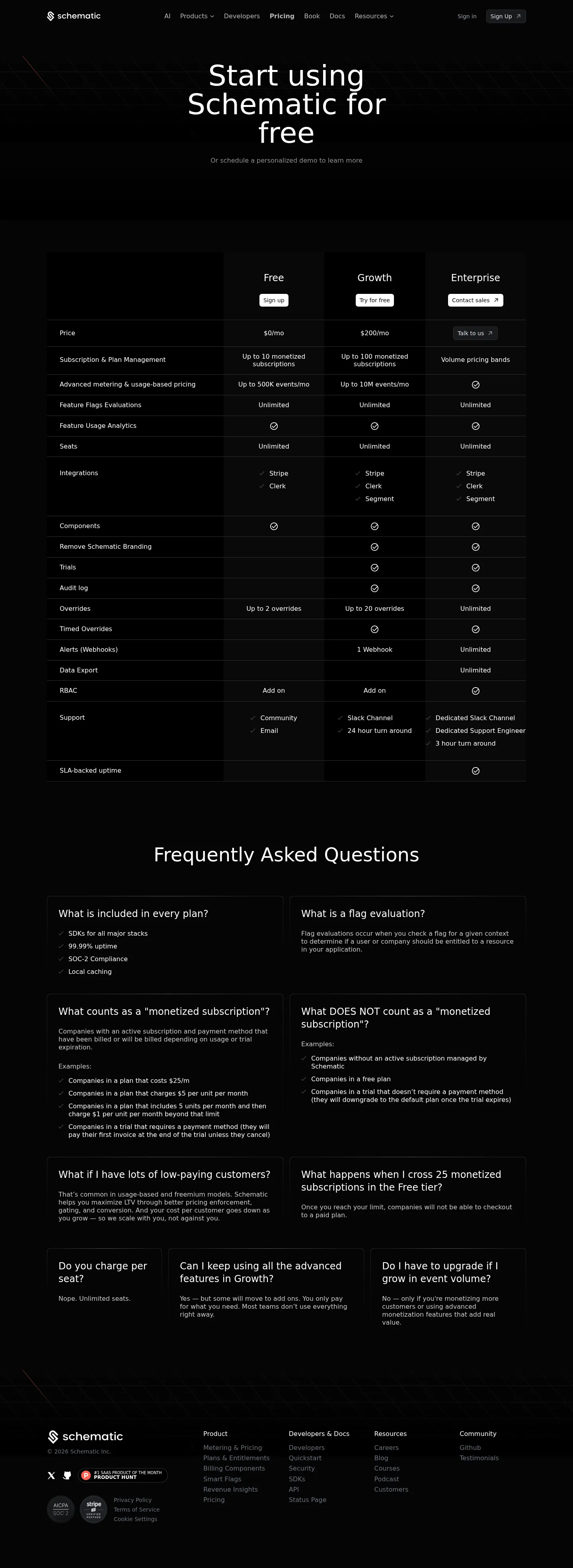
Because Schematic is a flat-tier subscription gated by meters (not per-unit billing), the “hidden” cost is really which ceiling you bump into first — monetized subscriptions or events — and what’s an add-on vs included. The free tier’s 10-monetized-subscription limit (with a hard checkout cliff once you cross it) is the gate most teams hit before the 500K-event ceiling: as soon as you’re billing real customers, Free stops letting them check out and you need Growth at $200/mo. RBAC is an add-on on both Free and Growth (only included on Enterprise), and Schematic references a Teams add-on bundle reported around $500/mo for unlimited exports, unlimited (and timed) overrides, unlimited webhooks and extended retention — neither of those shows on the headline tier price.
| Line item | Monthly cost (illustrative) |
|---|---|
| Free plan | $0 (up to 10 monetized subscriptions, up to 500K events) |
| Growth plan | $200 (up to 100 monetized subscriptions, up to 10M events) |
| Teams add-on bundle (reported) | ~$500 — unlimited exports/overrides/webhooks, extended retention |
| RBAC (Free / Growth) | Add-on (included on Enterprise) |
| Enterprise | Custom quote — volume bands, unlimited events/overrides |
A worked example: a SaaS billing 120 of its own customers through Schematic has already exceeded Growth’s 100-monetized-subscription ceiling, so it lands in Enterprise volume bands regardless of event count — the subscription meter, not events, is what tips most growing companies into a quote. Conversely a high-traffic free product with 8 paying customers but 800K events/mo is pushed to Growth by the event ceiling instead. Budget for the meter you’ll hit first, and treat RBAC and the Teams bundle as line items on top of the $200, not part of it.
Want to estimate your own Schematic bill? Use the Schematic pricing calculator to model costs across monetized-subscription counts and event volume.
Pricing evolution : Schematic pricing history and changes
Cadence
| Period | Price changes | Product / SKU additions | Notes |
|---|---|---|---|
| 2023 | n/a (pre-launch) | Company founded (Boulder) | Building entitlements/monetization infra |
| 2024 | Public tiers introduced | Public launch; $4.8M seed | ”Last mile of pricing & packaging” positioning |
| 2026 | Free $0 / Growth $200 / Enterprise | $6.5M round; verified Stripe App | ”Runtime monetization is infrastructure” repositioning |
Tracked range: 2023–present. Schematic publishes its Free and Growth prices and limits openly; Enterprise is quoted on volume bands. The timeline anchors on the 2024 public launch + seed, the April 2026 $6.5M round and Stripe App, and the live 2026-06-10 pricing-page capture.
Notable changes
- 2024-09 — Schematic goes publicly available and announces a $4.8M seed (led by MHS Capital) to build the “last mile of pricing and packaging” — entitlements decoupled from code.
- 2026-04 — $6.5M round (led by S3 Ventures) and a verified Stripe App; repositions around “runtime monetization is infrastructure” for the AI era, with entitlements as a first-class primitive.
- 2026-06 — Live tiers: Free $0 (10 subs / 500K events), Growth $200/mo (100 subs / 10M events) and quoted Enterprise volume bands — metered on monetized subscriptions + events, with unlimited seats throughout.
What’s unique : Schematic’s distinctive pricing mechanics
1. Priced on “monetized subscriptions,” not seats
The headline meter is the number of your end-customers you actually bill through Schematic — a value metric that rises with your revenue, not your headcount. Seats are unlimited on every plan, so Schematic’s price scales with the customer’s monetization success rather than how many internal users log in.
2. The upgrade trigger is wired into the product
Cross the free monetized-subscription limit and your customers literally cannot check out to a paid plan anymore. The meter doesn’t just throttle features — it gates your revenue event, which converts free users to Growth at the precise moment the tool starts paying for itself.
3. Two meters, but no per-unit overage
Tiers are bounded by both monetized subscriptions and monthly events, yet there’s no per-event or per-subscription overage charge — you simply move to the next tier. That keeps the bill predictable (a flat $0 or $200) while still scaling with usage, a freemium/usage hybrid rather than pure consumption billing.
4. Self-dogfooded entitlements
Schematic’s own Free/Growth/Enterprise gates, overrides and add-on bundles are built on the same entitlement primitives it sells — the pricing page is effectively a live demo of the product enforcing its own packaging.
Strengths & weaknesses
| Strengths | Weaknesses |
|---|---|
| Fully public Free and Growth prices ($0 / $200) and limits | Enterprise is quote-only on undisclosed volume bands |
| Value-aligned meter (monetized subscriptions), not seats | Two meters (subs + events) make “which tier” non-obvious |
| Flat tier price means predictable cost, no per-unit overage | RBAC is an add-on on Free/Growth, not included |
| Unlimited seats & flag evals on every plan | Reported ~$500 Teams bundle isn’t on the headline table |
| Genuine free tier with real limits (10 subs / 500K events) | Free checkout cliff at the subscription cap is abrupt |
Billing UX : Schematic billing controls and transparency
- Billing controls — A self-serve “Choose plan” button checks out Starter or Growth directly; Enterprise routes to “Schedule a demo” and a quoted, custom annual contract. A Billed monthly / Billed yearly segmented toggle sits above the plan cards (its effect on the displayed prices was not confirmed in this capture — the toggle did not visibly change the price when actuated).
- Usage visibility — A dedicated “How pricing works” panel beneath the plan cards restates each tier’s billing-volume cap and what’s included in plain language, separate from the plan-card feature lists (each of which also has a “See all” expander for the full feature set).
- Payment options — Starter and Growth read as self-serve card checkout; Enterprise is negotiated and can be priced on billing volume or a flat rate, whichever suits the customer, plus role-based access control and a Stripe integration.
- Self-qualification — A six-question FAQ accordion (“What do I get in the Starter plan?”, “Which plan is right for me?”, “How does Schematic’s pricing compare to other vendors?”, “Is my business a good fit for Schematic?”) sits directly under the pricing table so buyers can self-select a tier before talking to sales.
Strategic wins : Why Schematic’s pricing decisions worked
1. Pricing on the customer’s own monetization
By metering on “monetized subscriptions” — the customer’s billed end-users — Schematic’s price grows with its buyers’ revenue, the textbook value-metric alignment. It only costs more when the customer is making more, which is an easy expansion story. See choosing the right usage metric.
2. A free tier that converts itself
The free tier’s hard checkout cliff at the subscription cap means the upgrade isn’t a sales push — it’s a product event the customer hits the moment they succeed. That bakes PLG conversion into the meter. Related: how AI companies structure pricing.
3. Flat tiers over consumption billing
Capping each tier instead of charging per event keeps the bill predictable at $0 or $200, avoiding the bill-shock that plagues pure consumption pricing while still scaling with usage. See outcome-based pricing trends.
Areas to improve : Gaps in Schematic’s pricing approach
1. Two meters muddy self-qualification
Bounding tiers by both monetized subscriptions and events means a buyer can’t tell at a glance which ceiling they’ll hit — a high-traffic free app and a low-traffic billed one land in different tiers for different reasons. A clearer “you’ll outgrow Free when…” guide would help. See bill shock and cost unpredictability.
2. The Enterprise jump is opaque
Growth tops out at 100 monetized subscriptions, then it’s straight to quoted volume bands with no published next step. A visible mid-tier price (or even an indicative per-subscription band) would shorten the leap from $200 to “talk to us.”
3. Add-ons hide real cost
RBAC on Free/Growth and the reported ~$500 Teams bundle sit off the headline table, so the true cost of a production deployment can exceed the $200 sticker. Folding common needs into the tier — or listing add-on prices openly — would improve transparency.
Monetization stack & signals : how Schematic builds & buys its revenue engine
Buys 0 Builds 1
Schematic IS the entitlements + usage-metering layer it sells — that engine is the in-house build, and the product is itself 'built on Stripe' as a platform dependency. How Schematic processes its own self-serve Free/Growth payments is not disclosed; every Stripe reference describes the product reading a customer's Stripe, not Schematic's own checkout.
-
“Schematic is the system of record for plans, software entitlements, limits, credits, trials, add-ons, overrides, and exceptions.”
Signals reviewed · derived from engineering blogs
Key takeaways
- Meter on your customer’s value event, not seats. Schematic prices on “monetized subscriptions” — its buyers’ own billed customers — so its revenue rises with theirs rather than with headcount.
- Bake the upgrade into the meter. A free tier whose checkout cliff fires at the monetized-subscription cap converts users at the exact moment the product starts paying off — PLG without a sales nudge.
- Flat tiers beat per-unit for predictability. Capping tiers (no per-event overage) keeps the bill a flat $0 or $200 while still scaling with usage — a freemium/usage hybrid, not pure consumption.
- Don’t charge for the thing teams hate metering. Unlimited seats and unlimited flag evaluations remove the two dimensions developers most resent paying per-unit for, narrowing the meter to value.
- Public prices with gated enterprise is a workable middle. Open Free/Growth pricing earns self-serve trust while volume-band Enterprise preserves negotiating room for high-monetization accounts.
UBP implications
- The best value metric is your customer’s revenue, restated. “Monetized subscriptions” is essentially “how much money this customer makes via us” — the cleanest possible alignment between a billing tool’s price and the value it delivers. See usage-based pricing strategy.
- A capped free tier is a qualification meter. Schematic’s 10-subscription / 500K-event free limits act as a soft usage gate that filters real, monetizing users into the $200 Growth plan — freemium as lead qualification.
- Hybrid tiers tame consumption risk. Bounding each tier by usage but charging a flat fee gives buyers usage-based scaling without per-unit bill-shock — a pattern worth copying for anyone nervous about pure consumption pricing.
Sources
- Schematic pricing page (accessed 2026-06-10) — Free $0, Growth $200, Enterprise custom; monetized-subscription & event limits, overrides, webhooks, support tiers
- Schematic homepage (accessed 2026-06-10) — product surface (metering, entitlements, smart flags, billing components, revenue insights), Stripe App, customers
- Schematic raises $6.5M, launches Stripe App — PR Newswire (accessed 2026-06-10) — April 2026 round, S3 Ventures lead
- Schematic raises $6.5M — Crunchbase News (accessed 2026-06-10) — funding, founders, AI-era positioning
- Schematic raises $4.8M seed — PRWeb (accessed 2026-06-10) — 2024 seed, MHS Capital lead
- Schematic raises $6.5M to fix SaaS pricing for the AI era — Tech Startups (accessed 2026-06-10) — founded 2023 Boulder; founders Fynn Glover, Gio Hobbins, Ben Papillon; ~$12M total
Bottom line
Schematic is a runtime monetization platform — feature entitlements, usage metering, billing components and feature flags — and it prices itself the way it helps customers price: on “monetized subscriptions,” the billable end-customers you run through it, plus monthly events. Its tiers are public and flat: Free at $0/mo (10 monetized subscriptions, 500K events/mo), Growth at $200/mo (100 monetized subscriptions, 10M events/mo, data export, 24h Slack support), and a quoted Enterprise plan on volume pricing bands with unlimited events and a dedicated support engineer. Seats and flag evaluations are unlimited on every plan, so the meter tracks value (your monetization) rather than headcount — and the free tier’s checkout cliff at the subscription cap converts users exactly when the product starts paying for itself. RBAC and a reported ~$500 Teams bundle are add-ons to budget on top of the $200. Browse the pricing blueprint for more fully-researched company profiles.
Want to compare Schematic against other billing and monetization-infrastructure companies? Browse the pricing blueprint.
Pricing timeline : Major events on a vertical axis
Each milestone below corresponds to a public pricing change, product launch, or material adjustment. Major events use a filled marker; minor adjustments use a faded one.
Free / Growth $200 / Enterprise — metered on monetized subscriptions + events
Live shape: Free $0/mo (10 monetized subscriptions, 500K events/mo, 2 overrides, 1 webhook), Growth $200/mo (100 monetized subscriptions, 10M events/mo, 20 overrides, unlimited webhooks, data export, 24h Slack support), and quoted Enterprise (volume pricing bands, unlimited events/overrides, dedicated support engineer, 3h turnaround, SLA-backed uptime). Unlimited seats and unlimited flag evaluations on every plan.
$6.5M round + Stripe App; runtime monetization positioning
Schematic raised $6.5M (led by S3 Ventures; MHS, Active Capital, NextView, Ritual participating), launched a verified Stripe App, and repositioned around 'runtime monetization is infrastructure' for the AI era — entitlements as a first-class primitive. Total funding reached ~$12M. Pricing remained the three public tiers metered on monetized subscriptions + events.
Public launch + $4.8M seed
Schematic became publicly available and announced a $4.8M seed round (led by MHS Capital, with NextView, Active Capital and others) to build 'the last mile of pricing and packaging' for SaaS — entitlements and pricing enforcement decoupled from application code. This established the config-driven, code-light monetization model the pricing tiers sit on.
- · Schematic charges by 'monetized subscriptions' — the customers you actually bill — not by seats. Seats are unlimited on every plan, so your own team size never affects the price; only how many of your end-customers you monetize through Schematic does.
- · The free tier has a hard conversion cliff baked into the meter: once you cross 25 monetized subscriptions, your customers literally cannot check out to a paid plan anymore — the product gates its own buyer at the exact point you start making real money, forcing the upgrade.
- · Schematic eats its own dog food — it's a tool for enforcing entitlements and pricing tiers, and its own Free/Growth/Enterprise tiers (with feature gates, overrides, and add-on bundles) are themselves built and enforced on the same primitives it sells.
Questions & answers
- What is Schematic's pricing model?
- Schematic uses a public, tiered subscription metered on a single dimension: monthly billing volume — the revenue you run through the platform. Starter is free (up to $5K/mo in billing volume, up to 2 custom plans), Growth is $400/mo flat (unlimited billing volume, plans and customers), and Enterprise is a custom quote priced on billing volume or a flat rate. Seats are unlimited on every plan.
- Does Schematic offer a free tier?
- Yes. The Starter plan is $0/mo and supports up to $5K/mo in billing volume, up to 2 custom plans, unlimited flags, companies and environments, scheduled downgrades, and email support. As of the August 2026 pricing page, Schematic no longer discloses a specific event or monetized-subscription cap for the free tier — the single gating number is billing volume.
- How much does Schematic cost per month?
- The self-serve paid plan, Growth, is $400/month (up from $200/month as of mid-2026). That covers unlimited billing volume, unlimited custom plans and customers, unlimited features and flags, 20 company overrides, and a dedicated billing engineer in a private Slack channel. Above that you move to Enterprise, quoted on billing volume or a flat rate, whichever suits the customer.
- Is Schematic pricing usage-based or subscription?
- It is a hybrid: a flat monthly subscription tier ($0 or $400) whose ceiling is set by a single usage meter — monthly billing volume. You don't pay per dollar of volume directly; crossing a tier's billing-volume cap pushes you to the next plan, so usage drives which subscription you land on rather than producing a per-unit overage bill.